

CoreWeave borrowed $2.6 billion on August 7, and the credit agreement names everyone who gets paid out of it, in order, nine steps down. Read as a seating chart, the document produces a list of participants, and three of them were not on ours. It also prices the last seat. The loans buy about seven weeks of the company’s current building program. Of the build this facility finances, the shareholders fund about a third in cash. They also take step nine of nine, promise to write further checks whenever the coverage test misses, and can receive nothing from the structure until half the loan has been repaid. Everyone else at the table is paid on a date. Then there is the last row itself, which turns out to be four different positions: 16.8 percent of the shares carry 66.9 percent of the votes, and one group of holders has nothing besides the share.
FILED means a document filed with the Commission, cited by accession. REPORTED means the public record outside those files. Where a figure is our derivation, we say so.
Nothing here identifies an error, an inconsistency, or a bad actor, and we did not go looking for one. A credit agreement that ranks its claimants is doing what credit agreements do, and a borrower that agrees to those ranks has agreed to ordinary terms. The subject here is the order, and what the order costs the participant at the bottom of it.
The ledger is a construction of ours. The document does not present itself as a list of participants, and grouping it this way is a choice. Every quotation carries its section, and the accession is public.
What $2.6 billion buys
Term SOFR plus 5.50 percent, maturing September 1, 2031, commitments ending December 2026, rated Ba2 and BB+, arranged by JPMorgan and MUFG. The borrower is a limited purpose entity; the parent guarantee is full recourse. Collateral is the machines the loans buy plus customer contracts “averaging approximately three years in length,” against a loan of about five.
Sized against what the company spends, it is small. Cash paid for property and equipment in the first half of 2026 was $14.1 billion, about $2.35 billion a month (FILED). The loans are capped at 70 percent of the capital expenditure they finance, so $2.6 billion supports about $3.7 billion of building. That is about seven weeks of the current program, of which the loans themselves fund under five (ours).
Seven weeks. The rest of this piece is the price of them.
The order of payment
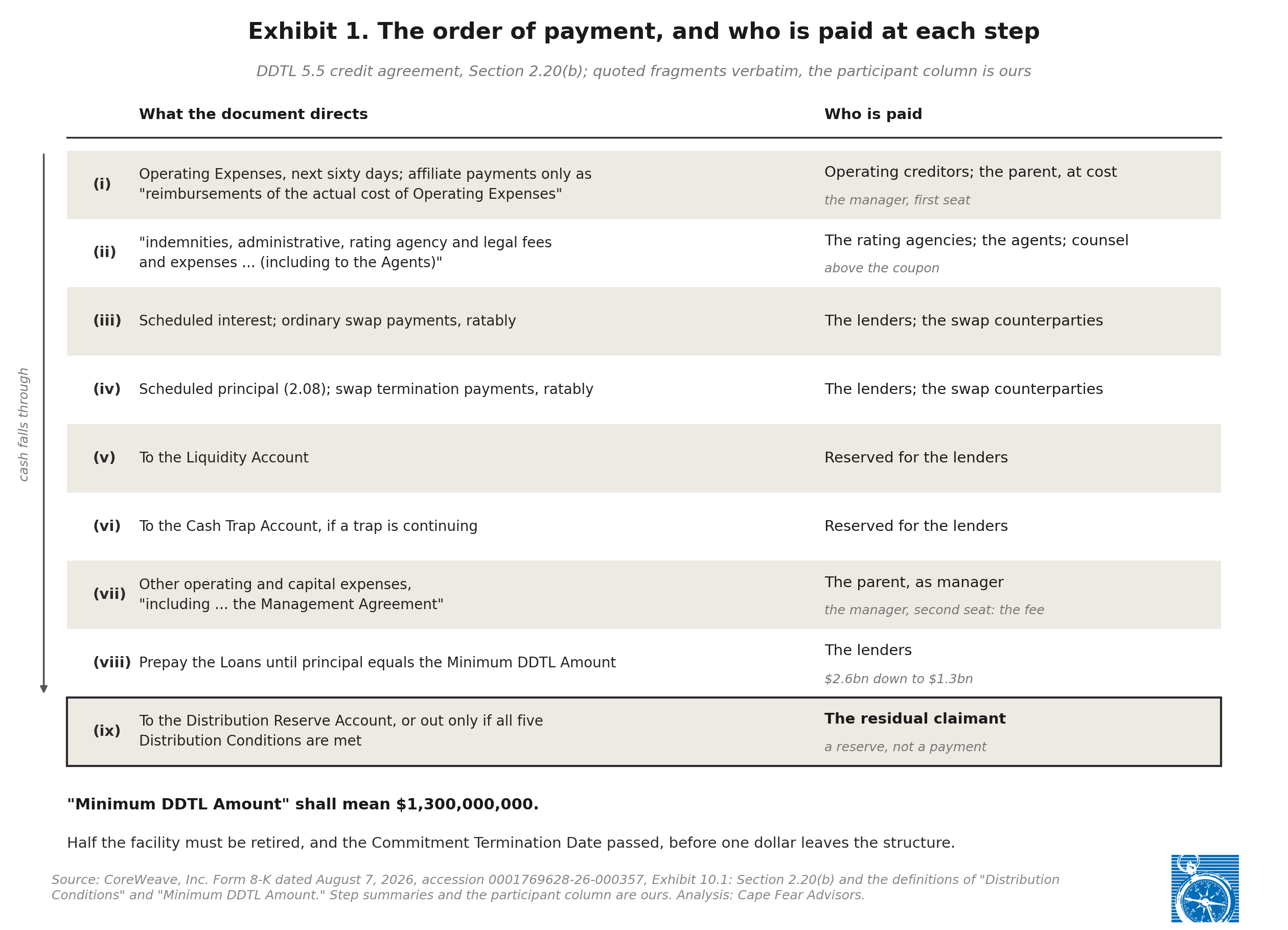
Section 2.20(b) applies the cash “at the following times and in the following order of priority,” nine steps. Three of the participants named in it were not on our ledger before we read the section.
The rating agencies are paid at step two, in the operative text: “indemnities, administrative, rating agency and legal fees and expenses (including fees, charges and disbursements of counsel).” Step three is the lenders’ scheduled interest. The agencies rank above the coupon on the debt they rated. That is where the drafters put them, and nothing more is claimed here than the placement.
The parent, as manager, is paid at two different steps, and the drafting separates the two. Step one covers operating expenses for the next sixty days. Its proviso admits affiliate payments under the Management Agreement only as “reimbursements of the actual cost of Operating Expenses paid by such Affiliate on behalf of the Credit Parties.” Step seven then expressly includes “any costs and expenses in respect of the Management Agreement.” The manager recovers its costs first in the whole waterfall, ahead of the rating agencies and ahead of the coupon, and collects the fee at step seven. One agreement, two seats, split along the line between cost and fee.
The swap counterparties are paid at steps three and four, ratably with the lenders. The facility requires hedging, and the hedge providers rank with the debt rather than behind it.
The parent appears in this document four times: as guarantor, on full recourse; as seller, since where the borrower buys from the parent the lenders receive the parent’s invoices and proceeds may be distributed up to pay them within seven business days; as manager, at steps one and seven; and, through its ownership of the borrower, as the residual claimant at step nine. It pays at one of those and collects at three.
The ninth step is not a payment
Cash reaching step nine goes “to the Distribution Reserve Account,” and leaves only if all five Distribution Conditions are satisfied and the date falls after the Commitment Termination Date. Four of the five are what any lender writes: representations true, no default, no cash shortfall, liquidity satisfied. The fifth is the one that matters.
“The outstanding principal balance of the Loans is equal to or less than the Minimum DDTL Amount.”
“Minimum DDTL Amount” shall mean $1,300,000,000.
Half the facility must be retired, $2.6 billion down to $1.3 billion, before one dollar leaves the structure. The residual claimant’s step is a holding account, and the key to it is repaying half the loan.
The price of the seat
The entry price is a definition: “‘Funding Date GPU Amount’ shall mean, with respect to any Credit Event, the amount equal to the product of (x) 70% and (y) Funding Date Capital Expenditures.” That is the whole definition.
So $2.6 billion of loans implies about $3,714 million of capital expenditure and about $1,114 million funded from outside the facility (ours). One qualification, run once and carried thereafter: the text caps the loans and requires the balance to be funded, without naming equity as the source. In practice, across a draw period ending in December 2026, the balance comes from the parent, and the parent’s own capital in 2026 is placement proceeds.
At 2026 placement prices, $1,114 million is roughly 10.2 million shares, about 1.85 percent of the 551.5 million outstanding at July 31, 2026 (ours). The discount reported during marketing adds about $78 million, arranger fees an amount not disclosed, and the undrawn balance half a point a year. Roughly $2.00 to $2.15 per share of hurdle, added by one facility, to buy seven weeks.
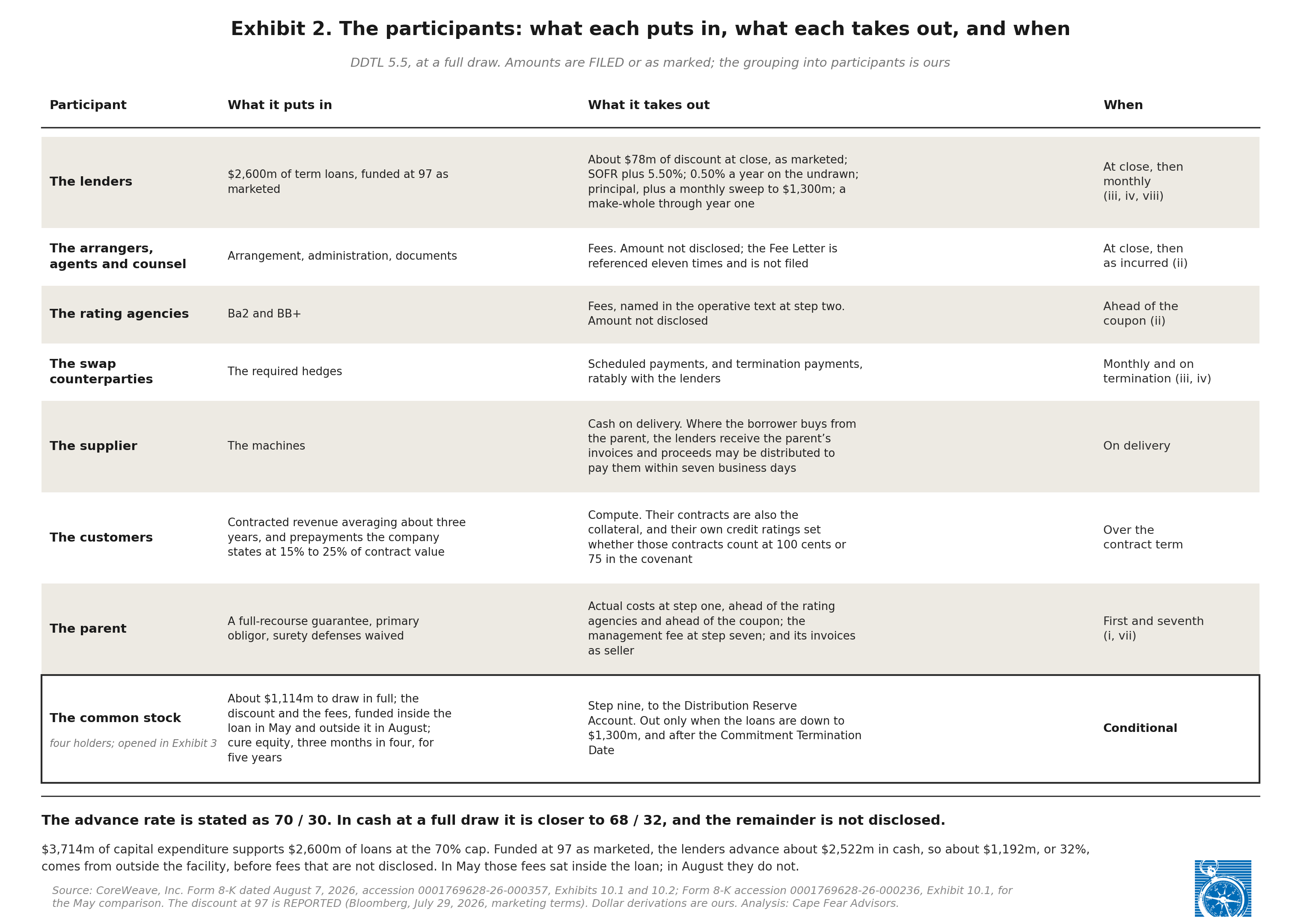
The stated split is also not the cash split. The 70 percent cap runs on the loan amount. Funded at 97 as marketed, the lenders advance about $2,522 million in cash against $3,714 million of capital expenditure. About $1,192 million comes from outside the facility rather than $1,114 million, and the split in cash is nearer 68 / 32 than 70 / 30 (ours, on the reported discount). Undisclosed fees sit on top, so 32 percent is a floor.
Three months earlier the same facility was cheaper in three ways
The published comparison has been the spread: SOFR plus 4.50 on the May facility, SOFR plus 5.50 on this one, same ratings from the same agencies, same unconditional parent guarantee. We wrote that comparison ourselves. Set side by side, the two definitions show the spread to be one of three changes.
May’s advance rate was 71.42 percent; August’s is 70.00, so the outside-funded leg rose from 28.58 percent to 30.00. And May’s loan amount was grossed up to cover “fees, premiums and expenses incurred in connection with the Transactions, including any fees and expenses incurred pursuant to the Fee Letters.” August has no such clause. Fees moved from inside the loan to outside it.
As effect rather than design: the marginal secured dollar became more expensive in three dimensions at once, and all three land on the same participant. At its own rate, the May facility required about $1,240 million from outside. The two together call for about $2,354 million against $2,982 million of private placements in the first half, so about 79 percent of the year’s equity is committed to two credit agreements (ours).
The third change answers a question the other two raise. What did the friction cost, and who paid it?
The bill has one number on it and four blanks. The number is the discount, reported during marketing as widening from 99 to 97, about $78 million on $2.6 billion, paid to the lenders at close. It is REPORTED and carried as marketed, because the credit agreement contains no discount of any kind, the phrase appears zero times, and the Fee Letter is referenced eleven times and is not filed. The blanks: arranger fees to JPMorgan and MUFG; rating agency fees at step two; administrative, agent and legal fees, also step two. All undisclosed. A half point a year runs on the undrawn balance, at a rate that is disclosed and against a schedule that is not.
The total is therefore not computable from the filing, and the visible floor is about $78 million. The second question the agreement does settle. In May the loan was grossed up to cover the fees, which means the lenders lent the money that paid them. In August there is no gross-up, so the fees come from outside the facility, which is the parent, which is the common stock. The friction did not only get larger. It changed pocket.
The same cover pages carry a fourth change. Morgan Stanley was Administrative Agent and joint lead arranger in May, with JPMorgan among eleven bookrunners; in August the two have traded places, MUFG holding the same seat in both. What the top seat earns is in the unfiled Fee Letter. The rotation is the fact.
The standing obligation
The coverage covenant is 1.35 to 1.00, first tested around February 2027. Section 7.03 supplies two remedies. The first is the ledger in one clause: contributed equity is “deemed to increase the Net Operating Income” for the test. The second, solely with respect to the coverage covenant, is entering into an Additional Master Services Agreement (or renewing an existing one) that satisfies the Eligibility Criteria, at a projected coverage of 1.35 and a projected contract value ratio of 2.40. There is no limit on the equity cure until three months past the draw period, and the first test falls inside that window. Thereafter it is available three months in every four, for the life of the facility. A missed principal payment is not an Event of Default if cured in time, and an insufficient sweep “shall not be deemed to be a Default or Event of Default.”
When the asset fails to cover its own debt service, the residual claimant may write a check, and the document records the check as though the asset had earned it.
Whether that clause binds is a question the filings answer without assumption. The company’s own sentence for FY2025: “our cash flows dedicated for debt service requirements totaled $4.4 billion... our net cash provided by operating activities was $3.1 billion.” Negative $1.3 billion before a dollar of capital expenditure, and cash capital expenditure was $10,309 million. The first half of 2026 runs the same way.
A second reading comes from this shelf’s quality-of-cash work. FY2025 operating cash flow was $3,058 million, of which deferred revenue contributed $4,174 million. With the customers’ prepayments set aside, the operating line is negative $1,116 million; the same subtraction gives negative $153 million for FY2023 and positive $700 million for FY2024 (ours, from filed lines). None of that is an allegation. Prepayments are normal in contracted-capacity businesses, the company states the convention at 15 to 25 percent of contract value, and customers receive reserved capacity for the money. The subtraction says what the operating line is made of.
The two facts are correlated, which closes the point on the cure. Prepayments arrive with signings. If signings slow, operating cash flow falls, the coverage test misses, and the cure asks the residual claimant for equity at the moment the equity market is least disposed to supply it. The document permits the cure. It does not supply it.
Inside the common stock
The last row of Exhibit 2 is one line, and four different positions.
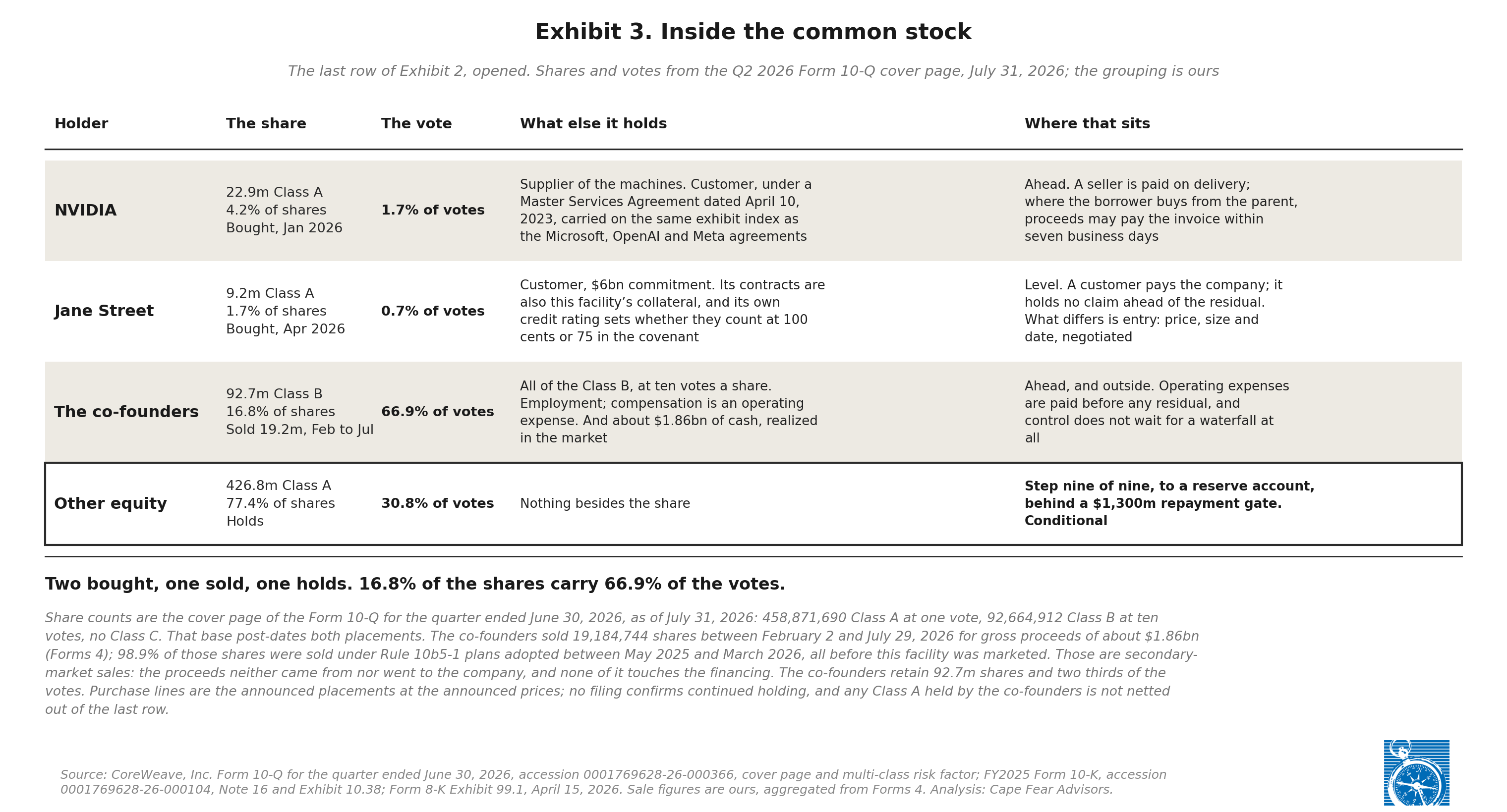
The count first, on a base that post-dates both strategic placements. The cover page of the Form 10-Q for the quarter ended June 30, 2026, as of July 31: 458,871,690 shares of Class A at one vote each, 92,664,912 shares of Class B at ten votes each, no Class C. The multi-class risk factor states that “As of June 30, 2026, our Co-Founders collectively hold all of the issued and outstanding shares of our Class B common stock.”
So 16.8 percent of the shares carry 66.9 percent of the votes (ours, from the filed counts). With the two announced strategic purchases netted out, the rest of the Class A is 77.4 percent of the shares carrying 30.8 percent of the votes.
The column that does the work is the one asking what else each holder has.
NVIDIA has three accounts where every other shareholder has one. The share: $2.0 billion at $87.20 in January 2026, about 22.94 million shares (FILED, Note 16). The supplier account: the machines. The concentration table names three suppliers at 23, 20 and 17 percent of purchases and identifies none of them, so the supplier seat is a fact about the product rather than about the table. And a customer account, in the “Master Services Agreement between CoreWeave, Inc. and NVIDIA Corporation, dated April 10, 2023,” carried on the FY2025 exhibit index alongside the Microsoft, OpenAI and Meta agreements (FILED). Whether that contract sits inside remaining performance obligations, and whether it arrived with a prepayment, is not disclosed.
No tracing of dollars is required, and none is available; nothing ties any investment to a use of proceeds. A supplier account ranks ahead of a residual claim by its nature: a seller is paid on delivery, a shareholder is paid last or not at all. One party holds a claim on the residual and two claims that do not wait for it.
The choice of account has a price, which is the Forge House argument with an advance rate attached. Under a 70 percent cap, equity of $2.0 billion supports about $6.67 billion of capital expenditure, of which about $4.67 billion is borrowed. The same $2.0 billion delivered as a discount on the chips is $2.0 billion less capex, $2.0 billion less collateral, and no equity, so it creates no borrowing capacity at all. Same cash, same silicon, same party, and the choice of form decides about $4.67 billion of borrowing. The covenant architecture then makes it recursive, because a price concession cures nothing and the cure socket takes equity or a qualifying MSA, and a price concession is neither.
Jane Street has two accounts, and one of them does three jobs. The share: $1 billion of Class A at $109.00, announced April 15, 2026. The customer account: in the same release, “$6 billion to use CoreWeave’s AI cloud platform,” described as expanding an existing relationship (FILED). Jane Street is not a lender, an agent or a manager, and it is paid at no step of the waterfall.
The customer account is the one that multiplies. The contract is revenue. It is also collateral, and a large share of it, about 35 percent of this facility’s committed contracts, second to Anthropic at about 40 percent (REPORTED, Dubitsky, August 4). And the counterparty’s own credit rating sets how much of that contract counts in the covenant.
That third job lives in the parent guarantee, which requires contracted revenues of at least $1,000,000,000. The test is weighted: “the sum of (i) the reasonably projected contracted revenues from such contracts with counterparties which have an Investment Grade Rating (as defined in the Revolving Credit Agreement) and (ii) the product of 0.75 and the reasonably projected contracted revenues from such contracts with counterparties which do not have an Investment Grade Rating.” A customer’s dollars count at 100 cents or at 75, depending on that customer’s own rating. A counterparty’s creditworthiness is a term of the loan that funds the machines that serve it.
The definition sits in a different agreement, and the guarantee points at it “as amended... from time to time,” so it moves without this facility being touched. Amendment No. 4, dated November 10, 2025, rewrote it. The text now reads: “‘Investment Grade Rating’ means a corporate family rating of at least ‘BBB-’ or higher from S&P or ‘Baa3’ or higher from Moody’s or, if no rating of Moody’s or S&P then exists, the equivalent of such rating by any other Nationally Recognized Statistical Ratings Organization.” The fallback to other agencies opens only where neither Moody’s nor S&P rates the counterparty, and both rate Jane Street: S&P at BB in June, Moody’s at Ba1 on the parent and Baa3 on four operating companies in July (REPORTED). Which of those entities signed with CoreWeave decides the answer, and no filing shows it.
The co-founders hold all of the ten-vote class, and employment, and compensation is an operating expense, which is paid before any residual. Control does not wait for a waterfall at all.
They are also the one holder in the exhibit moving the other way. Between February 2 and July 29, 2026 the three sold 19,184,744 shares for gross proceeds of about $1.86 billion, and 98.9 percent of those shares were sold under Rule 10b5-1 plans adopted between May 2025 and March 2026, every one of them before this facility was marketed (FILED, Forms 4; the aggregation is ours). Those are secondary-market sales. The proceeds neither came from nor went to the company, and no part of them touches this financing. The co-founders retain 92.7 million shares and about two thirds of the votes, so it is a reduction rather than an exit.
The ledger records direction, not conduct. Over the same seven months, inside one class of stock, NVIDIA bought, Jane Street bought, the co-founders sold, and the last row held. The seller keeps a great deal of option value. What separates it from the last row is that it also holds the cash.
The last row holds the share, and the column says nothing besides the share.
The covenant counts revenue, and revenue at this company costs money
That $1 billion runs against the intuition the number invites. The test is a revenue test, not a margin test, a cash test, or a profit test. Contracted revenue satisfies it, and contracted revenue at this company has arrived with a loss attached: FY2025 revenue of $5,131 million against a net loss of $1,167 million, or roughly 22 cents of net loss per dollar of revenue (FILED; the ratio is ours).
A covenant met by signing more contracts is met by taking on more delivery obligation, and delivering it consumes cash. The 75 percent haircut runs the same way from the other side: a customer without an investment grade rating must contract about $1.33 of revenue to produce $1.00 of covenant credit. The test can be satisfied by volume.
One caveat. Unit economics on any particular new contract are not disclosed, and a marginal contract need not carry the average. The narrower claim stands: a revenue covenant reads as protection, and on this filer’s record revenue is not the same thing as cash, and is not yet the same thing as profit.
Two ladders, both nine, measuring different things
This shelf already runs a nine-rung ladder, and the coincidence needs a word. That one measures distance from cash: cash on the barrel at the bottom, then trade payables, supplier finance, customer prepayments, component intermediation, vendor financing, equity in the counterparty, contingent support, and structures at the top. It is a taxonomy, and it ranks nothing. Section 2.20(b) measures order of payment inside one structure. Different axis, same number, and the two do not read across.
They touch at exactly one place. This entire facility is a single instance of the top rung, a structure, and inside it sit participants who reached it by the rungs below: customer prepayments funding the operating line, vendor financing on the equipment, equity in the counterparty on both the supply side and the demand side. One structure at the top of the ladder, holding four lower rungs inside it, with its own nine-step order deciding who is paid first.
The inversion
In the standard treatment a longer horizon raises the value of levered equity, because the option has more time. Here the extension is bought by the equity holder, so lengthening the horizon raises the strike.
That result is a statement about structure rather than outcome. A benefit exists: the machines produce revenue and the residual claimant owns the residual. The costs are certain, immediate and quantified. The benefit is contingent, deferred, behind eight steps and a $1.3 billion repayment gate, on contracts averaging three years against a loan of five. The Re-lease Eligibility Criteria require a Qualified Customer, US dollars, assignability, an approved site, a tenor “equal to, or longer than, six (6) months,” and terms “not materially worse, taken as a whole,” self-certified by the borrower’s own officer. There is no stated price floor.
The same arithmetic runs at stack scale. Approximately $10.0 billion was committed and undrawn at June 30, and drawing it at this facility’s rate would require about $4.29 billion of outside funding. That is an illustration at one facility’s rate, not a computation across the stack; the two agreements we have read use different rates, and as an illustration it holds. Undrawn capacity is presented as liquidity, and under an advance-rate structure it is a right to borrow that can be exercised only by first spending capital the company has not raised.
The whole thing, from the last seat
Read from the ninth step, the transaction comes to five sentences.
Real dollars went out: about $1,114 million to draw the facility, plus about $78 million of discount as marketed, plus fees nobody outside the deal can size. More dollars will have to be raised, because a cap of the same shape, at rates that vary by facility, governs every further draw, and about $10.0 billion sits committed and undrawn. Everyone ahead in the order has to be repaid, on dates the document sets, secured by the machines and guaranteed by the parent. The losses through the period have to be covered from somewhere else, because operations after debt service ran negative $1.3 billion in FY2025 and the covenant that protects the lenders counts revenue rather than cash. And the return, if there is one, sits nine steps away behind a gate that opens when half the loan is gone.
None of that is a forecast. Every clause of it is in the agreement or in the filings, and the last clause appears in the agreement twice, once as the order of payment and once as the condition on the reserve.
Seven weeks of building, about 1.85 percent of the company, and a standing obligation to fund the covenant three months in four for five years. Every other participant at this table has a date.
Cape Fear Advisors holds no direct position, long or short, in CoreWeave or in any company named here; any exposure is indirect, through managed funds it does not control, which may now include index funds holding the public companies named.
Anthropic is the developer of Claude, which is used in preparing this research, and Anthropic is reported to be the largest customer in the collateral pool of the facility read here, at about 40 percent of its committed contracts. That is the closest this nearness has come to the subject of a piece, and it cannot be checked away. What answers it is reproducibility rather than any assurance about the tool: every quotation carries its section or definition, every figure carries its accession or its REPORTED label, the derivations show their arithmetic, and the whole reading can be run again from the public record by anyone who opens the same documents.
Others named have ties to the filer or to each other. NVIDIA is a shareholder, the supplier of the machines the facility finances, and a customer under a master services agreement carried on the same exhibit index as the OpenAI, Microsoft and Meta agreements. Jane Street is a shareholder and a customer, and its contracts are part of this facility’s collateral. JPMorgan and MUFG are the arrangers and JPMorgan the administrative agent; Morgan Stanley held those seats on the May facility and is a bookrunner on this one; U.S. Bank is depositary and collateral agent. Moody’s, S&P and Fitch are rating agencies discussed here both as raters of this debt and as a paid participant in its waterfall.
Companies not named here, among them the lenders under the syndicate, the customers behind the redacted marks in the agreements, and the suppliers behind the concentration table, may hold positions or supply relationships that bear on the filer discussed, and that possibility is part of why every piece is re-checked for bias, ground facts, and filings rather than read against a fixed list. Figures are quoted from the filers without characterization, and the same standard of reading is applied to every party named.
Analysis: Cape Fear Advisors.
This analysis also appears on Substack.
Start a Conversation →Notes
(1) DDTL 5.5: CoreWeave, Inc. Form 8-K dated August 7, 2026, accession 0001769628-26-000357, Exhibit 10.1 (credit agreement, dated as of August 7, 2026), Exhibit 10.2 (parent guarantee), Exhibit 99.1 (press release, furnished). Quotations are verbatim and carry their section or definition.
(2) DDTL 5.0: Form 8-K, accession 0001769628-26-000236, Exhibit 10.1, dated as of May 15, 2026. The source for the “Funding Date GPU Amount” definition, the plural “Fee Letters,” and the cover page’s agent and arranger list. The interval between the two agreements is eighty-four days. In “The Sum of the Participants” we gave it as eleven weeks; it is twelve, and the longer interval is the one that runs against our own reading.
(3) Amendment No. 4 to the Revolving Credit and Guaranty Agreement, dated November 10, 2025, filed as Exhibit 10.7 to the Form 10-Q for the quarter ended September 30, 2025, accession 0001769628-25-000062. The exhibit is a blackline; the definition quoted is the amended text as marked. The original is in the agreement dated June 21, 2024, Exhibit 10.18 to the Form S-1.
(4) Jane Street: Form 8-K Exhibit 99.1, April 15, 2026, for the investment and the commitment. Its agency ratings and its share of this facility’s committed contracts are REPORTED. The contract shares are Rod Dubitsky’s, from “CoreWeave’s Near Debt Debacle, Jane Street and Fitch’s Curiously Timed Jane Street Upgrade”, August 4, 2026.
(5) NVIDIA: FY2025 Form 10-K, accession 0001769628-26-000104, Note 16 for the investment and Exhibit 10.38 for the Master Services Agreement dated April 10, 2023, first filed as Exhibit 10.31 to Form S-4/A, 333-289742, September 25, 2025.
(6) Share counts and votes: the cover page of the Form 10-Q for the quarter ended June 30, 2026, accession 0001769628-26-000366, as of July 31, 2026, and that filing’s multi-class risk factor for the statement that the co-founders hold all of the Class B. That base is used rather than the FY2025 cover page because the April 2026 placement post-dates the January 31 count. Class B outstanding fell from 106,660,052 at January 31 to 92,664,912 at July 31, consistent with the charter’s conversion-on-transfer provision and with 14,727,337 of conversions reported on Forms 4 in the same window. Those two figures differ by 732,197 shares, which the forms do not reconcile; the likeliest residual is conversions dated inside the window but settling outside the two cover-page dates, and we state the difference rather than net it. Sale figures are our aggregation of every Form 4 filed under the issuer’s CIK from January 15 to August 15, 2026, restricted to code S dispositions with transaction dates between the two cover-page dates, with proceeds computed as shares times the reported price per share. The Rule 10b5-1 status is the checkbox on each form, with plan adoption dates from the forms’ own footnotes. The NVIDIA and Jane Street lines in Exhibit 3 are their announced purchases at the announced prices; no filing confirms continued holding, and any Class A held by the co-founders is not netted out of the last row, which understates the concentration rather than overstating it. Percentages are ours.
(7) Operating and capital figures: FY2025 Form 10-K and the Form 10-Q for the quarter ended June 30, 2026, accession 0001769628-26-000366. The deferred revenue subtraction uses the cash flow statement’s line rather than the balance-sheet change, which avoids importing non-cash movement.
(8) The discount at 97: Bloomberg, July 29, 2026, reporting marketing terms before the August 10 close. Carried throughout as marketed.
(9) The nine-rung distance-from-cash ladder is from “Quality of Cash: Circular Financing and the AI Bubble,” August 1, 2026.
(10) Rounding: our derivations round away from the argument. The capital program comparison is 6.9 weeks, given as about seven. The per-share hurdle and the share percentage are computed on the July 31, 2026 count of 551.5 million shares rather than the December 2025 count, which is the larger denominator and the smaller result. The dilution is 1.853 percent, given as 1.85 rather than rounded up.
Published August 14, 2026. Corrected August 16, 2026.