

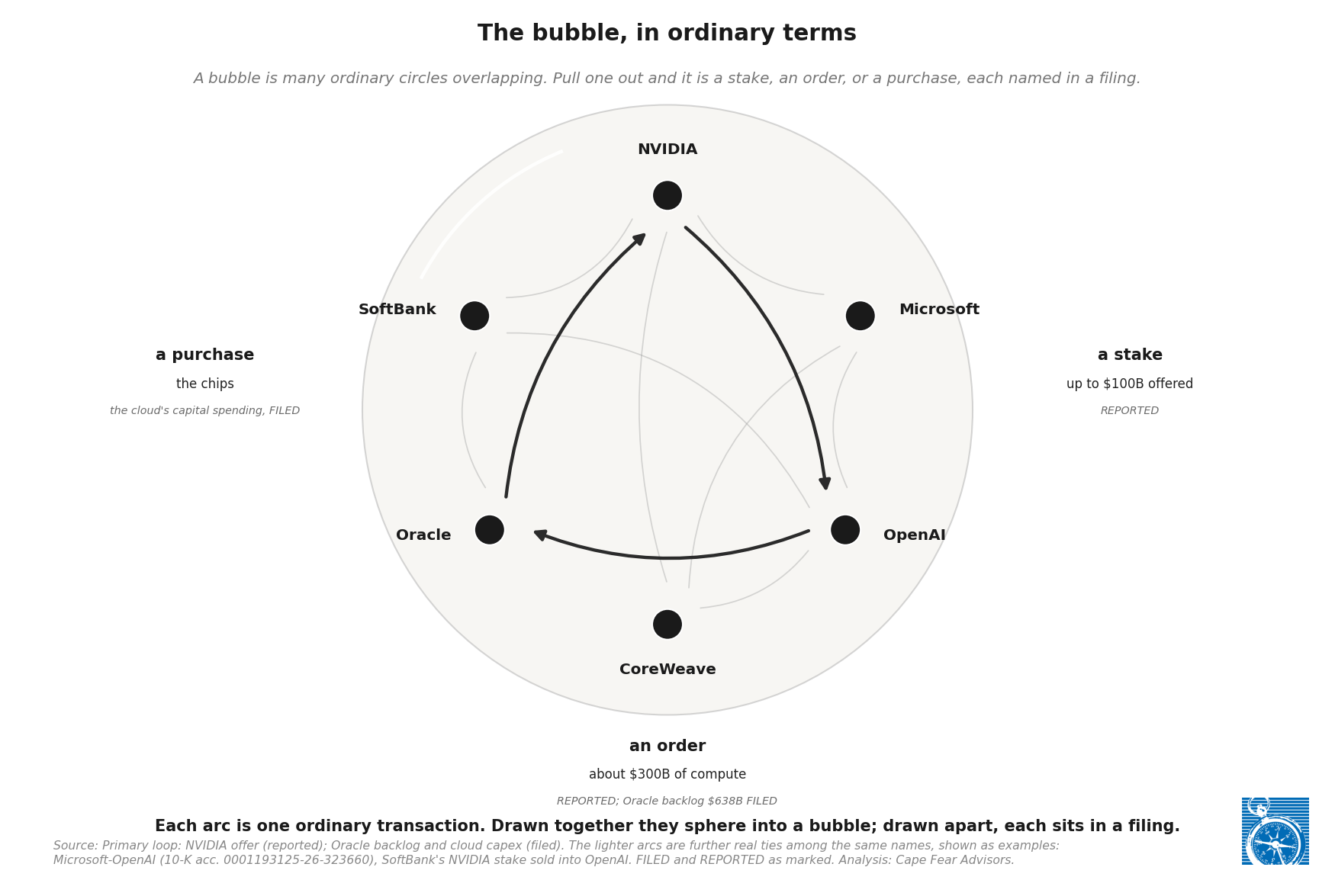
Circular financing has become the year’s alarm, and most of it is as old and ordinary as a cash register ringing a sale. This piece is a way to read it: a ladder from cash on the barrel to the most intricate vehicle, with a measure at every rung for how much is still cash and how much has turned to paper. The ladder does one useful thing. It tells the ordinary circle, which is everywhere, from the single place a circle closes with nothing outside to catch a fall. So the reading is done company by company. A bubble, if one is here, arrives at one address at a time, where the cash ran out, and the ladder is built to find it.
The ladder
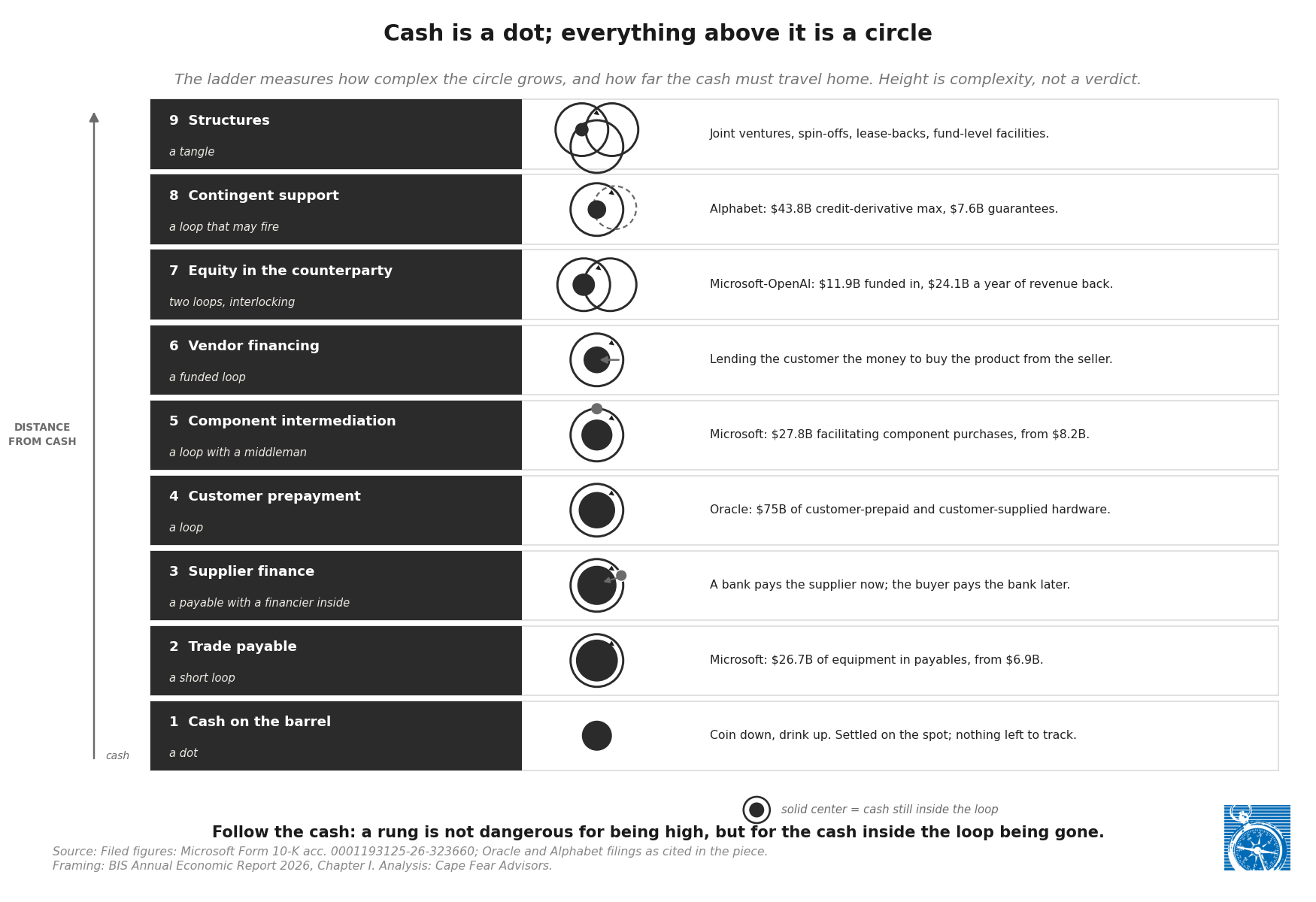
Every business runs on a circle. A coin goes down on the bar and the drink comes back, the circle drawn so tight it reads as a point: value out, value in, one instant, settled. A day of credit between the coin and the drink, or a promise, or a machine that earns its cost across years, opens the point into a loop. The money goes out and comes home later, from somewhere. The loop is ordinary, and small enough, most days, to pass without a name.
The cash register was the first circle. The drawer rings the sale before the cash is counted; it turns a coin in a hand into a number on a page, recorded and owed and waited on. Every arrangement since is that same loop, drawn larger, with more hands on it and more time inside.
Circular financing is as normal as the day is long. The chipmaker takes a stake in the lab, and the lab commits to years of chips; the landlord builds the data center and leases it back; the cloud funds the customer who fills the cloud. Drawn as a ring, the picture invites alarm. Read as a ladder, it is an address system, familiar at every rung. The lower rungs are the everyday, and at the aggregate the record stands whole: the capital spending, the debt, the order books, and the guarantees are filed, to the dollar, by companies that publish thousands of pages a year. The record is already there. What it waits for is a reader who will say which rung a dollar sits on, how much larger the number has grown, and who is left holding the loss if the wheel stops.
Two things hold at once, and this piece is the space between them. Circular financing is as normal as the day is long. And bubbles burst company by company. The first is why the alarm carries weight; the second is why the alarm, on its own, guides no one. A wheel that turns for the whole market still stops at one address, the address where the cash ran out and the paper stayed. This piece is the framework that tells the two apart: it shows the circle for the ordinary thing it is, and it shows that a bubble, where there is one, arrives one company at a time and not a sector at once. The tool is a ladder, read one rung at a time, with a mark at the one step where the circle closes on itself and nothing stands outside to catch a fall.
The ladder begins at the bar and climbs one rung at a time. Each rung adds a little time and one more balance sheet between the sale and its settlement, and the circle around the money widens by that much. Not one of the rungs is new; each predates the companies filling it this year.
The first rung above cash is the slow payment. A supplier ships and waits, and the wait rests on the balance sheet as a payable. Microsoft ended its June year with $26.7 billion of equipment purchases still sitting in accounts payable, against $6.9 billion a year earlier. The rung is trade credit, the first loop in commerce. The number is nearly four times what it was.
One rung along, that same payable can take a third party inside it. In supplier finance, a bank pays the supplier early and the buyer settles with the bank later, so an ordinary payable runs through a financier who now holds the timing. The arrangement carries its own disclosure line, required of buyers since 2023, and Microsoft’s filing shows none: the largest payable book in this group is the plain kind, a wait between two parties, not a loop with a bank set inside it. The rung is real, and on Microsoft’s page it sits empty.
A step up is the customer who pays first. Oracle carries about $75 billion of hardware its customers have prepaid or supplied ahead of the compute they will buy, cash arriving before the service it answers. One step further is the merchant of components: Microsoft holds $27.8 billion of receivables tied to buying server parts on others’ behalf, up from $8.2 billion, its balance sheet standing in the middle of its own supply chain.
Higher still is vendor financing, lending the customer the money to buy the product. Microsoft’s established line for it sits at $3.7 billion and has fallen; the classic rung stayed small while the newer ones swelled. On the same rung, SpaceX carries about $9.0 billion its own prospectus calls a failed sale-leaseback, a financing the accounting declined to read as a sale. Then the stake in the counterparty, the rung the alarm draws first: Microsoft has funded $11.9 billion into OpenAI and books about $24.1 billion a year of revenue from the same relationship, the two legs disclosed in one note. Above that, the contingent promise: Alphabet reports $7.6 billion of financial guarantees and a $43.8 billion ceiling on credit-derivative payments; Meta shows $46.0 billion of maximum exposure to vehicles it carries at $2.9 billion. And at the top, the structures: the joint ventures, the fund-level facilities, the SoftBank loan that gathered 21 new lenders this month.
Walked down, the ladder settles one fact. The money the alarm points at sits in the middle. The great sums are on the middle rungs, in trade credit and prepayments and component orders and stakes, the ordinary trades of any large enterprise carried out at a scale no enterprise has reached before. The vehicles the chart-makers fear, the structures at the top, hold less than the noise around them suggests. Height on the ladder is a measure of complexity, and complexity, on its own, is ordinary.
The pivot
The ladder measures one thing: how far a dollar sits from cash, and how tangled the circle around it has grown. Height is complexity, and complexity is ordinary. What the ladder is built to find is something else, and it comes into view on the way up: the place a circle has closed far enough that a failure inside it has no outside cash to catch it.
The more a loop closes on the same hands, the less stands outside it to break a fall. A trade payable has the whole of commerce behind it; if one supplier goes unpaid, the loss lands on a party who stands apart from the buyer. A circle that funds its own customer and takes its revenue back from that same customer has drawn the catch inside itself. While it turns, nothing shows. When a payment comes up short, the question is what stands outside the circle to absorb it, and the answer is sometimes nothing.
Enron is the structure worth remembering here, and only the structure. Its vehicles were capitalized with Enron’s own stock, so the thing meant to absorb a loss was a piece of the company the loss would fall on. Mark-to-market was the rule of its day, applied as written. The circle closed on one set of hands, and when the business stopped working it had only itself to fall back on. Whether a failure of that kind traces to fraud or to a business that simply stopped is a separate question and a separate craft. This work reads for the earlier thing, the place the cash stops working.
So the cliff is the closure of the loop, not the height of the rung. A structure many rungs up, with an independent party on the far side and a catch that stands outside the circle, is an open loop however intricate. A low, simple circle that funds its own demand and books the return has already pulled the catch inside. Two questions find it, and neither asks about intent: who stands on both sides of the paper, and does the thing that would absorb a loss stand inside the circle or outside it.
The cliff is the closure of the loop, not the height of the rung.
The checks
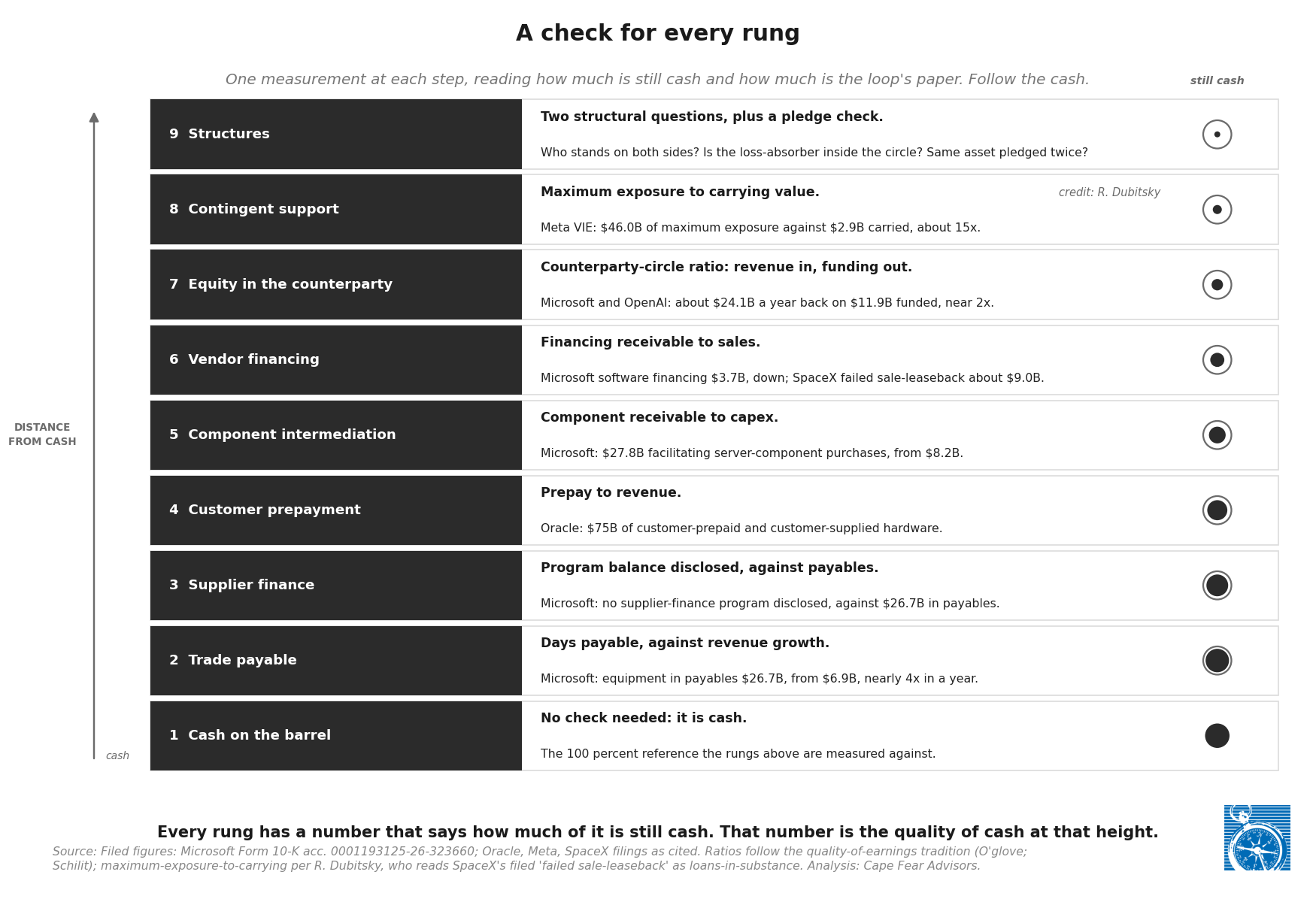
A ladder that only sorted arrangements by shape would be a filing cabinet. What makes it read is that each rung carries its own measure, a single ratio drawn from the filings that says how much of the rung is still cash and how much has turned to paper. Most come down from the quality-of-earnings tradition, the reading Thornton O’glove set out and Howard Schilit carried forward, the practice of asking what a reported number is made of. Applied rung by rung, they become a quality of cash.
Low on the ladder the measures are plain. On the trade-payable rung, the reading is days of payables set against the growth of the revenue they serve: a payable book swelling faster than the sales beneath it is a loop lengthening, cash held longer than the business earns it. On the supplier-finance rung above it, the reading is the program balance a buyer must now disclose, set against the payables it finances, which says how much of an ordinary payable book has a bank threaded through it. On the prepayment rung, prepaid balances against the revenue still owed as performance. On the component rung, the receivable that finances a supply chain against the capital spending it serves. Each is a fraction anyone with the filing can build.
Higher, the measures sharpen. On the stake rung the reading is the revenue a company takes from a firm it has funded, set against the money it has put in. When a stake returns two dollars of revenue for every dollar funded, and the revenue and the funding rest in the same note, the ratio reads the closeness of the loop. On the contingent rung sits the strongest single number the family holds, and it is Rod Dubitsky’s: maximum exposure set beside carrying value. Meta discloses $46.0 billion of maximum exposure to vehicles it carries at $2.9 billion, about fifteen to one, the size of the promise measured against the size of the mark. It reads what a footnote is holding back.
None of these is a verdict. Each reads for the one thing the ladder was built to find, the place the cash stops working. A ratio that drifts the wrong way for a quarter is a question; the same ratio drifting for a year, on a rung high enough that the catch has moved inside the circle, is the ladder pointing at an address. The measures do not accuse. They locate.
Who prints cash
There is one more cut, and it grades the whole ladder from outside it. Two kinds of entity make their own cash. A government issues it. A bank, lending, creates a deposit that did not exist a moment before, which is not a metaphor but the plain mechanics of the modern system, set out by the Bank of England over a decade ago. Every other party does one of two things with cash. It earns it, or it shows something that only looks like it.
The look is convincing at the top of a boom. A chipmaker that funds the buyers of its chips is, in a way, printing its own demand, and demand spends like money for as long as the buyers keep buying. The currency is compute rather than dollars, and the press is the circle: money out to the customer, orders back for the machines, revenue booked, the loop feeding itself. It is real while it turns. It is not cash. The dollars arrive only when a customer outside the circle pays a bill that clears.
Further from cash still is the mark. A fund that carries a private stake at a rising value can show a gain that reads like earnings, a golden egg laid each quarter. The egg is a valuation, not a settlement. It becomes cash on the day the stake is sold, and until that day it can rise and fall with nothing changing hands. A house whose best quarter is a mark on a position it still holds has shown the quality of cash at its thinnest.
This is why the earlier ladder in this series, the one that graded four dollars by what still had to happen to each, put the croupier’s dollar nearest cash and the mark’s dollar furthest. The croupier, the bank that places the paper, is paid first and in the settled article, and owes nothing further; the bank sits near cash whether it is printing a deposit or taking its fee. The mark is paid last, in a price that has to hold. Between them run the register’s dollar, a sale that waits on a solvent buyer, and the operator’s dollar, which a machine must earn across years. The circle does not change which dollar is which. It only makes the distance easier to forget.
Three registers of naming
The circle has been named three times this year, at three volumes, and the piece can stand among them. The loudest naming is the alarm: a bubble, reckless, a house of cards, drawn as one frightening ring. The alarm has the hard part right. Assembling this from the filings is difficult, and the difficulty is exhausting, and at the end of it many readers throw up their hands and shout. The shout has the strain right. It stops one step short of the reading.
The soberest naming came from the Bank for International Settlements, the central banks’ own bank, which in its 2026 report placed circular financing at the top of its list of risks and described it in flat, unfrightened prose: chipmakers and hyperscalers taking stakes in the labs that then commit to buy their chips, data centers built by third parties and leased back on long contracts, terms it called poorly disclosed. The institution is right that some of it is dark, and which part matters.
What is filed is the aggregate: the capital spending, the debt, the order books, the guarantees, printed to the dollar. What sits in shadow is the fine print of the private deals, the pledge order and the bilateral terms. A headline this week put hidden borrowing at more than a trillion and a half; the borrowing is not hidden, it is filed, and it is the terms that stay dark. Keeping those two apart is most of the work, because the alarm blurs them into one, and the blur is the frightening part.
Behind all three namings is the same slow machine. The rules that force a vehicle’s maximum exposure onto the page arrived within two years of the failure that prompted them and took most of a decade to sharpen, and they ask a great deal of any reader who would use them. The disclosure is there. It is written to be turned to rather than read, and turning to it is the whole of the craft.
The close
So the tool is a ladder, and the reading is a walk down it. Which rung does a dollar sit on. How much larger is the number than it was. Who holds the loss if the wheel stops, and does the thing that would hold it stand inside the circle or outside. A measure at every rung to say how much is still cash. None of it forecasts. All of it locates.
Circular financing is as normal as the day is long, and the sentence holds best whole, because half of it is the reassurance and half is the warning, and the two are true together. The circle is ordinary. And if a bubble is here, it will not arrive as a sector falling at once. It will arrive at one company, on one rung, at the moment the cash that was meant to catch a fall turns out to sit inside the circle that is falling. That is a company-by-company event, read one company at a time.
A company found at that rung is, first, only itself. Whether its trouble stays its own, sends ripples through the names around it, or reads as a tell of something larger is a second question, asked after the first and held apart from it. The one company matters to itself before it means anything for the rest. The bubble, if the word carries weight, is what a company might signal, not what it is.
The register was the first circle, and it is still the plainest one, because the drawer rings and the cash is counted in the same breath. Everything above it trades a little of that immediacy for a little more reach, and the trade is old and mostly sound. The work is only to keep counting: to walk the ladder to the rung where the counting stops, and to say so plainly, before the fall names the company.
Standing disclosure: Anthropic is the developer of Claude, which is used in preparing this research. That nearness cannot be fully checked away, which is why no claim here rests on trust in the tool: every figure carries a public source, and the record grades the rest. Among the companies named, OpenAI is a competitor of Anthropic; Alphabet holds a large position in Anthropic; CoreWeave and SpaceX are compute counterparties to it; and NVIDIA supplies the infrastructure that serves it. Companies not named here may hold positions or supply relationships that bear on the filers discussed, and that possibility is part of why every piece is re-checked for bias, ground facts, and filings rather than read against a fixed list. Figures are quoted from the filers without characterization, and the same standard of reading is applied to every filer named.
This piece is also available on Substack.
Notes
The trade-payable rung. Microsoft Corporation Form 10-K, fiscal year ended June 30, 2026, accession 0001193125-26-323660, Note 6: purchases of property and equipment remaining in accounts payable $26.7 billion at June 30, 2026, against $6.9 billion a year earlier. The Microsoft figures throughout are from this filing.
Supplier finance. The buyer-side disclosure requirement is FASB Accounting Standards Update 2022-04, supplier-finance-program obligations, effective for fiscal years beginning after December 15, 2022. A full-text search of the Microsoft 10-K returns no supplier-finance program.
The prepayment rung. Oracle Corporation, fourth-quarter fiscal 2026 results, Exhibit 99.1 to Form 8-K, accession 0001193125-26-265848: customer-prepaid and customer-supplied hardware of about $75 billion.
The component rung. Microsoft 10-K: $27.8 billion of other receivables related to facilitating the purchase of server components, up from $8.2 billion.
Vendor financing. Microsoft 10-K: customer software financing receivables $3.7 billion, down year over year. SpaceX: Form S-1 / final prospectus, accession 0001628280-26-042639, Note 17: sale-leaseback obligations deemed a failed sale-leaseback, $1.1 billion current and $7.9 billion non-current, about $9.0 billion, carried as related-party debt. The filed term is “failed sale-leaseback”; the reading of the arrangement as a financing in substance is Rod Dubitsky’s.
The stake rung. Microsoft 10-K, related-party disclosure under ASC 850: $11.9 billion funded into OpenAI and about $24.1 billion a year of revenue from the same relationship, the two legs in one note.
The contingent rung. Alphabet Inc. Form 10-Q, Notes 3, 5, and 10: $7.6 billion of financial guarantees and a $43.8 billion maximum on credit-derivative payments. Meta Platforms, Inc. Form 10-Q for the quarter ended June 30, 2026, accession 0001628280-26-050705: maximum exposure to loss of $46.0 billion against a carrying value of $2.9 billion for a data-center venture it does not consolidate. The maximum-exposure-to-carrying reading is Rod Dubitsky’s.
The structures rung. Reported: the SoftBank facility that added 21 lenders this month; NVIDIA’s investment offer to OpenAI, up to $100 billion, and an order of about $300 billion of compute; and, on the lead exhibit, SoftBank’s sale of its entire NVIDIA stake, about $5.83 billion, redeployed toward its OpenAI position in November 2025.
The quality-of-earnings tradition. Thornton O’glove, Quality of Earnings (1987); Howard Schilit, Financial Shenanigans.
Who prints cash. Bank of England, “Money Creation in the Modern Economy,” Quarterly Bulletin 2014 Q1 (Michael McLeay, Amar Radia, Ryland Thomas).
The institution. Bank for International Settlements, Annual Economic Report 2026, Chapter I, “Progress and peril.”
Enron. Used for structure only. The variable-interest-entity consolidation rules arrived with FIN 46 and FIN 46(R) in 2003 and were sharpened by FAS 167 in 2009.
On the shelf. The four-dollar ladder is The Quality of Cash: What Has to Happen Next, the shelf anchor; the croupier’s dollar is The Croupier Counts First; the aggregate-is-filed reading is Big Tech, Adding It Up: The Trillion That Was Never Hidden; the disclosure-gap companion is Apple, Adding It Up: The Immaterial Toll Booth. All on the Quality of Cash shelf.
Analysis: Cape Fear Advisors.