

Quality of cash is a way of reading a company: what is cash, what only looks like it, and whether the two balance or resolve. It reads one company at a time, though the answers are often in other companies’ filings, and it does not call an industry a bubble or a stock a buy. The position of this series is plain: if there is an AI bubble, it will show itself company by company, filing by filing, and not as a weather system over the whole sky. CoreWeave, the largest of the pure-play AI clouds, is where the reading is clearest, because nothing else in the frame softens what shows. This piece is written before its second-quarter numbers arrive.
This is a reading, not a verdict. Quality of earnings taught a generation to separate reported profit from the cash behind it; quality of cash sits next to that skill and asks, of the cash itself, how much of what a company records as cash is cash, and how much is a claim, a prepayment, a mark, or a balance still deciding what it is. It takes no relative view and puts no value on the shares. It runs on one principle: cash is the currency that has to balance or resolve in the end.
Most of what it reads is ordinary. Circular financing, one party funding the customer that buys from it, is as common as the day is long, and only rarely is it the extraordinary kind that earns alarm. Whether all of this is a bubble is a label history assigns later and no help now; the disservice would be the blanket judgment, emptying the bushel for one bruised apple, or calling a whole technology hollow because some of its financing runs in a circle. A thing can be overheated and a real advance at once, and some companies will come out of it stronger. So this is one company’s reading, and not a call on the rest. A bubble, if the word applies to anything here, gathers across an ecosystem, and a tip belongs to the leading edge. CoreWeave presents itself as that edge, “The Essential Cloud for AI,” the thing that “sits between the models and the silicon.” That is the reason to read it first.
Something is happening
Something is happening at CoreWeave that repays a slow read, none of it fraud, all of it filed.
It has never made a profit, and it asks that the reader look past that. In 2025 it earned $5.1 billion of revenue and lost $1.2 billion; the quarter that opened this year lost $740 million more. The company leads its own report not with those figures but with a $99.4 billion backlog and an adjusted EBITDA of $1,157 million at a 56 percent margin. That margin is an adjusted figure: it is what remains after depreciation and interest are added back, which is to say after the cost of the machines and the cost of the money are removed. Those two costs are the whole question, and the headline is defined to set them aside. One rung down, on the measure that keeps depreciation, the margin is one percent, and the chief financial officer has called one percent the trough.
Two companies, and the auditor said so
Set beside each other, the balance sheet and the income statement show two companies. One is a $99 billion promise; the other is a loss. That is the reader’s pair. The auditor names a different one, the accounting question underneath it: not promise against loss, but service against lessor. Deloitte and Touche named, as a critical audit matter, the judgment of “whether the contracts with customers are accounted for as a revenue contract for cloud-based services or a lease contract for cloud computing equipment.” A critical audit matter is not a criticism and not a ranking of risk; it is the auditor marking the judgment that was hardest to make and commending it to whoever holds the statements. The hardest judgment, by the auditor’s own account, was which company this is: a service that earns revenue, or a lessor of equipment. The company concluded service, because “generally either there are no identified assets or customers do not control or direct the use of underlying hardware,” the test the standard sets. A consequence of the service conclusion, and not its motive, is that the machines sit inside depreciation rather than out front in a lease.
The same matter names “the identification and treatment of contract terms that may impact the timing and amount of revenue recognized,” and that is where a number to watch appears. In the first quarter, $1.3 billion left deferred revenue, the caption that resolves into revenue, and entered a new caption, customer liabilities, that the filing does not define. The balance went from $137 million to $1,469 million in three months, most of it drawn from the long-dated portion into a current one, so that money once earned across years is now due within twelve. A caption with no definition can be read only from what it is not, and from the one thing that names it: the line’s own tag calls it a customer prepayment, in other current liabilities. So it is the customer’s cash, paid in advance, moved out of the prepayment account that becomes revenue and into a current one that does not. How and when it resolves, the filing does not say. That balance is a treatment of contract terms affecting the timing and amount of revenue, which is to say it sits inside the very judgment the auditor flagged as the hardest in the audit.
Outside the four corners
On July 30, the chief executive of Microsoft posted a return-on-invested-capital demonstration built on Morgan Stanley’s analysis, the work of Brian Nowak, of four companies, Microsoft, Alphabet, Amazon, and Meta, that together earn about 29.7 percent on capital against a 9 percent hurdle. It is a table, and it was laid by the chief executive of CoreWeave’s largest customer. He can sit at it, because the 29.7 is a blend and the blend is cover: a soft quarter in the buildout folds into search and software margins and never reaches the consolidated line. He can also sit out the pure-play version of the game entirely, because he does not have to play it. CoreWeave has no such choice. It is the blend pulled apart, with no legacy business to fold a miss into and a cost of debt, 9.1 percent on average and 9.625 on its June unsecured notes, already above the hurdle before a dollar of equity return, so its number arrives without cover. The four corners state the rule; the company-specific arithmetic the table only implies, that a dollar of these machines cannot return its cash and pay for the money that bought it inside the machine’s life, this series has already walked.
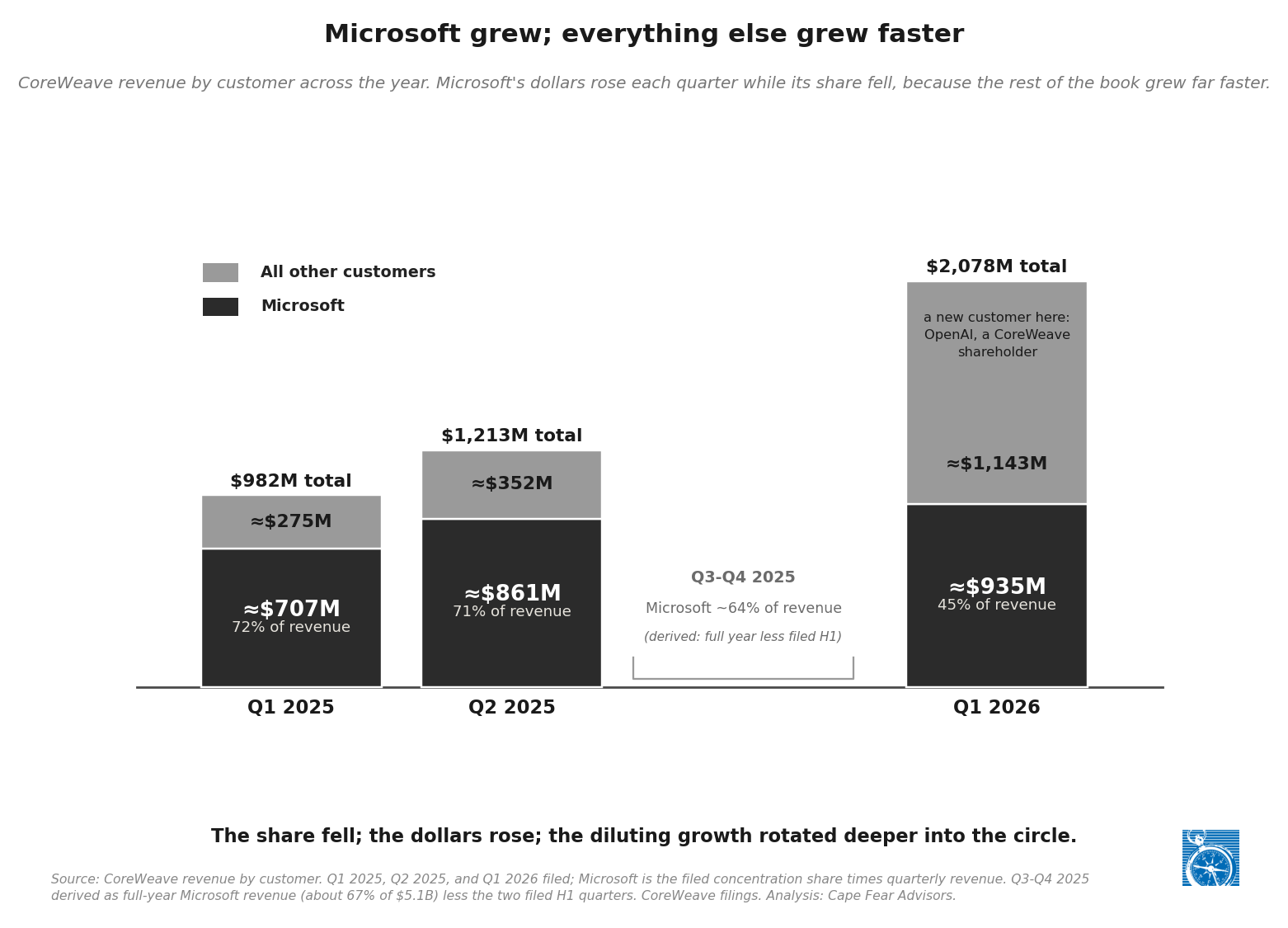
And the largest customer has not grown with the supplier the test leaves standing, though not in the way a glance suggests. Its share of CoreWeave’s revenue held above seventy percent for two quarters, 72 percent in the first quarter of 2025 and 71 in the second, before falling to 45 by the first quarter of this year, which reads at a glance as Microsoft buying less. The levels say the opposite. On figures derived from the filings, Microsoft’s dollars rose about a third, from roughly $707 million in the first quarter of 2025 to about $935 million a year later, while CoreWeave’s revenue more than doubled. Microsoft grew; the company around it grew faster, and the marginal dollar that diluted Microsoft came from other customers, among them OpenAI, which committed in 2025 and holds CoreWeave’s stock. The concentration did not fall away from the circle. It rotated deeper into it.
And the same week, the same customer’s chief financial officer named the freedom that lets it. Amy Hood, asked how Microsoft manages the risk of overbuilding, told investors the company’s capital spending had pivoted toward what she called “short-lived assets,” which “that’s CPUs and GPUs that have relatively shorter lead times,” and that if demand changes, “you can just slow down what is, in fact, the largest component... and the driver of” cost of goods sold, because “when you have the ability to late bind some of the more expensive components... you have a big book of business that’s flexible.” That is among the largest buyers of these chips describing optionality rather than commitment: the freedom to slow its own purchases without slowing its own business. She named no supplier, and the remark was about Microsoft’s own spending; its reach is the margin, not the contracts already signed, which are committed, but the ones that come next. A committed backlog is safe because it is committed; the freedom Hood described governs what comes after it, the renewal and the next signature, the same exposure the falling price carries later in this reading, now in the buyer’s own words. The chief executive published the test; the chief financial officer described the freedom. And she called the chips what the residual question already calls them, short-lived assets.
The sign of progress the company offers against all this, margin climbing off its one-percent trough toward a low-double-digit target, is measured on the wrong ruler for that table. A margin is income over revenue; the hurdle is income over capital; and on a business spending 7.7 times its EBITDA on equipment, even a low-double-digit margin is a low-single-digit return on the capital, a fraction of nine. The mark the company told the market to watch cannot carry it back inside the corners, and by its own year-end target it does not.
Every rung, up to the structure
It has used about every ordinary tool of this financing that the filings let anyone see. It takes its customers’ cash in advance. Its chief supplier both sells it chips and holds its stock, and one of its customers holds its stock as well. It ring-fenced its best contract, a Meta agreement its rating agency characterizes as take-or-pay though the contract’s commercial terms are redacted, into a separate company and financed it at investment grade, while the parent itself is rated speculative by all three houses, Ba3, B plus, and BB minus. And the last of these tools is the top of the ladder, structure, which the auditor also flagged: its second critical audit matter is whether a joint venture with a third-party developer, formed to build a multi-phase campus, belongs on the balance sheet at all.
The future the company is selling is premium-priced compute, rented to the few counterparties with the means and the stated intent to build it themselves. Microsoft, named in the annual report at about 67 percent of 2025 revenue, has just described, through its chief financial officer, the flexibility that governs what it buys next. Meta, the anchor of the investment-grade facility, has announced it is entering the cloud business. And the rates in the $99 billion backlog were written in the scarcity of 2023 through 2025, into a market that has since fallen between 64 and 75 percent from its peak on independent indices, with one hyperscaler cutting its own published prices up to 45 percent in a single announcement. A falling price pulls two things at once, the rate a contract renews at and the value of the machine that secures the debt, though a memory shortage has firmed near-term rates and has to be read out before the trend is read.
What has to happen next
So something has to happen, or not. The questions are few, and each is answered in a filing. Which rung will the quarter’s solution sit on, a new one or cash off an old one? Does the $1.3 billion earn into revenue as the machines deliver, settle as a note, a reversal, a return of cash, or a charge, resolve in a way no filing has shown, or simply stand another quarter, which an unaudited interim statement is allowed to let it do? Does the largest customer’s share keep falling? Does cash arrive from outside? And how does a business that sits outside the four corners present a future it concedes is unlikely to bring it back inside them?
Occam’s razor asks for the simplest answer. The reading here is that no simple answer is on the table; every candidate resolution is a hard one, and the absence of a simple path is itself the thing to notice. There may be a third kind of move as well, assembled for the occasion, an instrument or a structure without precedent in this company’s statements. A reading written before the data cannot describe what has not yet been done, and will not pretend to. It can say only that more structure and cash from outside may not be the only two answers, and that the unfamiliar move would be the most telling of all, because a company reaches for one when the familiar answers no longer serve.
The quality of cash is, in the end, the discipline of reading the second line first.
The other outcome has to be written as plainly, and on the scale the quarter can settle. The margin comes off its one-percent trough, as management said it would. The largest customer’s share steadies rather than falls further. The $1.3 billion earns into revenue the way deferred revenue is meant to. And cash, if it arrives, arrives from outside the circle, on terms the filing states. If the second quarter shows those, this reading says so first and in full: whatever the filing shows gets an even reading, and if the news is good it runs first. The larger question, whether the return ever clears nine percent on its own, no single quarter can answer, and the arithmetic above says it would be the harder climb for having no cover to lean on; that one the following filings grade, not this one.
And whichever of these it is, it may not arrive as the headline. Any company leads with its best news, and the answer to a question about last quarter’s cash can sit as the second line beneath a headline about something else, a new commitment, a larger number, a fresh partnership. That is ordinary; it is how stories are told. This reading only insists on looking under the headline for the line beneath it. The quality of cash is, in the end, the discipline of reading the second line first.
This reading presupposes no wrongdoing and finds none. A critical audit matter is the auditor’s ordinary flag of a hard judgment, placed there by the people who signed the statements. A high rung is a financing choice. A caption the market has no template for is a company writing its own presentation, the ordinary cost of going first. What the filings show is simpler and quieter: a company selling a story, that it is the essential cloud for the age, and a story that is not working out on the numbers, and that may, on the numbers, prove unable to. Selling a future the present cannot yet fund is the ordinary condition of a company asking to be believed before it can prove itself. The only question this reading holds open is whether the proof arrives, and cash is the place it would have to show.
Beyond the filings the series does not claim to see; where the record is silent, the blank is left a blank. The answer arrives on a date already on the calendar, in numbers the company files itself.
Standing disclosure: Cape Fear Advisors holds no position, long or short, in CoreWeave or in any company named here. Anthropic is the developer of Claude, which is used in preparing this research, and Anthropic is a customer of CoreWeave under a multi-year commitment; that commitment gives Anthropic an interest in CoreWeave’s health, and nothing in this reading serves or disserves it. The nearness cannot be fully checked away, which is why no claim here rests on trust in the tool: every figure carries a public source, and the record grades the rest. Others named here have ties to the company: Microsoft and Meta are its largest customers; NVIDIA supplies its accelerators and holds a position in it; OpenAI is a customer and holds a position in it; Morgan Stanley is among its arranging banks. Companies not named here may hold positions or supply relationships that bear on the filers discussed, and that possibility is part of why every piece is re-checked for bias, ground facts, and filings rather than read against a fixed list. Figures are quoted from the filers without characterization, and the same standard of reading is applied to every filer named.
Figures are verified against the primary filings; documents are cited by accession number. Analysis: Cape Fear Advisors.
Cape Fear Advisors holds no position in any security named in this analysis and has received no compensation from any company discussed.
This analysis also appears on Substack.
Notes
(1) FY2025 and Q1 2026 figures, the $99.4 billion backlog, power, adjusted EBITDA, and the chief financial officer’s “trough” remark: CoreWeave FY2025 10-K, the Q1 2026 press release, and the Q1 2026 earnings call.
(2) The two critical audit matters and the “service, not lease” conclusion: Deloitte & Touche LLP, FY2025 10-K (auditor’s report and Note 1); discussed across this series, first in “Adding It Up” and most recently in “Taken as a Whole” (July 4, 2026).
(3) The $1.3 billion reclassification out of deferred revenue, and the customer-prepayment line tag: Q1 2026 10-Q, Contract Balances.
(4) The customer-level dollars are derived, filed concentration share times filed quarterly revenue: Microsoft about $707M in Q1 2025 (72% of $982M), about $861M in Q2 2025 (71% of $1,213M), about $935M in Q1 2026 (45% of $2,078M); shares and revenue from the FY2025 10-K and the quarterly filings.
(5) The four corners: Morgan Stanley (Brian Nowak) hyperscaler return-on-invested-capital analysis, as rendered and posted by Microsoft’s chief executive on July 30, 2026.
(6) Amy Hood’s remarks on short-lived assets and slowing purchases: Microsoft FY2026 Q4 earnings call (Q&A, in response to Bernstein’s Mark Moerdler), quoted from a transcription-service record of the call, to be corrected by name should the company’s official transcript differ.
(7) The Microsoft, Meta, and OpenAI master services agreements and the OpenAI common-stock issuance (commercial terms redacted): S-1 and 8-K exhibits (Meta MSA; OpenAI MSA).
(8) Parent ratings Ba3 / B+ / BB- and the A3 ring-fenced facility: the agencies’ actions, the DDTL 4.0 8-K, and the June unsecured notes 8-K.
(9) The H100 rental decline (64 to 75 percent from the 2024 peak) and the AWS price reduction (up to 45 percent, effective June 1, 2025): AWS’s own announcement and independent indices, labeled as reported.
(10) The residual and the capex-to-EBITDA reading: this series’ “Twenty-Seven Years.”
(11) The self-descriptions “The Essential Cloud for AI” and “sits between the models and the silicon” are CoreWeave’s own.
Sources are public filings; the figures re-derive from them.
Analysis: Cape Fear Advisors.