

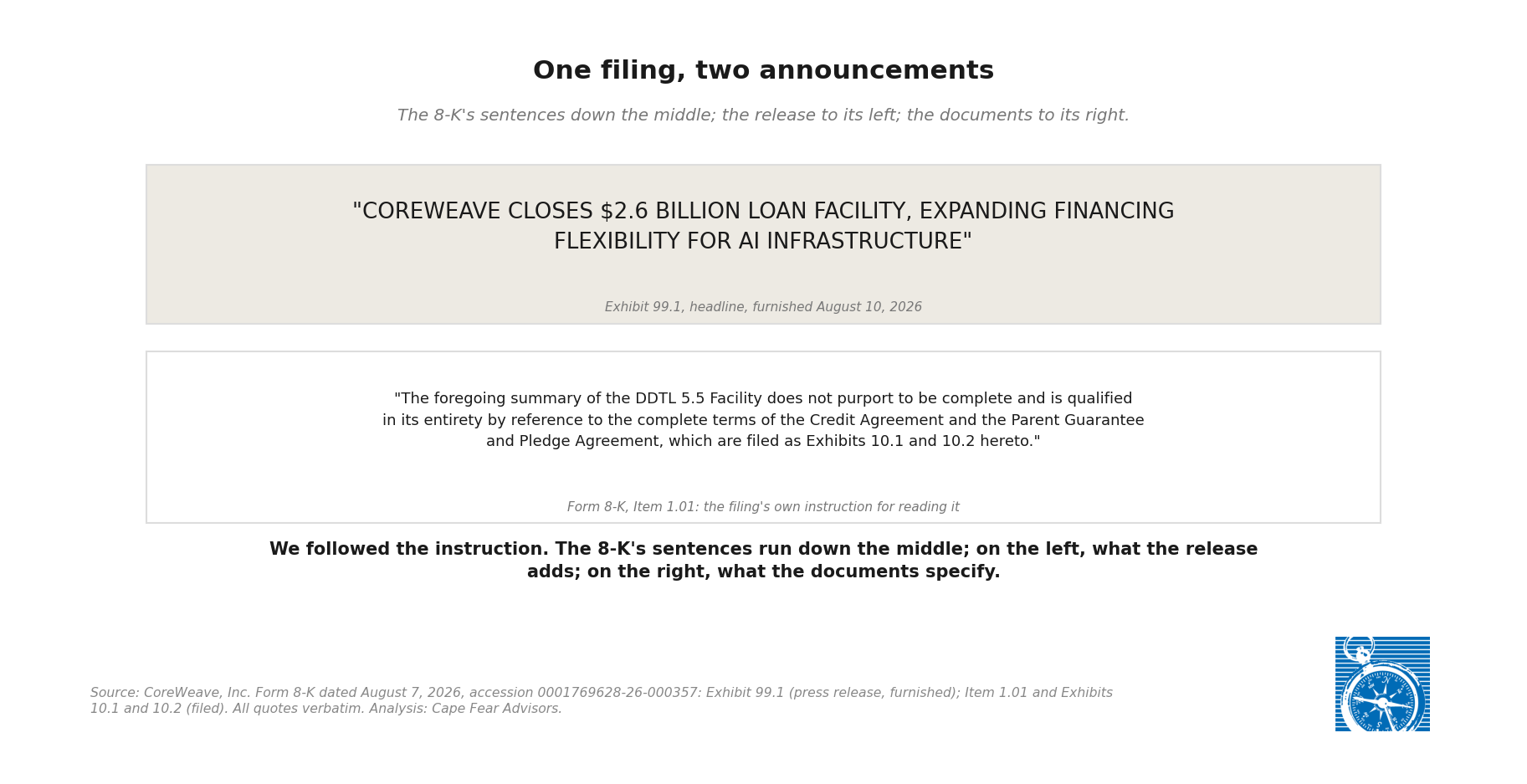
CoreWeave announced its DDTL 5.5 financing on Monday, in a filing dated the previous Friday, August 7: a credit agreement, a parent guarantee, a press release, and the Form 8-K that binds them, all under one accession number. The 8-K’s own summary states that it “does not purport to be complete and is qualified in its entirety by reference to the complete terms of” the agreements filed beside it, and its Item 7.01 attaches the release. We started with the 8-K and read outward, following the filing’s own instruction. In the exhibits below, the 8-K’s sentences run down the middle; on the left, the release’s language on the same point; on the right, the documents’ terms. The exhibits carry nothing but the filing’s own words. Every observation of ours, including any note that a layer is silent, appears in the comment beneath its exhibit, so a reader can take the documents without us, or with us, and can tell at every point which is which.
Two disclosures before the exhibits, one about the company and one about us. About the company: nothing in this piece identifies an error, an inconsistency, or a bad actor. We did not find one, and we did not go looking for one. Every document here is taken on its face as accurate, as complete under the rules that govern it, and as consistent with the others; the release is responsive to all filing and disclosure requirements; and the omissions noted below are expressly permitted. The subject of this piece is not conduct. It is what each kind of document can carry, and what a reader can learn by laying them side by side. About us: the spine and the matching are choices of ours. It is possible our framework excludes something, and possible that language we selected from the agreements would read differently beside language we left out. We are not reconstructing these documents for any legal purpose. A reader who wants to check the choices can: every column names its exhibit, the quotations from the agreements carry their section numbers, and the whole accession is public.
One more fact belongs up front: the layers of an 8-K do not carry equal weight, and that is by rule, not by choice of ours. The press release is furnished under Item 7.01 and, in the filing’s own words, “shall not be deemed ‘filed’ for purposes of Section 18 of the Securities Exchange Act of 1934... or otherwise subject to the liabilities of that section.” The summary and the agreements are filed. The rules sort a company’s statements into tiers of liability, and the company sorted its statements accordingly. We are reading the sort. The distinction between the columns below is one the rules themselves draw.
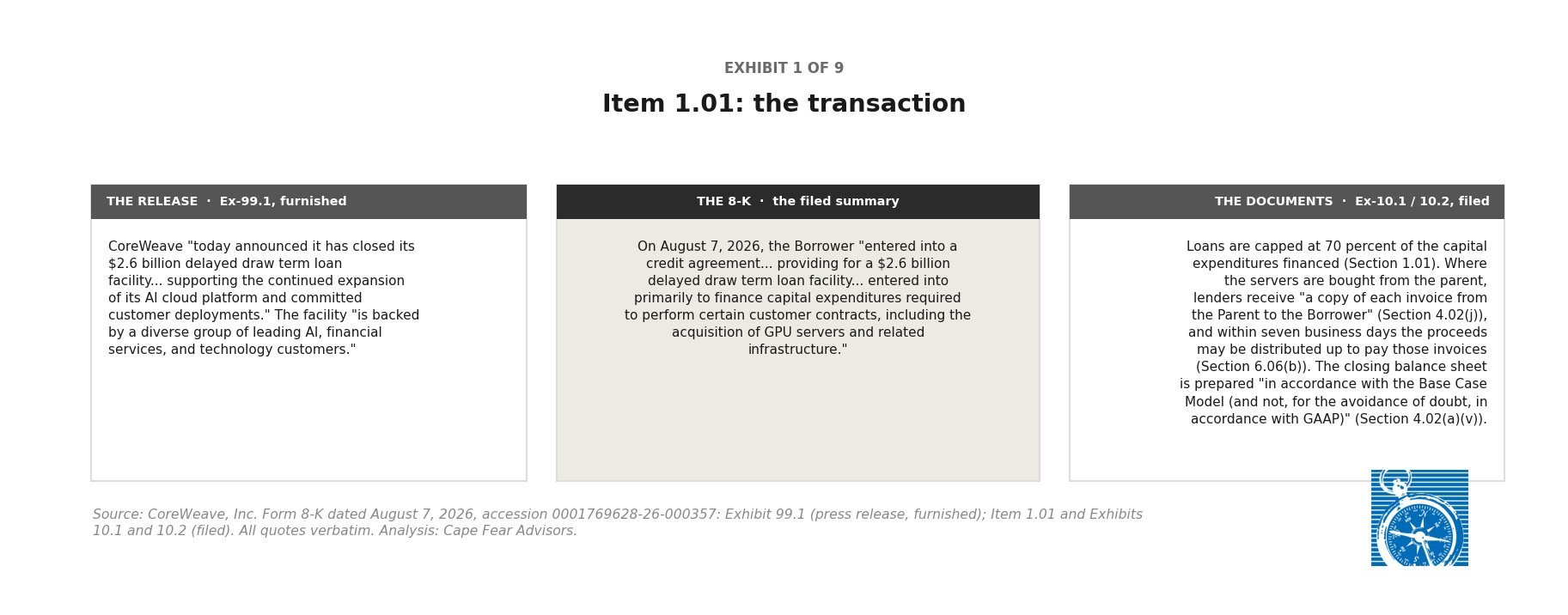
Comment: The filing opens with the parties and the purpose. The release expands the purpose into platform expansion and customer support; the agreements specify the mechanics: loans capped at 70 percent of the capital expenditures financed, the parent’s invoices delivered to the lenders where the borrower buys from the parent, and proceeds distributable up to pay those invoices within seven business days. The parent sells the servers to its own subsidiary, the lenders fund 70 percent of the invoice, and the proceeds may return to the parent. Every customer name in the agreements is replaced by the mark “[*].”
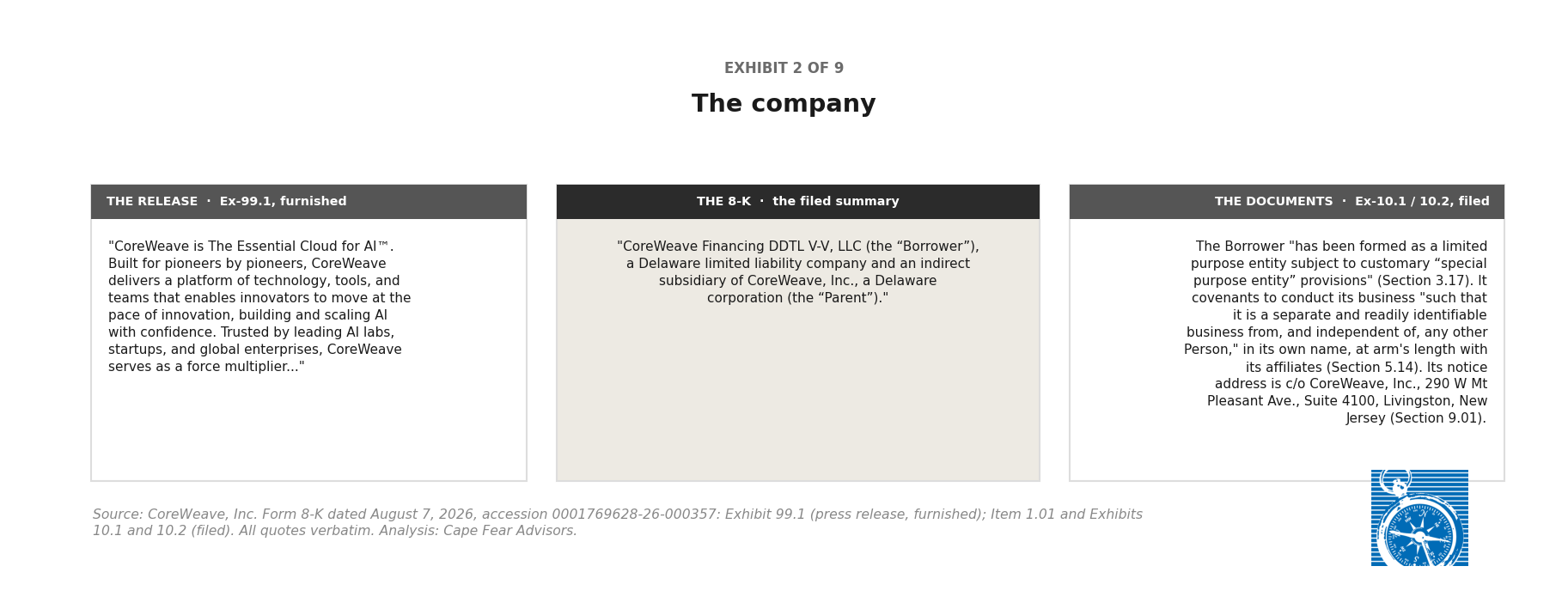
Comment: Each layer describes a company, and they do not describe the same one. The release’s About section describes CoreWeave, Inc. The agreements describe the borrower, a limited purpose entity covenanted to be separate and independent, whose notice address is the parent’s suite in Livingston. The 8-K describes both in a single clause and contains no further description of either company’s business.
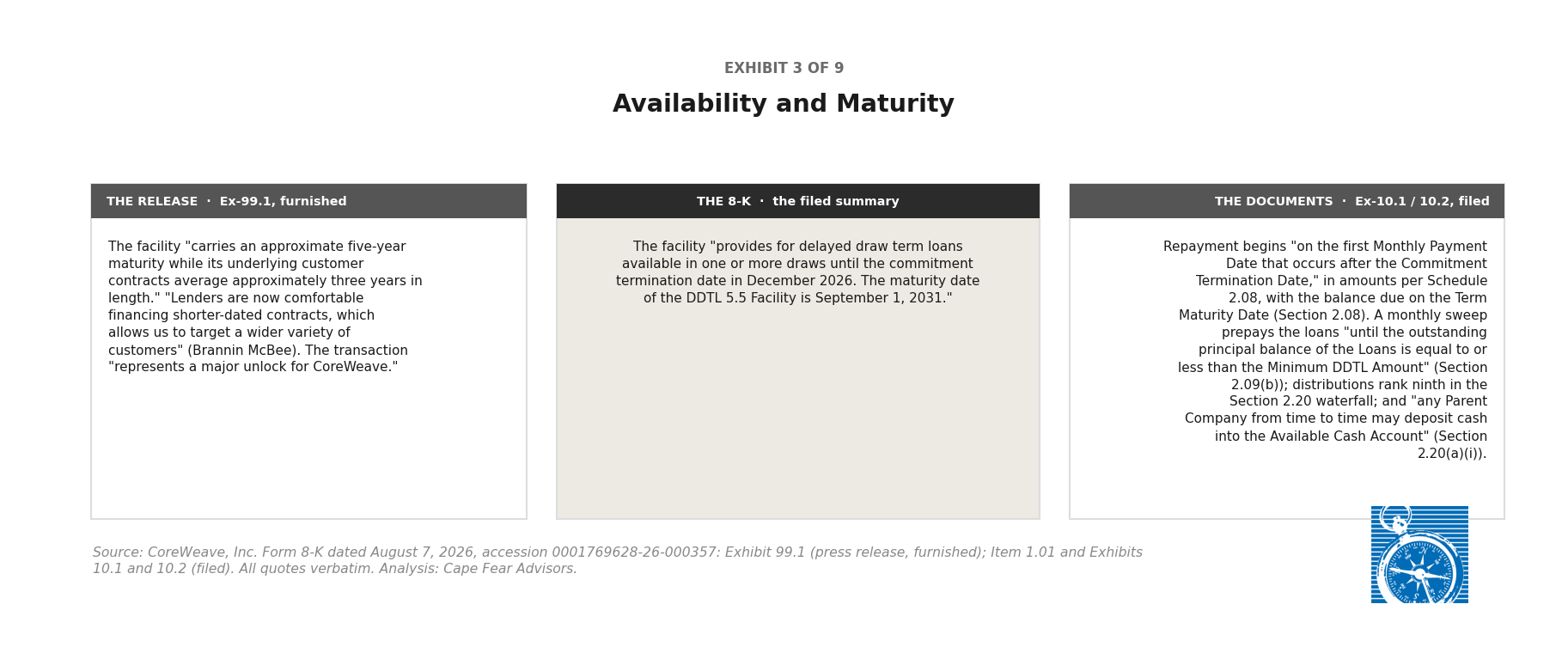
Comment: The dates are the same in every layer. The release compares the debt’s five years to the contracts’ three and reads the difference as lender confidence; the agreements set the order of cash: amortization beginning only after the draw period, on percentages in a schedule the filing omits, a sweep to the $1.3 billion floor, distributions ninth of nine, and deposits from any parent company accepted at any time. Cash exits the structure last and enters it freely.
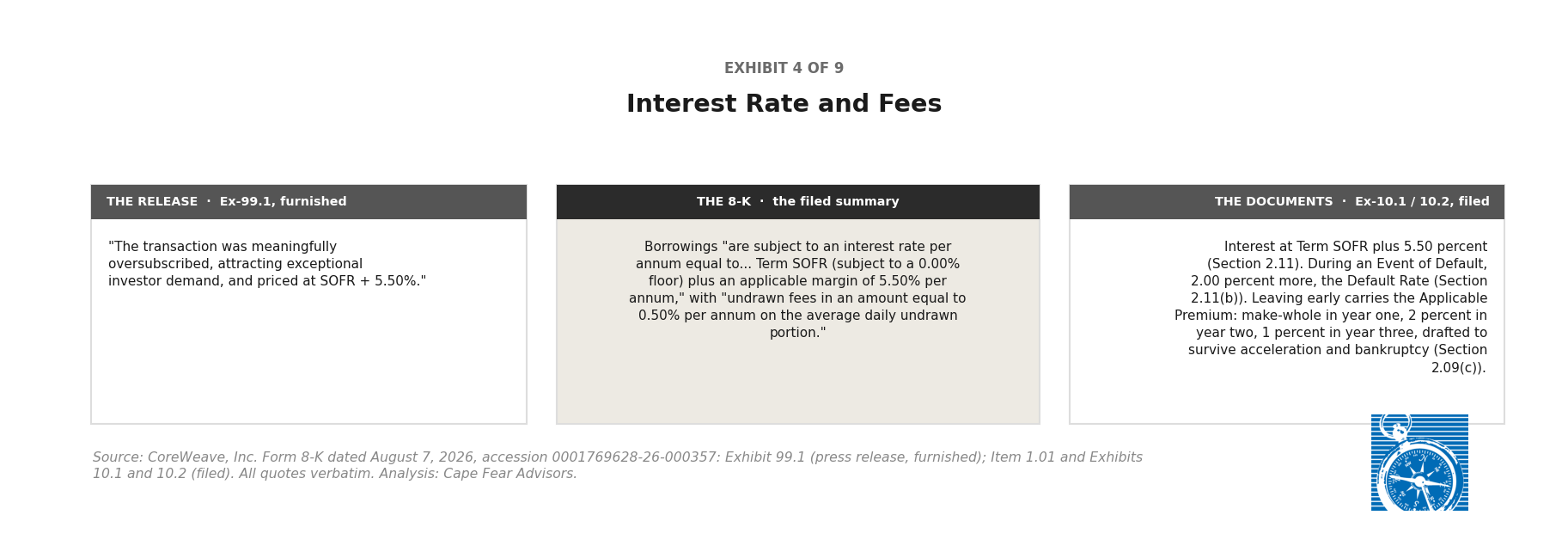
Comment: A debt sale produces two numbers, a quantity and a price. All three layers carry the price; one layer characterizes the demand. For scale, one comparison from outside the accession, pinned in the Notes: the company’s facility of the same ratings priced in May at SOFR plus 4.50 percent. The marginal secured dollar costs 100 basis points more than it did three months ago.
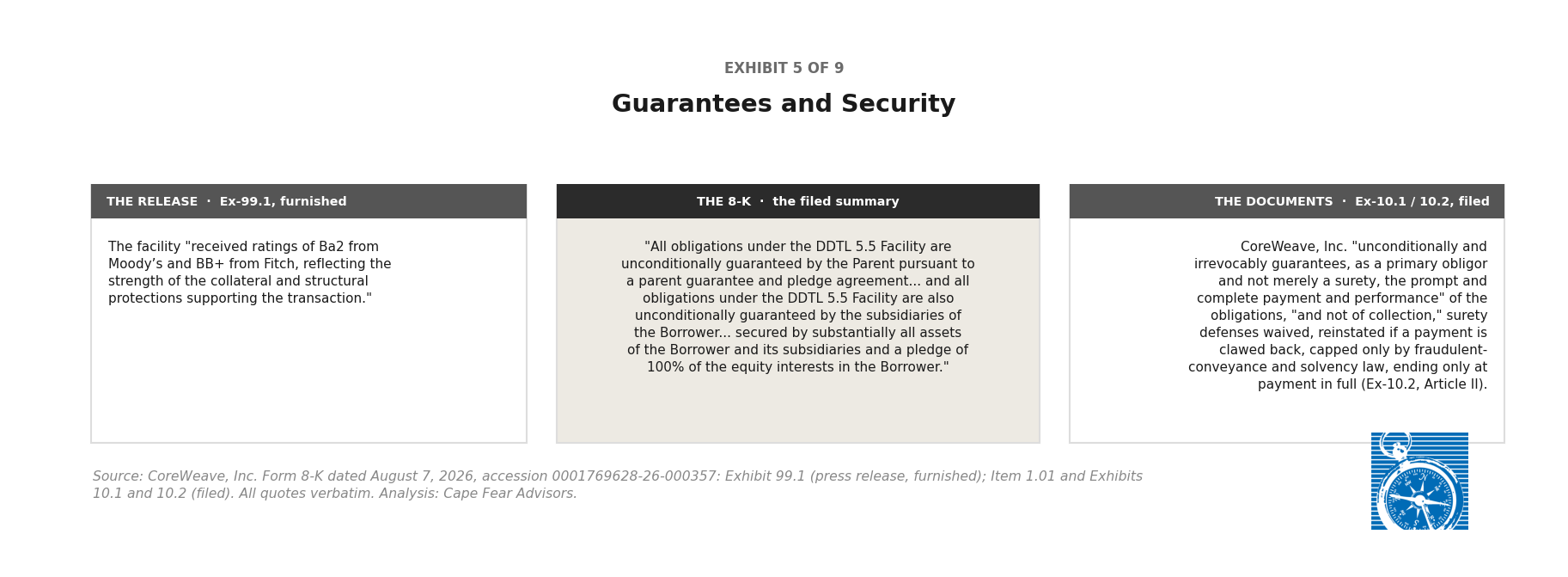
Comment: The words “guarantee” and “guarantor” appear zero times in the release, which attributes the ratings to collateral and structural protections. The filed 8-K names the unconditional parent guarantee in its first sentence on the subject, and the guarantee itself is Exhibit 10.2, full recourse, primary obligor, capped only by fraudulent-conveyance and solvency law. The support is named in the layers that are filed.
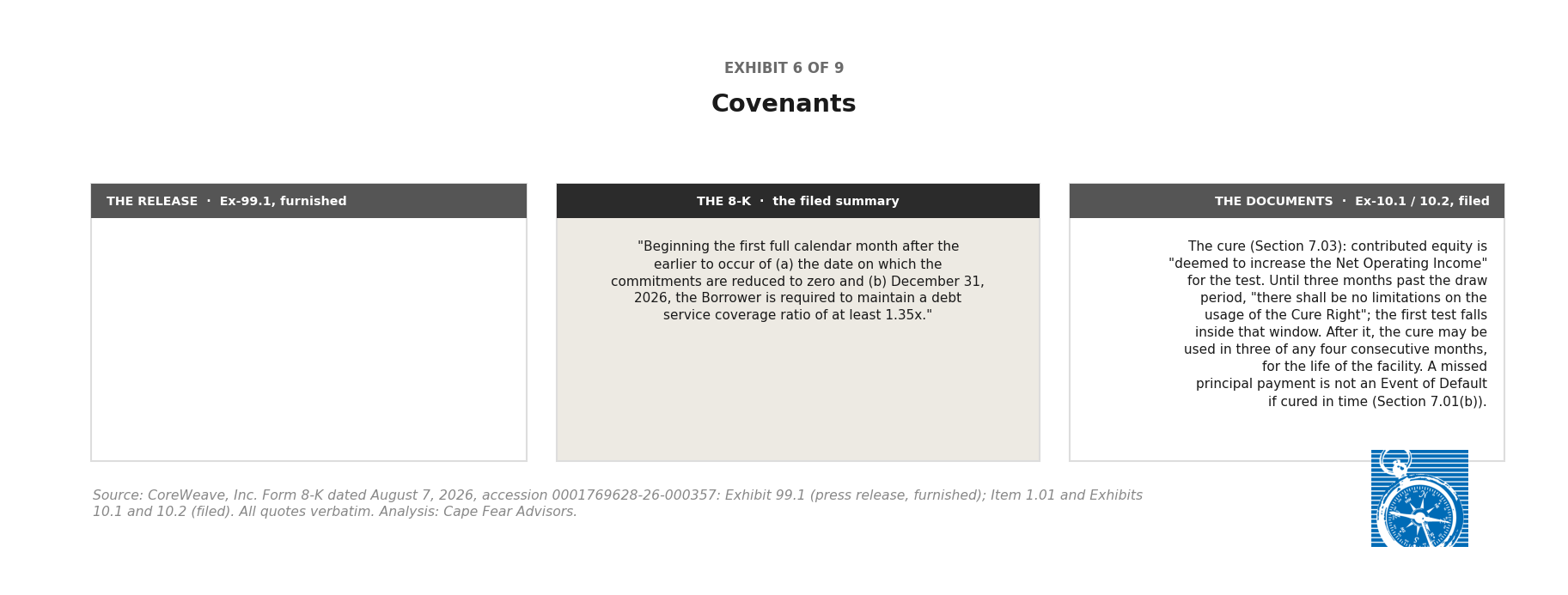
Comment: The release does not address the covenants directly; its left column above is empty for that reason. The 8-K names the test and its start date, which puts the first check of the coverage ratio around February 2027, earlier if the commitments end before December. The agreements name the cure: equity deemed income for the test, without limit through a window that contains the first test, and in three of any four consecutive months thereafter.
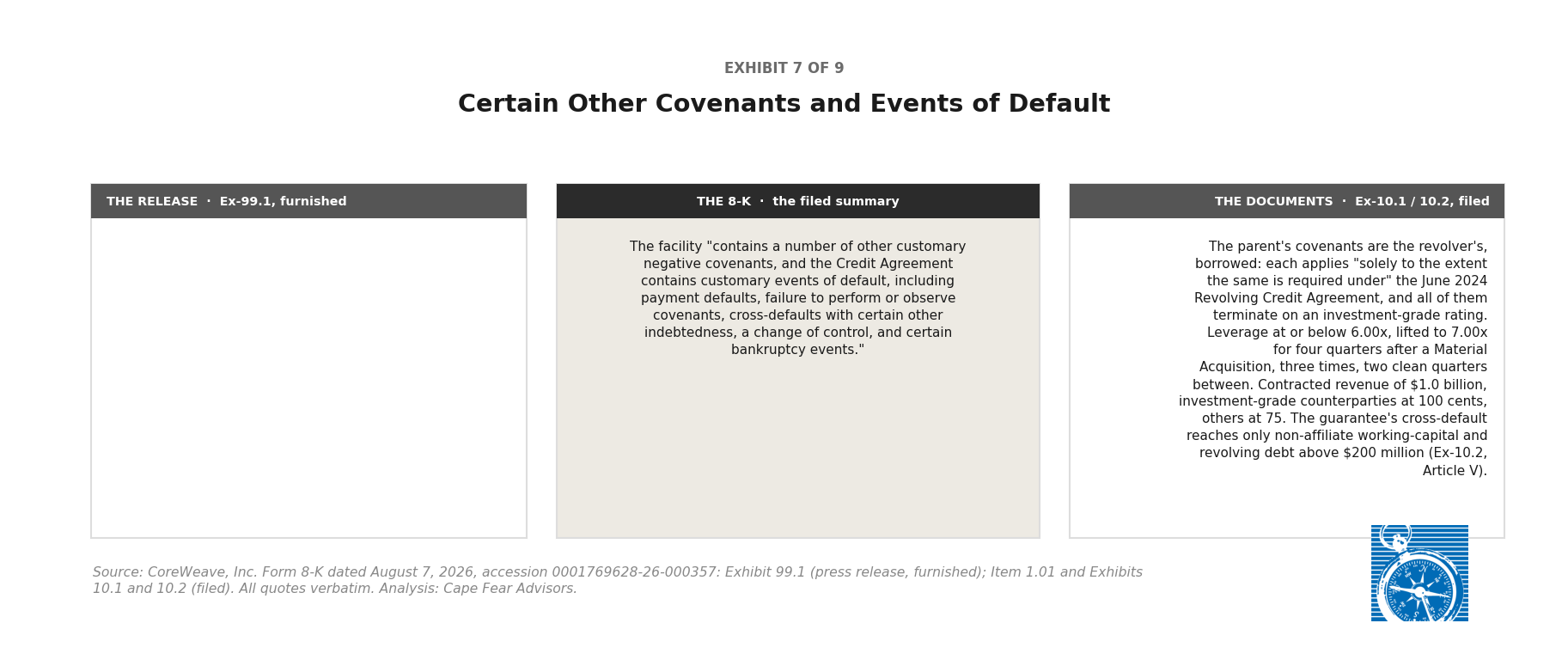
Comment: The release does not address these either. The 8-K describes them as customary, and they are; the agreements state what customary resolves to here: covenants borrowed from the revolver, terminating on an investment-grade rating, with a cross-default confined to non-affiliate working-capital and revolving debt.
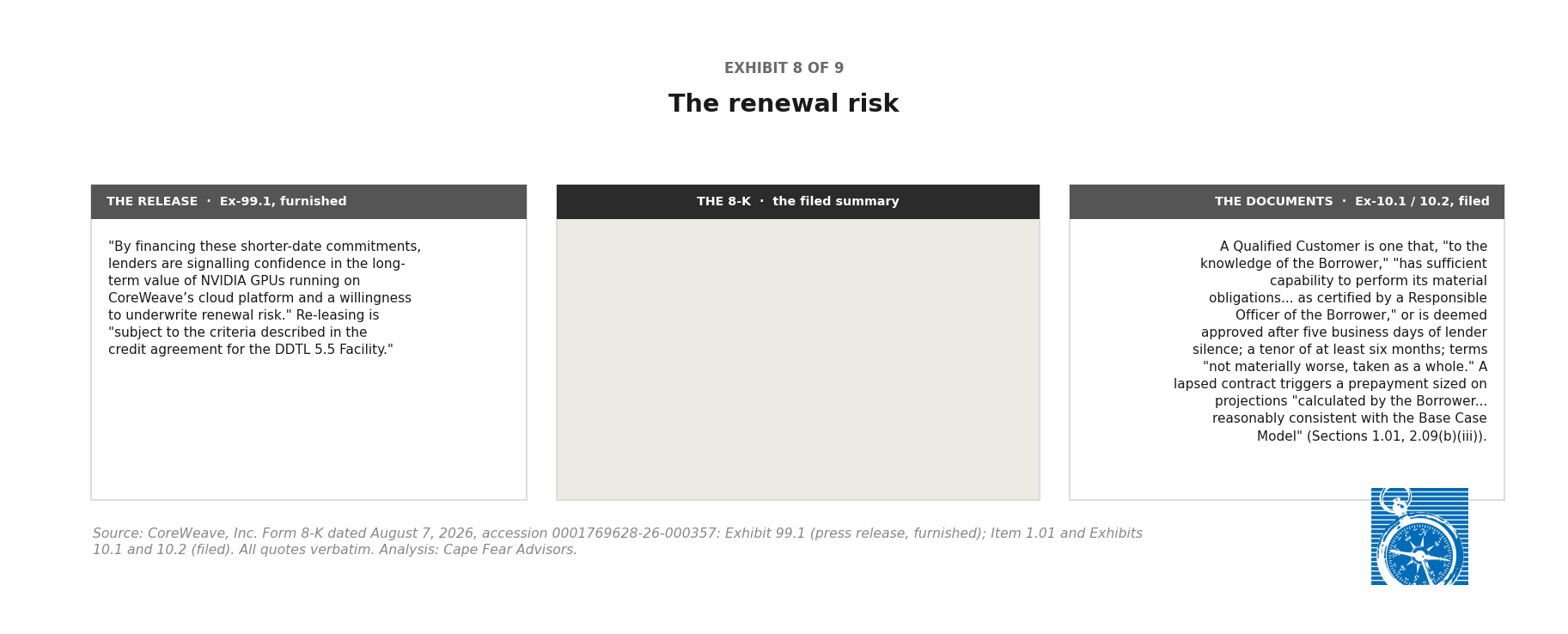
Comment: This row runs the other direction, and the empty cell above is the 8-K’s: the filed summary contains no sentence on renewal or re-leasing. The subject lives at the outer layers. The release, fairly, directs the reader to the document that contains the criteria, and the right column is what the reader who follows the pointer finds: a standard certified by the borrower’s own officer, a fallback approval by lender silence, and a backstop prepayment sized on the borrower’s own model. The Renewal Deadline itself is one of the marks: “[*].”
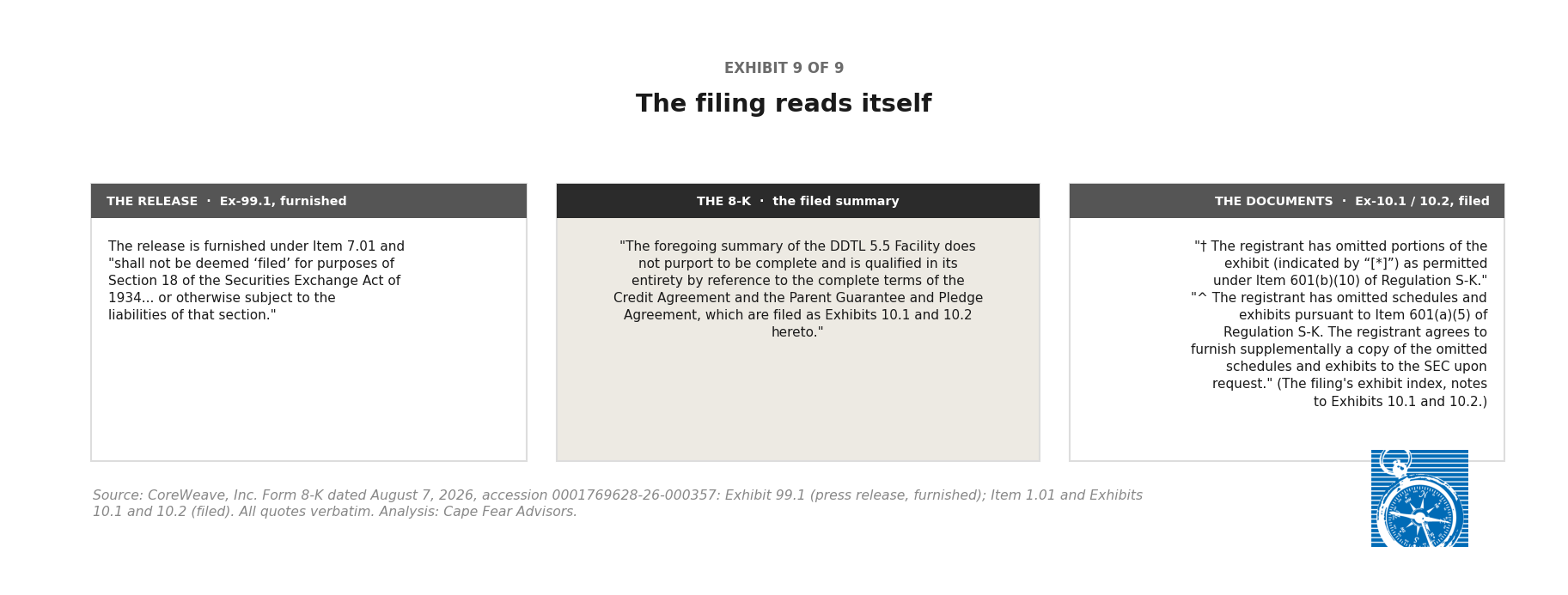
Comment: The filing closes by reading itself. Each layer holds exactly what its rules provide. The release is furnished and not deemed filed. The summary is qualified in its entirety by the exhibits. And the exhibits omit what the exhibit rules expressly permit, information that is not material and competitively sensitive, under the filing’s own index notes quoted above. The omissions are permitted and routine. Their effect, stated without any conclusion attached: the marks fall on the customer names, the data-center sites, the numerator of the 2.40:1.00 collateral test, the hourly GPU rate, and the renewal deadline, so the facility’s tests are public in their thresholds and not computable from the filing.
The remainders
A few remainders, from the same accession. The credit agreement is signed for the borrower by its Treasurer; the guarantee is signed for the parent by its Chief Financial Officer; they are the same officer, wearing each entity’s hat in its own document. The borrower’s first standalone audited financial statements will cover fiscal 2027, deliverable up to 150 days after year end, and the audit opinion may be qualified for impending maturity or a covenant breach without breaching the reporting covenant. The monthly sweep that pays the loans down takes the cash that is there; if there is less than the full amount, the shortfall itself is not a default, a standard feature of waterfall structures, which looks to the collateral accounts rather than to a promise of sufficiency. And the release counts “more than $30 billion of debt and equity capital year-to-date”; the composition, as we count it from the company’s announcements, is one equity placement in January and debt since, itemized in the Notes.
The form decides what the reader sees, and every form here was chosen and permitted.
The same facility, described three times, by one company, on one day, each register following its own rules and each consistent with the others. “The Forge House” read one set of numbers wearing two accounting forms; this filing is one transaction wearing three genres. The form decides what the reader sees, and every form here was chosen and permitted. For a reader who wants the repeatable version: the 8-K first, then its exhibits, and the release last. The announcement is the whole accession. The press release is one exhibit of it.
Standing disclosure: Cape Fear Advisors holds no direct position, long or short, in CoreWeave or NVIDIA; any exposure is indirect, through managed funds it does not control, which may now include index funds holding the public companies named. Anthropic is the developer of Claude, which is used in preparing this research; no claim in this piece rests on trust in the tool, since every column names its exhibit, the quotations from the agreements carry their section numbers, and the reading is reproducible from the public accession. NVIDIA, named in the release quoted here, is the maker of the GPUs that run in the servers the facility finances, and is an investor in CoreWeave (Note 2). The customer names in the agreements are redacted; whether Anthropic, or any counterparty of Anthropic’s, stands behind one of the “[*]” marks is not knowable from the filing, and we state that unknown rather than assume it away. Companies not named here, among them the banks arranging the facility and the customers behind its contracts, may hold positions or supply relationships that bear on the filers discussed, and that possibility is part of why every piece is re-checked for bias, ground facts, and filings rather than read against a fixed list. Figures are quoted from the filers without characterization, and the same standard of reading is applied to every filer named.
Analysis: Cape Fear Advisors.
This analysis also appears on Substack.
Start a Conversation →Notes
(1) The May comparison: CoreWeave’s DDTL 5.0, $3.1 billion, priced at SOFR plus 4.50 percent, rated Ba2 by Moody’s and BB+ by Fitch, per the company’s release of May 18, 2026 (Form 8-K, accession 0001769628-26-000236, Exhibit 99.1). DDTL 5.5 carries the same ratings from the same agencies at SOFR plus 5.50 percent; the difference is 100 basis points.
(2) The year’s raises, as announced by the company: an equity placement of approximately $2.0 billion to NVIDIA, priced January 23 (reported in the Form 10-Q for the quarter ended March 31, 2026, accession 0001769628-26-000222); thereafter, among others, an $8.5 billion delayed draw facility announced in March (accession 0001769628-26-000129), the $3.1 billion DDTL 5.0 in May, the $2.6 billion DDTL 5.5 closed August 10, and note offerings reported in the spring. The list is not exhaustive; the complete and checkable claim is narrower: we find no equity announcement after January 23, so the equity in the release’s “$30 billion of debt and equity” phrase is, by our count, the January placement.
(3) The first-test date is derived from the 8-K’s covenant description: testing begins the first full calendar month after the earlier of the commitments reaching zero and December 31, 2026.
(4) The agreements are dated Friday, August 7, 2026; the press release is dated Monday, August 10, 2026; both travel in the accession cited below.
Source
CoreWeave, Inc. Form 8-K dated August 7, 2026, accession 0001769628-26-000357: Exhibit 99.1 (press release, furnished); Item 1.01 and Exhibits 10.1 and 10.2 (filed). All quotes verbatim. Analysis: Cape Fear Advisors.