

The market has settled on the shape of this story: the companies that build the AI industry are financing the companies that buy from them, in a circle. The circle is taken as given. This piece reads one level down, to a fact the debate has passed over. With the cash held exactly the same, the form the financing takes is a choice, and the choice moves reported operating income, the segment line, and the growth rate the market watches, without moving a dollar: in the quarter just filed, the size of that choice is seven points of growth rate and a two-billion-dollar swing in reported gross profit, on cash that is identical in every column. NVIDIA is the case: it sells the machines that build the industry and is paid in weeks, at a software company’s margin, while its newest customers are the opposite, nearly all commitment. This is a companion to “The Fourth House,” reading the same relationship not for who holds the privilege, but for how it is recorded.
The house and the bubble
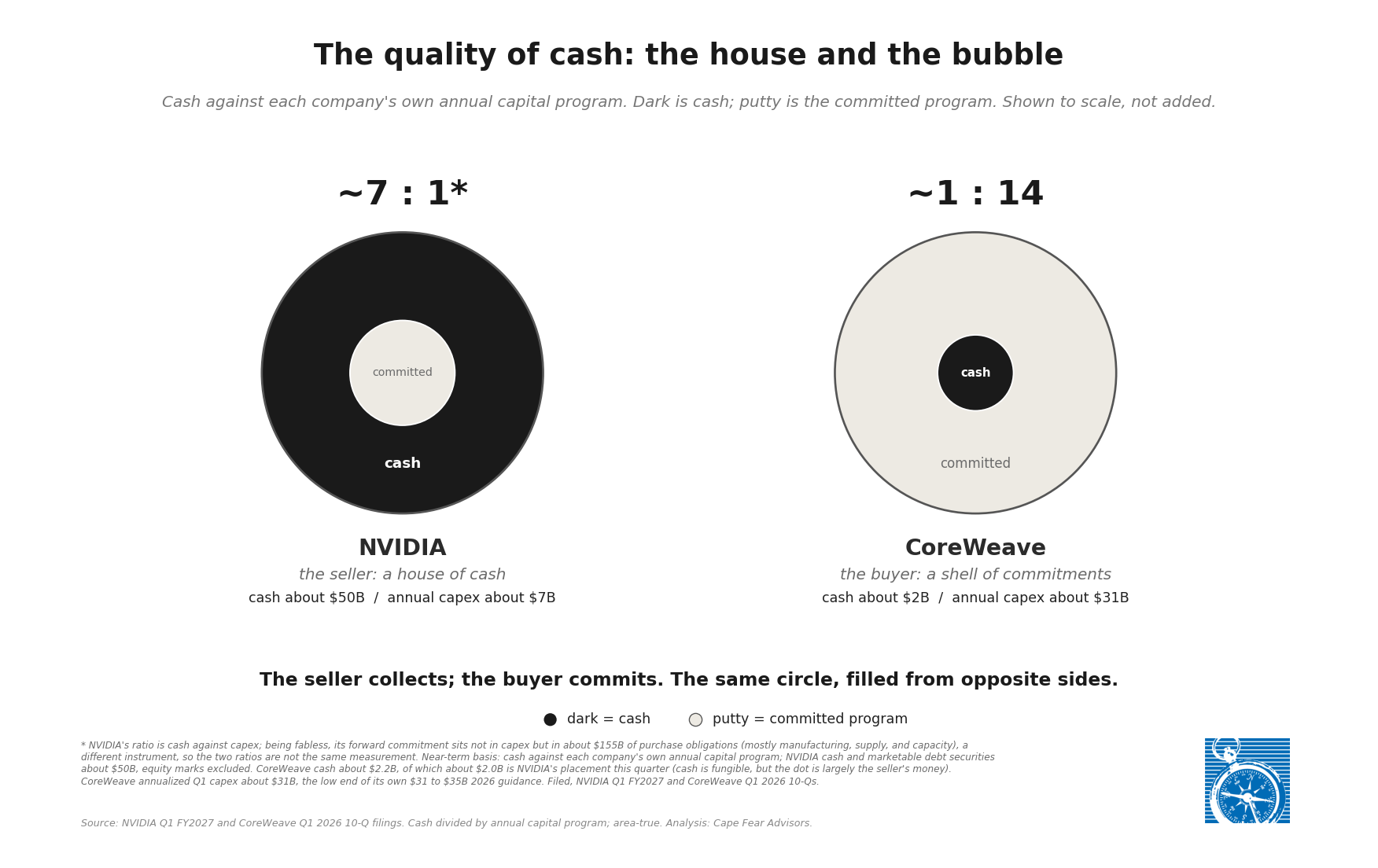
Set side by side, the two ends of the circle tell the story before any number does. Measured as cash against each company’s own annual capital program, NVIDIA is a house: roughly fifty billion dollars of cash and marketable debt securities against about seven billion of capital spending, close to seven to one, a disk of cash with only a small hole. CoreWeave is the bubble: about two billion of cash against a build running near thirty billion a year, about one to fourteen, a shell of commitment around a dot of cash. And the dot is mostly the seller’s money: about two billion of CoreWeave’s roughly two-and-a-quarter billion of quarter-end cash came in this quarter as NVIDIA’s placement, and even with that infusion the cash fell about eight hundred million over the quarter while the committed build ran on. It is the same circle, filled from opposite sides, the buyer’s small reserve of cash largely supplied from the seller’s large one. The seller collects; the buyer commits.
The house is unusual for a maker of physical things. NVIDIA carries a software company’s balance sheet because it does not build the fabs; it designs and sells, and the cash arrives at the register within about forty-five days. Its forward commitment is real but it does not sit in capital expenditure. It sits in roughly a hundred and fifty-five billion dollars of purchase commitments, mostly manufacturing, supply, and capacity, an instrument backed by the order book rather than by a plant, which is why the donut reads as full. The bubble is the ordinary condition of a company that must pour concrete and rack chips today against revenue that arrives over years, and whose cash today does not cover the year’s build.
The trade and the stake
On January 23, 2026, NVIDIA bought about two billion dollars of newly issued CoreWeave stock, at $87.20 a share, and it also sells CoreWeave the chips CoreWeave racks. That is the circle in miniature: the seller funds the buyer, and the buyer spends the funds back with the seller. It is not hidden and it is not improper. An equity investment measured at fair value is recorded as an investment; that is what the guidance requires. The question this piece asks is narrower and, we think, more useful: the same two billion of support could have been given in more than one ordinary form, and the form chosen decides what the reader sees.
We know, from “The Fourth House,” that no price concession in fact occurred: NVIDIA’s gross margin held near seventy-one to seventy-five percent straight through the placement, so the equity was support, not a discount. That is what makes the following a clean counterfactual rather than a guess. Re-expressing the equity as the price concession it was not is simply a way to see what the structure that was used accomplishes, and where it places what a concession would have shown. The exercise is deliberately inconsistent with the accounting that was correctly followed. It changes one thing, and it changes no cash.
The lever
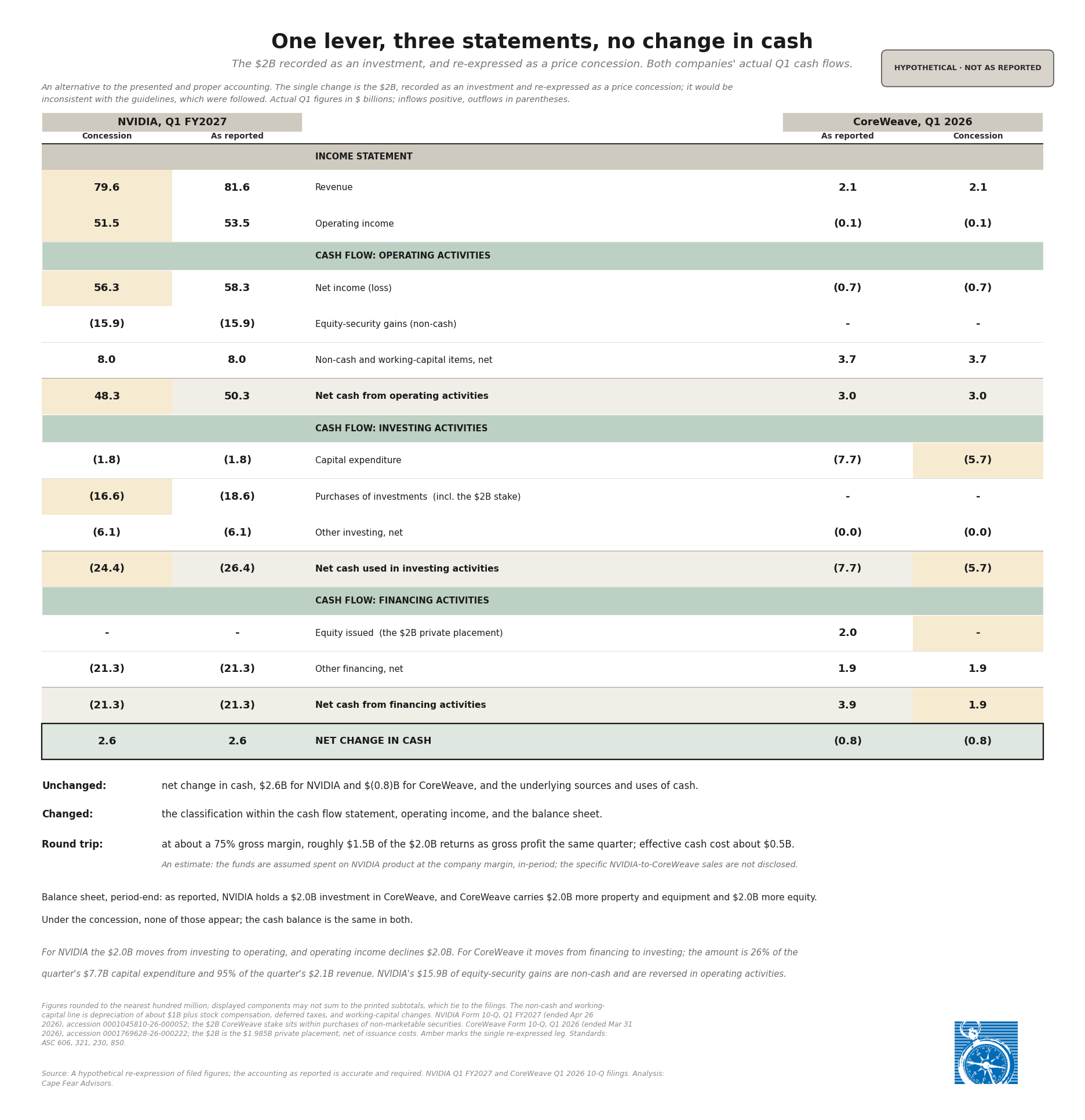
With both companies’ actual first-quarter cash flow statements laid side by side in their three layers, the two billion moves from an investment to a price concession. For NVIDIA it slides from the investing section up into revenue: revenue, operating income, and operating cash flow each fall two billion, while the investing outflow falls by the same two billion. Net change in cash: unchanged, at $2.6 billion. For CoreWeave it slides from financing into a smaller build: no equity is issued, and capital spending is two billion lower. Net change in cash: unchanged, at negative $0.8 billion.
What does not move is the cash, and the sources and uses beneath it. What moves is the classification within the cash flow statement, the operating income, and the balance sheet. As reported, NVIDIA holds a two-billion-dollar investment in CoreWeave, and CoreWeave carries two billion more in property and in equity. Under the concession, none of those appear. The choice of form decides which side of the operating line the two billion lands on: an investment sits below it, where a mark can even lift net income, while a concession sits above it, as a cost. Same dollar, opposite side of the line.
The round trip
The round trip is the second number, and it is sharper. Because CoreWeave spends the money on NVIDIA’s own product, at roughly a seventy-five percent margin, about three-quarters of the two billion, near $1.5 billion, returns to NVIDIA as gross profit in the same quarter. The investment’s effective cash cost is therefore about half a billion dollars, and reported operating income carries about $1.5 billion of gross profit from that funded demand. This is an estimate: the specific NVIDIA sales to CoreWeave are not disclosed, so it rests on the funds being spent on NVIDIA product at about the company margin, within the period. There are two numbers here, not one, and they are the same two billion doing two different things. As the equity deal, the chips are sold and funded: NVIDIA books about one and a half billion of gross profit on them and holds the stake as an asset. As a concession, the same chips are given away: NVIDIA books no revenue and carries their cost of about half a billion, so the exchange subtracts half a billion from gross profit instead. The dollar is identical; the reported gross profit swings the full two billion between the two, from half a billion given up to one and a half billion earned. The two billion is the same thing, and it is not the same thing. Stated that way, it is the circle completed: the funder funds the customer, the customer buys the funder’s high-margin product, and most of the outlay comes home as income the same quarter, while the outlay itself sits on the balance sheet as an asset rather than in the income statement as a cost.
The round trip is the part of this the market has largely reached on its own. The rest of this piece is where the same structure choice travels next, into the segment line, and into the rate a reader takes off it.
The segment
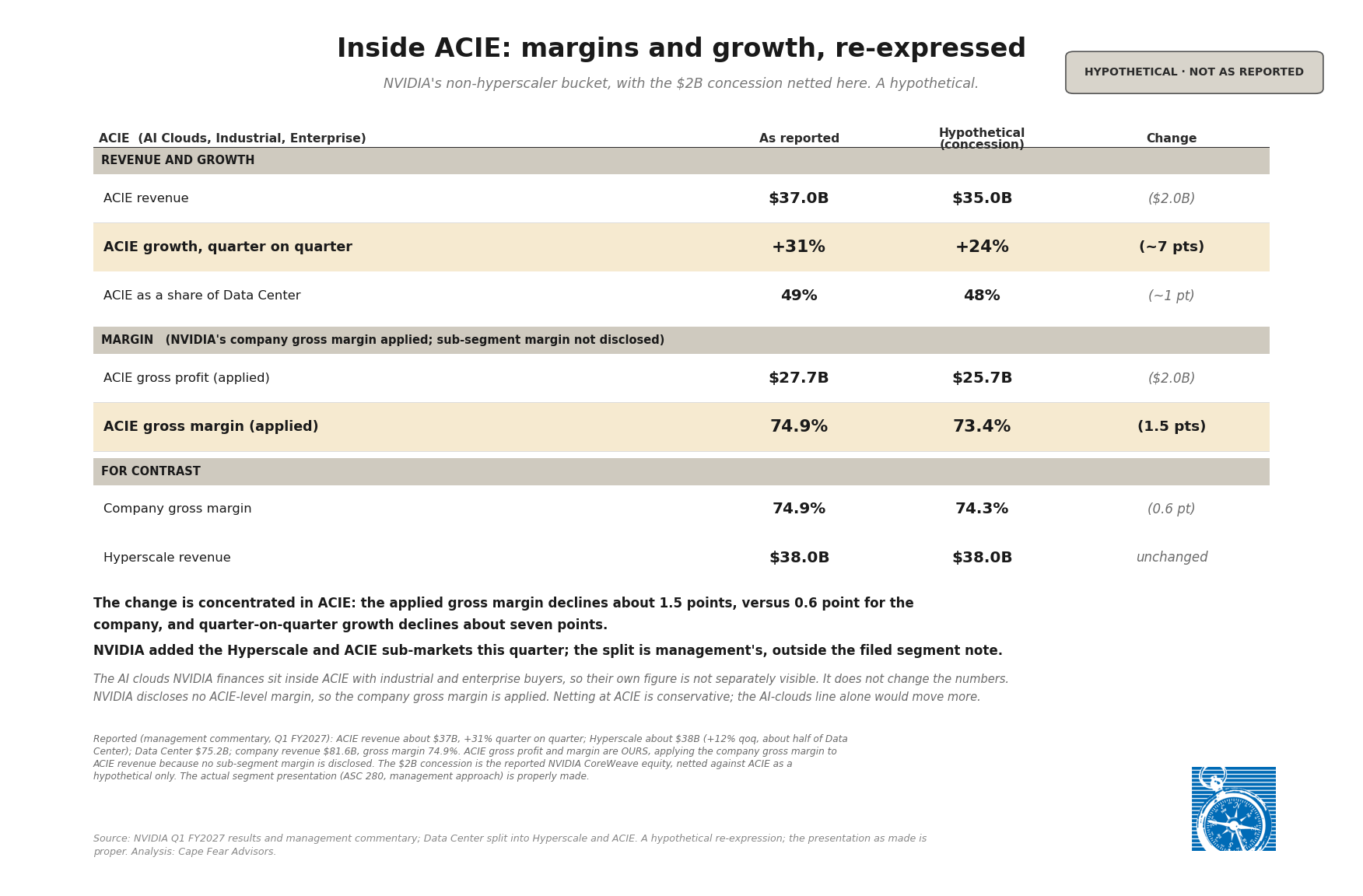
Circular financing at scale does more than move numbers between lines. There is now a place where they sit. With its May results NVIDIA recast how it reports Data Center, splitting the segment into two sub-markets for the first time, and the neocloud builders, the very companies this financing stood up, went into the one called ACIE, for AI Clouds, Industrial, and Enterprise. Management put ACIE at thirty-seven billion dollars for the quarter, up about thirty-one percent from the prior one; the hyperscaler bucket grew twelve percent in the same quarter, so the financed builders sit in the faster-growing half. Netted against that bucket, the concession slows its reported growth to about twenty-four percent quarter on quarter, and its margin, on the company rate applied for want of a disclosed one, eases about a point and a half. The change is immaterial to the company as a whole and concentrated inside the segment.
The split came on the earnings call and in a nine-quarter table posted to NVIDIA’s site, not in the filed segment note, whose reportable segments did not change. The new framework adds detail at the sub-market level, and removes it where it bears on this reading: the AI clouds NVIDIA finances are now folded into ACIE beside industrial and enterprise buyers, so their own figure cannot be read off the page. AI cloud revenue more than tripled year on year, management said, but as an aside, not as a line. It does not change the numbers. It changes what can be counted. That is the quiet cost of the circle growing large enough to name itself: the place where the demand now sits is also the place where the financed part of it is hardest to trace.
The ladder
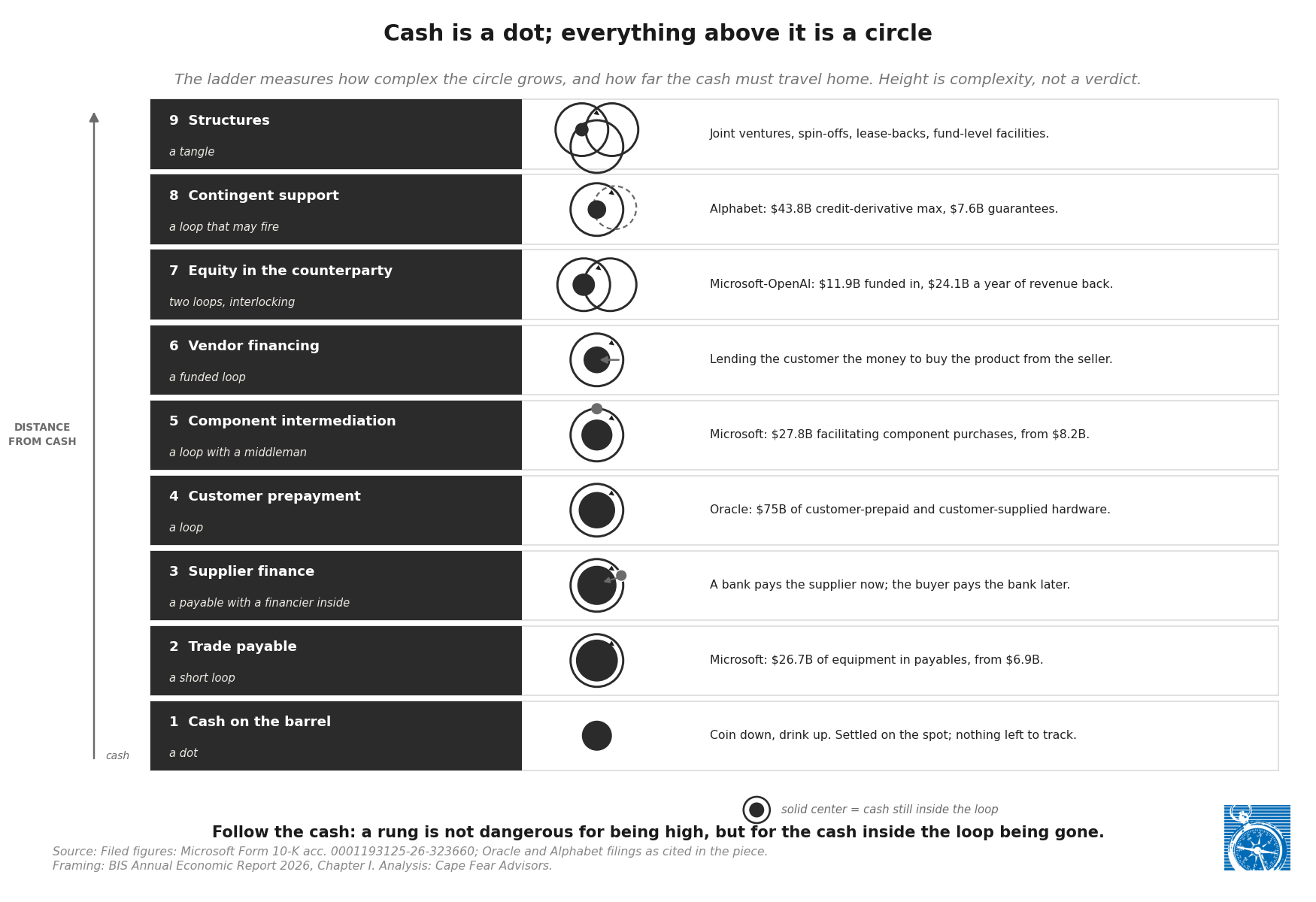
None of these forms is exotic. They are rungs on a ladder that runs from cash on the barrel, the only rung that is not a circle at all, up through trade credit, supplier finance, customer prepayment and component intermediation, vendor lending, equity in the counterparty, contingent support, and finally the wrapped structures at the top. Distance up the ladder is distance the cash must travel to come home. The structures in this relationship sit on named rungs of it: vendor financing at six, the equity stake at seven, the capacity backstop at eight. A price concession is the near-cash bottom, barely a circle. The law of the ladder holds here as everywhere: the cash is the same at every rung; climbing it moves the same support to a greater remove from the income statement, and the danger is not the height but the rung where the cash inside the loop is gone, replaced by the loop’s own paper.
The rung also decides what the buyer is left holding. Equity put cash on CoreWeave’s balance sheet; the price concession at the bottom would have been the same support given as a lower price, and would have left no cash there at all. The seller’s choice of form is, among other things, a choice about whether the buyer holds a reserve or a discount.
And the choice reaches past the current quarter. Bought at a two-billion discount, CoreWeave’s hardware would carry two billion less on the balance sheet, and so about two billion less depreciation across its life, lifting the buyer’s reported income in every period of the hardware’s life. The equity route leaves the asset at full cost and sets two billion of fresh equity beside it. So the seller’s choice of form does not only move the seller’s quarter; it sets the buyer’s reported earnings for years, the longest-lived instance in the exercise.
The second derivative
The reason to read this before the next print is that the choice of rung moves the one figure the careful observer relies on. The three readings, in order. The level is the segment’s revenue, about thirty-seven billion dollars for the quarter. The first derivative is how fast that level is growing, the roughly thirty-one percent quarter on quarter. The second derivative is how that growth rate is itself changing from one quarter to the next, whether the segment is speeding up or slowing down. Those watching for a change in the weather do not watch the level; they watch the second derivative, because that is where a turn shows first.
This exercise moves the first derivative directly. The same two billion, an equity deal rather than a concession, is the difference between the segment printing thirty-one percent and twenty-four percent, a seven-point gap in the growth rate. And because the second derivative is built on the first, the seven points pass straight into it: a quarter that would read as accelerating can read as accelerating faster, or a slowing one as holding, on the structure alone. The level barely moves, about five percent on the segment and immaterial to the company. The signal moves seven points. A reader tracking the turn has first to strip the structure choices out, or the number read was, in part, written by the structure. And the echo returns a quarter later, when the lower base reads as faster growth: the structure moves the signal both ways before it settles.
A reader tracking the turn has first to strip the structure choices out, or the number read was, in part, written by the structure.
What this is
This is a hypothetical, run because the debate around circular financing made it a question to work through on paper, and for no other reason. The accounting and the presentation as filed are, in our view, accurate and required. We change one thing, the form of a single two-billion-dollar arrangement, and we grant that the change would be inconsistent with the guidelines that were followed. We draw no conclusion from it, and we leave the numbers to do the work.
The corners we rounded, stated rather than buried: the $1.5 billion round trip assumes the funds bought NVIDIA product at about the company margin within the period, which is not separately disclosed; the concession’s effect on operating income assumes a price reduction on volume that would have sold anyway; the segment margin is the company rate applied, since none is disclosed at the segment level; and the two-billion figure is measured before tax and against each company’s own totals. None of these changes the finding. No cash moves, and the classification, the operating income, and the balance sheet move with the rung.
Standing disclosure: Cape Fear Advisors holds no direct position, long or short, in the securities discussed here. Any exposure is indirect, through managed funds it does not control, which may now include index funds holding the public companies named, among them NVIDIA and CoreWeave. Anthropic is the developer of Claude, which is used in preparing this research, and Anthropic is also a compute counterparty within the same circle of arrangements read here. That nearness cannot be fully checked away, which is why no claim here rests on trust in the tool: every figure carries a public source, and the record grades the rest. Others named have ties to Anthropic, among them Amazon and Alphabet, its two largest outside backers; and companies not named here may hold positions or supply relationships that bear on the filers discussed, which is why every piece is re-checked for bias, ground facts, and filings rather than read against a fixed list. Figures are quoted from the filers and from named parties without characterization, and the same standard of reading is applied to every party named.
Analysis: Cape Fear Advisors.
This analysis also appears on Substack.
Start a Conversation →Notes
(1) Figures are filed or reported as tagged, and given as ranges rather than points where the underlying figure is an estimate.
(2) The quality-of-cash exhibit is drawn on a near-term basis, cash against each company’s own annual capital program. NVIDIA cash and marketable debt securities are about fifty billion dollars, its marked equity holdings excluded; being fabless, its forward commitment sits mostly in about a hundred and fifty-five billion of purchase commitments, mostly manufacturing, supply, and capacity, a different instrument from capital expenditure. CoreWeave cash is about $2.2 billion; its annualized first-quarter capital spending, near thirty-one billion, sits at the low end of management’s own thirty-one to thirty-five billion guidance for 2026, so the build rate is not an artifact of one quarter. The ratio drawn as one to fourteen is about 13.7.
(3) The two-billion-dollar investment is filed: NVIDIA purchased 22,935,780 CoreWeave Class A shares at $87.20 on January 23, 2026. It sits within NVIDIA’s Q1 FY2027 investing activities, inside the $18.6 billion of purchases of non-marketable securities, and appears in CoreWeave’s Q1 2026 financing activities as a $1.985 billion private placement, net of issuance costs, the fifteen million between the two being issuance costs.
(4) NVIDIA’s gains from equity securities for the quarter were $15.9 billion, net, added back in operating cash flow as a non-cash item. About $13.4 billion of that is the period’s unrealized gain on publicly held positions still held at quarter-end, the figure carried in “The Fourth House”; the balance, about $2.5 billion, is the rest of the period’s equity-security gains. The non-marketable holdings carry $5.3 billion of gross unrealized gains, but that is a cumulative, life-to-date balance, not part of this quarter’s total. The companion figures are the same line read at two levels, not two in tension.
(5) The ladder exhibit is reproduced from our framework piece, “Quality of Cash: Circular Financing and the AI Bubble,” where its per-rung instances are anchored to their filings. Here it stands as the taxonomy; the placement of the structures in this relationship onto rungs six, seven, and eight is made in the text above.
(6) Sources: NVIDIA Form 10-Q, Q1 FY2027 (ended April 26, 2026), accession 0001045810-26-000052. CoreWeave Form 10-Q, Q1 2026 (ended March 31, 2026), accession 0001769628-26-000222. NVIDIA Q1 FY2027 results and segment commentary; NVIDIA and CoreWeave releases on the January 26, 2026 investment. Standards referenced: ASC 606, 321, 230, 280, 450/440, 850. Companion reading: “The Fourth House,” and, on the buyer’s side, “CoreWeave: What Has to Happen Next.”