

Quality of earnings has a long tradition. It asks, of the profit a company reports, how much is backed by cash and how much by accounting. We have been building a companion reading that sits next to it, one layer down. We call it the quality of cash. It asks, of the cash a company records or is credited with, how much is money in the current period, and how much is a claim, a prepayment, a mark, or a balance still deciding what it is. We ran it first on OpenAI, to see what the exercise could show, what it could not, and what questions it would leave us with.
OpenAI, to scale
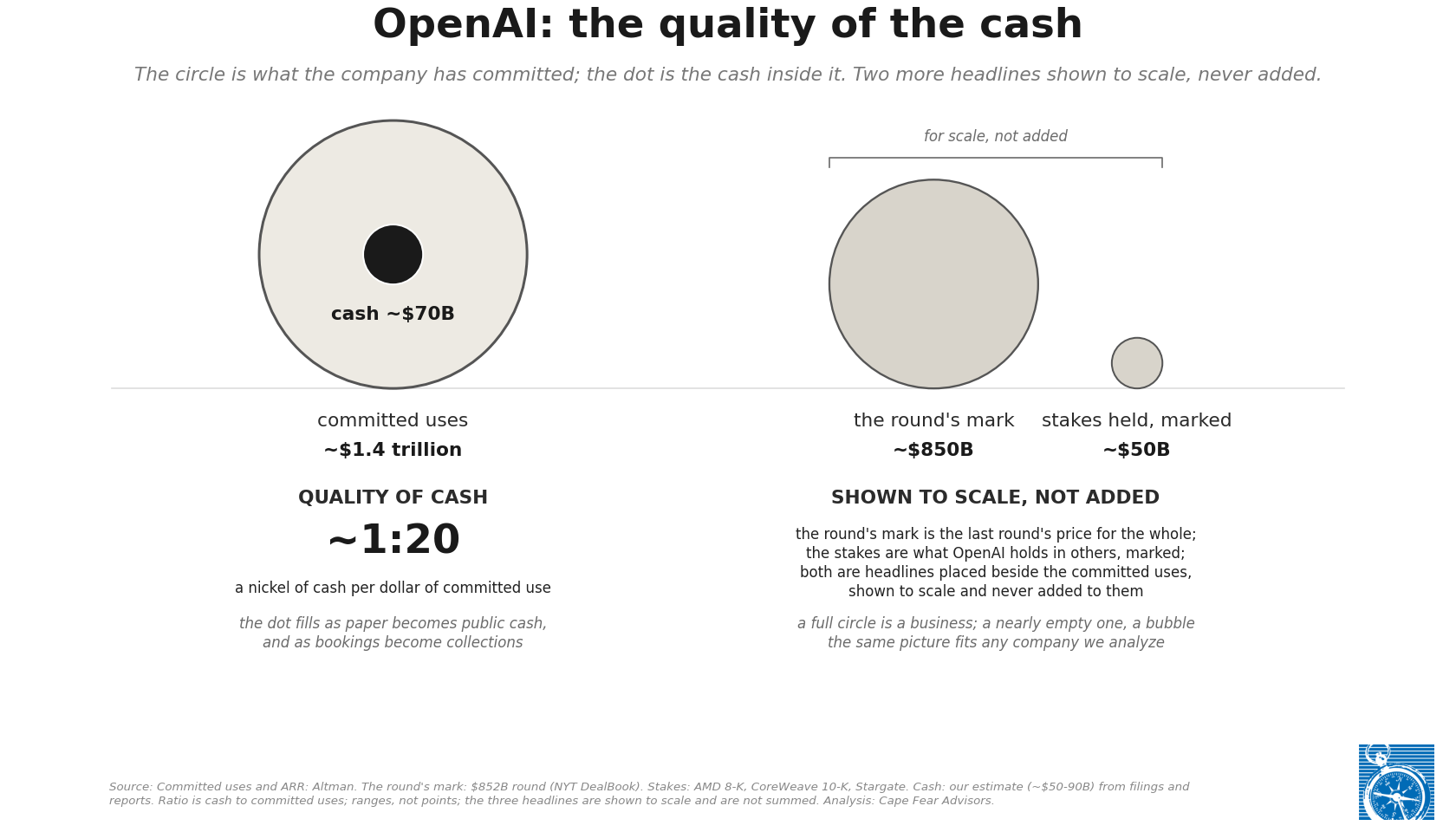
The measure we lead with is a ratio: cash to committed uses. For OpenAI, cash is the money we can see, an estimate in the range of $50 to $90 billion; committed uses are what the company has agreed to spend, about $1.4 trillion as announced. The ratio sits near one to twenty, about a nickel of cash for every dollar committed. On the page the circle is the commitment and the dot at its center is the cash, and the dot looks like a speck, just one twentieth of the circle. Two further headlines sit beside it, the round’s mark of about $852 billion (reported) and the stakes OpenAI holds and carries at a mark, about $50 billion. They are drawn to scale, and they are not added to the commitment, because they are different kinds of number. The picture looks more like a bubble than a donut. What that means is the rest of the work.
How we got there
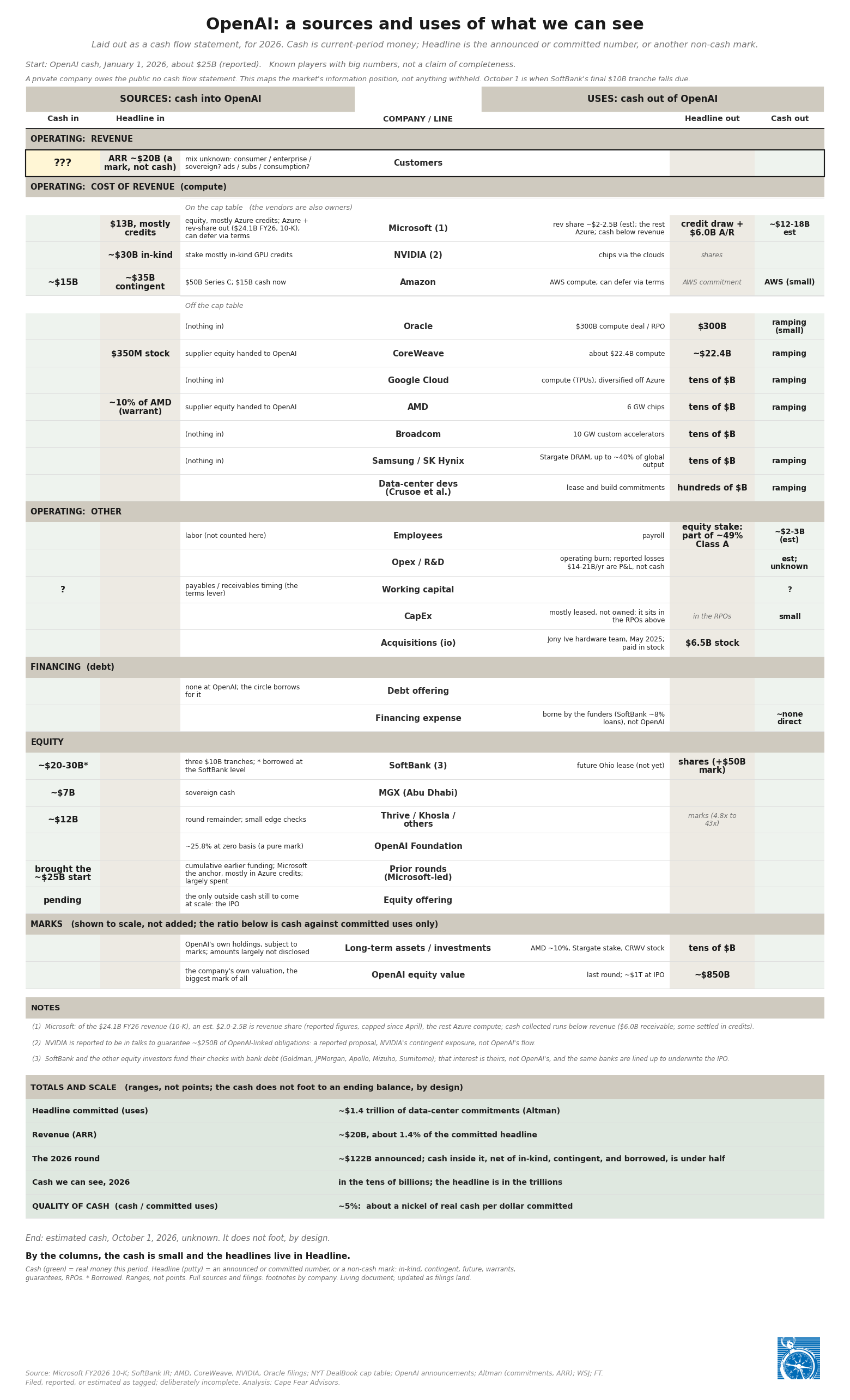
The ratio needs a structure behind it, and we borrowed one that readers already know. We took the shapes of income and cash flow statements and put the cap table down its spine (1), one player to a line, and filled each line from a filed or announced relationship. Where a figure is filed we say filed; where it is announced or reported we say so. Each dollar is counted once. Cash is carried as a range, because OpenAI is private and we can see its cash only through its counterparties and its own statements, so we place the dot at the midpoint. The statement does not foot, by design; the two columns, cash on one side and headline on the other, are the finding.
What the statement shows
The ledger reads by its two columns: cash on one side, headline on the other, and the distance between them is the finding.
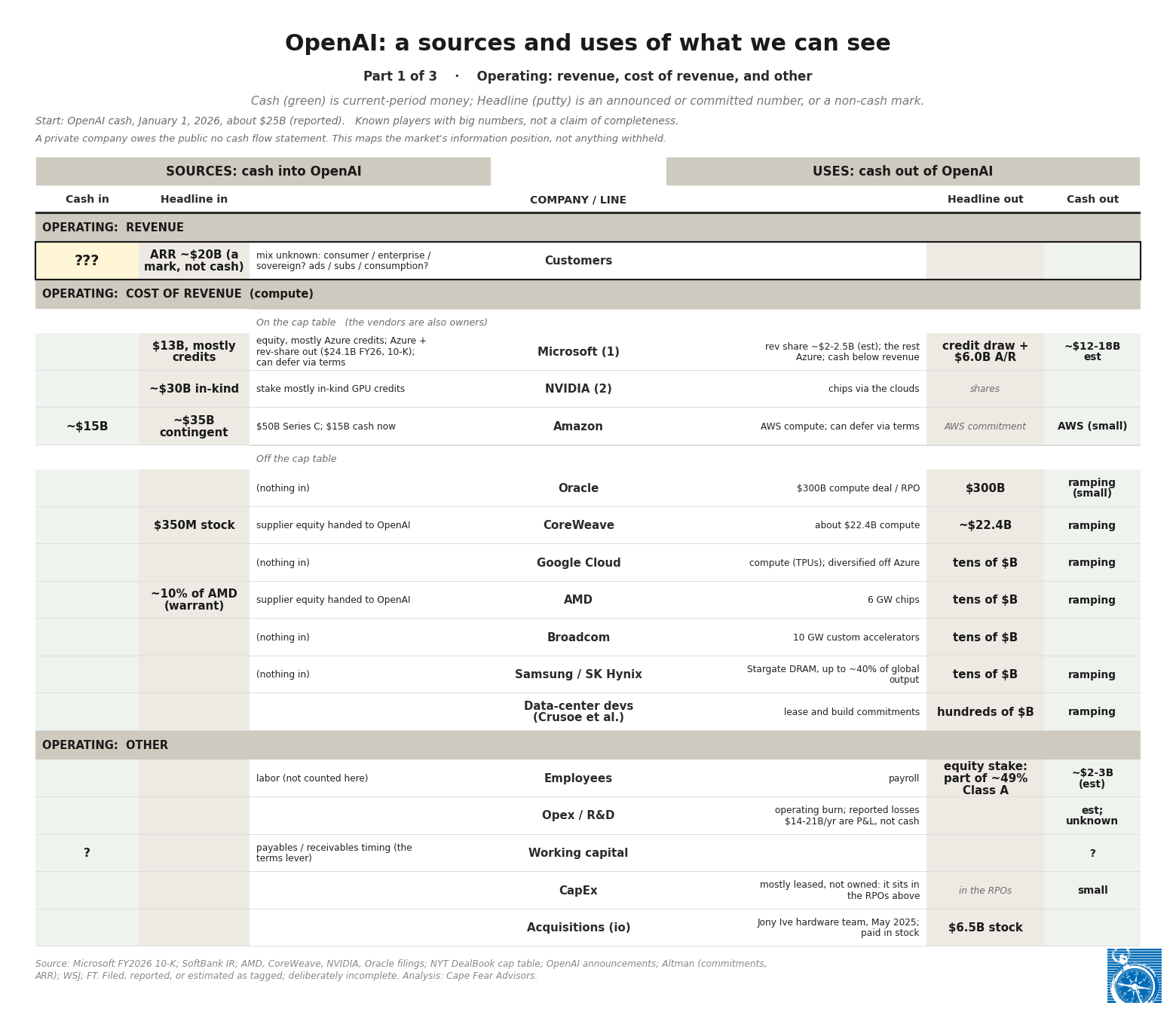
The structure is circular financing, and circular financing is common; money moving in a loop earns no grade by itself. Inside the loop, though, there are full circles, closed relationships where cash that leaves as investment returns as revenue. The picture we lead with borrows a word from those loops. A full circle in the quality of cash shows a business; a full circle of financing shows only the loop, and a loop can turn without value forming inside it. The question the statement is built to answer is where, inside these loops, the cash and the value are made, and where a dollar only passes through, counted again at each stop. We avoid that concern on the loops by taking each commitment once and letting the statement refuse to foot.
The dot is drawn as one substance, but cash has qualities, and we have counted them before: cash owed and waiting on a solvent buyer, cash that needs years of a machine earning before it arrives, cash that holds only while a mark holds its price, and the fee a croupier lifts at settlement while the money is still in motion (The Croupier Counts First). Which quality the build would throw off is the whole of the catch-up question. A nickel today rises toward a dollar only if the cash the commitments produce is the kind that holds, and the machine-dependent kind, the neoclouds’ kind, needs years of earning to become cash at all.
Some of what leaves is hard cash, owed regardless of the loop and paid down the rungs of the stack: payroll, and the overhead that keeps the people working, the office and lab leases, the power that stays on in the research buildings. Part of what reaches OpenAI as cash is itself borrowed, raised by a partner against its own stake, so even the cash is not quite cash. Payment terms in the system can run long, a lever the largest partners hold. And Microsoft is the worked example of the line the whole reading turns on: the transition from compute provided in kind to cash that has to be paid, as credits run down and the bill comes in money. On figures reported by The Information (2), the $24.1 billion Microsoft recorded from OpenAI in its fiscal 2026 (filed) (4) resolves to roughly $2.0 to $2.5 billion of revenue share, capped since April, and the balance Azure compute, and with a $6.0 billion receivable outstanding (filed) and part of the rest settled in prepaid credits, the cash Microsoft collected runs below the revenue it recorded.
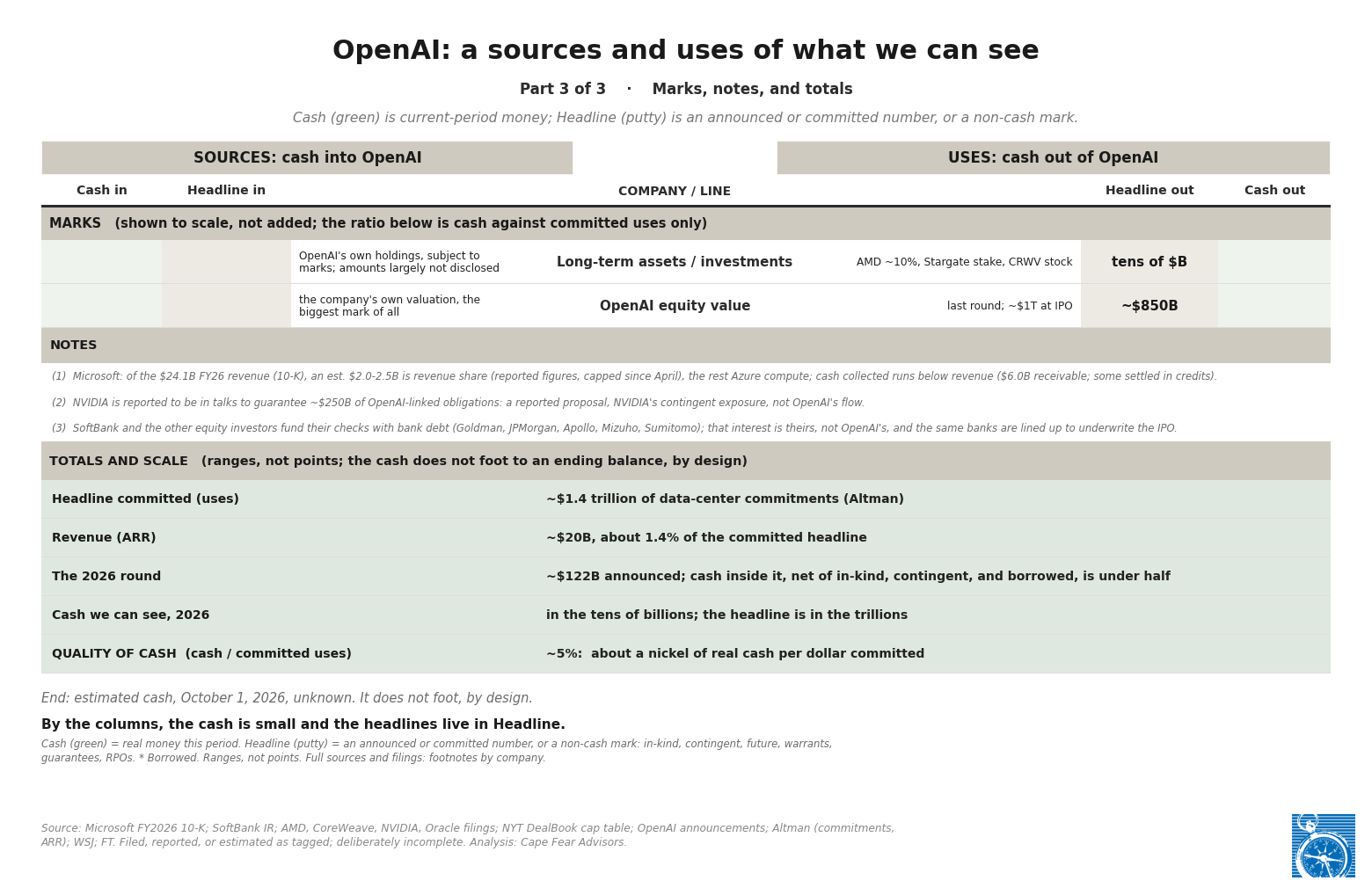
The players themselves show the shape. Microsoft appears twice, as a funder and as a vendor, which is why it is set apart on the statement. The commitment Microsoft did not carry forward now sits with Oracle. NVIDIA appears on three lines at once, as a supplier, as an owner on the cap table, and, as reported, in talks to guarantee about $250 billion behind a partner’s build. CoreWeave is the pure play whose customers are the labs themselves, Microsoft among them, so its cash in is the circle. A handful of names, Microsoft, Oracle, NVIDIA, SoftBank, and CoreWeave, carry most of both columns, which is why the cap table works as the spine. Most of what comes in is not cash either, the announced round weighted toward marks, in-kind contributions, and guarantees, with a thin slice of real money.
What it leaves open
The first open question is revenue: whether it arrives to fill the dot. Reported annual recurring revenue is a small figure against the commitment, and the dot can fill in two ways, from a public listing that turns paper into cash, with a figure near $1 trillion reported for an eventual offering, or from a revenue ramp that turns bookings into collections. The statement shows the gap and the doors out; it does not say which one opens.
The financing lines carry their own questions. Microsoft’s transition is the largest: how much real cash OpenAI needs as compute credits run down, and how much of that Microsoft still extends through terms. SoftBank’s cash comes with a string, borrowed against the OpenAI stake, so the question is not only how much reaches the company but whose money it is if the mark falls and the loan is called. Oracle’s question is whether it has taken on more than it can hold, carrying a large capital program on negative free cash flow, at a rating one notch above high yield, both reported (9), while it books the commitment Microsoft passed on.
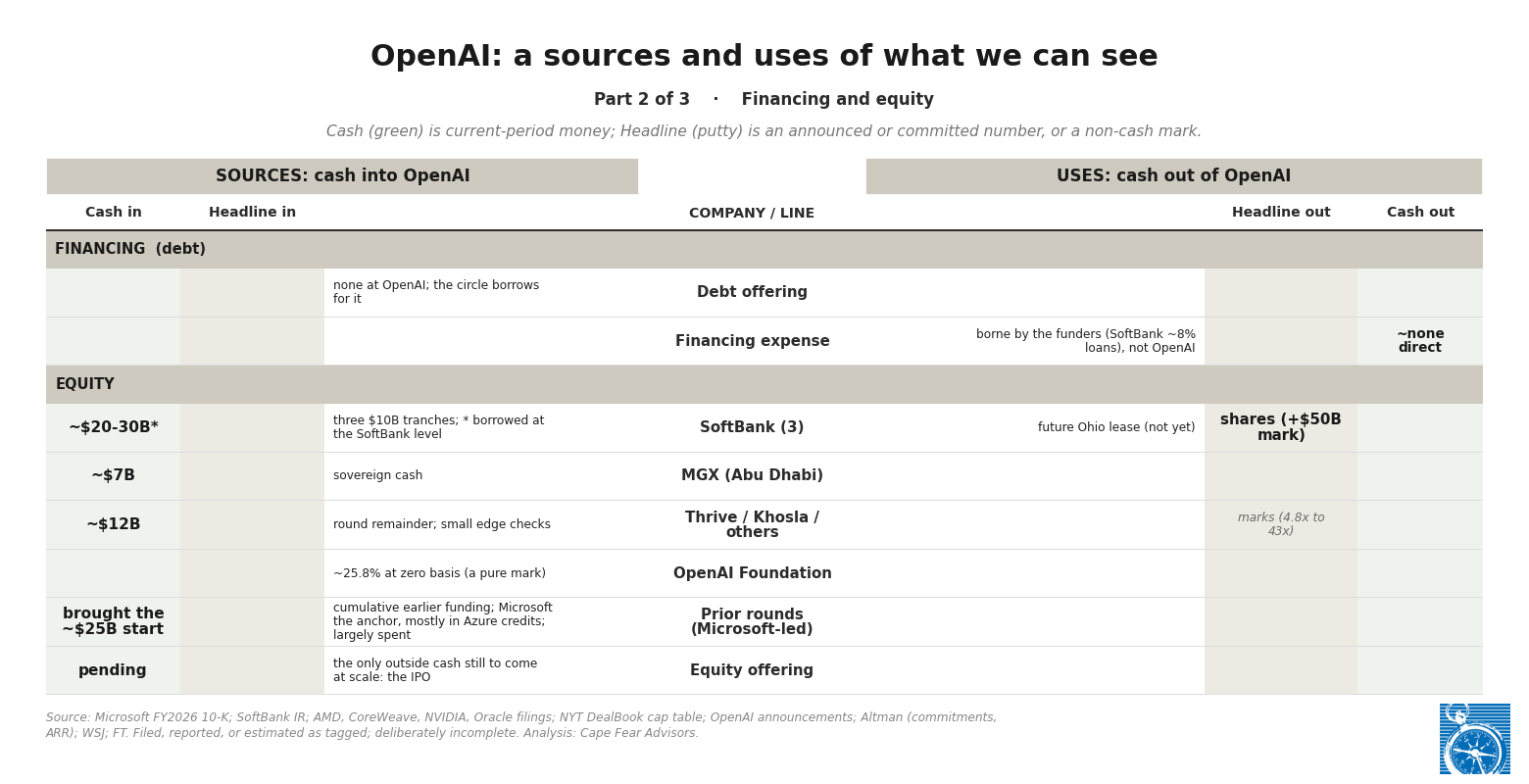
The last question is who rides on the marks. OpenAI’s valuation sits as an asset on other balance sheets, held by funds, by a partner under the equity method, and by employees, and a compression of the round’s mark travels to each of them. Beneath that sits the structure question, the Foundation and the for-profit arrangement, which decides who is owed first if the marks give way. We sit in that circle too: our work relies on assistance from Anthropic, one of the parties in it, and we do not think it possible to use an AI platform fully outside the circle and unbiased by participation, so we run the work forward and backward, looking for mistakes or possible bias.
A donut and a bubble
A single reading is a number without a scale, so we ran the same ratio on a company at the other end of the picture.
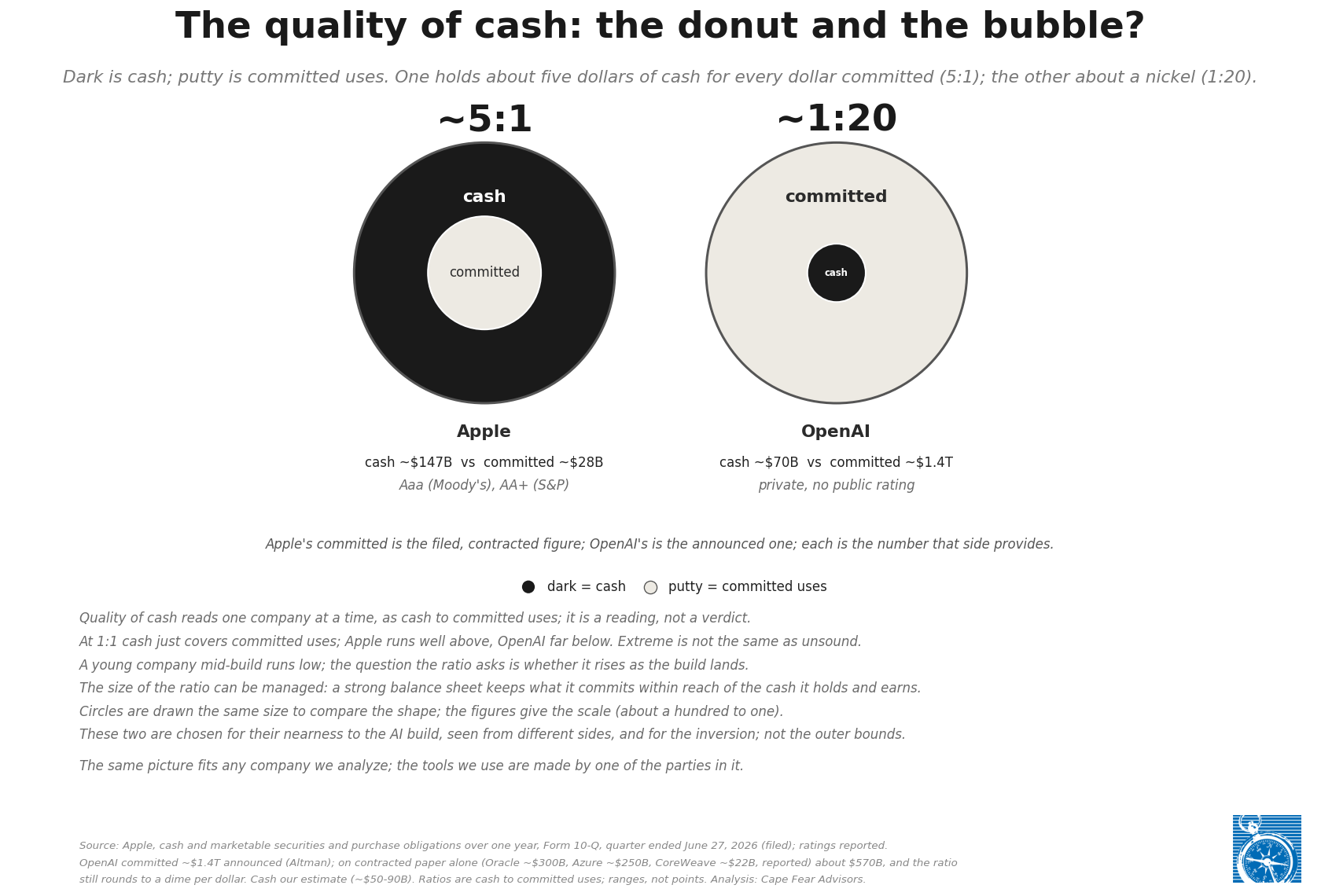
Apple holds about five dollars of cash for every dollar it has committed, a ratio near five to one. Its cash is the body of the circle and its commitment a small hole: a donut. OpenAI is the inversion, its commitment the shell and its cash just a speck floating in space: a bubble. Dark is cash and putty is committed uses in both, so only the proportion flips. The two committed figures differ in kind, and we say so: Apple’s is filed and contracted, from its Form 10-Q for the quarter ended June 27, 2026 (3); OpenAI’s is announced. Scored on contracted paper alone, on the Oracle cloud agreement of about $300 billion, the Azure purchase commitment of about $250 billion, and the CoreWeave contract of about $22 billion, all reported, OpenAI’s commitment falls to roughly $570 billion and the ratio rises to about twelve cents per dollar, a dime by rounding, on a contract list that is not complete. The distance between the two survives the change of basis.
We did not pick these two because they are the outer bounds. They sit near the center of the AI discussion, seen from two sides, and the comparison makes both of the questions people are already asking legible at once. A reader who looks at OpenAI and says bubble is easy to understand; so is a reader who looks at Apple, a company with quality of cash to spend and little build of its own, and asks what its AI plan is. Extreme is not the same as unsound. A company mid-build runs a low ratio as a matter of course, and the reading asks less whether the number is small now than whether it rises as the build lands. A low ratio does not settle the matter on its own, though, because losses re-sharpen the point: a profitable company mid-build would let its own earnings catch the cash up, while OpenAI’s reported losses, on the order of $14 to $21 billion a year, keep the point sharp.
Whether to run it again
This is not a market call. We take no view on the shares, and nothing here signals a decision to buy or sell. It is a tool for reading a company through its cash and its connections: where the money comes from, where it is owed, and where it would have to arrive for the picture to fill. A map of the circle names the players; this reads what runs between them, and it holds the number as a dial rather than a headline, one that can be checked again next quarter. The two doors, a public listing and a revenue ramp, are where a change would show first.
What would move the reading is specific. The dot rises if the offering lands and real cash comes in, or if a revenue ramp collects at a margin that clears the cost of the capital already committed. It does not rise on another announcement, another mark, or another commitment, however large. Those are the conditions we watch for, and their absence is a reading too.
Taken that way, a bubble becomes a question asked of one company at a time, in the place where the cash either arrives or does not. The prototype leaves a question about itself, whether the reading is useful enough to run across the ecosystem, and our hypothesis is that it is: a single ratio, taken on a common basis and watched over time, stratifies the players by how much of what they have committed their cash can reach, and by whether that reach is widening or narrowing as the build proceeds. So the next readings are the ones more likely in the middle of the spectrum, or new edge cases to bring in. Companies in transition tend to land in the middle as well, their dependencies and business models already diverging from what they were even six months ago, and Oracle, a software company becoming an infrastructure one, is the case we mean. We will take the same picture to them, on the same basis, and watch it move.
Related, on the Quality of Cash shelf: The Croupier Counts First; The $235 Billion Cash Gap; CoreWeave: What Has To Happen Next; CoreWeave, Twenty-Seven Years.
Standing disclosure: Cape Fear Advisors holds no direct position, long or short, in the securities discussed here. Any exposure is indirect, through managed funds it does not control, which may now include index funds holding the public companies named. Anthropic is the developer of Claude, which is used in preparing this research, and Anthropic is also a counterparty inside the circle read here. That nearness cannot be fully checked away, which is why no claim here rests on trust in the tool: every figure carries a public source, and the record grades the rest. Others named have ties to Anthropic, among them Amazon and Alphabet, its two largest outside backers and rows on this ledger; and companies not named here may hold positions or supply relationships that bear on the filers discussed, which is why every piece is re-checked for bias, ground facts, and filings rather than read against a fixed list. Figures are quoted from the filers and from named parties without characterization, and the same standard of reading is applied to every party named.
The full ledger
Analysis: Cape Fear Advisors.
This analysis also appears on Substack.
Start a Conversation →Notes
Figures are filed or reported as tagged, and given as ranges rather than points.
(1) The cap table and the roster of counterparties are drawn from OpenAI’s cap table as reported from leaked materials (NYT DealBook; The Information). A private company files no cap table; this is the market’s information position, not a claim of completeness.
(2) OpenAI revenue used for the revenue-share estimate is reported by The Information, reproduced with the inference and revenue-share figures at Where’s Your Ed At; first-quarter 2026 revenue about $5.7 billion. The arrangement changed in October 2025 and again in April 2026, when Microsoft stopped paying OpenAI its share while OpenAI continued paying Microsoft, subject to a cap (CNBC); the effective date is not disclosed, and the agreement, if filed after an offering, is likely to be heavily redacted. The $2.0 to $2.5 billion is our recalculation, on a June-fiscal-year basis, of about a fifth of a revenue-share-eligible base; the balance of the $24.1 billion is Azure compute.
(3) Apple cash and marketable securities about $147 billion and purchase obligations over one year about $28 billion, from Apple’s Form 10-Q for the quarter ended June 27, 2026 (filed; SEC EDGAR accession 0000320193-26-000020); credit ratings reported (Aaa, Moody’s; AA+, S&P). Apple’s twelve-month component-supply obligations are working capital, excluded from the multi-year committed figure; adding even a large within-year supply number leaves the ratio comfortably above one to one.
(4) Microsoft’s $24.1 billion of fiscal 2026 revenue from OpenAI and the $6.0 billion receivable are filed (Form 10-K, fiscal year ended June 30, 2026; SEC EDGAR accession 0001193125-26-323660), which also records $13.0 billion of funding commitments, $11.9 billion funded. The disclosure and the surrounding accounting changes are examined in Olga Usvyatsky and Francine McKenna, “Microsoft’s 2026 Annual Report: What’s going on with all the accounting changes?” (The Dig).
(5) OpenAI committed uses about $1.4 trillion and annual recurring revenue about $20 billion, stated by Sam Altman on November 6, 2025 (CNBC; TechCrunch); annual losses about $14 to $21 billion, reported. The round’s mark about $852 billion follows the roughly $122 billion round reported ahead of an offering (reported); an eventual offering near $1 trillion, reported.
(6) Contracted commitments used in the change of basis: the Oracle cloud agreement about $300 billion and the CoreWeave contract about $22 billion, reported; the Azure purchase commitment about $250 billion, reported at the October 2025 recapitalization and not itself in Microsoft’s 10-K. NVIDIA is reported to be in talks to guarantee about $250 billion of OpenAI-linked data-center obligations (reported), separate from its announced staged investment and ten-gigawatt systems partnership.
(7) OpenAI cash about $50 to $90 billion is our estimate, built from disclosed and reported funding net of in-kind, contingent, and borrowed components, with the dot placed at the midpoint.
(8) Dated tests ahead, as of writing: NVIDIA’s next quarterly filing in late August, CoreWeave’s print on August 11, SoftBank’s October tranche, and Microsoft’s next quarter. The reading updates as each lands.
(9) Oracle free cash flow negative about $23.7 billion in fiscal 2026, and a BBB- rating, one notch above high yield (S&P Global Ratings, July 9, 2026); reported, from Oracle’s fiscal 2026 results and the S&P action.
Sources are public filings and named reported coverage; the figures re-derive from them.
Analysis: Cape Fear Advisors.