


Five beliefs, and the first carries the other four
Some prospective investors are reported at $16 billion to $19 billion; Nscale is reported to hope for about $30 billion; the FT has reported a target of up to $35 billion.(1) [REPORTED] The last filed price for the equity is the Series C, at $20.39 a share in March 2026.(2) [FILED]
Those prices have to believe five things:
- The contracted book gets delivered: built, powered and accepted on the contracts' dates.
- Financing follows delivery.
- The cash cost of running it stays at or below 30 percent of revenue.
- Something comes after the book: Monarch fills, the fleet earns a second life, or both.
- The returns reach the ordinary holder.
Delivery is the condition for the other four, so the work starts there.
A contracted book, mostly still to build
At August 31 Nscale had 1,370 MW of IT capacity under contract across 17 sites, and 55 MW of it online and earning revenue.(2) [FILED] That leaves 1,315 MW to build, three in four of it on sites Nscale owns.(3) [OURS on FILED] The contracts total $103.4 billion. Microsoft holds more than half the capacity, in Portugal, Texas, Norway and the UK; Anthropic holds a third, all of it at Monarch in West Virginia.(2)(3) [FILED; OURS]
The reverse DCF values the contracted book first. At a 10 percent discount rate and a cash cost of 30 percent of revenue, the book comes to about $8.6 billion. Read after the offering, with the convertible notes and about $3 billion of IPO proceeds in net cash, $16 billion is that book delivered.(3) [OURS on FILED and REPORTED]
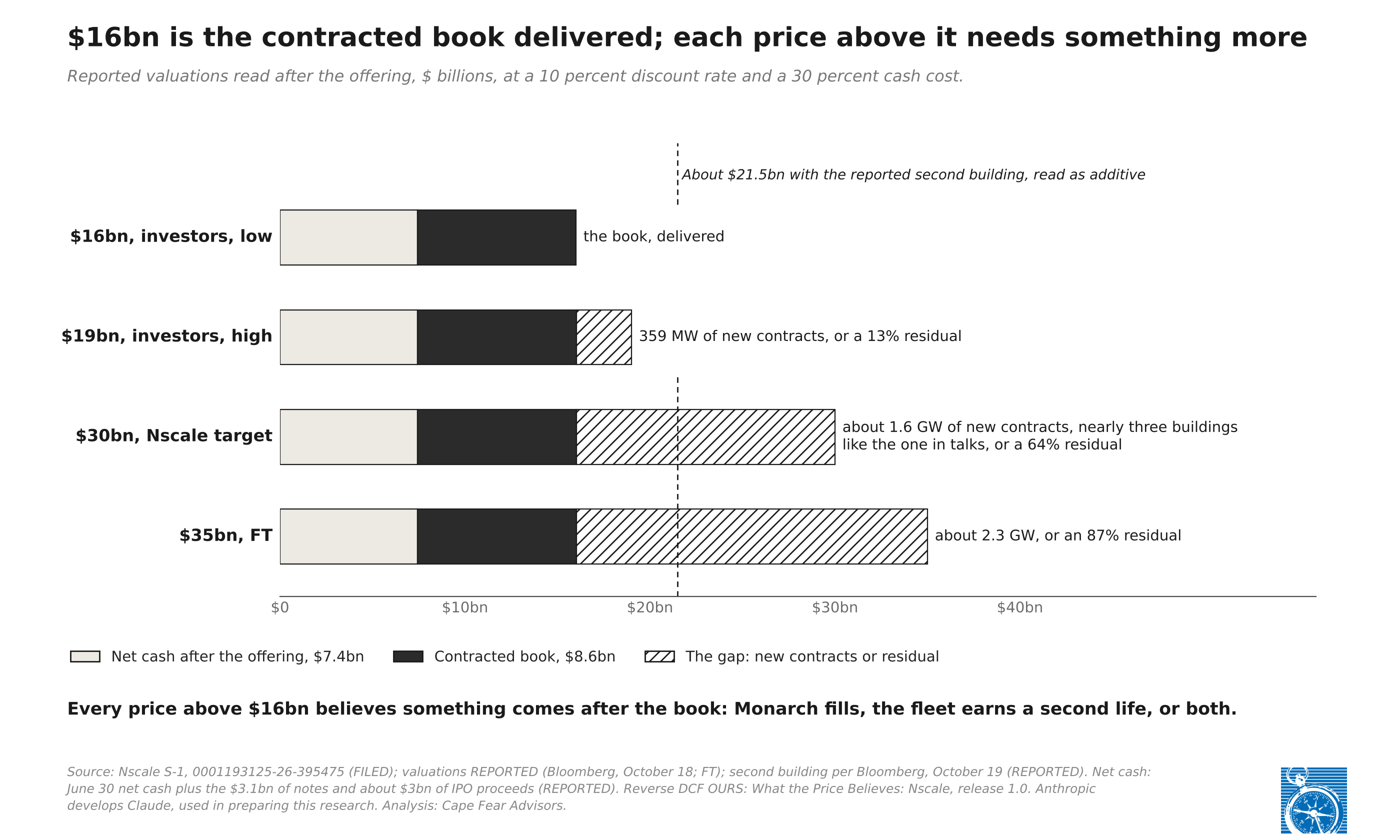
Every price above $16 billion needs something beyond the book. At $19 billion it is 359 MW of new contracts on the book's average terms. At $30 billion it is about 1.6 GW, or a residual value of about 64 percent of build cost in 2034, or a mix of the two.(3) [OURS] That $16 billion lands on the book delivered is a fit at one setting: at a 25 percent cost the same price needs only 78 percent of the book delivered, and at a 12 percent discount rate it needs about 240 MW more.
Delivery: a late tranche costs its fees and its refund
The contracts set the cost of a late site. A Microsoft tranche not accepted within 60 days can be ended, with a refund of its upfront payment as "the sole remedy." An Anthropic tranche can be ended if financing is not in place by the Longstop Date, with no further obligation on either side. Fees start on acceptance.(4) [FILED]
The weekend's news sits inside that structure. Microsoft's reported exit from the 50 MW Loughton site is 3.6 percent of capacity and about $0.5 billion of the book's value: about as much as a year's delay at Monarch, and under a third of two points on the discount rate.(3)(5) [REPORTED; OURS] A late site defers its fees and its capex together, under the S-1's plan to "defer, reduce or cancel" capital spending if financing is not obtained.(2) [FILED]
Financing follows delivery, and one input carries it
To the end of 2027, before Monarch, Nscale's committed uses are about $27.9 billion. Cash and arranged facilities, the notes and NVIDIA's purchase cover $11.1 billion. The rest rests on customer cash still to come: $19.2 billion, 63 percent of the sources, if every remaining prepayment arrives at delivery.(3) [OURS on FILED] On those terms the plan carries about $2.4 billion to spare, and it holds while nearly 88 percent of the remaining prepayments arrive on time.
The prepayment is the one input that decides this section. The S-1 states a weighted-average prepayment of "23% of our active and contracted TCV."(2) [FILED] Anthropic's orders carry no prepayment term, so if the 23 percent is weighted over all contract value, the rest of the book prepays 40.4 percent.(3) [OURS on FILED] That sits beside Microsoft's roughly 40 percent upfront to Nebius and above its 20 percent to IREN, and CoreWeave's filed 15 to 25 percent.(6) [REPORTED; FURNISHED; FILED] Over the non-Anthropic book alone, the 23 percent leaves customer cash still to come of about $9.0 billion, and the $2.4 billion surplus becomes a need of about $7.9 billion.(3) [OURS] The filing leaves the reading open, and the difference is about $10.3 billion.
Monarch borrows on its own. Its financing is special-purpose debt benchmarked to Anthropic's credit, with no binding commitments at the filing, and either side may end an order if it is not in place by the Longstop Date.(4) [FILED]
Cost: 30 percent sits against the company
The base charges 30 percent of revenue as cash cost; the company's case is 25 percent. Applied to Nscale's sites, CoreWeave's filed cost per megawatt gives 15 to 17 percent of contract revenue.(3)(7) [OURS on FILED] The base stays at 30 because that cross-check is borrowed, Monarch generates its own power at a price the filing leaves out, and Nscale's own first half of 2026 ran $189.6 million of cost of revenue on $140.6 million of revenue, in the ramp.(2) [FILED] The 30 percent base binds only if contract revenue falls to about $6.8 million per megawatt a year, below CoreWeave's $8.24 million today.(3) [OURS]
What comes after the book, and whose demand it is
Above $16 billion, every price is a bet on Monarch, on the fleet's second life, or on both, and the two are substitutes in the arithmetic: the same gap paid two ways. CoreWeave's own market value implies its fleet sells at 0.76 to 1.37 times cost new at the end of 2032; Nscale at $30 billion needs 64 percent of build cost back in 2034, on a different fleet.(3)(7) [OURS]
On October 19 Bloomberg reported Nscale in talks with Anthropic on about $45 billion for a second Monarch building of 460 MW, which could be finalized within days, with Anthropic holding first refusal on a third.(8) [REPORTED] Read as additive to the filed contract, which the report does not state, and on the first building's terms, it adds about $5.5 billion of value, and the book then supports about $21.5 billion.(3) [OURS] At $30 billion it takes nearly three such buildings, one a year; at the company's 25 percent cost, it and one more.
The building raises the odds the capacity is billed, and it raises the amount to finance before it is: about $16.5 billion of capex on terms with no prepayment, while the first building's financing has no binding commitments.(3)(4) [OURS; FILED] With it, about half of Nscale's capacity rests on Anthropic's demand. The growth case for Nscale is then Anthropic's growth case, and a reader who holds one holds the other.
The holders beside the public
Returns reach the ordinary holder after three things the S-1 sets out. Aker holds $2.5 billion of economic interest in an intermediate holding company, to be "collapsed... immediately prior to this offering" on exchange terms the S-1 does not state. NVIDIA, which has committed $2.18 billion of equity, its November purchase included, and guaranteed a Texas lease, holds default warrants that stay outstanding after the listing. And $3.1 billion of notes convert at the offering. The founder's option hurdles, at $5 billion, $10 billion and $20 billion of market value, sit below the $30 billion target.(2)(3) [FILED; OURS] At listing the vote is one per share.
Same customer, same supplier, the money in a different order
Against CoreWeave the customer and the supplier are the same; the order of the money differs. CoreWeave borrowed first, with nearly 90 percent of its debt recourse to the parent, and leases its sites; Nscale was prepaid first, had $137 million of debt drawn at June 30, and owns most of its sites.(2)(7) [FILED] CoreWeave's price waits on the second contract. Nscale's waits on the first delivery, and on Monarch filling.
Since the filing
The month since the S-1 has been read as a cooling, and the record supports that reading line by line without settling it. Firmus withdrew its ASX listing; CoreWeave and Nebius each fell 24 percent in five sessions; NEXTDC halted trading over a delayed power supply at its Melbourne site; Fermi paid $25 million to remove a 400 MW lease covenant from its Texas campus loan, and its 8-K is silent on the loan's February 2027 project financing test.(5)(9) [REPORTED; FILED] Read together, the lines can be taken as a trend; read singly, each is one site or one deal. Nscale's S-1 named the power, permit and community risks before these reports, and its contracts price a late site in advance.
What would change the reading
Each item is a document with a date.
- The S-1/A: a price range, the Aker exchange terms, and any restatement for Loughton. It is the filing most likely to move every figure here at once.
- The second Monarch building, signed and filed, with its term, prepayment and Longstop Date.
- Anthropic's own public filing, reported for about October 26, which puts the demand behind the fourth belief on the record.
- Monarch's Qualifying Financing committed, or the Longstop Date reached without it.
- Nscale's first 10-Q as a public company, with a cash cost ratio on revenue.
- The NVIDIA purchase closing, around November 16.
The work behind this summary
This piece is the summary. Behind it sits What the Price Believes: Nscale, the second in the series from Cape Fear Advisors that reads what the market prices of AI infrastructure companies imply, against the filed record. CoreWeave was the first.
The work has three parts:
- A 22-page deck in belief order: delivery, financing, cost, what comes after the book, and the holders, with the record since the filing, a rate-and-cost grid that gives every price's need across twelve discount and cost settings, the second building as a switch, and a page that maps each belief to the document that settles it.
- The workbook behind it. The 17 filed sites, the hub map, uses and sources, the two books, the participant ledger and the reverse DCF, with every assumption a labeled switch and every figure tagged. Thirteen checks tie it to the S-1 and to its own switches.
- A one-page note on what changed in each edition, and why.
Nscale's next refresh follows the S-1/A. CoreWeave's follows its Q3 10-Q.
The filings shelf here stays free, as it has been. What the Price Believes is a separate, paid product for readers who want to run the numbers themselves. It is $100 a month or $1,000 a year for one named reader, cancelable at any time, and the current edition arrives by email the same business day. It is available at capefearadvisors.com/research.
Research, not investment advice. This piece and the work it introduces are general analysis of public filings and reported valuations, prepared without regard to any reader's circumstances. It names no price. Each reader owns the decisions made with it. Full terms on the offering page.
Standing Disclosure
Cape Fear Advisors and its principal hold no position in the securities discussed, other than any held through broad index or pooled funds over which they exercise no control. Anthropic is the developer of Claude, which is used in preparing this research; Anthropic is one of Nscale's two largest contracted customers, and is reported in talks on a second building. Microsoft, the other, announced an investment in Anthropic in November 2025. The same standard of reading is applied to every filer named.
Notes
[1] Bloomberg, October 18, 2026 (investors at $16 billion to $19 billion; Nscale hoping for about $30 billion); Financial Times, September 2026 (up to $35 billion). REPORTED.
[2] Nscale S-1, September 18, 2026, 0001193125-26-395475: Business, Facilities and the capacity chart (1,370 MW contracted, 55 MW active, August 31), MD&A (23 percent weighted-average prepayment; H1 2026 revenue and cost of revenue; the plan to "defer, reduce or cancel" capex and the going-concern assessment), Related Party Transactions, Executive Compensation, Description of Certain Indebtedness. FILED.
[3] Cape Fear Advisors, What the Price Believes: Nscale, release 1.0, October 20, 2026, and its workbook. Base: 10 percent discount rate, 30 percent cash cost; reported valuations read as equity after the offering, with net cash of $7,441 million including the $3.1 billion of notes and about $3 billion of IPO proceeds (REPORTED). Revenue per new megawatt is undelivered contract value over the 1,315 MW to deliver over the filed 5.7-year term. Needs floored; cash and value rounded up. The second building is read as additive and inside Monarch's first phase, from 2029, on a 5.7-year term: OURS. Construction OURS on the filed inputs in notes 2 and 4.
[4] Nscale S-1, Exhibit 10.19 (Microsoft statements of work: upfront payment per tranche; refund as the sole remedy for a tranche not accepted within 60 days) and Exhibit 10.25 (Anthropic order form: no prepayment term; fees after acceptance; Qualifying Financing benchmarked to Anthropic's credit; the financing-out at the Longstop Date). FILED.
[5] Financial Times and The Telegraph, October 18, 2026 (Loughton); FT, October 2026 (CoreWeave and Nebius, October 13 to 17); CNBC and Bloomberg, October 9 (Firmus); NEXTDC request for trading halt to ASX, October 19 (AEDT). REPORTED.
[6] Nebius annual report, April 30, 2026, as reported (about $6.96 billion of upfront payments on $17.4 billion); IREN 8-K Exhibit 99.1, November 3, 2025 (FURNISHED); CoreWeave Q2 2026 10-Q, 0001769628-26-000366, MD&A (FILED).
[7] Cape Fear Advisors, What the Price Believes: Nscale, release 1.0, October 17, 2026: cost per megawatt and revenue per megawatt from CoreWeave's Q2 2026 10-Q (OURS on FILED); the fleet price its market value implies, published as 0.76 to 1.37 times cost new; debt and recourse from Note 10 (FILED).
[8] Bloomberg, October 19, 2026, 4:02 p.m. EDT, citing people familiar with the negotiations; Nscale and Anthropic declined to comment. REPORTED.
[9] Fermi Inc. 8-K, October 16, 2026, 0001213900-26-109980 (the amendment and the $25 million of fees), and 8-K, February 10, 2026, 0001213900-26-014270, Exhibit 10.1, section 7.15 (failure to close a 400 MW project financing by the first anniversary is an event of default). FILED. Absence probe, 15:07 UTC October 20: the October 16 8-K text has no hit for "Project Financing," "February 10, 2027," "7.15" or "Event of Default," and its filing index carries no exhibit; Fermi has filed nothing since.
Nscale's EDGAR docket, CIK 2110365, checked at 15:07 UTC (11:07 a.m. Eastern) on October 20, 2026: the S-1 of September 18, preceded by the public DRS and three DRS/As; no amendment since the S-1.
Analysis: Cape Fear Advisors.
This piece also appears on Substack. Cape Fear Advisors is an independent advisory firm based in Portsmouth, NH.
Contact Cape Fear Advisors