


A price is a set of beliefs about the future, held all at once. This piece reads CoreWeave’s equity and credit prices back into the beliefs they require, then tests each one against the filed record through June 30, 2026 and the financings through October 17. In the base state, cash reaches the Class A holder only after 2032, and only with capital not yet arranged, which is the sense in which the equity is a call on the fleet’s second life. This is the summary of a longer piece of work, introduced at the end.
Six beliefs, and the first carries the other five
At the October 16 close of $61.39, CoreWeave’s equity carried a market value of about $33.9 billion.(1) [OURS on REPORTED] Its four dollar senior notes traded at yields of 14.81 to 15.30 percent, against coupons of 9.00 to 9.75 percent at issue.(2) [OURS on REPORTED]
Those two prices, read together, have to believe six things:
- The company finds the cash to stay liquid through the run-off of its backlog.
- Each new claim on the business can still be sold.
- The fleet keeps its value after the first contracts end.
- The operating metrics improve.
- The next contract reprices at or above the first.
- The returns reach the Class A holder.
The first belief is the condition for the other five, so the work starts there.
Delivering the backlog needs cash in 2027
At June 30 CoreWeave reported $103.7 billion of remaining performance obligations, its contracted backlog.(3) [FILED] The run-off is the business that delivers it: finish the build, serve the contracts, pay the debt as it falls due, and stop at the backlog. Growth past it is a separate test.
Finishing the build takes about $23 billion more, on the fleet’s own record of capital in service against revenue.(4) [OURS on FILED] Against that, the company holds cash and $10.0 billion of facility availability at June 30: most of it delayed-draw loans tied to named contracts, the rest a revolver.(3) [FILED]
Every default in the construction, the build and the filed loan term aside, sits in the company’s favor where a choice exists: committed loans drawn in full, the revolver counted as extended through 2032, two delayed-draw loans whose draw periods have ended counted as still available, shortfalls carried with no interest, and an operating cost in the second half of 2026 below any quarter on record.(4) [OURS]
On those settings the run-off needs $4.5 billion beyond cash, committed loans and the revolver by the end of 2027. [OURS on FILED] On management’s own cost and loan terms, with a $20.5 billion build, the figure is $1.3 billion. In a harder case, with a three-month delivery delay, dearer loans and no revolver, it is $20.2 billion.(4) [OURS]
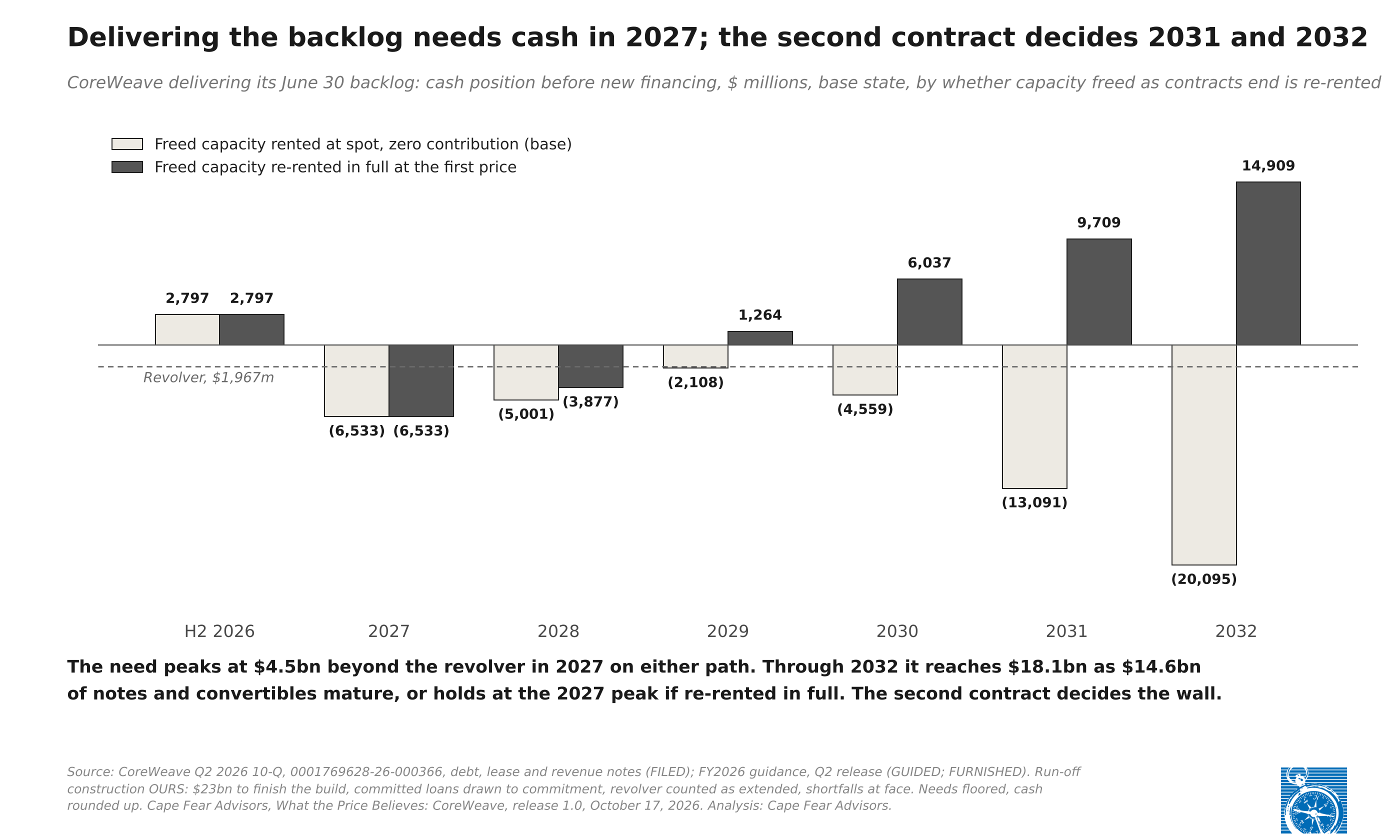
The 2027 figure is the same on both paths in the exhibit: it arrives before the backlog runs down. Management’s liquidity statement covers the year from the filing of the June quarter’s report, to about August 2027.(3) [FILED] The two readings meet at the edge of that window.
The at-the-market program funds the cash position
On September 17 CoreWeave registered 35 million Class A shares for sale at the market, on a day the stock closed at $79.88.(5) [FILED] The company said it expected to agree to no sales until at least 30 days after the convertible purchase agreement it priced the same day, which puts the first sales on October 19.(5) [FILED] The stated uses run from repaying debt and operating expenses to capital expenditures.(6) [FILED]
All 35 million shares at the October 16 close would raise about $2.1 billion gross: nearly half the base need for 2027, and all of the need on management’s terms.(4) [OURS] The build to finish and the contracts are the same with or without the program. It is cash for the gap, and its size depends on a share price that has fallen 23 percent since the day it was announced. [OURS on REPORTED]
The wall in 2031 and 2032
The backlog runs down from mid-2030, to about $8 billion of revenue a year.(4) [OURS on FILED] Signed leases run about twelve years.(3) [FILED] In 2031 and 2032, $14.6 billion of notes and convertibles mature.(3) [FILED]
Paid in cash, those maturities take the need to $18.1 billion through 2032. Refinanced, with the notes at their October 16 yield and the convertibles at anywhere from their 2.875 percent coupon to the same 14.81 percent, the need through 2032 is $4.8 billion to $5.3 billion.(4) [OURS]
The bonds price that question directly. At October 16 block trades, three of the four dollar notes sat at or past 1,000 basis points over Treasuries. At the 10 to 30 percent recovery implied by S&P’s recovery rating, those spreads imply a 33 to 56 percent risk-neutral chance of default by maturity.(2) [OURS on REPORTED] Spreads carry risk, liquidity and call premiums as well, so real-world odds sit lower: this is what the price implies. The parent stands behind nearly 90 percent of the debt and receives about 20 cents of each dollar earned inside its financing vehicles.(3)(7) [FILED; REPORTED]
Their frame and ours
Management’s own illustration of a five-year contract, in its March 2026 investor presentation, leaves 16 of every 100 dollars of revenue to the parent, at a 25 percent cost ratio and an 80 percent loan at 6.5 percent.(8) [REPORTED; GUIDED] At the company’s Q2 direct cash cost of 35.8 percent and the terms of its most recent filed loan, the same contract leaves about 4.(4) [OURS on FILED]
Through 2030 the two frames sit within about $2.7 billion of each other. After 2030 they part, on one question: whether cost leaves with the contract, as a revenue ratio assumes, or stays with the lease, which runs about twelve years. On management’s cost frame the need through 2032 is $1.9 billion to $4.7 billion, depending on when the 30 percent target is reached. On ours, $18.1 billion.(4) [OURS]
The second contract decides it
The price is a bet on the fleet’s second life. Solved directly, the market value implies a fleet selling at the end of 2032 for 0.76 to 1.37 times its cost new, depending on the return the equity is assumed to earn.(4) [OURS] That is 4.2 to 7.5 years of the fleet’s peak operating earnings.
Volume decides the wall. If the capacity freed as contracts end is re-rented in full, at any renewal price from 50 to 125 percent of the first, the need through 2032 stays at the 2027 peak, and from about 60 percent the wall clears beyond the revolver.(4) [OURS] Price decides the equity.
Microsoft is the clearest read on that second contract. It was the top customer behind the first contracts, 67 percent of CoreWeave’s 2025 revenue.(9) [FILED] Since then it has contracted with at least four other neoclouds, among them Nebius on five-year terms with about $7.0 billion upfront, IREN on five-year terms with 20 percent prepaid, and Nscale for up to $43.8 billion through December 2033.(10) [FURNISHED; REPORTED; FILED] The supply side runs the other way: ASML expects 2027 and 2028 supply to fall short of demand, which is the case in which the second contract holds its price.(11) [FURNISHED]
What would change the reading
Each item is a document with a date.
- At-the-market sales from October 19: how many shares, at what price. Sales appear after the fact, in periodic reports.
- The Q3 10-Q, in November: the cash cost ratio against 41.3 percent, capex and power against guidance, the liquidity statement, and whether the two delayed-draw loans were drawn. If both lapsed undrawn, the 2027 need rises to about $6.2 billion.
- A financing that arranges the 2027 need, and what it costs the Class A holder.
- The 2031 and 2032 maturities refinanced, and at what price.
- Renewal prices on comparable cohorts from 2027, and where Microsoft places its renewals.
The full calendar and the sensitivity of the headline to each construction choice are in the work introduced below.
The work behind this summary
This piece is the summary. Behind it sits What the Price Believes: CoreWeave, the first in a new series from Cape Fear Advisors that reads what the market prices of AI infrastructure companies imply, against the filed record.
The work has three parts:
- A 35-page deck in five acts: the two businesses inside one company, the cash in every state, the parent and the price, management’s frame beside ours, and the residual value, with an appendix that sizes every construction choice against the headline, one setting at a time.
- The workbook behind it. Every assumption is a labeled switch, every default is stated, and every figure carries its source and its tag. The state moves between bull, base and bear, any input can be changed, and the run-off, the debt service, the refinancing and the fleet price the market implies all recalculate. The filed ties are built in as checks.
- A one-page note on what changed in each edition, and why.
Each company is refreshed after its filings. CoreWeave’s next refresh follows the Q3 10-Q. Nscale is next, at its offering pricing; IREN and Nebius are candidates.
The filings shelf here stays free, as it has been. What the Price Believes is a separate, paid product for readers who want to run the numbers themselves: the desk analyst, the credit reader, the allocator who wants the construction as well as the conclusion. It is $100 a month or $1,000 a year for one named reader, cancelable at any time, and the current edition arrives by email the same business day. It is available at capefearadvisors.com/research.
Research, not investment advice. This piece and the work it introduces are general analysis of public filings and market prices, prepared without regard to any reader’s circumstances. Each reader owns the decisions made with it. Full terms on the offering page.
Standing Disclosure
Cape Fear Advisors and its principal hold no position in the securities discussed, other than any held through broad index or pooled funds over which they exercise no control. Anthropic is the developer of Claude, which is used in preparing this research; CoreWeave announced a multi-year agreement with Anthropic in April 2026. Microsoft, named here, announced an investment in Anthropic in November 2025. The same standard of reading is applied to every filer named.
Notes
[1] Close of $61.39 on October 16, 2026 (Yahoo Finance, REPORTED); shares outstanding at July 31, 551,536,602, from the Q2 2026 10-Q cover (0001769628-26-000366, FILED). Market value OURS.
[2] FINRA TRACE, median $1 million-plus block trades on October 16, 2026 (REPORTED); U.S. Treasury par curve (REPORTED); spreads, yields and default probabilities OURS. Hazard = spread / (1 − recovery); cumulative = 1 − exp(−hazard × years). Recovery of 10 to 30 percent follows S&P’s recovery rating of 5 (REPORTED). Ratings: Moody’s B1, S&P B (REPORTED).
[3] CoreWeave Q2 2026 10-Q, 0001769628-26-000366: Note 2 (remaining performance obligations), Note 10 (debt, maturities and liquidity), the lease note, and MD&A (liquidity statement). FILED.
[4] Cape Fear Advisors, What the Price Believes: CoreWeave, release 1.0, October 17, 2026, and its workbook. Base state unless stated. Construction OURS on the filed inputs in notes 3, 5 and 6; needs floored and cash rounded up, in the company’s favor, except the $23 billion build, which rounds the fleet ratio’s $22.8 billion against it, and the filed 4.66-year loan term, against five years. Management’s terms: cash operating cost to 30 percent of revenue by 2028, an 80 percent advance at 6.5 percent over five years, an eight-year life and freed capacity re-rented in full, on a $20.5 billion build. The harder case adds a three-month delivery delay from 2027, drops delayed-draw loan 5.0, prices facilities at SOFR plus 25 basis points plus 5.50 percent over three years, drops the revolver, holds $1 billion of minimum cash and renews at 70 percent. Fleet price at 0, 9.75 and 14.81 percent compounding on the market value.
[5] CoreWeave 8-K, 0001769628-26-000429 (at-the-market program and the expected standstill; the convertible purchase agreement is unfiled); 8-K 0001769628-26-000432 ($79.88 close on September 17; the 2.875 percent convertible due 2033). FILED.
[6] CoreWeave 424B5, September 17, 2026, 0001628280-26-062362, use of proceeds. FILED.
[7] Financial Times, interview with Brian McBee, co-founder and Chief Development Officer, October 14, 2026 (REPORTED), for the 20 cents. Recourse to the parent from Note 10 of the Q2 10-Q and the delayed-draw loan 5.5 guarantee, 8-K 0001769628-26-000357 (FILED); 89.5 percent of June 30 principal, OURS on FILED.
[8] CoreWeave March 2026 investor presentation, page 6, company website. REPORTED; GUIDED. The presentation describes its figures as illustrative.
[9] CoreWeave 10-K for fiscal 2025. FILED.
[10] Nebius 6-K, 0001104659-25-088312 (FURNISHED), with the upfront payments as reported; IREN 8-K Exhibit 99.1, November 3, 2025 (FURNISHED); Nscale S-1, September 18, 2026, 0001193125-26-395475 (FILED), statements of work with Microsoft of up to $43.8 billion, a ceiling. Microsoft’s contracts with other neoclouds, including Lambda, as reported by Bloomberg, October 2, 2025 (REPORTED).
[11] ASML Q3 2026 6-K, 0001628280-26-065813. FURNISHED.
CoreWeave’s EDGAR docket, CIK 1769628, checked at 13:11 UTC (9:11 a.m. Eastern) on October 18, 2026: the latest filings are insiders’ Forms 4 of October 14 and Forms 144 of October 13, and nothing after September 22 beyond insider forms.
Analysis: Cape Fear Advisors.
This piece also appears on Substack. Cape Fear Advisors is an independent advisory firm based in Portsmouth, NH.
Contact Cape Fear Advisors