

The fiber laid for the dot-com boom still carries traffic, for owners who bought it after the companies that laid it failed, and the railroads’ track did the same a century before. The AI buildout is now the size of telecom in 2000. Whether it outruns its demand is open, and we leave it open on purpose; we take no position on any company’s valuation. What the record answers is the next question: if the build does outrun its demand, who ends up holding it.
What 2000 left in the ground
In 2002, one estimate put 95 percent of the fiber laid in the late 1990s unlit.[1] The fiber stayed in the ground, and the companies that laid it changed hands. Global Crossing went into bankruptcy carrying about $11 billion of debt and preferred stock, and came out in December 2003 with ST Telemedia holding 61.5 percent for $250 million.[2] Level 3 bought WilTel, the former Williams Communications network, in 2005.[3] The fiber went on carrying traffic, in time far more of it, for owners who paid a fraction of what had been borrowed to lay it.
The railroads ran the same course a century earlier, at more than twice the scale. The lines with traffic, the trunk lines with shippers and earnings, competed with lines built ahead of traffic on borrowed money. The West Shore opened beside the New York Central in 1884 and was in receivership by the spring of 1885; that year, under an agreement brokered by J. P. Morgan, the New York Central took it on lease.[4] After the panic of 1893, Union Pacific’s line from Omaha to Ogden was sold in foreclosure for $110 million to a group that included E. H. Harriman.[5] The track ran throughout. The cars were financed apart from it, through equipment trusts in which the lender held title, and a road in receivership would generally keep up its equipment payments “when it can pay no other fixed charges.”[6]
The cast carries over, loosely, with one turn of its own. In this build the rails are the powered sites, the land, the grid connection and the shell, and the rolling stock is the chips. The neoclouds had lines laid, sites powered and chips running, when the lines with traffic needed more track, and the lines with traffic came to them: in 2025 Microsoft was CoreWeave’s top customer, at about 67 percent of its revenue, and in the second quarter of 2026 its largest customer, unnamed in the quarterly report, was still 36 percent.[7] So a neocloud runs on borrowed traffic. It borrows against contracts with customers that have the traffic: CoreWeave reports $103.7 billion of remaining performance obligations, and its newest facility lends five-year money against three-year contracts, on equipment it depreciates over six years.[8] That contract is the new piece: a bridge carrying the lenders’ money from the companies with demand to the companies that borrowed to build, with a price that resets at renewal. The hyperscalers are the lines with traffic, and they can lay rails of their own and build their own rolling stock, down to their own chips. A line with traffic that builds its own track can leave a leased line built and idle. Whether that happens here is what the renewals will show.
In Bridge Work we described a cooling: the money still moving this autumn, at a higher price and with more conditions attached. Whether it portends a cold front is open. If it does, the record says what follows: the asset outlasts the financing above it, and it goes to whoever has cash when the seller has to sell. Who that will be is partly settled now, in how the build is financed, and that is what the rest of this piece reads.
As large as telecom, and a different kind from housing
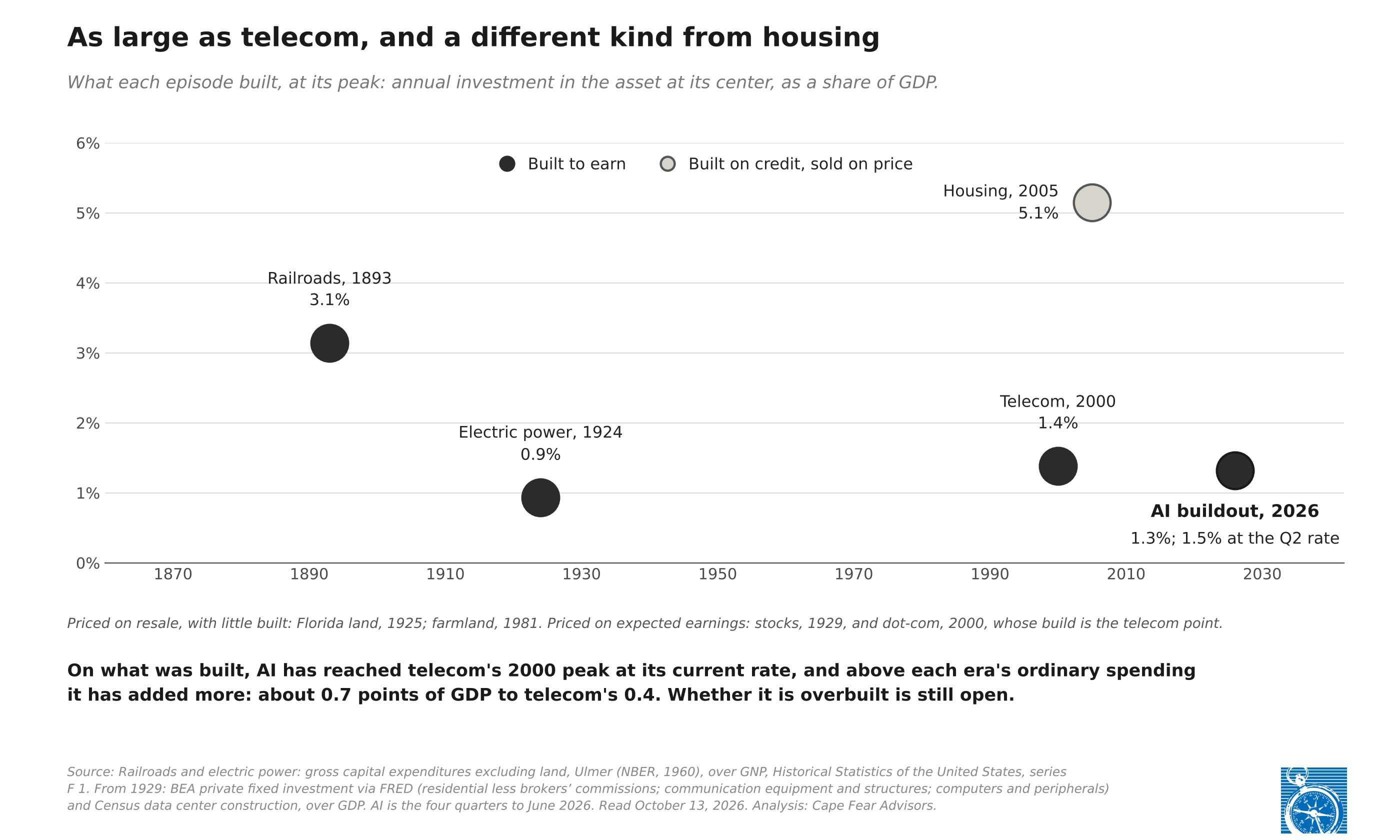
On what each episode built, the AI buildout sits beside telecom. Investment in computers and data centers ran at 1.3 percent of GDP over the four quarters to June 2026, and at 1.5 percent at the second quarter’s annual rate.[9] Telecom’s build in 2000 was 1.4 percent.[10] The railroads in 1893 were 3.1 percent of GNP, and electric power in 1924 0.9 percent.[11] Above each era’s ordinary spending, AI has added more than telecom did: about 0.7 points of GDP, against 0.4.[9][10]
Housing in 2005 was 5.1 percent, and it belongs to a different family.[12] A house bought on credit in 2005 was financed against what the next buyer would pay; a railroad, a fiber route or a data center is financed against what it earns.[13] That is where both popular comparisons slip. Dot-com stocks were priced on expected earnings, and what that boom built is the telecom point on the chart. Housing was built on credit and sold on price, and AI is built to earn.
The chart counts what was spent, the smaller and firmer number. We have shown that the commitments behind the larger plans are disclosed, in footnotes and exhibits, and that much of what is announced is gated: a cancellation right on 90 days’ notice, a capacity commitment that “may be reduced,” a facility that funds only against delivered equipment.[14] An announced trillion is a ceiling on the build, and the spent figure is its measure. Overbuilding in this family is capitalism doing its ordinary work: each decision to build is rational on its own, and the total can run ahead of demand.
The structure fails, the plant runs
The plants held up in electric power too. Samuel Insull’s holding companies, stacked above operating utilities across the Midwest, went into receivership in 1932 while the generating plants kept serving customers.[15] Congress answered with the Public Utility Holding Company Act of 1935, and the operating companies carried on under it.[16] The structure failed, the plant ran, and the new rules were written for the structure.
The same course has already been run inside this build’s own cast. Iris Energy, now IREN, financed bitcoin miners through non-recourse vehicles that borrowed from NYDIG. When the bitcoin price fell, two vehicles defaulted in November 2022 and a receiver was appointed in February 2023; days later the parent used its own supplier prepayments to buy the next generation of miners. In August 2023 the court approved the receiver’s sale of the old machines, and about 1,500 more still on order, to the lender. They went as mining equipment, through a stalking-horse sale open to higher bids that the court found commercially reasonable: a sale process set the price, and the owner changed.[17] The lender’s attempt to reach the parent ended in a settlement in 2025.[18] The parent kept its sites and became an AI cloud. CoreWeave began as an Ethereum miner in 2017, and its turn to AI compute is the version where the timing favored the asset holder.[19]
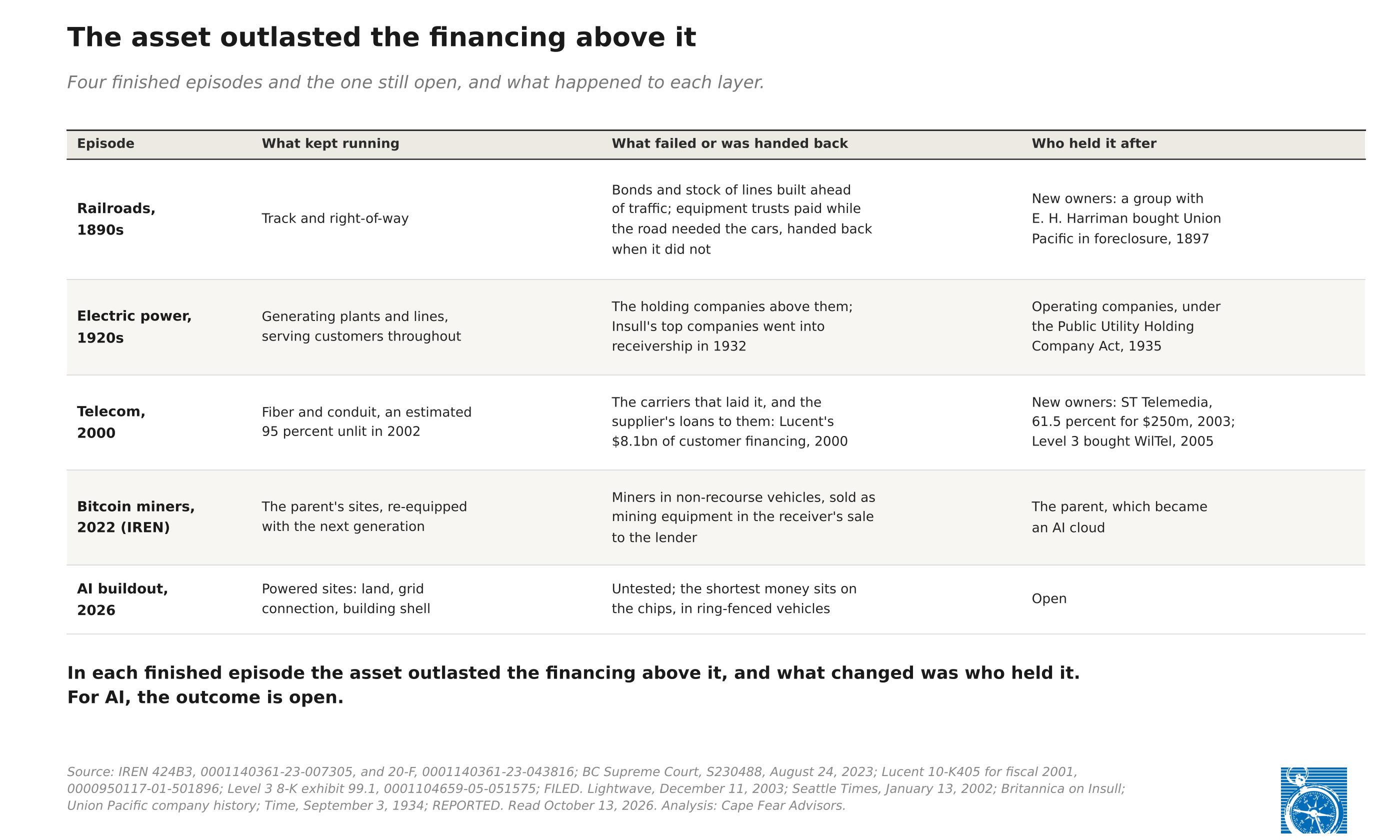
In each finished episode the asset outlasted the financing above it, and the buyers were whoever had cash when the sellers had to sell. Each ended in new owners, new rules, or both. We name that pattern and leave its application to AI open.
Who stands where on the bridge
Position is observable, and outcome is open. Bridge Work put it plainly: a company with the cash to wait crosses the bridge on its own schedule, and the bridge matters most to the ones that need cash before the far end.
The lines with traffic fund the build from their own cash. Over the trailing four quarters, Microsoft generated $67.0 billion of operating cash flow beyond its capital spending, Alphabet $53.3 billion and Meta $41.0 billion, about $161 billion among the three; Amazon’s spending ran $11.6 billion ahead of its operating cash flow, on a net basis.[20] Depth is no guarantee of judgment, and Western Union was the deep incumbent when the telephone arrived.[21] Depth is what lets a buyer wait for the seller who has to sell.
Oracle is the edge of this system, as we put it in What the $40 Billion Would Rest On. It carries $664 billion of remaining performance obligations and has put its balance sheet behind meeting them: capital spending $28.7 billion ahead of operating cash flow, funded with debt; a 2056 bond trading about 90 basis points wider over Treasuries than in February; and a BBB- rating from S&P since July 9.[22] OpenAI’s share of the backlog has been reported at about half, by S&P among others. The word “OpenAI” appears in Oracle’s quarterly report zero times, and Oracle named OpenAI among the customers it was raising money for in February: named when raising money, pooled in the document that reports results.[23] Lenders in this build have set a threshold for counterparty quality in a filed covenant: CoreWeave’s counts contracted revenue from an investment-grade counterparty at 100 cents on the dollar and from any other at 75, and BBB- is the lowest grade that counts in full.[24] The covenant reaches CoreWeave’s own counterparties; what it shows beyond them is where the threshold sits, and Oracle, at BBB-, stands at it: one notch down, a customer of its grade moves from 100 cents to 75. On October 8 the Financial Times reported that OpenAI had told investors its annualized revenue was approaching $50 billion at the end of September, against about $70 billion circulated a few weeks earlier; the stated cause was a definition, how sales through cloud partners are counted. Oracle’s shares fell about 6 percent that day.[25] Its credit held: the 2056 notes stood at about 275 basis points over Treasuries on October 7 and again on October 8.[22] No contract changed and no filing moved. We read the move as the price doing its job, with the equity, which prices the upside, marking down its view of the customer behind about half the backlog, and the bonds, which price the risk of default, holding still. The “about half” is S&P’s July estimate, against a $638 billion backlog, as reported. A reader who takes Oracle as the edge case reads the record as we do: a $664 billion backlog, about half of it reported to rest on one customer, standing at the threshold.
CoreWeave stands on the bridge and owns that position. It put ten capital-markets filings on the record in thirty-eight weeks this year, nine of them since March 31, about one every three weeks, and has run an at-the-market share program since September 17.[26] Each financing lays the next plank. Its own release describes lenders showing “a willingness to underwrite renewal risk,” and the renewal is the gap beneath the planks, where three-year contracts reprice against five-year money and six-year books.[8]
The supplier’s share
The supplier stands on both banks. Vendor financing is the circular-financing story under its older name, and it decomposes into a sale and a loan: the complexity changes who controls the asset and the money, and leaves the size of the build where it is.[27] NVIDIA describes AI clouds and model makers as “growing faster than their balance sheets and long-term credit profiles can support.”[28]
We measure how far a supplier has to reach as the required share. On $100 of NVIDIA equipment, at NVIDIA’s filed gross margin of 75.0 percent, NVIDIA keeps $75 of gross profit. CoreWeave’s newest facility advances 70 percent of the cost, so lenders fund $70, and someone has to find the other $30. That $30 is 40 percent of NVIDIA’s $75.[8][28] The required share is the share of its own margin a supplier would have to hand back to close its customer’s gap: about 40 percent at these terms. It is on our watch list relative to where it stands today, because it measures how much of the supplier’s profit the build needs in order to keep buying.
Lucent described the same condition in 2001, customers “requiring their suppliers to arrange or provide long-term financing,” and its provision for customer financings went from $66 million in fiscal 1999 to $2,249 million in 2001.[29] Lucent’s gross margin was 40.5 percent in fiscal 2000 and 9.7 percent in 2001; NVIDIA’s is 75.0 percent, and 2026 is a different market. That is sequence and carries no forecast.
Rails and rolling stock
Who buys in a shortfall is partly settled before one, by the lenders, and they know the difference between the rails and the rolling stock. A loan against the line is repaid from what the line earns; a loan against rolling stock rests on title to the machine, as the equipment trusts did. The chips are this build’s rolling stock, on the shortest money, in vehicles fenced off from the parent. On the chips, tenor shows how a lender has chosen to be repaid: from the rent, or from the machine. In August 2025 IREN leased two sets of NVIDIA GPUs five days apart, each financed in full. One, on $96.2 million of GB300s, runs 24 months, collects $106.4 million and ends in a $1 buyout: the lessor is repaid from the rent, at about 10 percent a year. The other, on $101.8 million of B200s and B300s, runs 36 months and collects $100.2 million, less than cost, with an option at the lower of market value and 18 percent of cost: that lessor is repaid only if the machines hold their value, for about 9 percent a year at best.[30] Between them, the most either lessor collects for the machines themselves at the end of the term is $1 on one lease and 18 percent of cost on the other. A lender that runs past the contract and inside the asset’s booked life has underwritten the residual as well as the renewal, and the renewal is where that shows. The rolling stock is what the filings let us read today. The rails, the powered sites and the long-dated money behind them, are the next read.
The test, both ways
All of this matters only if the build turns out to be more than demand will pay for. That is the one claim we have to test, and the test has to be able to say no. Six measures will show which way it is going, each from a document a reader can open:
- Renewal prices. Whether the second contract on a cluster prices at, above or below the first. This is the lead item, because the renewal is where the bridge is repriced. It begins to show in 10-Qs from 2027.
- Landlord lease rates per megawatt, newest against earliest, in filed leases.
- The prepayment share of new contracts, set against deferred revenue.
- Hyperscaler silicon, whether in-house chips arrive on schedule.
- The marginal cost of neocloud capital, like for like, facility by facility.
- The required share, relative to where it stands today.
If renewals price at or above first contracts, lease rates rise and the required share holds, the build is meeting its demand, and we will say so first and in full. If they move the other way, the record above describes what has followed before, and we will read the companies one at a time for what their prices imply about that record.
We start with CoreWeave, before its third-quarter report in early November.
Free to read, no paywall. Readers who find the work useful can support it at the foot of the page; payment offsets the time and buys no access. Corrections run in daylight, dated, in a comment or in the following piece, and a reader who finds one is doing us a favor.
Standing Disclosure
Cape Fear Advisors holds no direct position, long or short, in the securities discussed here. Any exposure is indirect, through managed funds it does not control, which may include index funds holding the public companies named.
Anthropic is the developer of Claude, which we use in preparing our work. In this piece Anthropic appears as SpaceX’s compute customer; Amazon and Alphabet, named here, hold large positions in Anthropic, and NVIDIA supplies the infrastructure providers that serve it. OpenAI appears as a counterparty described in Oracle’s filings and in reporting. Every figure carries a public source, and no claim here rests on trust in the tool. Figures are quoted without characterization, and nothing here identifies an error or a bad actor. This piece is research, not investment advice. It makes no market call, no forecast and no rating call, and takes no view on where any security is headed.
Notes
[1] Alwyn Scott, Seattle Times, January 13, 2002, citing an estimate, unattributed in the article, that about 95 percent of installed fiber was unlit. [REPORTED]
[2] Lightwave, December 11, 2003: Global Crossing emerged from Chapter 11 on December 9, 2003; ST Telemedia invested $250 million for 61.5 percent; long-term debt and convertible preferred stock had stood at about $11 billion at the end of 2001, including about $1 billion at Asia Global Crossing. [REPORTED]
[3] Level 3 Communications, Form 8-K, exhibit 99.1, October 31, 2005, accession 0001104659-05-051575: 115 million shares of Level 3 common stock and $370 million in cash, from Leucadia National. WilTel as the successor to Williams Communications is REPORTED. [FILED]
[4] Ron Chernow, The House of Morgan (Atlantic Monthly Press, 1990), pp. 52 to 55, on the 1885 agreement aboard Morgan’s yacht Corsair between the New York Central and Pennsylvania interests; Arthur G. Adams, The Hudson Through the Years, 3rd ed. (Fordham University Press, 1996), pp. 211 to 215: West Shore trains running from Weehawken to Buffalo by January 1, 1884, the line in receivership by the spring of 1885, and its lease to the New York Central. Both as cited in the Marist College archives’ page on the New York, West Shore and Buffalo Railroad. [REPORTED]
[5] Union Pacific, company history (“Post Construction”), on the receivership following 1893 and the November 1, 1897 foreclosure sale. [REPORTED]
[6] Time, “State of Rails,” September 3, 1934, on equipment trust payments in receivership. [REPORTED]
[7] CoreWeave, Form 10-K for 2025, accession 0001769628-26-000104, risk factors: “We recognized an aggregate of approximately 67% of our revenue from our top customer, Microsoft, for the year ended December 31, 2025.” Form 10-Q for the quarter ended June 30, 2026, accession 0001769628-26-000366, concentration note: Customer A, 36 percent of revenue; the quarterly report letters its customers and states that the letters “may represent different customers than those reported in a previous period,” so the 36 percent is left unattributed here. The share fell as revenue roughly doubled. [FILED]
[8] CoreWeave, Form 10-Q for the quarter ended June 30, 2026, accession 0001769628-26-000366: remaining performance obligations of $103.7 billion. Delayed-draw term loan 5.5, credit agreement, exhibit 10.1 to accession 0001769628-26-000357: the advance is “the product of (x) 70% and (y) Funding Date Capital Expenditures.” The five-year term against contracts averaging about three years, and “a willingness to underwrite renewal risk,” are from CoreWeave’s release of August 10, 2026, exhibit 99.1 to the same accession, as we read them in “Bridge Work,” October 11, 2026. The six-year life for technology equipment is in CoreWeave’s Form 10-K for 2025, note 1, accession 0001769628-26-000104. [FILED; FURNISHED]
[9] BEA private fixed investment in computers and peripheral equipment, seasonally adjusted annual rate, via FRED (B935RC1Q027SBEA), averaging $363.7 billion over the four quarters to June 2026, plus Census private construction spending on data centers, averaging $56.9 billion over July 2025 to June 2026, over nominal GDP averaging $31,778 billion. Second quarter 2026 alone: $420.1 billion plus $66.7 billion over $32,563 billion, 1.495 percent, printed as 1.5. Both categories include ordinary spending alongside the AI build. In 2019, computers ran 0.55 percent of GDP and data center construction 0.04 percent, $8.5 billion; the increment to the four quarters is about 0.73 points. Power is excluded here and for telecom alike. [OFFICIAL and OURS]
[10] BEA communication equipment ($123.3 billion) and communication structures ($18.8 billion), 2000, over GDP of $10,251 billion: 1.39 percent. The same series ran 0.98 percent of GDP in 1995, an increment of about 0.41 points to 2000; measured from 1993, its low in the decade, 0.85 percent and about 0.54 points. [OFFICIAL and OURS]
[11] Railroads: gross capital expenditures of steam railroads excluding land, $433 million in 1893, Melville J. Ulmer, Capital in Transportation, Communications, and Public Utilities (NBER, 1960), Table C-1, over GNP of $13.8 billion, Historical Statistics of the United States, Colonial Times to 1970, series F 1. Excluding land understates the railroads. Electric light and power: $791.6 million in 1924, Ulmer, over GNP of $84.7 billion. [OURS from published series]
[12] BEA residential investment less brokers’ commissions, 2005, ($671.0 billion) over GDP ($13,039 billion): 5.146 percent, printed as 5.1; 6.57 percent with commissions. Commissions are excluded; they pay for a sale. [OFFICIAL and OURS]
[13] The line has a soft edge, and it is conceded here. Houses earn an imputed rent, and railway securities traded on resale too. The distinction drawn is where the financing looked for repayment: in a sale of the asset, or in what the asset earns. [OURS]
[14] The cancellation right is SpaceX’s compute agreement with Anthropic, terminable by either party on 90 days’ notice, in SpaceX’s final prospectus, accession 0001628280-26-042639. The capacity commitment is Meta’s, in its quarterly report for the period ended June 30, 2026, accession 0001628280-26-050705. The delivered-equipment funding is the delayed-draw structure at note 8. We read all three in “Adding It Up: How to Read an AI Headline,” September 30, 2026; the disclosure of the commitments in footnotes is the subject of “The Trillion That Was Never Hidden,” July 30, 2026. [FILED]
[15] Encyclopaedia Britannica, “Samuel Insull”: Middle West Utilities formed in 1912; the top companies went into receivership in 1932. [REPORTED]
[16] The Public Utility Holding Company Act of 1935 and the Commission’s oversight of holding-company breakups, 1936 to 1961, with operating companies such as American Electric Power and the predecessor of Entergy continuing. [REPORTED, general history]
[17] Iris Energy (IREN) prospectus, 424B3, February 2023, accession 0001140361-23-007305, and annual report on Form 20-F for fiscal 2023, accession 0001140361-23-043816: default notices November 4, 2022, claiming $107.8 million; 3.6 exahashes a second switched off; receiver appointed February 3, 2023; 6.7 exahashes a second of new miners bought February 8, 2023. Supreme Court of British Columbia, No. S230488, Approval and Vesting Order, August 24, 2023 (Milman J.): the sale under the Stalking Horse Asset Purchase Agreement of June 7, 2023 between the receiver and “NYDIG ABL LLC, or its designee,” found “commercially reasonable”; Schedule F directs Bitmain to deliver “approximately 1,500” S19j machines ordered by IE CA 4 Holdings under its 2021 futures contract to the receiver or to NYDIG. We read the order at source for this piece. The price is in the receiver’s Fourth Report of August 17, 2023, which we have yet to read. What the lender did with the machines after the sale is outside the record read here. [FILED; court record]
[18] Iris Energy 20-F for fiscal 2024, accession 0001628280-24-038677, and IREN 10-K for fiscal 2025, accession 0001878848-25-000063: the trial court’s August 2023 ruling, the Court of Appeal’s reversal in June 2024, and the August 2025 settlement at a cost $18.2 million above prior accruals. [FILED]
[19] Decrypt, March 2025, on CoreWeave’s founding in 2017 as Atlantic Crypto and its move from Ethereum mining to AI infrastructure, citing the registration statement. [REPORTED]
[20] Operating cash flow less purchases of property and equipment, trailing twelve months to June 30, 2026 (Microsoft’s fiscal year), from XBRL: Microsoft 0001193125-26-323660; Alphabet 0001652044-26-000071; Meta 0001628280-26-050705; Amazon 0001018724-26-000026, whose capital spending is reported net of proceeds and incentives; Oracle, twelve months to August 31, 2026, 0001193125-26-389274. Cash capital spending excludes assets acquired under finance leases, which flatters Microsoft and Meta on a total-build basis. [OURS from FILED]
[21] Western Union’s position in the telegraph when the telephone was introduced, 1876 to 1879. [REPORTED, general history]
[22] Oracle Corporation, Form 10-Q for the quarter ended August 31, 2026, accession 0001193125-26-389274: remaining performance obligations of $664 billion. Operating cash flow less capital spending per note 20. The 6.70 percent notes due 2056 on FINRA TRACE against the Treasury 30-year par yield, as we read them in “Bridge Work”: about 185 basis points on February 4; on October 7 a yield of 8.419 percent against 5.67, and on October 8 8.348 percent against 5.60, about 275 on both days; institutional trades on October 9 at 273 and 275. The yield fell about 7 basis points on October 8 and the spread held. S&P Global Ratings’ cut to BBB- on July 9, 2026, widely reported. [FILED; OURS; REPORTED]
[23] Text search of the Form 10-Q per note 22 for “OpenAI,” run at 18:20 UTC October 10, 2026: zero instances, as printed in our “The Other Side of the Headline,” October 10, 2026. S&P’s estimate that about half of the then $638 billion of remaining performance obligations was tied to OpenAI, as reported by Computing, July 2026. Oracle free writing prospectus under Rule 163, accession 0001193125-26-032650, filed February 2, 2026: “to meet the contracted demand from our largest Oracle Cloud Infrastructure customers, including AMD, Meta, NVIDIA, OpenAI, TikTok, xAI and others.” [FILED; REPORTED]
[24] CoreWeave parent guarantee for delayed-draw term loan 5.5, exhibit 10.2 to accession 0001769628-26-000357, Section 6.9(b): contracted revenues of at least $1,000,000,000, counting contracts with counterparties holding an Investment Grade Rating in full and others at “the product of 0.75.” The rating is defined in the revolving credit agreement as amended November 10, 2025 (exhibit 10.7 to accession 0001769628-25-000062): a corporate family rating of at least BBB- from S&P or Baa3 from Moody’s. The covenant is CoreWeave’s and applies to CoreWeave’s contracts; Oracle is used here to show where the threshold falls, as in our October 7 piece. [FILED; OURS]
[25] George Hammond and Stephen Morris, “OpenAI annualised revenues $20bn less than previously signalled,” Financial Times, October 8, 2026; OpenAI declined to comment. Oracle’s move is CNBC’s intraday figure for October 8, as carried in our October 10 piece. The reading of the move is ours. [REPORTED; reading OURS]
[26] CoreWeave current reports on EDGAR, January 2 to September 22, 2026, as counted in our “The Other Side of the Headline”: financing reports dated January 2, March 31, April 14, April 21, May 18, June 18 and August 10, the June 5 shelf registration, the September 17 prospectus supplement for the at-the-market program (accession 0001628280-26-062362), and the September 22 convertible notes. Nine of the ten fall in the 25 weeks from March 31 to September 22, one every 2.8 weeks. [OURS on FILED]
[27] Our “Quality of Cash: Circular Financing and the AI Bubble,” August 2026: the ladder from cash on the barrel to the most intricate vehicle, with a check for each rung. [OURS]
[28] NVIDIA, Form 8-K of August 26, 2026, accession 0001045810-26-000073, CFO commentary for the second quarter of fiscal 2027: GAAP gross profit $72,142 million on cost of revenue $24,079 million, a 75.0 percent gross margin; the quotation on customers’ balance sheets; third-quarter outlook of 74.0 percent, plus or minus 50 basis points, at which the required share is about 41 percent. The required share, (1 - a) / m, where a is the lenders’ advance rate and m the supplier’s margin, is set out in our “The Required Share,” August 23, 2026, and applied to CoreWeave’s four filed advance rates in “NVIDIA, What Comes Back,” August 22, 2026: 30 over 75 is 40 percent. The illustration assumes the equipment is all NVIDIA’s; where a build carries other content, the required share is higher. [FURNISHED; arithmetic OURS]
[29] Lucent Technologies, annual report on Form 10-K405 for the fiscal year ended September 30, 2001, accession 0000950117-01-501896: customer financing commitments of $8.1 billion at September 30, 2000 ($6.7 billion of loans, $1.4 billion of guarantees), against revenue of $28,904 million in fiscal 2000; provisions for uncollectibles and customer financings of $66 million, $505 million and $2,249 million for fiscal 1999, 2000 and 2001; gross margin of 40.5 percent in fiscal 2000 and 9.7 percent in fiscal 2001, after inventory write-downs. [FILED]
[30] IREN 10-K for fiscal 2025, accession 0001878848-25-000063, note on hardware purchase and equipment financing agreements: on August 23, 2025, a 36-month lease financing 100 percent of the $101.8 million purchase price of 1,000 B200 and 1,200 B300 GPUs, fixed monthly payments of $2.8 million following delivery, “aggregate of $100,200,000” (the monthly figure is the filing’s rounding: the aggregate over 36 is $2.783 million), with an option “at the lower of its prevailing fair market value and 18% of the initial purchase cost”; on August 28, 2025, a 24-month lease financing 100 percent of the $96.2 million purchase price of 1,200 GB300s, $4.4 million a month, aggregate $106.4 million, with a $1 buyout; a parent guarantee on both. Yields are ours: level monthly payments of the filed aggregate, compounded to an annual rate; 10.3 percent on the 24-month lease, and on the 36-month lease 9.2 percent if the option is exercised at 18 percent, with rent alone $1.6 million short of cost. [FILED; yields OURS]
Analysis: Cape Fear Advisors.
This piece also appears on Substack. Cape Fear Advisors is an independent advisory firm based in Portsmouth, NH.
Contact Cape Fear Advisors