

The public offerings that would put a price on the buildout’s newest companies are waiting, and the capital has found other routes: prepayments, convertibles, bridge rounds. The newest are priced off offerings that have not happened. At one public borrower the filings show the cost of waiting rising; Oracle’s bonds, the one investment-grade credit read here, stepped up through July and have steadied since; and in three filed equity grants the shares move later in the deal. None of it is a forecast. All of it is measurable.
The week’s offerings
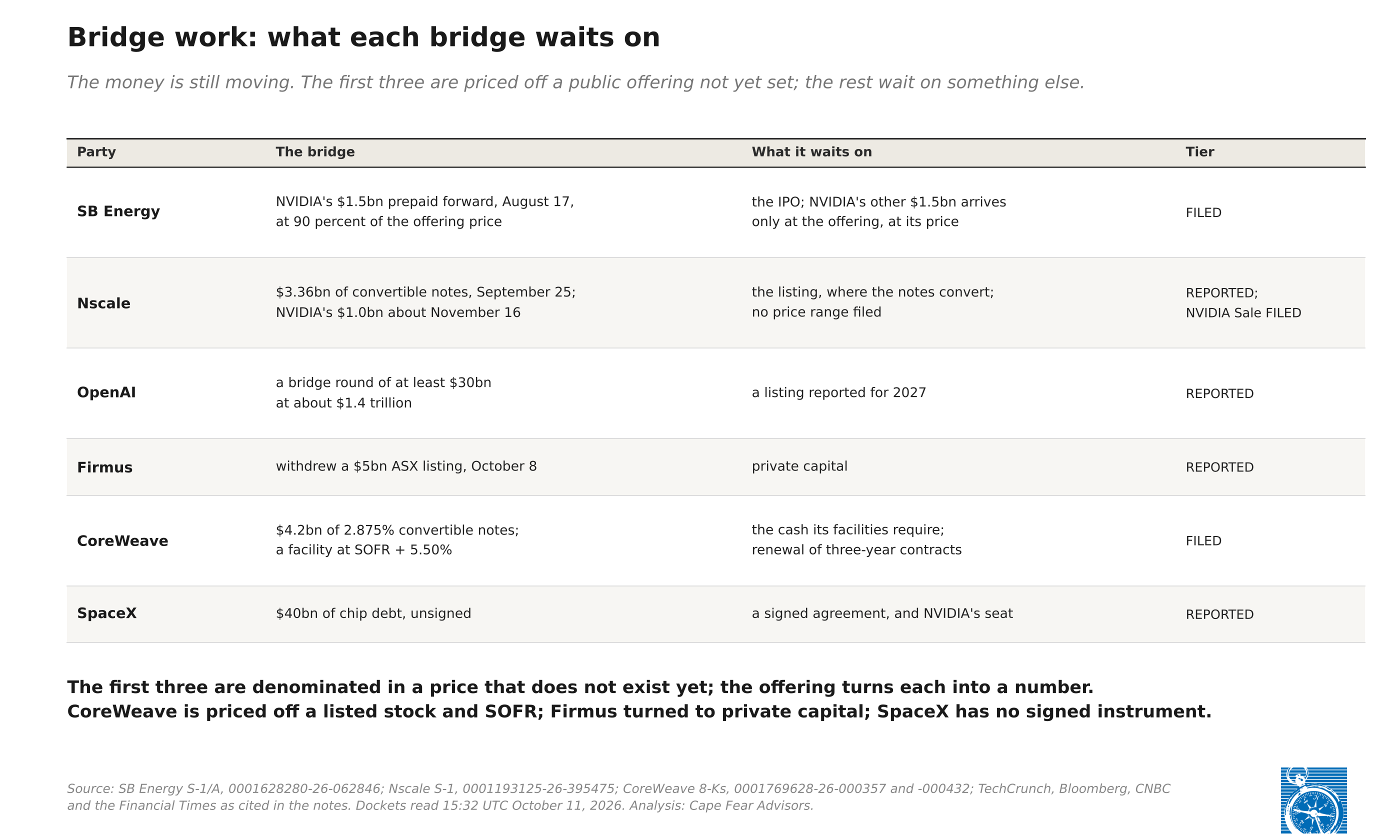
On October 8 Firmus, an NVIDIA-backed operator of AI data centers, withdrew a planned $5 billion listing in Australia, citing “market volatility and conditions,” and said it would pursue private capital.(1) [REPORTED] Nscale’s registration statement of September 18 is still its latest filing, with no price range.(2) [FILED probe] SB Energy’s launch was reported postponed on September 25, and its last amendment is dated September 21.(3) [REPORTED; docket FILED] OpenAI is reported to be raising at least $30 billion as a bridge to a listing now expected in 2027.(4) [REPORTED] On its reported timetable, Anthropic’s public filing would come by about October 25; the company had not finalized a valuation target as of mid-September.(5) [REPORTED; date OURS] SpaceX’s reported $40 billion of chip debt is unsigned, and the guarantor’s seat our October 7 piece, “What the $40 Billion Would Rest On,” found open is still open on the record.(6) [REPORTED]
The money itself is still moving. Nscale raised $3.36 billion in convertible notes on September 25. NVIDIA prepaid $1.5 billion to SB Energy on August 17. SoftBank paid OpenAI its final $10 billion on October 1.(7) [FILED and REPORTED] The capital is clearing privately, and it is waiting for the public price.
What each bridge is priced off
The instruments are specific about what they wait on. NVIDIA’s prepayment buys SB Energy shares at 90 percent of the offering price, and its other $1.5 billion arrives only at the offering, at that price.(8) [FILED] Nscale’s notes convert at its listing.(7) [REPORTED] OpenAI’s round bridges to a listing a year out. Each is denominated in a price that does not exist yet, and the offering is the event that turns each one from a promise into a number. A bridge has a far end: a company holding enough cash reaches it on its own schedule, and one that needs cash sooner reaches it at the market’s.
The price of waiting, at one company
CoreWeave’s delayed-draw facilities carry the clearest series on the record. The facility of May 2026, guaranteed by the parent, priced at SOFR plus 4.50 percent on $3.1 billion. The facility of August, also guaranteed by the parent, priced at SOFR plus 5.50 percent on $2.6 billion.(9) [FILED] Both are floating, so the 100 basis points measure the borrower and the structure rather than the September move in Treasury yields.(10) [OURS; yields from Treasury]
The company’s own release names what changed. The August facility “carries an approximate five-year maturity while its underlying customer contracts average approximately three years in length,” which CoreWeave presents as lenders “signalling confidence in the long-term value of NVIDIA GPUs” and “a willingness to underwrite renewal risk.”(11) [FURNISHED] Both readings are in the same sentence: lenders took the renewal risk, and charged more for it.
The convertibles run the same way. The April notes, $4.0 billion due 2032, carry 1.75 percent; the September notes, $4.2 billion due 2033, carry 2.875 percent, and the capped calls bought with the two issues cost $430.5 million and $566.2 million out of proceeds.(12) [FILED]
Oracle: a step, then a plateau
Oracle is the one investment-grade credit read here, and the spread on its bonds is the market’s price for buildout credit in its plainest form. The shape is a step followed by a plateau. Its 6.70 percent notes due 2056 were issued in February and traded on February 4 at a yield of 6.76 percent, about 185 basis points over the 30-year Treasury. By July 24 they yielded 8.02 percent, about 286 over. On October 8 they yielded 8.35 percent, about 275 over.(13) [OURS on FINRA TRACE and Treasury data] The spread stepped up by about 100 basis points between February and late July and has narrowed slightly since. From July 24 to October 8 the bond’s yield rose about 33 basis points and the 30-year Treasury’s about 44: the later yield move is the Treasury market’s and then some, and the spread narrowed by about 11. Oracle’s five-year default swaps traced the first half of that path, from about 144 basis points at the start of the year to about 203 in late July.(14) [REPORTED]
Verify, then trust
The equity side has moved in the same direction, and three filed instruments show it in date order.
When CoreWeave went public in March 2025 it issued OpenAI $350 million of Class A shares alongside the compute contract, at signing, for no cash, the arrangement traced in “NVIDIA, A Little Bit of Money In.”(15) [FILED] In October 2025 AMD issued OpenAI a warrant for up to 160 million shares at a penny, vesting on purchase milestones beginning with the first gigawatt delivered and on stock-price targets that escalate to $600.(16) [FILED] In September 2026 Akamai issued Anthropic a warrant that vests 40 percent on Anthropic’s first payment and 20 percent per additional $3 billion committed, exercisable at the market price, $861.8 million in cash with no cashless exercise, and returnable to Akamai if Anthropic falls short on payment, whether or not exercised, as set out in “What the Next Billion Costs.”(17) [FILED]
Shares at signing; then shares on delivery at a nominal price; then an option at market that follows payment and can be taken back. At CoreWeave the shares moved first and the contract earns them. At Akamai the contract performs first and the shares follow. Three instruments across three counterparty pairs are a sequence, and the record holds a contemporaneous variant: Qualcomm’s warrant to Amazon, issued in September, the same month as Akamai’s, vested 15 percent on issuance and allows cashless exercise.(18) [FILED] What sets Akamai’s apart is the order: payment, then shares, with the shares returnable.
Temperature, not season
This reads as a change in temperature, and it carries no forecast. Some of it is the general rate terrain: Treasury yields rose from late September into October, and at Oracle that accounts for all of the yield move since July and about 11 basis points more.(10) Some of it may be early sentiment. What the record supports is narrower and measurable: at CoreWeave the cost of the bridge has risen, at Oracle the credit premium has steadied since July, the equity has moved later in the deal, and the public price is what the newest bridges wait on.
A company with the cash to wait crosses the bridge on its own schedule. The bridge matters most to the ones that need cash before the far end, in a market asking for more proof, and a higher price, than it did six months ago.
What we want, and what we watch
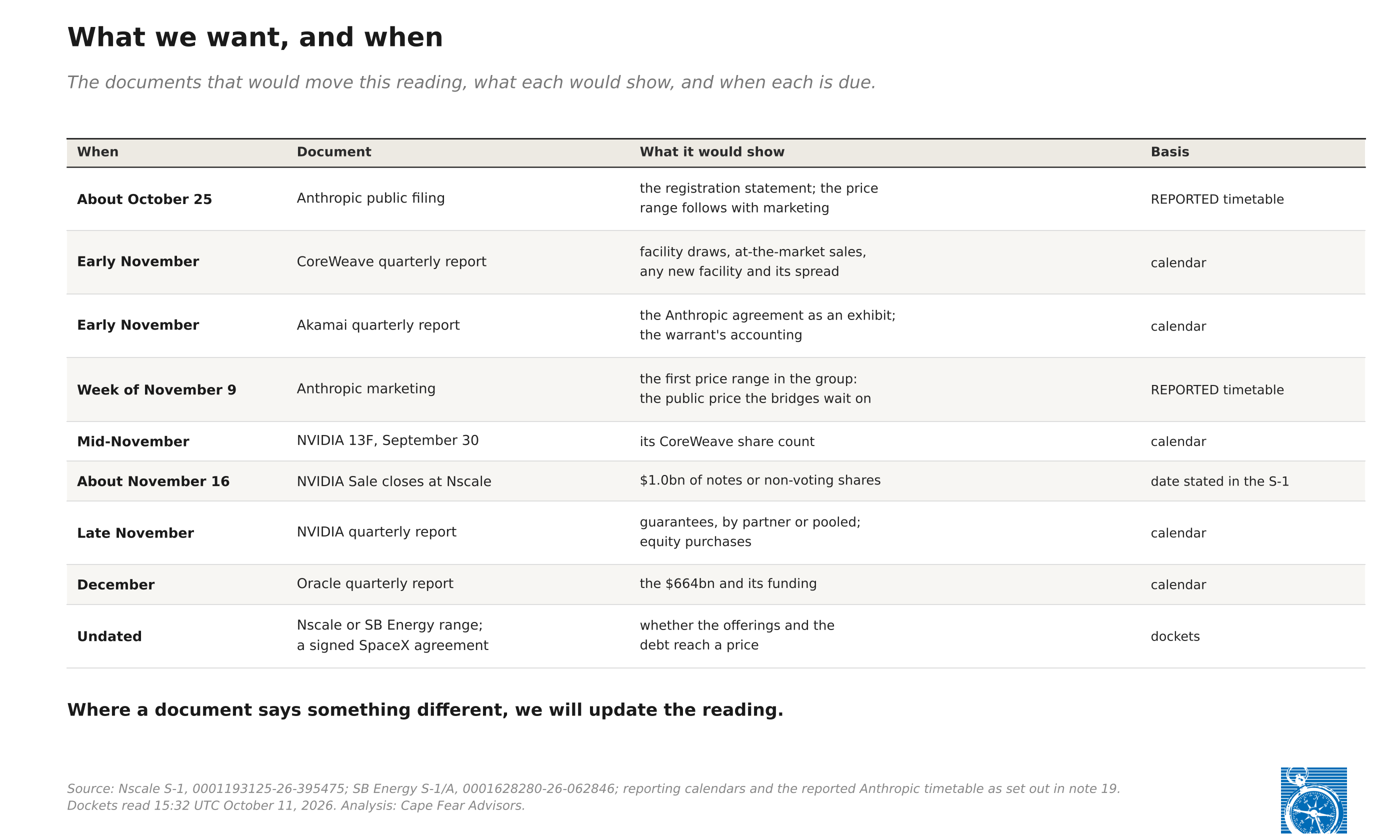
The documents that would move this reading are dated, and the first is a price. On its reported timetable, Anthropic’s public filing would come by about October 25, and its price range, the first in this group, would follow with marketing the week of November 9. The early-November quarterly reports carry CoreWeave’s facility draws and Akamai’s Anthropic agreement. NVIDIA’s own reports in November carry its CoreWeave holding and its guarantees. Where a document says something different, we will update the reading.(19)
Free to read, no paywall. Readers who find the work useful can support it at the foot of the page; payment offsets the time and buys no access. Corrections run in daylight, dated, in a comment or in the following piece, and a reader who finds one is doing us a favor.
Standing Disclosure
Cape Fear Advisors holds no direct position, long or short, in the securities discussed here. Any exposure is indirect, through managed funds it does not control, which may include index funds holding the public companies named.
Anthropic is the developer of Claude, which we use in preparing our work. In this piece Anthropic is the holder of Akamai’s warrant and a company whose offering is reported to be pending. Every figure about Anthropic carries a public source, and no claim here rests on trust in the tool. CoreWeave, Akamai, AMD, Nscale, SB Energy, Oracle and NVIDIA are read for their own filed documents and for reported terms. Firmus, OpenAI, SoftBank and SpaceX’s reported financing appear as reported. Figures are quoted without characterization, and nothing here identifies an error or a bad actor. This piece makes no market call, no forecast and no rating call, and takes no view on any security.
Notes
(1) REPORTED. Firmus withdrew its ASX listing application on October 8, 2026, as reported October 9 by CNBC, from the company’s emailed statement, and by Bloomberg: about $5 billion at A$11 a share; NVIDIA was among the investors in its $2 billion private round in August.
(2) FILED probe. Nscale Ltd submissions record, CIK 2110365, read 15:32 UTC October 11, 2026: latest filing the Form S-1 of September 18, 2026, accession 0001193125-26-395475; no amendment.
(3) REPORTED and FILED. Amy Or, IFR, September 25, 2026: a planned $5 billion offering at about $50 billion, launch postponed over a valuation gap. SB Energy, Inc. submissions record, CIK 2133037, read 15:32 UTC October 11: latest filing the Form S-1/A of September 21, 2026.
(4) REPORTED. Bloomberg, September 29, 2026: a bridge round of at least $30 billion at about $1.4 trillion, with the listing moved to 2027.
(5) REPORTED and OURS. Marketing the week of November 9 is reported. An issuer that submits a draft registration statement for nonpublic review files it publicly at least 15 days before any road show, under the Division of Corporation Finance’s announcement of June 29, 2017 (for emerging growth companies, Securities Act Section 6(e) as amended by the FAST Act), so that timetable implies a public filing by about October 25; the confidential submission is indicated by Reuters’ review of a draft prospectus, reported September 29. Business Insider, September 13, 2026: the company “has not finalized a valuation target.”
(6) REPORTED and OURS. Financial Times, October 6, 2026; the seats NVIDIA holds and the one it does not, in our October 7 piece.
(7) FILED and REPORTED. Nscale: $3.36 billion of convertible notes led by Third Point, converting at the listing, with NVIDIA’s $1.0 billion arriving about November 16 (TechCrunch, September 25; the NVIDIA Sale in Nscale’s S-1 per note (2)). SB Energy: note (8). SoftBank Group Corp., “Execution of Follow-on Investment (Third Tranche) in OpenAI,” October 1, 2026.
(8) FILED. SB Energy Form S-1/A per note (3): the Prepaid Forward Contract of August 17, 2026, $1.5 billion for shares at 90 percent of the initial public offering price, funded in full that day, and NVIDIA’s $1.5 billion concurrent private placement at the offering price.
(9) FILED. CoreWeave Form 10-Q for the quarter ended June 30, 2026, accession 0001769628-26-000366, debt note: DDTL 5.0, May 2026, SOFR plus 4.50 percent, $3.1 billion, guaranteed by the parent. CoreWeave Form 8-K, accession 0001769628-26-000357, August 7, 2026, Item 1.01: DDTL 5.5, $2.6 billion, Term SOFR plus 5.50 percent, maturity September 1, 2031, guaranteed by the parent.
(10) OURS and official. Both facilities float over SOFR. U.S. Department of the Treasury, daily par yield curve: on September 25, October 7 and October 9, the 10-year yield was 5.17, 5.28 and 5.24 percent and the 30-year 5.49, 5.67 and 5.60 percent. CNBC, September 27, 2026, on the rise in data-center borrowing costs (REPORTED).
(11) FURNISHED. CoreWeave press release of August 10, 2026, Exhibit 99.1 to the Form 8-K per note (9).
(12) FILED. CoreWeave Form 8-K, accession 0001769628-26-000432, September 22, 2026: $4.2 billion of 2.875 percent Convertible Senior Notes due 2033, capped calls of about $566.2 million. CoreWeave Form 8-K, accession 0001769628-26-000164, April 14, 2026: $4.0 billion of 1.75 percent Convertible Senior Notes due 2032, with capped calls; the $430.5 million cost per the Form 10-Q in note (9).
(13) OURS on public data. Oracle Corporation 6.70 percent notes due February 4, 2056, CUSIP 68389XEB7, TRACE symbol ORCL6302045: end-of-day trades from FINRA’s Fixed Income Data (TRACE), read October 11, 2026. February 4, $5 million or more at 99.283, yield 6.756 percent; July 24, $1.285 million at 85.184, 8.017 percent; September 29, 8.190 percent; October 7, $2 million at 81.385, 8.419 percent; October 8, 8.348 percent. Spreads are each yield less the 30-year Treasury par yield on the same date from the Treasury’s daily curve (4.91, 5.16, 5.59, 5.67 and 5.60 percent, and 5.60 on October 9), rounded to the nearest basis point: 185, 286, 260, 275 and 275. The notes are callable; they trade near 82, below any call price, so the yield to maturity is also the yield to worst and the spread to maturity is the conservative measure. It is a measure, not a market quotation of credit spread. Later trades of small size can carry dealer markups; on October 9 trades of $4.5 million and $5 million printed at 8.326 and 8.347 percent, 273 and 275 basis points over.
(14) REPORTED. CNBC, February 2, 2026, on the fall after the financing plan; Bloomberg, about July 20, 2026, as carried by AI Weekly, July 28: 203 basis points against 144 at the start of the year. S&P cut Oracle to BBB- in July (REPORTED). Later readings near 227 and 261 basis points circulated in secondary reports in late September and around October 8 without a named data provider, and the piece does not use them.
(15) FILED. CoreWeave Form S-1/A, accession 0001193125-25-052207, Exhibit 10.25, the Common Stock Issuance Agreement with OpenAI of March 7, 2025; accounted for as consideration payable to a customer, per CoreWeave’s Form 10-Q in note (9). The arrangement is set out in “NVIDIA, A Little Bit of Money In,” September 13, 2026.
(16) FILED. Advanced Micro Devices, Inc. Form 8-K, accession 0001193125-25-230895, October 6, 2025: “a warrant... to purchase up to an aggregate of 160 million shares of common stock... at an exercise price of $0.01 per share,” vesting “based on milestones tied to purchases of AMD Instinct GPU products,” the first tranche “after the delivery of the initial one (1) gigawatt,” and “further subject to achievement of specified Company stock price targets that escalate to $600 per share for the final tranche.”
(17) FILED. Akamai Technologies, Inc. Form 8-K, accession 0001193125-26-401048, September 24, 2026, Exhibit 4.1, Warrant Agreement of September 18, 2026: a warrant for 387,051 shares of Series B Non-Voting Convertible Preferred Stock; vesting conditions in Section 2.03; exercise price $2,226.60 per preferred share, 20 common per preferred; 387,051 times $2,226.60 is $861.8 million; cash exercise without net settlement; forfeiture on a Payment Shortfall in Section 2.04. The instrument is set out in “What the Next Billion Costs,” September 26, 2026.
(18) FILED. QUALCOMM Incorporated Form 8-K, accession 0001104659-26-105718, September 8, 2026, Item 3.02: a warrant of September 3, 2026 to an Amazon affiliate for up to 25,000,000 shares at $161.26, which “allows for cashless exercise,” vesting on commercial arrangements, binding purchase orders and purchases up to $60 billion, “with 3,750,000 shares being vested upon issuance.” 3,750,000 over 25,000,000 is 15 percent.
(19) FILED and OURS. The rows of the face: Anthropic’s public filing on the reported timetable (note (5)); CoreWeave’s and Akamai’s quarterly reports for the quarter ended September 30, due early November on their reporting calendars; NVIDIA’s Form 13F for September 30, due by mid-November; the NVIDIA Sale at Nscale, which “will close on or around November 16, 2026” (Nscale S-1 per note (2)); NVIDIA’s quarterly report for the quarter ending late October, due late November; Oracle’s quarterly report for the quarter ending November 30, due in December; and the Nscale, SB Energy and SpaceX dockets per notes (2), (3) and (6). The dates are reporting calendars except where quoted.
Analysis: Cape Fear Advisors.
This piece also appears on Substack. Cape Fear Advisors is an independent advisory firm based in Portsmouth, NH.
Contact Cape Fear Advisors