

On October 8 a report about OpenAI’s revenue appeared, the shares of companies that sell AI computing fell, and none of their filings that day named OpenAI. The companies holding the labs’ largest commitments are the other side of the headline: each discloses its side in its own document, under its own rules. From that side, the largest commitments in the frame run to 3,133 times a year’s revenue, and every quantitative line that decides what a filer must say about a customer or a transaction is struck on one year or on one transaction.
October 8
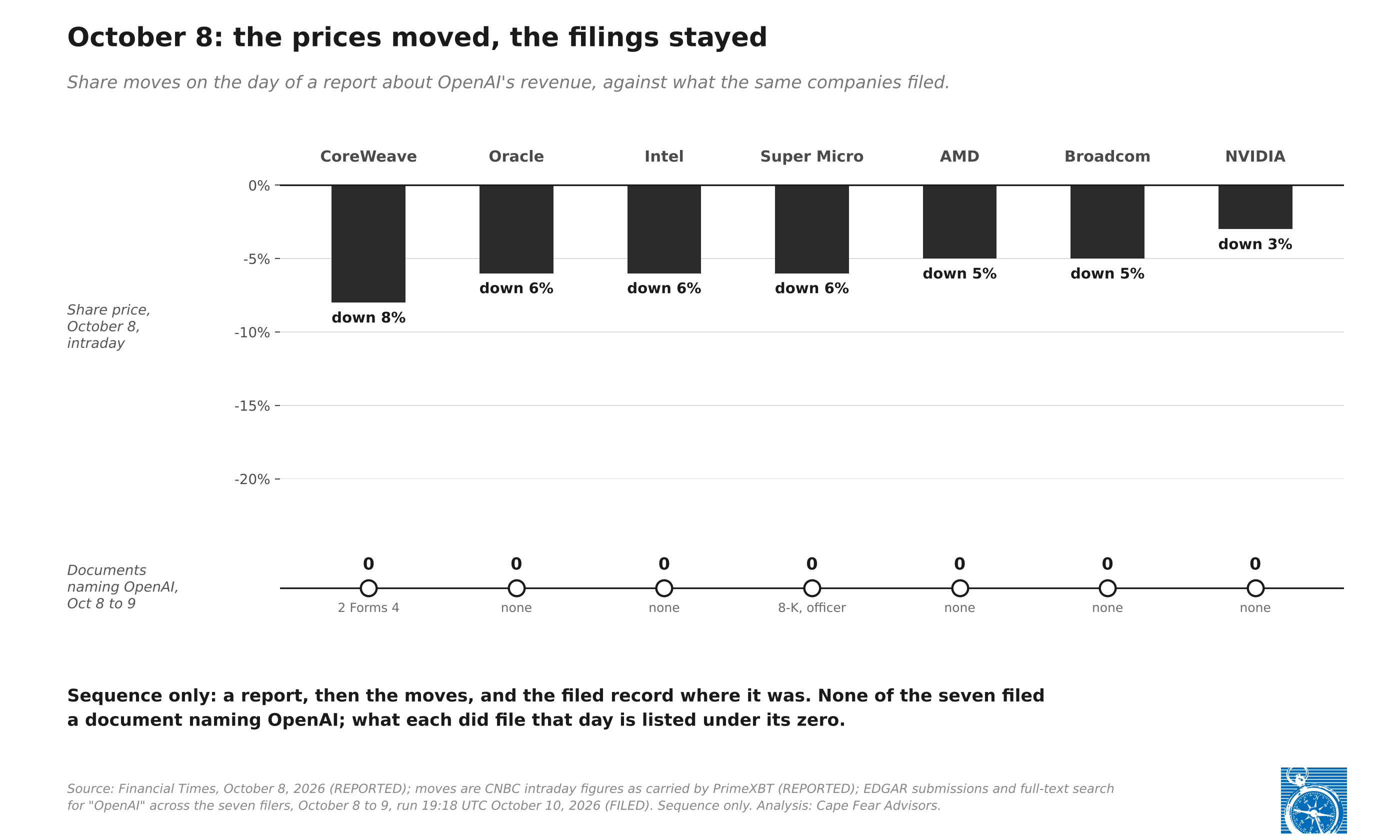
The Financial Times reported on October 8 that OpenAI had told investors its annualized revenue was approaching $50 billion at the end of September, against about $70 billion circulated a few weeks earlier. The stated cause was a definition: Anthropic counts sales through cloud partners in its figure and OpenAI does not, and investors had grossed OpenAI’s figure up to compare the two.(1) [REPORTED]
By CNBC’s intraday count that day, CoreWeave fell 8 percent, Oracle 6, Intel and Super Micro 6 each, AMD and Broadcom 5 each, and NVIDIA 3.(2) [REPORTED] Of the seven, two filed anything on October 8: CoreWeave two Forms 4, and Super Micro a current report on an officer change. A full-text search for “OpenAI” across all seven filers’ documents for October 8 and 9 returned nothing.(3) [FILED; the probe is ours.] The record shows the sequence and no more: a report, then the moves, and the documents unchanged.
Our September 30 piece, “Adding It Up: How to Read an AI Headline,” set out four questions to put to an announced figure: the tenor, the twelve months, the fine print, and the reason the filer gives for reporting at all.(4) It read the headline from the side that announces it. This piece is its second half, and it reads the same commitments from the other side, from the filings of the companies holding them.
Three positions frame it, and each is stated once. Arrangements of this shape, a supplier taking equity in a customer, a chip maker guaranteeing a lease, a customer prepaying its supplier, appear in capital-intensive industry whenever the capital has to arrive before the revenue does, and the shape describes who owes what to whom. Outcomes arrive company by company, so the reading stays at the level of the company. And the headline total and the filed record are two lenses on the same commitments: the first is fast and reaches markets within the day, the second is slow and covers only filers, and the useful work is the reconciliation between them.
3,133 times a year’s revenue
Nscale filed its registration statement on September 18. At August 31 it carried $103.4 billion of active and contracted total contract value under long-term take-or-pay contracts, of which $2.6 billion was active.(5) [FILED] Its revenue for 2025 was $33.0 million.
$103.4 billion is 3,133 times $33.0 million. [OURS on FILED]
Each of the two largest contracts inside it, on its own, runs more than ten times the highest of the earlier rows, TeraWulf’s 112.8. Nscale’s agreements with Anthropic of August 25 provide for payments of up to approximately $44.6 billion, 1,352 times its 2025 revenue; its statements of work with Microsoft provide for up to approximately $43.8 billion through December 2033, 1,327 times.(5) [OURS on FILED] Total contract value is Nscale’s own defined measure. The accounting measure, remaining performance obligations under ASC 606 of $56.4 billion at June 30 plus $2.0 billion of minimum lease payments under ASC 842, comes to 1,770 times, and it predates the Anthropic agreements.(6) [OURS on FILED]
SB Energy, the SoftBank developer building for OpenAI in Ohio and Texas and the subject of “The Fourteenth Position” in September, filed its latest amendment on September 21. It reports backlog of approximately $439 billion against 2025 total revenue of $213.5 million.(7) [FILED] That is 2,057 times. [OURS on FILED] Of the $439 billion, approximately $1 billion is expected to be recognized within 24 months. The registration statement’s own description of the figure: “a hypothetical estimate based on management’s assumptions and is not necessarily indicative of future revenue.”(7)
Both figures come from registration statements still awaiting effectiveness. Nscale’s offering has yet to price, and IFR reported on September 25 that the launch of SB Energy’s had been postponed over a gap between the $50 billion valuation sought and investors’ indications.(8) [REPORTED] Each figure is the company’s description of itself in an offering document: the structure as proposed, before any buyer has priced it.
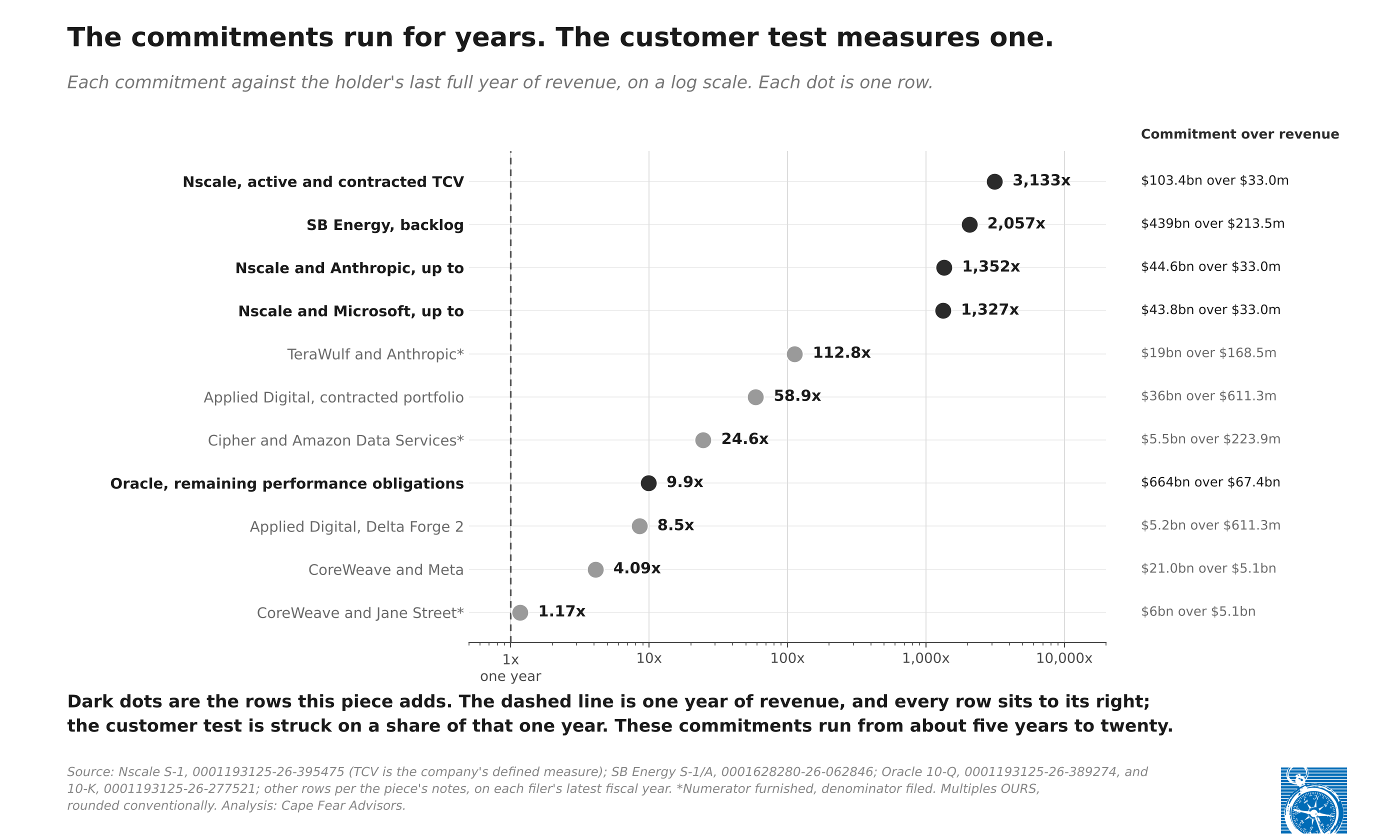
The earlier rows on the face come from the frame our September 30 piece declared: TeraWulf’s 20-year lease with Anthropic at 112.8 times, and Applied Digital’s contracted portfolio of $36 billion at 58.9 times its latest fiscal year.(9) Nscale and SB Energy sit more than an order of magnitude above both. Every row sits to the right of the one-year line; the nearest, CoreWeave’s compute for Jane Street at 1.17 times, is still more than a full year of CoreWeave’s revenue. Oracle, the largest company holding the far end of these commitments, sits at 9.9 times: remaining performance obligations of $664 billion at August 31 against fiscal 2026 revenue of $67,357 million.(10) [OURS on FILED]
A large ratio is what a contracted build looks like before the capacity is delivered, and every company on the face is building. The ratio carries no prediction about whether the contracts pay. What it measures is the distance between the commitment and the yardstick the rules apply to it.
Every quantitative line that decides what a filer must say about a customer or a transaction is struck on one year or on one transaction. ASC 280-10-50-42 tests a customer against 10 percent of a year’s revenues. Rule 1-02(w) tests a transaction’s significance against the filer’s assets, income or investments. Neither is denominated in a multi-year commitment, and the commitments on this face run from about five years to twenty. The one disclosure that does reach past a year, remaining performance obligations under ASC 606-10-50-13, asks for an aggregate and a timing and leaves out the customer, which is how Oracle’s $664 billion reaches the record as a total. This is the one claim here that can be wrong, because it rests on the rules rather than on any filer’s document. If a rule, staff guidance or filed disclosure applies a quantitative test to total contract value, we will update the finding.
One document, one date
Nscale and SB Energy are registering for the first time, so their current-report record is empty. Everything either has disclosed reached the public record in a registration statement: Nscale’s on September 18, SB Energy’s on September 1 with amendments on September 4 and September 21.(5)(7) CoreWeave, by comparison, put ten capital-markets filings on the record in thirty-eight weeks, each with an item election of its own.(11) [OURS on FILED]
A registration statement is the document with the strongest reason to be complete, because the party filing it is selling shares. Nscale’s shows what that buys. It files the form of its Anthropic order as Exhibit 10.25, redacts the price, and prints the terms.(12) [FILED]
“at Provider’s request to facilitate Provider’s and Parent’s efforts to secure Qualifying Financing, Anthropic is entering into separate agreements with Provider and other Affiliates of Provider... for all four (4) tranches at the Site”
The financing the order requires is benchmarked to the customer: “prevailing market terms for comparable financings for similar data center or GPU procurement transactions involving customers having a credit and risk profile comparable to Anthropic’s.” If the financing has not closed by a longstop date, whose length is redacted, “each party may terminate this Order... neither party will have any further obligation or liability under this Order.” The prospectus: “As of the date of this prospectus, we have not obtained binding commitments for any of the financings required to fund performance under the Anthropic Services Agreements.”(5) [FILED]
So the largest single commitment on the face is a ceiling on a contract that holds only if its financing closes by a set date, and the filer says so in its own exhibit. The same arrangement read from the announcing side is a number. SpaceX’s prospectus took the opposite route with its Anthropic agreements: it prints the money, $1.25 billion a month through May 2029, and the agreement is absent from its exhibits.(13) [FILED] One filer prints the terms and withholds the price; the other prints the price and withholds the terms.
The same guarantee at two sizes
NVIDIA guarantees obligations at both of these builders, and the two guarantees reached the record at opposite ends of its disclosure.
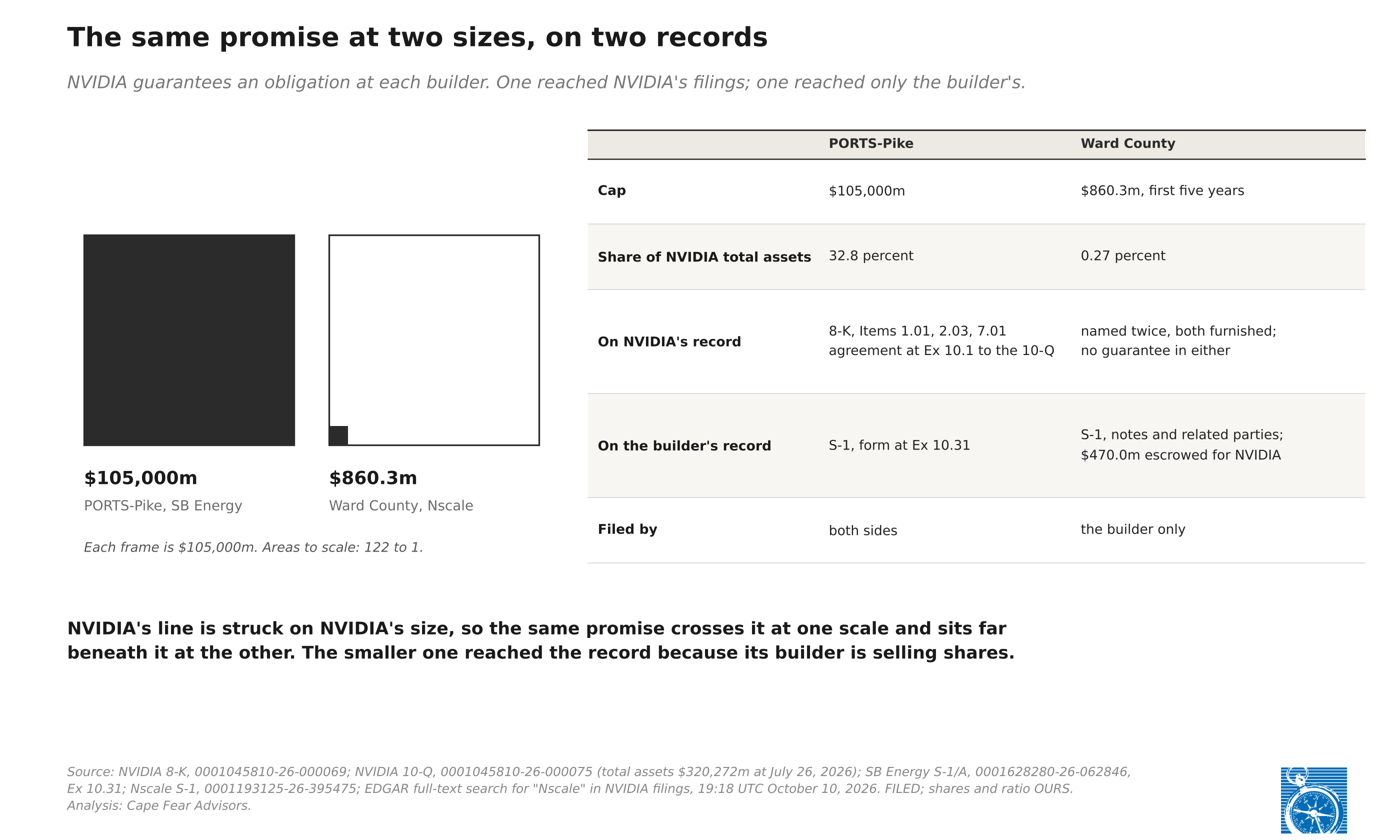
At SB Energy’s PORTS-Pike campus in Ohio, NVIDIA’s residual value guaranties, read in “The Circle at the Gate,” are capped at $105 billion in aggregate. NVIDIA reported them in a current report of August 17 under Item 1.01, its material agreement item, and Item 2.03, the item for a new direct financial obligation or off-balance sheet arrangement, and filed the agreement as Exhibit 10.1 to its next quarterly report. SB Energy filed the form as Exhibit 10.31.(14) [FILED] Both sides filed.
At Nscale’s leased facility in Ward County, Texas, NVIDIA guarantees the first five years of lease payments up to $860.3 million, under an agreement of October 14, 2025, and was paid in warrants. Nscale holds $470.0 million in escrow as recourse for NVIDIA, which leaves $390.3 million of the guarantee uncovered by cash.(15) [FILED; the subtraction is ours.] NVIDIA’s own record names Nscale twice since September 2025, in an earnings release and an annual report to shareholders, both furnished, and neither mentions a guarantee.(16) [FILED probe] Seen from NVIDIA’s side, the Ward County guarantee has one filed end, and it is at Nscale.
The two instruments are the same kind of promise, and the larger is 122 times the smaller. Against NVIDIA’s total assets of $320,272 million at July 26, the PORTS-Pike cap is 32.8 percent and the Ward County guarantee is 0.27 percent.(17) [OURS on FILED] The line that decides what NVIDIA reports is struck on NVIDIA’s own size, so the same promise crosses it at one scale and sits far beneath it at the other. The smaller one reached the record because the party it protects is selling shares.
NVIDIA’s quarterly report carries a further $3.5 billion of “land, power, and shell guarantees for select AI cloud partners’ data center lease obligations in the event of their default,” as one figure, with no partner named.(18) [FILED] It is the pool of warrant-backed lease guarantees set out in “NVIDIA, The Scarce Thing Is a Credit Standing.” The description fits the Ward County guarantee’s form; whether that guarantee sits inside the figure is a question the documents we read leave open.
Named when raising money
Oracle’s quarterly report for the quarter ended August 31 carries remaining performance obligations of $664 billion, of which it expects to recognize about 13 percent in the next twelve months.(10) [FILED] The word “OpenAI” appears in that report zero times. So do “concentration” and “single customer.”(19) [FILED; the probe is ours.] OpenAI’s share of the $664 billion has been reported at about half, by S&P among others.(20) [REPORTED]
On February 2, 2026, Oracle filed a free writing prospectus, dated the day before, announcing its plan to raise $45 billion to $50 billion in the calendar year. It names the customers the money is for:
“Oracle is raising money in order to build additional capacity to meet the contracted demand from our largest Oracle Cloud Infrastructure customers, including AMD, Meta, NVIDIA, OpenAI, TikTok, xAI and others.”(21) [FILED, under Rule 163]
Named in the document that raises money, pooled in the document that reports results. Both are ordinary. The standard that requires the $664 billion asks for a total, and the segment rule that tests a major customer asks for the amount and leaves out the name. The difference between the two documents is the difference between their purposes, the pattern “Oracle, Adding It Up: One Column” applied to Oracle in July: names where the accounting compels them, the aggregate where it permits.
Microsoft names the same counterparty, with numbers, for a reason it states: it holds about a quarter of OpenAI, which makes OpenAI a related party under ASC 850, and its annual report discloses $24.1 billion of revenue from OpenAI and a $6.0 billion receivable, figures set against its total revenue in “What the Next Billion Costs.”(22) [FILED] Its commercial backlog of $678 billion names no customer; Microsoft put OpenAI’s share at about 45 percent on its January call.(23) [REPORTED]
On October 8 Oracle’s shares fell on the day of a report about a counterparty its quarterly report does not name. CoreWeave, which fell further, carries OpenAI on its record in a third way. When it went public in March 2025, CoreWeave named OpenAI and filed the agreement under which it issued OpenAI $350 million of Class A shares alongside the compute contract.(24) [FILED] It accounts for those shares as consideration paid to a customer, the treatment traced in “NVIDIA, A Little Bit of Money In”: no cash came in, and the value sits as an asset amortized against the revenue the contract earns, which makes the shares part of the price.(24) [FILED] Its quarterly report names OpenAI as a customer, at up to $6.5 billion through May 2031, and the indenture for its 9.625 percent notes of June 18 gives “the OpenAI Contract” a row of its own, deeming debt against it compliant at 75 percent loan to value, at 90 if OpenAI carries an investment grade, or at full cost if the debt is pure equipment financing, with all such debt capped at $7.0 billion.(25) [FILED]
Three holders of one counterparty, three records. Microsoft owns about a quarter of OpenAI, so the related-party standard names it with numbers. CoreWeave’s shares went the other way, as part of the price of a compute contract, and reached the record named in its registration statement and amortized in its revenue. Oracle has no stake either way and carries OpenAI inside a total. Each record follows the rule that reaches it, and none of the three changed a document on October 8.
Four ways to be quiet
Four mechanisms let an arrangement sit on the record without its counterparty’s name, and the other side adds instances to the first three.(26) Two of them have already appeared here. Oracle’s $664 billion and NVIDIA’s $3.5 billion are pooling: each is a total that no rule requires to be itemized, and each is complete as filed. The third, a split across provenance tiers, withholds nothing. CoreWeave filed the $1.0 billion equity leg of its arrangement with Jane Street and furnished the compute leg, about $6 billion, so the two legs of one relationship carry different liability. The fourth withholds the arrangement itself, and the one instance a reader of filings can find, Apple and Google’s search placement, reached the public through a courtroom.
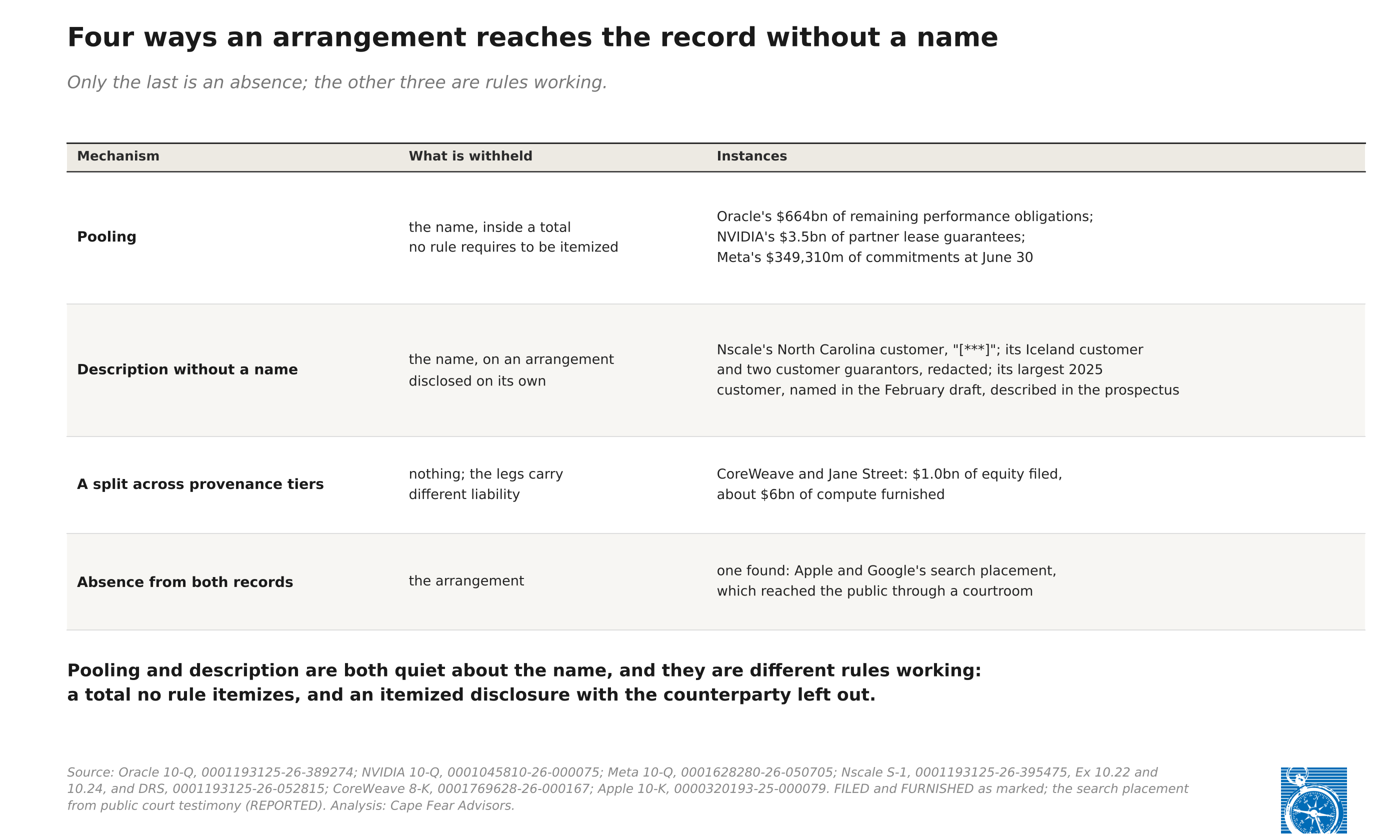
Pooling and description are both quiet about the name, and they are different rules working. Pooling is a total that no rule itemizes. Description is an itemized disclosure with the counterparty left out. Nscale shows both inside one filer. Its draft registration statement of February 17, submitted in confidence and now public on EDGAR, names its largest 2025 customer: “our largest customer was ByteDance.” The registration statement of September 18 describes its largest 2025 customer as “a customer that represented 73% of our revenue.”(27) [FILED] One filer, two descriptions of the same position, named in the draft and described in the prospectus. Only the fourth row is an absence, and its count is what a reader of filings can find: one, surfaced by litigation.
The other side of $518 billion
The figure that opened this season of headlines was $518 billion: Anthropic’s compute commitments, from a draft prospectus Reuters reviewed, split six ways among Broadcom ($161.2 billion), Google ($111.1 billion), Amazon ($110 billion), SpaceX (up to $84.5 billion), Microsoft ($31.4 billion) and AMD (more than $20 billion).(28) [REPORTED] All six file with the Commission, and their filings put a commitment value on about $43.75 billion of the total, all of it SpaceX’s, on base terms, the figure our September 30 piece struck.(28) [OURS on FILED]
Three filed commitments to Anthropic sit outside the split. Nscale’s, up to approximately $44.6 billion, signed August 25. Akamai’s, $11.6 billion over seven years, filed September 24. TeraWulf’s 20-year Kentucky lease, about $19 billion, a figure carried only in its furnished release.(5)(29) [FILED, FILED and FURNISHED] The filed values outside the split, $56.2 billion, exceed the filed values inside it. [OURS on FILED]
That sentence adds three things measured three ways, and the addition is the point. Nscale’s figure is a ceiling on agreements that dissolve if the financing fails. Akamai’s runs seven years with no service start date in the filing. SpaceX’s is a base term that either party can end on 90 days’ notice. A total of the three would carry the defects of any headline aggregate: it double counts an expansion announced at its full value, it adds numbers struck on different bases, and it stops at the announcement, unchanged when a delivery gate passes or a financing fails to close.
OpenAI’s side has its own far end, and it is quieter this month. SB Energy’s leases with an OpenAI affiliate cover approximately 8.0 gigawatts of IT capacity on 20-year terms, and the PORTS-Pike campus is a substantial majority of its data center backlog.(7) [FILED] Its docket shows no amendment since September 21, four days before the postponement was reported.(30) [FILED probe] NVIDIA’s first $1.5 billion is already in: it prepaid that amount on August 17 for shares at 90 percent of the offering price, under a prepaid forward contract, funded in full that day.(7) [FILED] SoftBank paid OpenAI the third and final $10 billion tranche of its follow-on investment on October 1, funded with foreign-currency senior notes.(31) [REPORTED, from the company’s release] And OpenAI’s own listing is reported to have moved to 2027, behind a bridge round of at least $30 billion at $1.4 trillion.(32) [REPORTED] SB Energy has had no market in which to react to October 8, and the record carries nothing that connects the two.
What we want, and what we watch
Anthropic’s registration statement, when it is distributed, is the first document in which the counterparty to these commitments speaks for itself; the reported timetable puts it at about October 25.(33) [OURS on REPORTED dates] These questions go into our review of it, and each is something we will look to confirm:
- The schedule of the commitments by year, and by counterparty.
- The share that is non-cancelable, which Reuters reported at about 80 percent with the SpaceX agreements outside it.(28)
- Whether sales through cloud partners are recognized gross or net, which is the definition at the center of October 8.
- How Anthropic describes the Nscale agreements and their financing condition from its side.
- Whether the figures that circulated in September match any figure it files.
The other documents that bear on this reading, and when each is due, sit with these questions on the face that follows.(34) Where one of them says something different, we will update the findings.
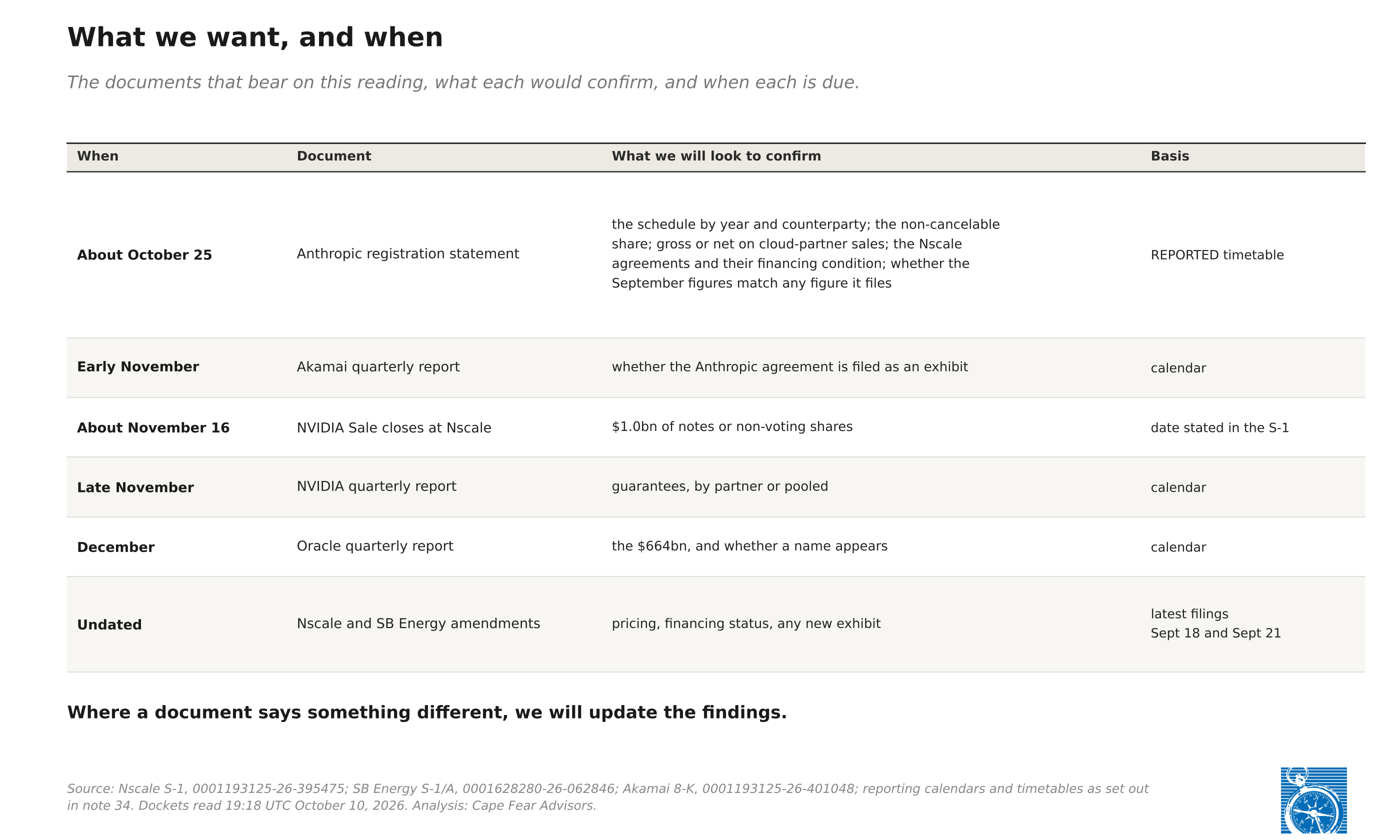
The other side of the headline is a set of companies building against contracts many times their size, describing those contracts in the documents their own rules require. The headline adds them up. The filings, read one at a time, say what each company is owed, by whom, on what terms, and what ends the obligation. Both lenses are needed. On October 8 the headline changed, and the filings stayed where they were.
Free to read, no paywall. Readers who find the work useful can support it at the foot of the page; payment offsets the time and buys no access. Corrections run in daylight, dated, in a comment or in the following piece, and a reader who finds one is doing us a favor.
Standing Disclosure
Cape Fear Advisors holds no direct position, long or short, in the securities discussed here. Any exposure is indirect, through managed funds it does not control, which may include index funds holding the public companies named.
Anthropic is the developer of Claude, which we use in preparing our work. In this piece Anthropic is the counterparty to Nscale’s agreements read in full, to the $518 billion of commitments read from the counterparties’ side, and to Akamai’s and TeraWulf’s filed commitments, and the close sets out questions for its registration statement. Every figure about Anthropic carries a public source, and no claim here rests on trust in the tool. Nscale, SB Energy, Oracle, NVIDIA, CoreWeave, Akamai, TeraWulf, Applied Digital, Cipher, Microsoft, SpaceX, Broadcom, Amazon, Alphabet and Google, AMD, Intel, Super Micro, Meta and Apple are read for their own filed documents and for reported terms only. OpenAI, SoftBank, Jane Street, ByteDance and Spring (SG) Pte. Ltd. appear as counterparties described in other companies’ filings and in reporting, and the piece makes no claim about any of them beyond what those documents state. Figures are quoted without characterization, and nothing here identifies an error, an inconsistency or a bad actor. This piece makes no market call, no forecast and no rating call, takes no view on any security, and takes no view on whether any filer met its disclosure obligations.
Notes
(1) REPORTED. George Hammond and Stephen Morris, “OpenAI annualised revenues $20bn less than previously signalled,” Financial Times, October 8, 2026. OpenAI declined to comment.
(2) REPORTED. CNBC intraday figures for October 8, 2026, as carried by PrimeXBT the same day. Closing moves may differ.
(3) FILED. EDGAR submissions records for CoreWeave (CIK 1769628), Oracle (1341439), Intel (50863), Super Micro (1375365), AMD (2488), Broadcom (1730168) and NVIDIA (1045810), read at 19:18 UTC October 10, 2026: on October 8, CoreWeave Forms 4 at 0001769628-26-000446 and -000447, and Super Micro Form 8-K at 0001375365-26-000023, Items 5.02 and 9.01; nothing else. EDGAR full-text search for “OpenAI” across the seven, October 8 to 9, returned zero documents.
(4) OURS. “Adding It Up: How to Read an AI Headline,” September 30, 2026.
(5) FILED. Nscale Ltd, Form S-1, accession 0001193125-26-395475, September 18, 2026: total contract value and active value at August 31, 2026 (Prospectus Summary); 2025 revenue of $33.0 million; the Anthropic Services Agreements, “aggregate payments to us of up to approximately $44.6 billion”; the Microsoft statements of work, “up to approximately $43.8 billion through December 2033”; and, under Business, Customers and Business Model, “As of the date of this prospectus, we have not obtained binding commitments for any of the financings required to fund performance under the Anthropic Services Agreements.” 103,400 over 33.0 is 3,133.3; 44,600 over 33.0 is 1,351.5; 43,800 over 33.0 is 1,327.3. Printed ratios round conventionally.
(6) FILED. Same S-1, notes to the condensed consolidated financial statements: remaining performance obligations under ASC 606 of $56.4 billion at June 30, 2026, including $7.1 billion from the significant financing component on customer prepayments, and $2.0 billion of minimum lease payments under ASC 842. 58,400 over 33.0 is 1,769.7.
(7) FILED. SB Energy, Inc., Form S-1/A, accession 0001628280-26-062846, September 21, 2026 (original S-1 at 0001628280-26-059639, September 1; exhibits-only amendment September 4): backlog of approximately $439 billion, approximately $1 billion expected within 24 months, and the “hypothetical estimate” sentence; total revenue for 2025 of $213,467 thousand, including $63.3 million of unrealized gains on power price swaps; the 17 PORTS-Pike leases of August 17, 2026, approximately 8.0 GW-IT, 20-year initial terms; and the Prepaid Forward Contract of August 17, 2026. 439,000 over 213.467 is 2,056.5. On revenue from contracts with customers alone, $142,981 thousand, the multiple is 3,070.
(8) REPORTED and FILED. Amy Or, IFR, September 25, 2026. Nscale’s submissions record shows the S-1 of September 18 as its latest filing, with no amendment and no final prospectus (read 19:18 UTC October 10, 2026).
(9) FILED, FURNISHED and OURS. The other rows on the face, each on its filer’s latest full fiscal year, from the frame declared in our September 30 piece:
- Applied Digital: approximately $36 billion of base-term contracted revenue at August 31, 2026, in the proxy statement (DEF 14A, accession 0001493152-26-044325) and the release furnished October 7 (0001144879-26-000057); Delta Forge 2, approximately $5.2 billion, in the Form 10-Q (0001144879-26-000059); fiscal 2026 revenue of $611.3 million (10-K, 0001144879-26-000048). 36,000 over 611.3 is 58.9; 5,200 over 611.3 is 8.5.
- TeraWulf and Anthropic: about $19 billion in the release furnished July 6 (0001104659-26-080583), with no figure in the filed documents; 2025 revenue of $168.5 million (10-K, 0001083301-26-000031). 112.8, FURNISHED over FILED.
- Cipher and Amazon Data Services: $5.5 billion in the release furnished November 3, 2025 (0001819989-25-000110); 2025 revenue of $223.9 million (10-K, 0001819989-26-000009). 24.6, FURNISHED over FILED.
- CoreWeave and Meta: approximately $21 billion, Form 8-K Item 8.01 (0001769628-26-000154); CoreWeave and Jane Street, about $6 billion of compute furnished at Exhibit 99.1 to 0001769628-26-000167; 2025 revenue of $5,131 million (10-K, 0001769628-26-000104). 4.09 and 1.17.
(10) FILED. Oracle Corporation, Form 10-Q for the quarter ended August 31, 2026, accession 0001193125-26-389274: “Remaining performance obligations were $664 billion as of August 31, 2026, of which we expect to recognize approximately 13% as revenues over the next twelve months.” Fiscal 2026 revenue of $67,357 million from the Form 10-K, accession 0001193125-26-277521. 664,000 over 67,357 is 9.86.
(11) OURS on FILED. Counted from CoreWeave’s current reports on EDGAR, January to September 2026.
(12) FILED. Nscale S-1 per note (5), Exhibit 10.25, Form of Order for GPU Services between Anthropic PBC and Nscale GPU MCC B1.1 LLC, sections 1(c) and 9(a) and 9(d). Redactions are under Item 601(a)(5) and 601(b)(10) of Regulation S-K.
(13) FILED. SpaceX final prospectus, Form 424B4, accession 0001628280-26-042639. EDGAR full-text search for “Anthropic” within SpaceX’s filings, January 1 to October 10, 2026, run 18:25 UTC October 10, returns seventeen documents: the registration statement and its amendments, the final prospectus, free writing prospectuses, correspondence and staff letters. None is an exhibit. SpaceX’s correspondence of June 1, accession 0001628280-26-039278, addresses the agreements’ termination provision.
(14) FILED. NVIDIA Form 8-K, accession 0001045810-26-000069, August 17, 2026, Items 1.01, 2.03 and 7.01; NVIDIA Form 10-Q for the quarter ended July 26, 2026, accession 0001045810-26-000075, Exhibit 10.1; SB Energy S-1 per note (7), Exhibit 10.31, Form of PORTS-Pike Residual Value Guaranty.
(15) FILED. Nscale S-1 per note (5), note 10 to the 2025 consolidated financial statements, NVIDIA Warrants, and Certain Relationships and Related Party Transactions: the Guarantee of Lease Agreement of October 14, 2025, “up to a maximum amount of $860.3 million” for the first five years; the $470.0 million Escrow Fund “as recourse for NVIDIA,” reported as restricted cash; non-default warrants for 9,476,700 Series B preferred shares at $0.01 and default warrants exercisable on a Relevant Default Event.
(16) FILED probe. EDGAR full-text search for “Nscale” within NVIDIA’s filings, September 1, 2025 to October 10, 2026, run 19:18 UTC October 10: two documents, Exhibit 99.1 to Form 8-K accession 0001045810-25-000228 (November 19, 2025, furnished) and the annual report to shareholders at 0001045810-26-000038 (May 12, 2026, furnished). The search records a failure to find; it is not a claim that no other document exists.
(17) OURS on FILED. NVIDIA total assets of $320,272 million at July 26, 2026, Form 10-Q per note (14). 105,000 over 320,272 is 32.78 percent; 860.3 over 320,272 is 0.2686 percent; 105,000 over 860.3 is 122.05.
(18) FILED and FURNISHED. NVIDIA Form 10-Q per note (14), Guarantees: “The maximum gross exposure under all agreements is $3.5 billion,” classified as credit derivatives; the same figure in the CFO commentary furnished at Exhibit 99.2 to Form 8-K accession 0001045810-26-000073, August 26, 2026.
(19) FILED probe. Text of the Form 10-Q per note (10), searched at 18:20 UTC October 10, 2026 for “OpenAI,” “concentrat,” “single customer” and “one customer”: zero instances each. EDGAR full-text search for “OpenAI” within Oracle’s filings, June 1, 2025 to October 10, 2026, run 19:18 UTC, returns two documents: the free writing prospectus in note (21) and Exhibit 99.1 to Form 8-K accession 0001193125-25-199175 (September 9, 2025, furnished).
(20) REPORTED. S&P Global Ratings on Oracle, July 2026, as reported.
(21) FILED. Oracle free writing prospectus under Rule 163, accession 0001193125-26-032650, dated February 1 and filed February 2, 2026, Registration Statement No. 333-277990.
(22) FILED. Microsoft Corporation Form 10-K for the fiscal year ended June 30, 2026, accession 0001193125-26-323660, Note on investments: an equity-method investment representing “an approximate 25% interest on an as-converted basis”; revenue from commercial arrangements with OpenAI, inclusive of revenue-sharing payments, of $24.1 billion for fiscal 2026; accounts receivable from OpenAI of $6.0 billion at June 30, 2026; commercial remaining performance obligations of $678 billion, about 30 percent to be recognized in the next twelve months. The word “OpenAI” appears 26 times in the document.
(23) REPORTED. Microsoft’s fiscal second-quarter earnings call, January 2026; the figure is absent from the Form 10-K in note (22).
(24) FILED. CoreWeave Form S-1/A, accession 0001193125-25-052207, Exhibit 10.25, the Common Stock Issuance Agreement with OpenAI of March 7, 2025: $350 million of Class A common stock, the share count set by dividing that amount by the IPO price, tied to the master services agreement of the same date. CoreWeave Form 10-Q for the quarter ended June 30, 2026, accession 0001769628-26-000366: the risk factor naming OpenAI OpCo, LLC and the order form under which OpenAI “committed to pay us up to approximately $6.5 billion through May 31, 2031”; Note 1, 9 million shares with an aggregate value of $350 million issued under the commercial agreement; and the supplemental non-cash line “Issuance of common stock for contract incentive.” CoreWeave’s accounting policy records payments to customers as a contra-revenue asset; “NVIDIA, A Little Bit of Money In,” September 13, 2026.
(25) FILED. CoreWeave Form 8-K, accession 0001769628-26-000291, June 18, 2026, Exhibit 4.1, indenture for the 9.625 percent senior notes due 2032, definitions of “OpenAI Contract” and the permitted SPV debt provisions.
(26) FILED and REPORTED. Oracle per note (10); NVIDIA per note (18); Meta Platforms Form 10-Q for the quarter ended June 30, 2026, accession 0001628280-26-050705; Nscale S-1 per note (5), Exhibit 10.24 (North Carolina GPU Credit Agreement, “Customer shall mean [***]”), Exhibit 10.22 (Macquarie Iceland Facility, customer and two customer guarantors redacted) and Exhibit 10.12 (Macquarie Senior Facility, “Spring Singapore” defined as Spring (SG) Pte. Ltd., company number 202325236K, under a cloud services agreement of May 15, 2025); the S-1 states its largest customer was 73 percent of 2025 revenue. CoreWeave and Jane Street per note (9). Apple and Google: the search placement, about $20 billion, from public court testimony; Apple’s fiscal 2025 Form 10-K, accession 0000320193-25-000079, names Google only inside a litigation risk factor.
(27) FILED and REPORTED. Nscale draft registration statement, Form DRS, accession 0001193125-26-052815, submitted February 17, 2026 and made public on EDGAR: “For the year ended December 31, 2025, our largest customer was ByteDance, which accounted for [blank in the original] % of our revenue.” EDGAR full-text search for “ByteDance” within Nscale’s filings returns that document alone (19:18 UTC October 10); “Spring (SG)” returns Exhibit 10.9 to the DRS/A of June 26 (0001193125-26-285636) and Exhibit 10.12 to the S-1. The S-1 sentence is under Business, Customers and Business Model. A loan exhibit to the S-1 (Exhibit 10.12) defines the customer under the facility it finances as Spring (SG) Pte. Ltd., a Singapore company; the S-1 does not tie that entity to the 73 percent description, and this piece draws no link between them. The Financial Times reported on September 23, 2026 that the draft had named ByteDance, as carried in Francine McKenna’s The Dig, September 24, and Olga Usvyatsky’s Deep Quarry, October 3.
(28) REPORTED and OURS. Reuters, September 29, 2026, from a confidential draft prospectus; the split sums to $518.2 billion, and about 80 percent is reported non-cancelable, with the SpaceX agreements outside that share. SpaceX’s filed $1.25 billion a month for 35 full months is $43.75 billion, on base terms, as struck in our September 30 piece.
(29) FILED and FURNISHED. Akamai Form 8-K, accession 0001193125-26-401048, September 24, 2026, $11.6 billion over seven years. TeraWulf Form 8-K, accession 0001104659-26-080583, July 6, 2026, Item 8.01, and Form 10-Q note 18, accession 0001083301-26-000166: a 20-year lease, signed and not commenced, with no dollar figure in either filed document; the approximately $19 billion is in the furnished release. 44,600 plus 11,600 is 56,200, against 43,750.
(30) FILED probe. SB Energy submissions record, CIK 2133037, read at 19:18 UTC October 10, 2026: latest filing the Form S-1/A of September 21.
(31) REPORTED. SoftBank Group Corp., “Execution of Follow-on Investment (Third Tranche) in OpenAI,” October 1, 2026: $10.0 billion through SoftBank Vision Fund 2, funded with foreign-currency senior notes announced September 24; cumulative investment $64.6 billion.
(32) REPORTED. Bloomberg, September 29, 2026, as carried by AI Weekly; the Financial Times of October 8 per note (1) reports funding talks at about $1.4 trillion.
(33) OURS on REPORTED. An issuer that submits a draft registration statement for nonpublic review files it publicly, with its prior draft submissions, at least 15 days before any road show: for issuers other than emerging growth companies, under the Division of Corporation Finance’s announcement of June 29, 2017; for emerging growth companies, under Securities Act Section 6(e) as amended by the FAST Act. Reuters’ review of a draft prospectus (note (28)) indicates Anthropic submitted confidentially, so marketing the week of November 9, as reported, implies a public filing by about October 25.
(34) FILED and OURS. The rows of the face: the NVIDIA Sale, $1.0 billion of unsecured convertible loan notes or Non-Voting Shares to be issued to NVIDIA under the Subscription Agreement of September 15, 2026, which “will close on or around November 16, 2026” (Nscale S-1 per note (5), Prospectus Summary, Recent Developments); Akamai’s quarterly report for the quarter ending September 30, the first in which the Anthropic agreement of September 24 (note (29)) can be filed as an exhibit, due early November on its reporting calendar; NVIDIA’s quarterly report for the quarter ending late October, due late November on its reporting calendar; Oracle’s quarterly report for the quarter ending November 30, due in December; and the Nscale and SB Energy dockets per notes (5), (7) and (30). The dates are reporting calendars, not company statements, except where quoted.
Analysis: Cape Fear Advisors.
This piece also appears on Substack. Cape Fear Advisors is an independent advisory firm based in Portsmouth, NH.
Contact Cape Fear Advisors