

SpaceX is reported to be raising about $40 billion to buy NVIDIA chips, three quarters of it as investment-grade debt. So far it exists only in reporting. A grade on debt like this rests on one of three things: the borrower’s own standing, the contracts the chips will serve, or the supplier’s credit. Each of the three is on the record today, and so is the supplier’s other seat. We set out here what the grade could rest on, and the documents that will say which, before any of them arrive, so that this piece can be graded against them when they do.
What was reported, and what is filed
On October 6 the Financial Times reported that SpaceX is in talks to borrow about $40 billion to buy NVIDIA chips: roughly $10 billion of bank loans and $30 billion of investment-grade debt, with Apollo Global Management leading and Pacific Investment Management Co. among the investors considering a piece. The talks were described as early, with a close expected in 2027. SpaceX, Apollo and NVIDIA did not respond to requests for comment, and Pimco declined to comment.(1)
SpaceX’s most recent filing of any kind is a Form 4/A of September 30.(2) Every term below that describes the deal is reported. Every term that describes what the deal would sit on is filed or published by a rating agency, and each carries its tag.
The one chip financing already on the record
We have kept a ledger of SpaceX’s cash since May, and one line in it already speaks to this. SpaceX has financed chips before, and the financing is in its quarterly report. A subsidiary, CTC Property, leased AI infrastructure hardware from Valor Equity Partners, whose founder Antonio Gracias is a SpaceX director. The arrangement failed sale-leaseback accounting, so the cash landed as debt and the hardware stayed on SpaceX’s balance sheet. The balance was $13,329m at June 30, up from $4,507m at December 31, and related-party interest was $327m in the second quarter alone.(3) [FILED]
Against the quarter-end balance, $327m a quarter is at least 9.81 percent a year, at least 3.7 points above the 6.03 percent effective rate on SpaceX’s own June notes.(3) [OURS on FILED; a floor, struck on the ending balance.] The one chip financing of record was priced like high-yield debt. So the question this report raises is narrower than whether SpaceX can finance chips. It has, at a price. The question is what would move the price, and a $30 billion investment-grade tranche would be a change in kind as well as in size.
It would also be restricted money. Our August reading of the cash gap put about $430 billion of cash to deploy through 2030 against about $75 billion that can move, and sorted the sources by where each can go: money raised against a project reaches that project.(4) Debt raised to buy NVIDIA chips reaches the AI compute row, about $300 billion of the stack. Cursor, Starbase Louisiana, Spectrum and Terafab stand where they stood.
Three things a grade can rest on
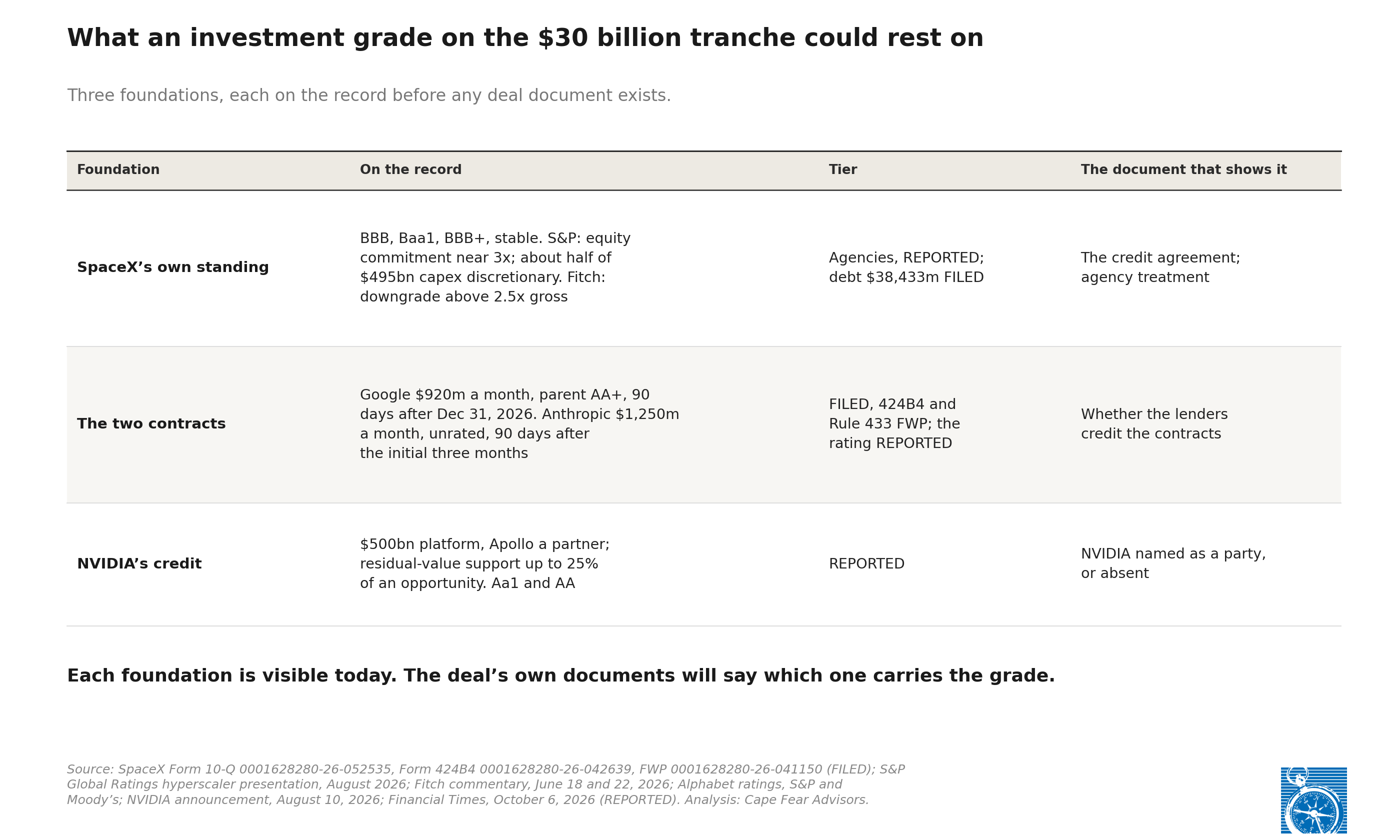
The borrower’s own standing
SpaceX already holds an investment grade at the corporate level: BBB from S&P, Baa1 from Moody’s and BBB+ from Fitch, all with stable outlooks.(5) Senior unsecured debt issued at that standing would carry it. The question is what the grade rests on, and two of the agencies have said.
S&P’s August presentation on the hyperscalers rates SpaceX on an expectation that leverage stays under 2.0x, records a company commitment to issue equity if leverage approaches 3x, and carries $495 billion of capital spending from 2026 through 2028, about half of it discretionary.(6) Fitch’s June commentary sets its downgrade sensitivity at EBITDA leverage sustained above 2.5x, runs its rating case at about 1.7x for 2026 and 1.9x for 2027, and names among its upgrade conditions a “willingness to curtail investment to preserve credit metrics.”(7) [REPORTED, from the agencies.]
Two agencies, one shape: the grade rests on the spending being stoppable. Borrowing $40 billion to buy chips turns part of the stoppable spending into debt service.
The scale, on SpaceX’s filed debt of $38,433m at June 30 and two earnings bases:(8)
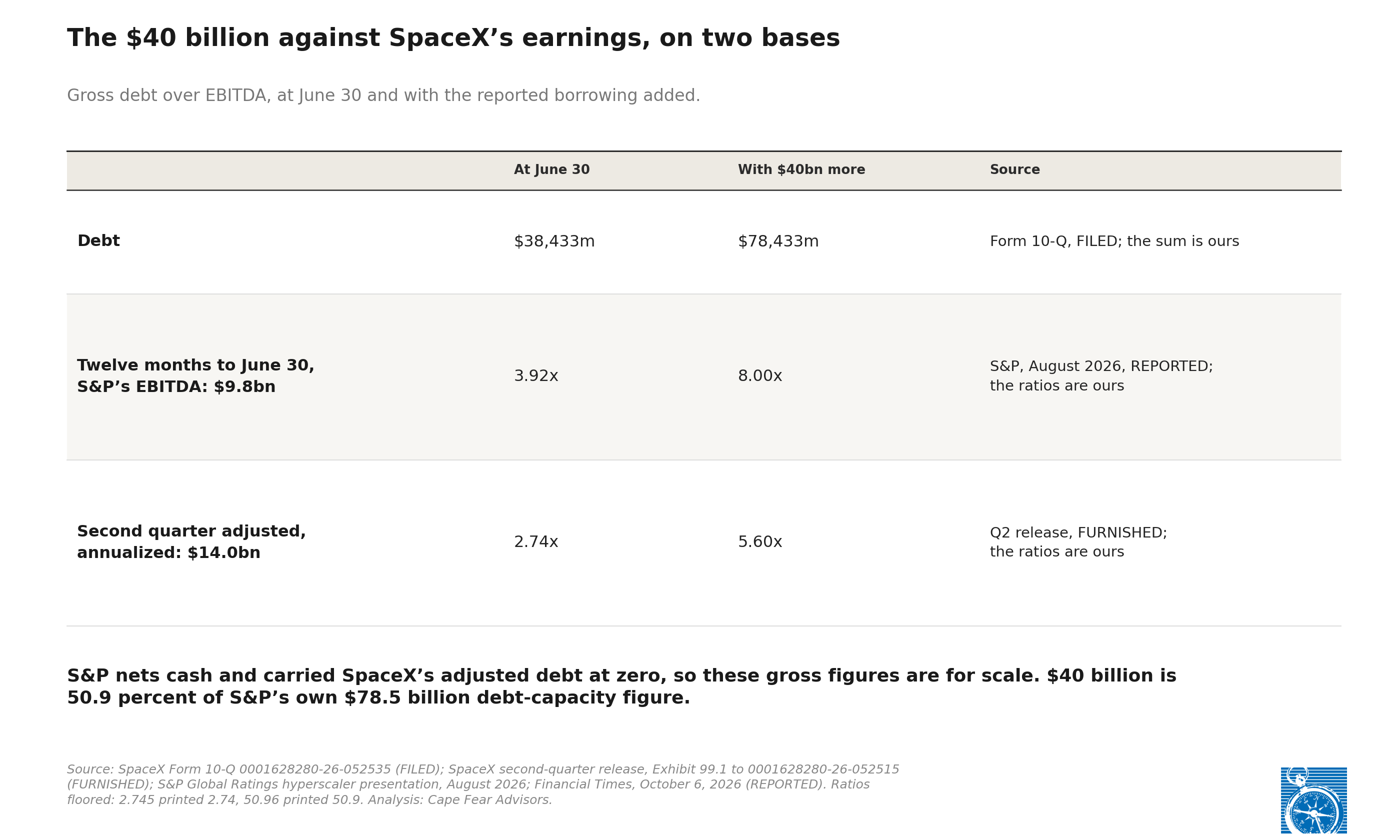
Gross leverage runs from 3.92x today to 8.00x with the borrowing on S&P’s base, and from 2.74x to 5.60x on the second quarter’s.
S&P’s own measure nets cash, and it carried SpaceX’s adjusted debt at zero at June 30, so these gross figures are ours and are for scale. S&P also publishes a debt-capacity figure for SpaceX of $78.5 billion; $40 billion is 50.9 percent of it. Fitch’s trigger is struck on gross leverage. Against the June debt, its 1.9x case for 2027 implies EBITDA near $20.2 billion, and the 2.5x trigger leaves about $12.1 billion of room. $40 billion is 3.29 times that room. [OURS, an inference that holds debt at its June level, an assumption of ours.]
The contracts
Two compute contracts are on SpaceX’s record. Anthropic pays $1.25 billion a month through May 2029, and either party can end the agreements on 90 days’ notice after an initial three-month period; that sentence is in the final prospectus.(9) Google pays $920 million a month from October 2026 through June 2029, with a delivery gate that fell on September 30 and a 90-day notice right that opens after December 31, 2026; that agreement sits in a free writing prospectus filed six days before pricing.(10) [FILED] SpaceX told the Commission’s staff on June 1 that it “negotiated for a termination provision” of 90 days.(11)
The neocloud record shows how lenders credit contracts like these. CoreWeave’s parent guarantee on its DDTL 5.5 facility tests a minimum of $1 billion of contracted revenue, counting revenue from an investment-grade counterparty in full and from any other counterparty at 0.75.(12) [FILED] That weighting prices the counterparty’s rating and leaves the term unpriced. Written the same way, Google’s agreement counts in full, 90-day term included, because its parent Alphabet is rated AA+ and Aa2.(13) Anthropic’s counts at three quarters, because Anthropic carries no published rating.
The investment-grade structures in this market so far rest on both legs. CoreWeave’s ring-fenced DDTL 4.0 drew A3 from Moody’s on a long-term contract with an investment-grade customer, reported as Meta, while the parent sits at Ba3.(14) IREN’s $3.6 billion against Microsoft’s five-year take-or-pay contract amortizes inside the term and drew single-A ratings from Fitch and Morningstar DBRS.(15) [REPORTED] SpaceX’s two contracts carry the counterparty quality in one case, and 90 days of tenor in both.
The supplier’s credit
NVIDIA announced on August 10 a set of financing platforms with Apollo, BlackRock, Blackstone, Brookfield, Goldman Sachs and KKR, intended to mobilize more than $500 billion, with NVIDIA able to provide residual-value support for up to 25 percent of an opportunity. A rating agency has since published the 25 percent figure in its own analysis.(16) [REPORTED] Apollo is a platform partner and the reported lead here. Whether this deal sits inside the platform is unreported.
If NVIDIA’s support attaches, the grade moves from SpaceX’s BBB toward NVIDIA’s Aa1 and AA.(17) If it stays out, the grade rests on SpaceX and its two contracts.
NVIDIA is already a participant, on a different ledger
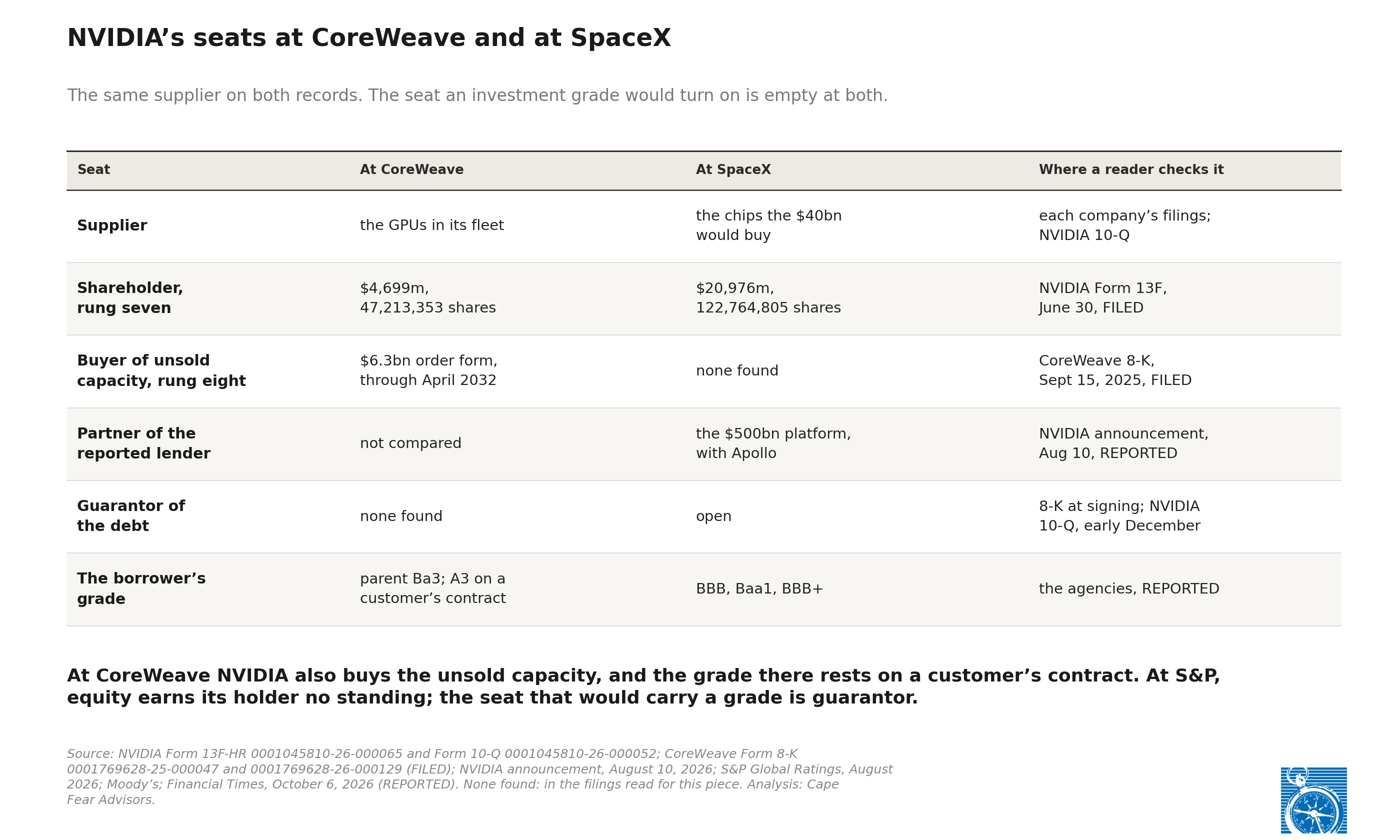
Most of what will be written about this deal this week asks whether NVIDIA will take part. On the record it already has, three ways.
NVIDIA’s second-quarter Form 13F carries Space Exploration Technologies at $20,976m, 33.1 percent of its reported equity book of $63,440m.(18) [FILED] NVIDIA is the supplier of the chips the $40 billion would buy, at a filed gross margin of 74.93 percent in the quarter ended April 26.(19) And through the platform it is a partner of the reported lead lender. Three seats are filled before any document is signed: supplier, shareholder and partner of the lender. The open seat is guarantor.
Our published ladder of vendor support says where each sits. NVIDIA holds rung seven, equity in the counterparty, and stands on rung eight, contingent support, at up to $105 billion for one campus; rung six, vendor lending, stayed empty in every filing we have read.(20) S&P has said what rung seven buys: it excludes Amazon’s stakes in Anthropic and OpenAI, and Microsoft’s 27 percent of OpenAI, from those holders’ credit metrics.(21) At S&P, equity in a counterparty earns its holder no standing, so the question for this deal is whether NVIDIA steps onto rung eight in its credit form, as a guarantor.
CoreWeave is the comparison we already hold, and it shows why the form matters. There NVIDIA holds $4,699m of stock, and since September 2025 it has been obligated to buy CoreWeave’s unsold cloud capacity through April 2032 under an order form with an initial value of $6.3 billion: rung eight in its revenue form.(22) [FILED] CoreWeave’s parent is rated Ba3, and the A3 in its structure rests on a customer’s contract.(14) At CoreWeave NVIDIA also holds the capacity-buyer seat, which the SpaceX filings we have read leave empty, and it sits beside a parent below investment grade. The seat that would carry a grade, guarantor, is empty at both companies on the record we have read.
A customer that is a shareholder of its supplier, financed by the supplier’s platform partner, to buy the supplier’s product, is circular in shape. It is also ordinary in kind: arrangements of this shape appear in capital-intensive industry whenever the capital has to arrive before the revenue does. The filings say who holds which seat, and stop there.
Where it would land
Off balance sheet is a disclosure question as much as a financing one, and each route lands in a different place.
If SpaceX borrows directly, the debt sits on its balance sheet and in every leverage ratio, and the obligation reaches a current report. When SpaceX sold $25 billion of notes in June it reported them under Item 8.01, Other Events, and attached the indenture. No SpaceX current report carries Item 2.03, the item written for a new direct financial obligation.(23) [FILED] The substance was complete either way, and the item is the filer’s election.
If a vehicle buys the chips and leases them back, the landing depends on the accounting. A failed sale lands as debt, as Valor’s did. A successful one lands as a lease liability, pooled in the lease note with every other lease.
All of it sits outside the existing noteholders’ covenant. The June indenture’s one restrictive covenant, Section 4.08, limits debt secured on “Principal Property,” a closed list of plants, spaceports and research, design, administrative and sales facilities, and data centers are absent from the list. Section 4.08(a) separately excepts liens that secure the acquisition of property.(24) [FILED; the reading is ours.]
Oracle, at the edge
The contract half of the argument has a guardrail, and Oracle is where it shows. S&P cut Oracle to BBB-, the lowest investment-grade notch, on July 9, and its own forecast has Oracle at 4.4x against a 4.5x threshold in fiscal 2027 and 2028.(25) [REPORTED] The market has sat nearer the line than the rating has: Oracle’s five-year credit default swaps were reported at about 203 basis points in late July, the widest since 2008.(26) [REPORTED] What holds Oracle on the line is its customers’ money: $11,363m of prepayments carrying a significant financing component in its first fiscal quarter, 49 percent of its operating cash flow.(27) [FILED]
A covenant written the CoreWeave way counts an Oracle contract at 100 cents today and at 75 the day Oracle crosses. With every contract unchanged, each structure leaning on Oracle’s standing re-weights at once. An investment-grade customer can carry a structure, and a customer’s grade can move.
What we want, and what we watch
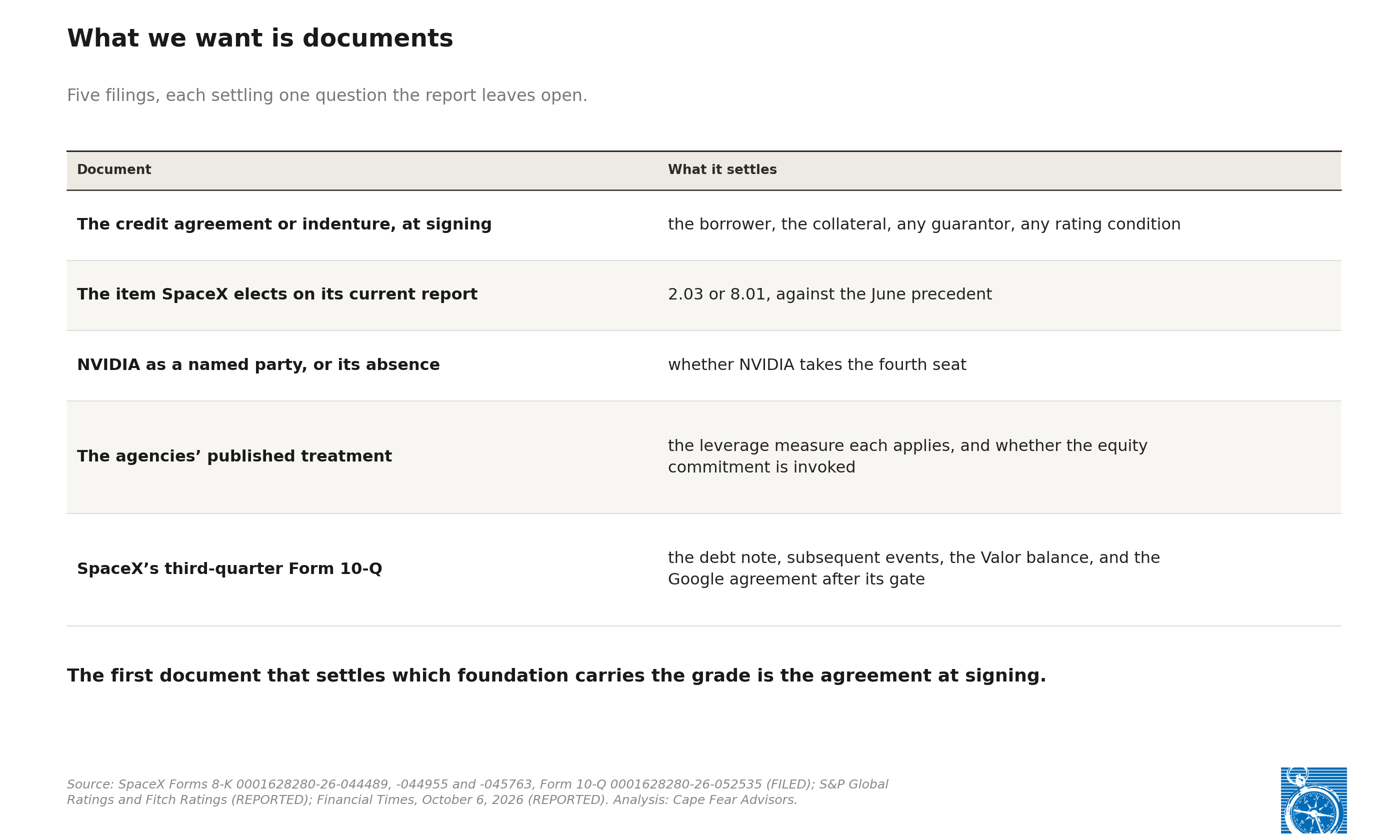
What we want is documents.
What we watch is dates.
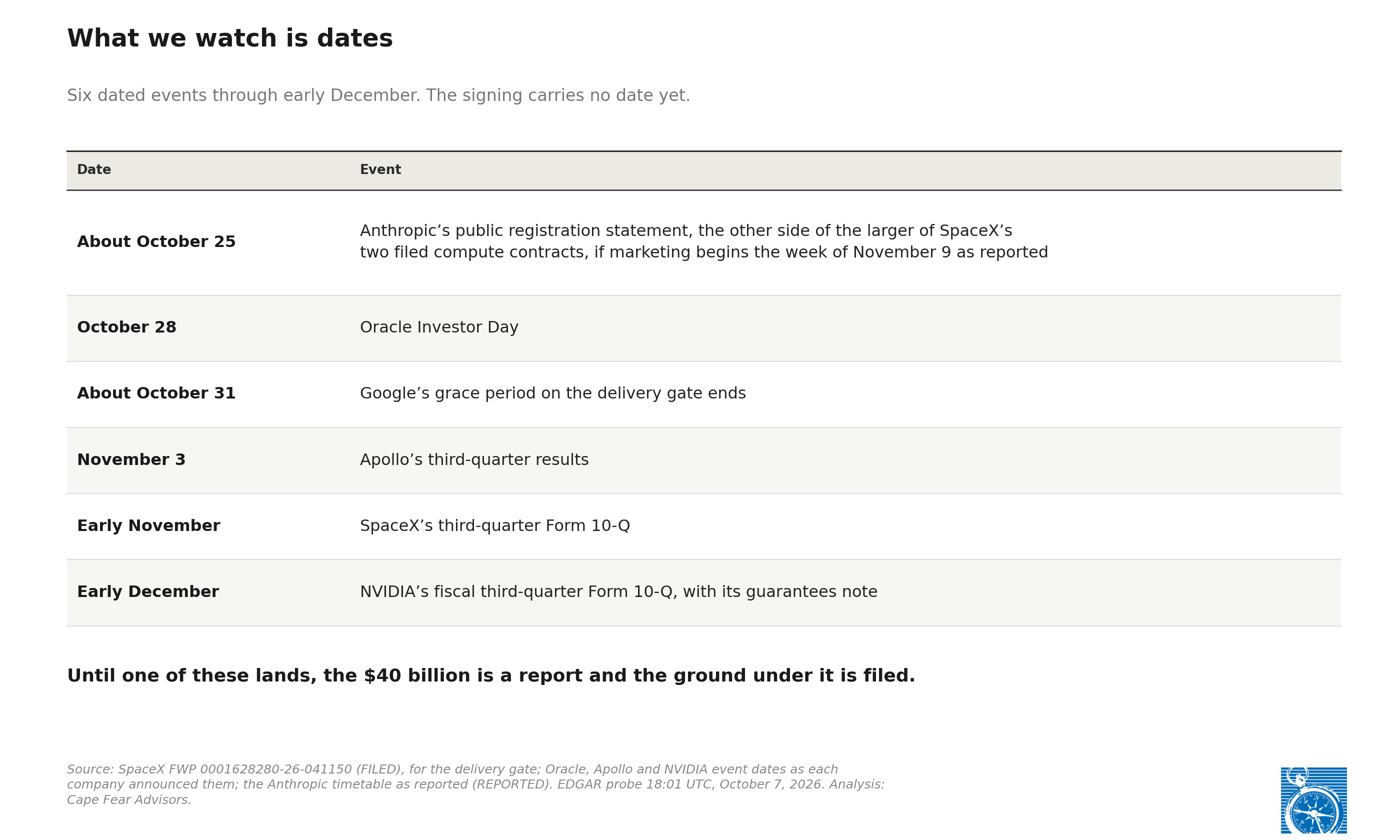
Until one of these lands, the $40 billion is a report and the ground under it is filed. The first document that settles which foundation carries the grade is the agreement at signing. We will read it the day it is filed and print what it says, whichever foundation it names.
Free to read, no paywall. Readers who find the work useful can support it at the foot of the page; payment offsets the time and buys no access. Corrections run in daylight, dated, in a comment or in the following piece, and a reader who finds one is doing us a favor.
Standing Disclosure
Cape Fear Advisors holds no direct position, long or short, in the securities discussed here. Any exposure is indirect, through managed funds it does not control, which may include index funds holding the public companies named.
Anthropic is the developer of Claude, which is used in preparing this research. In this piece Anthropic is the counterparty to one of the two SpaceX contracts read, and the piece describes Anthropic’s lack of a published rating. Every figure about that contract carries a public source, and no claim here rests on trust in the tool. NVIDIA, Oracle, CoreWeave, Alphabet, IREN, Apollo, Amazon and Microsoft are read for their own filed documents, published ratings and reported terms only. Figures are quoted without characterization, and nothing here identifies an error, an inconsistency or a bad actor. This piece makes no market call, no forecast and no rating call, takes no view on any security, and states no view on what any filer was required to disclose.
Notes
(1) REPORTED. Financial Times, October 6, 2026, as carried by Reuters and Bloomberg the same day. Deal structure, collateral, guarantor, tenor and pricing are unreported.
(2) FILED. SpaceX submissions record, CIK 0001181412, read at source at 18:01 UTC on October 7, 2026: most recent filing a Form 4/A, accession 0001213900-26-105393, September 30. Full-text search for “Space Exploration Technologies” at 8-K scope returned no current report in October at the same time.
(3) FILED. SpaceX Form 10-Q for the quarter ended June 30, 2026, accession 0001628280-26-052535, related-party note: $2,039m current and $11,290m long-term, $13,329m in all, from $4,507m at December 31, 2025; related-party interest $327m in the quarter and $513m for the half. The 9.81 percent is 327 times four over 13,329. It is a floor in the sense that any average balance below the ending balance makes the rate higher; the balance rose from $4,507m to $13,329m across the half. The June notes’ weighted average effective rate of 6.030 percent at June 30 is from the debt note of the same report; 9.813 less 6.030 is 3.78, printed as at least 3.7.
(4) OURS. “SpaceX, Adding It Up: The $430 Billion Cash Gap,” August 29, 2026, which sets out the stack, the $75,009m of movable cash and the fungibility framework.
(5) REPORTED. Agency ratings as published at initiation in June 2026 and carried in S&P’s August presentation and Fitch’s June commentary.
(6) REPORTED. S&P Global Ratings, presentation on the hyperscalers, August 2026, credit metrics and company slides: rating BBB/Stable, downgrade threshold 2.0x, debt capacity $78.5bn, EBITDA of $9.8bn for the twelve months to June 30, 2026, adjusted debt of zero, $495bn of capital spending 2026 to 2028 with about half discretionary, and a company commitment to issue equity if leverage approaches 3x.
(7) REPORTED. Fitch Ratings, commentary of June 18 and June 22, 2026: BBB+, stable; downgrade sensitivity at EBITDA leverage sustained above 2.5x; rating case about 1.7x at year end 2026 and 1.9x at year end 2027; upgrade sensitivities including “demonstrated adherence to stated financial policy over multiple reporting periods, including willingness to curtail investment to preserve credit metrics.”
(8) FILED, FURNISHED and OURS. Total debt of $38,433m at June 30, 2026 from the Form 10-Q in note (3): SpaceX Notes $25,000m, other financings $13,406m, X notes $27m. Second-quarter adjusted EBITDA of $3.5bn from SpaceX’s second-quarter release, furnished August 4, 2026, accession 0001628280-26-052515, annualized to $14.0bn. S&P’s $9.8bn per note (6). The ratios are ours: 38,433 and 78,433 over each base. The Fitch inference: 38,433 over 1.9 is 20,228; 2.5 times 20,228 less 38,433 is 12,137; 40,000 over 12,137 is 3.296, printed as 3.29. 38,433 over 14,000 is 2.745, printed as 2.74; 40 over 78.5 is 50.96 percent, printed as 50.9. Each is floored, in the direction away from the argument.
(9) FILED. SpaceX final prospectus, Form 424B4, accession 0001628280-26-042639: “Pursuant to these agreements, the customer has agreed to pay us $1.25 billion per month through May 2029, with capacity ramping in May and June 2026 at a reduced fee. After the initial three-month period, the agreements may be terminated by either party upon 90 days’ notice.”
(10) FILED. SpaceX free writing prospectus under Rule 433, June 5, 2026, accession 0001628280-26-041150. The final prospectus describes the Anthropic agreements and no other compute agreement; probe and hours in “Adding It Up: How to Read an AI Headline,” September 30, 2026.
(11) FILED. SpaceX correspondence to the staff, June 1, 2026, accession 0001628280-26-039278.
(12) FILED. CoreWeave Parent Guarantee, Exhibit 10.2 to accession 0001769628-26-000357, August 7, 2026, Section 6.9(b), Minimum Contracted Revenue, read at source October 7, 2026: “the sum of (i) the reasonably projected contracted revenues from such contracts with counterparties which have an Investment Grade Rating (as defined in the Revolving Credit Agreement) and (ii) the product of 0.75 and the reasonably projected contracted revenues from such contracts with counterparties which do not have an Investment Grade Rating.” The test applies to the extent Section 7.02 of the Revolving Credit Agreement requires it. The sentence weights the counterparty’s rating alone.
(13) REPORTED. Alphabet’s ratings, AA+ from S&P and Aa2 from Moody’s, as carried in our record since July 2026. The counterparty to the agreement is Google; the rating is its parent’s.
(14) FILED and REPORTED. DDTL 4.0, Form 8-K accession 0001769628-26-000129; the A3 and A (low) ratings and the parent’s Ba3 are REPORTED; the customer’s identity is REPORTED. CoreWeave’s own presentation describes the rating as “supported by a long-term customer contract with an investment-grade AI enterprise” (FURNISHED).
(15) REPORTED. Corey Trinetti, “Microsoft’s Childress, Texas, Data Centers: A $9.7 Billion AI Cloud Owned by IREN,” Measured AI, October 6, 2026, from IREN’s disclosures: a $1.5bn delayed-draw term loan and $2.1bn of 5.96 percent notes due December 31, 2031, fully amortizing from Microsoft’s fees, rated Asf by Fitch and A (low) by Morningstar DBRS.
(16) REPORTED. NVIDIA’s announcement of August 10, 2026, carried on the chief executive’s account: “In some cases, NVIDIA may provide a residual-value support mechanism for up to 25% of an opportunity.” The agency figure is from a rating action of September 2026 recording the option to provide credit support for up to 25 percent of the aggregate financing raised through the platforms.
(17) REPORTED. NVIDIA’s ratings, Aa1 from Moody’s and AA from S&P, as affirmed in September 2026.
(18) FILED. NVIDIA Form 13F-HR for the quarter ended June 30, 2026, accession 0001045810-26-000065. 20,976 over 63,440 is 33.06 percent, printed as 33.1.
(19) FILED. NVIDIA Form 10-Q for the quarter ended April 26, 2026, accession 0001045810-26-000052.
(20) OURS and FILED. The ladder is set out in “NVIDIA, The Scarce Thing Is a Credit Standing,” August 27, 2026. The residual value guaranties, cumulatively capped at $105 billion, are FILED, Form 8-K accession 0001045810-26-000069, Items 1.01, 2.03 and 7.01, and Exhibit 10.1 to Form 10-Q accession 0001045810-26-000075.
(21) REPORTED. S&P presentation per note (6), company slides.
(22) FILED. NVIDIA Form 13F-HR per note (18): CoreWeave Class A, 47,213,353 shares, $4,699,617,158. CoreWeave Form 8-K, accession 0001769628-25-000047, filed September 15, 2025, Item 1.01, read at source October 7, 2026: an order form of September 9, 2025 under the Master Services Agreement of April 10, 2023, “which has an initial value of $6.3 billion,” under which NVIDIA “is obligated to purchase the residual unsold capacity through April 13, 2032.” “Empty at both companies” is scoped to the filings this shelf has read for each; it records a failure to find.
(23) FILED. SpaceX Forms 8-K of June 22, June 23 and June 26, 2026, accessions 0001628280-26-044489, 0001628280-26-044955 and 0001628280-26-045763, each under Item 8.01 with Item 9.01; the indenture is Exhibit 4.1 to the last. The submissions record in note (2) carries no SpaceX current report under Item 2.03.
(24) FILED. Indenture of June 26, 2026, Exhibit 4.1 to accession 0001628280-26-045763, Section 1.01 definitions of “Principal Property” and “Secured Debt,” and Sections 4.08 and 4.09, read at source October 7, 2026. The 7.5 percent of Consolidated Total Assets basket in Section 4.09 applies to Secured Debt that Section 4.08 would otherwise reach. That a GPU in a data center falls outside the definition is our reading of the closed list.
(25) REPORTED. S&P presentation per note (6), credit metrics and leverage slides; Oracle downgraded to BBB- on July 9, 2026.
(26) REPORTED. Bloomberg, as carried by AI Weekly, July 28, 2026, updated August 10, 2026: Oracle five-year credit default swaps at about 203 basis points, the highest since the 2008 financial crisis.
(27) FILED and FURNISHED. Oracle Form 8-K, accession 0001193125-26-387905, Exhibit 99.1, condensed consolidated statement of cash flows for the three months ended August 31, 2026: “Increase in deferred revenues from customer prepayments with significant financing component” $11,363m against net cash provided by operating activities of $23,103m. The percentage is ours.
Analysis: Cape Fear Advisors.
This piece also appears on Substack. Cape Fear Advisors is an independent advisory firm based in Portsmouth, NH.
Contact Cape Fear Advisors