


CoreWeave’s unsecured bonds closed at their highest yields since issue this week, the notes due 2031 at 968 basis points over Treasuries, at the edge of the 1,000 where a bond is called distressed, and investors judged the door to new unsecured borrowing shut. The secured door stays open, on terms written against the customer’s credit rating: two filed documents cap lending at 90 cents against an investment-grade customer’s contract and at 75 against anyone else’s, and the frontier labs sit on the 75 side. The flex is what a supplier hands back from its own margin so its customer can keep buying: about 13 percent of NVIDIA’s margin against an investment-grade contract, 33 against the rest. This piece reads how far it stretches, and what the record says happens at its end.
The week, as the record shows it
On October 13 every CoreWeave senior note closed at its highest yield since issue, the 9.75 percent notes due 2031 at 968 basis points over Treasuries of the same maturity. The next day, in trades of unstated size, those notes changed hands at 15.21 percent and the 9.625 percent notes due 2032 at 15.08 percent, about 1,021 and 1,005 basis points over.[1] A spread of 1,000 basis points is where the industry starts calling a bond distressed, and the Wall Street Journal reported investors’ view that CoreWeave “likely can’t issue more unsecured bonds” at these levels; secured loans against customer contracts, and equity, remain open to it.[2]
On Thursday NVIDIA’s chief executive, whose company holds CoreWeave stock, said “their cost of capital is actually decreasing.”[3] The filings price the next dollar higher. CoreWeave has priced two kinds of borrowing twice since the spring, and both times the second price was the higher: the parent-guaranteed delayed-draw loan at SOFR plus 4.50 in May and SOFR plus 5.50 in August, the convertible coupon at 1.75 percent in April and 2.875 percent in September.[4] The next dollar also comes tied to its use and to a customer’s credit: it is lent against a named contract, at an advance that customer’s rating sets. The book’s weighted effective rate fell, from 9.49 percent at December 31 to 8.41 percent at June 30, as a 2 percent convertible and a 7 percent loan against an investment-grade customer’s contract came in and loans at 15 and 11 percent were paid down.[4] That fall is a change of mix; read at the margin, the cost of CoreWeave’s debt is rising. A portfolio manager at AllianceBernstein put the week in one line: higher rates are “an effective tax on marginal borrowers, and the marginal borrower in the AI trade is anyone who’s not a high-quality hyperscaler.”[2]
In Bridge Work we described a change in temperature: money still moving, at a higher price and with more conditions attached. This week is a reading on that thermometer. Whether it is a cooling or a cold front is open, and the rest of this piece reads where the line between them is drawn.
The rating follows the contract
Two filed documents set the terms on which CoreWeave borrows against its customers.
The first is the indenture for its 9.625 percent notes due 2032, signed June 18. It caps any loan to a CoreWeave special-purpose vehicle at 90 percent of the collateral’s value where a material portion of the vehicle’s contracts are with investment-grade counterparties, and at 75 percent where they are with anyone else, and it lets the parent guarantee such loans on the same two caps. One customer has a row of its own: loans against the OpenAI contracts are capped at 75 percent, at 90 if OpenAI carries an investment-grade rating, with $7.0 billion of such debt allowed in all.[5]
The second is the parent guarantee on the August delayed-draw loan. It requires at least $1.0 billion of contracted revenue, and it counts that revenue at full value from investment-grade counterparties and at 75 cents on the dollar from other counterparties.[6]
The advance rates CoreWeave has signed sit on those lines. The March loan, against a contract with an investment-grade customer reported as Meta, advances 90 percent and carries an A3 rating. The May loan advances 71.42 percent and the August loan 70.[7] Nscale’s prospectus shows the same ladder at a second neocloud: its Ward County facility, against Microsoft’s contract, advances up to 90 percent of GPU capital spending at SOFR plus 2.375, within 12.5 basis points of CoreWeave’s March loan.[8]
The bondholders wrote the customer’s credit rating into the parent’s own covenant. A contract with an investment-grade customer borrows 90 cents and counts in full; a contract with anyone else borrows 75 and counts at 75.
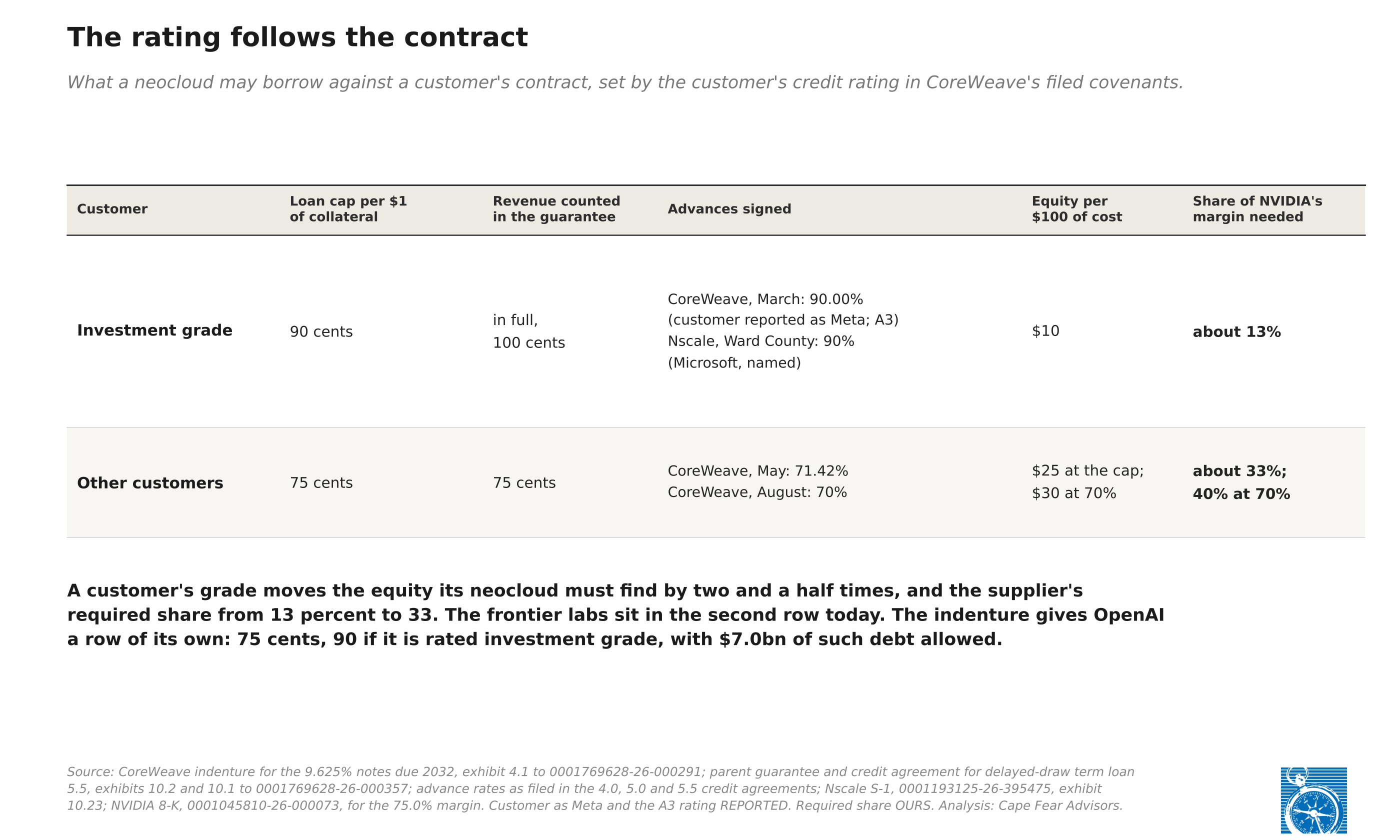
The frontier labs sit on the 75 side today. Anthropic carries no rating from Moody’s, S&P or Fitch; Kroll Bond Rating Agency rated it BB+ in June, one notch below investment grade, on financial information Anthropic supplied.[9] Its contracts and Jane Street’s are reported as the two largest in CoreWeave’s August facility.[10] Bankers for Anthropic and OpenAI are pressing the large agencies for investment-grade ratings once the labs list.[9] CoreWeave’s financing chief told the Financial Times this week that contracts with lower-rated customers will reach what he called “the insurance tranche” in time (“I do think it’ll get there”), and that the labs’ listings would help.[11] Insurance money would be a new lender on the second row, and its advance rate will be on file when such a facility closes. The labs’ grade is the variable the next contract is written on.
The flex, in one formula
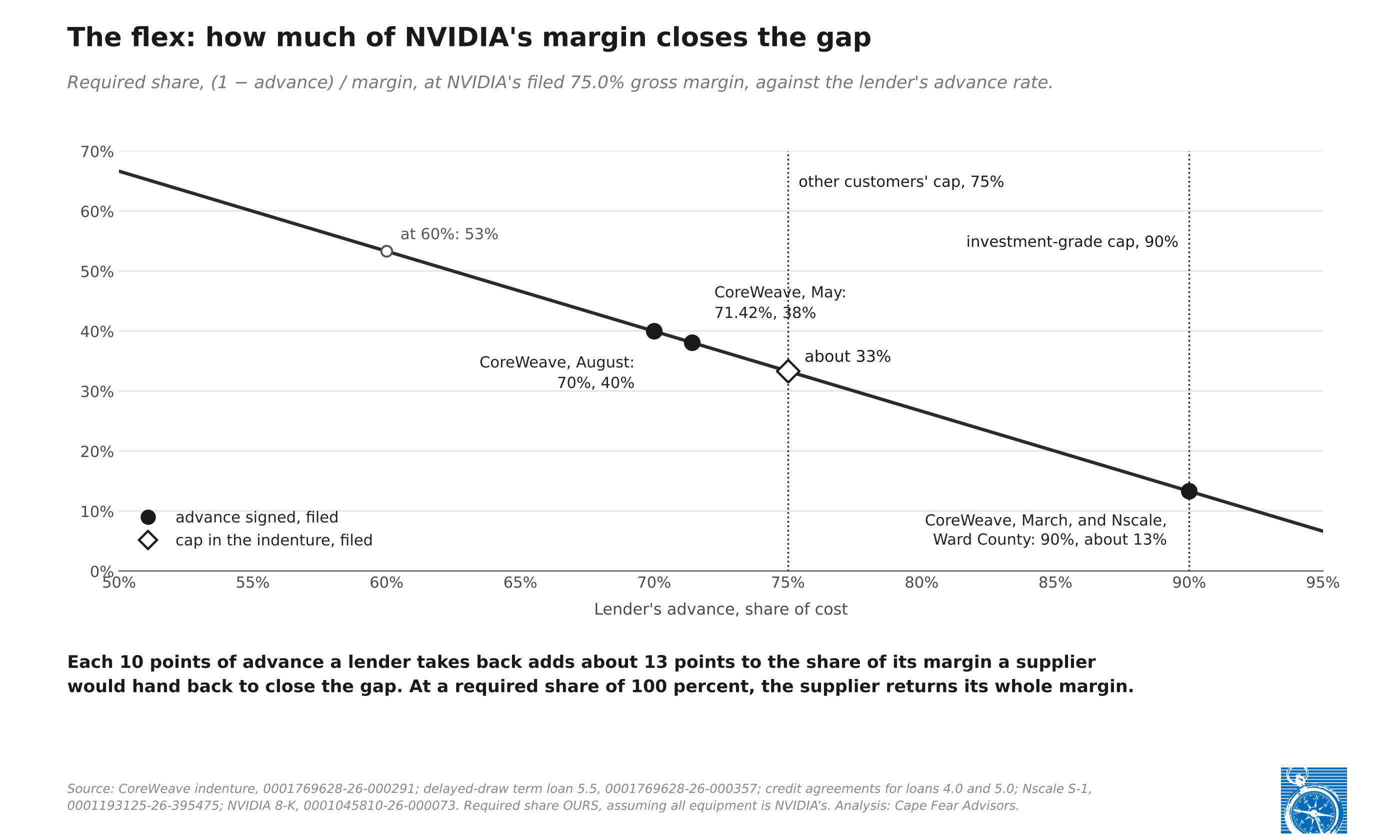
The required share measures it.[12] On $100 of NVIDIA equipment at NVIDIA’s filed gross margin of 75.0 percent, NVIDIA keeps $75 of gross profit. A lender that advances a share of the cost leaves the rest for the borrower to find, and that remainder, divided by the supplier’s margin, is the share of its own profit the supplier would have to hand back to close the gap.
At the investment-grade cap of 90 percent, the neocloud finds $10 and the required share is about 13 percent. At the 75 percent cap for other customers, it finds $25 and the share is about 33 percent. At CoreWeave’s August advance of 70, it is $30 and 40 percent; at 60, $40 and 53 percent. A customer’s credit rating moves the equity its neocloud must find by two and a half times, and the supplier’s required share from 13 percent to 33. Each 10 points of advance a lender takes back adds about 13 points to the share.
The August loan says where its gap is filled. Its advance is 70 percent of capital spending “funded in cash,” and its definition of the equity behind the other 30 counts “contributions to the Borrower from the proceeds of Indebtedness” incurred by a parent.[13] The lender’s own document counts the parent’s debt, passed down, as the equity at the gate. In September CoreWeave sold $4.2 billion of convertible notes and kept about $3.6 billion after the purchasers’ discount and the cost of the capped calls.[13] This week investors said that door is shut at these prices. Beyond the parent’s cash on hand, what remains at the gate is the share program running since September 17, and the supplier.[14]
Suppliers already carry part of the gap, each in its own instrument. NVIDIA bought $2.0 billion of CoreWeave stock in January, holds an order to buy CoreWeave’s unsold capacity, about $6.3 billion through April 2032, and has filed residual value guaranties capped at $105 billion behind data centers leased to OpenAI.[15] Broadcom’s June quarterly report carries a guarantee of up to $29 billion of a customer’s lease payments to the vehicle that bought Google’s chips for Anthropic; separately, the Financial Times reported this week that about $4.4 billion of the $35 billion that vehicle borrowed rests on Anthropic’s own credit. One figure guarantees the rent, the other describes the vehicle’s debt, and they measure different things.[16]
Lucent ran the flex to its end a generation ago, as we set out in Tuesday’s piece: $8.1 billion of customer financing commitments in September 2000, and a gross margin that fell from 40.5 percent to 9.7 the following year.[17] NVIDIA’s margin is 75.0 percent and 2026 is a different market; the comparison is sequence and carries no forecast.
At a required share of 100 percent, a supplier hands back its whole margin to make the sale. Short of that point, the neocloud’s lender decides how much of the supplier’s output is bought with someone else’s money.
Where the flex ends: inside the fence
The fence is drawn in the same indenture. CoreWeave’s delayed-draw loans sit in special-purpose vehicles that own the GPUs and the customer contracts. Each dollar the chips earn pays interest, principal and running costs first, and about 20 cents reaches the parent, on the account CoreWeave’s financing chief gave this week.[11] The indenture lists the existing vehicles by name and lets the company designate future ones “at its sole discretion and at any time,” and the September convertible keeps the vehicles out of its own default test.[5][18] S&P rates the parent B+ and its unsecured notes a notch lower at B, with expected recovery of 10 to 30 percent in a default; the vehicles’ lenders stand first on what sits inside the fence.[19]
The record has run this course already, in the same cast. Iris Energy, now IREN, financed bitcoin miners through non-recourse vehicles. Two defaulted in November 2022, a receiver was appointed in February 2023, and in August 2023 a court approved the sale of the machines to the lender through a stalking-horse process it found commercially reasonable. The parent kept its sites and became an AI cloud.[20]
The flex ends at the first contract whose gap the suppliers decline to carry, and the first owner to change is the vehicle’s. The structure implies that order; whether it comes to pass is open. The asset stays and the owner changes, as we set out on Tuesday.[21]
Where each party stands when its price is strongest
NVIDIA, Micron and the neoclouds are all pricing at or near their peaks. These are shortage prices, set in the market and written into contracts both sides signed. The subject here is what a peak price does to the financing beneath it, and the cost structure decides what each peak pays. High prices make every seller look brilliant; the cost structure decides who is still standing when they come down. Memory has run this cycle for decades, and Micron’s filings carry it end to end.
Micron’s gross margin was negative 32.7 percent in the quarter ended March 2, 2023, on $3.7 billion of revenue. In the quarter ended September 3, 2026, it was 86.8 percent, on $54.2 billion.[22] The annual report says why: margins “improved primarily due to increases in average selling prices,” and cash from operations “is highly dependent on selling prices for our products.”[23] The margin is the memory price, read through a cost structure that moves slowly. Since 2009 the share price and the margin have risen and fallen together, and at the last two turns the price moved first: its quarter-end high came in May 2018, a quarter before the margin peaked at 61.0 percent, and it had stopped falling by August 2022, two quarters before the margin bottomed.[24] This quarter the margin set a record, and on October 16 the price stood about 16 percent below its September close. That is sequence and carries no forecast.
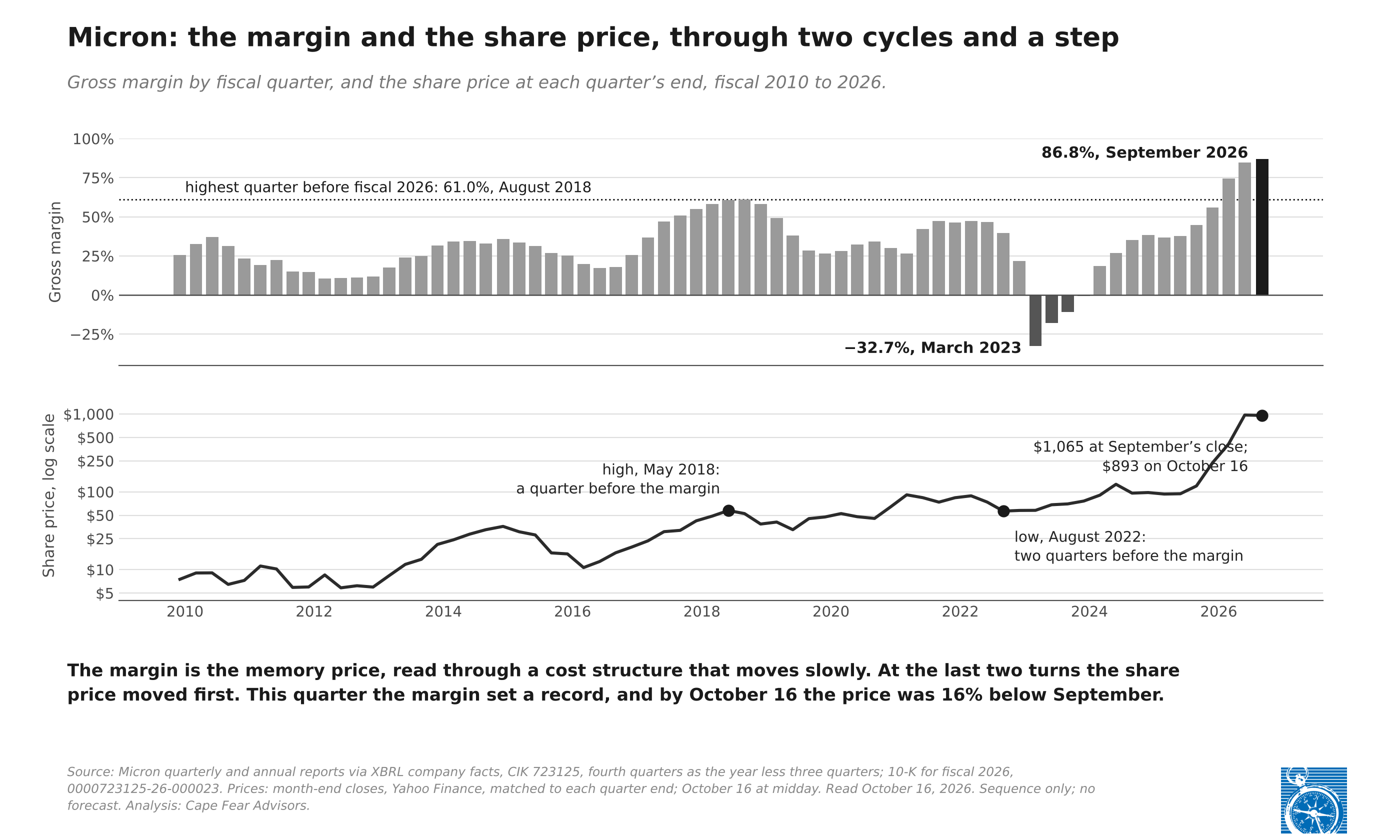
The required share carries a margin in its denominator, and the shares in this piece divide by NVIDIA’s 75.0 percent, a margin struck at prices at or near their peak. At a margin of 60 percent, the investment-grade cap would ask 16 percent of it and the 75 cap 41; at 50, it would ask 20 and 50.[12] A supplier’s room to carry the flex is widest at its peak margin, where the share it would return is smallest and the margin it returns from is largest; as the margin falls, both move against it. Micron’s record shows how far a margin travels: from 61.0 percent to negative 32.7 in under five years, and to 86.8 three and a half years after that.[22]
Whether Micron’s present cycle is the same kind as the last two is open. Revenue went from $11.3 billion to $54.2 billion in four quarters, and this year Micron signed multi-year agreements with price floors and took $12.75 billion of its customers’ cash on deposit. It expects those agreements, “even at floor pricing levels, to yield gross margins meaningfully above our peak quarterly margins in any past cycle.”[23] At the trough the industry tells the story from the other side: Apple and other customers “squeezed suppliers during past downturns, sowing the seeds for current shortages, memory executives say.”[25]
Micron prices at the peak on fabs partly depreciated, so the price reaches the margin almost whole, and its floors are signed with its customers’ cash on deposit. The neoclouds price at their peak too; CoreWeave raised its prices by about 25 percent in July.[26] They do it on new machines at full depreciation, financed at this year’s cost of money, and the contract they sign is the one a lender advances against at 90 or at 75. At the peak a memory maker collects deposits from its customers; a neocloud posts the equity its lender leaves to it, and the supplier fills what it chooses to.
What we want, and when
The flex holds if the labs list with investment-grade ratings and the advance rates on the next facilities move back toward 90, if renewal prices hold where contracts reprice, and if the unsecured market reopens to CoreWeave below the distressed line. It runs short if advance rates fall below 70, if the required share climbs past what the suppliers carry, or if a vehicle defaults. The documents that settle each arrive on a calendar, set out in the exhibit, and each one can move the reading either way.[27]
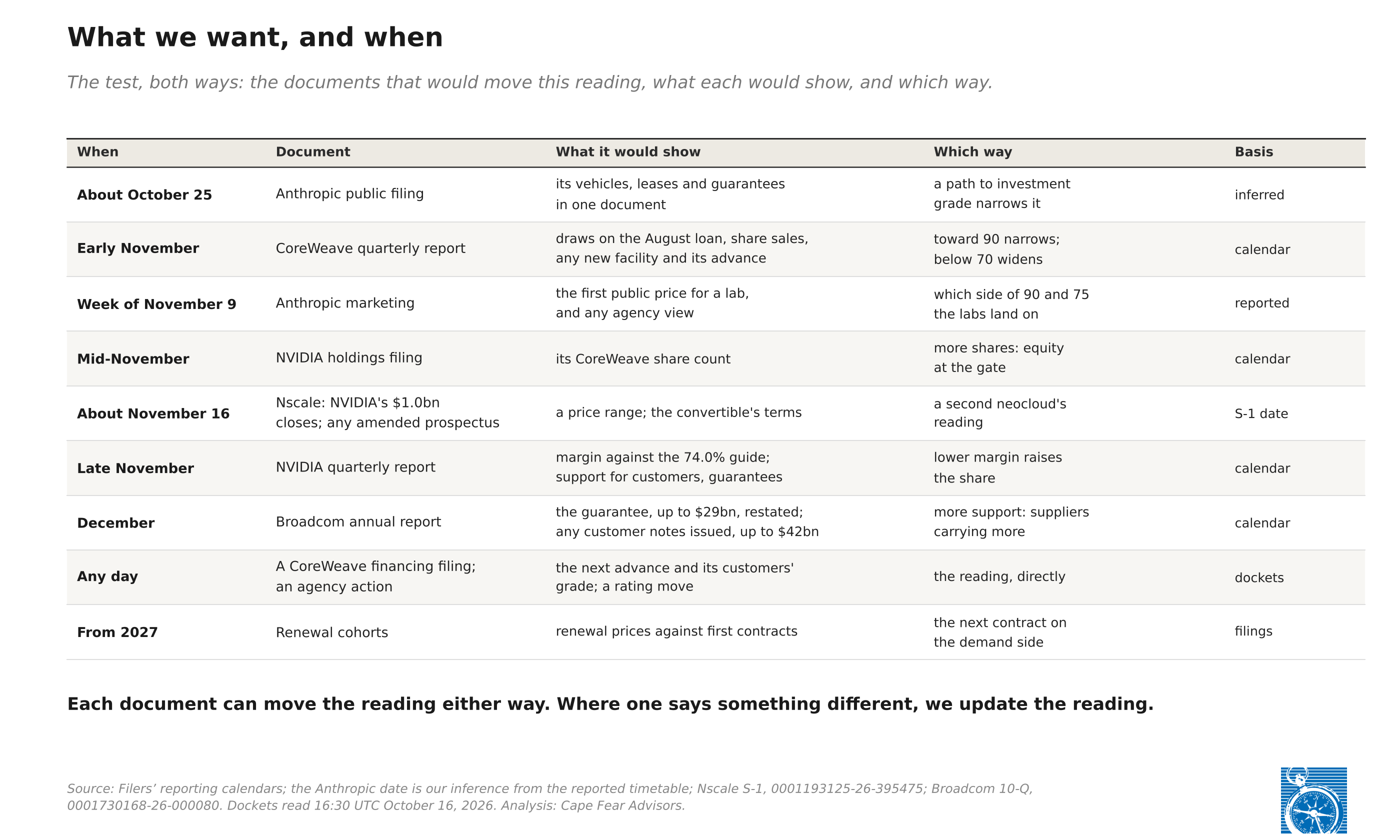
The record says where the line is drawn. The next filings say which side of it the labs land on, and where a document says something different, we update the reading.
Free to read, no paywall. Readers who find the work useful can support it at the foot of the page; payment offsets the time and buys no access. Corrections run in daylight, dated, in a comment or in the following piece, and a reader who finds one is doing us a favor.
Standing Disclosure
Cape Fear Advisors holds no direct position, long or short, in the securities discussed here. Any exposure is indirect, through managed funds it does not control, which may include index funds holding the public companies named.
Anthropic is the developer of Claude, which we use in preparing our work. In this piece Anthropic appears as a counterparty in CoreWeave’s and Nscale’s financing and as the lessee in the vehicle Broadcom guarantees; NVIDIA, Broadcom and Alphabet, named here, supply or invest in the companies that serve it. OpenAI appears as a counterparty named in CoreWeave’s indenture and NVIDIA’s filings. Every figure carries a public source, and no claim here rests on trust in the tool. Figures are quoted without characterization, and nothing here identifies an error or a bad actor. This piece is research, not investment advice. It makes no market call, no forecast and no rating call, and takes no view on where any security is headed.
Notes
Rounding: shares of a supplier’s margin are rounded down, so each printed share is at or below the arithmetic; company figures are carried as filed or rounded conventionally to one decimal; spreads to the nearest basis point.
[1] FINRA TRACE, trades in CoreWeave’s 9.25 percent notes due 2030, 9.00 and 9.75 percent notes due 2031 and 9.625 percent notes due 2032 (FINRA symbols CRWV6083302, CRWV6130541, CRWV6364372, CRWV6424531), read October 13 and 14, 2026. October 13 closing yields: 13.05, 13.76, 14.68 and 14.60 percent, each the note’s highest since issue; spreads 812, 879, 968 and 956 basis points. October 14 intraday trades, sizes unread: 13.44, 14.08, 15.21 and 15.08 percent; spreads 849, 911, 1,021 and 1,005 basis points. Spreads are ours, against the U.S. Treasury daily par yield curve for each date, interpolated linearly to each note’s maturity. The Wall Street Journal (note 2) independently reports the 2031 notes more than 10 percentage points over the comparable Treasury. [REPORTED market data; spreads OURS]
[2] David Uberti, Jack Pitcher and Sam Goldfarb, “The Riskiest Corner of the AI Trade Is Crashing Into Higher Rates,” Wall Street Journal, October 15, 2026: the distressed threshold at 10 percentage points over the comparable Treasury; investors and analysts on unsecured issuance and the secured and equity alternatives; the quotation from Ali Bendarkawi of AllianceBernstein. [REPORTED]
[3] Brian Sozzi, “Nvidia CEO Jensen Huang addresses CoreWeave stock plunge,” Yahoo Finance, October 15, 2026, quoting remarks at a Bloomberg event in Stockholm. NVIDIA’s holding of 47,213,353 CoreWeave Class A shares at June 30, 2026, Form 13F-HR, accession 0001045810-26-000065. [REPORTED; FILED]
[4] CoreWeave, Form 10-Q for the quarter ended June 30, 2026, accession 0001769628-26-000366, debt note: effective interest rates by instrument, weighted by carrying principal ($21,615 million at December 31, 2025; $35,551 million at June 30, 2026), 9.49 and 8.41 percent; delayed-draw term loan 5.0, May 2026, SOFR plus 4.50 percent. Delayed-draw term loan 5.5, Form 8-K accession 0001769628-26-000357, August 7, 2026, Term SOFR plus 5.50 percent. Convertible coupons of 1.75 percent (April 2026, due 2032) and 2.875 percent (September 2026, due 2033, note 13). The weighting is ours. [FILED; arithmetic OURS]
[5] CoreWeave, indenture for the 9.625 percent senior notes due 2032, dated June 18, 2026, exhibit 4.1 to Form 8-K accession 0001769628-26-000291: the definitions of “Existing SPV,” “Future SPV” and “Future SPV Credit Agreement” (an LTV Ratio of no greater than 90.0 percent where a material portion of the SPV’s contracts are with investment-grade counterparties, and 75.0 percent otherwise); clause (24) of permitted indebtedness, permitting parent guarantees on the same caps; the OpenAI contract terms (75 percent, 90 percent if OpenAI holds an investment-grade rating, 100 percent loan-to-cost for pure equipment debt, $7.0 billion aggregate). The “material portion” test is the indenture’s term. [FILED]
[6] CoreWeave parent guarantee for delayed-draw term loan 5.5, exhibit 10.2 to accession 0001769628-26-000357, Section 6.9(b): contracted revenues of at least $1,000,000,000, counting contracts with counterparties holding an Investment Grade Rating in full and others at “the product of 0.75.” The rating is defined in the revolving credit agreement as amended November 10, 2025 (exhibit 10.7 to accession 0001769628-25-000062): a corporate family rating of at least BBB- from S&P or Baa3 from Moody’s. [FILED]
[7] Advance rates as filed in CoreWeave’s credit agreements for delayed-draw term loans 4.0 (90.00 percent), 5.0 (71.42 percent) and 5.5 (70 percent; exhibit 10.1 to accession 0001769628-26-000357, “the product of (x) 70% and (y) Funding Date Capital Expenditures”), as compiled in our ”NVIDIA, What Comes Back,” August 22, 2026. The 4.0 facility’s A3 rating and its customer as Meta are REPORTED; CoreWeave’s own presentation describes the customer as “an investment-grade AI enterprise.” [FILED; REPORTED; FURNISHED]
[8] Nscale Ltd, Form S-1, September 18, 2026, accession 0001193125-26-395475, “Description of Certain Indebtedness” and exhibit 10.23: the Ward County GPU Facility, $1,850.0 million, Microsoft Corporation named as customer, SOFR plus 2.375 percent, advance the lesser of 90 percent of GPU capital expenditure and a 1.30x debt service coverage sizing. [FILED]
[9] Michelle Chan, Rafe Rosner-Uddin and George Hammond, “Anthropic secured highest junk credit rating in June,” Financial Times, October 16, 2026, on documents seen by the FT: KBRA’s BB+ issuer rating; the information supplied and withheld; bankers’ approaches to the large agencies; the $4.4 billion of junior debt. [REPORTED]
[10] The two largest committed contracts in delayed-draw term loan 5.5, Anthropic and Jane Street, as reported by Rod Dubitsky, October 15, 2026, and in our ”CoreWeave, the DDTL 5.5 Participant Ledger,” August 14, 2026. [REPORTED]
[11] Ryan McMorrow, “CoreWeave targets ‘unlimited’ insurance money to fund AI build-out,” Financial Times, October 14, 2026, quoting Brannin McBee, CoreWeave’s co-founder who leads its financing: the insurance tranche; “I do think it’ll get there”; the order in which a dollar earned inside the vehicles is paid, with “the remaining 20 cents going to the parent.” [REPORTED]
[12] The required share, (1 − a) / m, where a is the lenders’ advance rate and m the supplier’s gross margin: our ”The Required Share,” August 23, 2026. NVIDIA, Form 8-K of August 26, 2026, accession 0001045810-26-000073: a 75.0 percent GAAP gross margin for the second quarter of fiscal 2027, and a third-quarter outlook of 74.0 percent, at which the 70 percent advance requires about 40.5 percent. Unrounded: 13.33, 33.33, 38.11, 40.00 and 53.33 percent at advances of 90, 75, 71.42, 70 and 60. At margins of 60 and 50 percent, the 90 and 75 advances require 16.67 and 41.67 percent, and 20.00 and 50.00; these are sensitivities, struck on the identity, and carry no forecast. The figures assume the equipment is all NVIDIA’s; where a build carries other content, the required share is higher. [FURNISHED; arithmetic OURS]
[13] Delayed-draw term loan 5.5 credit agreement, exhibit 10.1 to accession 0001769628-26-000357: the advance and “Funding Date Capital Expenditures,” which includes capital expenditure to “be funded in cash”; “Equity Proceeds,” clause (c), “contributions to the Borrower from the proceeds of Indebtedness (other than the Obligations) incurred by any direct or indirect parent of the Pledgor.” CoreWeave, Form 8-K accession 0001769628-26-000432, September 22, 2026: $4.2 billion of 2.875 percent convertible senior notes due 2033; $4,137.0 million of net proceeds after purchasers’ discounts; capped calls of about $566.2 million funded from proceeds; $3,570.8 million retained is our subtraction. Whether these proceeds were contributed to the borrower is unfiled. [FILED; arithmetic OURS]
[14] CoreWeave, prospectus supplement for the at-the-market program, September 17, 2026, accession 0001628280-26-062362: up to 35,000,000 Class A shares. Sales to date are unfiled until the third-quarter report. [FILED]
[15] CoreWeave, Form 8-K accession 0001769628-26-000044: 22,935,780 Class A shares to NVIDIA at $87.20, $2.0 billion, January 2026. The capacity order form, about $6.3 billion through April 2032, as read in our ”What the $40 Billion Would Rest On,” October 7, 2026. NVIDIA, Form 8-K accession 0001045810-26-000069, August 17, 2026: “multiple residual value guaranties,” cumulatively capped at $105 billion for the initial commitment. [FILED]
[16] Broadcom, Form 10-Q for the quarter ended August 2, 2026, accession 0001730168-26-000080 (first filed as a subsequent event at accession 0001730168-26-000054): a maximum potential liability of about $29 billion, undiscounted, for “a customer’s” lease obligations to a financial partner. The guarantee runs to the lease, and the vehicle’s $35 billion of debt and its $4.4 billion junior tranche (note 9) are the vehicle’s borrowing, so the three measure different things, and a sum of them has no meaning. The customer as Anthropic and the vehicle as Google-chip purchaser are from Broadcom’s 8-K of April 6, 2026 and public reporting, as set out in our ”Anthropic, the Financing Before the Filing,” July 6, 2026. [FILED; REPORTED]
[17] Lucent Technologies, annual report on Form 10-K405 for the fiscal year ended September 30, 2001, accession 0000950117-01-501896: customer financing commitments of $8.1 billion at September 30, 2000; gross margin of 40.5 percent in fiscal 2000 and 9.7 percent in fiscal 2001, after inventory write-downs; the provision ladder and the company’s description of customers’ financing demands are in our October 13 piece, note 29. [FILED]
[18] Indenture for the 2.875 percent convertible senior notes due 2033, exhibit 4.1 to accession 0001769628-26-000432: section 6.01(h), cross-acceleration for the company or any “Significant Subsidiary,” a term defined “(excluding any Existing SPV or Future SPV).” [FILED]
[19] S&P Global Ratings, research update of April 9, 2026, as reported by Investing.com: issuer credit rating B+ affirmed, outlook revised to positive; senior unsecured notes rated B with a recovery rating of 5, meaning 10 to 30 percent expected recovery. The Wall Street Journal’s “B” (note 2) matches the issue rating. [REPORTED]
[20] Iris Energy (IREN) prospectus, 424B3, February 2023, accession 0001140361-23-007305, and annual report on Form 20-F for fiscal 2023, accession 0001140361-23-043816; Supreme Court of British Columbia, No. S230488, Approval and Vesting Order, August 24, 2023, the sale to “NYDIG ABL LLC, or its designee,” found “commercially reasonable”; as read in our October 13 piece. [FILED; court record]
[21] Our ”Adding It Up: The Flex,” October 13, 2026. [OURS]
[22] Micron Technology, quarterly and annual reports, XBRL company facts for CIK 723125, read October 16, 2026: gross margin over revenue by fiscal quarter; fourth-quarter figures are the fiscal year less the first three quarters. Quarter ended March 2, 2023: revenue $3,693 million, gross margin negative $1,206 million (negative 32.66 percent). Quarter ended August 28, 2025: revenue $11,315 million. Quarter ended September 3, 2026: revenue $54,229 million, gross margin $47,047 million (86.76 percent). Highest quarterly margin before fiscal 2026: 61.0 percent, quarter ended August 30, 2018. The XBRL record runs from fiscal 2009 and lacks two of its quarters. [FILED; arithmetic OURS]
[23] Micron Technology, Form 10-K for the fiscal year ended September 3, 2026, accession 0000723125-26-000023: the quotations on average selling prices, cash from operations and floor-price margins; strategic customer agreements signed in the third and fourth fiscal quarters, take-or-pay with binding volumes over multi-year terms, most priced “subject to minimum and maximum bands”; customer deposits of $12.75 billion received in 2026, nearly all scheduled for repayment between 2029 and 2031; letters of credit of $7 billion. [FILED]
[24] Micron share prices: month-end closes from Yahoo Finance, read October 16, 2026, matched to each fiscal quarter’s end (to the prior month-end where the quarter closes in the first half of a month); September 2026 close $1,065.11; $893.45 at midday October 16, 16.1 percent lower. The turns are read from the series on exhibit 3. For readers who test the lead statistically: with the quarterly change in the log of the price against the change in the margin in percentage points, December 2009 to September 2026 (68 quarters, the 2008 observation excluded for the gap that follows it), the correlation is 0.31 in the same quarter, 0.36 with the margin’s change one quarter later and 0.39 two quarters later; ending in September 2025, before this year’s step, 0.21, 0.30 and 0.38. With percentage changes on both sides the correlations fall near zero, so the coefficients are fragile to the transform, and the piece rests on the turns. [REPORTED market data; analysis OURS]
[25] Amrith Ramkumar and Rolfe Winkler, “Apple Pushes Trump to Allow Chinese Memory Chips Amid Micron Opposition,” Wall Street Journal, July 24, 2026. [REPORTED]
[26] CoreWeave second-quarter earnings call, August 11, 2026, as reported: a price increase of about 25 percent across its offerings in July. [REPORTED]
[27] Exhibit 4’s dates: Anthropic’s public filing about October 25 is our inference from the reported timetable, and marketing the week of November 9 is reported, as set out in ”Bridge Work,” note 5, October 11, 2026. Quarterly and annual reports by each filer’s calendar; NVIDIA’s holdings filing by the 45-day rule. Nscale, Form S-1, accession 0001193125-26-395475: $2.1 billion of convertible loan notes and a further $1.0 billion of convertible loan notes or non-voting shares to be issued to NVIDIA (the “NVIDIA Sale”), a minimum of $3.1 billion converting at listing; the NVIDIA Sale “will close on or around November 16, 2026.” Nscale submissions record, CIK 2110365: latest filing the Form S-1 of September 18, 2026 (probe time in the checker brief). Broadcom, Form 10-Q accession 0001730168-26-000080 (note 16): beside the guarantee, the customer “may, under certain circumstances and if needed, issue to us convertible promissory notes up to an aggregate principal amount of $42 billion,” to be used solely for its lease obligations; none had been issued at August 2, 2026. Broadcom’s fiscal year ends in early November, and its annual report follows in December. [FILED; REPORTED; dates OURS where inferred]
Analysis: Cape Fear Advisors.
This piece also appears on Substack. Cape Fear Advisors is an independent advisory firm based in Portsmouth, NH.
Contact Cape Fear Advisors