

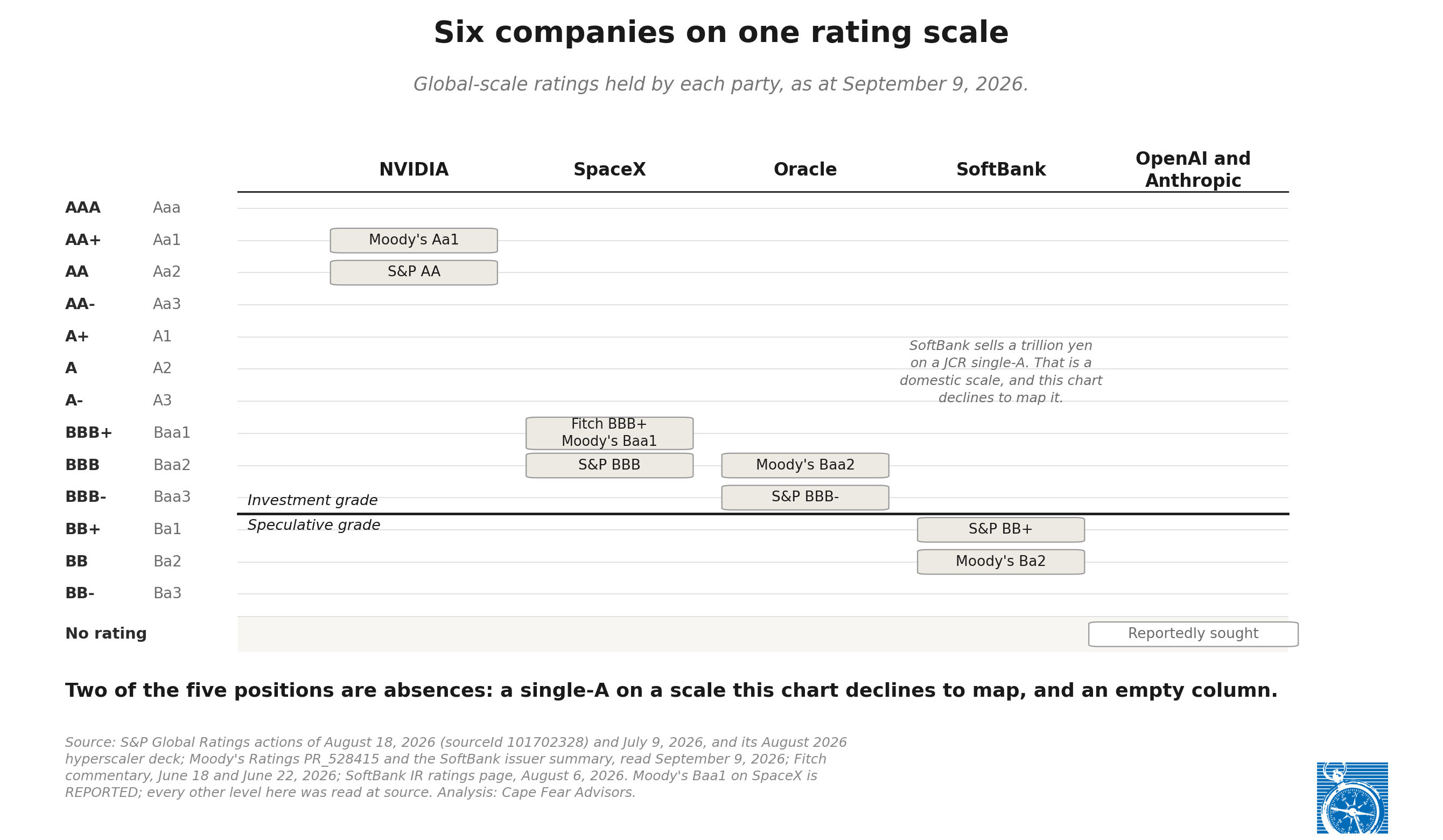
One issuer holds an A, a BB+ and a Ba2 at the same time, from three agencies, and it asked for one of them. That is the clue. A grade is a property of a relationship rather than of a company, which is why it is the one input here that money alone leaves alone. It is also the input the circle runs on: S&P counts a lease guarantee as the guarantor’s own debt until the beneficiary has a grade, and Fitch would raise SpaceX for a demonstrated willingness to curtail investment. The Circle at Rest set out one grade and four instruments. This is the same question put to six balance sheets, and one of them has room to spare.
On August 24, 2026 SoftBank Group Corp. announced its 70th unsecured straight corporate bond. The terms came on September 4: one trillion yen, 4.750 percent, seven years, maturing September 16, 2033. Item 19 of the announcement reads “Credit rating (planned): A (Japan Credit Rating Agency, Ltd.).” (1)
Four days later the same company published this:
We reaffirm that SBG has not obtained any credit ratings from Moody’s. Since withdrawing our request for ratings from Moody’s on March 25, 2020, we have neither provided them with any information regarding their ratings nor received any requests for information or inquiries from them for over six years. Moody’s opinions are therefore based solely on their subjective assumptions and hypotheses, with no reasonable factual basis. (2)
The company’s own ratings page, as of August 6, 2026, lists two agencies: JCR at A long term and J-1 short term, and S&P at BB+. Moody’s appears nowhere on it. (3) Moody’s carries the company at Ba2, corporate family rating, stable outlook, with a credit opinion dated September 3, 2026 and governance scored G-4. Its periodic review completed on August 28, 2026, the same day the company called its opinions baseless. (2)
One issuer, three standings that run from single-A to double-B, and the company recognizes two of them.
NVIDIA
One grade, four instruments. We published the arithmetic on September 8 and it stands as the frame here. (4) A single grade prices four separately written arrangements: NVIDIA’s extended payment terms to certain investment grade customers, with days sales outstanding at 60 against a 51-day baseline; $105,000m of residual value guaranties that terminate when the counterparty achieves a satisfactory credit rating; CoreWeave’s parent guarantee counting contracted revenue from an investment grade counterparty at 100 cents and otherwise at 75; and SpaceX’s March 2026 bridge, whose margin ran 0.75 to 1.75 percent over Term SOFR on the company’s debt rating. (5)
Since then the guaranty itself has reached the public record twice. NVIDIA filed the form as Exhibit 10.1 to its own quarterly report on August 26, and the landlord filed substantially the same document nine days later. Section 13 lists nine events that release NVIDIA. Three of them turn on a rating, and each rating level is redacted in both filings. (6)
So the threshold that ends the largest position in NVIDIA’s book sits in NVIDIA’s own filed document and is withheld from NVIDIA’s own investors as immaterial.
S&P published its own treatment of these instruments in August. Residual value guaranties are contingent, debt-like obligations, and one bullet sets a rule that turns on the counterparty: “Lease guarantees for third-party leases are included in our debt measure if the ultimate beneficiary of the guarantee is not IG; we will not include it if it is IG.” Another describes calculating “the exposure of the chip manufacturer under the RVG,” using its own view of chip depreciation in place of the chip maker’s. (7)
The counterparty’s grade is a switch inside the guarantor’s debt measure. Absent a grade, the guarantee is the guarantor’s debt. Present, it falls out of the measure. That is the same event Section 13 uses to release NVIDIA, arriving from the other side: one rating action terminates the guaranty under its own terms and clears the adjustment from the guarantor’s metrics, at no cost to the counterparty.
SpaceX
SpaceX is the comparison because it is building at scale, it went public in June, and it obtained its grade in the same quarter. That makes it the one company in this structure to have taken the whole route recently enough to read. In March 2026 it borrowed $20,000m on an unsecured bridge whose margin was set by its own debt rating. On June 18 Fitch published BBB+, with Baa1 from Moody’s and BBB from S&P. Days later the company issued $25,000m of notes at a weighted average 5.855 percent over 11.7 years, repaid the bridge in full, and booked an $18 million loss on extinguishment. (8) (9)
Fitch’s scoring separates the company from its position. Sector, positioning and operational characteristics score at the single-A level. Profitability and financial structure score bb. Governance takes two notches for voting control concentrated in one person, a calibration adjustment adds one back, and the standalone profile arrives at bbb+. (10)
Management targets a minimum cash balance of $25 billion and no shareholder distributions, and Fitch records both. Underneath them sits the expectation that carries the rating: Fitch describes a material portion of the capital program as uncommitted and deferrable, and expects the company to defer discretionary capital deployment if capital markets access were curtailed. (10)
Four days later Fitch rated the notes and published the sensitivities. Management’s leverage target is 2x to 3x gross, the downgrade trigger is leverage sustained above 2.5x, and the agency expects management to size discretionary capital spending to available leverage capacity, deferring the spend to hold the ceiling. The upgrade list runs the same way, and its second item is demonstrated adherence to stated financial policy over multiple reporting periods, including willingness to curtail investment to preserve credit metrics. (11)
An investment grade rating on a company spending far more than it earns rests on the proposition that the spending can be stopped, and the route to a better one runs through stopping it.
SoftBank
SoftBank’s position is the opposite one and it is stated in public. The group withdrew its request to Moody’s in 2020, has refused contact for six years, calls the resulting opinion baseless, and has asked repeatedly for its removal. Moody’s has rated it throughout, and maintains the file: an upgrade to Ba2 in September 2025, a periodic review in August 2026, a credit opinion and a fresh set of ESG scores in September 2026. (2) It then sold a trillion yen of seven-year paper into the Japanese retail market on a solicited single-A, and is reported to be marketing $10bn to $20bn of dollar and euro paper with investor meetings from September 14. (3)
The group has spent the same period funding a $30,000m commitment to OpenAI in three tranches of $10,000m, two of them drawn on a $40,000m unsecured bridge. On September 9 it announced the prepayment of the entire $25,900m outstanding on September 15, from a facility of which $30,000m had been drawn. (12)
A company that declines one agency, pays another, and retires an unsecured bridge early is stating which opinions it accepts. The market it sells into decides which standing applies.
OpenAI and Anthropic
The Financial Times reported on September 8 that Morgan Stanley and Goldman Sachs have held talks with the agencies on behalf of Anthropic and OpenAI, seeking an investment grade rating soon after each company’s listing. Rating analysts told the paper that no decision is made, that both companies remain unprofitable, and that at least one agency places both deep in speculative grade. (13)
That is the demand side of the scarce asset, assembled by bankers before the companies are public. The reason a supplier cares is in NVIDIA’s own filed document: the $105,000m ends when the counterparty wins one.
Oracle
Moody’s set the terms in February. Affirming Baa2 with a negative outlook, it credited Oracle’s plan to raise preferred stock and up to $20 billion of common equity inside $45bn to $50bn of calendar 2026 funding needs, and its senior credit officer wrote that “the incredible scale of the cost and commitments required to build out the business should be funded with a meaningful proportion of equity to maintain an investment grade rating.” The outlook named the counterparty: “significant counterparty risk with Oracle’s largest AI Infrastructure customer which we expect is OpenAI.” (14)
A grade offered on a condition about how the building gets paid for. Four months later Oracle answered it, in its fourth quarter release, reporting remaining performance obligations of $638 billion, up 363 percent year over year, against free cash flow of negative $23.7 billion for the fiscal year. (15)
Most of the RPO increase in both Q3 and Q4 were large scale AI contracts where the customer prepaid Oracle for the purchase of the GPUs, or the customer bought and supplied the GPUs to Oracle. The prepaid and customer supplied hardware portions of our large AI contracts now total $75 billion. This substantially reduces the amount of capital Oracle must raise to build out our AI datacenters. (15)
Two rungs of our own ladder, named by the operator using them and quantified at $75 billion. (16) Customer prepayment and component intermediation, described in the company’s own release as a substitute for capital it would otherwise have to raise. Part of it reaches the audited statements, and it arrives priced. The fiscal 2026 cash flow statement carries $4,592m of increase in deferred revenues from customer prepayments with a significant financing component, none in either prior year, and the revenue note discloses interest expense recognized on it. A prepayment carrying a financing component is a loan from the customer, and the filer accounts for it as one. (15) Oracle still raised $43 billion of debt and $5 billion of equity in the fiscal year and expects about $40 billion more in the next, including a $20 billion at-the-market program. (15)
Four weeks after that release, on July 9, 2026, S&P cut Oracle from BBB to BBB-, the lowest investment grade notch. The reasons reported are fiscal 2027 capital expenditures of $90bn to $95bn against a prior forecast of $60bn, a free operating cash flow deficit widening to about negative $42bn, and OpenAI at about half of the remaining performance obligations. (17)
S&P’s own forecast has Oracle at 4.4x adjusted leverage in each of fiscal 2027 and fiscal 2028, against the 4.5x downgrade threshold printed on the same chart. (7) Oracle reports the first quarter of fiscal 2027 after the close today. (15)
The substitution reduced the capital Oracle had to raise, and the standing moved anyway.
Why it is scarce
Every other input in this buildout answers to capital. Land is bought. Power is contracted. Shells are built. Machines are ordered, and where the order is too large for the buyer’s balance sheet, the seller supplies the credit, which is the whole subject of this shelf.
A credit standing is granted rather than bought, on conditions that run against the thing the capital is for. SpaceX states it plainly on the record: the rating came with a disclosed policy of holding $25 billion in cash and making no distributions, and an upgrade path that runs through curtailing the investment. The price is a promise, and SpaceX pays it with the $25 billion staying where it is. The instrument that would lower the cost of building is issued on evidence that the building can stop.
That is the contradiction the four instruments sit on. Each of them turns on a counterparty’s credit standing, and the condition attached to getting one is a promise to slow the spending those balance sheets exist to fund. Equity in those counterparties buys none of it either: S&P excludes Amazon’s stakes in Anthropic and OpenAI, and Microsoft’s 27 percent of OpenAI, from the credit metrics of the holders. (7)
NVIDIA’s own grade carries a condition of the same kind. S&P affirmed AA on August 18 with a downgrade threshold of adjusted leverage above 1.5x, and Moody’s affirmed Aa1 the same day while writing that the guaranty and its exposure to a single offtaker reflect a substantially higher tolerance for financial risk. NVIDIA sat in a pro forma net cash position of about $72.5 billion. (18) NVIDIA, SpaceX and Oracle each hold a grade with a number written against it, each set by its own agency on its own measure: 1.5x, 2.5x and 4.5x. Those are gates, and a company that reaches one loses the standing it is using. The gate at the top of NVIDIA’s book carries a number too, and it is the one that is redacted. One of the three has the room to carry its own. That is the company whose standing the four instruments spend.
Where that leaves it
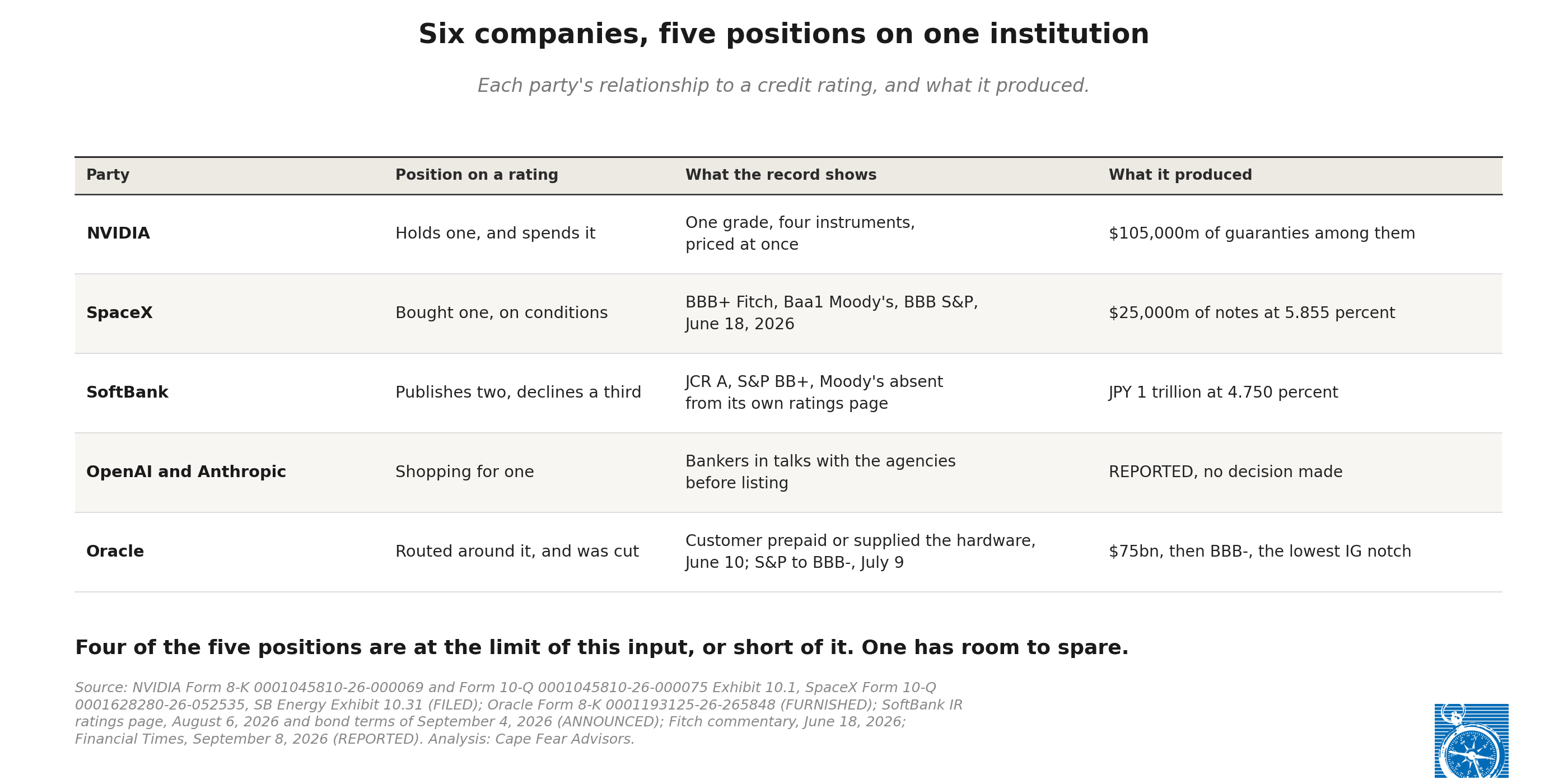
Six companies, one institution, five positions: hold it and spend it, buy it and accept the terms, decline it and sell anyway, shop for it before listing, or arrange the cash so the question of raising it recedes. The fifth produced money rather than permission, and lost a notch regardless. Structuring reached the capital requirement and left the standing where the agency put it.
Five positions on one institution, and the same price on every grade whose conditions we have read: a promise to spend less than the capital would allow.
Three documents would extend this reading as they land, and one of them lands today. Oracle reports its first quarter after the close, and the line to read is whether the prepaid and customer supplied hardware total moves from $75 billion. A rating action on OpenAI would put a price on the release. An unredacted Section 13 would say what “satisfactory” means. Each teaches something further about the same institution, and the standing each of them tests was set before any of them arrives.
Standing Disclosure
Anthropic is the developer of Claude, which is used in preparing this research. NVIDIA holds a position in Anthropic taken in late 2025 and supplies infrastructure that serves Anthropic. Anthropic is named here only where the Financial Times names it, as one of two companies whose bankers are reported to be seeking a rating, and where S&P names it as a lessee and a counterparty, and we make no assessment of Anthropic’s creditworthiness and compute none of its figures. NVIDIA’s reported equity book carries Space Exploration Technologies at $20,976m of a $63,440m total, per its Form 13F-HR at accession 0001045810-26-000065, struck at June 30, 2026 on the section 13(f) list, a different perimeter from any figure here. Among the other companies named, OpenAI is a competitor of Anthropic, and SB Energy is developing capacity that hosts compute for that competitor. That nearness cannot be fully checked away, which is why no claim here rests on trust in the tool: every figure carries a public source, every construction is tagged as ours, and the record grades the rest.
Notes
(1) SoftBank Group Corp., “Issuance of the 70th Unsecured Straight Corporate Bond,” August 24, 2026, and “Determination of Terms and Conditions for the Issuance of the 70th Unsecured Straight Corporate Bond,” September 4, 2026. ANNOUNCED. One trillion yen, 4.750 percent per annum, seven-year term, maturity September 16, 2033, issue price and redemption price 100 percent. The planned credit rating of A from Japan Credit Rating Agency, Ltd. appears as item 19 of the August 24 announcement, alongside the underwriter syndicate and Aozora Bank, Ltd. as trustee.
(2) SoftBank Group Corp., “Comment on Moody’s Release Related to Unsolicited Ratings,” August 28, 2026. ANNOUNCED. The quoted passage is the company’s own. The release responds to a Moody’s periodic review of the same date. Moody’s Ratings’ issuer summary for SoftBank Group Corp., organization id 600017433, read at source on September 9, 2026, carries a Ba2 long-term corporate family rating, not on watch, and a stable outlook, both dated September 17, 2025, when Moody’s upgraded the corporate family rating to Ba2 from Ba3 and revised the outlook to stable from positive; ESG scores dated September 3, 2026, being a credit impact score of CIS-4 and issuer profile scores of E-2, S-3 and G-4; and the announcement of a completed periodic review dated August 28, 2026. The credit opinion of September 3, 2026 states that the Ba2 “is underpinned by the significant value of its investment portfolio including listed marketable investments, which provide alternatives to financing,” that listed assets were about two-thirds of the portfolio at the end of June 2026, that market value-based leverage fell below 20 percent at that date, and that the rating is constrained by exposure to event risks from large and unpredictable transactions and by low interest coverage, with recurring income relying primarily on dividends from SoftBank Corp. The three levels sit on two different kinds of scale. JCR is a Japanese domestic agency and its scale is not a like-for-like map to the global scales S&P and Moody’s use, so this piece prints the three levels and declines to count the notches between them.
(3) SoftBank Group Corp., Investor Relations, “Ratings,” read at source on September 9, 2026. ANNOUNCED. The page is stated as of August 6, 2026 and lists JCR at A for long-term bonds and J-1 for short-term, and S&P at BB+ for long-term with no short-term rating shown. Moody’s is absent from the table, which is consistent with the company’s position at note (2). The September 14 to 17 investor meetings for a reported $10bn to $20bn dollar and euro offering are REPORTED, carried in September 2026 coverage; we have read no offering document.
(4) “NVIDIA, the Circle at Rest,” published September 8, 2026, sets out the four instruments and the release condition on the $105,000m.
(5) NVIDIA Corporation, Form 10-Q for the quarter ended July 26, 2026, accession 0001045810-26-000075, FILED, and Form 8-K dated August 17, 2026, accession 0001045810-26-000069, Items 1.01 and 2.03, FILED. The days sales outstanding figure of 60 and the extended terms for certain investment grade customers are from the CFO Commentary furnished as Exhibit 99.2 to Form 8-K, accession 0001045810-26-000073, and are furnished rather than filed. The 51-day baseline is ours. CoreWeave’s parent guarantee terms at 100 cents and 75 cents are from CoreWeave, Inc., Form 8-K dated August 7, 2026, accession 0001769628-26-000357, filed August 10, 2026, Exhibit 10.2, the parent guarantee and pledge agreement for the DDTL 5.5 facility, FILED. The covenant counts “the reasonably projected contracted revenues from such contracts with counterparties which have an Investment Grade Rating” in full and applies a factor of 0.75 to contracted revenues from counterparties without one, against a threshold of $1,000,000,000. The definition it points to sits in the revolver rather than in the guarantee, as amended by Amendment No. 4 to the Revolving Credit and Guaranty Agreement, dated November 10, 2025, filed as Exhibit 10.7 to CoreWeave’s Form 10-Q for the quarter ended September 30, 2025, accession 0001769628-25-000062: an Investment Grade Rating is “a corporate family rating of at least ‘BBB-’ or higher from S&P or ‘Baa3’ or higher from Moody’s”, with a fallback to another nationally recognized agency only where neither rates the counterparty. Both read at source. SpaceX’s bridge margin grid is at note (8). Exhibit 10.1 to this same quarterly report is the residual value guaranty at note (6).
(6) NVIDIA Corporation, Form 10-Q for the quarter ended July 26, 2026, accession 0001045810-26-000075, filed August 26, 2026, Exhibit 10.1, Form of Residual Value Guaranty, and SB Energy, Inc., Amendment No. 1 to Form S-1, accession 0001628280-26-060761, filed September 4, 2026, Exhibit 10.31, Form of PORTS-Pike Technology Campus Residual Value Guaranty. Both FILED, both read in full at source on September 9, 2026. The guarantor filed the form nine days before the landlord did. Section 13(a) of each sets the same nine termination events; items (iii), (iv) and (v) each turn on a credit rating and each rating level is redacted, items (vi), (vii) and (viii) are redacted in full, and item (ix) is the twentieth anniversary of the commencement date. Each carries the Item 601(b)(10) legend that the omitted information is both not material and of a type the registrant treats as private or confidential, and each states that the total liability for the guaranty and all Related Guaranties “shall not exceed $105,000,000,000.” The two versions differ: NVIDIA’s exhibit carries 59 redaction marks against 57 in the landlord’s, and the two additional marks sit at the definition of Discount Rate and at the mechanics reducing the Liability Cap. That count reconciles a discrepancy our own working record has carried since September 5, where 56, 57 and 59 were recorded across three reads; the figures belong to different documents, and the 56 was a miscount in one of those reads. The reading that a threshold stated in a document and withheld from it is a stronger fact than an undefined term is ours. That NVIDIA filed the guaranty in its own quarterly report on August 26 was surfaced for us by Olga Usvyatsky and Francine McKenna, “Reviewing SB Energy’s IPO dreams,” Deep Quarry with The Dig, September 9, 2026, and we verified it at source before printing it. That piece sets SB Energy’s confidential draft registration statement of May 22 against the public S-1 of August 31, and on this guaranty it covers the aggregate cap, the ready-for-service condition, the decline over time, the remedy menu, and the Item 601 materiality question the redactions raise. Our own reading of the release condition is at note (4), published September 8.
(7) S&P Global Ratings, “S&P Global Ratings’ View On Artificial Intelligence And Hyperscalers: Key credit ratings considerations,” Naveen Sarma, David Tsui, Andrew Chang and Shripad Joshi, August 2026, 20 pages. Read in full on September 9, 2026. The publication carries the legend “This report does not constitute a rating action,” and nothing in it is a rating. The two quoted passages are from slide 11, “Treatment Of Residual Value Guarantees (RVGs) And Other Guarantees,” which also treats backstop guarantees such as unpurchased cloud capacity of a counterparty as lease guarantees, and tax affects the resulting debt adjustments at 21 percent. The deck names no NVIDIA instrument, and it does not say which of its guarantee rules it would apply to the PORTS-Pike residual value guaranty; the reading that the rules bear on that instrument is ours. Slide 8 carries S&P adjusted leverage for Oracle at 4.4x in fiscal 2027 and fiscal 2028 against a 4.5x downgrade threshold marked on the same chart, and for SpaceX at 1.0x, 1.4x and 1.7x across 2027 to 2029 against a 2.0x threshold; the series are our reconstruction from the chart’s data labels and the thresholds are printed on the slide. Slide 2 places SpaceX in a six-company hyperscaler set with Alphabet, Amazon, Meta, Microsoft and Oracle, and puts 2027 capital expenditure for the six above $1.3 trillion. The per-company pages state that Amazon’s stakes in Anthropic and OpenAI and Microsoft’s 27 percent interest in OpenAI are excluded from those companies’ credit metrics, and record Oracle’s commitment to investment grade together with customer prepayments offsetting capital expenditure. Slide 5 lists “Circular financing” among named concerns and slide 6 lists “Revenue/kW charged” among monitored industry metrics; both constructions predate this deck on our shelf, the deck predates our reading of it, and we make no priority claim in either direction.
(8) Space Exploration Technologies Corp., Form 10-Q for the quarter ended June 30, 2026, accession 0001628280-26-052535. FILED. The $20,000m bridge entered March 2026, its Term SOFR margin grid of 0.75 to 1.75 percent depending on the company’s debt rating, the $25,000m of notes issued June 2026 at a weighted average 5.855 percent over 11.7 years, the repayment of the bridge in full, and the $18 million loss on extinguishment.
(9) The three ratings assigned to SpaceX on June 18, 2026 carry three different provenances and the exhibit reflects the split. Fitch’s BBB+ is READ AT SOURCE in the commentaries at notes (10) and (11). S&P’s BBB with a stable outlook is READ AT SOURCE on slide 3 of the deck at note (7), which carries it in the 2Q26 credit metrics table. Moody’s Baa1 is REPORTED, carried in our published SpaceX record, and we have read no Moody’s document on this issuer.
(10) Fitch Ratings, “Fitch Publishes Space Exploration Technologies Corp.’s ‘BBB+’ IDR; Outlook Stable,” rating action commentary, June 18, 2026, relevant committee dated June 16, 2026. Read in full. The Corporate Rating Tool scores, the two-notch governance constraint, the financial policy targets of a $25 billion minimum cash balance with no planned shareholder distributions, and the expectation that the company would defer discretionary capital deployment if capital markets access were curtailed, are all from that document. The prospectus at accession 0001628280-26-042639 carries a dividend policy stating that the company does not anticipate declaring or paying dividends; no filing on the registrant’s record carries the cash target, searched in full text at source on September 8, 2026.
(11) Fitch Ratings, “Fitch Rates SpaceX’s Proposed Senior Unsecured Notes ‘BBB+’,” rating action commentary, June 22, 2026, relevant committee dated June 16, 2026. Read in full at source on September 9, 2026. This is a separate document from note (10) and rates the instrument rather than the issuer. The 2x to 3x gross EBITDA leverage target, the downgrade trigger at leverage sustained above 2.5x, the upgrade trigger at leverage sustained below 1.5x, the expectation that management sizes discretionary capital spending to available leverage capacity, and the upgrade item quoted in part here, being demonstrated adherence to stated financial policy over multiple reporting periods including willingness to curtail investment to preserve credit metrics, are all from that document. It also carries a rating case of EBITDA leverage around 1.7x at year end 2026 and 1.9x at year end 2027 on a gross measure matching management’s own gross target, pro forma liquidity above $100 billion including approximately $101.5 billion of cash, and an assumption of $85.7 billion of IPO proceeds. S&P’s series at note (7) runs on a different measure, and this piece uses the two separately.
(12) SoftBank Group Corp., “Early Repayment of Bridge Loans,” September 9, 2026, ANNOUNCED, and “Execution of Bridge Facility Agreement Primarily for the Follow-on Investments in OpenAI,” March 27, 2026, ANNOUNCED. Facility amount $40.0 billion, unsecured, five lenders, maturity March 25, 2027; $30.0 billion drawn to date; prepayment of the entire $25.9 billion outstanding announced for September 15, 2026. The tranche structure of $10.0 billion each on April 1, July 1 and a planned October 1 is from the company’s releases “Execution of Follow-on Investment (First Tranche) in OpenAI” of April 1, 2026 and “Execution of Follow-on Investment (Second Tranche) in OpenAI” of July 1, 2026. The commitment itself was announced in “Follow-on Investments in OpenAI” of February 27, 2026. All read at source on September 10, 2026.
(13) Michelle Chan, Rafe Rosner-Uddin, Ryan McMorrow and George Hammond, “Anthropic and OpenAI bankers push for top-tier credit ratings post-IPO,” Financial Times, September 8, 2026. REPORTED. No figure here is computed from it.
(14) Moody’s Ratings, “Moody’s Ratings affirms Oracle’s Baa2 rating on equity announcement; Outlook remains negative,” New York, February 2, 2026, PR_518972. Read at source on September 9, 2026. Baa2 senior unsecured and P-2 commercial paper affirmed, outlook negative. The equity plan, the $45bn to $50bn of calendar 2026 funding needs, the quoted passages from Senior Credit Officer Matthew Jones, and the outlook language naming counterparty risk with the customer the agency expects is OpenAI, are all from that document. The February action and the July downgrade at note (17) are separate events by separate agencies: Moody’s affirmed at Baa2 with a negative outlook in February; S&P cut to BBB- in July.
(15) Oracle Corporation, Form 8-K dated June 10, 2026, accession 0001193125-26-265848, Items 2.02 and 8.01, Exhibit 99.1. FURNISHED rather than filed. Remaining performance obligations of $638 billion at quarter end, up 363 percent year over year and $85 billion sequentially from $553 billion; free cash flow of negative $23.7 billion for fiscal year 2026; the prepaid and customer supplied hardware portions of the large AI contracts totaling $75 billion; $43 billion of debt and $5 billion of equity financing raised in fiscal 2026 and approximately $40 billion expected in fiscal 2027 including a $20 billion at-the-market program. The quoted passage is Oracle’s own. Our readings of this release and of the fiscal 2026 annual report behind it are at “Adding It Up: The Quality of Cash,” June 23, 2026, which sets out why the $75 billion appears in a furnished release and in no line of the audited statements, and “Oracle, Adding It Up: One Column,” July 2, 2026, which reads the $638 billion against the annual report’s own disclosure that no customer reached 10 percent of revenues in any of the last three years. The $4,592m of increase in deferred revenues from customer prepayments with a significant financing component, its absence from fiscal 2025 and fiscal 2024, the interest expense recognized on that component, and deferred revenues of $15,395m at May 31, 2026 against $10,733m a year earlier, are from Oracle Corporation, Form 10-K for the fiscal year ended May 31, 2026, accession 0001193125-26-277521, filed June 22, 2026, FILED, in the consolidated statements of cash flows and the revenue note. The same annual report states remaining performance obligations of $638 billion “of which we expect to recognize approximately 12% as revenues over the next twelve months.” The reading that a prepayment carrying a financing component is a loan from the customer is ours, and the accounting it rests on is the filer’s. The first quarter of fiscal 2027 is announced for release after the close on Thursday September 10, 2026, per Oracle’s investor news of September 2, read at source that morning.
(16) The nine rungs are ours, set out in “Quality of Cash: Circular Financing,” published August 1, 2026. Customer prepayment is the fourth rung and component intermediation the fifth. The reading that Oracle’s release quantifies both as a capital substitute is ours, and the sentence it rests on is quoted above.
(17) The S&P downgrade of Oracle Corporation from BBB to BBB- on July 9, 2026, its stable outlook, and the reasons given, being fiscal 2027 capital expenditures of $90bn to $95bn against a prior forecast of $60bn, a free operating cash flow deficit widening to approximately negative $42bn, adjusted leverage in the mid four times, and OpenAI accounting for approximately half of remaining performance obligations, are REPORTED. We have read coverage of the action and not the rating report itself, and the figures carry the reliability of their sources. Our own record has carried the BBB- level since our July reading of Oracle’s position, and the Financial Times at note (13) refers to the same downgrade. S&P’s annual review of August 12, 2026, sourceId 101701435, read at source on September 9, 2026, shows the components behind the level: business risk strong, financial risk aggressive, an anchor of bb+, every modifier neutral, and one notch of comparable rating analysis reaching a stand-alone profile of bbb- and a rating of BBB-/Stable/A-3. That publication states on its face that it does not constitute a rating action.
(18) S&P Global Ratings, “Nvidia Corp. To Provide Financial Support For SB Energy AI Infrastructure Campus Buildout; Ratings Affirmed,” August 18, 2026, 10:45 EDT, sourceId 101702328, and Moody’s Ratings, “Moody’s Ratings affirms NVIDIA’s Aa1 senior unsecured rating; outlook remains positive,” New York, August 18, 2026, PR_528415. Both read at source on September 9, 2026. S&P affirmed the AA issuer credit rating with a stable outlook and states that the downgrade threshold for the rating is adjusted leverage exceeding 1.5x, against $106 billion of cash and marketable securities, $33.5 billion of funded debt, and a pro forma net cash position of about $72.5 billion at April 26, 2026. The same action treats the guaranty as debt, with an adjustment of $4.2 billion in fiscal 2029 rising to approximately $37.7 billion in fiscal 2032, tax affected at 21 percent, struck as the difference between the guaranteed minimum value and the agency’s own assessed value of each building under its CMBS global property evaluation methodology. It describes the guarantee as running building by building across nine buildings, each with a separate lease, effective as each meets its ready to service conditions, with capacity expected online between 2028 and 2030. It names the remedies that Exhibit 10.31 brackets: assuming all obligations and curing monetary defaults, installing a replacement tenant, selling the data centers with proceeds offsetting the guaranteed minimum value and paying any shortfall, or making a one-time payment equal to the remaining guarantee obligations to extinguish the exposure and terminate the guaranty. It states that both SB Energy and OpenAI are unrated by S&P Global Ratings, and that the option to backstop up to $125 billion, being 25 percent of more than $500 billion of intended third-party platform capital, adds credit risks. Moody’s affirmed Aa1 senior unsecured and Prime-1 short term with the positive outlook maintained; the quoted judgment on tolerance for financial risk is its own, and it describes the same release condition in the same undefined words the filing uses. Neither action prints the rating level that releases the guaranty.
Cape Fear Advisors publishes every piece free. A paid subscription offsets the time this reading takes and buys no access that a free reader lacks.
Analysis: Cape Fear Advisors.
This piece also appears on Substack. Cape Fear Advisors is an independent advisory firm based in Portsmouth, NH.
Contact Cape Fear Advisors