

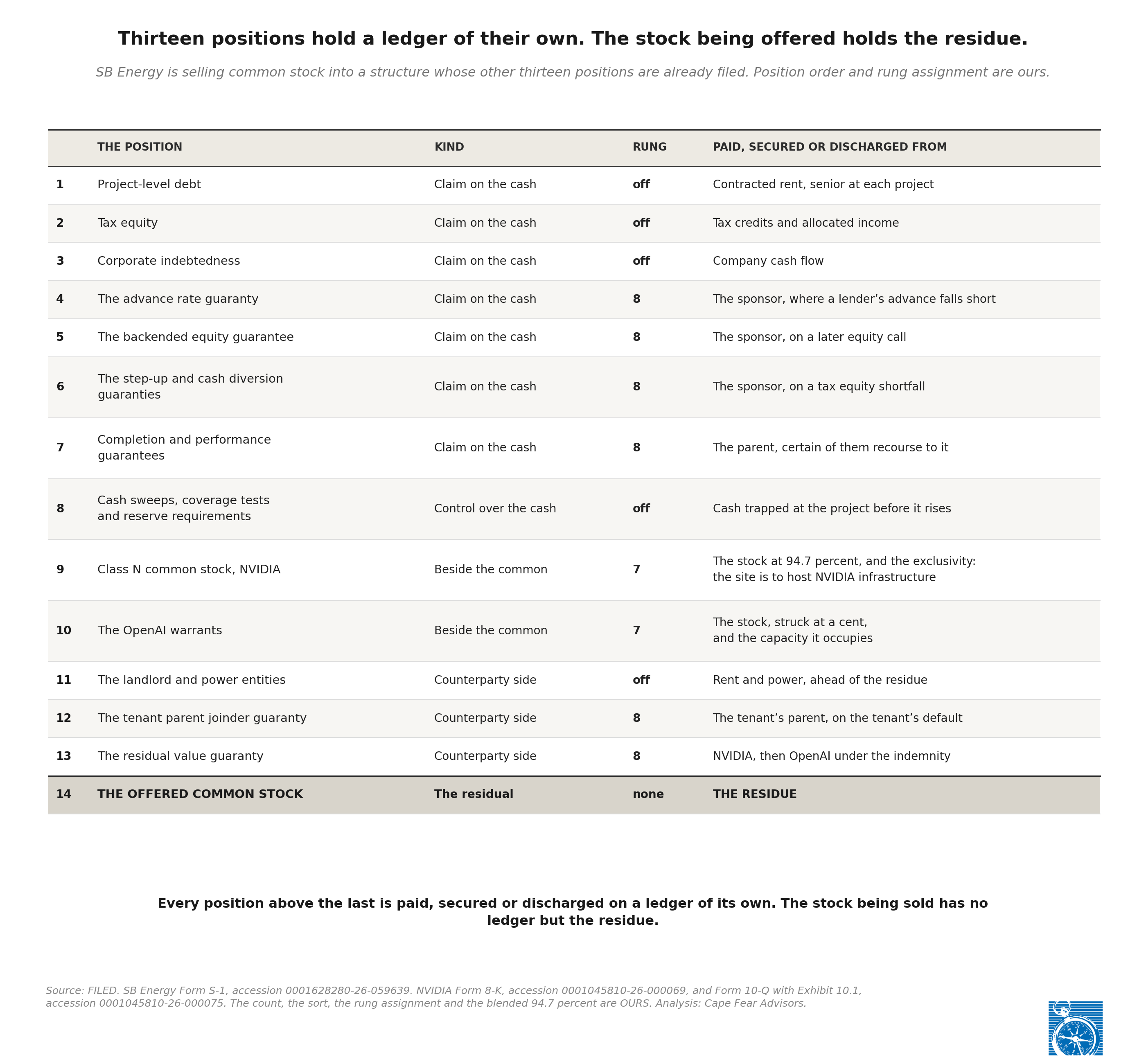
SB Energy, Inc. filed a registration statement on September 1, 2026 for an initial public offering on Nasdaq under the symbol SBE. The coverage led on one sentence from the filing’s own summary risk factors, that the company is substantially dependent on OpenAI. This piece takes a different route through the same document and two of NVIDIA’s, and counts the positions in the structure that hold a ledger of their own. There are thirteen, each disclosed. The offered stock is the fourteenth, and the residue is its whole ledger.
Quality of cash reads one company at a time. It stops at position and leaves recommendations on the shares to others. It asks what is cash, what only looks like it, and where a dollar sits in the order that decides who is paid. Every arrangement described here is disclosed by the party that entered into it, and the risks discussed are the risks the filing sets out.
One arrangement, four documents, two names
On August 17, 2026 NVIDIA Corporation filed a current report under Items 1.01 and 2.03, being entry into a material definitive agreement and the creation of a direct financial obligation. The section heading reads Residual Value Guaranties. NVIDIA entered into multiple residual value guaranties with SB Energy relating to leases for approximately 4.25 gigawatts of information technology load at what the current report calls the Portsmouth Site, with an affiliate of OpenAI Group PBC as tenant. (1)
Nine days later, NVIDIA’s quarterly report described the same arrangement. There the language is credit support on a land, power and shell buildout, with the guarantees limited to defined portions of lease and power payments. (2) The commentary furnished with the second quarter results the same day uses the same construction. (3)
A week after the current report and before either of the others, Global Data Center Hub read the same 8-K and put the distinction in a headline: NVIDIA guaranteed the resale rather than the rent. That reading also found that the figure setting what NVIDIA owes appears in no public document. (4)
On September 1, SB Energy’s registration statement names NVIDIA as a strategic investor and residual value guarantor at the campus. (5)
The instrument’s own name appears in the agreement’s current report and in the counterparty’s registration statement, and the quarterly report describes it by what the payments cover. The two descriptions carry different economics. A guarantee of lease payments stands behind a rent stream. A residual value guarantee stands behind what an asset fetches once the rent stops, and the mechanism in the current report is the second: on a tenant default, NVIDIA pays the shortfall between a guaranteed minimum value and the amounts recovered through a replacement lease or a sale. (1)
The form of the guaranty is filed as an exhibit. It runs to 43,635 characters and carries fifty-nine redactions. Among them: the formula that computes the covered loss amount, the discount rate, and the identity of the tenant. Schedule II, which holds the guaranteed minimum value and the liability cap, is referenced three times and is not attached. The exclusion legend states that the excluded information is both not material and of a type the registrant treats as private or confidential. (6)
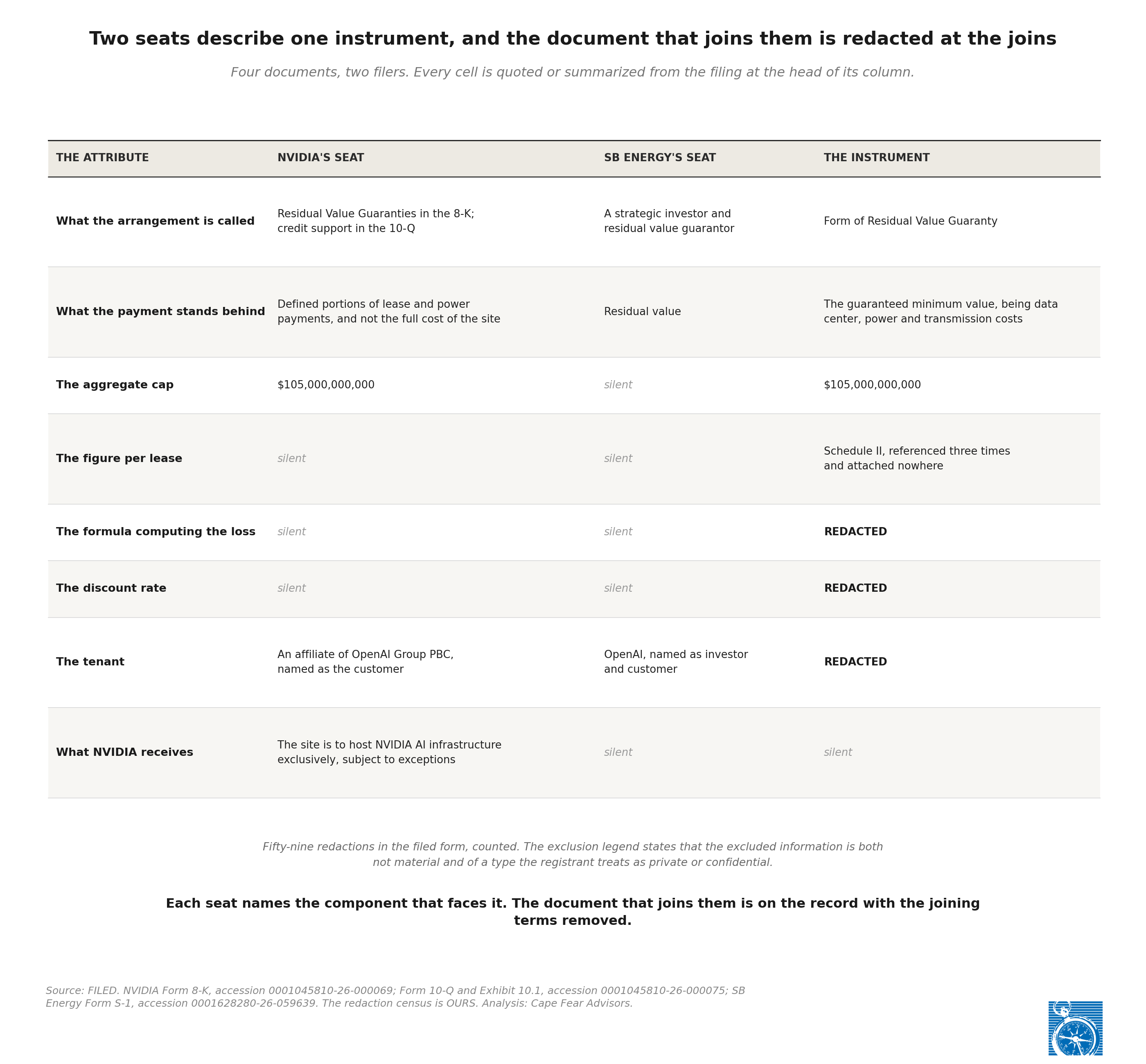
What the exhibit does supply is the basis. The guaranteed minimum value is comprised of data center, power and transmission related costs, related to 4.25 gigawatts of critical information technology load, with total liability across the related guaranties capped at $105,000,000,000. (6) The guarantee is written against a cost.
The rungs at Piketon
The recitals to the guaranty describe five parties. NVIDIA is the guarantor and is named. The landlord is a Delaware limited liability company left blank in the form. A power affiliate enters power purchase and supply agreements for the premises. The tenant appears as a redaction. And a tenant parent, also redacted, has executed a joinder to the lease guaranteeing all of the tenant’s obligations. (6)
That joinder is a second guarantee on the same lease, and it stands ahead of NVIDIA’s.
The registration statement places the rest. SoftBank and OpenAI are strategic investors and customers across three campuses. SoftBank Group Capital Limited has provided a guaranty of tenant obligations at the Cosmos campus with anticipated aggregate exposure of approximately $2.9bn. OpenAI holds 3,991,809 warrants exercisable at $0.01, of which 1,737,867 vest at or before pricing and 2,253,942 remain unvested. NVIDIA has committed $1.5bn for a new class of non-voting stock at the offering price, and has prepaid a further $1.5bn to Energy Global, the parent entity, for shares of the same class deliverable on closing at ninety percent of the offering price. (5)
Across the two tranches NVIDIA pays 94.7 percent of what the public pays for a class that ranks equally with the common on distributions and converts into it one for one, and half of that money reaches the selling parent rather than the company. (5)
At the campus itself the arrangement is exclusive. In exchange for the guaranties the site is to host NVIDIA infrastructure exclusively, subject to limited exceptions, and NVIDIA holds an option exercisable in its sole discretion to provide credit support for approximately 3.8 additional gigawatts as the site scales. (2)
The backlog and what it costs
SB Energy reports contracted backlog of approximately $439bn, of which $430bn sits in the data center segment, against a portfolio of 8.8 gigawatts of contracted information technology capacity. Of that capacity 0.8 gigawatts is under construction and 8.0 gigawatts is contracted and has yet to start. The weighted average remaining contract length on the data center leases is 19.6 years. (5)
The cost of building it is disclosed. Twice in the risk factors the filing states that backlog-associated capex, tied to contracted projects alone, amounts to an estimated $178bn, measured on a cash basis from June 30, 2026. (7)
Two filed figures produce a ratio. Revenue of $439bn against capital of $178bn is 2.47 times. Spread across the 19.6 year weighted average the contracted revenue runs at $22.4bn a year, which against $178bn is a gross yield on cost of 12.58 percent and an undiscounted payback of 7.9 years inside a 19.6 year contract. Those are constructions from the filer’s figures. (8)
The 12.58 percent is the top of a band, and SB Energy itemizes what separates the top from the bottom. Backlog-associated capex, the filing states, does not reflect operating expenses, maintenance costs, non-capitalized interest expense, non-capitalized taxes, non-capitalized overhead, depreciation, cost overruns, timing delays, customer defaults or other costs. (7) Each item is named. None is sized.
The largest of them is calculable in principle. Interest on $178bn at a senior secured cost of seven to nine percent leaves a spread of 3.58 to 5.58 points over the debt, and that spread carries every remaining item on the list plus whatever premium the residual holder requires for construction risk, counterparty risk and residual risk that the lenders decline to take. (8)
Two of the excluded items have filed consequences. Certain of the triple-net lease structures include caps on eligible expenses, so the pass-through to tenants is bounded. And cost overruns, the filing states, may need to be funded from equity contributions or other sources recoverable only outside the existing revenue contracts, thereby reducing anticipated equity returns. (9)
The ledger, and the thirteen positions
SB Energy states the order itself. Shares of its common stock are structurally subordinated to all project-level and corporate indebtedness and other liabilities of its subsidiaries, the company expects to incur a substantial amount of additional indebtedness to finance the Pike County campus and other pipeline projects, and shareholders’ claims are junior in right of payment to all of it. (10)
The order that sentence names, and the positions standing alongside it, are enumerable from the four documents.
At June 30, 2026 SB Energy carried approximately $4.0bn of aggregate principal indebtedness, of which $1.2bn was current. Project-level entities were parties to over $3.6bn of project-level debt. Beside that indebtedness and outside it sit approximately $1.7bn of tax equity financing arrangements, which are partnership interests and carry their own priority. (10) Six project facilities are named with amounts: Cosmos Senior Secured Notes at $999.0m, Pelicans Jaw at $857.8m, Libra at $512.9m, Hickory at $473.0m, Athos Storage at $361.9m and the Eiffel Term Loan at $88.7m, totaling about $3,293m. (11)
Against each of those the sponsor has written guarantees. The financing schedule describes limited sponsor guarantees including tax equity cash diversion, advance rate, step-up and backended equity guarantees, in each case subject to caps and termination upon specified project milestones, with a bridge loan advance rate guaranty sized at about $100m at one facility. (11) An advance rate guaranty stands behind the fraction a lender will lend against. A backended equity guarantee is a promise to supply residual capital later.
Above those sit the project-level cash sweeps, debt service coverage tests and reserve account requirements the filing describes as restrictions imposed by project lenders. (10) Above those, the completion and performance guarantees, certain of which are recourse to the parent company. (12) Then the Class N stock, the penny warrants, the landlord and power entities, the tenant parent guaranty and the residual value guaranty.
Thirteen positions in this structure hold a ledger of their own, and each is disclosed in one of the four documents. They sort into three kinds. Eight are claims on SB Energy’s cash or controls over it: the project debt, the tax equity, the corporate debt, the three groups of sponsor guarantee, the completion and performance guarantees, and the lender covenants. Two rank beside the common on other terms, being the Class N stock, which is pari passu on distributions and was bought at 94.7 percent of the offering price, and the penny warrants. Three sit on the counterparty’s side of the lease: the landlord and power entities, the tenant parent joinder, and the residual value guaranty, whose recourse runs to OpenAI through the indemnity. (13)
Position six holds two instruments, the step-up guarantee and the tax equity cash diversion guaranty, because both are sponsor guarantees written into the same facilities at the same level. Counting them apart gives fourteen positions ahead of the common. The reading holds either way, because what the count establishes is that every position but the last is paid, secured or discharged on a ledger of its own. (13)
What each participant is paid out of
The participants in this structure are paid from different ledgers, and the difference decides who has a reason to fund it.
A supplier earns margin on what the site buys and is paid on delivery. A tenant secures occupancy. A guarantor secures exclusivity. A controlling owner avoids the completion guarantees it has already written. Each of those returns is computed on that participant’s own books and arrives whatever the residue does.
The two positions that rank beside the common work the same way. A holder of the Class N stock takes the same distribution the common takes and paid 94.7 percent of the price to reach it, and a holder of a penny warrant takes it having paid a cent. Ranking alongside a position and buying it at a discount are different things, and the discount is the ledger.
The buyer of the offered common stock is paid from the residue alone, which is what puts it fourteenth.
And expansion lengthens the queue in front of that residue, because each additional vehicle adds a participant who settles before it. A new campus, a new tax equity partnership or a new project facility each closes its own ledger on its own terms, and each closes ahead of the last position in the queue.
The offering’s size against the requirement follows the same arithmetic. A raise of $6bn, which is an assumption and appears in no filed figure, covers 3.4 percent of the $178bn of contracted capex. NVIDIA’s $3bn does not all arrive beside it. Half of that money buys shares from Energy Global, which is a purchase from the selling parent and funds nothing the contracted book requires, so the capital reaching the structure is $7.5bn and the share is 4.2 percent. Held against an equity share of the capital structure of fifteen to thirty percent, the offering and the half of the placement that reaches the company supply between about a seventh and a bit over a quarter of the residual capital the contracted book requires. (8) The remainder is unraised, and every future raise ranks ahead of this one or dilutes it.
Where the ladder and the ledger disagree
The thirteen sort further against the nine-rung ladder published in August. Six sit at rung eight, contingent support: the four sponsor and parent guarantees, the tenant parent joinder, and the residual value guaranty. Two sit at rung seven, equity in the counterparty: NVIDIA’s Class N stock and OpenAI’s warrants. Five stand off the ladder, being the project debt, the tax equity, the corporate debt, the lender covenants and the structure’s own entities, all of them third-party finance or plumbing. (14)
No filed arrangement at this campus stands on rungs one through six. Rungs one through six are arrangements where something is delivered and paid for, so the advance comes back through trade. Rungs seven and eight are arrangements where a position is taken and settled later, or an exposure is written that fires on a condition. Every filed participant arrangement at Piketon is the second kind.
That reading has a date on it, and the date is the point. The campus is to host NVIDIA infrastructure under an exclusivity that is filed, and the equipment purchases it contemplates are ahead of it. The morning the site starts buying, rungs one and two fill with trade credit on the largest single order the ladder has carried, and the arrangement that is exclusive today becomes a supply relationship with a payable attached. That trigger is printed here, with its expiry attached. (14)
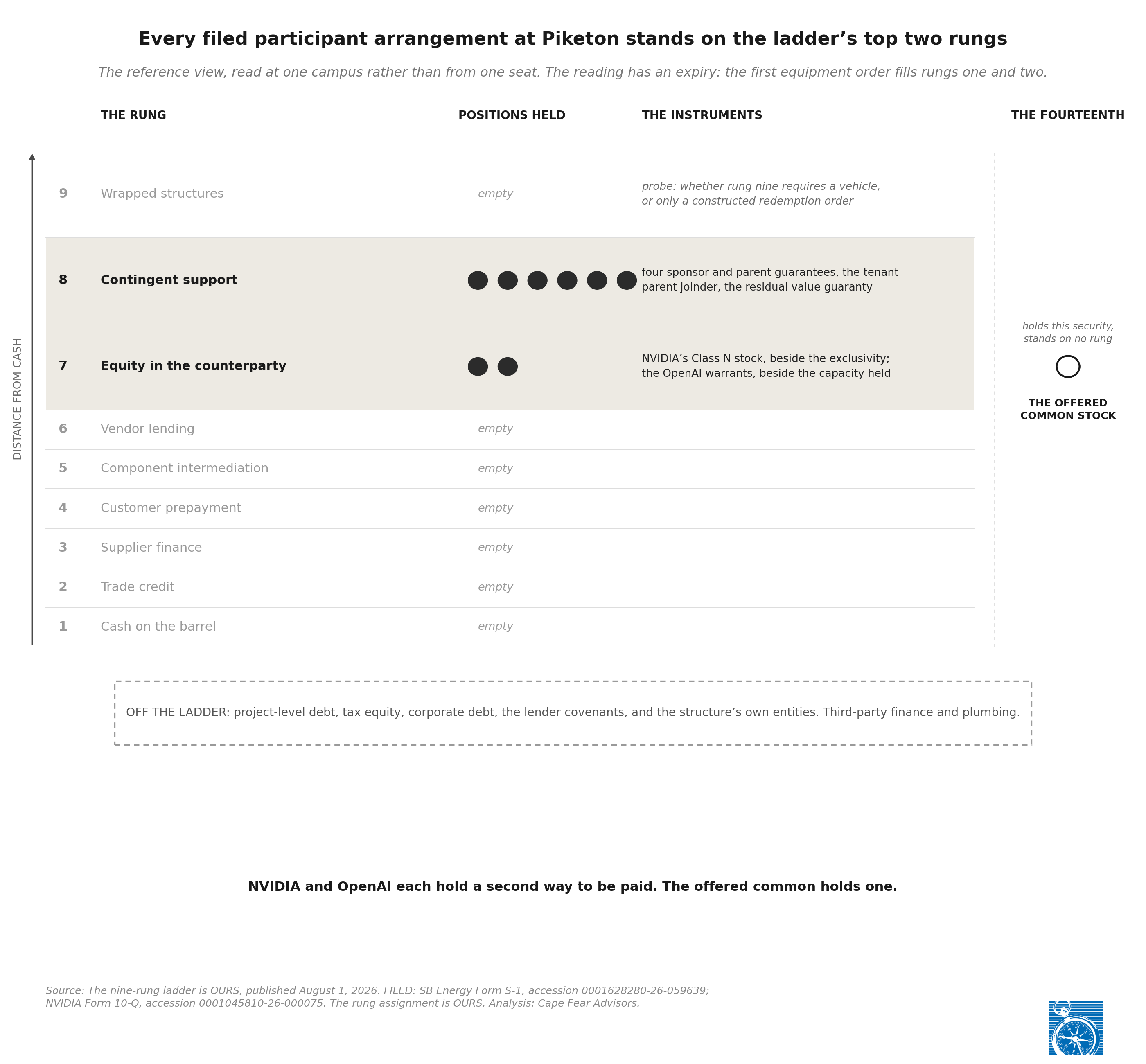
Which gives the fourteenth position its structural form. Three parties hold equity in this company. OpenAI stands on rung seven and is paid through the warrants and through the capacity it occupies. NVIDIA stands on rung seven and is paid through the stock and through the exclusivity, the site being one that is to host NVIDIA infrastructure subject to limited exceptions. The buyer of the offered common holds the same class of security and stands on no rung at all.
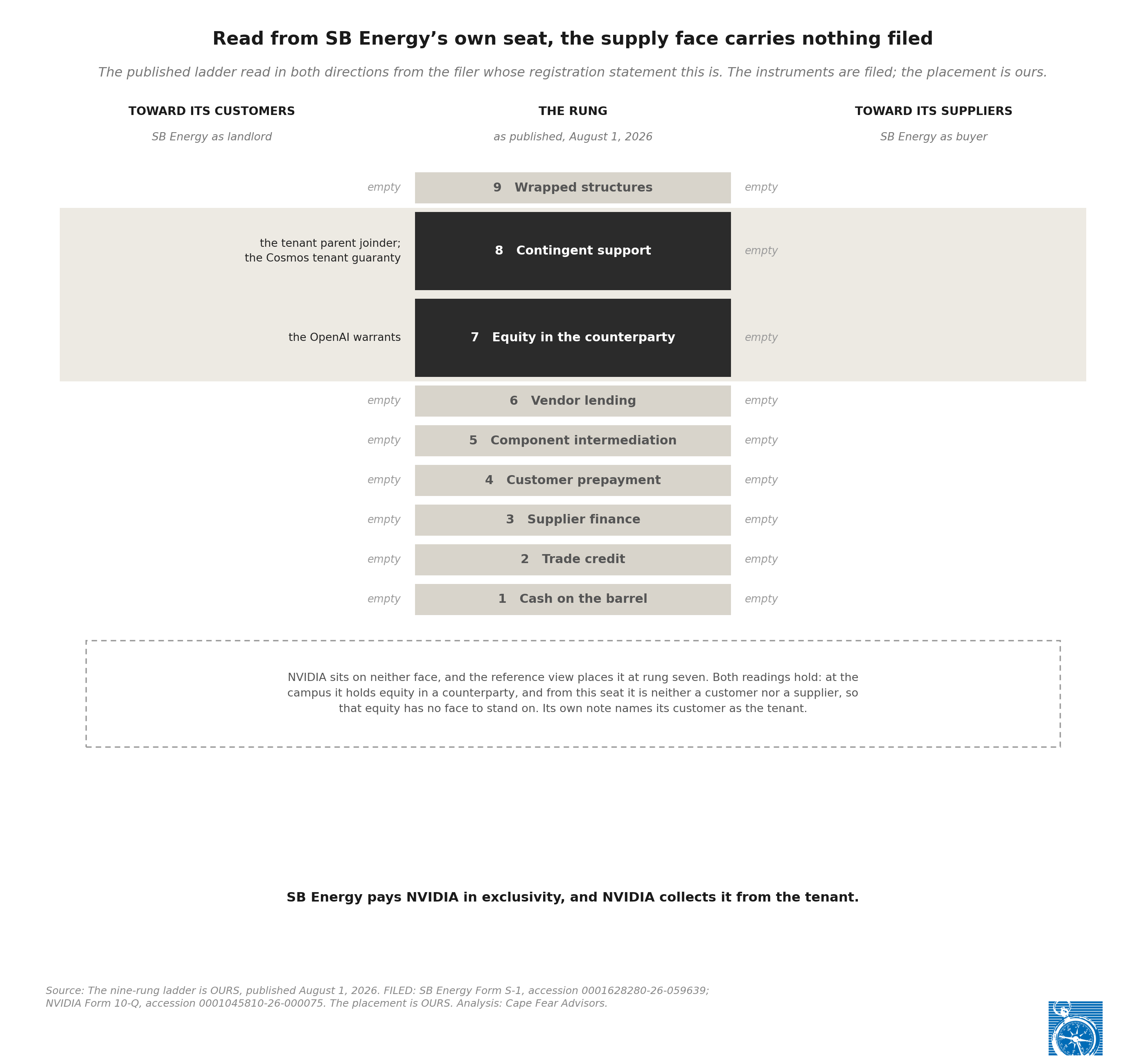
The second of those two legs points somewhere else, and the guarantor’s own note says where. NVIDIA describes the guarantees as given on behalf of a customer, an affiliate of OpenAI Group PBC. (2) So SB Energy pays NVIDIA in exclusivity, and NVIDIA collects that exclusivity from the tenant. The consideration is granted by the landlord and the revenue arrives from the customer, which is one arrangement with its two ends at two different companies.
Read the ladder from SB Energy’s own seat instead of across the campus and the supply face carries nothing filed. OpenAI is a customer and holds the warrants, and the tenant parent joinder and the Cosmos guaranty sit beside them. NVIDIA is neither a customer nor a supplier of SB Energy on this record, so the equity it holds has no face to stand on. Both readings hold, because a campus is a place and a seat is a party, and the difference between them is what the ladder measures. (14)
And the ladder sees only part of the ledger. The four sponsor guarantees, the project debt, the tax equity and the lender covenants run to financiers, who buy nothing from SB Energy and sell it nothing. Three arrangements reach the ladder where thirteen positions reach the ledger, and the gap is the two instruments doing different work.
Three parties hold this equity. NVIDIA is paid a second way through the exclusivity it takes, OpenAI through the capacity it occupies, and the buyer of the offered common is paid once.
What has to be believed
The economics can clear at one corner. Holding contracted revenue at $22.4bn a year against $178bn of capital, at sixty to eighty percent debt, seven to nine percent, and asset lives of twenty-five to thirty-five years, the pre-tax return on equity across the eight corners of that box runs from 6.9 to 20.6 percent. (8) The leverage, rate and life assumptions are constructions. The revenue and the capital are filed.
The two ends of that range are made by leverage working in opposite directions, and the reason is a number the box exposes. Before any borrowing, the contracted book returns 9.73 percent on capital at a thirty-five year asset life and 8.58 percent at twenty-five years. Where the asset returns 9.73 against debt at seven percent, borrowing four dollars for every one of equity lifts the return to 20.6. Where it returns 8.58 against debt at nine percent, the asset earns less than the money that bought it, and the same four dollars of borrowing takes the return down to 6.9. (8)
Both corners sit inside a range built on the filed figures.
Reaching them requires a specific list. Financings at a billion apiece numbering 178 to place $178bn, each priced at the market of its day, the count standing as an illustration of the scale and not a schedule. Nine phases of construction at the Pike County campus, the first expected in NVIDIA’s fiscal 2029, which begins in late January 2028. (2) Eight gigawatts of contracted capacity moving from unstarted to operating. A counterparty paying rent for 19.6 years on average. And the interconnection SB Energy describes as the binding constraint on delivery, in a market where hyperscale timelines have stretched to approximately seven years in Northern Virginia and three in Texas. (15)
Delay carries filed consequences. Any delay in securing interconnection or in posting required credit support that prevents timely project delivery could trigger obligations to pay liquidated damages, provide additional credit support, or permit tenants to exercise buy-out options or termination rights. (12) The third of those reaches the backlog itself.
And the reported figures that would ordinarily settle a reader’s view are produced by transactions the company reports it lacked effective controls over. SB Energy discloses a material weakness in internal control over financial reporting for the years ended December 31, 2025 and 2024, because controls related to accounting for complex transactions were operating ineffectively to evaluate significant complex transactions or to assess the related presentation and disclosure requirements. (16)
The complex transactions are the reported numbers. Of $138.7m of revenue in the first half, $67.4m is unrealized derivative gains, $58.7m comes from contracts with customers and the remaining $12.6m sits in other revenue lines. Of the $3,208.9m net loss attributable to SB Energy, $2,573.1m is warrant liability charges and $589.5m is stock compensation, which leaves $46.3m for everything else the company did in the half. And the split of the loss between the company and its tax equity investors runs on hypothetical liquidation at book value, which SB Energy explains allocates a disproportionately large share of losses to noncontrolling interests in periods when projects are placed in service and credits are generated. The company gives the worked instance: the loss attributable to noncontrolling interests fell $260.1m, from $310.2m in 2024 to $50.1m in 2025, primarily because credits were generated in 2024 and not in 2025. (17)
Every obligation in this structure attaches on a step that comes before it. The guarantees attach on lease commencement, the lease commences on service readiness, service readiness follows construction, construction follows financing, and the financing follows the residual capital. The capital the offering raises carries no condition of the structure’s own, and it is the only money here that funds ahead of every milestone and collects after all of them.
A reader taking the narrowing loss as operating progress is reading a construction schedule.
Nobody in this structure negotiated a price
Every party already inside agreed to a position. NVIDIA committed $3bn at the offering price and at ninety percent of the offering price, and neither number exists yet. NVIDIA negotiated a ratio, and the number that ratio multiplies has yet to be set. OpenAI’s warrants strike at a cent. SoftBank holds ownership, a tenancy and a guaranty. Not one of them contracted on the figure the offering will eventually carry. (5) (1)
So the reading stops at position because position is the currency the participants transacted in, and the buyer of the offered common stock is the first party in this structure asked to supply a price.
What the reading looked for was the reason that party would hold. Coverage names the forms it takes: the margin a supplier earns on what the site buys, the occupancy a tenant secures, the capacity a counterparty locks, the exclusivity a guarantor takes, the guarantee a parent avoids by funding completion. Each of the thirteen holds one of them. The fourteenth holds the residue and holds it alone.
At $105,000,000,000 the guaranty caps NVIDIA’s exposure at about $24.7bn per guaranteed gigawatt, against SB Energy’s own backlog-associated capex of $20.2bn per contracted gigawatt. The two figures sit about a fifth apart, and the gap widens once the power projects inside SB Energy’s average are removed. Two filers corroborate each other on the cost of a gigawatt at one site, which places the cost figure in the right range and settles nothing about the equity. (8)
On the disclosure as filed, the reading found no reason to hold the fourteenth position that one of the thirteen does not already hold with a second form of payment attached. That is a statement about a search, and the search covered four documents across two filers, the risk factors, the financing schedule, the capital stock description and the filed form of the guaranty, together with a sweep of the published record on September 4. (4) The capital the offering raises is necessary to the structure, and on these documents it is the only capital in it that is paid one way.
The band around that residue runs from 6.9 to 20.6 percent before tax, and its floor sits below the cost of the debt that produces it. (8) A price can be computed from a band that wide. The reason a new participant would pay it is the thing the reading looked for and did not find.
Which side the stalling risk sits on
One exposure is placed differently from the rest, and the three kinds sort it. Every instrument on the counterparty’s side of the lease attaches when the campus is built: the residual value guaranty on service readiness, the tenant parent joinder on a lease that has commenced, the indemnity on an amount already paid. The sponsor’s guarantees to this structure’s lenders and builders run the other way. The completion and performance guarantees fire when the campus is not built. The advance rate guaranty fires where a lender’s advance falls short, the backended equity guarantee on a later equity call, and the step-up and diversion guaranties on a tax equity shortfall, none of which waits for a built campus. (12) (11)
SoftBank’s guaranty at the Cosmos campus is the exception on its own side, and it stands with the counterparty instruments: filed in SoftBank Group Capital’s own name, it fires after a lease has commenced and a tenant has failed. (5)
Every guarantee in this structure that pays out when the structure stumbles was written on the sponsor’s side. The counterparty’s instruments, and the sponsor’s one tenant guaranty, pay out after it is built and then fails.
The filing places the completion guarantees as recourse to the parent company, and which entity that names is a term the reading could not settle. The glossary defines Energy Global, LP as the indirect parent entity before the closing distribution and SBE Global, LP as the direct one, and Energy Global is the party that received NVIDIA’s $1,500m prepaid forward. SoftBank sits above both as controlling shareholder and appears in its own name on a different instrument, the guaranty of tenant obligations at the Cosmos campus at about $2.9bn. (5) (18)
So the exposure to the campus not being built sits on the sponsor side of this structure and on no other side of it, and it is the one exposure here that funding the residual would retire. Naming the entity that carries it needs a defined term the filing did not put in front of the reading, and the piece says nothing about what anybody will do.
The documents as they stand are the offering
The redaction legend settles most of what a reader might otherwise wait for. The registrant states that the excluded information is both not material and of a type it treats as private or confidential. (6) That is an asserted basis for withholding, and nothing on the record obliges the filer to file the terms it covers.
So Schedule II is not promised, and neither is the loss formula nor the discount rate. The guaranteed minimum value, the figure that decides what NVIDIA owes and therefore what the landlord collects, sits behind that assertion. A later comment letter could reach it and none has. The offering prices on the documents as they stand.
One document is coming. A priced prospectus or an amended registration statement sets the price and the percentage the reading does not reach, and it carries whatever case the roadshow makes. Three more could arrive without being promised: the completion and performance guarantees sized with the parent-recourse portion identified, a parent funding commitment under any name, and the next project facility’s advance rate, which is the lenders’ own statement of the equity this book requires per dollar advanced. (12) (5) (11) One is a trade fact and a filing would follow: the first equipment order at Piketon.
Any of them would move the reading, and naming them is what makes the conclusion a finding instead of a posture. Absent them, the case for the fourteenth position stays unmade on the documents that exist, which are the documents the offering is being made on.
Cape Fear Advisors publishes every piece free. A paid subscription offsets the time this reading takes and buys no access that a free reader lacks. The subscription page carries the amounts.
Standing Disclosure
Anthropic is the developer of Claude, which is used in preparing this research, and the nearness runs closer on this piece than on most. OpenAI, the tenant whose credit every instrument read here stands on, is Anthropic’s principal competitor. This reading weighs that tenant’s place in the structure, and it was produced with a tool built by that tenant’s principal rival. NVIDIA, the guarantor read here at source, holds a position in Anthropic taken in late 2025. SB Energy, SoftBank Group and their affiliates have no relationship to Anthropic known to the author, and the absence of a known tie is a weaker statement than a checked one. That nearness cannot be fully checked away, which is why no claim in this piece rests on trust in the tool. Every figure carries a public source, every construction is tagged as such, and the piece reaches position and stops short of a valuation or a recommendation on the shares. Companies not named here may hold positions or supply relationships that bear on the filers named, and that possibility is part of why every piece is re-checked for bias, ground facts and filings instead of being read against a fixed list. Figures are quoted from the filers without characterization, and the same standard of reading is applied to every filer named.
Notes
(1) NVIDIA Corporation, Form 8-K dated August 17, 2026, accession 0001045810-26-000069, Items 1.01, 2.03 and 7.01. The section heading is Residual Value Guaranties, and the operative sentence reads that on August 17, 2026 NVIDIA entered into multiple residual value guaranties with SB Energy relating to leases for approximately 4.25 gigawatts of IT load in the aggregate at the Portsmouth Site. The three documents name the campus three ways: the current report calls it the Portsmouth Site, the filed form of guaranty places the premises in the City of Piketon, Ohio, and the registration statement calls it the PORTS-Pike Technology Campus. On a trigger event NVIDIA pays an amount generally equal to any shortfall between the guaranteed minimum value of a lease and amounts recovered through a replacement lease or sale, and may elect to assume the lease, require reletting, initiate a sale process, allow termination, or defer for up to one year while paying specified project agreement costs. The guarantees terminate on the earliest of the twentieth anniversary of lease commencement, OpenAI terminating the lease in accordance with its terms, OpenAI achieving a satisfactory credit rating, and other customary events. OpenAI has agreed to reimburse and indemnify NVIDIA for amounts paid to the landlord under the agreements.
(2) NVIDIA Corporation, Form 10-Q for the quarter ended July 26, 2026, accession 0001045810-26-000075, filed August 26, 2026, guarantee note. The filing date carries the nine day interval stated in the body and is confirmed against the filing index. Each guarantee generally becomes effective upon commencement of the applicable lease, with guarantee amounts increasing as each of the nine phases of construction is completed, the first expected in fiscal year 2029, which begins in late January 2028. Maximum gross exposure across all guarantees is $108.5bn, being $3.5bn for AI cloud partners and $105bn for SB Energy.
(3) NVIDIA Corporation, CFO Commentary on Second Quarter Fiscal 2027 Results, Exhibit 99.2 to the Form 8-K dated August 26, 2026, accession 0001045810-26-000073, furnished under Item 2.02. The same exhibit states that each generation of NVIDIA infrastructure deployed at the campus could represent approximately 1.5 million GPUs, or approximately $150bn to $200bn in NVIDIA revenue. That figure appears in this furnished exhibit and in a blog post of August 17, 2026. The search that failed to find it in a filed document covered the full text of the Form 8-K of August 17, the Form 10-Q for the quarter ended July 26 including Exhibit 10.1, and the Form 8-K of August 26 with its exhibits, and it reaches no further than those three filings. It is enumerated in the exhibit’s own forward-looking statements list.
(4) Global Data Center Hub, “NVIDIA Did Not Guarantee The Rent. It Guaranteed The Resale.”, August 24, 2026, published without an individual byline. The credit is for the distinction and for the observation that the guaranteed minimum value appears in none of the public documents, both of which that piece reached first and from the same current report. What this reading adds is the comparison across NVIDIA’s own two documents, which that piece does not run; the census of fifty-nine redactions in the filed form; Schedule II named as the schedule holding the guaranteed minimum value and the liability cap, referenced three times and attached nowhere; and the cap read against its 4.25 gigawatt basis. That is the sharpest reading of the guaranty mechanics found in the sweep. The sweep ran on September 4, 2026 across thirty-one queries covering Substack, Seeking Alpha, Smartkarma, SSRN, X, LinkedIn, Reddit, the data center and energy trade press, and the analytical columns of the financial press, with twelve candidate pages retrieved in full. It was English and Japanese language, ran through a single search index, and reached the paywalled financial press only where no authorization wall intervened. A Reuters Breakingviews column of September 1 returned an authorization error and its contents are unknown. Within that scope the sweep located no valuation of this filer built from the registration statement, no claim-priority analysis, and no treatment of the backlog-associated capex figure.
(5) SB Energy, Inc., Form S-1, accession 0001628280-26-059639, filed September 1, 2026. The full text was extracted and searched, 1,543,341 characters. Class N common stock is non-voting, ranks pari passu with common stock on distributions and converts one for one into voting common stock. The blended price of 94.7 percent is a construction and is share-weighted rather than dollar-weighted. $1,500m at the offering price buys 1,500 divided by P shares and $1,500m at ninety percent of it buys 1,666.7 divided by P, so $3,000m buys 3,166.7 divided by P and the average price paid is 0.947 of P. A dollar-weighted average of the two prices gives 95.0 percent, and the share-weighted figure is the one a holder is paid on.
(6) NVIDIA Corporation, Exhibit 10.1 to the Form 10-Q cited at note 2, Form of Residual Value Guaranty. Fifty-nine redactions, counted. The redaction legend reads that certain information identified by three asterisks has been excluded because it is both not material and is the type of information that the registrant treats as private or confidential. The premises are in the City of Piketon, Ohio.
(7) SB Energy Form S-1, risk factors. Backlog-associated capex appears as a defined term forty-four times.
(8) Constructions from the filed figures. Figures run in $bn in this piece and the house’s $m with commas is set aside for it, because the quantities span from $88.7m at one project facility to $105,000,000,000 at the guaranty cap and the $m convention makes the large ones unreadable; the one figure printed in full digits is printed as the instrument writes it. $439bn over 19.6 years is $22.4bn a year; against $178bn that is 12.58 percent and a 7.9 year payback. The 19.6 year weighted average is stated for the data center leases while the $439bn is the whole backlog, so the year is struck on the wider revenue against the narrower duration. Running the data center segment alone at $430bn gives $21.9bn a year, a 12.32 percent yield and an 8.1 year payback. The printed choice is the one that flatters the return, and both are stated here because a reader will perform the subtraction. The return on equity box holds revenue and capital at the filed figures, models debt as interest-only and depreciation as straight line, and varies leverage between sixty and eighty percent, cost of debt between seven and nine percent, and asset life between twenty-five and thirty-five years. All eight corners: 6.92, 7.96, 10.82, 10.96, 12.64, 13.82, 14.92 and 20.64 percent. The floor is eighty percent debt at nine percent over twenty-five years and the ceiling is eighty percent debt at seven percent over thirty-five years, so leverage makes both ends. Return on capital before borrowing is 8.58 percent at a twenty-five year life and 9.73 percent at thirty-five. The offering’s share of the requirement is struck on the capital that reaches the structure. NVIDIA’s $3,000m is halved for this purpose because $1,500m of it was prepaid to Energy Global for shares deliverable on closing, which is a purchase from the selling parent and adds nothing to the contracted book, so $6,000m plus $1,500m is $7,500m, which is 4.2135 percent of $178bn and prints as 4.2. Against an equity share of fifteen to thirty percent the brackets are 0.2809 and 0.1404, and the low end sits fractionally under a seventh, so the verbal bracket is stated as approximate. The $6bn raise is an assumption and appears in no filed figure; a placeholder is standard in a registration statement at this stage and the sensitivity is linear, so a $4bn raise covers 2.2 percent of $178bn and an $8bn raise covers 4.5 percent. The guaranteed value per gigawatt is $105bn over 4.25 gigawatts. SB Energy’s capex per gigawatt is $178bn over 8.8 gigawatts, and that figure covers power projects as well as data centers, so the data center figure sits below it and the multiple between the two sits above 1.22 times.
(9) SB Energy Form S-1, risk factors on construction cost and lease structures.
(10) SB Energy Form S-1, risk factor on structural subordination, and the indebtedness figures at June 30, 2026.
(11) SB Energy Form S-1, project financing schedule. The six named facilities total $3,293.3m, which is 1.85 percent of $178bn. Against the stated figure of over $3.6bn of project-level debt that leaves roughly $300m carried in facilities the schedule aggregates without naming, and the residual is stated here because a reader will perform the subtraction. SB Energy states $19bn of capital raised to date, which is 10.7 percent of $178bn.
(12) SB Energy Form S-1, liquidity risk factor and interconnection risk factor. The phrase completion and performance guarantees, certain of which are recourse to the parent company, appears without a figure, and sizing those guarantees is the open probe on this file.
(13) The count is a construction and it counts positions in the structure rather than claims in a waterfall, because the thirteen are of three kinds and only the first kind is a seniority claim. Eight claims on SB Energy’s cash or controls over it: project-level debt; tax equity; corporate indebtedness; the advance rate guaranty; the backended equity guarantee; the step-up guarantee and tax equity cash diversion guaranty taken together; the completion and performance guarantees; and the project-level cash sweeps, coverage tests and reserve requirements. Two ranking beside the common on other terms: the Class N common stock, which note 5 records as pari passu on distributions and which was bought at 94.7 percent of the offering price, and the OpenAI warrants at a cent. Three on the counterparty’s side of the lease: the landlord and power entities; the tenant parent joinder; and the residual value guaranty, whose recourse runs to OpenAI through the indemnity recorded at note 1. Position six holds two instruments because both are sponsor guarantees written into the same facilities at the same level, and counting them apart gives fourteen. What unites the thirteen is that each is paid, secured or discharged on a ledger of its own, and the offered common stock holds no ledger but the residue.
(14) The rung assignment is a construction, against the nine-rung ladder published August 1, its second publication in “NVIDIA, the Forge House,” and the ladder read in both directions September 1. The residual value guaranty is placed at rung eight. It carries a claim to rung nine, wrapped structures, because the guaranty, the tenant parent joinder and the tenant’s indemnity to the guarantor together construct a redemption order across three parties, and the open question is whether rung nine requires a vehicle or only a constructed order. Every published instance of rung nine to date is a vehicle, so the placement stays at eight and the question prints here. The claim that rungs one through six carry no filed arrangement is scoped to filed arrangements and to this campus, and it has a stated expiry: the exclusivity is filed and the equipment purchases it contemplates are ahead of it, so the first order fills rungs one and two. The purchaser is unnamed on the record, and NVIDIA’s own note calls the tenant’s affiliate its customer, so the trigger fills whichever seat places the order: the campus reading holds either way and the seat reading’s supply face fills only where SB Energy buys.
(15) SB Energy Form S-1, on power availability as the binding constraint and on interconnection timelines for deployments above 50 megawatts in 2025.
(16) SB Energy Form S-1, internal control risk factor, quoted in substance. The company states it is taking steps to remediate.
(17) SB Energy Form S-1, revenue and results discussion, and the hypothetical liquidation at book value explanation in management’s discussion and analysis.
(18) SB Energy Form S-1, glossary and the prepaid forward contract definition. Energy Global, LP is defined as the indirect parent entity prior to the closing distribution, holding its interest through SBE Global, LP as the direct parent entity, and the prepaid forward contract of August 17, 2026 is between Energy Global and NVIDIA. The referent of the phrase parent company in the liquidity risk factor is unsettled on the text reached, and an earlier draft of this piece attributed both the completion guarantees and the prepaid forward to SoftBank Group. That attribution is withdrawn. Identifying the entity behind the completion guarantees is an open probe.