

The plant sits on 3,777 acres of federal ground in Pike County, in southern Ohio, about four miles south of the village of Piketon and twenty-two miles north of Portsmouth, on the stretch of US 23 that runs down from Columbus through Chillicothe. South of Columbus the road and the Scioto River hold the same valley the whole way, through Circleville and Chillicothe and Waverly and Piketon, and both of them end at the Ohio River in Portsmouth. Near the end the highway is called Scioto Trail. In March 1913 that river crested near forty feet at Chillicothe, eight feet above anything recorded there, and put seventy percent of the town under water.
Construction started on the federal ground in late 1952. It began enriching uranium in the mid-1950s, for submarines, for weapons, and later for power stations. Two clocks run from there and they stop eleven years apart. Enrichment ended in 2001, when the work moved to Paducah. The machines stayed on until June 6, 2012, when the last cell in the X-326 building was shut, after more than fifty-seven years. Nothing has been made there since.
In March, federal officials announced what would go on it next: ten gigawatts of data center, to be powered by a 9.2 gigawatt gas plant that the United States federal government owns and Japan is financing under a trade agreement.
This week OpenAI signed. The lease runs twenty years. The landlord is SB Energy, a SoftBank subsidiary in which OpenAI is already a shareholder. And NVIDIA, which sells the machines, agreed to stand behind up to $105 billion of what the site owes, in exchange for the exclusive right to supply the first half of it.
That is the whole transaction in four sentences, and every figure in it comes from a newspaper rather than from a document filed with a regulator. Which is the second story here, and the one that lasts.
The first sign of it is that three accounts published on the day of the signing describe three different instruments.
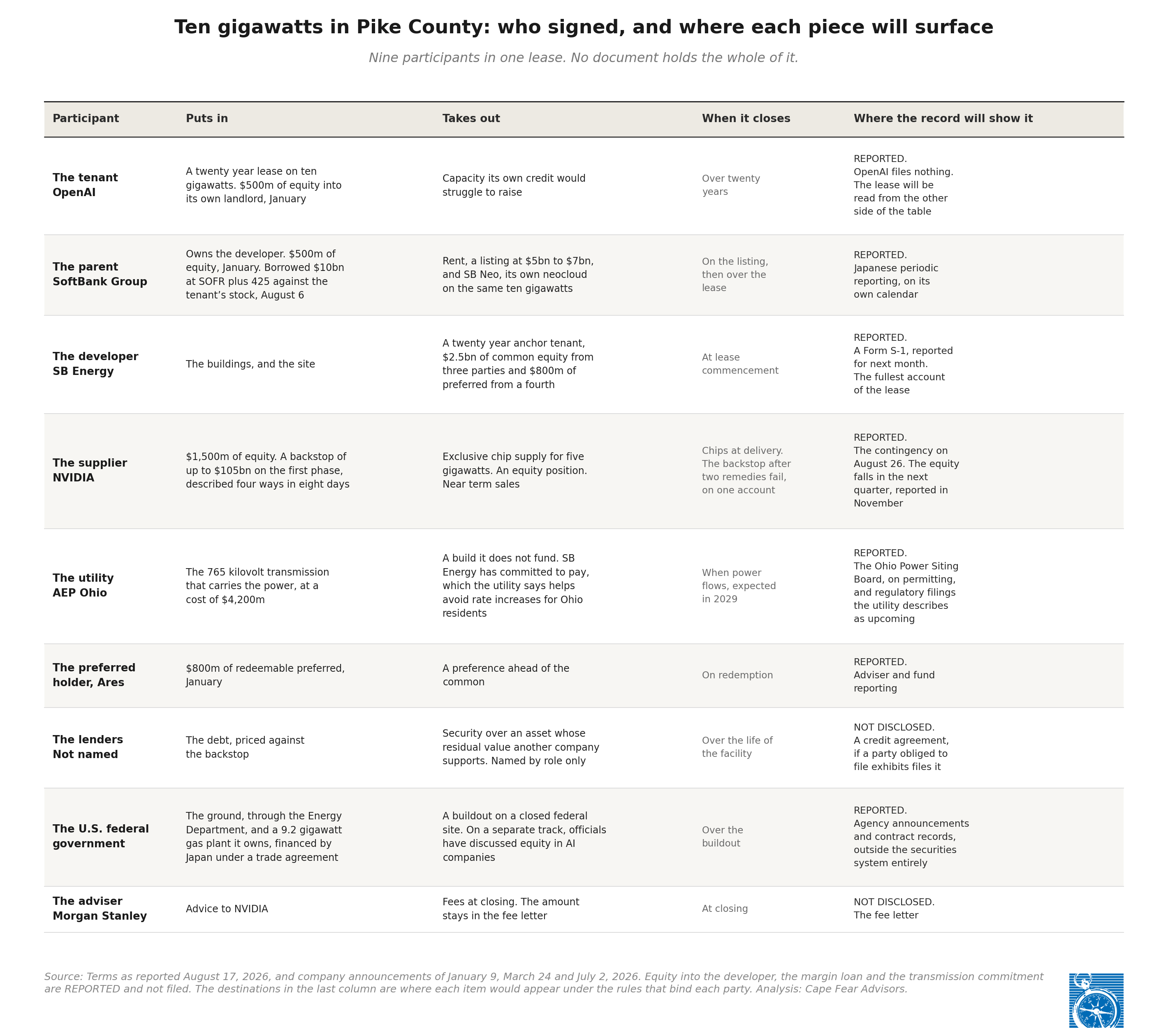
The record will fill in, and the way it fills in is the point. No single document holds this transaction. Each party discloses the slice it owns, in the form its own rules require, on its own calendar. NVIDIA reports a contingency in nine days. SB Energy describes the whole lease in a registration statement next month, because a company selling shares has to. SoftBank reports on a Japanese schedule. The lenders appear in a credit agreement filed as an exhibit by whoever is required to file it. OpenAI, which pays the rent for twenty years, files nothing at all. Assembling the transaction means collecting nine partial views, published at nine different times, each shaped by a different obligation.
Power first, water second
The Atomic Energy Commission announced the choice of this ground on August 12, 1952, and published what it had weighed. Five criteria, in the order it gave them: availability and cost of producing electric energy; adequacy of water supply; sociological factors, such as the population of surrounding communities and the local labor supply; available transportation facilities; and climate and weather. Stone and Webster had narrowed the search to the Ohio River valley between Paducah and Parkersburg. The Commission picked a site on the Scioto.
Both of the first two criteria were then built to order.
For power, a group of investor-owned utilities formed the Ohio Valley Electric Corporation in 1952 for the single purpose of supplying the Piketon plant, and put up two coal stations to serve it: Kyger Creek at Gallipolis, Ohio, 1,086 megawatts, and Clifty Creek at Madison, Indiana, 1,304 megawatts. Both came on in 1955. The arrangement with the Department of Energy ended in 2003.
For water, the X-611 treatment plant drew raw water from the Scioto through well fields, was built for forty million gallons a day, and typically ran over ten million. The site’s own history puts that at enough to serve a city of a hundred thousand.
So a special purpose company was formed to build the power, and a treatment plant was built to take the water, because the enrichment cascade could run on nothing less. Seventy-four years later the same ground is chosen again, on the same two inputs.
The arrangement for the power is public and sized. A 9.2 gigawatt gas plant, nearly four times what OVEC built for the cascade, and $4,200 million of new 765 kilovolt transmission that AEP Ohio will build and SB Energy has committed to pay for, with power expected to flow in 2029.
The arrangement for the water is unstated. Every account of the signing carries gigawatts, dollars, acres and jobs. A search of them for a withdrawal figure, a consumption figure, or a cooling method returns nothing. The ground was picked in 1952 on the second criterion as much as the first, and the second criterion has yet to appear.
What was signed
REPORTED, and the terms as described. OpenAI signed a twenty-year lease on ten gigawatts from SB Energy, which SoftBank majority owns. NVIDIA agreed to stand behind up to $105,000 million, beginning with a first phase. In return NVIDIA becomes the exclusive chip provider for the first half of the site and takes an equity stake in SB Energy, including a $1,500 million investment. It holds an option to extend the commitment to the full campus. Morgan Stanley advised NVIDIA.
The mechanics matter more than the headline number, and the mechanics are where the accounts part company. Three descriptions of the commitment ran on the day of the signing, and a fourth was published by NVIDIA a week before it.
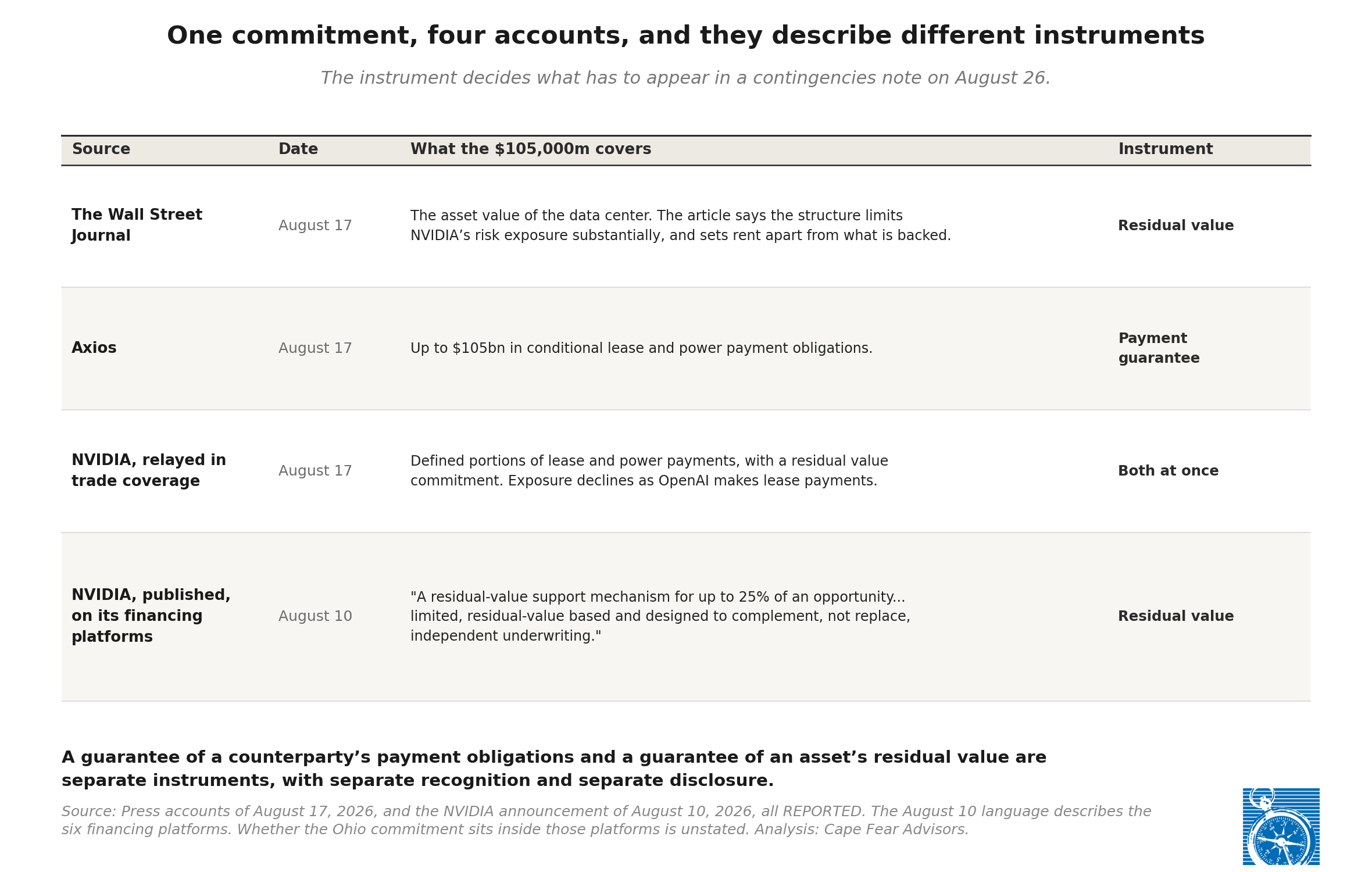
The first two describe opposite instruments. The third describes both at once, which would reconcile them and would make this a hybrid. The fourth is the company’s own published language, and it lands on residual value, though it was written about the financing program a week earlier and reaches this site only if this site sits inside that program. Whether it does remains unstated.
That term decides the accounting. A guarantee of a counterparty’s payment obligations and a guarantee of an asset’s residual value are separate instruments with separate recognition, separate measurement, and separate disclosure. Which one this is determines what NVIDIA’s contingencies note has to carry on August 26.
The phase size splits three ways as well. The Journal puts the guaranteed first phase at around five gigawatts and gives NVIDIA exclusivity over the first half of the site. Axios puts the guaranteed phase at eight IT gigawatts. Reuters writes that NVIDIA will secure up to eight gigawatts of computing capacity at the campus, which describes capacity obtained rather than obligations guaranteed. Three accounts, one signing, published within hours.
The waterfall belongs to the Journal and carries here as the Journal’s. On that account, if OpenAI leaves, SB Energy first tries to re-lease the site at the same price. Failing that, it tries to sell. Only then does NVIDIA pay the difference in value, and the commitment reaches completed data centers alone. On that reading the $105,000 million is a ceiling behind two prior remedies, on buildings still to be built, measuring the most NVIDIA could owe.
The participants, and what each one gets
A ledger asks the same four questions of every party: what was put in, what comes out, when the trade closes, and where a reader can check it.
OpenAI commits to twenty years of rent on ten gigawatts and receives capacity its own credit would struggle to raise. Its trade closes over two decades. Since January it has also been a shareholder in its landlord.
SoftBank Group owns SB Energy, put $500 million into it in January, and stands to realize value through a listing the developer is reported to be preparing as soon as next month at a raise of $5,000 million to $7,000 million. It is also building a business that sells what its tenant sells: on July 2 it established SB Neo, a Delaware company owned 51 percent by SoftBank Corp. and 49 percent by SoftBank Group, to sell cloud computing to large American enterprises, drawing on group infrastructure the release describes as “currently being developed at a 10-gigawatt scale,” with services planned by fiscal 2028.
And eleven days before SB Energy signed a twenty-year lease to OpenAI, SoftBank was reported to be borrowing against OpenAI’s stock. On August 6 it secured a $10,000 million margin loan at about 425 basis points over the secured overnight financing rate, two years with a one-year extension, collateralized by its OpenAI shares. Behind that sit a $40,000 million bridge loan signed in March with JPMorgan and Goldman Sachs leading, proceeds from selling $5,830 million of NVIDIA stock and $12,730 million of T-Mobile stock, cumulative investment in OpenAI of roughly $64,600 million, and group debt of about 20.45 trillion yen, or roughly $135,000 million. All REPORTED.
SB Energy builds and owns the buildings, and receives a twenty-year anchor tenant plus $2,500 million of common equity from three parties and $800 million of preferred from a fourth, $3,300 million in all. Its trade closes at commencement, and the backstop is what makes borrowing against the site financeable. Its obligations run past the buildings: it has committed to pay for $4,200 million of transmission it will own none of.
AEP Ohio builds the 765 kilovolt transmission that carries the power, and takes a build it does not fund, since SB Energy has committed to pay for it, in an arrangement the utility says will help avoid increases to transmission rates for Ohio residents. Its trade closes when power flows, expected in 2029. Its slice of the record lands where none of the others do: the Ohio Power Siting Board, on permitting that requires public input, environmental impact study and land use analysis, and in regulatory filings the utility describes as upcoming.
NVIDIA commits equity and a contingent obligation, and receives exclusivity over five gigawatts of chip supply, a position in SB Energy, and near-term sales. It is reported as expecting to sell hundreds of billions of dollars of chips into the first phase, and to have discussed financing OpenAI’s purchase of those chips. A week before the signing it announced memoranda with Apollo, BlackRock, Blackstone, Brookfield, Goldman Sachs and KKR to establish platforms intended to mobilize over $500,000 million of third-party capital for AI compute infrastructure, subject to final agreements. Its trade closes at delivery, on cash terms. On the Journal’s account of the terms, its obligation stays open until a re-lease and a sale have both been tried.
Ares put in $800 million of redeemable preferred equity in January and takes a preference ahead of the common.
The lenders put in the debt priced against the backstop, and take security over an asset whose residual value another company has agreed to support. Their trade is the one the rest of the structure makes possible. Every account so far describes them by their role. Whether they come from NVIDIA’s new platform is a fair question.
The United States federal government owns the ground through the Department of Energy, and owns the 9.2 gigawatt gas plant, which Japan is financing under a trade agreement. Commerce Secretary Howard Lutnick and Energy Secretary Chris Wright are reported as deeply involved. On a separate track, senior officials have been discussing equity stakes in major AI companies on behalf of the public, and OpenAI floated a five percent stake in early July. Anthropic has said publicly that it stands outside those discussions, and the talks remain talks.
Morgan Stanley advised NVIDIA and will be paid at closing. The amount stays in the fee letter.
Nine participants. NVIDIA supplies the silicon, guarantees the buildings, and owns a piece of the landlord. OpenAI rents the buildings, owns a piece of the same landlord, and has floated selling a stake to the government that owns the ground.
The developer’s cap table is the circle
The equity into SB Energy, in date order.
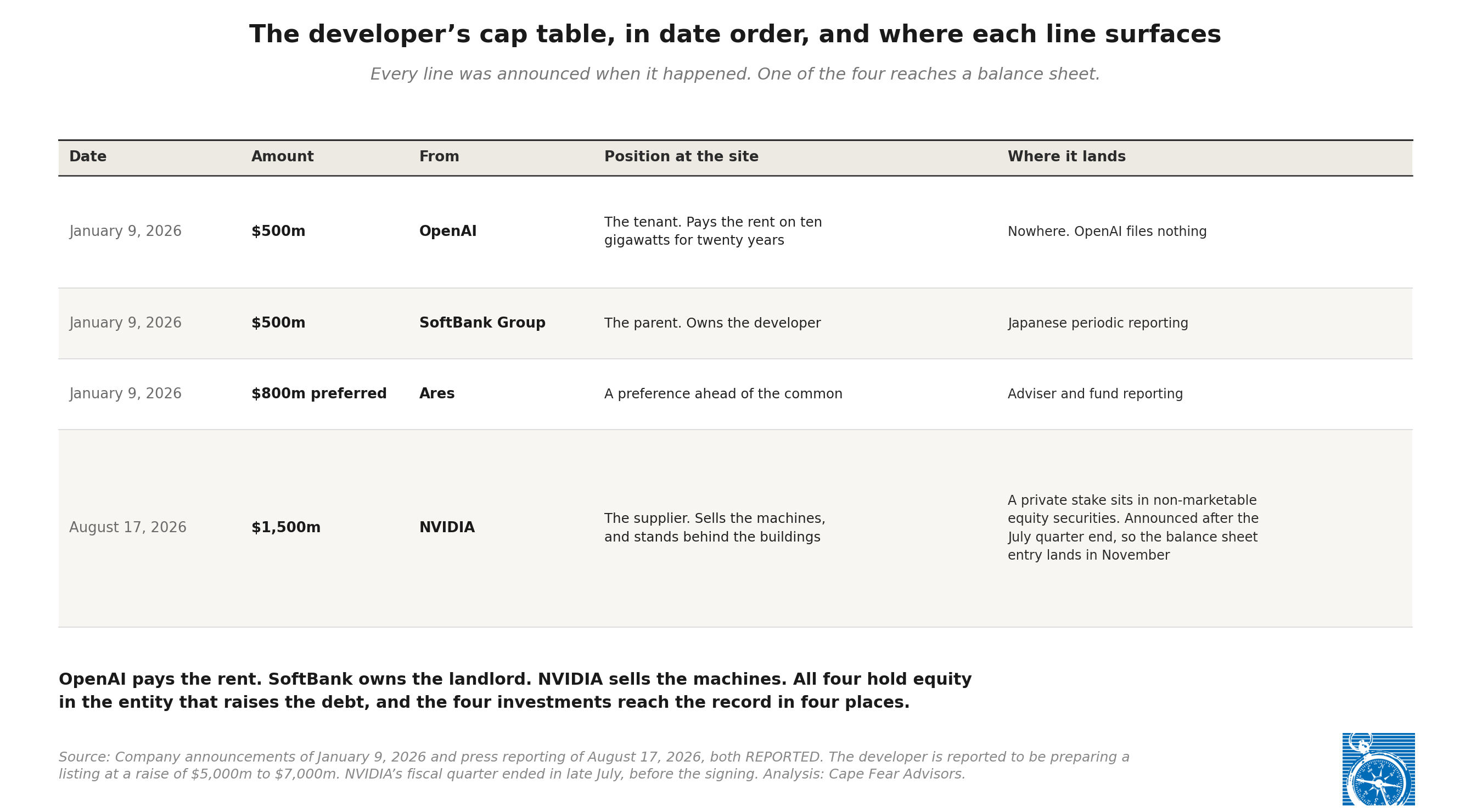
OpenAI pays the rent, SoftBank owns the landlord, NVIDIA sells the machines, and all three hold equity in the entity that raises the debt. SB Energy plans to list within weeks. All four lines were announced when they happened. Setting them in one column is the only new thing here.
NVIDIA answered the obvious question about this shape a week before the signing. The post of August 10 announcing the six financing platforms carries a section headed The Important Questions, and the first one is “Is this circular financing?” The answer given: “This initiative is designed to address that concern. We are bringing independent, long-term institutional capital into the AI infrastructure market.” The capital providers, the post says, “independently underwrite each project,” assessing the customer, demand, utilization, cash flow and residual value.
A shorter answer arrived on the morning of the signing, in a separate post: “No. OpenAI will pay the lease.” In the same post Huang put OpenAI’s infrastructure plans at about $600,000 million of NVIDIA compute through 2030.
The two answer different questions, and the longer one is the more useful. Circularity describes the path capital travels, and capital travels in a circle by construction. A bank lends a depositor’s savings to a builder who pays a supplier who banks the proceeds at the bank. Vendor credit, prepayments, and equity taken in a customer draw the same circle tighter.
The cap table is that circle drawn once: the party that sells the machines holds equity in the landlord and stands behind the obligations of the buildings the machines go into. The description belongs to the parties.
Whether the mechanism is sound is the separate question, and it turns on the terms. How much is committed. In what order the remedies run. What the buildings fetch on resale. Whether OpenAI pays the rent for twenty years. The August 10 answer speaks to the underwriting, which is a real answer to a real concern. The August 17 sentence speaks to the rent, which is the last question on the list and the one that settles the rest of them.
Is this Stargate
A fair question, because SB Energy is a Stargate partner. It joined in January, the announcement described the partnership as part of the program, and its site there is 1.2 gigawatts in Milam County, Texas. A third-party survey in April counted seven United States Stargate sites, with Oracle owning the hardware at five and SoftBank at two. The Ohio entry on that list is Lordstown, a SoftBank and Foxconn joint venture under 0.3 gigawatts, described as primarily a manufacturing facility.
Piketon is a separate site, roughly thirty times Lordstown, in the southern part of the state. The account of the signing describes it by its own terms and leaves the program out.
What separates them is who supplies the credit. Across the Stargate sites as described, the party that owns the hardware carries an investment grade balance sheet and puts the assets on it. At Piketon, SB Energy raises the debt and NVIDIA makes that debt cheaper by standing behind the value of the buildings, in exchange for the exclusive right to sell into them. A vendor supporting the resale value of its own product is a different place for the credit to sit, and where the credit sits is what a lender prices.
We built this frame in July, on a different pair of names
In July we read a special purpose vehicle that had borrowed roughly $35,000 million to buy Google’s chips and lease them to Anthropic. Because the vehicle owned the hardware, the borrowing sat on its books rather than on the user’s. Broadcom guaranteed the debt. Anthropic had filed nothing. The parties around it had, and their filings read together showed the whole structure.
Piketon is that shape again, with the nouns changed. A vehicle owns the assets. The user leases them, and the obligation sits on the vehicle’s books. A third party with no ownership of the debt stands behind it. The user files nothing. The parties around it file everything a reader has, which is the same reading we ran on the tenant’s own landlords last week.
Two differences, and the second one decides August 26.
The asset changed from silicon to real estate and power. Chips depreciate on a technology cycle and these buildings carry a twenty year lease, so the residual value question that the guarantee answers is a different question with a different shape.
And in the July structure, the guarantee appeared in the guarantor’s own quarterly report. Broadcom stated it at a maximum of $29,000 million, in a figure the market had been reporting as undisclosed. That is the precedent, on the same instrument class, one quarter ago: the number that nobody else would name showed up in the filing of the party that gave it.
So the test on August 26 has a worked example. A supplier that stands behind a customer’s financing discloses the maximum in its own contingencies note, and a reader who waits for that note learns the number the reporting could not settle.
The number has fallen by more than half, in two cuts, in three weeks
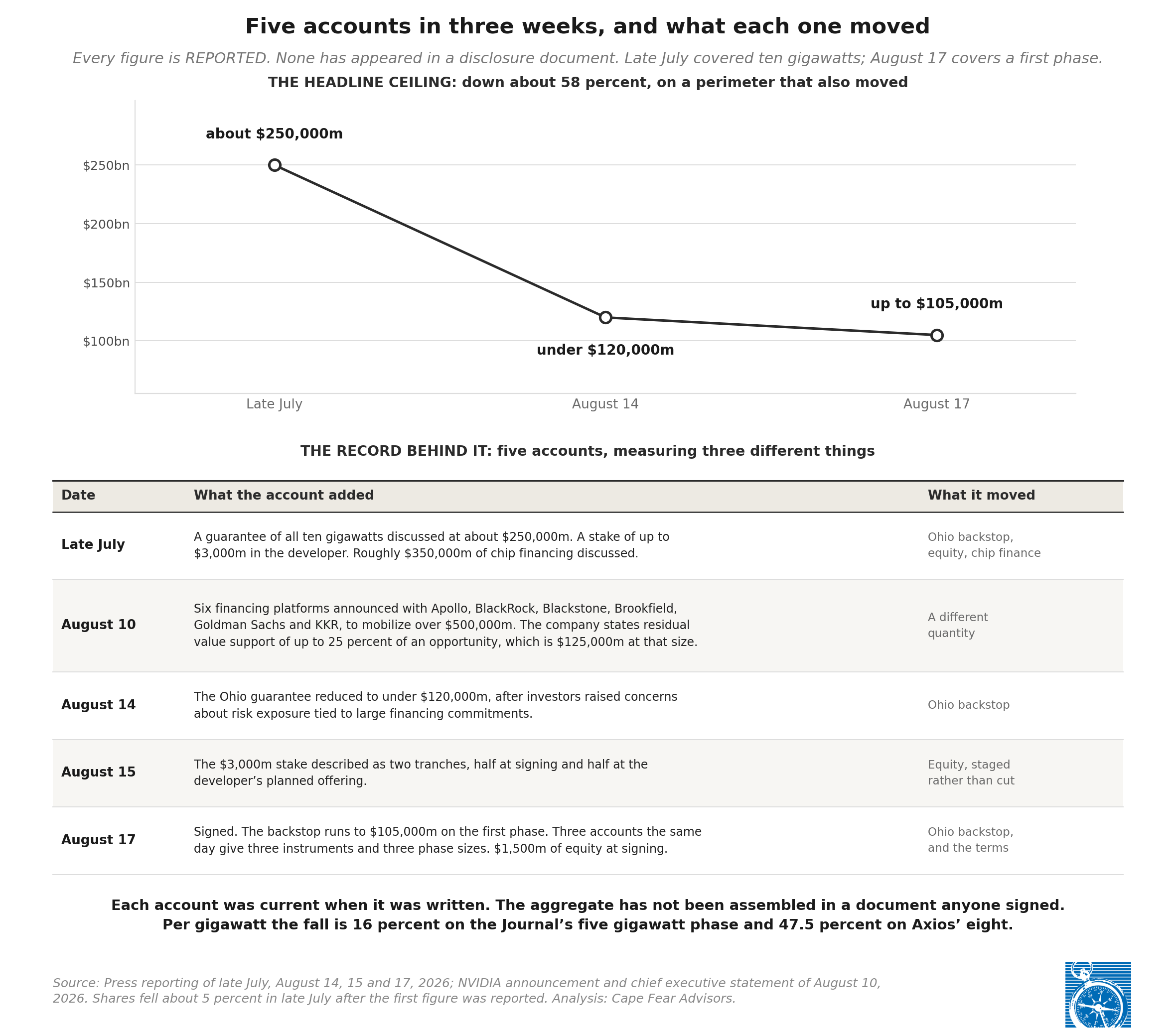
NVIDIA shares fell about 5 percent in late July after the first of those figures was reported. A late July account of roughly $350,000 million to finance chips for the site stays open in the signing report.
AND A FOURTH FIGURE BELONGS BESIDE THESE, THOUGH IT MEASURES SOMETHING ELSE. The August 10 post states the program in the company’s own words. The platforms with Apollo, BlackRock, Blackstone, Brookfield, Goldman Sachs and KKR are “designed to mobilize over $500 billion of third-party capital,” a figure the post is careful to describe as aggregate capital the platforms are built to raise over time. And on the support NVIDIA supplies against it:
“In some cases, NVIDIA may provide a residual-value support mechanism for up to 25% of an opportunity, assessed carefully on a project-by-project basis. That support is limited, residual-value based and designed to complement, not replace, independent underwriting.”
Twenty-five percent of the $500,000 million program is $125,000 million, which is the ceiling reported that week.
THAT SENTENCE ALSO SPEAKS TO THE DISAGREEMENT ABOVE. The company’s own published description of the mechanism it offers is residual value based. If the Ohio commitment sits inside this program, the company has already characterized the instrument, and the characterization matches the Journal’s account rather than the Axios one. If it sits outside, the August 10 language reaches none of it.
So the two ceilings side by side raise a question nobody has answered. Inside the program, one project consumes 84 percent of the declared capacity. Outside it, NVIDIA’s total declared contingent capacity across both is $230,000 million. And the 25 percent cap runs the other way as arithmetic: OURS, $105,000 million at that ceiling implies an opportunity of about $420,000 million. Huang’s own post of August 17 puts OpenAI’s infrastructure plans at about $600,000 million of NVIDIA compute through 2030, and trade coverage puts each hardware generation at the site at $150,000 million to $200,000 million. The implied figure sits inside those, which is a check on the reporting rather than a confirmation of the structure.
THE EQUITY DID NOT MOVE THE SAME WAY, AND THE DISTINCTION MATTERS. A report of August 15 describes the $3,000 million stake as two tranches, half at signing and half at SB Energy’s public offering. The $1,500 million in the signing report is the first of those, and reading it as a reduction from $3,000 million would mistake a schedule for a cut. The backstop fell. The equity was staged.
So the headline ceiling fell about 58 percent in three weeks, across three accounts, and has yet to appear in a disclosure document.
HOW MUCH OF THAT FALL IS PRICE AND HOW MUCH IS PERIMETER IS UNSETTLED, BECAUSE THE PHASE SIZE IS UNSETTLED. The late July figure covered all ten gigawatts, which is $25,000 million a gigawatt. The signed figure covers a first phase, and the accounts give that phase two sizes. On the Journal’s five gigawatts it is $21,000 million a gigawatt, a fall of 16 percent. On Axios’s eight it is $13,125 million a gigawatt, a fall of 47.5 percent. The headline number fell 58 percent; per gigawatt the fall lies somewhere in a band of roughly 16 to 47 percent, and which end depends on which account of the phase is right. Each version was current when it was written, which means the figure a reader carries depends on the day the reading happened. The terms behave the same way inside a single day: three accounts of one signing, hours apart, describe three instruments and three phase sizes. Reading order decides the answer.
One filed number, for scale
There is a version of this trade already in the record, measured and audited, and it is small.
FILED, NVIDIA’s Form 10-Q for the quarter ended April 26, 2026: “In fiscal year 2026, we entered into agreements to guarantee partners’ facility lease obligations in the event of their default in exchange for warrants. The maximum gross exposure under all agreements is $3.5 billion, which is reduced as the partners make payments to the lessors over terms ranging from 5 to 7 years. The partners have placed $712 million in escrow to mitigate our potential exposure.”
Set against Piketon, it is the same company, the same family of instrument, and the same consideration flowing back in the form of the counterparty’s own paper. The filed version carries a maximum of $3,500 million gross, against which $712 million sits in escrow, and it is carried at a fair value the filing calls immaterial. It covers facility lease obligations, and it amortizes as the partners pay the lessors, which is the feature NVIDIA’s own description of the Ohio commitment also names.
The reported Piketon ceiling is about thirty times the entire filed guarantee book.
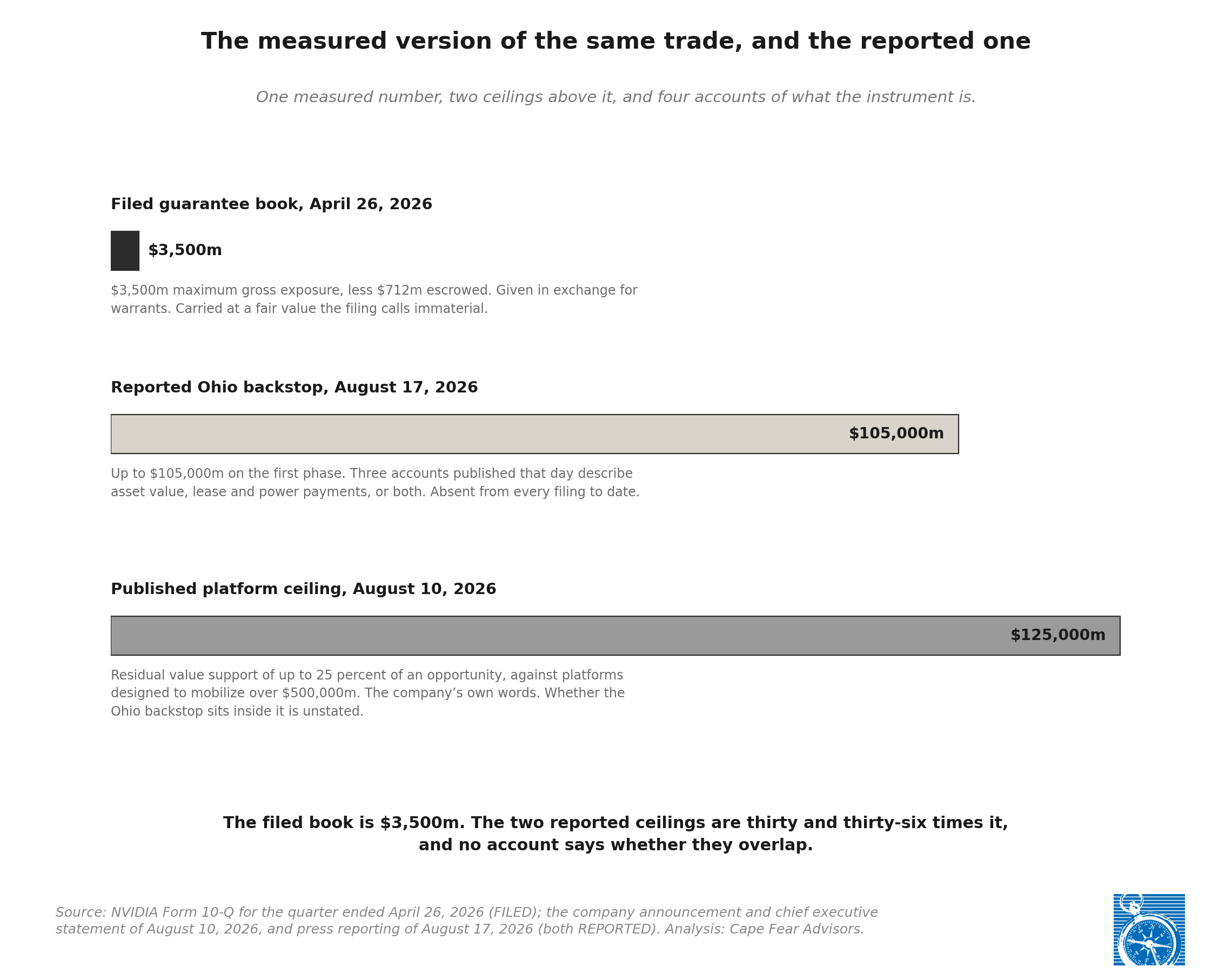
Whether the two are the same instrument is precisely what the accounts disagree about. The point here is the state of the record: the small version is measured, the large version is described three ways.
The record arrives in pieces, and two arrive soon
August 26. NVIDIA reports its fiscal second quarter. The guarantees and contingencies disclosure either moves toward the reported numbers, stays near $3,500 million, or moves partway. The third outcome is the most useful, because the disclosed increment would be the executed share and the remainder would be what stands announced alone. On the Journal’s account of the terms, three features each argue for the middle outcome: the commitment backs asset value, it reaches completed buildings, and payment arises after a re-lease and a sale both fail. On the Axios account it is a payment guarantee, which is the reading that would put the largest figure in the note. The print settles which account was right.
SB Energy’s S-1. A listing next month means a registration statement describing the anchor lease, OpenAI as the tenant, OpenAI’s shareholding in the issuer, and NVIDIA’s support, from the other side of the table. It is the more informative document, because the party filing it has every reason to describe the backstop fully. The backstop is what makes the debt financeable.
Those two are the near ones. Behind them sit the credit agreement that names the lenders, whenever a party obliged to file exhibits files it; SoftBank’s reporting on its own schedule; and the annual reports where a twenty-year lease commencing at some future date turns into a right-of-use asset and a liability on somebody’s balance sheet. Each document answers a different question, and each is written to a different reader.
The two halves of NVIDIA’s own participation separate by three months. Its fiscal second quarter ended in late July, before the signing, so the August 26 report can carry the contingency as a subsequent event and the $1,500 million of equity has no balance sheet to land on until the quarter that ends in October, reported in November. A private stake in a private developer sits in non-marketable equity securities, the caption that went from $22,251 million to $43,364 million in a single quarter. One transaction, one company, two disclosures, a quarter apart.
What the record supports
Every figure above is either FILED or REPORTED, and the tag says which. The account of the terms belongs to the outlets that published it and is carried here as theirs, including where they conflict. What instrument the commitment is, and therefore what has to appear in a contingencies note, is a question August 26 answers.
The outcomes remain open in both directions. OpenAI may fill ten gigawatts and pay every dollar of rent for twenty years. The site may run at capacity on gas the federal government owns. The lenders may be repaid with the backstop untested. What is measurable today is narrower and it holds whichever way those land: the largest single arrangement of its kind signed this year is described in newspapers, and the one comparable instrument that has reached a filing is measured at $3,500 million.
The ground was chosen in 1952 for power and water, at the scientific frontier of that decade. It has been chosen again on the same two inputs, for the frontier of this one. What each of the nine agreed to is a matter of public interest, and by the end of next month some of it will also be a matter of public record, filed a piece at a time, by parties other than the one paying the rent.
Notes
(1) The site. The Portsmouth Gaseous Diffusion Plant, on 3,777 acres owned by the United States Department of Energy in Pike County, Ohio, about four miles south of Piketon on US Route 23 and, in the Commission’s own 1952 announcement, approximately twenty-two miles north of Portsmouth. The Department’s Portsmouth Strategic Vision gives the acreage and states that the site sits along the Scioto River. Construction began in late 1952; enrichment ceased and moved to Paducah in 2001; the final cell in the X-326 building was shut on June 6, 2012, after more than fifty-seven years of cascade operation. An earlier version of this piece carried 3,714 acres and an enrichment start of 1954; the acreage is corrected to the Department’s figure and the start date is given as the mid-1950s, since the Department’s own account puts completion of the plant in 1956 while the cascade’s fifty-seven year run implies a mid-decade start. THE FOOTPRINT OF THE ANNOUNCED CAMPUS IS A FRACTION OF THE RESERVATION, reported at 640 acres. That figure is carried by a site opposed to the project, citing a Department fact sheet, and is stated here with its source and that stance named, since it has not been second-sourced. The acreage, the river and the operating dates come from the Department’s Portsmouth Strategic Vision and the site’s own historical materials. All REPORTED. The location relative to the highway is described in hedged terms because it was not independently surveyed.
(1a) The river. The Scioto rises in Auglaize County in west-central Ohio and runs about 230 miles southeast past Columbus, Circleville and Chillicothe to the Ohio River at Portsmouth. US 23 shares that valley from Columbus south, and is named Scioto Trail approaching Portsmouth. The road departs from the river north of Columbus, where the highway runs toward Delaware and Marion and the river’s headwaters lie to the west, so the piece claims the shared valley only for the southern half. The flood of March 1913 is carried as history rather than as a finding: it remains Ohio’s worst, and at Chillicothe the river crested near forty feet, about eight feet above any prior record, with roughly seventy percent of the city under water.
(1b) The 1952 criteria, the power, and the water. The five site selection criteria and the August 12, 1952 announcement are quoted from the site’s own historical materials, as is the Stone and Webster narrowing to the Ohio River valley between Paducah and Parkersburg. Ohio Valley Electric Corporation was formed in 1952 by investor-owned utilities to serve the Piketon plant; Kyger Creek near Gallipolis, Ohio, is stated at 1,086,300 kilowatts and Clifty Creek near Madison, Indiana at 1,303,560 kilowatts, both producing from 1955, with the Department of Energy affiliation ending in 2003. The X-611 Water Treatment Plant is stated at a 40 million gallon per day design capacity, typically processing over 10 million gallons daily for the cooling water system, drawn from the Scioto River through the X-605A sanitary wells and the X-608A and B well fields, and described as enough to serve a city of 100,000. All REPORTED.
(1c) The absent water figure, and the probe behind it. The accounts of the August 17 signing were searched for a water withdrawal, consumption, or cooling figure for the announced campus. NONE WAS FOUND IN ANY OF THEM. The published accounts carry gigawatts, dollars, acres and jobs. One site opposed to the project refers to a separate water usage report and to cooling water cycling near a contaminated aquifer, without figures. Per the standing rule this is a documented failure to find rather than a finding that no figure exists, and the registration statement named above is where a site risk of this kind would ordinarily be described.
(1d) AEP Ohio and the transmission. REPORTED, the utility’s own announcement of March 24, 2026: new 765 kilovolt transmission infrastructure to serve the ten gigawatt campus at Piketon, at $4,200 million, with power expected to flow in 2029. SB ENERGY IS STATED AS COMMITTED TO PAYING FOR THE INFRASTRUCTURE, which the announcement says “will help avoid increases to transmission rates for Ohio residents,” and which the utility’s Marc Reitter describes as supporting economic development “while protecting our ratepayers from the costs associated with this new infrastructure.” The Ohio Power Siting Board is named as overseeing permitting, with public input, environmental impact studies and socioeconomic and land use analysis, and the utility describes upcoming regulatory filings. This is the participant whose slice of the record sits with a state commission rather than with the Securities and Exchange Commission, and the piece uses it for that.
(2) The March announcement. Federal officials announced approximately ten gigawatts of data center capacity at the site, powered by a 9.2 gigawatt gas plant owned by the United States federal government and financed by Japan under a trade agreement. REPORTED, March 2026.
(3) The signing, and the four accounts. The Wall Street Journal, Axios and Reuters, all August 17, 2026, plus NVIDIA’s own published statement of August 10, 2026. The four descriptions of the commitment are set out in Exhibit 2 and quoted rather than reconciled, because the record does not reconcile them. Each outlet’s characterization is attributed to that outlet throughout. The two remedy waterfall belongs to the Journal alone.
(4) The two answers on circularity, and how they were dated. NVIDIA’s post of August 10, 2026, “NVIDIA AI Factory Compute Is Becoming an Investable Asset Class,” carried on the chief executive’s X account, X status 2086934705207959965. The shorter answer, “No. OpenAI will pay the lease,” is X status 2089331487342829862, linked from Yahoo Finance’s coverage of August 17, 2026; Benzinga carried the same line with the attribution “Huang wrote” and no date or medium. X status identifiers encode a millisecond timestamp, recoverable as (id >> 22) + 1288834974657. The August 10 identifiers decode to 17:56 and 20:42 Eastern on August 10; the third decodes to 08:40 Eastern on August 17. THE METHOD IS SET OUT SO THAT A READER CAN RUN IT. An earlier working version of this piece asserted the date without support and was corrected before publication.
(5) The filed guarantee book. FILED. NVIDIA Corporation Form 10-Q for the quarter ended April 26, 2026, accession 0001045810-26-000052: agreements entered in fiscal year 2026 guaranteeing partners’ facility lease obligations in the event of default, in exchange for warrants; maximum gross exposure under all agreements of $3.5 billion, reduced as partners make payments to lessors over terms of five to seven years; $712 million placed in escrow. Carried at a fair value the filing describes as immaterial.
(6) The July structure, and the Broadcom precedent. Set out in “Anthropic, the financing before the filing” (July 6, 2026, this series) and carried again in “Anthropic, Adding It Up: The Judgment Calls” (July 17, 2026), which is the linked destination because its note 6 holds the description relied on here. A vehicle borrowed approximately $35 billion to acquire Google chips leased to Anthropic, and Broadcom guaranteed $29 billion of it. THE ACCESSION NUMBER FOR THE BROADCOM REPORT IS NOT PINNED HERE, so this note cites the July piece rather than the filing, and the July piece carries the reading of how the beneficiary was described. The precedent used is narrow: a supplier that stood behind a customer’s financing stated the maximum in its own report.
(7) The developer’s cap table. Company announcements of January 9, 2026 for the OpenAI, SoftBank Group and Ares investments, and press reporting of August 17, 2026 for NVIDIA’s. All REPORTED. The August 15, 2026 report describing the NVIDIA stake as two tranches, half at signing and half at SB Energy’s planned offering, corrects an earlier reading in our own drafting that treated the $1,500 million as a reduction from $3,000 million. The reduction was in the backstop; the equity was staged.
(8) SoftBank Group. The $10,000 million margin loan of August 6, 2026 at approximately 425 basis points over the secured overnight financing rate, collateralized by OpenAI shares; the $40,000 million bridge loan of March 2026; disposals of $5,830 million of NVIDIA stock and $12,730 million of T-Mobile stock; cumulative investment in OpenAI of approximately $64,600 million; and group debt of approximately 20.45 trillion yen. All REPORTED. SB Neo was established July 2, 2026, per the company’s own release. The paragraph is retained because the parent’s borrowing capacity is what stands behind the developer’s equity, and the lease is twenty years long.
(9) Stargate. A third-party survey of April 2026 counted seven United States sites, with Oracle owning the hardware at five and SoftBank at two, and listed Lordstown, Ohio, a SoftBank and Foxconn joint venture under 0.3 gigawatts, described as primarily a manufacturing facility. REPORTED. SB Energy joined the Stargate partnership in January 2026 with a 1.2 gigawatt site in Milam County, Texas. The account of the Piketon signing describes it on its own terms.
(10) The implied opportunity, tagged OURS. $105,000 million at the 25 percent ceiling NVIDIA published on August 10 implies an opportunity of approximately $420,000 million. This is arithmetic on two REPORTED inputs and carries no claim that the Ohio commitment sits inside the platform program. Whether it does is unstated in every account. The comparison figures are Huang’s own of approximately $600,000 million of NVIDIA compute for OpenAI’s infrastructure through 2030, and trade coverage of $150,000 million to $200,000 million per hardware generation at the site.
(11) What was searched and not found. No Form 8-K from NVIDIA on the Ohio commitment was on EDGAR as of the date of this piece; the probe was run and is stated as a documented absence rather than a finding. No registration statement from SB Energy had been filed. The listing is REPORTED as planned for as soon as next month, at a raise of $5,000 million to $7,000 million.
Figures tagged FILED come from documents filed with the Securities and Exchange Commission and are cited by accession number. Figures tagged REPORTED come from news accounts and company announcements, and carry the reliability of their sources rather than of a filing. Figures tagged OURS are our own arithmetic on stated inputs, and the inputs are named.
The pieces are free and they stay free. Paid subscriptions open today, and nothing sits behind them: no early access, no subscriber-only posts, no part of the record that costs more to see. What a subscription pays for is the time. Nine participants, four accounts of one commitment, one filed number and eleven notes took a day, and the day is the product. Support from anyone who values the work and can afford it keeps it coming at this pace. Anyone who cannot should read it anyway, which is why it is open.
Standing disclosure: Cape Fear Advisors holds no direct position, long or short, in the securities discussed here. Any exposure is indirect, through managed funds it does not control, which may now include index funds holding the public companies named, among them NVIDIA, SoftBank Group, Ares Management, Morgan Stanley, Apollo, BlackRock, Blackstone, Brookfield, Goldman Sachs, KKR, Oracle and Broadcom. Anthropic is the developer of Claude, which is used in preparing this research. Anthropic is a direct competitor of OpenAI, the tenant whose lease is read here, and Anthropic is named in the body of this piece in connection with the federal equity discussions. Anthropic is also a compute counterparty within the same circle of arrangements read here, and Broadcom, whose guarantee is used as the comparison for August 26, guaranteed the financing of chips leased to Anthropic. That nearness cannot be checked away, which is why no claim here rests on trust in the tool: every figure carries a public source, and the record grades the rest. Others with ties to Anthropic include Amazon and Alphabet, its two largest outside backers, and Google, a compute counterparty, which is named here in the July comparison; and companies not named here may hold positions or supply relationships that bear on the parties discussed, which is why every piece is re-checked for bias, ground facts, and filings rather than read against a fixed list. Figures are quoted from the filers and from named parties without characterization, and the same standard of reading is applied to every party named.
Analysis: Cape Fear Advisors. Not investment advice.
Published August 17, 2026.
This piece also appears on Substack. Cape Fear Advisors is an independent advisory firm based in Portsmouth, NH.
Contact Cape Fear Advisors