

Circular financing is ordinary, and a trade receivable is the simplest instance of it. Pointed upstream the same instrument has other names, and none of them carries what vendor financing carries, so the questions have followed the word. What was advanced decides what the failure leaves. Credit leaves a creditor. A commitment to buy leaves a write-down. The two get financed as though they were one thing, and only one of them leaves anybody to call.
The ladder, and why we numbered it from one side
Circular financing is a phrase people reach for when a seller hands a buyer something of value and the buyer uses it to buy from the seller. Put that way it sounds like an accusation. It also describes an invoice. A company that ships goods on sixty-day terms has extended value to its customer, and the customer uses that value to take delivery of the goods. Sixty days is how commerce works, and nobody calls it anything.
That was the starting point of the piece published on August 1. If the ordinary case and the alarming case are the same act, then the useful question stops being whether an arrangement is circular and starts being how far it goes and what it costs. So the ladder was built to measure the distance.
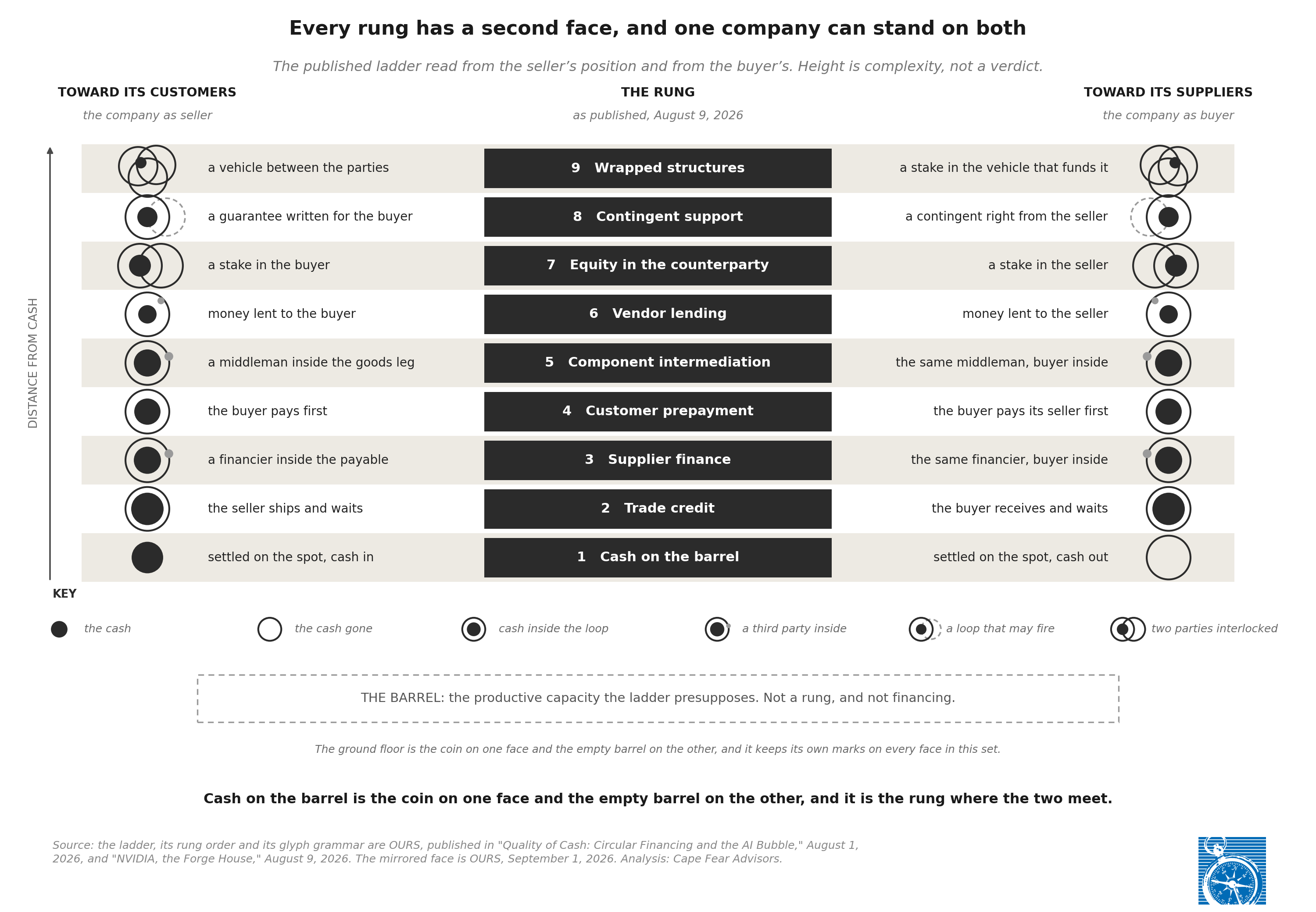
Nine rungs. Cash on the barrel at the bottom, where a coin goes down and the goods come back and nothing is owed by morning. Then trade credit, where the seller ships and waits. Then supplier finance, where a bank steps into the middle of a payable. Then customer prepayment, where cash arrives before the goods do. Then component intermediation, where a company stands inside its own supply chain buying parts on somebody else’s behalf. Then vendor lending, where the seller lends the buyer the purchase price. Then equity in the counterparty. Then contingent support, a promise that fires on a condition. Then, at the top, the wrapped structures, where the cash sits several balance sheets from home.
Distance up the ladder is distance the cash travels before it comes back. The law of the ladder is that the cash is the same at every rung and only the reported figures move. Height is complexity. It is not a verdict.
Those rungs were numbered from a seller’s seat, because the question that produced them was a seller’s question. A maker of equipment also supplies the money to buy the equipment, and the question was where that money sat.
Read from a buyer’s seat, the same nine rungs carry a second face, and the instrument on each face is the same instrument. A payable is a receivable seen from the other side of one invoice. An equity stake in a customer and an equity stake in a supplier are the same position pointed in opposite directions. A capacity backstop given is a capacity commitment taken.
One company can stand on both faces at once. One company does. (1)
Borrowed, built, and one definition that moves
Some of this is the market’s and some of it is ours, and the difference belongs in a paragraph before anyone leans on either.
Two of the mirrors already carry names. Factoring is rung three read from the other seat. Lending to a supplier is rung six read from the other seat. Reverse factoring carries an accounting standard and a disclosure requirement that has applied to buyers since 2023. None of that is ours. The rung order, and the reading of each pair as one rung with two faces, is what was built.
That is stated for a practical reason and not a proprietary one. Anyone can pick this frame up and run it against a filer, and it helps to know which parts have standard definitions behind them and which parts are construction.
One definition moves here, and it is declared rather than left to be found. Component intermediation, rung five, appeared on August 1 with Microsoft’s receivable for parts bought on others’ behalf as its example. The rung is read here as the structure and not as that instrument: a company standing inside its own supply chain with a third party interposed on the goods leg. The symmetry is the reason. Rung three puts a third party inside the money leg and rung five puts one inside the goods leg, which is why the two have shared a mark since the first drawing. (2)
Six and four
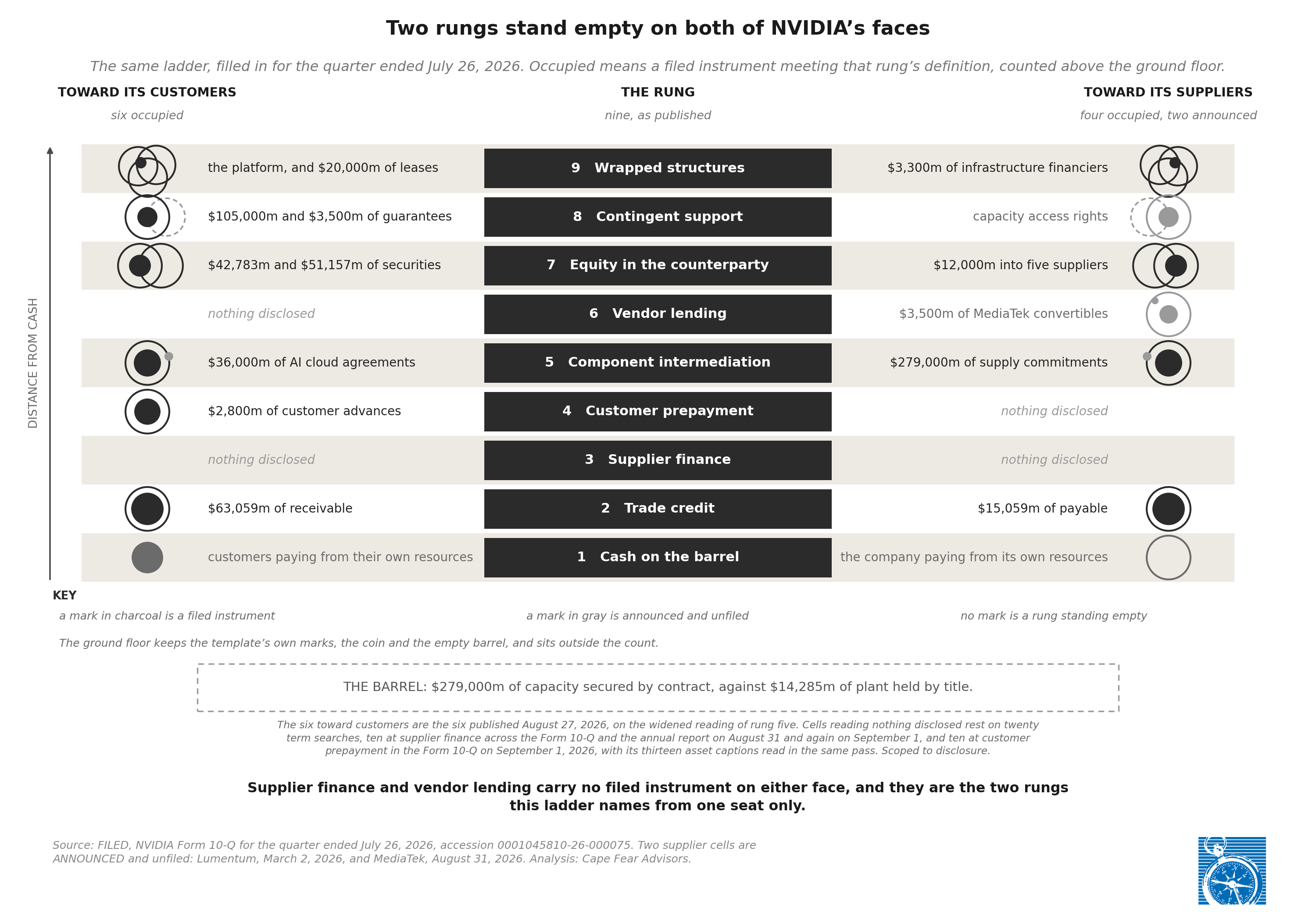
Occupancy needs a rule before it needs a count, and this one has three parts. A position is occupied when a filed instrument sits at it. The instrument has to meet that rung’s definition. Direction can come from the counterparty’s record, because direction belongs to an arrangement and not to a filing, and no filing sorts a securities book by which way it points. (3)
Cash on the barrel sits under the count and not in it. Every sale settles somewhere, so the ground floor is drawn and not counted.
On that rule, and on NVIDIA’s quarter ended July 26, 2026: six positions occupied toward customers, four toward suppliers. Two more toward suppliers are announced and carry no filing, being vendor lending and contingent support. What is counted is a position on a rung and not an instrument, so one instrument that sits on two rungs is counted at each. The split runs across rungs and not across faces. A convertible bond has a bond component and an option component, and those parts sum to the face amount, so each part is counted where it sits. One undivided obligation is a single thing wherever it is read from, and counting it on both faces would add a position that does not exist.
Toward customers the company stands on trade credit, with $63,059m of receivable. On customer prepayment, with $2,800m of advances. On component intermediation, with $36,000m of commitments to buy back cloud capacity, which is the rung turned around. On equity in the counterparty, with $42,783m of marketable and $51,157m of non-marketable securities. On contingent support, with guarantees of $105,000m and $3,500m. And on the wrapped structures. (4)
Toward suppliers it stands on trade credit, with $15,059m of payable. On component intermediation in its forward form, with $279,000m of supply and capacity commitments. On equity in the counterparty, with $12,000m of positions completed into five suppliers since September 2025. And on the wrapped structures, with $3,300m of equity-method interests in infrastructure financiers held as unconsolidated variable interest entities, against a maximum loss exposure of $4,700m. (5)
Concentration in that receivable fell rather than rose. The top three names went from 64 percent of the balance to 49, and the largest single name from 30 percent to 22.
The six toward customers are the six published on August 27, and the widening declared in the section above is what keeps the number at six. Under the August 1 definition, which named an instrument, the $36,000m of cloud commitments falls out of rung five and the count is five. The count held and the membership rule moved. A company that widened a definition and then called the prior period unchanged is the kind of thing this shelf writes about, which is why both halves are in the sentence. (6)
Two rungs stand empty on both faces. Supplier finance carries nothing in either direction. Vendor lending carries nothing toward customers, and the one item pointed upstream is announced and unfiled. And those two happen to be the only rungs on the ladder that are named from a single seat. Supplier finance takes its name from the buyer, who arranges it. Vendor lending takes its name from the seller, for the same reason. Each has a mirror, and neither mirror has a name.
The two rungs whose reflections go unnamed are also the two rungs with nothing filed on either side, and a mechanism will carry that further than a coincidence will. An arrangement with no name on one side is an arrangement nobody asks about, and what nobody asks about is what nobody breaks out. That is a hypothesis, and the second filer this frame runs against will take it or keep it. (7)
Nobody asked
On the second-quarter call, in the prepared remarks, NVIDIA’s Chief Financial Officer said in substance that the scale of the support is recognized, that some will call it circular financing, and that the company sees it differently. Sixteen days earlier, asked the question directly, the chief executive had answered in one word. No.
Then the call moved to questions, and nobody asked. Not once on the call. The company raised the subject itself and then took queries about margins and supply. (8)
Every exchange in that question period concerned customers, and so did the coverage read through the end of August. When it reached the upstream side, in the last days of the month, it reached it as a portfolio of stakes and not as a rung.
Vendor financing is why, and the term carries its history inside it. It is the name attached to the nine equipment makers who had extended $25,600m of credit to telecom carriers by the end of 2000, and to the third or more of that money which did not come back. Twenty five years later the words still carry the wreck.
Point the same arrangement upstream, at a supplier instead of a customer, and there are names for it. Tooling advances and supplier advances both describe a buyer funding a supplier’s capacity, and neither carries much of anything.
One upstream name does carry a charge. Supply chain finance took one when Greensill Capital collapsed in 2021, and the buyer disclosure requirement this piece cites further down is part of what followed. The difference is where the charge attaches. It went to a financier who ran a structure badly, and it left the structure usable by anyone else. Vendor financing’s charge went to the sellers themselves, and it was earned with their own money. The stigma follows the seat and not the arrangement, which is why an upstream arrangement that has names still draws no questions. (9)
Where a name does reach upstream, it lands in two places at once. Vendor financing means the vendor does the financing, which is the arrangement three paragraphs up. Supplier financing on that same pattern means the supplier does it, which is money received from a supplier, and that is vendor lending read from the buyer’s chair. Supplier finance, in accounting, means reverse factoring, which sits a rung away with a bank in the middle and carries a disclosure rule the first arrangement does not. Anyone who meets the first and goes looking for the second finds nothing, because the rule attaches to a program with a financier inside it and not to a loan from a vendor. (10)
Structure and vocabulary have come apart in both directions. One name carries a charge its structure lacks. Another covers two structures that are not the same. The answers on the record address the names. The question was about the structure, and the structure runs both ways.
A rung fills
Four supply-side rungs carried no filed instrument when the quarter was read, which with the four occupied is the eight the ladder counts. Supplier finance and customer prepayment carry nothing in either form. The other two carry the announcements, and those are the two announced positions in the count. At contingent support, $2,000m into Lumentum in March, alongside a purchase commitment and future capacity access rights. At vendor lending, an announcement that arrived four days after the filing was read.
NVIDIA announced on August 31 that it had put $3,500m into convertible bonds issued by MediaTek, roughly ninety percent of a $3,900m issue. The figure matches one of the two guarantees on the customer face by coincidence and has nothing to do with it. (11) MediaTek discloses in Taipei rather than to the Commission, and no Form 8-K had followed as of the morning of September 1. So the instrument is announced and not filed, which is why the occupancy face marks it and does not count it.
The counterparty stands on three sides at once. It is a supplier, whose system-on-chips ship combined with NVIDIA processors. It is an ecosystem partner, adopting an interconnect the annual report describes, in the company’s own words, as built to let hyperscalers and custom chip designers plug their own processors into NVIDIA’s platform. And it is reported as a partner in a competing inference-chip program, which is reporting and not a filing, and is carried here as such.
One instrument, and it does not belong to one rung. A convertible bond is a loan with an option stapled to it, so part of what was paid bought a bond and part bought a claim on equity. Vendor lending carries the first and equity in the counterparty carries the second, and the split between them comes from the coupon and the conversion premium and not from the face amount. Neither rung carries $3,500m. Both carry a share, and the shares add to the whole.
The bond half is paid and senior. It carries a coupon, ranks ahead of equity, and holds the conversion upside besides, so the company took something for its money and stayed out of the risk while doing it. (12)
That rule matters more as the arrangements get more mixed, and the piece will lean on it later.
Plant against paper
A payment upstream is the ordinary shape for this company, and the balance sheet shows why.
Property and equipment, net, stands at $14,285m, which is 4.46 percent of $320,272m of total assets. Securities in other companies run $128,083m, almost nine times the plant. The company holds more paper in other people’s businesses than it holds in buildings and machines of its own by a factor approaching nine. Shivaram Rajgopal made the underlying observation first, that the property, plant and equipment in this business sits on a contract manufacturer’s books, and the credit is his. (13)
The filing says where the money went instead. Supply and capacity commitments reach $279,000m, from $119,000m a quarter earlier. That is 19.5 times the plant held by title and 34.8 times the $8,000m the company has committed to its own capital expenditure. Capacity secured by contract runs about twenty times capacity held by deed.
That figure fills component intermediation on the supply face, and it is also what this shelf calls the barrel, which is one number read for two things. The rung is the structure, a company standing inside its own supply chain. The barrel is the magnitude, the productive capacity the whole ladder presupposes, which is not itself a rung and is not financing. Here it is rented and not owned. The note names it plainly: the commitments are for data center infrastructure systems, primarily memory and manufacturing facilities. Manufacturing facilities. Not inventory. Plant, committed to and not owned, and the caption mixes a working-capital commitment and a capital commitment in one line without splitting them. (14)
Set the obligation to buy against the obligation to deliver and the gap is wide. The same quarterly report carries $279,000m of purchase obligation and $3,200m of revenue from remaining performance obligations on contracts longer than a year. That is 87.1 times, and the two figures sit in different notes with nothing setting them side by side. Two cautions belong with it. Hardware sold on ordinary purchase orders recognizes at delivery and stays outside the performance obligation figure, so the sales book is structurally short-dated by the model. And the supply commitments can be canceled, rescheduled or adjusted before firm orders are placed. (15)
One more line in that note raises a question the filing leaves open. Commitments decrease, in the filing’s own words, as capacity is used by third-party customers or by the company itself for its research and development. Which commitments is the question. The nearest antecedent is the company’s own cloud service agreements, the $29,000m, and on that reading the clause describes an ordinary offtake mechanic. Read against the $36,000m written toward AI clouds, the same clause would say that a promise made to customers is discharged in part by the company buying the same capacity for itself. The two captions sit in different tables and read almost identically, and a resemblance between two captions decides nothing.
The company’s own compute book has been steady while the rest grew. Cloud service agreements ran $27,000m, then $30,000m, then $29,000m across three quarters, in the same stretch that supply and capacity commitments nearly tripled. (16)
Three changes, all dated
Three things moved in the disclosure this year, and each is stated here as sequence and nothing more.
A risk factor in January became a balance sheet note in August. Longer payment terms of ninety days up to one year, granted on investment-grade customer purchases and sized by build, appear for the first time in the quarter ended July 26, 2026. The annual report carried the instrument as a risk factor with no duration attached.
The definition of a direct customer changed twice, both times dated. Channel partners alone in April and July of 2025. Cloud service providers and hyperscale companies added in October. Hyperscale companies out and AI model makers in by the annual report. The class named for the largest buyers left the definition in the same fiscal quarter the platform table gained a member.
And a line item went from not material to $3,300m in two quarters. Equity-method investments in infrastructure financiers were not material in January, ran $1,000m in April, and reached $3,300m in July, held as unconsolidated variable interest entities with a maximum loss exposure of $4,700m and a determination that the company is not the primary beneficiary. Variable interest, primary beneficiary and maximum loss each appear zero times in the annual report. (17)
The rating threshold in the first of those three runs out of the building and back in the other door. Toward customers it is a condition, since investment-grade purchasers get the longer terms. Toward suppliers it is a qualification supplied and not required.
A data center developer building at Nueces County, Texas has described its counterparty on two leases of 352 megawatts each as an unnamed, investment-grade hyperscaler. The Financial Times reported on July 28, citing five people, that the counterparty is NVIDIA. Neither company has confirmed it, so the identification is reporting and the description belongs to the developer.
A rating also ends an obligation. The $105,000m on the customer face is a set of residual value guaranties given to SB Energy Corp. on August 17, 2026, covering about 4.25 gigawatts of IT load at a campus in Pike County, Ohio, with OpenAI as the tenant. NVIDIA’s obligations run to the twentieth anniversary of each lease and end earlier on a short list of events, one of which the filing states as “OpenAI achieving a satisfactory credit rating.” The form of the instrument is filed as an exhibit to the same quarterly report that carries the number. On August 17 this shelf read the same campus and found four accounts of the commitment describing four different instruments, and said the quarterly report would settle which one it was. It did.
So the threshold decides three things at once. Which customers get to wait before paying. Who gets a building. And when the largest contingent obligation on the customer face comes off. (18)
2001, twice
Lucent and Cisco are usually named in one breath, as a single cautionary tale about a bubble. They failed differently, and what each advanced is why.
Lucent advanced credit to carriers, toward its customers, on the vendor lending rung, and the loss appeared as write-offs against a counterparty. Cisco advanced commitments to component suppliers, toward its suppliers, on component intermediation and the payable, and the loss appeared as a $2,200m excess inventory charge in the quarter ended April 28, 2001. One of them had a counterparty on the other side. The other had nobody.
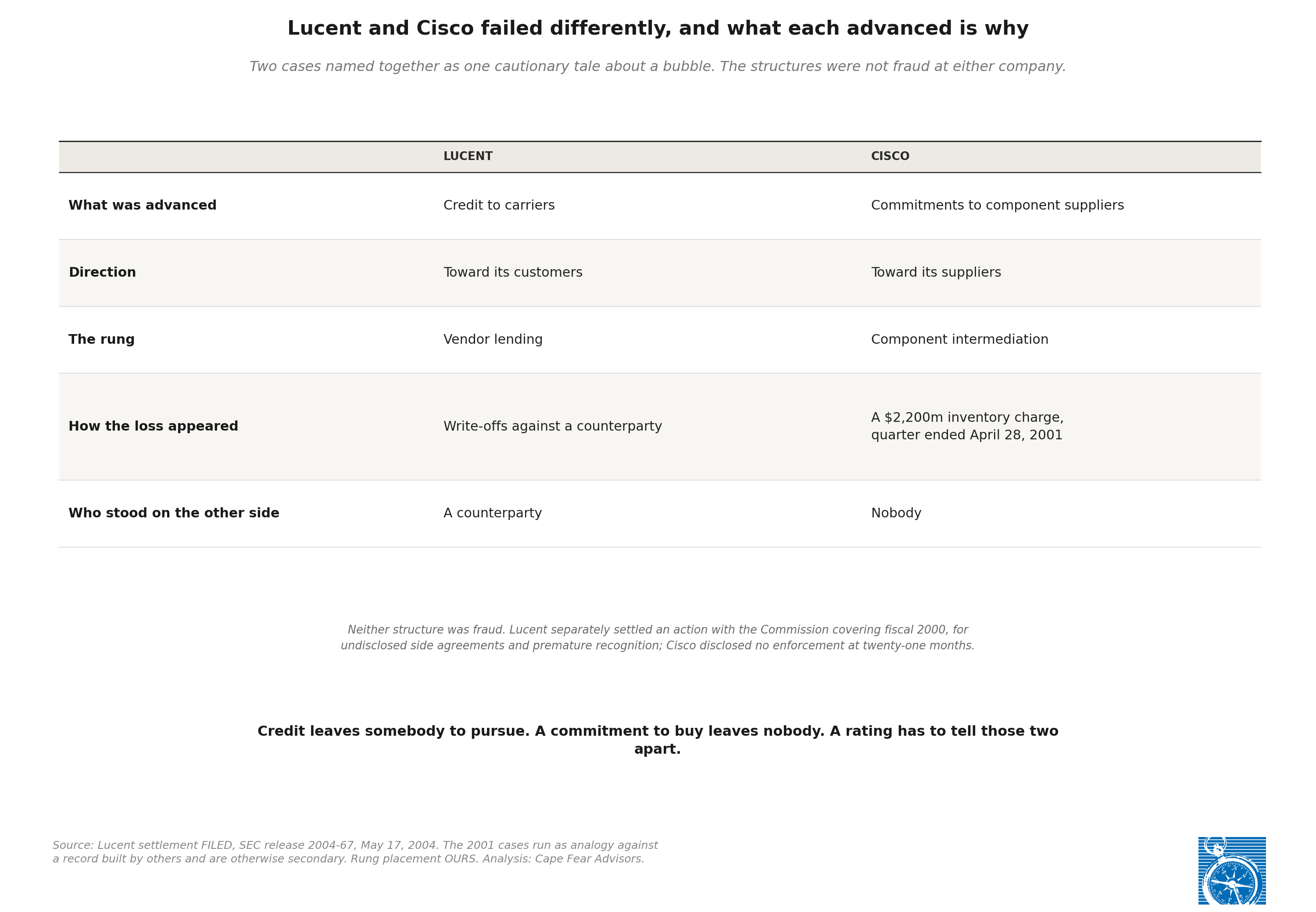
What each company advanced decided what its failure left. Lucent advanced credit, so its loss had a counterparty behind it, and a counterparty can be pursued, negotiated with, restructured. Cisco advanced commitments to buy parts, so its loss was inventory nobody ordered, and there is nobody on the other side of a write-down.
Direction tracked that difference here and did not cause it. A convertible bond bought from a supplier is upstream and it is still credit, so if that counterparty failed the holder would be a creditor with a claim. What decides the failure mode is what was advanced.
Which is a distinction somebody has to draw before a rating means much. Shivaram Rajgopal, working the same ground in August, closed on the hope that the credit rating agencies have asked for the counterparty data and are processing it. This shelf would put it the same way.
The structures were not fraud at either company, and the distinction has to survive the paragraph. Lucent separately settled an action with the Securities and Exchange Commission on May 17, 2004, covering $1,148m of revenue and $470m of pre-tax income in fiscal 2000, with a $25m penalty and nine officers and employees named. The conduct was undisclosed side agreements and premature recognition. It was not the vendor financing. Two things happened at one company and they were different things. (19)
Two cases are not the whole cohort, and the cohort holds more than two failure modes. What was advanced can be credit, which leaves a creditor. It can be a commitment to buy, which leaves inventory nobody ordered. It can also be equity taken in a counterparty, which leaves a mark and a residual claim standing behind everyone senior. That third mode is the one this company is heaviest on, at $42,783m of marketable and $51,157m of non-marketable securities, and neither case here works it. The cohort contains examples of it and this piece does not run them.
Both cases are worked thoroughly, in two literatures that do not read each other. Cisco’s is a supply chain case and Lucent’s is a finance case, and the current wave of comparisons inherited the finance one. The analogy is drawn against a record others built instead of rebuilding it, and what is added is the placement.
Which leads somewhere calmer than the comparison usually goes. If a bubble sits anywhere in these arrangements, it sits on the demand side, where the question is whether the buyers can pay. The supply side is ordinary. A large buyer securing capacity, taking positions in the companies that build for it, and committing to purchase what they make is what large buyers do, and the ladder places it without alarm.
The same arrangement, two presentations
Rung five is a judgment call, and that is the interesting part, and not a hole in the frame.
Microsoft’s version of standing inside its own supply chain produced a receivable, sitting among the assets. NVIDIA’s produces a commitment, sitting in a note. Same structure, two presentations, two different places in a filing, and a reader comparing the two by caption would see no common arrangement at all.
That is a comparability problem and it belongs to disclosure. Filers look at the same economics and reach different judgments about what the thing is and where it goes, and both judgments can be defensible. A frame that sorts by structure instead of by caption exists for that reason.
Direction is also taken from outside the filer, because no filing sorts a securities book by which way an arrangement points. That is what makes the supply column countable, and it means part of the count rests on documents the subject did not file.
One company in one quarter demonstrates a frame. More will come from running it against other filers than from running it again here.
Positioned for either
This company is positioned to be tested in either direction, or both. None of what follows is a forecast.
Toward customers its exposure is receivables and marks, set against $320,272m of assets and a half year that produced $141,410m before tax. Toward suppliers the agreements can be canceled before firm orders, which is the protection the 2001 supply-side case did not have.
One qualification belongs here and not in a footnote. Part of that cushion is borrowed. On June 18, 2026 the company completed a debt offering of $24,500m across seven tranches, from 4.250 percent notes due 2028 to 5.625 percent notes due 2056. A balance sheet is a stronger shield when it is funded than when it is raised, and this one is both. (20)
The reason underneath the resilience sits in one filed number anyway. The gross margin arrives at delivery. Gross profit of $72,142m on revenue of $96,221m in the quarter is 74.97 percent, against the 75.0 the company prints. A company taking almost seventy five cents of every dollar at the moment the goods move has most of what it advanced back before any position it holds is ever marked.
Equity gains ran $23,707m in the half, which is 98.2 percent of $24,140m of other income and 16.7 percent of the $141,410m before tax. That is what standing high on the ladder looks like in the composition of earnings. (21)
So the ladder is not a verdict on this company, and the height of a rung is not one either. What the two faces show is where the arrangements sit, and which of them nobody has a name for.
The rung nobody is standing on
The denial is exact, and it stays exact.
Vendor lending is the rung the phrase points at, the one where a maker of equipment lends a customer the money to buy it, and that rung carries no filed instrument toward customers. It carries none toward suppliers either. Of all nine rungs, the one the argument has been about is the one nobody is standing on.
What the two faces show instead is ten occupied positions across six rungs, in two directions, carrying the arrangement the phrase describes. (22)
That will change, with the addition of another filled rung, equally ordinary in its components and its positioning and complex in its structure. The morning a Form 8-K makes the MediaTek convertible a filed instrument, vendor lending fills toward suppliers and the sentence above stops being true. This shelf would rather print the trigger than wait for someone to find it.
Standing Disclosure
Anthropic is the developer of Claude, which is used in preparing this research, and Anthropic is a counterparty to arrangements adjacent to the ones read here. Two companies named in this piece have ties to it: NVIDIA holds a position in Anthropic, taken in late 2025, and Microsoft, named here for the receivable that defined a rung, is an investor in it as well. That nearness cannot be fully checked away, which is why no claim in this piece rests on trust in the tool. Every figure carries a public source and the record grades the rest. Companies not named here, among them the memory makers, foundries and packagers behind the capacity discussed, may hold positions or supply relationships that bear on the filers named, and that possibility is part of why every piece is re-checked for bias, ground facts and filings instead of being read against a fixed list. Figures are quoted from the filers without characterization, and the same standard of reading is applied to every filer named.
Notes
(1) The nine-rung ladder, its rung order and its glyph grammar are OURS, published in “Quality of Cash: Circular Financing and the AI Bubble,” August 1, 2026, and “NVIDIA, the Forge House,” August 9, 2026. The second face is OURS, first drawn September 1, 2026.
(2) The August 1 definition, verbatim: “One step further is the merchant of components: Microsoft holds $27.8 billion of receivables tied to buying server parts on others’ behalf, up from $8.2 billion, its balance sheet standing in the middle of its own supply chain.” Reading rung five as the structure that description names, rather than as the receivable that carried it at that filer, is a change to the definition and is declared in the body for that reason.
(3) The occupancy rule is OURS, in three parts, and the third part is the one that makes the supply column countable: no filing sorts a securities book by direction, so direction is established from the counterparty’s record where the filer’s own document is silent.
(4) FILED. NVIDIA Form 10-Q for the quarter ended July 26, 2026, accession 0001045810-26-000075, read at 1:14 pm and 1:31 pm Eastern on August 27, 2026. Receivable $63,059m, customer advances $2,800m from $160m, marketable equity securities $42,783m, non-marketable securities $51,157m, guarantees of $105,000m and $3,500m, AI cloud agreements $36,000m and third-party leases $20,000m inside Additional Commitments and Guarantees.
(5) FILED, same accession. Payable $15,059m. Supply and capacity commitments $279,000m from $119,000m. Equity-method interests in infrastructure financiers $3,300m, held as unconsolidated variable interest entities with maximum loss exposure of $4,700m and a determination that the company is not the primary beneficiary. The $12,000m of completed positions into five suppliers since September 2025 is ANNOUNCED, from the counterparties’ own releases and filings, and sits inside the filed securities balances without being broken out.
(6) Published August 27, 2026 in “NVIDIA, the Scarce Thing Is a Credit Standing.” Six rungs carrying a disclosed instrument, on the customer face. The August 27 count was taken on the widened reading of rung five, which is declared at note (2) and stated in the body. On the August 1 reading, which named Microsoft’s receivable, the $36,000m of AI cloud agreements falls out and the customer count is five.
(7) The probes behind the two empty rungs. Rung three: ten terms searched across the Form 10-Q and the fiscal 2026 Form 10-K on September 1, 2026, being factoring, factored, sale of receivables, sales of receivables, transfers of receivables, receivables purchase agreement, securitization, without recourse, discounted receivable, and accounts receivable financing. All ten absent from both documents, and all ten run a second time against both at source the same day at 1:22 pm Eastern, with the same result. Rung four toward suppliers: ten terms searched in the same Form 10-Q at 1:08 pm Eastern on September 1, 2026, being supplier prepayment, prepaid supply, prepayment to supplier, capacity reservation, reservation of capacity, advances to suppliers, supplier advances, deposits with suppliers, supplier deposit, and prepaid inventory. All ten absent. The balance sheet’s thirteen asset captions were read in the same document and none breaks out a prepayment to a supplier, a deposit with a supplier or a reservation of capacity. Prepaid expenses and other current assets, and other assets at $15,746m against $8,301m at the year end, stand undecomposed, and an amount below the breakout threshold would sit in either. Both claims are scoped to disclosure and not to existence.
(8) REPORTED. The second-quarter earnings call of August 26, 2026, prepared remarks and question period. Whether the same words also appear in the furnished CFO commentary, Exhibit 99.2 to Form 8-K accession 0001045810-26-000073, is open; the August 26 reading of that exhibit does not carry them, and if they are there the tag moves to FURNISHED. The one-word answer of August 10 is REPORTED, on X, status 2086934705207959965.
(9) The $25,600m of vendor financing extended by nine equipment suppliers by the end of 2000, and the estimate that between a third and eighty percent of it was lost, are Shivaram Rajgopal’s, sourced by him to McKinsey via CFO.com, published August 28, 2026. The primary was sought here on September 1, 2026 and not reached: both candidate CFO.com addresses returned that publication’s current front page rather than the archived article. The figure therefore stands at two removes and is stated as his. Tooling advances and supplier advances are ordinary market terms and are named here without a source because they are not in dispute.
(10) The buyer disclosure requirement for supplier finance programs is ASU 2022-04, codified at ASC 405-50, effective for buyers from 2023. The standard followed the collapse of Greensill Capital in 2021 and the fund suspensions and losses around it, which is why supply chain finance is the one upstream name carrying a charge of its own. That charge attaches to a financier rather than to a seller, which is the distinction drawn in the body.
(11) The two announced supplier positions. At contingent support, ANNOUNCED: the Lumentum arrangement of March 2, 2026, a $2,000m investment alongside a purchase commitment and future capacity access rights, from the counterparty’s own release. The equity half sits inside the $12,000m at note (5) and the capacity access rights are the rung eight position, which is one instrument counted at two rungs. At vendor lending, ANNOUNCED, NVIDIA release of August 31, 2026, and trade reporting of the issue size. MediaTek’s own disclosure sits with the Taiwan exchange. No Form 8-K had followed as of the morning of September 1, 2026, checked against the filer’s record by Greg Collins; a Form 144 and a proxy statement had filed and nothing else.
(12) The decomposition of a convertible into a bond component and an option component is ordinary practice. Applying it to place one instrument on two rungs, with the parts summing to the face amount, is OURS. The coupon, the ranking ahead of equity and the conversion feature are terms of the instrument as announced. The coupon rate and the conversion premium that would size the split sit with MediaTek’s Taiwan disclosure and have not been read here.
(13) FILED, same accession. Property and equipment, net, $14,285m against total assets of $320,272m. Marketable equity securities, non-marketable securities and marketable debt securities sum to $128,083m. The observation that the property, plant and equipment in this business sits on a contract manufacturer’s books is Shivaram Rajgopal’s, in correspondence of August 1, 2026.
(14) FILED, same accession. Capital expenditure commitments $8,000m. The note describes the supply commitments as being for data center infrastructure systems, primarily memory and manufacturing facilities. Ratios OURS: 4.46 percent, 19.5 times, 34.8 times, and almost nine times, each floored.
(15) FILED, same accession. Remaining performance obligations of $3,200m on contracts longer than one year, against $279,000m of supply and capacity commitments, being 87.1 times, ours and floored. The cancellation language is the filing’s own.
(16) FILED, same accession, and the antecedent of “our commitments” in this sentence is not settled by the sentence. Verbatim: “AI clouds procure our data center infrastructure products and we commit to cloud service agreements, which the AI clouds can unilaterally stop providing to us and sell to third-party customers at more advantageous rates. Our commitments decrease as capacity is used by third-party customers or by us for our research and development efforts. If certain criteria are met, we will participate in revenue share generated by the AI clouds from third-party customers.” The company’s own cloud service agreements of $29,000m sit in a separate table and are described there as providing cloud infrastructure to support research and development of its open models. The series $27,000m, $30,000m and $29,000m runs across three quarters.
(17) FILED. The terms sentence appears first in the quarter ended July 26, 2026. The direct-customer definition changes are read across the quarterly reports of April and July 2025, October 2025, and the Form 10-K for the year ended January 25, 2026, accession 0001045810-26-000021. Variable interest, primary beneficiary and maximum loss were searched in that annual report on September 1, 2026 and appear zero times.
(18) REPORTED. Hut 8’s description of its counterparty on two leases of 352 megawatts each at Nueces County, Texas as an unnamed, investment-grade hyperscaler. The identification of that counterparty as NVIDIA is the Financial Times, July 28, 2026, citing five people. Neither company has confirmed it, and the developer’s own filing carrying the description has not been read here. The guaranties are FILED: NVIDIA Form 8-K, accession 0001045810-26-000069, filed August 17, 2026 at 8:41:33 Eastern, Items 1.01 and 2.03, read at source on September 1, 2026 at 1:41 pm Eastern. The aggregate obligation is “cumulatively capped at $105 billion for its initial commitment under the Agreements,” the tenant is OpenAI, the counterparty is SB Energy Corp., the site is the PORTS Technology Campus in Pike County, Ohio, and the termination events are quoted as “the 20th anniversary of the commencement of the applicable lease, the termination of the applicable lease by OpenAI in accordance with its terms, OpenAI achieving a satisfactory credit rating, and other customary termination events.” The Form of Residual Value Guaranty is Exhibit 10.1 to the Form 10-Q at accession 0001045810-26-000075. The same campus was read on this shelf on August 17, 2026 in “Circular Financing, in Chips, Land, Power and Demand,” which recorded four accounts of the commitment describing four different instruments and named the quarterly report as what would settle which one it was. The residual value guaranty is the account that held, and the earlier piece stands as written.
(19) FILED. Securities and Exchange Commission release 2004-67, May 17, 2004, for the Lucent settlement, covering $1,148m of revenue and $470m of pre-tax income in fiscal 2000, a $25m penalty, and nine officers and employees. Cisco’s $2,200m excess inventory charge is from its report for the quarter ended April 28, 2001. Both cases are drawn here as an analogy against a record built by others and are otherwise sourced to secondary accounts. The cohort of equipment suppliers that extended credit in that cycle also contains companies that took equity in their customers, which is the third failure mode named in the body; those cases are named as a class here and are not worked.
(20) FILED. NVIDIA Form 8-K of June 18, 2026, accession 0001193125-26-275783, items 8.01 and 9.01. A debt offering of $24,500m across seven tranches, from 4.250 percent notes due 2028 to 5.625 percent notes due 2056.
(21) FILED and OURS. Gross profit of $72,142m on revenue of $96,221m is 74.9753 percent, floored to 74.97 and ours; the company prints 75.0. Income before income tax of $141,410m for the half, other income and expense, net of $24,140m, and gains from equity securities of $23,707m are FILED, and the shares of 98.2 percent and 16.7 percent are ours and floored. The gross margin figures are the quarter and the income figures are the half, which the sentences carrying them state.
(22) Ten occupied positions across six distinct rungs, being trade credit, customer prepayment, component intermediation, equity in the counterparty, contingent support and wrapped structures, counted above the ground floor on the rule at note (3).
Analysis: Cape Fear Advisors.
This piece also appears on Substack. Cape Fear Advisors is an independent advisory firm based in Portsmouth, NH.
Contact Cape Fear Advisors