

The chip plant SpaceX calls essential is described in seven records, each at a different level of commitment, and each can be replaced by the next document without contradicting the others. Stateless is the word for a project that holds every one of those descriptions at once and has yet to settle into any one of them. Exploring is the job management is paid to do; this is what the exploration looks like from the reader’s seat.
One filing, two exhibits
On June 8, 2026, the week its offering priced, SpaceX filed a free writing prospectus under Rule 433 that carried two exhibits.(1)
The first was the company’s European prospectus, risk factors included. “While we expect to construct Terafab to address such supply constraints, Terafab may not be successful.” And further down: “we expect to continue sourcing a significant portion of our compute hardware from third-party suppliers, and we may not be able to achieve our objectives with respect to Terafab within the expected timeframes, or at all.”
The second was a transcript. On June 4, at J.P. Morgan’s headquarters in New York, the bank’s chairman and chief executive, Jamie Dimon, interviewed SpaceX’s chief executive in front of 350 people in the room and, by Dimon’s count, “3,500 of our top individual investors around the country, across 100 branches.” J.P. Morgan Securities was one of five representatives of the underwriters, committed to 83,333,333 shares.(1) Asked why SpaceX was going public now, the chief executive answered that the company was “embarking on a massive new growth phase and we need capital for that.”
Then Dimon asked about the plant himself: “Now you’re talking about building Terra Fab, building chip fabs. What compelled you do that now with all the other things you’re working on?” The answer ran to about 200 words. Memory and logic are “the limiting factor”; there is “not a single high volume computer memory fab in America right now. Zero”; “even if, if you take the best case assumptions of the memory makers and the logic makers, it is not enough to meet the demand that is anticipated.” And then: “And that’s why we need to do Terra Fab. It seems essential. Otherwise we will not, there will not be enough chips.”
This was the offering speaking. The question came from the chief executive of one of the banks selling the stock, to that bank’s clients, during the sale, and SpaceX filed the transcript under Rule 433 as a prospectus communication, legend and all. Investors were handed both descriptions in one accession number: essential, and possibly unbuilt. Both are accurate. One is a statement of need and the other is a statement of uncertainty, and the company filed them side by side.
The next day SpaceX filed a second free writing prospectus, carrying its chief financial officer’s interview with Gavin Baker.(2) Bret Johnsen explained why the plant mattered:
“If you look at it when you start talking about NVIDIA or the AI5 chip or TPU, all of a sudden you start talking about TSMC. And so it isn’t that you’re being able to diversify out from a supply chain perspective if you go one more layer down.”
He described what a new foundry needs to exist: a customer prepared to say “we will take every wafer that you can yield out,” which leaves “a capital risk only.” And he placed the economics to one side:
“I would tell you that we didn’t load that into our business model so that will be an upside. But anytime you are talking about a 50% or 60% margin stacked with a 75% margin on top of that, you can imagine that if you get it right and your yields ramp over time, it can be a margin benefit. But that’s really not as much of the focus as it is to make sure that we have assured the supply of silicon.”
The final prospectus makes the same case in filed prose: the orbital compute plan “would be constrained by pure reliance on external foundries.”(3) It names Intel twenty-seven times, after the Commission’s staff asked about Intel’s role, and names TSMC zero times. Across SpaceX’s filings this year, TSMC appears once: in Johnsen’s interview, as the dependency the plant was meant to relieve.(4)
That is the starting point. Supply is the purpose, TSMC is the constraint, the margin is a bonus outside the model, and the cost is “not yet determined.”
We have followed Terafab since the IPO week. The Terafab Record (July 7) read the state and county filings behind the announcement and found one executed signature. The Cost of Not Beginning (July 26) asked what the market was paying for an attempt that had yet to begin. The State of the Merger (July 27) followed the project across the two companies. The August cash-gap pieces, at $400 billion and $430 billion, recorded the fab going quiet as the AI line grew. How to Read an AI Headline (September 30) set “essential” beside “undetermined.” This is the update, with three more months of record.
Seven records
Since June the project has accumulated descriptions faster than it has accumulated commitments. Each of the seven below is a fair account of something. They differ in how much each binds.
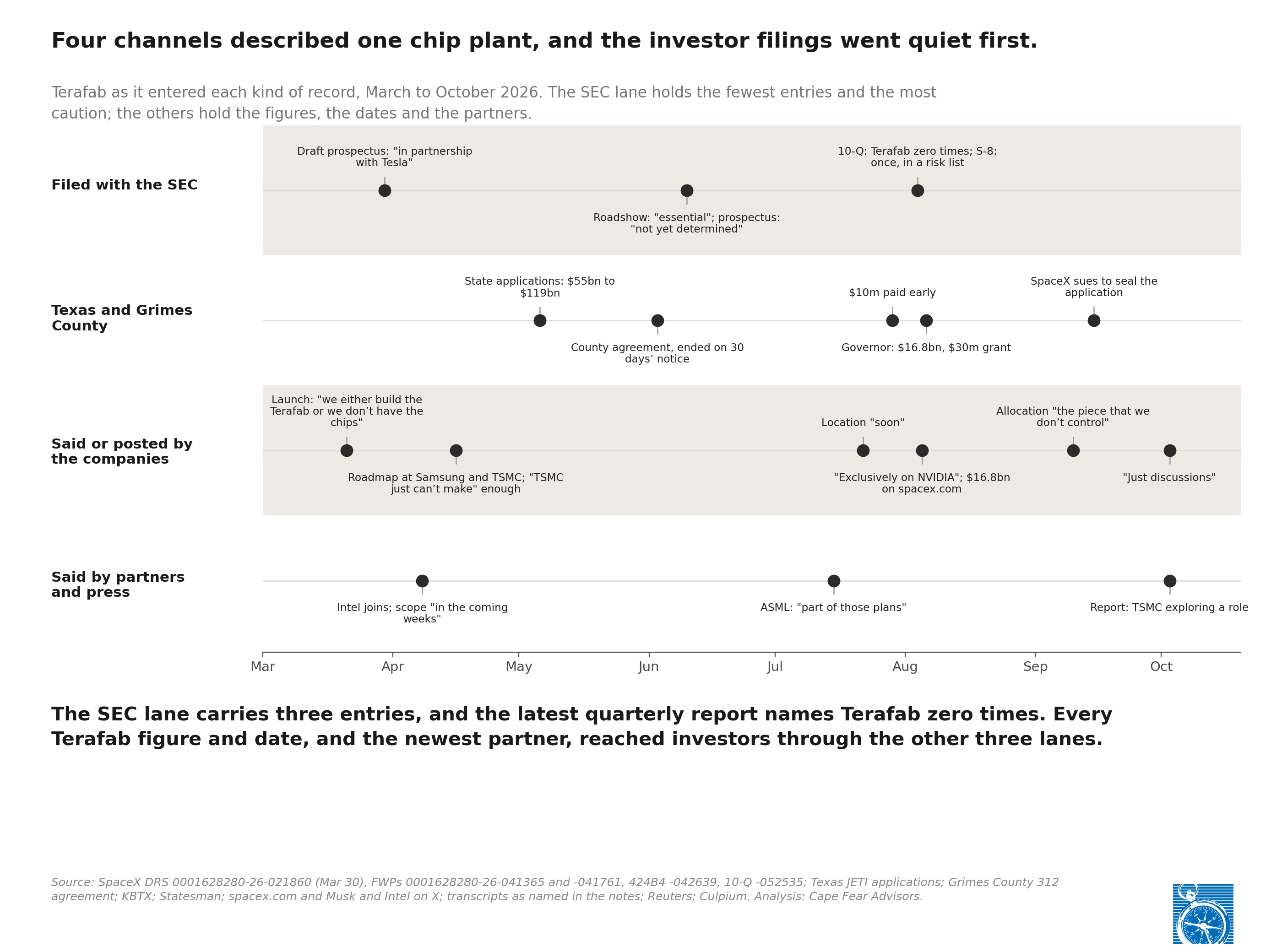
1. The prospectus. A “general framework” with Tesla, under which “any specific projects ... (including any development timelines, milestones and capital expenditures) ... have not yet been determined.” The sentence is there because the staff asked for it.(5)
2. The state applications. Eight applications under the Texas JETI program commit to 80 jobs and lay out a taxable-value schedule: about $40 million of property on the ground this year, $176 million in 2027, $4.2 billion in 2028. The applications put the build at $55 billion for initial phases and up to $119 billion across four.(6)
3. The companies, and the Governor. On Tesla’s second-quarter call on July 22, the chief executive said: “The Terafab, we expect to announce a location soon, and provide more details about our plans in that regard. We’ll leave that to the product, the launch announcement rather than try to squeeze it into an earnings call.” Fifteen days later, SpaceX’s website announced Grimes County: “The initial phase of Terafab is estimated to require approximately $16.8 billion in capital investments from SpaceX and Tesla, with potential future expansion phases bringing total investment much higher.” Tesla posted the news on X with a link to SpaceX’s page. The Governor’s office announced the same $16.8 billion and 3,000 jobs, with a $30 million Texas Enterprise Fund grant, and named SpaceX alone. The Phase 1 figure is 62 percent above the $10.37 billion in the state applications.(7)
The companies’ own capital figure went out on a web page and a post on X. SpaceX’s only current report in August after its results was the Cursor closing. Tesla’s filings carry the word Terafab zero times, and describe the project without the name: its first-quarter 10-Q says Tesla is “expanding our scope of manufacturing to include semiconductor fabrication,” and its furnished first-quarter update says the partnership with SpaceX “aims to build the largest chip fab ever,” beginning “with the Tesla-owned Research Fab on our Gigafactory Texas campus.” On the April call the chief executive put that research fab at “probably, you know, a $3 billion dollar-ish initiative.”(7)
4. The county. The one executed agreement. Grimes County and Space Exploration Technologies Corp. signed a tax abatement effective June 3. SpaceX agrees to invest at least $5 billion by the end of 2030 and employ 1,800 by the end of 2035, pays $10 million up front, non-refundable, and pays $20 million a year from 2027. The same document provides that “Nothing in this Agreement shall obligate Owner to construct the Improvements,” and that SpaceX may terminate “at any time and for any reason” on 30 days’ notice. Leaving before June 1, 2027 cancels the 2027 payment.(8) SpaceX paid the $10 million early. “We got the check on Wednesday. It went in the bank on Thursday. And today is Friday. So they beat their deadline,” the county judge, Joe Fauth, told KBTX on July 31, adding: “We’re cautiously optimistic.”(9)
5. The ground. By September 29 the land was cleared, with a street address on Timberwolf Trail.(10)
6. The courthouse. The Attorney General ruled on July 28 that most of the county’s Terafab records must be released. SpaceX sued in September to keep the abatement application sealed, including its cost data and the negotiation correspondence.(11)
7. The partner. Tim Culpan, writing at Culpium on October 3, reports that TSMC is exploring a role in Terafab, most likely as owner and operator with SpaceX as investor, committed buyer, or both. It is reported from unnamed sources, ahead of any filing. Hours later, replying on X to a post about the report, the chief executive described the state himself: “Just discussions, but something may come of it.”(12)
The record written for investors carries the least commitment of the seven. The one signed agreement can be ended on 30 days’ notice. The most detailed account of the project’s cost is the one under seal.
What was said instead
August 4 produced three SpaceX documents on one day, and each holds a different state.
The second-quarter 10-Q names Terafab zero times, and NVIDIA zero times.(13) An S-8 registration filed the same day keeps Terafab in its list of forward-looking risks, among “new and innovative technologies, products, and services, including our AI platforms and Terafab.”(14) And on the earnings call, the chief executive said: “going forward, we’ve decided to build exclusively on NVIDIA because we think the Vera Rubin architecture is the best architecture.”(15) The orbital computer he described was “essentially an optimized Vera Rubin NVL72 computer.” SpaceX’s own page for that satellite says something else today: “We are AI chip vendor agnostic. Our system architecture supports compute modules from any provider.”(16)
On September 10 at Goldman Sachs, Johnsen repeated it: “we came out and talked about the fact that we’re NVIDIA exclusive.” He added that allocation is “the piece that we don’t control.”(17)
That is the build-against-buy question in the CFO’s own words. NVIDIA’s GAAP gross margin for the quarter ended July 26 was 75.0 percent.(18) Every dollar of NVIDIA systems carries about 75 cents of NVIDIA’s gross profit, which is the figure Johnsen named in June. Insourcing would capture only part of it, since a new fab carries its own depreciation, yield ramp and equipment suppliers. The size of the prize is filed. The size of the catch is open.
TSMC, in two states
The plant’s relationship with TSMC runs through the record in a sequence that makes the stateless point without help.
On April 15, three weeks after Terafab was announced, the chief executive laid out Tesla’s chip roadmap on X: the AI6 chip “using the Samsung 2nm fab in Texas,” and AI6.5 “using TSMC 2nm in Arizona.”(19)
On April 16, TSMC’s chairman was asked about Terafab on his first-quarter call. C.C. Wei answered that Intel and Tesla are both TSMC customers, and then: “Having said that, there are no shortcuts. ... it takes 2-3 years to build a new fab. No shortcuts. It takes another 1-2 years to ramp it up.”(20)
On the evening of April 17, two minutes apart, the chief executive answered on X. At 10:28: “SpaceX/Tesla will be always be major customers of TSMC and not competitors in the normal sense of the word.” At 10:30: “TSMC just can’t make the staggeringly large number of chips needed! If they could, we would not need to do this.”(21)
TSMC’s July call passed over Terafab.(22) In October, the reported structure has TSMC running it, and the chief executive’s own account of where that stands is the stateless sentence in eight words: “Just discussions, but something may come of it.”(12) Nine minutes later he quote-posted a fan account’s claim that “anything TSMC contributes to Terafab would basically be supplemental,” and added: “A sufficiently large quantity is a quality all its own.”(23) By morning the same partner had been described as an owner-operator, a discussion, and a supplement.
Customer, reason, and candidate operator: three positions for one counterparty, and every one of them consistent with the others. Buying from TSMC, needing more than TSMC can make, building elsewhere, and partnering with TSMC can all be true at once. That is what stateless means. Every description holds, and the decision is still to be made.
Where is Intel?
The TSMC report drew one fair objection: where is Intel? The record answers in decreasing volume.
On April 7, Intel posted that it was “proud to join the Terafab project with @SpaceX, @xAI, and @Tesla to help refactor silicon fab technology.” Its chief executive told staff, in a memo reported by CRN, that Intel “will disclose more broadly the scope and nature of this engagement” in the coming weeks.(24) On Tesla’s April call, the chief executive said: “We plan to use Intel’s 14A process.”(7) SpaceX’s prospectus names Intel twenty-seven times, including the sentence that “neither Tesla nor Intel are obligated to remain a part of the project.”(1)(4) The Director, Terafab, came from Intel.(25) The project’s own website, terafab.ai, names Intel zero times; it lists the chips Terafab is to make as AI5, AI6 and D3.(16)
Since April the volume falls. Intel passed over Terafab on its July call. Its second-quarter 10-Q committed the company to completing its 14A process with Terafab unnamed, and the documents for its $20 billion stock offering in August are silent on the project.(26) Nearly six months after “the coming weeks,” the scope of Intel’s engagement appears in no filing by any of the three companies. Intel reports its third quarter in late October.
Intel is the partner the filing named. Its state is the one with the least on the record since.
Exploring is the job
Weighing build, buy and partner is ordinary for a decision of this size, and the company told investors from the start that bought hardware would carry much of the plan: “we expect to continue sourcing a significant portion of our compute hardware from third-party suppliers. We view Terafab as complementary to these relationships.”(3) The CFO said the margin was outside the model.
The other parties to the decision have their own reasons to keep it open. NVIDIA already sells at scale to Google, Amazon, Microsoft and Meta, each of which designs its own accelerators. Intel’s January 10-K said it might pause its 14A process “if we are unable to secure a significant external customer,” and that it had “further slowed down” construction in Ohio. By its July 10-Q, Intel had “committed to completing development of Intel 14A.” Intel has named Terafab in one line of a furnished earnings release, in April. Its filings since are silent on it, including the documents for a $20 billion stock offering in August.(26)
But exploration has costs, and some of them are visible:
- The county payments. $10 million, paid ahead of its August 2 deadline, and $20 million a year from 2027 if the agreement is held past June 1, 2027.(8)(9) The $10 million is the first Terafab dollar on the record as spent, and it bought the right to keep exploring.
- The people. A Director, Terafab, hired in June from 17 years at Intel, on Tesla’s payroll.(25)
- The dependency. For as long as the decision stays open, supply is “the piece that we don’t control.”(17)
- The counterparties’ clocks. Intel committed to its node without Terafab. ASML’s chief financial officer said on July 15 that “Terafab is also part of those plans,” with 2027 equipment orders nearly booked.(27) TSMC is reported to be choosing a Texas site. Other parties’ decisions can settle a question for a company that has yet to settle it.
And some of the costs are invisible, because they fall on the reader. The terms of the Tesla framework are undetermined. The TSMC discussions are reported only. The application’s cost data is in litigation.
The decision is material by the company’s own description, and the description was delivered inside the offering. The prospectus says the orbital plan would be constrained without it; the chief executive says it seems essential; the CFO says its purpose is assured supply. The exploration takes place outside the record investors read, and that record says, accurately, that the project’s timelines and costs “have not yet been determined.”
The swing item
Exploring is the job. The size of what turns on the outcome is the reason the choice matters to anyone holding the stock.
SpaceX’s AI segment spent $15,828 million on capital expenditure in the second quarter, about $63 billion at an annual rate, and the company as a whole spent 2.35 times its revenue.(28) The share of that spending that is NVIDIA hardware is undisclosed. On NVIDIA’s company-wide gross margin of 75.0 percent, the margin carried inside it depends on the share. If a quarter of the spending is NVIDIA hardware, the NVIDIA margin inside it comes to $11,871 million a year; at half, $23,742 million; at three quarters, $35,613 million. Those are 37.9, 75.9 and 113.9 percent of SpaceX’s second-quarter revenue at an annual rate.
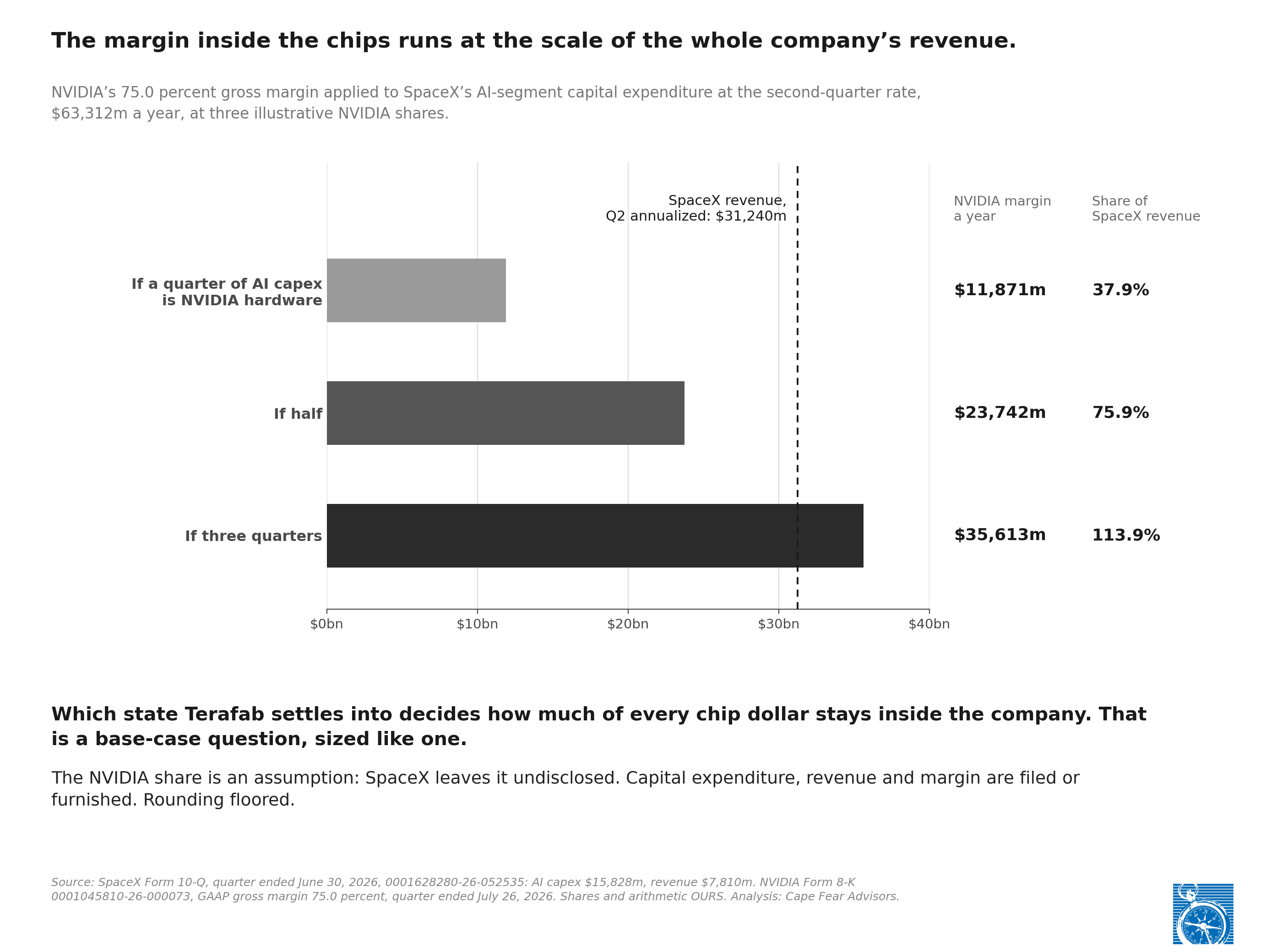
The shares are ours and illustrative; the capital expenditure, the margin and the revenue are filed or furnished. On any of them, the designer layer Johnsen named runs at a scale comparable to the company’s entire current revenue. And that is at today’s spending, ahead of the target the CFO filed in June: “ideally 100 gigawatts a year is our target in the years to come.”(2)
This is why the decision sits poorly in the line valuation models keep for options on the future. SpaceX’s AI segment already buys the chips. The state Terafab settles into decides what fraction of every chip dollar stays inside the company for the life of the plan. For a company spending more than twice its revenue on what it will own a decade from now, the chip decision is a swing item in the base case.
Where the money lands
Each state puts the same need in a different place. Buying pays both of the margins Johnsen named. A plant TSMC runs, with SpaceX designing the chips, keeps the designer’s layer and pays the foundry’s. A plant SpaceX owns keeps both.
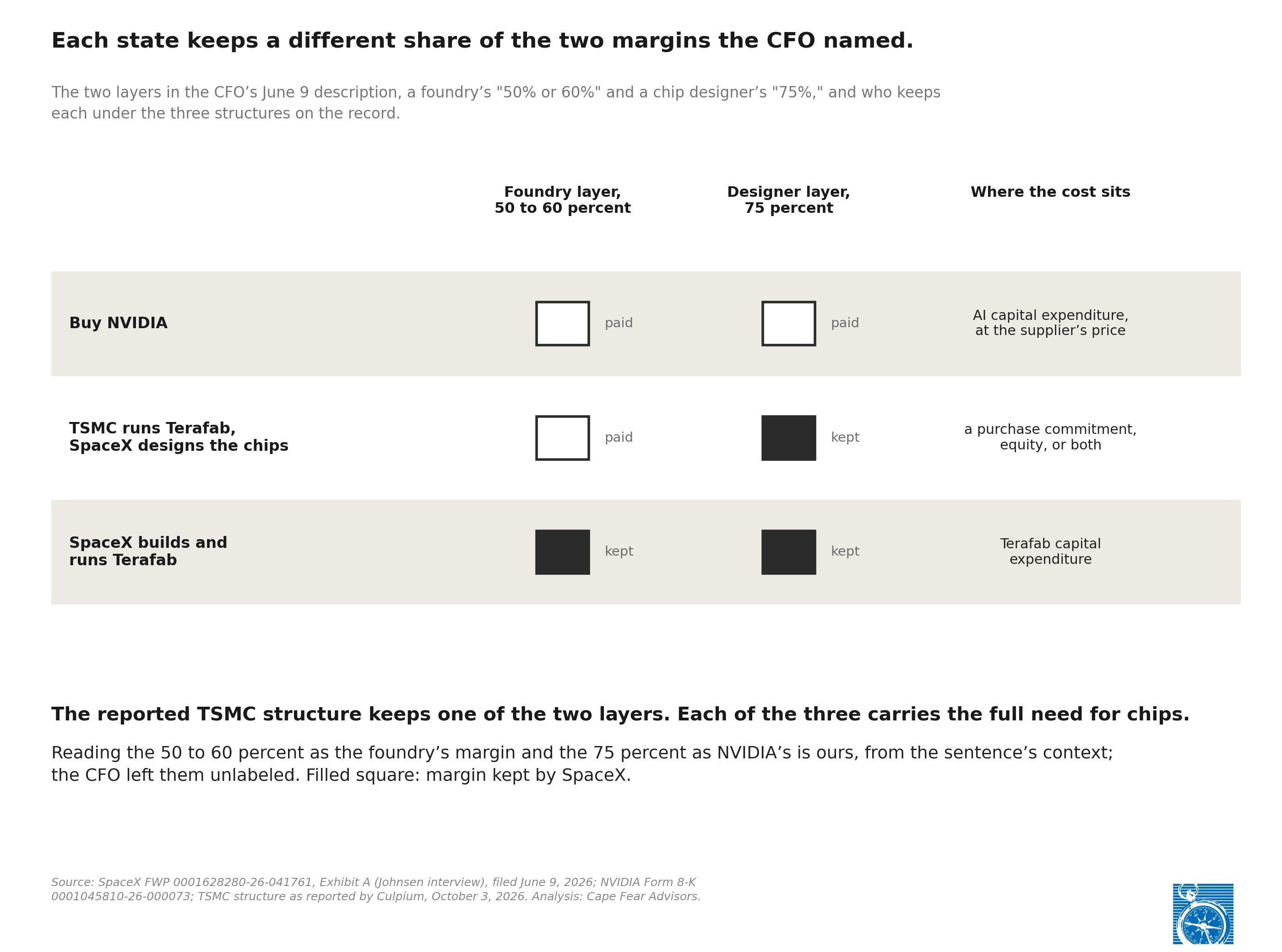
Reading the 50 to 60 percent as the foundry’s margin and the 75 percent as NVIDIA’s is ours, from the sentence’s context; Johnsen left them unlabeled. The reported structure captures one of the two layers he named. Each of the three carries the full need. In our August accounting of SpaceX’s commitments through 2030, Terafab carried about $5 billion and AI compute about $300 billion, the bought NVIDIA hardware included.(29) A third state would move the need to a third line.
Can the plan be bought?
The margin is half of it. The other half is whether the chips exist to be bought at all, and the company’s own filed figures answer that.
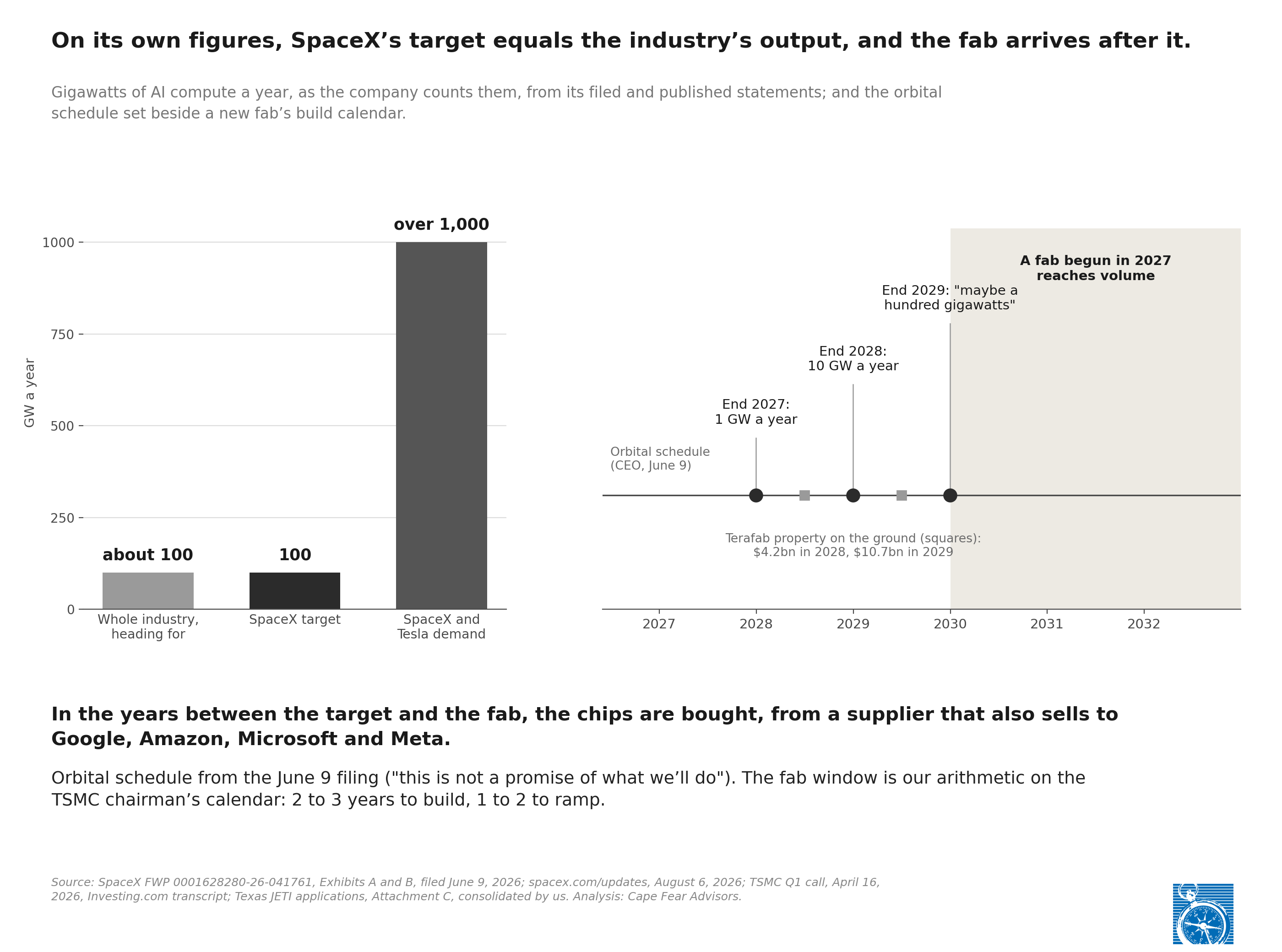
In the conversation SpaceX filed on June 9, the chief executive put the whole industry’s output at “maybe around 100 gigawatts a year of AI compute.” In the same exhibit he set SpaceX’s orbital schedule: “roughly an annualized rate of a gigawatt per year by the end of next year,” then “in two and a half years hitting an annualized rate of 10 gigawatts a year to space, in three and a half years, maybe a hundred gigawatts,” with the caution that “this is not a promise of what we’ll do.” The CFO, in the other exhibit: “ideally 100 gigawatts a year is our target in the years to come,” and the supply chain “won’t be there for us to ramp” to it “without being able to have a Terafab.”(2) On August 6 the company’s website put combined SpaceX and Tesla demand “in excess of 1 terawatt (TW) of compute, which is significantly larger than the current global supply.”(7)
On its own figures, SpaceX’s target equals the industry’s entire output. The plant meant to close that gap runs on a slower clock. TSMC’s chairman puts a new fab at two to three years to build and one to two to ramp; the state applications put $4.2 billion of Terafab property on the ground in 2028 and $10.7 billion in 2029.(6)(20) On that arithmetic, which is ours, a fab begun in 2027 reaches volume between 2030 and 2032, after the year the orbital target names. In the years between, the chips are bought, from a supplier that also sells to Google, Amazon, Microsoft and Meta.
And the supplier has a book of its own. NVIDIA’s quarter to July 26 carried $96,221 million of revenue; one direct customer was 16 percent of it, and some indirect customers are each 10 percent or more.(30) If every dollar of SpaceX’s second-quarter AI capital expenditure had gone to NVIDIA, it would come to 16.4 percent of that revenue, the size of NVIDIA’s largest direct customer. SpaceX bids for allocation against buyers with long-running plans of their own, with its own stated plan to make chips once its plant runs, and allocation is, in the CFO’s words, “the piece that we don’t control.”(17)
The conundrum has a filed date. SpaceX’s agreement with Google required the committed GPUs by September 30, 2026; after a one-month grace period, Google may terminate, or accept the GPUs delivered at a pro rata lower fee.(31) The revenue meant to carry the near term runs on the same chips the long-term plan has to buy. As of 14:52 UTC on October 3, the outcome is unreported in either company’s filings.(32)
That is the conflict, and the company named it first: the target needs the fab, and the schedule runs ahead of it. The state Terafab settles into decides whether the plan is supplied, and at whose margin, in the years that carry most of the value of a company priced on what it builds next. It changes what an investor in SpaceX owns ten years out: a buyer of chips at a supplier’s price, a partner in another company’s plant, or the owner of one.
What would settle it
One instrument. A guaranteed purchase agreement or an equity commitment, with any partner, would be the first binding commitment to the plant or its output, and it would reach the purchase-commitment disclosure in a quarterly filing and possibly a current report. That is the moment “not yet determined” becomes a number.
If the plant is TSMC’s and in Grimes County, the county agreement would have to move first. It abates improvements owned by SpaceX “or its successors and assigns,” and assignment to a party outside the SpaceX group requires the county’s consent, which happens on a public agenda.(8) If the plant is the Dallas-area campus in coverage of TSMC’s Texas plans, the Grimes County agreement is the one left standing, cancellable at a known price.
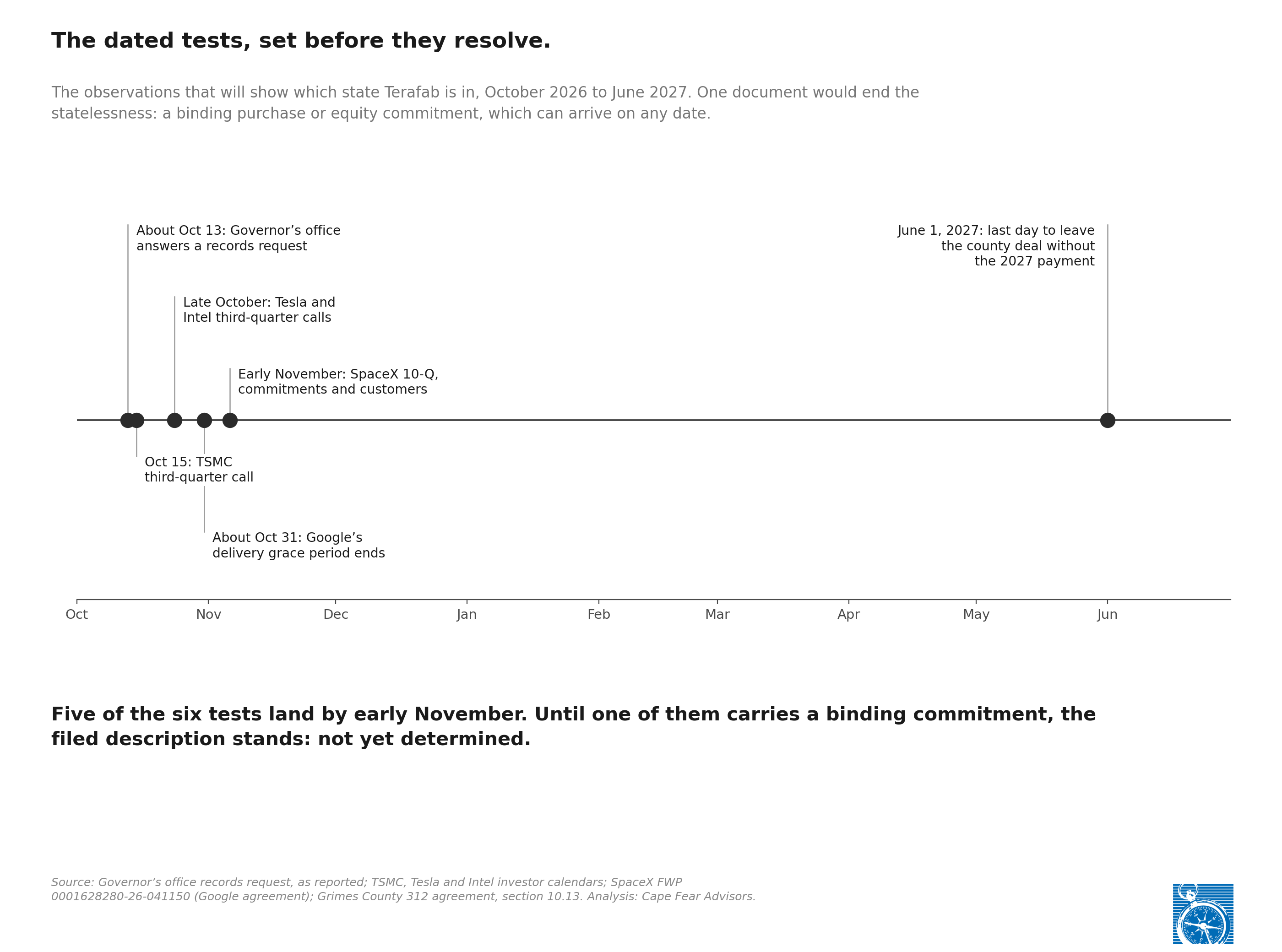
The dated observations come quickly. About October 13, the Governor’s office answers a records request on the $16.8 billion. On October 15, TSMC reports its third quarter, the first on-record moment after the chief executive’s reply. Around October 31, the grace period on Google’s delivery gate runs out. Tesla and Intel report in late October, and SpaceX’s third-quarter 10-Q arrives in early November, with its purchase commitments, its customer concentration, and its count of Terafab and NVIDIA. The last date is June 1, 2027, the final day to leave the county agreement without the 2027 payment.
Seven descriptions of one undecided project, every one of them fair. The filed one is the shortest, and it is accurate: not yet determined.
Corrections
October 3, 2026. Two corrections to “Adding It Up: How to Read an AI Headline,” published September 30. First, that piece said Akamai named Anthropic “four and a half months later.” Akamai named Anthropic in its September 24 filing; the counterparty of the May 5 commitment is unnamed in every filed document, so the interval joined two arrangements the record has yet to join. A dated comment on that piece says so. Second, that piece quoted the June 4 interview as “Yeah, it seems like essential” and called the quotation filed. The filed transcript reads “It seems essential,” and the printed version followed the spoken recording. This piece quotes the filing; note 1 carries the probe.
We read every reply, and it shapes what we work on next. If this piece was useful, a restack, a share, a comment, a like or a note on what to look at next tells us the work is landing and where to point it; a free subscription brings the next one straight to the inbox, and following on Substack Notes, Bluesky, X or LinkedIn carries the shorter findings between pieces. Everything here stays free. Paid subscriptions offset the time and buy no access. Corrections run in daylight, dated, in the next piece rather than quietly in this one, and a reader who finds one is doing us a favor.
Standing Disclosure
Cape Fear Advisors holds no direct position, long or short, in the securities discussed here. Any exposure is indirect, through managed funds it does not control, which may include index funds holding the public companies named.
Anthropic is the developer of Claude, which is used in preparing this research, and the nearness here is close. Anthropic’s compute agreement with SpaceX, at $1.25 billion a month, is SpaceX’s largest disclosed customer relationship, and this piece analyzes the chip economics and the supply allocation behind that compute, a constraint Anthropic shares as a buyer of compute. Amazon and Alphabet, Anthropic’s two largest outside backers, appear here, Alphabet’s subsidiary as the counterparty to SpaceX’s Google agreement. That nearness cannot be checked away, which is why no claim here rests on trust in the tool: every figure carries a public source, and the notes say which are filed, which are reported and which are ours.
SpaceX, Tesla, Intel, NVIDIA, TSMC and ASML are read here for their own filings and public statements and for nothing else. Grimes County and the State of Texas are read for their own records.
Companies not named here may hold positions or supply relationships that bear on the companies discussed, which is why every piece is re-checked for bias, ground facts and filings rather than read against a fixed list.
Figures are quoted from the filers and from named parties without characterization. This piece states no view on whether any filer’s disclosure was correct or required, because what a filer was required to file is not observable from outside. It sizes an undisclosed variable against filed figures and makes no valuation call, and nothing here is advice about any security.
Notes
(1) SpaceX free writing prospectus, Rule 433, filed June 8, 2026, accession 0001628280-26-041365. The video was posted on J.P. Morgan’s account on X; the transcript is “slightly edited for clarity.” Underwriter allocations from the final prospectus (note 3), Underwriting section. Exhibit A is the prospectus approved by Germany’s BaFin on June 5; Exhibit B is the June 4 interview transcript, which spells the project “Terra Fab.” Our September 30 piece, “Adding It Up: How to Read an AI Headline,” quoted this line as “Yeah, it seems like essential,” with the spoken filler of the recording, and described it as filed. The filed transcript reads as quoted here, and EDGAR full-text search returns the filed wording only in this accession.
(2) SpaceX free writing prospectus, filed June 9, 2026, accession 0001628280-26-041761, Exhibit A (Gavin Baker’s interview of Bret Johnsen, “slightly edited for clarity”). Exhibit B of the same filing carries a June 8 conversation in which the chief executive says of the orbital compute timeline, “this is not a promise of what we’ll do.”
(3) SpaceX final prospectus, Rule 424(b)(4), accession 0001628280-26-042639.
(4) EDGAR full-text search, SpaceX (CIK 0001181412), January 1 to October 3, 2026, run 19:58 UTC October 2: “TSMC,” one result (note 2); “Taiwan Semiconductor,” none; “Samsung,” none. Intel count in the final prospectus from our July 17 reading of the staff correspondence, which records the increase from 10 to 27 after the staff’s first-round comment.
(5) Staff comment letters to SpaceX, rounds of April 24 and May 19, 2026, and the final prospectus (note 3).
(6) Texas Comptroller JETI applications for the TeraFab project, consolidated taxable-value schedule from Attachment C across both school districts. The consolidation and the by-year figures are ours, from “SpaceX, Adding It Up: The Terafab Record,” July 7, 2026.
(7) Tesla second-quarter call, July 22, 2026, prepared remarks, transcripts as published by StockAnalysis and Investing.com. SpaceX, “Breaking Ground on Terafab in Texas,” spacex.com/updates, August 6, 2026, read at source October 2. Tesla on X, August 6, 2026, status 2085365278276284803, read at source. Office of the Governor of Texas, “Governor Abbott Announces SpaceX Expansion In Grimes County,” August 6, 2026. SpaceX current reports: EDGAR submissions record, read 20:16 UTC October 2. Tesla: EDGAR full-text search for “Terafab,” CIK 0001318605, 2026 to date, zero results, run 20:40 UTC October 2; Form 10-Q for the first quarter, accession 0001628280-26-026673; first-quarter update furnished as Exhibit 99.1 to Form 8-K, accession 0001628280-26-026551. Tesla first-quarter call, April 22, 2026, transcript as published by EV Wire. The $10.37 billion Phase 1 figure is from the applications (note 6).
(8) Grimes County, Chapter 312 Tax Abatement Agreement with Space Exploration Technologies Corp., effective June 3, 2026, read at source: §§3.4, 3.6, 4.1, 4.2, 5.1, 10.11, 10.13. The companion Section 381 agreement holds the county’s maintenance-and-operations take from the project at $20 million a year through 2061.
(9) KBTX, “SpaceX pays Grimes County $10 million ahead of deadline under Terafab tax agreement,” Lillian Kosh, August 1, 2026, quoting Judge Joe Fauth. The interview date follows from “today is Friday,” being July 31; on that reading the check arrived July 29 and was deposited July 30. REPORTED; the county’s check register or August minutes would make it a county record.
(10) KBTX, September 29, 2026.
(11) Austin American-Statesman, September 2026, on the lawsuit; Attorney General ruling of July 28, 2026, as reported.
(12) Tim Culpan, Culpium, October 3, 2026, “Exclusive: TSMC Exploring Plans to Work With Elon Musk’s Terafab,” www.culpium.com/p/exclusive-tsmc-exploring-plans-to, and his follow-up the same day, “Elon Musk Confirms TSMC-Terafab Talks,” www.culpium.com/p/elon-musk-confirms-tsmc-terafab-talks. Musk on X, October 3, 2026, status 2106290920605790717, replying to @wholemars, read at source; Culpan reported the reply the same day (“Elon Musk Confirms TSMC-Terafab Talks,” Culpium, October 3). Separately, Reuters (September 30), Digitimes (September 30) and Bloomberg (October 1) reported TSMC evaluating a Texas expansion without naming Terafab.
(13) SpaceX Form 10-Q for the quarter ended June 30, 2026, accession 0001628280-26-052535, read at source 20:23 UTC October 2: “Terafab,” zero; “NVIDIA,” zero; “chip manufactur,” zero.
(14) SpaceX Form S-8, filed August 4, 2026, accession 0001628280-26-052712.
(15) SpaceX second-quarter call, August 4, 2026, transcript as published by Motley Fool and Tom’s Hardware.
(16) SpaceX, “AI Satellite” page, spacex.com/spacexai/starmind, and terafab.ai, both read at source October 3, 2026, about 13:05 UTC and re-read at 14:03 UTC. The SpaceX home page describes “Developing Orbital AI Compute” and names none of its compute customers. terafab.ai names Intel, TSMC, NVIDIA and Grimes County zero times each.
(17) Goldman Sachs Communacopia and Technology Conference, September 10, 2026, transcript as published by StockAnalysis.
(18) NVIDIA Form 8-K, furnished August 26, 2026, accession 0001045810-26-000073.
(19) Post on X, April 15, 2026, read at source.
(20) TSMC first-quarter 2026 earnings call, April 16, 2026, transcript as published by Investing.com; roic.ai’s transcript agrees in substance. Tim Culpan wrote on the exchange the same day: “TSMC to Musk: There’s No Shortcuts in the Chip Business,” Culpium, April 16, www.culpium.com/p/tsmc-to-musk-theres-no-shortcuts.
(21) Posts on X, April 17, 2026, statuses 2045328655140680076 and 2045329014009512427, read at source. Both reply to a post quoting Wei. The first is quoted as written.
(22) TSMC second-quarter 2026 earnings call, July 16, 2026, from our August 11 record.
(23) Musk on X, October 3, 2026, 08:00 UTC, status 2106293251233738928, quoting @XFreeze, read at source; the reply in note 12 is status 2106290920605790717, nine minutes earlier on both posts’ displayed timestamps (3:51 and 4:00 a.m. Eastern). Both posts were re-read at source and captured at 13:42 and again at 14:03 UTC October 3; the captures are kept in the working record.
(24) Intel on X, April 7, 2026, read at source as quoted by Tesla’s post of the same day. Memo from Lip-Bu Tan to Intel staff, as reported by CRN and TrendForce, April 16, 2026; the CTO, Pushkar Ranade, was named to lead the work. Intel’s April 23 call named Terafab and its July 23 call passed over it, from our July 27 and August 11 records. On Intel’s foundry effort more broadly, Tim Culpan, “Exclusive: Inside TSMC, Intel and Apple’s Circle of Trust,” Culpium, September 2, www.culpium.com/p/inside-tsmc-intel-and-apples-circle.
(25) Reported via the hire’s LinkedIn profile (Electrek, June 30, 2026).
(26) Intel Form 10-K, accession 0000050863-26-000011; Form 10-Q for the first quarter, 0000050863-26-000079; Form 10-Q for the second quarter, 0000050863-26-000157; first-quarter earnings release furnished April 23, 2026, 0000050863-26-000077.
(27) Roger Dassen, ASML, July 15, 2026, as reported by Reuters. The line is absent from the investor-call transcripts we read and appears to come from the company’s media call.
(28) SpaceX Form 10-Q for the quarter ended June 30, 2026 (note 13): AI segment capital expenditure $15,828m; total capital expenditure $18,369m; revenue $7,810m. Annual rates are four times the quarter. NVIDIA gross margin from note 18. The share column is an assumption for illustration and is labeled as such on the exhibit.
(29) “SpaceX, Adding It Up: The $430 Billion Cash Gap,” August 29, 2026, which carries Terafab at about $5 billion through 2030 on its own by-year schedule.
(30) NVIDIA Form 10-Q for the quarter ended July 26, 2026, accession 0001045810-26-000075, Note 7 and “Concentration of Revenue,” read at source October 3, 2026. 15,828 over 96,221 is 16.4496 percent, floored to 16.4. Every percentage this piece derives is floored, our rule where rounding could favor the argument. The comparison treats SpaceX’s whole AI-segment capital expenditure as NVIDIA purchases, the upper bound.
(31) SpaceX free writing prospectus, filed June 5, 2026, accession 0001628280-26-041150.
(32) EDGAR submissions records for SpaceX (CIK 0001181412) and Alphabet (CIK 0001652044), read 14:52 UTC October 3, 2026: no filing by either since September 25. EDGAR full-text search for “Cloud Service Agreement” and “SpaceX” in Alphabet filings since September 1: zero. “Terafab” in SpaceX, Tesla and Intel filings since August 5: zero.
Analysis: Cape Fear Advisors.
This piece also appears on Substack. Cape Fear Advisors is an independent advisory firm based in Portsmouth, NH.
Contact Cape Fear Advisors