

One project sits described in halves across two filings: one company filed the name and no numbers, the other filed the activity and no name. Between the two companies, money is already crossing every wall the record can see: a stake received as change from a third room, a battery invoice that grew three and a half times in a quarter, and a mark that supplied about three quarters of one company’s quarterly income and is unmaking the next quarter in real time. The question of a merger assumes a future event. The record shows one already happening, through instruments that require no vote, and it shows something else: a formal deal would not make the entanglement visible. It would make most of it disappear.
The question, and the tense it comes in
The question this week, asked everywhere either stock is discussed, is whether Tesla and SpaceX will merge, and when. Held against the filed record, the question is mis-timed. The merger is already happening, in most of the ways two public filers can combine, and each of those ways is documented below. One word gets its two meanings separated at the door: in the statute books, a merger is a specific act, a vote and a certificate that no one has filed, and nothing below says otherwise; that formal act is called a combination throughout this piece. In the market’s mouth, the merger is a condition. The title borrows the market’s word, and the piece reports the condition’s tense. If the structure of it looks malformed, a project with no name in one filing and no numbers in the other, a stake that arrived sideways, an influence presumed from a person, the form is largely an outcome of the several rulebooks the arrangement balances and flows through: securities disclosure that captures events, accounting that captures elections, related person policies that capture transactions, state law that sets the venue. Each instrument took the shape its rulebook allowed. The shape of the whole is what a combination looks like while it remains unfiled. What remains undone is the formal transaction, and no one outside the companies knows what steps would be taken or how; nothing here predicts any. What can be done from outside is read the state of the merger as it stands: what has crossed, what it did to the financial statements, what the boundary costs to keep, and what a formal combination would change about what a holder of either stock can see.
The one person who can settle the question was asked it directly on July 22, on Tesla’s second quarter earnings call, and answered in two parts. The first described the present: “there’s more and more overlap.” The second deferred the future: combining companies “can’t” be discussed on an earnings call and “has got to be done with the appropriate process.” Transcript providers differ on the exact wording, and the Notes carry the variants. The two parts of the answer are the two halves of this piece: the overlap, present tense and filed, and the process, future tense and not. One more thing the record does not show is any requirement that the state resolve. Entangled and separate is itself a durable configuration; controllers have run constellations of related public companies for decades without combining them, and nothing in either filing sets a clock on the arrangement itself. The present tense of this piece is not a countdown, and the one clock in this story belongs to its owner.
One project, filed in halves
Start with the chip project, where the market’s merger logic starts.
SpaceX’s prospectus names the project and declines the numbers. Terafab appears in the S-1 as “a chip manufacturing initiative with Tesla and Intel,” governed by “a general framework” whose financial terms, intellectual property rights, and ultimate term are, in the filing’s own words, not finalized. A sentence the Commission staff’s comments produced, repeated at four separate places, states that any specific projects under the framework “have not yet been determined.” The drafting history is part of the record: the confidential draft of March 30 described “an announced chip manufacturing initiative in partnership with Tesla,” with no framework caveat and no mention of Intel; the staff’s first comment letter forced Intel in by name and asked for material terms, timelines, milestones, and capital expenditures; the second pressed the company to state plainly that none had been determined. What survived into the final prospectus is a project with named partners and no determined content. Both versions are FILED, with accessions in the Notes.
Tesla’s most recent quarterly filing does the opposite: the activity and never the name. The management discussion states that Tesla is “expanding our scope of manufacturing to include semiconductor and solar fabrication.” The word Terafab appears nowhere in the document and has never appeared in any Tesla filing; the count since March 2026 is zero, through a full quarterly report and the earnings release beside it. The zero broke only in an unfiled venue: on the July 22 call the controller discussed Terafab by name, called it necessary, and said a location announcement was expected soon.
Between the two filings, the project is fully described by neither. The specific dollars live in a third place entirely, a Texas county and state record, under the name of a SpaceX subsidiary, describing phased investment of up to $119 billion, read in full earlier in this series in The Terafab Record. One company filed the name. The other filed the activity. The dollars sit in a county clerk’s office. And the Texas record carries the merger thesis in miniature: the May applications describe the project, in a sworn filing, as “led by a consortium of affiliated advanced technology companies, including Tesla, Inc., Space Exploration Technologies Corp. (SpaceX), and xAI Corp.” By the swearing, xAI had not existed as a separate company for three months. SpaceX’s own prospectus combines it retrospectively, effective February 2, 2026, and never uses the name xAI Corp at all. The sworn description names a partner the paperwork had already absorbed; the name outlived the company, which is this piece’s argument about the boundary, written into the record by the project itself. A reader who wants the whole project must consolidate three records that no single filer presents together.
The staffing runs ahead of the paperwork. In June, a seventeen year veteran of Intel’s fabs, most recently the factory manager responsible for Intel 18A technology development transfer, construction, tool installation, and startup, joined Tesla in Austin. His title, per his own verified profile, is Director, Terafab. None of the three companies announced the hire, and no filing carries it; it became public because reporters read his resume. The word that appears in no Tesla filing is a job title on Tesla’s payroll, held by an executive supplied, in effect, by the third partner, for a project the second partner’s prospectus says has not been determined. REPORTED; sourcing in the Notes.
The counterparties themselves answer differently on whether the project’s name exists. Across the July prints: ASML named Terafab on July 15; TSMC did not on July 16; Tesla filed zero and said the name on its call on July 22; Intel, whose chief executive named the partnership in April, said the word zero times on its own July 23 call, while presenting the roadmap for exactly the node class the project’s sworn application names. One project, four public companies touching it, four different answers to whether it can be said out loud. Intel has itself filed nothing on the project, ever.
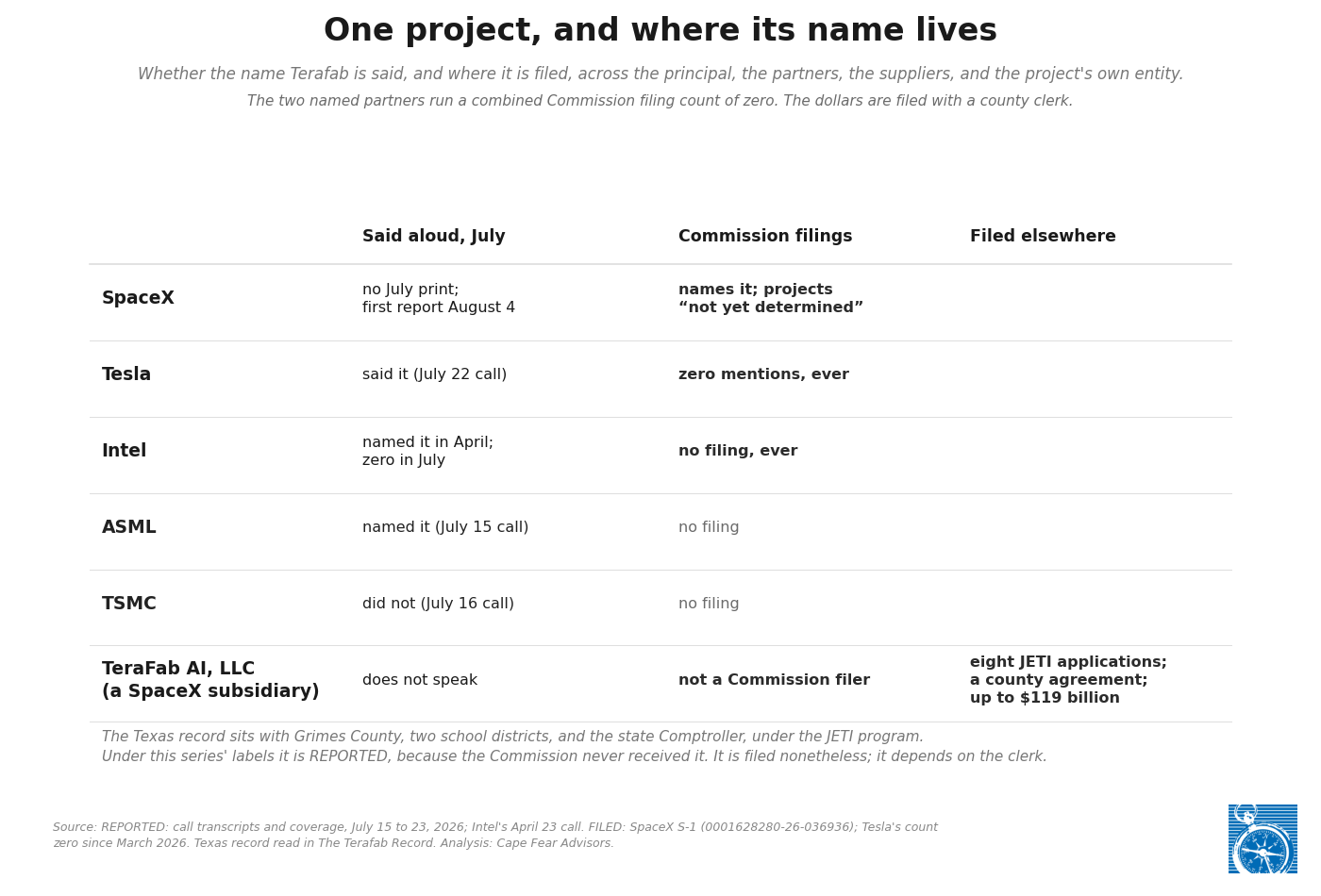
And the dependency runs backward across the wall. On Tesla’s own call, the controller said the chip project is necessary to scaling Optimus, which is Tesla’s product roadmap. That statement is oral and REPORTED; it appears in no Tesla filing. Tesla’s next act, by its controller’s own words in Tesla’s own venue, depends on a project whose name Tesla has never filed and whose determined content does not exist in the partner’s prospectus.
The money already crossing
The equity crossed in March. Tesla’s related party note: “Upon receiving the applicable regulatory approvals, the Company invested $2.00 billion in SpaceX common stock (formerly a preferred share investment in xAI) representing an ownership interest of less than 1% in March 2026.” Read slowly, that sentence documents a chain: Tesla invested in xAI; SpaceX acquired xAI and paid in SpaceX’s own stock; Tesla’s position converted. The stake arrived as change from a transaction between two other rooms owned by the same person. The earlier entry in this series observed that SpaceX’s acquisitions have been paid for in its own stock, xAI and Cursor both; Tesla’s footnote is the counterparty record of that currency, received and now marked, by a filer sharing the same controller. FILED.
The commerce crossed all year, and it grew. The same note discloses that SpaceX bought $318 million of Tesla’s Megapack products in the second quarter, against $242 million of cost, in the ordinary course, under Tesla’s Related Person Transactions Policy. The six month figures put the first quarter near $87 million, so the second quarter ran about three and a half times the first, and the single related buyer supplied about one tenth of Tesla’s energy generation and storage revenue. The prior year’s comparative is the sentence after: transactions with related parties were immaterial in 2025. This commerce did not exist at scale five quarters ago. Grid storage is terrestrial data center infrastructure, and SpaceX’s own prospectus attributes its capital spending surge to “the rapid expansion of our terrestrial data centers,” so the buyer’s capital line and the seller’s revenue line are watching the same buildout from opposite sides of one invoice. Both materiality determinations are the issuers’ own and defensible at these sizes; the observation is only that the money is crossing, at a growing rate, and that the record says so.
And it crosses in one direction. Nothing in the record read here shows SpaceX holding any Tesla stock: a position above five percent would file its own disclosure and none exists, and the offering documents’ balance sheet, read in full earlier in this series, carries nothing below it. The paper flows one way, outward from the company whose stock is the currency, and the sensitivity flows with it. Tesla’s income statement is now a function of SpaceX’s tape. SpaceX’s owes nothing to Tesla’s.
Three incomes, and the one that carried the quarter
Then the mark, which is where the entanglement stopped being a footnote and reached an income statement the whole market reads. Olga Usvyatsky surfaced the Tesla side of this on the day the records diverged, in her July 26 analysis of how Alphabet and Tesla accounted for the same investment differently, and the accounting argument that follows is hers, cited with her name on it.
Tesla’s policy note states that Tesla is “presumed to have significant influence over our equity method investment in SpaceX under ASC 323... as our CEO also serves as the CEO of SpaceX,” and that, not having control, Tesla “elected the fair value option in accordance with ASC 825... to provide a more relevant measure of the investment’s current economic value.” The consequence, as Usvyatsky wrote and as Francine McKenna quoted her: under the equity method Tesla would have recorded its proportionate share of SpaceX’s operating results, and SpaceX’s most recent filed quarter is a net loss of $4.28 billion. The fair value option instead remeasures the stake and runs the change through income. The economics did not move an inch; the accounting produced about a billion dollars of pre-tax income. At an ownership interest under one percent, the share of losses avoided would have been tens of millions; the swing is almost entirely the gain recognized. Both treatments are permitted. Tesla chose, and said why in one filed sentence.
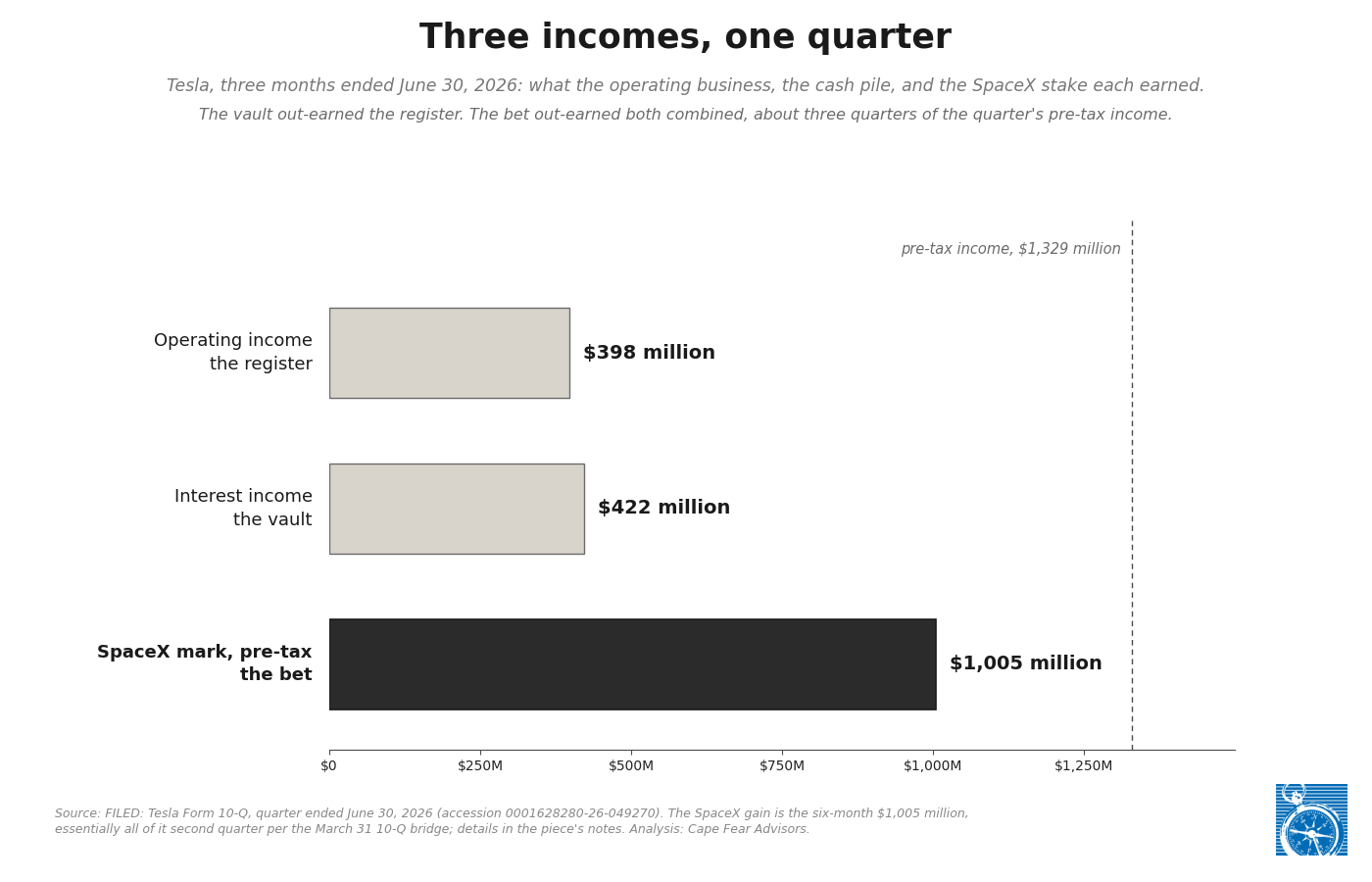
What the choice did to the quarter reads best as three lines. In the three months ended June 30, Tesla’s operating income was $398 million. Its interest income was $422 million. Its unrealized gain on the SpaceX stake, essentially all of which belongs to the quarter on the bridge set out in the Notes, was $1,005 million, against pre-tax income of $1,329 million. Three incomes: the register, the vault, and the bet. The vault out-earned the register. The bet out-earned both combined, and supplied about three quarters of the quarter’s pre-tax income. Revenue grew 25 percent from the prior year while operating income fell nearly 57 percent, so the six month bottom line, flat against last year at $1.6 billion, is flat only because a mark on the neighbor replaced what the operating business used to earn; about half the six months’ pre-tax income is the one line.
The election has a sequel every quarter, and the sequel is running now. Tesla’s measure is taken from market observable inputs, and SpaceX’s stock has fallen hard since the June 30 measurement date; Usvyatsky flagged earnings sensitivity to the SpaceX share price as the coming issue before this week made it visible. On the same convention, scaled to the quote, the position that measured near $3.0 billion at June 30 stood near $2.0 billion at Friday’s close, near its cost: the billion dollar gain that carried the second quarter existed for about four weeks of tape. The exact figure belongs to Tesla’s next filing; the direction and the rough size belong to arithmetic. This week’s coverage explains one stock by the other, a drag, a tumble, a pull. The filed mechanism is plainer than the metaphors: an election converts one company’s tape into the other company’s income statement, in both directions, mechanically, every quarter. Nothing is dragging anything. A footnote is doing exactly what it said it would do.
The pile, and its price
Beside all of this sits the cash. Tesla held $15.2 billion of cash and equivalents and $28.3 billion of short term investments at June 30, about $43.5 billion together, roughly flat since December. Across the six months the company generated $8.6 billion of operating cash flow and spent $8.3 billion on capital expenditure, so the pile neither grew nor deployed; it earned $422 million of interest in the quarter, an annualized yield near 3.9 percent.
One asset sits beside the pile and belongs to none of it. The SpaceX stake is presented within other non-current assets, not among the cash or the investments, so nothing above includes it. It is an asset that produces income and no capital: it ran a billion dollars through the income statement while sitting unspendable, since the shares predate the offering and are of the class the lockup agreements cover, the measurement runs on market observable inputs rather than the exchange quote, and a sale of size by this particular holder would be a related party adjacent event in both companies’ records. Income statement active, balance sheet inert. Held against the system the two companies already form, the stake nets to nothing even now: one room’s asset is the other room’s paper, and a system cannot spend a claim on itself. The gain that carried Tesla’s quarter was real to Tesla’s holders. To the system, it was the system marking itself.
Across the wall, the room with the attempt priced $25 billion of notes in June at a weighted coupon of about 5.86 percent, and committed in its filings to hold $25 billion of minimum cash that the ratings rest on. The controller’s system, read across the two filings, is paid about 3.9 percent for money in one room and pays about 5.9 percent for money in the other, and the wall between the rooms is the corporate separateness whose door the July 22 answer named. That is an observation about two filed records side by side, and it is left as one.
Tesla is anything but inert; the opposite problem marked the quarter, with capital spending surging on robotics, on artificial intelligence infrastructure, and on a development fab in Austin that is Tesla’s facility and Tesla’s spending. The precise statement is narrower. The one attempt Tesla’s roadmap depends on, by the controller’s own words in Tesla’s own venue, is the one thing the $43.5 billion is not funding, and the one word Tesla’s filings never use. The company is trying at every scale except the one the dependency requires. Its cash earns a money market yield while the project its next product requires is financed next door at a premium, by a company that had to borrow. None of that is an allocation critique: Tesla capital into the fab would itself be a related party transaction of scale, so the kept boundary and the undeployed pile are the same fact seen twice.
The boundary, and its keepers
All of this crossing is managed, and the management is visible, which is itself information. Tesla’s related party note invokes the Related Person Transactions Policy by name. On the July 22 call, within moments of the controller’s merger answer, Tesla’s general counsel described SpaceX as a “great partner” providing “numerous beneficial transactions,” the boundary being tended in real time, in the venue where the question landed. The significant influence sentence is careful drafting: influence presumed, control expressly disclaimed, the election justified in a single clause. On the other side of the wall, SpaceX’s prospectus discloses the controlled company structure in full: two classes, one vote and ten, about 85 percent of the voting power on about 42 percent of the economics, a board exempt from independence requirements, a shareholder proposal threshold the vote structure places out of reach. None of the apparatus is improper. Its visible effort is the point: this much machinery exists because this much boundary needs keeping, and the keeping is a cost both shareholder bases pay every quarter.
There is a filed history of what “the appropriate process” means at this address. In 2016 the controller stood on both sides of a combination once before, when Tesla acquired SolarCity. That transaction produced a process, the process produced six years of litigation under the entire fairness standard, a trial court ruling in 2022, and an affirmance in 2023. The history predicts nothing here. It is cited because it is the one documented instance of the machinery the July 22 answer invoked, and because it prices, in years and in court records, what controller on both sides costs to clean.
That history has a jurisdiction problem, and the jurisdiction may be the least examined player in the whole question. The SolarCity process ran in Delaware, under Delaware’s entire fairness standard, in a court with a century of precedent on controllers. Neither company is a Delaware company anymore. The sequence: in January 2024 the Delaware Court of Chancery voided the controller’s Tesla compensation award. Within weeks, SpaceX reincorporated in Texas. By June, Tesla’s shareholders had approved the same move. In September 2024 the Texas Business Court opened, a new venue created by the 2023 legislature for large commercial and governance disputes. Tesla’s Texas governing documents carry a 3 percent ownership threshold for derivative claims, which at current prices asks a would-be plaintiff to hold tens of billions of dollars of stock before bringing the kind of claim the SolarCity holders brought; in 2025 the state codified presumptions favoring directors and officers and authorized thresholds of that size. SpaceX’s package is reported to run further, to mandatory arbitration of shareholder claims. Even the listing participates: the offering was admitted to Nasdaq and to Nasdaq Texas, per the prospectus cover. Each step was lawful and disclosed, and the sequence is stated as sequence. What it produces is a plain fact about the last rung of any ladder: the one precedent for the appropriate process was made under a standard, in a courtroom, that no longer governs either company, and the courtroom that does govern them is two years old, thinly precedented, and has never priced a transaction like the one the market keeps asking about. The SolarCity record prices the old venue. The new venue has no prices yet.
And beneath the apparatus sits the fact the apparatus cannot reach. The significant influence presumption in the accounting literature ordinarily arrives through ownership: a fifth of the shares, seats on a board. Tesla holds less than one percent of SpaceX and presumes significant influence anyway, for the reason its own footnote gives: the CEO is the CEO. The stake does not create the influence; the person does, and the filing says so. Policies can wall transactions, committees can wall approvals, disclosure can record what crosses. Nothing partitions the place where the decisions of both companies form. The accounting has already located the merger where it lives.
The ladder, and its paperwork
What would deeper entanglement look like, and how would a reader know? Every rung has a filing attached, so the forward looking content of this piece can be a list of documents rather than a forecast.
A definitive Terafab project agreement, the step that converts the framework’s undetermined projects into determined ones, files as a material definitive agreement at SpaceX and, at the sizes the Texas record describes, at Tesla; its absence to date is why the prospectus sentence still governs. Tesla capital committed to the fab, in any form, files as a related party transaction, with the proxy scale disclosure that follows size. A combination itself requires the process the controller named, a registration statement, and the fairness machinery whose one local precedent ran six years.
The last rung carries one more set of documents, and this series read them in May, before the offering existed. Both companies adopted 2025 performance awards, and both plans carry change in control provisions. Under Tesla’s plan, a qualifying transaction disregards the operational milestones, the million robots and the million robotaxis and the $400 billion of adjusted EBITDA, and the deal price itself satisfies the market capitalization tranches of an award of up to 423.7 million shares. SpaceX’s award sits in 200 million super voting Class B shares, in a company where the Class B holders alone can remove the chief executive. The mechanics were set out in The $8.5 Trillion Grease Gun on May 1, which also noted that the architecture, once the offering completed, could not be undone; the offering completed on June 12. No scenario from that piece is repriced here and no intention is attributed to anyone. The record holds two filed logics attached to the same act: an industrial one, the fab both roadmaps need, and a compensatory one, a transaction that converts two award structures with the operating tests waived. Both are in documents. They are stated side by side and left there.
One more thing the ladder shows, against the market’s intuition: the rungs are not equally heavy, and the heaviest is the one treated as the modest option. A definitive joint venture, the step the framework anticipates, is the most governance-expensive structure two companies sharing a CEO can operate. Every project the framework ever determines becomes a negotiated contract between related parties, and the prospectus’s own list of what stands unresolved, the financial terms, the intellectual property rights, the ultimate term, is precisely the list of conflicts needing management, project by project, for as long as the venture runs. Each determination would ask for independent process on both sides of the table, and the one person who holds the whole plan in his head could represent neither side of it. The framework asks the wall to hold at exactly the place this piece has already shown no wall can be built. A combination would not meet that requirement. It would dissolve it. Dissolving it is not lightness: a combination concentrates the same complexity into a single transaction, with the process, a new venue, and two award structures of its own to carry. None of the rungs is light. The ladder sorts the shape of the weight, recurring against concentrated, not its presence. Whether any of that bears on which rung ever gets climbed is not knowable from outside and is not guessed at here. What is knowable: at least four months after the framework was announced, the number of projects determined under it is zero, and the structural weight of determining any is part of the record a reader can price.
The ladder also has a clock, and the clock belongs to no one writing about it. The owner spoke it on July 22: a location, soon. His prospectus set no date for the fab, and needs its chips for a constellation it expects as early as 2028. His county agreement pays $10 million on August 2 and dates its investment commitments to 2030, and the product he says needs the chips is Tesla’s next act. Around the undetermined framework the parties are not evenly placed: one company has the money, the engineering bench, and the demand; one has the county agreements and the payment falling due; the named third partner has the node and has filed nothing; and the machine suppliers are further along in speech than the partners are in paper, with ASML naming the project on its own call while the framework that would order its machines remains undetermined. A fab, unlike a holding structure, does not keep. So the durable constellation reading meets its limit here: the configuration can persist, but the project cannot proceed inside it as it stands. The framework must resolve into some form, determined projects, a different structure, or one partner proceeding alone, and each form leaves a different mark in the record. If Terafab moves forward inside the framework, something formalizes and files. If it moves forward outside the framework, one partner proceeding alone, the Commission’s files stay silent, exactly as the previous entry read that silence, and the mark lands in the Texas record instead: permits, payments, construction, the clerk’s side of the ledger. If nothing moves, the dates pass and say so. Three roads, three different papers, all on the owner’s clock and no one else’s.
What a combination would make invisible
The market’s question carries an assumption: that a merger would clarify things. The record runs the other way, and the other column comes first, because the dark would not be bought for nothing.
The savings would be real. One board where two now each run their own process. One disclosure apparatus where two now tend a boundary every quarter. No related person machinery standing between a battery and its buyer, no arm’s length price constructed for a transaction whose two sides already share a mind, no general counsel following the controller’s answers in real time, and no venture whose every project requires the one person who understands it to recuse from both sides of it. The entanglement documented above carries a standing maintenance tax on both companies, and a combination cancels the tax. No figure exists outside the companies, but the direction is not in doubt: the case for combining is a real case, and it is a case for efficiency.
What it costs is the record itself.
The marks would go away. A parent cannot hold a mark to market gain on its own subsidiary. The $1,005 million, the line that made the second quarter and is unmaking the third, ceases to exist by operation of consolidation, and with it goes the most legible signal the entanglement has ever produced. The mark made the relationship visible on a page the whole market reads, and the mark is precisely what a combination deletes.
The cash would go invisible. The batteries would still ship; the flow would not stop. But an intercompany sale nets to zero in consolidation, and the disclosure that today lets anyone compute the margin, $318 million against $242 million, about 24 points, dies with the eliminations. Whatever shadow survived would survive in segment reporting, and segment reporting runs on the management approach: the segments are what the chief operating decision maker reviews, and intersegment revenue appears only if it sits inside the measure that officer looks at. The chief operating decision maker of the combined company would be the controller. Whether a reader ever again saw the flow between the rooms would be, in the most literal sense the accounting framework allows, his judgment call, made by choosing what he reviews. That is a description of the framework, not a legal conclusion, and the Notes say so. This series has spent a month on materiality by silence, the judgment a company renders by filing nothing. Consolidation would hand the record its successor: visibility by judgment.
The stake would end the strangest way of all. Its final mark would be set by the transaction itself, the deal price being the last quote it is ever measured against, and then it would stop being an asset entirely, because a combined company holding the stake would be holding its own shares. An asset that was never available to the combination nets to nothing inside it. The mark is priced by the deal and extinguished by the closing, in the same instant.
The acknowledgments would dissolve. The significant influence sentence becomes control and disappears into a parent’s consolidated whole. The related party note, the policy citation, the general counsel’s tended boundary, all of it becomes internal, in the way that a wall becomes a hallway.
So the state of the merger is this. It exists in a framework with named partners and no determined projects. It exists in a job title on one company’s payroll spelling a word that company has never filed. It exists in a stake that arrived as change, in an invoice that grew three and a half times in a quarter, in a mark that carried one quarter and is unmaking the next, in an influence presumed from a person rather than a position, and in two award structures waiting at the last rung with the tests waived. It exists, most completely, in the only consolidated entity the record currently has: a reader holding both filings at once. What it does not yet exist in is a filing of its own, and the record makes one thing plain about that final document: its arrival would not turn the lights on. The lights are on now. The filings are the lights.
A holder of either stock is currently paying for the boundary and collecting the visibility. The wall costs process and buys sight. The dark costs sight and buys speed.
One filed sentence sits underneath that trade, and the previous entry in this series rested on it. SpaceX’s prospectus states that “we believe speed is a competitive advantage,” and that the company prioritizes “execution speed, capacity expansion, and technological leadership over near-term margin optimization.” Yesterday’s piece read that doctrine as the plan’s engine, and the governance structure as its stated price. Against the trade above, the sentence does one more job: the dark buys speed, and speed is the one good in this trade that one of the two companies has already declared it values above the others, in a registration statement, to the buyers of the offering. The doctrine does not answer the question of the last rung. It prices one side of it, in the issuer’s own words, and it has been on file since May. The doctrine speaks to building rather than to dealmaking, and carrying it from one to the other is this piece’s transfer, not the filing’s claim.
The record supplies the price list for both sides of the trade, and the choice between them belongs to a process one person would begin, in a courtroom with no precedents, on a date no filing yet names.
A holder of either stock is currently paying for the boundary and collecting the visibility. The wall costs process and buys sight. The dark costs sight and buys speed.
Related, on the shelf: SpaceX, Adding It Up: The Cost of Not Beginning; The $8.5 Trillion Grease Gun; The $10.25 Trillion Hypothesis; The Terafab Record; The Three Layer Cake: SpaceX’s Governance Structure; The $235 Billion Cash Gap; Cursor Stock and the Investment-Grade Refinancing. On the Tesla mark, read Olga Usvyatsky first; on the income mechanics of unrealized gains, Francine McKenna.
Standing Disclosure
Anthropic is the developer of Claude, which is used in preparing this research, and Anthropic is also a compute counterparty to SpaceX, whose contracts are part of the record read here. That nearness cannot be fully checked away, which is why no claim here rests on trust in the tool: every figure carries a public source, and the record grades the rest. Others named have ties to Anthropic, including Google and its parent Alphabet, a SpaceX compute counterparty and a large holder of Anthropic; and companies not named here, among the chip and cloud suppliers, may hold positions or supply relationships that bear on the filers discussed, which is part of why every piece is re-checked for bias, ground facts, and filings rather than read against a fixed list. Figures are quoted from the filers and from named analysts without characterization, and the same standard of reading is applied to every party named.
Analysis: Cape Fear Advisors.
Notes
How to read the labels. Every load-bearing figure below carries a source and a status. FILED means a document filed with the Commission and cited by accession, which any reader can pull. REPORTED means the public record outside the Commission’s files: transcripts, local and trade coverage, market data, and analysis posted by its author. The distance between those two words is, as ever, much of what the piece is about.
Prices and figures. Tesla figures are FILED, from the Form 10-Q for the quarter ended June 30, 2026 (accession 0001628280-26-049270) and the Form 10-Q for the quarter ended March 31, 2026 (0001628280-26-026673): revenue $28,236 million against $22,496 million a year earlier; operating income $398 million against $923 million; interest income $422 million; income before income taxes $1,329 million for the quarter and $2,077 million for the six months, with a quarterly provision of $201 million; net income $1,128 million for the quarter and $1,619 million for the six months against $1,610 million; cash and equivalents $15,219 million and short term investments $28,305 million at June 30 against $16,513 million and $27,546 million at December 31; six month operating cash flow $8,634 million and capital expenditure $8,282 million; energy generation and storage revenue $3,139 million for the quarter. Market prices are REPORTED, closes only, intraday prints excluded: Tesla closed $313.03 and SpaceX $115.07 on Friday, July 24, 2026. Percentages are rounded against the argument throughout: the mark is 75.6 percent of quarterly pre-tax income, stated as about three quarters; 48.4 percent of six month pre-tax income, stated as about half; the Megapack revenue is 10.1 percent of segment revenue, stated as about one tenth; interest income annualizes to 3.88 percent on the June 30 pile, stated as about 3.9.
The mark, and the election. FILED, Tesla 10-Q. The policy language verbatim: “We are presumed to have significant influence over our equity method investment in SpaceX under ASC 323, Equity Method Investments and Joint Ventures, as our CEO also serves as the CEO of SpaceX but as we do not have control over the investee, we have elected the fair value option in accordance with ASC 825, Financial Instruments, to provide a more relevant measure of the investment’s current economic value to financial statement users.” The related party note verbatim: “Upon receiving the applicable regulatory approvals, the Company invested $2.00 billion in SpaceX common stock (formerly a preferred share investment in xAI) representing an ownership interest of less than 1% in March 2026.” The cash flow statement carries the $1,005 million unrealized gain for the six months; the first quarter filing shows the position acquired for $2,002 million in the first quarter and carried at approximately that amount at March 31, then classified within Level 2, so the attribution of essentially the whole gain to the second quarter is a bridge across the two filings rather than a printed quarterly line. The reversal arithmetic in the text scales the June 30 measure proportionally to the SpaceX quote and is an estimate on a stated assumption; the filed answer belongs to the third quarter report. The comparison of Tesla’s accounting with Alphabet’s, and the argument that the fair value election rather than any valuation input is the choice that produced the income, belong to Olga Usvyatsky (“Tesla’s investment in SpaceX: The $1 Billion Accounting Choice,” July 26, 2026), quoted publicly by Francine McKenna; her work is the reason this piece exists in its present form. One shape note is this piece’s own arithmetic on her point, not hers: at under one percent ownership, the equity method share of losses avoided is tens of millions, so the billion dollar swing is almost entirely the gain recognized. The S-1 states the same conversion from its side, describing Tesla’s “January 2026 commitment to invest in xAI” as an investment that, upon SpaceX’s acquisition of xAI, “was converted into an equity interest in SpaceX.” Both filers describe the same change of hands, independently, from opposite ends of it.
The framework, and its drafting history. FILED. The confidential draft registration statement of March 30, 2026 (accession 0001628280-26-021860) described “an announced chip manufacturing initiative in partnership with Tesla,” without Intel and without caveats. The staff’s first comment letter (0000000000-26-004247) directed the company to discuss the material terms of Intel’s partnership, timelines, milestones, and capital expenditures; the second (0000000000-26-005119) pressed the company to state that these “have not yet been determined.” The S-1 and final prospectus (0001628280-26-036936; 0001628280-26-042639) carry the surviving language: a chip manufacturing initiative with Tesla and Intel, a general framework, terms not finalized, and, in four places, “Any specific projects undertaken pursuant to this framework will be subject to separate negotiations and agreements (including any development timelines, milestones and capital expenditures) and have not yet been determined.” The Texas record, REPORTED from county, district, and Comptroller documents and local coverage, is read in The Terafab Record and carries the up to $119 billion of phased investment under TeraFab AI, LLC. The applications’ Parent Company Information names Space Exploration Technologies Corp alone, at the same 1 Rocket Road address as the applicant; no xAI entity appears on any ownership line of the eight sets. The sworn project description in the May applications reads “led by a consortium of affiliated advanced technology companies, including Tesla, Inc., Space Exploration Technologies Corp. (SpaceX), and xAI Corp.” The S-1 presents its financials as the retrospective combination of the companies to include the historical results of xAI, “which was acquired by SpaceX, effective February 2, 2026,” the entity history running through X.AI Holdings Corp., which had itself absorbed X Holdings on March 28, 2025; the prospectus uses X.AI Holdings Corp. and later X.AI Holdings LLC, and never the name xAI Corp. The applications’ node claim, sworn: “sub-2 nanometer class nodes.”
The staffing. REPORTED. Gary Jiang’s verified LinkedIn profile, as identified by Electrek on June 30, 2026 and covered by Tom’s Hardware, TrendForce, and others through July 1, lists 17 years and 9 months at Intel, most recently as factory manager responsible for Intel 18A technology development transfer, construction, tool installation, and startup, with earlier fab management at Ocotillo, and a June 2026 start at Tesla in Austin under the title Director, Terafab. Coverage varies between seventeen and eighteen years; the profile’s figure is used. No company announcement or filing exists.
The word counts. Tesla’s FILED Terafab count is zero across all filings since March 2026, including the July 22 earnings release exhibit (8-K, 0001628280-26-049213) and the July 23 10-Q. The 10-Q’s management discussion states Tesla is “expanding our scope of manufacturing to include semiconductor and solar fabrication.” The four print scoreboard is REPORTED from earnings transcripts and coverage: ASML named Terafab on July 15; TSMC did not on July 16; Tesla said it on the July 22 call while its filings stayed at zero; Intel’s chief executive discussed the partnership by name on April 23 and the word did not occur on Intel’s July 23 call, including in its 14A node roadmap discussion. Intel has made no Commission filing referencing the project.
The July 22 statements. REPORTED, from Tesla’s second quarter earnings call. The merger answer is rendered by Reuters as “there’s more and more overlap” and combining companies “can’t” be discussed on an earnings call and must follow “the appropriate process”; one transcript rendering carries the additional clause “especially with the Terafab, that’s really going to be a gigantic project,” recorded here as context and to be confirmed against the primary transcript at print. Tesla’s general counsel, Brandon Ehrhart, followed with the “great partner” and “numerous beneficial transactions” characterizations, per Reuters. The statement that the chip project is necessary to scaling Optimus is from the same call, oral, and appears in no Tesla filing.
The commerce. FILED, Tesla 10-Q, related party note, verbatim in relevant part: $318 million of revenue and $242 million of cost of revenue from SpaceX’s purchase of Megapack products in the quarter, $405 million and $307 million for the six months, in the ordinary course under the Related Person Transactions Policy, with other related party transactions immaterial, and 2025 comparatives immaterial. The first quarter figures are the six month figures less the second quarter. The buyer’s side attribution, “the rapid expansion of our terrestrial data centers,” is FILED in SpaceX’s prospectus, in identical words in each period discussed.
Governance, and the precedent. SpaceX’s structure is FILED in its prospectus and read in The Three Layer Cake: two classes at one and ten votes, about 85 percent of voting power on about 42 percent of the economics, controlled company exemptions, and a 67 percent shareholder proposal threshold. The controller’s Tesla ownership is a matter of Tesla’s proxy record. The SolarCity history is a matter of court record: the 2016 acquisition, with the controller on both sides, was litigated under the entire fairness standard through a 2022 Court of Chancery decision and a 2023 affirmance. It is cited as the one documented local instance of the process invoked on July 22, and for nothing else.
The venue. The Texas Business Court opened September 1, 2024, created by the Texas legislature in 2023; the 2025 amendments to the Business Organizations Code (SB 29) codified presumptions favoring directors and officers and authorized derivative ownership thresholds of up to 3 percent (coverage: Sidley’s Enhanced Scrutiny, May 2025). Tesla’s Texas reincorporation was approved by shareholders in June 2024 and is FILED in its proxy and subsequent charter documents; its adoption of the 3 percent derivative threshold is carried in its governing documents and was the subject of a filed exempt solicitation by the New York State Comptroller (accession 0001214659-25-015361). SpaceX’s Texas incorporation is FILED in the S-1; the mandatory arbitration characterization of its shareholder claim provisions is REPORTED from governance commentary and should be confirmed verbatim against the prospectus’s forum and arbitration provisions at print. The Nasdaq and Nasdaq Texas listing is FILED on the 424B4 cover. The January 2024 Chancery decision and the 2016 to 2023 SolarCity litigation are matters of court record. The sequence is stated as sequence; no purpose is attributed to any step.
The one way flow. The absence of any SpaceX position in Tesla stock is an absence in the record read here: no Schedule 13D or 13G by SpaceX with respect to Tesla exists, and the S-1’s balance sheet and investment disclosures, read in full in earlier entries, carry no such position. Absence of evidence in filings read is stated as exactly that.
The compensation plans. FILED in the respective companies’ 2025 award documents and read in The $8.5 Trillion Grease Gun (May 1, 2026) and The $10.25 Trillion Hypothesis. The Tesla award runs to 423.7 million shares across tranches tied to market capitalization and operational milestones, and its change in control provisions disregard the operational milestones, with the transaction price determining the market capitalization achieved. The SpaceX award comprises 200 million Class B shares with additional tranches tied to orbital data center milestones. This piece cites the mechanisms only. The May piece’s transaction scenario was a hypothetical at pre offering marks and is not repriced or endorsed here; no intention is attributed to any party.
The pile, and the spread. Tesla’s cash figures are FILED as above, and the SpaceX stake is not among them: the policy note states the equity investment is presented within other non-current assets, so the $43.5 billion excludes it. The lockup characterization in the text reads the offering’s general lockup terms, FILED in the final prospectus, against the March 2026 origin of Tesla’s shares; Tesla makes no specific disclosure of its position’s lockup status, and the final prospectus’s lockup schedule should be confirmed at print. SpaceX’s $25 billion of June notes at a weighted average coupon near 5.855 percent, and the $25 billion minimum cash commitment, are FILED (8-K accession 0001628280-26-044955) and were read in Cursor Stock and the Investment-Grade Refinancing. The juxtaposition of one company’s cash yield with the other company’s coupon is an observation about two filed records and carries no suggestion of any transaction between them.
The speed doctrine. FILED. “We believe speed is a competitive advantage... we continue to prioritize execution speed, capacity expansion, and technological leadership over near-term margin optimization,” SpaceX S-1 and final prospectus (0001628280-26-036936; 0001628280-26-042639), fragment-confirmed against EDGAR full text at the prior entry’s print check on July 26. Its reading as the plan’s engine, and the governance structure as the price of the speed, is in SpaceX, Adding It Up: The Cost of Not Beginning.
What consolidation would erase. The elimination of intercompany revenue and of a parent’s mark on a subsidiary in consolidation are descriptions of the ordinary operation of the accounting framework. The segment reporting discussion describes ASC 280’s management approach, under which reportable segments and their disclosed measures follow what the chief operating decision maker regularly reviews. These are descriptions of the framework, not legal conclusions, and no view is expressed on what any combined entity would or should disclose.
What arrives next, and how it lands. Written before any of it, whatever it is. A definitive Terafab agreement would file as a material definitive agreement at both companies, converting the framework’s undetermined projects into determined ones, and would date this piece’s account of the framework to the day before it arrived. An announced combination would begin the process the July 22 answer named; nothing here predicted one, and the ladder above is a list of filings, not a forecast. A denial of any combination changes no present-tense instrument described here. The Texas record’s own dates are arrivals too: the August 2 payment and the dated investment commitments are as legible passing unmet as filings are landing; the payment date falls on a Sunday, so a Monday landing is the calendar working. SpaceX proceeding alone under its already disclosed plan generates no Commission filing, per the previous entry’s own reading of that silence, and arrives in the Texas record instead. And on the mark: a recovery in the SpaceX quote by the September 30 measurement date prints no loss and proves the sensitivity just the same; the claim is the mechanism, not the mark, and it runs in both directions by construction. In every case, the sources of this piece predate it, each is public and dated, and the earliest is this series’ own entry of May 1. A piece built from dated public documents will sometimes publish close to the record’s next document. Proximity is not foresight, and none is claimed.
Analysis: Cape Fear Advisors.
This article is also available on Substack.
Contact Cape Fear Advisors