

A large AI announcement hands a reader one number. Set four of them side by side and they are four different kinds of thing: a ceiling, a rate, a commitment conditioned on delivery, and a total whose clock starts on a date no filing states. They can be added, and the sum describes an obligation no party has. The filings are where a reader finds out which is which, and they will not finish the job. Some answers arrive a quarter late, some are redacted, some sit in a letter few readers open, and some relationships are invisible until a document lands that shows one existed. What a reader gets is the questions, in a form specific enough to ask, and the standing to decide for themselves whether the answers matter.
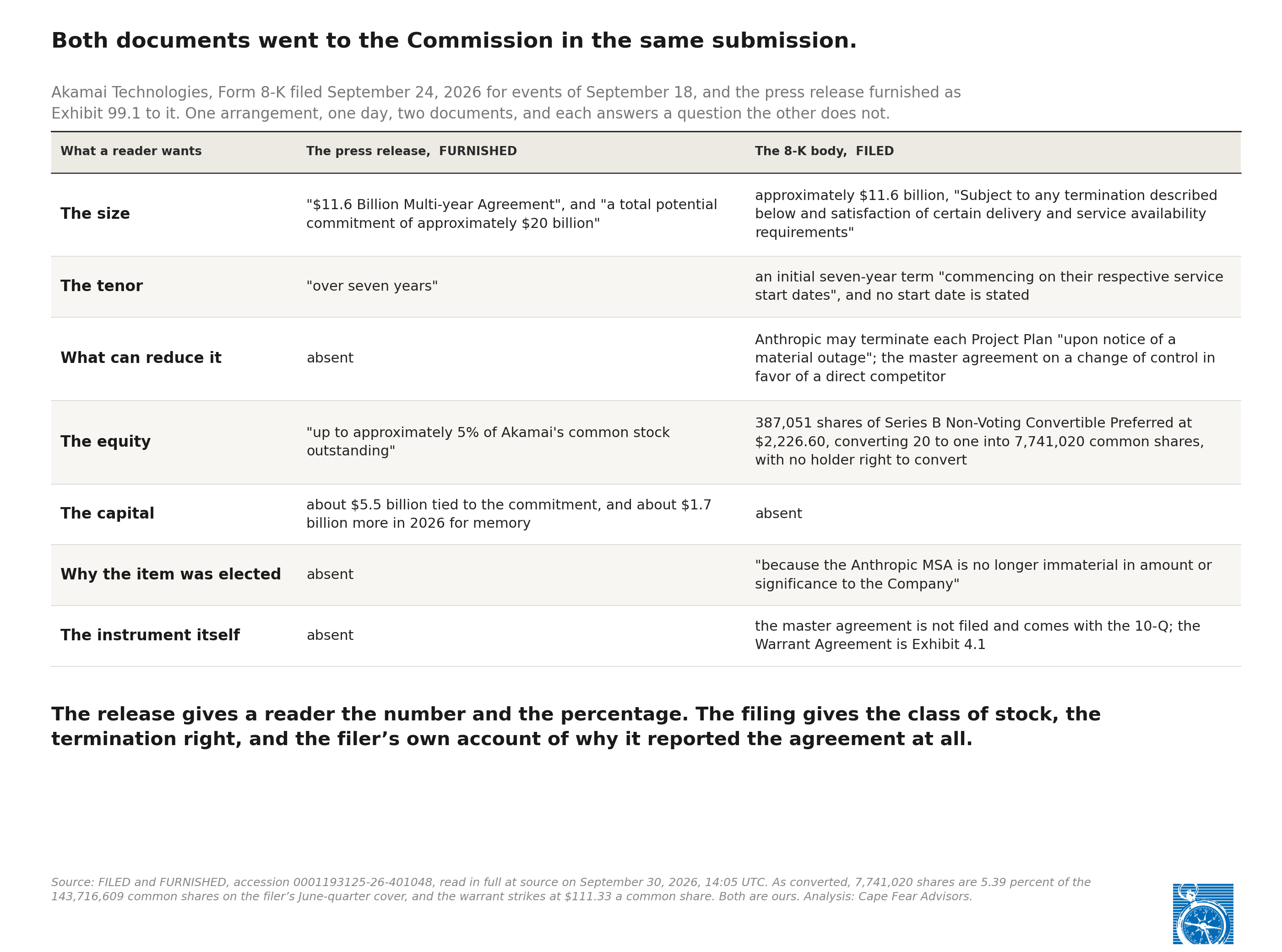
On September 24, 2026, Akamai Technologies sent two documents to the Securities and Exchange Commission in a single submission. One was a current report on Form 8-K. The other was a press release, furnished as Exhibit 99.1 to it. They describe the same arrangement, signed on the same day, with the same counterparty.
The release is headlined “Akamai Announces $11.6 Billion Multi-year Agreement with Anthropic to Support Growing Demand.” The commitment runs “over seven years.” The relationship could grow “by up to an additional $9 billion, which represents a total potential commitment of approximately $20 billion.” And Akamai has issued Anthropic a warrant “for up to approximately 5% of Akamai’s common stock outstanding.”
In the filing, that $11.6 billion is “Subject to any termination described below and satisfaction of certain delivery and service availability requirements.” Each Project Plan has “an initial seven-year term commencing on their respective service start dates,” and no service start date appears. Anthropic “may terminate each Project Plan upon notice of a material outage.” And on the warrant the filing carries what the release leaves out: the instrument is 387,051 shares of Series B Non-Voting Convertible Preferred Stock at $2,226.60 a share, converting twenty to one into 7,741,020 shares of common, and the holder has no right to convert at its election. Those 7,741,020 shares are 5.39 percent of the 143,716,609 shares of common outstanding on the cover of the filer’s June quarter, and 5.11 percent of the count after the warrant shares are added. The vesting mechanics of that warrant, which pay 516,068 shares for each additional billion committed, we worked in an earlier piece, so we leave them there; what we take from the filing here is the comparison with the release beside it. The release said approximately 5 percent, and both readings support it. [FILED; the two percentages are ours, and each prints its denominator.]
The exhibit index carries the rest of the answer. The Certificate of Designations is filed in full as Exhibit 3.1 and the Warrant Agreement as Exhibit 4.1, with portions redacted under Item 601(b)(10)(iv) and schedules omitted under Item 601(a)(5). The master services agreement itself is not filed and comes with the quarterly report, as do the Lenovo and Jabil agreements. The release also puts the capital behind the commitment at about $5.5 billion, with about $1.7 billion more in 2026 to pre-purchase components including memory. [FURNISHED.]
Both documents are accurate. Each answers a question the other does not.
Why the addition is the problem
The question under all of this is whether the AI buildout is a bubble, and that question is answerable one company at a time. We have held that position since August and hold it here: circular financing is ordinary, a shape is not a verdict, and we take no view on any security.
Company by company, the filings show three things the headline leaves out. They show circular financing, where the same money and the same obligations move between a small number of parties. They show a wide range of relationships, from a filer that puts its instrument on the record to one that reports the same kind of instrument with no exhibit at all. And they show negotiated positions: terms one party asked for and the other agreed to, which differ from arrangement to arrangement because two sets of lawyers wrote them.
That last point is the one a headline erases, and one filer states it outright. SpaceX told the Commission’s staff that its ninety-day termination right is something “the Company negotiated for,” and gave its commercial reason. Akamai’s warrant vests when its counterparty commits more; Generac’s vests when its counterparty pays. Akamai’s counterparty holds non-voting preferred with no right to convert; Generac’s holds common stock with registration rights and a cashless exercise. These are not market terms. They are outcomes.
The announced figures are not a common denominator. One is a ceiling, one is a rate, one is a commitment subject to delivery and service availability, one is a lifetime that begins on a date no filing states. They can be added, and the sum describes an obligation no party has. That is the addition in the title, and it is the problem.
The tenor, because an announcement carries a lifetime
The first thing a headline figure leaves out is how long it runs.
Akamai’s two figures sit in the same three bullets at the top of one page. The commitment is $11.6 billion. The ceiling, with the additional $9.0 billion, is $20.6 billion, which the release prints as approximately $20 billion. The ceiling is 1.78 times the base. [FILED and FURNISHED; the ratio is ours.]
That shape recurs. Applied Digital states both numbers in one sentence: “approximately $36 billion in total contracted base-term lease revenue, or $86 billion if all renewal options are exercised.” Base against full renewal is 2.39 times at the portfolio. [FILED; the ratio is ours.]
And at SpaceX, the arrangement readers have asked about most this year, the same structure produces four figures for one contract.
SpaceX’s own prospectus states the rate: “Pursuant to these agreements, the customer has agreed to pay us $1.25 billion per month through May 2029, with capacity ramping in May and June 2026 at a reduced fee. After the initial three-month period, the agreements may be terminated by either party upon 90 days’ notice.” [FILED, accession 0001628280-26-042639.]
Thirty-five full months at that rate is $43,750m. One year at that rate is $15,000m. Ninety days at that rate is $3,750m. Those three are ours, struck on a filed rate. The two ramp months sit outside them because the same sentence prices May and June 2026 at “a reduced fee” and gives no figure for it, which puts the thirty-seven month total in a band between $43,750m and $46,250m instead of on a number, and the document withholds what separates the two.
The fourth figure comes from the other side: Reuters, reading a confidential Anthropic prospectus, reports compute agreements with SpaceX of up to $84,500m through 2029. [REPORTED, from a document not on the public record.]
One arrangement, four figures, and the outer against the inner is $84,500m against $3,750m. Every one of them is accurate about the question it answers. The ceiling is what the buyer may spend. The rate is what the seller has been told it will be paid. The notice period is the most either of them is committed to.
The gap between the outer figure and the filed rate can be located without being closed, and the subtraction crosses two provenance tiers, so it prints them. Running the filed rate seven months past its filed end date, to December 2029, gives $52,500m. Against the reported $84,500m that leaves $32,000m the calendar cannot reach, REPORTED less OURS-on-FILED. A second reported account puts the figure at $15 billion a year through May 2029, which is the filed monthly rate to the dollar. So the difference sits in the words “up to,” in whatever the plural “agreements” covers, and in what a ramping deployment does to a monthly fee. The document that would settle it is not one anybody outside the process can open.
The twelve months, because the rules ask and an announcement does not
Item 303 of Regulation S-K asks a filer for its material cash requirements in the near term and the long. An announcement has no such obligation.
Meta’s June quarter carries $349,310m of non-cancelable contractual commitments, and splits it: $53,520m due in 2026 and $81,650m in 2027. The first year is 15.32 percent of the total and the two years together are $135,170m, or 38.70 percent. CoreWeave’s remaining performance obligations stood at $103,700m at the same date, with 41 percent expected over the initial twenty-four months. [Both FILED; the percentages of the Meta total are ours.]
Akamai’s near term cannot be struck, and the reason is instructive. No filed document gives a service start date, so the seven years have no beginning. What the record does give is the filer’s own revenue: $4,208m for fiscal 2025. The commitment is 2.76 times one year of it. [FILED; the multiple is ours.]
The fine print, where the tenor is regulated
Three kinds, all filed, and all of them reduce a headline.
A cancellation right. SpaceX’s ninety days’ notice, above.
A contingency. Meta, in the same note as the $349,310m: “contingent obligations to purchase up to $14.72 billion of cloud capacity over a five-year period, which may be reduced if the cloud service provider is able to sell such capacity to other customers.” That figure is additional to the $349,310m, and a reader who subtracts it has gone the wrong way.
And a measure already net of things an announcement cannot show. CoreWeave, defining its remaining performance obligations: “Variable consideration primarily consists of potential reductions to the transaction price in the future, such as estimates of future potential credits to customers under availability of service agreements, amounts that may not be recognized as revenue due to delivery delays, and estimates of committed cloud computing capacity that the Company has the right to resell.”
The name arrives late, and two filers show the two ways it happens
Akamai’s quarterly release of May 7, 2026 carried this headline: “Leading, U.S. based frontier model provider commits $1.8 billion over seven years for Cloud Infrastructure Services.” [FURNISHED.] The master services agreement it describes is dated May 5, two days earlier. Seven years, the same tenor the September Project Plans carry. No filed document says whether that commitment is Anthropic’s.
SpaceX’s draft registration statement described its compute counterparty as “a third party.” [FILED.]
Both filers eventually named Anthropic. The routes differ, and the difference is what separates one filer from another.
Akamai named it in its own filing, four and a half months later, and said why. SpaceX named it after the Commission’s staff asked. The staff’s letter of May 29, 2026 is on the public docket:
“We note the revisions made in response to prior comment 3, including that Anthropic will pay you $1.25 billion per month for access to compute capacity across COLOSSUS AND COLOSSUS II. Please tell us what consideration you gave to filing this agreement. See Item 601(b)(10) of Regulation S-K. Additionally, please revise here to quantify the amount of compute capacity provided to Anthropic pursuant to the agreement.”
The final prospectus names Anthropic PBC eight times, with a GPU count, a monthly fee and a term.
Those letters sit on any filer’s own page on the Commission’s system, as UPLOAD and CORRESP filings, published on the ordinary schedule after a review closes. They are a filed index of what a document did not say until it was asked. The comment-letter trail as a readable object, and the counts that size it, were set out by Olga Usvyatsky and Francine McKenna in “Post-mortem: The SEC’s pre-IPO comment letters to SpaceX,” July 17, 2026. The four letters below were read at source.
The judgment call is in the letter
SpaceX answered the staff on June 1, 2026, and the answer is an exhibit argument and not a materiality argument.
“the Cloud Services Agreements are not material contracts required to be filed as exhibits because they (i) were entered into in the ordinary course of the Company’s business and (ii) do not fall within any of the categories of ordinary-course contracts that Item 601(b)(10)(ii) requires to be filed.”
The company then worked the four categories, and the second one is where the ninety days reappears:
“the Company believes the related compute capacity and revenue opportunity would easily be redeployed to other customers given the shortage of frontier AI compute capacity or alternatively could be utilized for the Company’s own compute initiatives, which is a reason why the Company negotiated for a termination provision that allows either party to terminate the agreements with 90 days’ notice. This termination right, which either party may exercise without adverse contractual consequences, is inconsistent with the substantial dependence requirement in Item 601(b)(10)(ii)(B).”
So one clause does three jobs. In the prospectus it is the thing that can reduce the total. In the letter it is a term the company states it negotiated for, with its commercial reason attached. And in the same letter it is the ground on which the contract itself is not filed. A reader holding only the prospectus sees the first of the three.
The company also severed, in advance, the inference a reader would otherwise draw from seeing the arrangement described in the prospectus at all:
“The Company has disclosed certain terms of the Cloud Services Agreements to provide investors with additional context regarding the provision of the Company’s compute capacity to Anthropic. However, for purposes of Item 601(b)(10), the Company respectfully advises the Staff that the Cloud Services Agreements are not material contracts required to be filed as exhibits.”
The staff asked for two things and received one. The company added the compute quantification to the prospectus and declined to file the agreement. The next staff letter, dated June 2, returns to neither.
The same question, answered the other way
That sentence has a longer history, and we gave it its own piece. Two years earlier the Commission’s staff asked Apple how it had applied its qualitative factors to the discussion of Services revenue. Apple’s response of April 29, 2024:
“management concluded that the change in Services net sales was both quantitatively and qualitatively immaterial and, as such, concluded that no additional disclosures would be required under Item 303(a) of Regulation S-K to enhance a reader’s understanding of the Company’s results of operations.”
And then Apple cited the Commission’s own guidance back to it, quoting the direction to “avoid the unnecessary information overload for investors that can result from disclosure of information that is not required, is immaterial, and does not promote understanding.” That is Release No. 33-8350, effective December 29, 2003, and it is the source of the idea that more disclosure can be the wrong answer.
The figure the judgment turned on is withheld. Apple’s earlier letter of March 20, 2024, filed under a request for confidential treatment, states that “management uses a materiality threshold of [***] at the registrant level as a starting point.” A decrease of $11.0 billion in total net sales and an increase of $7.1 billion in Services net sales are each described as “well below” it.
Two filers, two provisions, two judgments pointing opposite ways on whether a reader is told more. Neither judgment appears in the document it governs. It appears in the letter about the document.
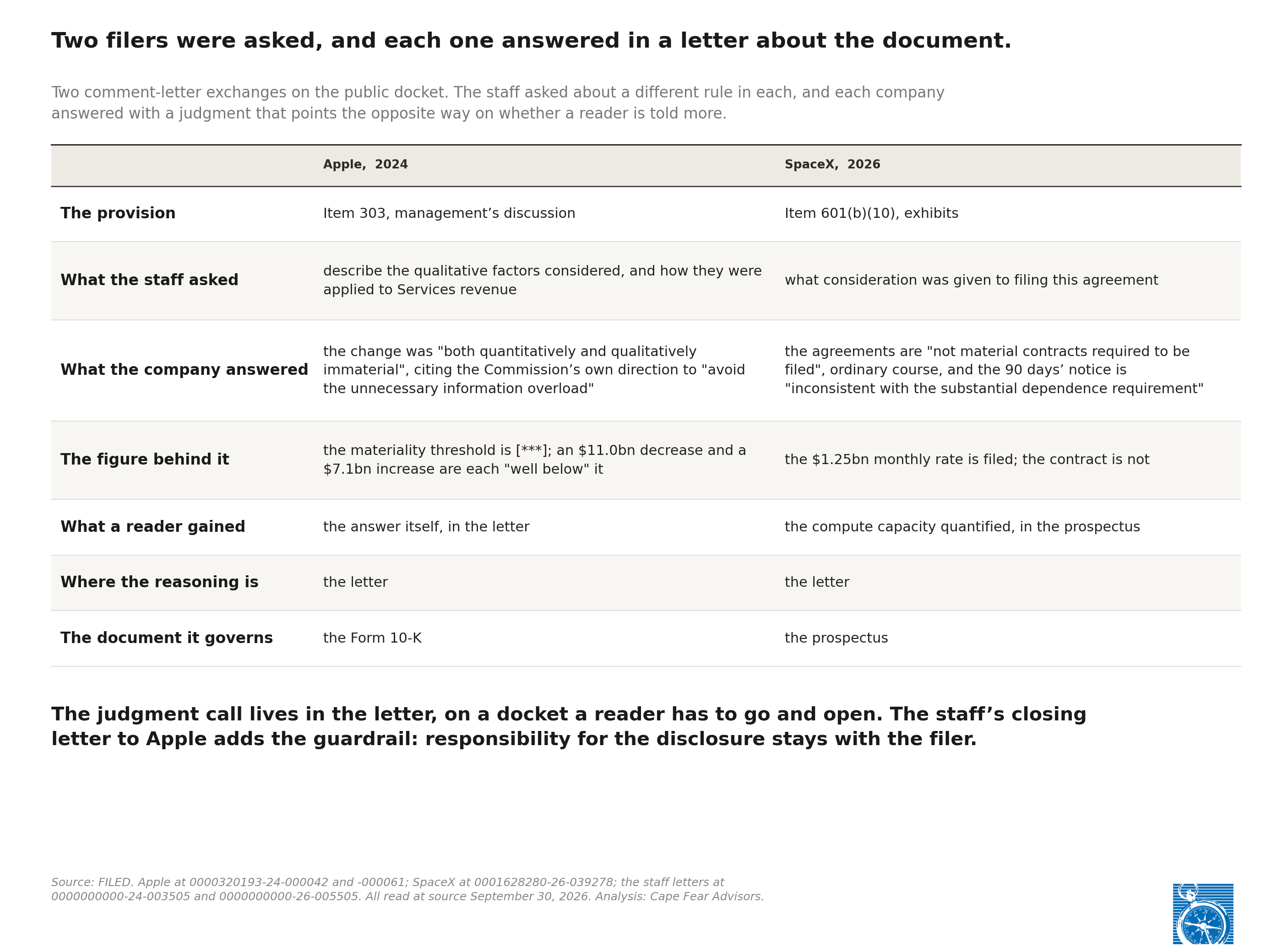
One guardrail belongs beside all of it, and it is the staff’s own sentence, closing the Apple review on May 16, 2024: “We remind you that the company and its management are responsible for the accuracy and adequacy of their disclosures, notwithstanding any review, comments, action or absence of action by the staff.” Responsibility for the disclosure stays with the filer, and a closed review leaves it there.
What a filer says about its own reasoning, and how rarely
Item 1.01 of Form 8-K requires a filer entering into a material definitive agreement outside the ordinary course to report it. The item’s text does not require the filer to say why it deemed the agreement material.
Akamai said it anyway, twice in one report, naming the item:
“The Company has determined that the Anthropic MSA is a material agreement within the meaning of Item 1.01 of Form 8-K because the Anthropic MSA is no longer immaterial in amount or significance to the Company.”
The same sentence appears for the Jabil agreement in the same filing.
Forty-six current reports across the frame of filers examined here carry Item 1.01 between January 1 and September 30, 2026. Every one was read. Two state a reason. The other is Applied Digital, on June 26, explaining that a revolver increase to $430.0 million “caused the Credit Agreement to become material to the Company and thereby requires disclosure under this Current Report on Form 8-K.” [All FILED; the count is ours.]
The phrase Akamai used is the rule’s own. Item 601(b)(10)(ii) says a contract in one of its listed categories “shall be filed except where immaterial in amount or significance.” Akamai took the words the exemption is written in and used them to say the exemption had stopped applying.
The rest of the frame reported the agreement and said nothing about why, which is ordinary and permitted.
The instrument, and whether a reader can open it
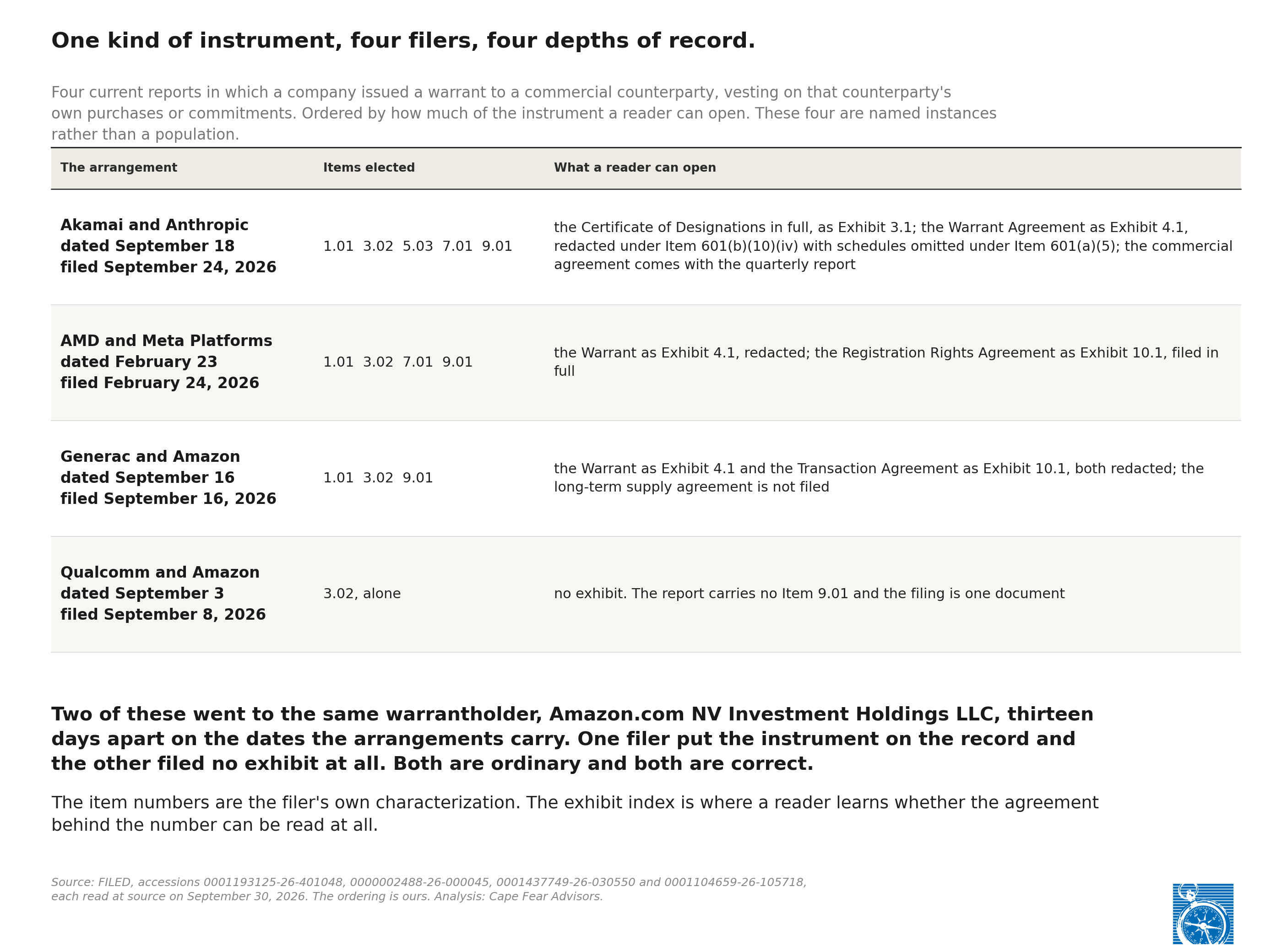
An item number is the filer’s own characterization. The exhibit index is where a reader learns whether the agreement behind the number can be read at all, and on one instrument class this year it runs from everything to nothing.
Four current reports issued a warrant to a commercial counterparty, vesting on that counterparty’s own purchases or commitments.
Akamai filed the Certificate of Designations in full as Exhibit 3.1, and the Warrant Agreement as Exhibit 4.1 with portions redacted under Item 601(b)(10)(iv) and schedules omitted under Item 601(a)(5). AMD, on February 24, filed its warrant to Meta Platforms as Exhibit 4.1, redacted, and the registration rights agreement behind it as Exhibit 10.1 in full. Generac, on September 16, filed its warrant to Amazon and the transaction agreement as Exhibits 4.1 and 10.1, both redacted, and the long-term supply agreement the warrant vests against is not filed. Qualcomm, on September 8, reported its own warrant to the same warrantholder, Amazon.com NV Investment Holdings LLC, under Item 3.02 alone. That report carries no Item 9.01, and the filing is a single document with no exhibit.
Thirteen days and one warrantholder separate two of those records. Qualcomm’s arrangement is dated September 3 and Generac’s September 16, both with Amazon.com NV Investment Holdings LLC, and one of them filed the warrant and the transaction agreement while the other filed no exhibit at all. Both are ordinary, both are correct, and a reader who wanted the instrument would find it in one case and not in the other.
And the case where the reasons for an item election are clearest sits a year outside the window counted here, which is the reason to name it rather than count it. Across thirty days in August and September 2025, Intel filed three current reports on three equity issuances to three counterparties. Two used Item 3.02 with Regulation FD. The middle one, on August 25, added Item 1.01 and filed the instrument itself: Exhibit 10.1, the Warrant and Common Stock Agreement with the United States Department of Commerce, dated August 22, 2025, carrying $8,869,800,000 of disbursements, with the form of warrant contained inside it as Exhibit 4.1. One filer, one month, three issuances, and the one a reader can open all the way down is the one whose counterparty was the federal government.
The characterization decides what a reader is told next
This is the part that pays a reader back later.
Form 8-K, Item 1.02, governs the termination of a material definitive agreement. It opens: “If a material definitive agreement which was not made in the ordinary course of business of the registrant and to which the registrant is a party is terminated otherwise than by expiration of the agreement on its stated termination date.” And the instruction to Item 1.01 supplies the test for both items: an agreement is outside the ordinary course “if it involves the subject matter identified in Item 601(b)(10)(ii)(A) - (D) of Regulation S-K.”
Those are the same four categories SpaceX walked in its June 1 letter. The letter was written to answer a question about an exhibit index, and it settles the treatment of a future termination at the same time.
Akamai treated its Anthropic agreement as a material definitive agreement under Item 1.01 and said so. SpaceX treated its Anthropic agreements as ordinary course and filed nothing. Both are correct on their own facts. The consequence is that if the same counterparty walked away from both, one filer would report it in a current report and the other would not.
What would still reach a reader is a quarterly filing: the discussion of results under Item 303, and, where a customer reaches ten percent of revenues, the concentration disclosure under ASC 280-10-50-42, which asks for the fact, the amount and the segment. That standard does not ask for the name.
One offering, two documents, one agreement
The clearest instance of all of this arrived in June, and it needs no census.
On June 5, 2026, SpaceX filed a free writing prospectus under Rule 433. It is 1,607 characters long and it exists to carry one thing:
“On June 5, 2026, we entered into a Cloud Service Agreement with Google LLC (”Google”) with respect to access to compute capacity. The compute capacity provided includes approximately 110,000 NVIDIA GPUs, CPUs, memory, and other related components. Pursuant to the agreement, the customer has agreed to pay us $920 million per month from October 2026 through June 2029, with capacity ramping up through September at a reduced fee. If we fail to deliver access to the committed amount of GPUs by September 30, 2026, then following a one-month grace period, Google may immediately terminate the agreement or accept the number of GPUs provided, with a corresponding pro rata reduction in the monthly fees. After December 31, 2026, the agreement may be terminated by either party upon 90 days’ notice.”
Thirty-three months at that rate is $30,360m. [OURS, on a filed rate.]
The final prospectus, filed seven days later and running to about 1.55 million characters, does not describe that agreement. Its business section on compute services names Anthropic and no one else. Its subsequent-events note names Anthropic and no one else. The monthly fee and the GPU count appear nowhere in it.
The fine print of the two agreements differs in a way no headline could show. Anthropic’s ninety-day notice runs after an initial three-month period. Google’s runs only after December 31, 2026, and in its place the first phase carries a delivery gate: a date, a one-month grace period, and a counterparty election between walking away and taking less at a lower price.
The counterparty is not a stranger to the filer. Google is an existing SpaceX equity investor, named in the prospectus as a party to the Amended and Restated Investors’ Rights Agreement of August 4, 2020, and the beneficial ownership table names no holder of five percent or more other than the founder. Both of those are filed. What the ordinary-course analysis would yield on an agreement with a counterparty in that position is a question we do not reach, because what a filer was required to file is not observable from outside.
Essential, and undetermined
The same offering carries the same split in the other direction, and this one has a third party in it who arrived because a regulator asked.
SpaceX’s confidential draft described its chip-manufacturing initiative as being “in partnership with Tesla.” Intel was absent from it. The staff’s first comment letter, April 24, 2026, put Intel in:
“On pages 6, 123, and elsewhere, you discuss TERAFAB, your announced chip manufacturing initiative in partnership with Tesla. Recent news articles have noted that you have also partnered with Intel on this project. To the extent material, please revise your disclosures to discuss the material terms of Intel’s partnership on this project. In addition, to the extent known, include a discussion regarding the anticipated timeline for development of your TERAFAB chip manufacturing initiative, including milestones and anticipated capital expenditure required.”
The final prospectus names Intel twenty-seven times.
Now take the same project to the two other partners’ own filings. Across the Commission’s full-text record the word appears in SpaceX’s registration family and its staff correspondence, once in an Intel exhibit, and in no Tesla filing at all. Intel’s one use is a single bullet in the business highlights of its first-quarter earnings release, furnished as an exhibit on April 23, 2026.
“Intel joined the Terafab project as a strategic partner alongside SpaceX, xAI, and Tesla. Intel’s ability to design, fabricate, and package ultra-high-performance chips at scale will help accelerate efforts to refactor silicon fab technology.”
Intel has filed nothing on the project since, including in the documents for a twenty-billion-dollar equity offering in August.
The same initiative reads three ways depending on which document is open. In a filed interview it is what the chief executive calls it:
“That’s why we need to do the TeraFab. Yeah, it seems like essential, otherwise there will not be enough chips.”
The same filed transcripts put the facility at around 100 million square feet, ten times the size of Tesla’s Texas plant.
In the prospectus it is a framework: “we have agreed with Tesla on a general framework for the future development of Terafab. Any specific projects undertaken pursuant to this framework will be subject to separate negotiations and agreements (including any development timelines, milestones and capital expenditures) and have not yet been determined.” That sentence is a staff product too; the second comment letter pressed the company to state it “to provide material context.”
And in the risk factors, which is where a reader who keeps going ends up, it is this:
“While we have a framework agreement with Tesla, neither Tesla nor Intel are obligated to remain a part of the project, and we may not enter into any such definitive agreements.”
Essential in the interview, undetermined in the prospectus, and in the fine print neither partner is obligated to stay. All three are in the same offering, filed within weeks of each other, and each is accurate about the document it sits in.
The free writing prospectus docket holds two kinds of gap. In one direction it carries an ambition the prospectus declines to commit to. In the other it carries an agreement the prospectus does not mention.
The amount and the name live in different notes
One more pair, and it is the shape this piece exists to name.
We read the landlord layer these instruments sit in here, and the agreement that follows is one of the documents behind it. Cipher Digital’s Amended and Restated Recognition Agreement is filed in full, signed by Cipher Barber Lake LLC, Fluidstack USA II Inc. and Google LLC on November 20, 2025. It names the party standing behind the tenant. Every one of its eight schedules reads [REDACTED], including Schedule B, “THE FLUIDSTACK LEASE,” Schedule F, “Financial Support Agreement,” and Schedule G, “Pledge Agreement.” Inside the body, “Baseline Capacity” means [REDACTED] MW of electrical power.
Alphabet’s quarterly report for the June 2026 quarter describes the same class of obligation from the other end: “agreements with certain third parties to backstop certain payment obligations related to data centers, which we account for as credit derivatives.” It gives the size. Maximum potential future payments under those credit derivatives are $43.8 billion. It names no counterparty.
One arrangement class, two filed documents, and each supplies exactly what the other withholds. The landlord’s exhibit gives a reader the name and stops at the number. The guarantor’s quarterly report gives the number and stops at the name. Neither filer did anything unusual. A disclosure about a specific instrument names the instrument; a disclosure about an aggregate reports the aggregate.
One figure shows the scale of what an aggregate can hold. In the same report, Alphabet’s gains on equity securities were $99,031m for the quarter, against income before taxes of $138,753m, which is 71.37 percent of it. The company attributes the gains “primarily” to unrealized gains from SpaceX “and a private company,” and gives no split between the two. [FILED; the percentage is ours.]
The same shape shows up where there is no AI at all
The temptation at this point is to conclude that something about this industry’s disclosure is unusual. The measurement says otherwise.
The same count ran on two control frames, on the identical method and the identical window: twenty pharmaceutical and biotechnology filers, chosen for collaboration agreements and milestone payments, and twenty-three oil, gas and liquefied natural gas filers, chosen because take-or-pay offtake is the closest filed analogue to a compute commitment. Neither frame carries any AI content.
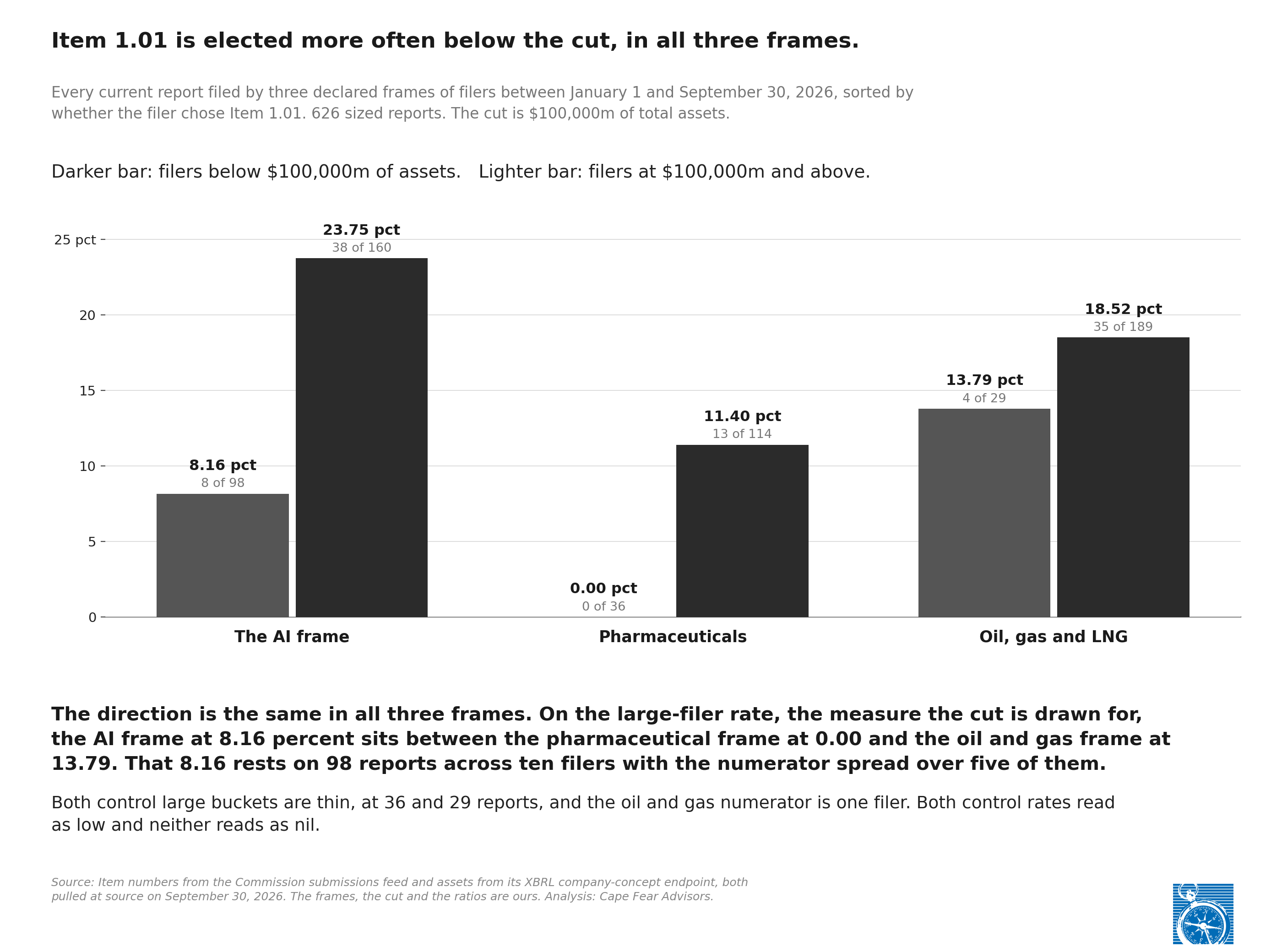
Two of the twenty pharmaceutical filers return no assets figure on the standard tag, so that frame’s bucket rows cover the eighteen that do, being 150 reports and 13 elections, while its item-mix row covers all twenty, being 172 reports and 15 elections. The 626 counts the sized reports, being 258, 150 and 218; the twenty-two unsized pharmaceutical reports bring the read population to 648. The other two frames are fully sized and every row in them runs over the same population.
Three frames, 626 sized current reports, one direction. Smaller filers elect Item 1.01 more often than larger ones in every frame measured. On the large-filer rate, the measure the cut is drawn for, the AI frame’s 8.16 percent sits between the pharmaceutical frame’s 0.00 and the oil and gas frame’s 13.79. On the rate below the cut it is the highest of the three, and on the ratio of the two rates it is 2.91 against oil and gas at 1.34, with the pharmaceutical ratio undefined because its large-filer rate is zero.
The cautions print with the figures. Both control large buckets are thin, at 36 and 29 reports, so both control rates read as low and neither reads as nil. Every one of the four Item 1.01 elections in the oil and gas large bucket belongs to a single filer. The AI frame’s 8.16 percent is the best supported figure in the table, resting on 98 reports across ten filers with the numerator spread over five of them.
The pattern is a property of how current reports get written. The buildout is being reported as exceptional and the disclosure practice around it is ordinary, which is why the questions in this piece work on a lease in Texas or a license in New Jersey.
Where to look, in any filing
The portable part. An announced figure is one party’s answer to one question; each row below is a different question, answered by a different document.
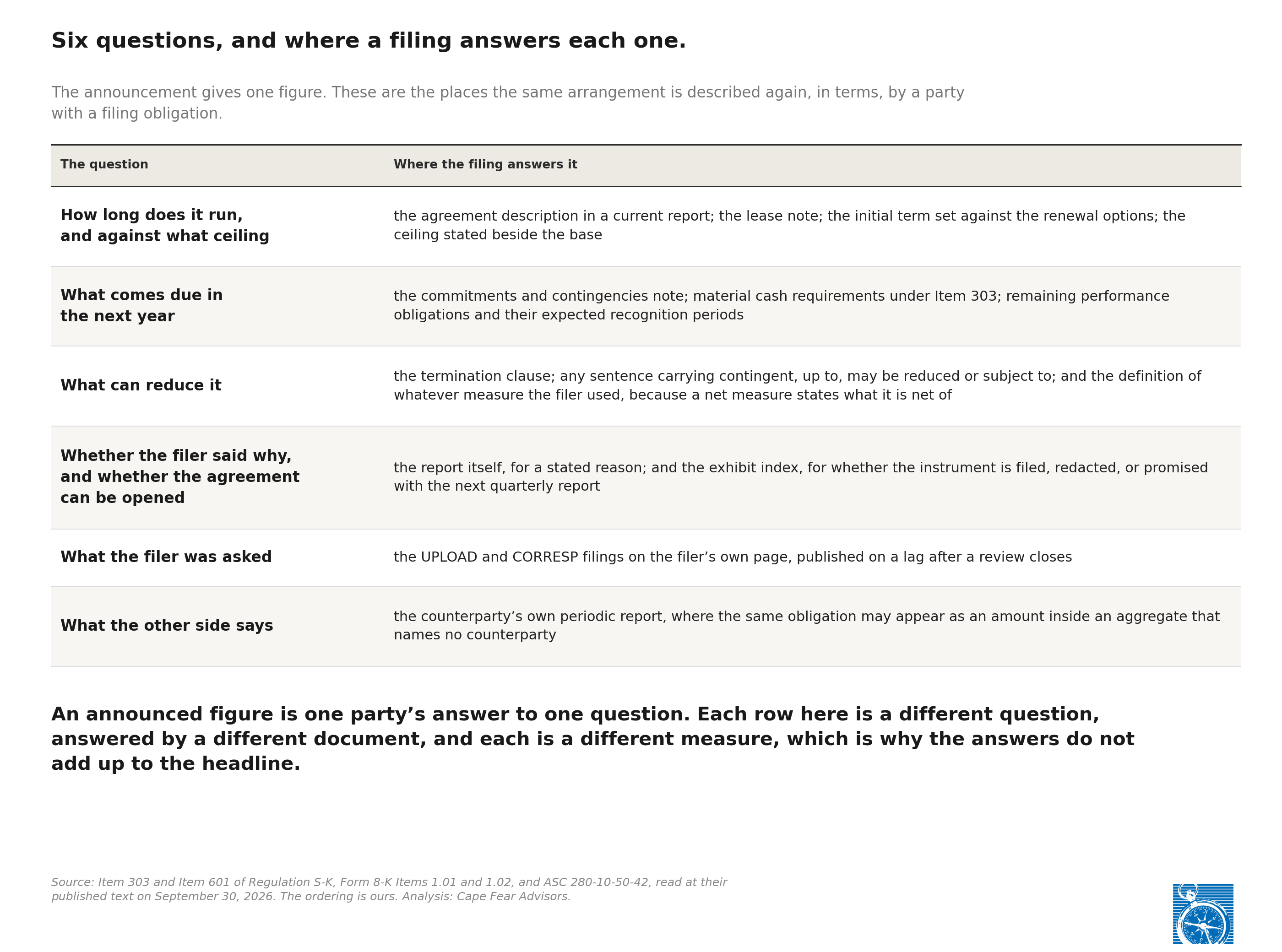
What a reader is left holding
Four questions, and each returns something a headline leaves out. How long does this run, and against what ceiling. What comes due in the next year. What can reduce it. And whether the filer said why it reported at all, and whether the agreement behind the number can be opened.
Each answer stays inside what the record supports. An announcement reports what was agreed and is accurate about that. A cancellable contract can run its full term and an uncancellable one can be renegotiated, so none of this settles whether an arrangement is a good one. And what a filer was required to disclose sits outside a reader’s reach, which is why we report characterizations and their consequences and leave the grading alone.
And the four questions will not all come back answered. Akamai’s service start dates are absent, so its near-term split cannot be struck. Apple’s materiality threshold is redacted, so the line its judgment turned on stays hidden. The SpaceX agreement behind the largest monthly figure above is not filed at all, and the Google agreement beside it appears in one document of an offering and no other. A reader can work every one of these and still come away holding questions instead of answers.
Two of those are worse than an unanswered question, and both are in here. An arrangement can sit inside an aggregate that names no counterparty, in which case a reader has no way to know a relationship exists and so no reason to ask about it. And a reader who gets all the way to an answer can look at it and judge it differently than the filer did; materiality is a judgment, the filer makes it first, and nothing about a filer making it forecloses anyone else from reaching the other conclusion on the same facts.
Which is the point of asking rather than adding. A reader who stops at the first figure has a lifetime total and one party’s framing of it. A reader who works the four questions has a near-term obligation, a cancellation horizon, a net measure, a filer’s own account of why it reported, and a specific list of what is still missing. That last item earns its place, because a question a reader can name is a question a reader can put to the company.
What we do not know
Which of the four SpaceX figures covers the same perimeter as the others, because the reported ceiling covers “agreements” in the plural and no filed document says how many there are or what each one is. Whether Anthropic’s own registration statement, when it arrives, describes the same arrangement in the same terms. What Akamai’s service start dates are, and therefore what the commitment comes to in the next twelve months. What share of Alphabet’s $43.8 billion of credit derivatives sits behind any building named anywhere. And whether the pattern in the three frames survives a fourth.
Three things would change the reading. A passage in the final prospectus stating any material term of the Google agreement: the counterparty, the monthly fee, the GPU count, the delivery gate or the notice date. Any one of those would retire the reading that the arrangement is described in one document of the offering and in no other. A registrant reporting a terminated ordinary-course agreement under Item 1.02, which would show the cross-reference was read too narrowly. And a fourth frame on the same method and window where large filers elect Item 1.01 more often than small ones.
Everything here stays free either way. Readers who find the work useful can support it at the foot of the page; payment offsets the time and buys no access. Corrections run in daylight, dated, in the next piece rather than quietly in this one, and a reader who finds one is doing the house a favor.
Standing Disclosure
Cape Fear Advisors holds no direct position, long or short, in the securities discussed here. Any exposure is indirect, through managed funds it does not control, which may now include index funds holding the public companies named.
Anthropic is the developer of Claude, which is used in preparing this research, and in this piece that nearness is at its closest: Anthropic is the counterparty in both of the arrangements the piece opens with, and one of the two documents behind the largest figure here is Anthropic’s own confidential prospectus, which no one outside the process can open and which this piece therefore carries as REPORTED and counts nowhere. That nearness cannot be checked away, which is why no claim here rests on trust in the tool: every figure carries a public source and the record grades the rest. Amazon and Alphabet are Anthropic’s two largest outside backers. Both are read here for their own filings, Amazon as the warrantholder in two of the four warrant reports and Alphabet for its quarterly report and its credit derivatives, and Alphabet’s subsidiary is the counterparty in the free writing prospectus and the named support party in the Cipher exhibit.
Akamai, Applied Digital, AMD, Generac, Qualcomm, Intel, Meta Platforms, CoreWeave, Cipher Digital, Tesla and Apple are read here for their own filed documents and for nothing else. Space Exploration Technologies is a registrant whose offering is the subject of several movements and whose correspondence is on the public docket. The twenty pharmaceutical and biotechnology filers and the twenty-three oil, gas and liquefied natural gas filers named in the notes enter this piece only as counted populations, and no reading of any individual one of them is offered.
Companies not named here may hold positions or supply relationships that bear on the filers discussed, which is why every piece is re-checked for bias, ground facts and filings rather than read against a fixed list.
Figures are quoted from the filers and from named parties without characterization, and the same standard of reading is applied to every party named. This piece states no view on whether any filer’s disclosure, characterization or item selection was correct or required, because what a filer was required to file is not observable from outside. Nothing here identifies an error, an inconsistency or a bad actor, and nothing here is advice about any security.
Notes
The rounding convention. Characterizations in words run away from the reading: about, nearly and roughly all point against our own reading. Printed ratios and percentages round conventionally and carry their numerator and denominator, so a reader reproduces them exactly. The Akamai ceiling is 20.6 over 11.6, or 1.78 times; Applied Digital’s renewal ratio is 86 over 36, or 2.39; the commitment against one year of revenue is 11,600 over 4,208, or 2.76; the warrant is 7,741,020 over 143,716,609, or 5.39 percent; and 35 of 189 is 18.52 percent. An earlier piece on this shelf, linked above, printed that warrant percentage as 5.38, floored under the convention in force then, for the same quotient. That piece stands as printed and the inputs are identical in both.
The reduced fee, and the band it puts the total in. The prospectus says capacity ramps “in May and June 2026 at a reduced fee” and gives no figure for it. The phrase appears four times and the only dollar figure standing within 500 characters of any of them is the $1.25 billion monthly rate itself, so the discount is unknown in size. What the record fixes is that the fee exists, the two months it covers, and its direction. May 2026 through May 2029 is thirty-seven months; thirty-five of them are at the stated rate, giving $43,750m, and thirty-seven at that rate would give $46,250m. The term total sits between the two, and only the discount separates them. The same construction makes the $3,750m a ceiling rather than a settled amount: it is ninety days at the highest rate the document states. Where those ninety days would fall is a separate question the record leaves open, because the initial three-month period’s own start date is unstated, which is the same absence that stops the Akamai near-term split from being struck.
The three frames, declared. A population claim is only as good as its stated membership.
The AI frame, 23 filers of which 22 return an assets figure: NVIDIA, Apple, Alphabet, Microsoft, Amazon, Meta, Broadcom, Intel, Oracle, Qualcomm, Equinix, Digital Realty, Nebius, CoreWeave, IREN, Galaxy Digital, TeraWulf, Applied Digital, Cipher Digital, Core Scientific, Akamai, SpaceX and AMD. Selected as filers carrying a disclosed compute, chip or data-center arrangement inside the buildout, across supply, hyperscale, neocloud and landlord layers, and declared before the sweep ran. Nebius is the one member returning no assets figure on the standard tag, and it returns no current report in the window either, so it sits in the frame list and in neither bucket.
The pharmaceutical and biotechnology frame, 20 filers of which 18 return an assets figure: Johnson & Johnson, Pfizer, Merck, AbbVie, Eli Lilly, Bristol-Myers Squibb, Amgen, Gilead, Vertex, Regeneron, Moderna, Alnylam, Exelixis, Ionis, Neurocrine, United Therapeutics, Halozyme, Arrowhead, Biogen and Incyte. Selected for collaboration agreements with milestone payments, equity issued to a counterparty alongside a license, and a wide size spread. Biogen and Incyte return neither Assets nor AssetsNet.
The oil, gas and liquefied natural gas frame, 23 filers, all sized: ExxonMobil, Chevron, ConocoPhillips, Occidental, EOG, SLB, Phillips 66, Marathon Petroleum, Valero, Williams, Kinder Morgan, ONEOK, Energy Transfer, Enterprise Products, Cheniere, Targa, Devon, Diamondback, Antero, Range, Chord, Matador and Magnolia. Selected because take-or-pay offtake is the closest filed analogue to a compute commitment, and because the size spread crosses the cut.
The cut, and why it holds. The $100,000m threshold was set before the control frames existed. A cut chosen after seeing one frame’s data would not be expected to hold its direction across two unrelated industries on the identical method and window, and it does. That is a robustness result the piece did not set out to produce.
The probes, with their hours. All times are Coordinated Universal Time on September 30, 2026 unless stated. Two probes below read the same document and print different character counts, 1,549,188 and 1,541,546, because each pass stripped the filing’s markup under a different rule. Both read the prospectus in full and the difference is in the extraction rather than in the corpus.
(1) The final prospectus does not describe the Google agreement. Corpus: SpaceX Form 424B4, accession 0001628280-26-042639, 1,549,188 characters, read in full. Instrument: term search on Google, 920 and 110,000, with the business section on compute services and the subsequent-events note read directly. Result: nine hits on 920, all share counts, repurchases or unrelated debt balances; four on 110,000, all COLOSSUS II cluster descriptions; no hit joins Google to a compute agreement. Re-run at 18:05 on September 30, 2026, at source, with the same result: nine hits on Google, two of them within 300 characters of compute language, being a competitor list and a director biography, and neither joins Google to an agreement. The filer’s own docket was walked at the same hour and carries one current report since the offering, dated August 14, 2026, which contains neither the word Google nor the word compute.
(2) No filed document gives a service start date for the Akamai Project Plans. Corpus: Akamai Form 8-K and exhibits, accession 0001193125-26-401048, read in full. Run 14:05.
(3) No filed document says whether the May commitment is Anthropic’s. Corpus: Akamai’s quarterly release, accession 0001086222-26-000054, and the September current report. Run 14:20.
(4) The June 2 staff letter returns to neither request. Corpus: SpaceX UPLOAD accession 0000000000-26-005581, read in full. Run 16:10.
(5) Two of forty-six Item 1.01 reports state a reason. Corpus: every current report carrying Item 1.01 filed by the AI frame between January 1 and September 30, 2026, being 46 reports, each identified by its own cover page and read in its 8-K body with exhibits excluded. Instrument: fourteen patterns covering no longer immaterial, has determined that, deems, because, material to the Company, abundance of caution, thereby requires disclosure, significance, voluntary, not required to file and crossed a threshold. Every body cached. Run 15:55.
(6) The four warrant reports. Corpus: current reports at accessions 0001193125-26-401048, 0000002488-26-000045, 0001437749-26-030550 and 0001104659-26-105718, each body and exhibit index read at source. Run 15:52.
(7) The Terafab record across filers. Corpus: the Commission’s full-text search for the term, all forms, January 1, 2025 to September 30, 2026, run at source. Result: SpaceX’s own registration family and staff correspondence; one Intel exhibit, being Exhibit 99.1 to accession 0000050863-26-000077 of April 23, 2026; one unrelated filer; and no Tesla filing. A filer-scoped re-run against Tesla’s own identifier returns zero and against Intel’s returns one. Run 16:30.
(8) The reduced fee is unquantified. Corpus: SpaceX Form 424B4, accession 0001628280-26-042639, 1,541,546 characters, read in full. Instrument: every occurrence of the phrase, with a scan for any dollar figure within 500 characters of each. Result: four occurrences, and the only dollar figure standing near any of them is the $1.25 billion monthly rate itself. Re-run at source 18:05.
(9) Item counts and asset figures. Source: the Commission’s submissions feed and its XBRL company-concept endpoint, both pulled 13:25, and the AI frame re-derived by a second independently written pass at 14:45 returning identical figures.
Sources. Akamai Technologies, current report and exhibits, accession 0001193125-26-401048, and quarterly release, accession 0001086222-26-000054. Space Exploration Technologies, final prospectus, accession 0001628280-26-042639; free writing prospectus of June 5, 2026, accession 0001628280-26-041150; free writing prospectus carrying the interview, accession 0001628280-26-041365; correspondence of June 1, 2026, accession 0001628280-26-039278; staff letters, accessions 0000000000-26-005505 and 0000000000-26-005581. Apple, correspondence, accessions 0000320193-24-000042 and 0000320193-24-000061; staff letters, accessions 0000000000-24-003505 and 0000000000-24-005673. Cipher Digital, amended and restated recognition agreement, accession 0000950103-25-015073. Alphabet, quarterly report, accession 0001652044-26-000071. Applied Digital, current report, accession 0001493152-26-030333. Meta Platforms and CoreWeave quarterly reports as cited. Form 8-K and Item 601 of Regulation S-K read at the Commission’s published text. The comment-letter trail as a readable object, and the counts that size it, are Olga Usvyatsky and Francine McKenna, “Post-mortem: The SEC’s pre-IPO comment letters to SpaceX,” Deep Quarry with The Dig, July 17, 2026.
Analysis: Cape Fear Advisors. Every quoted passage is FILED or FURNISHED at the accessions carried in the notes and was read at source between September 24 and September 30, 2026. Item counts are taken from the Commission’s submissions feed and asset figures from its XBRL company-concept endpoint, both pulled on September 30, 2026. The $84,500m figure is REPORTED from a document that is not on the public record and enters no count in this piece. Ratios, month counts, percentages of filed totals, the control-frame selections and the four questions are ours, and this piece makes no market call, no forecast and no valuation call.
This piece also appears on Substack. Cape Fear Advisors is an independent advisory firm based in Portsmouth, NH.
Contact Cape Fear Advisors