
The neoclouds rent computers by the hour to buyers whose own buildings are unfinished. Amazon has sold compute for twenty years, Microsoft and Google nearly as long, and the two that disclose it earn thirty-five to thirty-nine cents on the dollar. This industry sells it at a loss, on money whose newest dollar costs nine percent. The difference is which layer each of them owns, and the layer that pays is the one that takes four years to build. The documents say why it exists, why it prices the way it does, and who is paid before its owners are.
CoreWeave is one of them. Last quarter it took in $2,575m and lost $49m running the business, before it paid $640m of interest. In the same three months Amazon’s cloud segment earned 39.3 cents of operating profit on every dollar it billed, and Google’s earned 35.5.
The same service. A forty-one point gap before the interest and sixty-six after it. The question in the title is what the loss-making version is for.
The documents give two answers and they sit on opposite sides of the company. To the supplier whose chips have to move, it is a place to put them: NVIDIA paid $2,000m in cash for 22,935,780 shares in January. To the buyer whose building is unfinished, it is rented time: Amazon Web Services approached Entergy Mississippi for power in April 2023 and wanted it within about twenty months, against a forty-eight-month wait for transformers.
Both of those answers name a party that gets paid, and so does the rest of the chain. The lender is paid 9.12 percent against contracted receivables. The landlord building for this tenant borrowed at 9.875. The customer holds a fixed price and pays part of it in advance. What the owners of the business hold is whatever the machines fetch after all of them.
Both answers expire. The rented time ends when the building opens, and Amazon’s own buildings in Madison County started coming online in the summer of 2025, running Amazon’s own silicon.
Last week the company touched its capital structure three times in two days. It sold $3,700m of convertible notes to institutions, spent $498.8m of what it raised on a hedge against its own share price, and registered 35,000,000 more shares, 6.34 percent of the register, with four banks standing behind a collared forward. The prospectus gives one purpose as “migrating our enterprise credit profile toward investment grade.”
The two reasons this business exists both run on the buyer’s clock. The financing runs on its own.
The ladder
Six companies sold cloud infrastructure in the quarter ended June 30, 2026, and their filings put them in an order.
Amazon Web Services earned 39.3 cents of operating profit on the dollar. Google Cloud earned 35.5. DigitalOcean earned 10.4. Rackspace lost 4.9 at the consolidated line. CoreWeave lost 1.9 before interest and 26.7 after it, and Nebius lost 30.2. Microsoft reports its Intelligent Cloud segment annually instead of at this scale, and for the fiscal year it earned 41.3.
Adjusted earnings invert the order. Nebius reports an adjusted margin of 40.5 percent, 70.7 points above its operating margin, and CoreWeave reports 58.6, which is 60.5 above. None of the three largest sellers of cloud infrastructure discloses an adjusted earnings measure for its cloud segment.
Two of those six meet the test for a merchant seller of artificial-intelligence compute that files with the Commission: CoreWeave and Nebius. This piece reads the larger.
Rackspace reports both models inside one filer and labels them itself. Its Public Cloud segment is “a services-centric, capital-light model” selling managed services on Amazon, Microsoft and Google platforms. Its Private Cloud segment is “a technology-forward, capital-intensive model” serving customer environments hosted in its own data centers. Public Cloud passed 79.2 percent of its revenue through to those three platforms last quarter and earned 4.67 cents of segment profit per dollar billed, struck before corporate cost. Private Cloud earned 21.83 on the same basis.
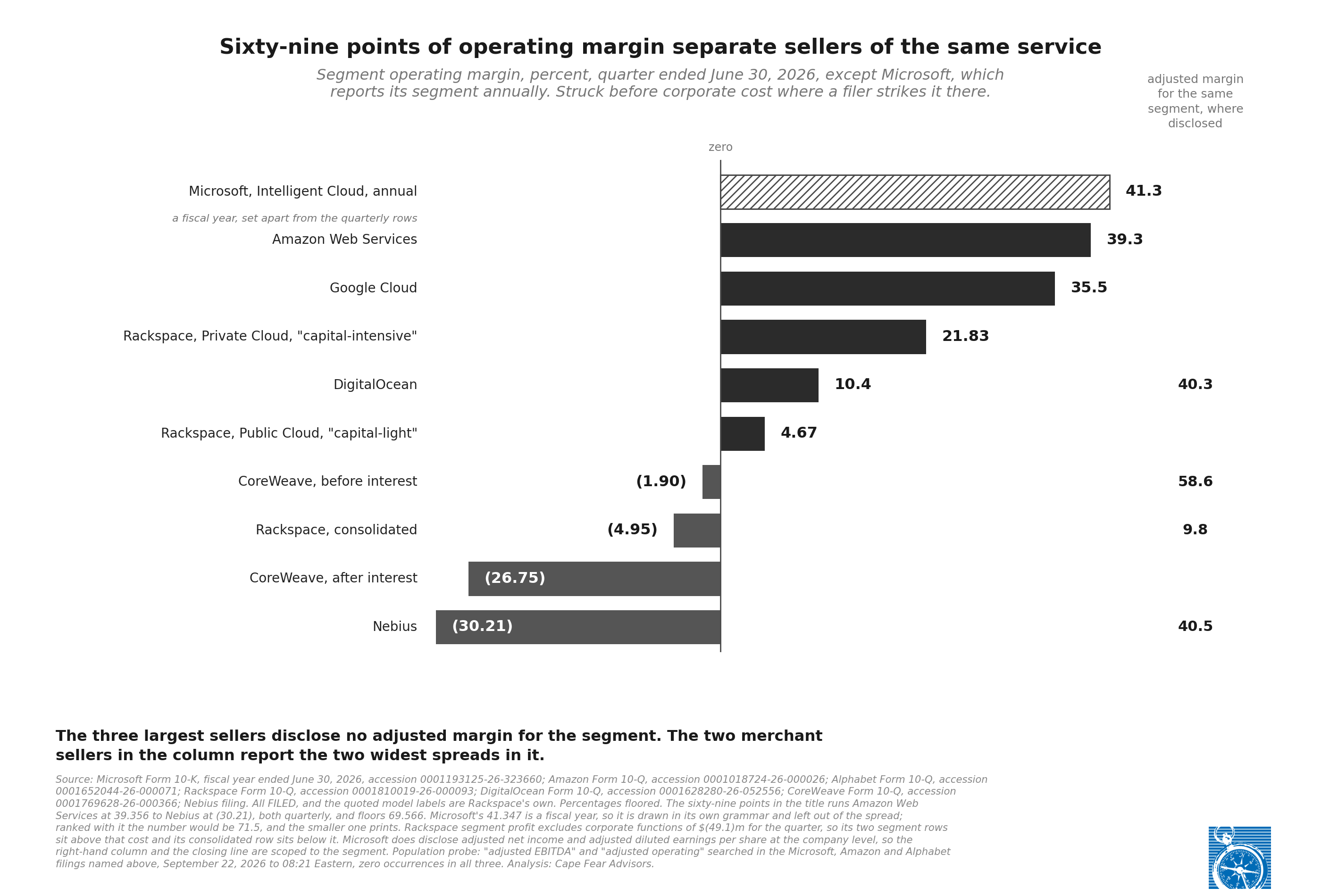
The ratio is 4.67 times, from 4.6757, in favor of owning the machines.
Size is the obvious alternative explanation and the ladder contains its control. DigitalOcean and Rackspace’s Public Cloud segment are filers of a similar order. The one that owns the machines under its service earns 10.4 and the one that rents every layer beneath it earns 4.67.
So the chain orders by who owns the layer beneath what they sell, and a layer is priced by its lead time.
Twenty months against forty-eight
In April 2023 Amazon Web Services approached Entergy Mississippi for power at two campuses in Madison County, wanting it within about twenty months.
The equipment that steps utility voltage down to a data center takes longer than that. Lead times for large power transformers ran to forty-eight months, which leaves twenty-eight months short. Mississippi legislated part of it away: Senate Bill 2001 created a class of data processing projects requiring at least $10bn of investment and 1,000 jobs, and it removed the certificate of public convenience and necessity, the competitive bidding requirement and the usual local notice. That took about twelve months out. Sixteen months of it stands.
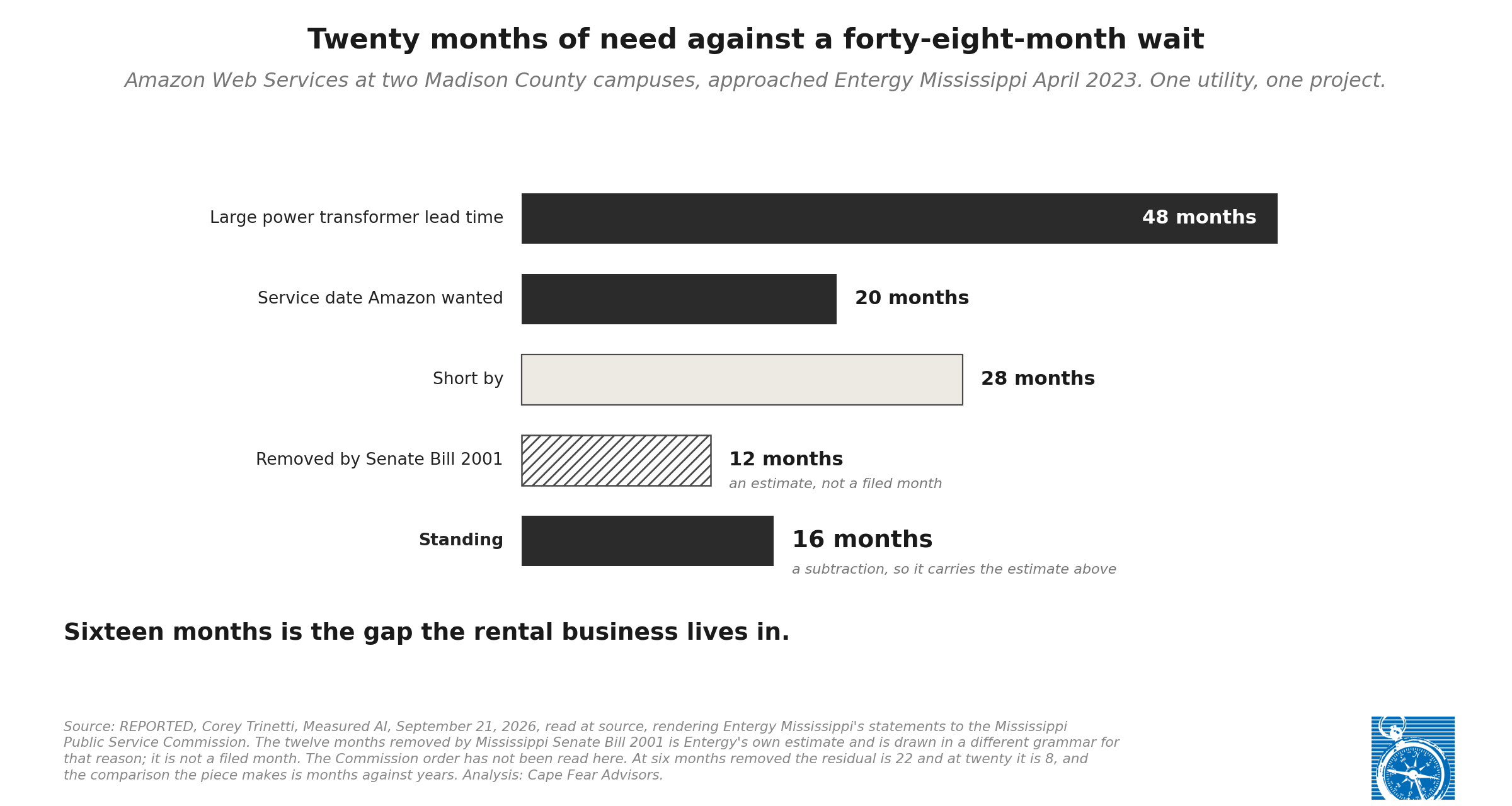
Sixteen months is the gap the rental business lives in. A buyer that has committed to a service date and holds a transformer order behind it has two options: wait, or rent from somebody whose building is already finished. The second option costs more per hour and it arrives on time.
The bill for the first option goes somewhere too. Entergy told the Commission that its Interim Facilities Rate Adjustment raised a typical residential bill by about $5.43 a month at the January 2026 step, or about $6.98 with related schedules. The Commission’s chairman, Chris Brown, described the rider as “for now, the one instance in which ratepayers were subsidizing the large customer.” Entergy’s answer runs in the same docket: Amazon revenue fully offset what would otherwise have been a $36m rate increase, and 2030 rates sit about 16 percent below where they would without the load, on a benefit today of under a dollar a month. The rider is charged now and the offset accrues later.
A regulated competitor for the same compute contract is financed at an allowed return, with recovery beginning before the asset serves anyone, from a customer class that holds no vote. A merchant operator at 9.12 percent bids against that.
The middle rung exists because two clocks disagree, and the disagreement has a measured length.
Losing money at the peak
A supplier that exists because a market is short ought to be earning while the shortage lasts, the way a high-cost semiconductor fab does, and leaving when it ends. This one loses money at the peak, and the documents carry three reasons.
The first is where the company came from. Its own risk factors state that it was founded in September 2017, launched its cloud platform in 2020, and that before 2022 most of its revenue came from “past crypto mining offerings, which were discontinued.” A fleet whose alternative use was an idle rig will accept a price that leaves a fleet financed at nine percent short, and the same filing discloses “limited experience with respect to determining the optimal prices for our platform.”
The second is that a seller who contracts forward at a fixed price has handed the scarcity to the buyer, which is what the buyer was paying for. The third is that the high-cost fab can idle a line, where this one carries a schedule that amortizes whatever the market does. The gap that created the role runs sixteen months and the newest money financing it runs seventy-eight.
The market does pay for the other posture. Uncontracted capacity fetched $2.75 in September against $2.35 on one-year contracts, a seventeen percent premium, and the credit agreement prices the two states differently. The contracted book is what made the debt raisable, and it is what gave the scarcity away.
Where the margin goes
CoreWeave billed $2,575m in the June quarter and lost $49m on operations. The money departs at the financing line, and the company priced its own money twice this year.
In July it repriced a secured term loan. Talk was SOFR plus 425 to 450 and the loan printed at SOFR plus 550, at 97 against 99 at launch, a yield near 9.1 percent. The filed credit agreement carries a marginal secured rate of 9.12 percent. Nine weeks later it sold $3,700m of convertible notes at a coupon of 2.875 percent.
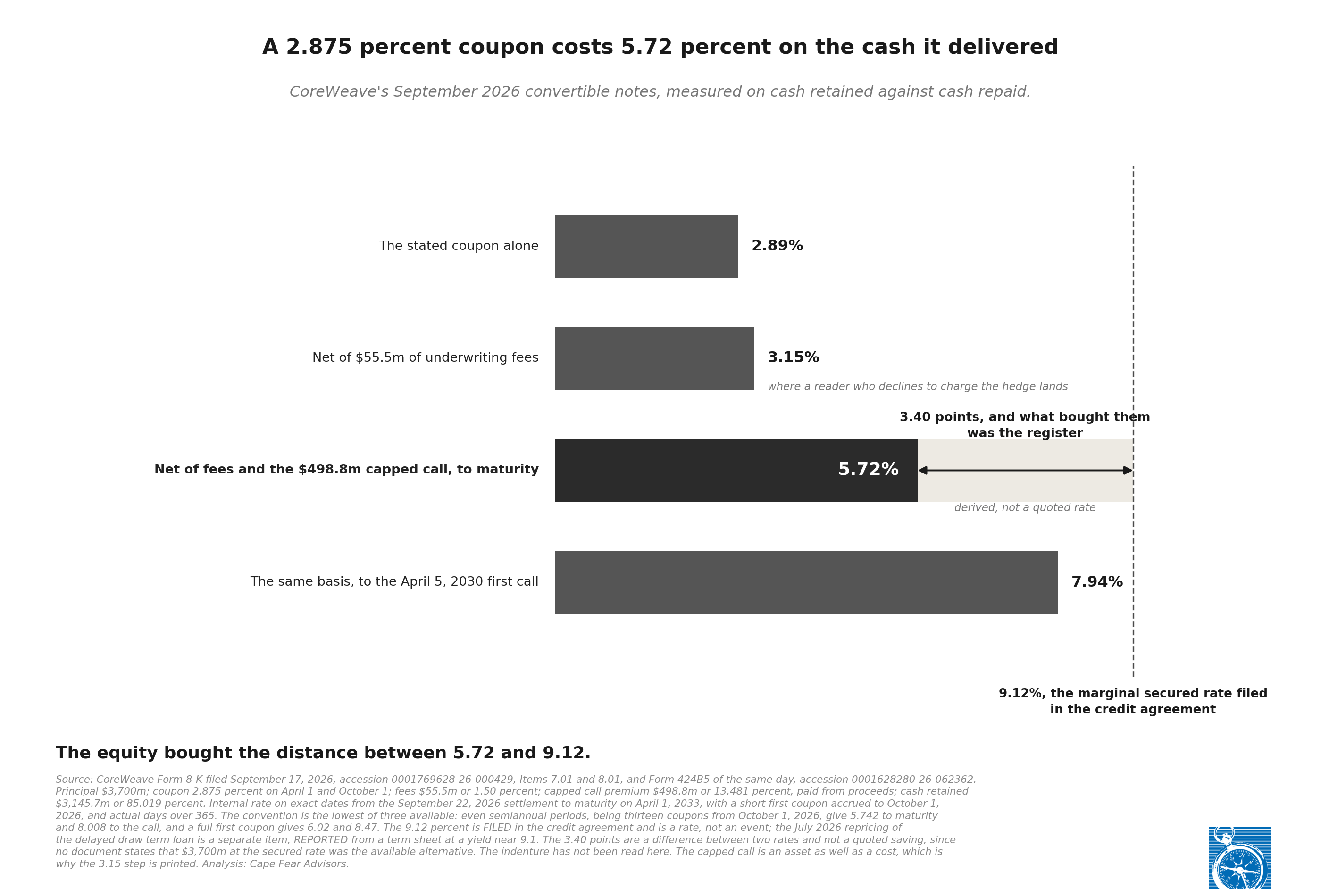
The second figure is the printed one and the first is the one the company pays. Underwriting fees took $55.5m. A capped call on its own shares took $498.8m more, paid out of the proceeds. CoreWeave kept $3,145.7m of the $3,700m, owes coupons on all of it, and repays the principal in April 2033. Measured on the cash that reached the balance sheet, the notes cost 5.72 percent, about twice the coupon they carry.
The $498.8m went to the share count and left the principal where it was. A capped call buys options on the issuer’s own shares, so it narrows what gets delivered on conversion while the $3,700m stands. The interest saved against the filed marginal secured rate comes to $231.1m a year, and what purchased that was the register: a conversion option on 37,811,780 shares, 6.85 percent of the company, with $498.8m of paid-in capital then spent buying back a strip of the same option. The saving reaches the income statement and its price sits in equity.
The company presents its own version. An offering presentation furnished with the September 17 filing carries a chart titled “Continued Progress in Driving Down Cost of Debt,” showing a weighted average interest rate falling from 14.9 percent in fiscal 2023 to 8.3 at the June quarter and 7.8 pro forma. The footnote to the last column prices a $3.5bn convertible issuance at 2.625 percent and states that the pro forma “does not include DDTL 5.5,” which is the facility repriced in July at about 9.1 percent. The notes printed at $3.7bn and 2.875 percent. An average tells a reader what the stack costs and a marginal rate tells a reader what the next dollar costs.
A lender advancing against contracted receivables prices the contract and not the machine. The revenue is fixed by that contract for its term, so the return the lender requires comes out of a fixed number, and the operator keeps the residual. That residual is a claim on the layer beneath the asset, which the operator rents.
The buffer and the replacement
A company that prices at the margin of a short market carries the scarcity in its price. Scarcity ends by design, because capacity responds to it. When capacity catches up, the marginal supplier’s price moves first, since marginal supply is what a buyer stops needing first.
Until it moves, signed contracts hold the realized price. And the counterparties holding most of the book are the parties building the replacement.
A contract holds the price against a fall and holds it against a rise as well, and the rise is what happened. One-year H100 rates bottomed at $1.70 in October 2025, reached $2.35 by March, and the spot composite settled at $2.75 on September 14, all of it after the book was written. CoreWeave reported prices rising on three chip generations in the June quarter, and its own presentation puts an increase of about 25 percent across product lines in July. The same book that buffers a future decline has been a drag on the increase that already arrived.
The book’s length is the buffer, and it is shortening. CoreWeave’s weighted average remaining term on performance obligations came in from 84 months to 78 across the reported series, on a book that grew 70.8 percent. The offering presentation furnished last week puts the contracts signed in the third quarter at three to six months. The average tail runs six and a half years and the newest paper runs a quarter or two.
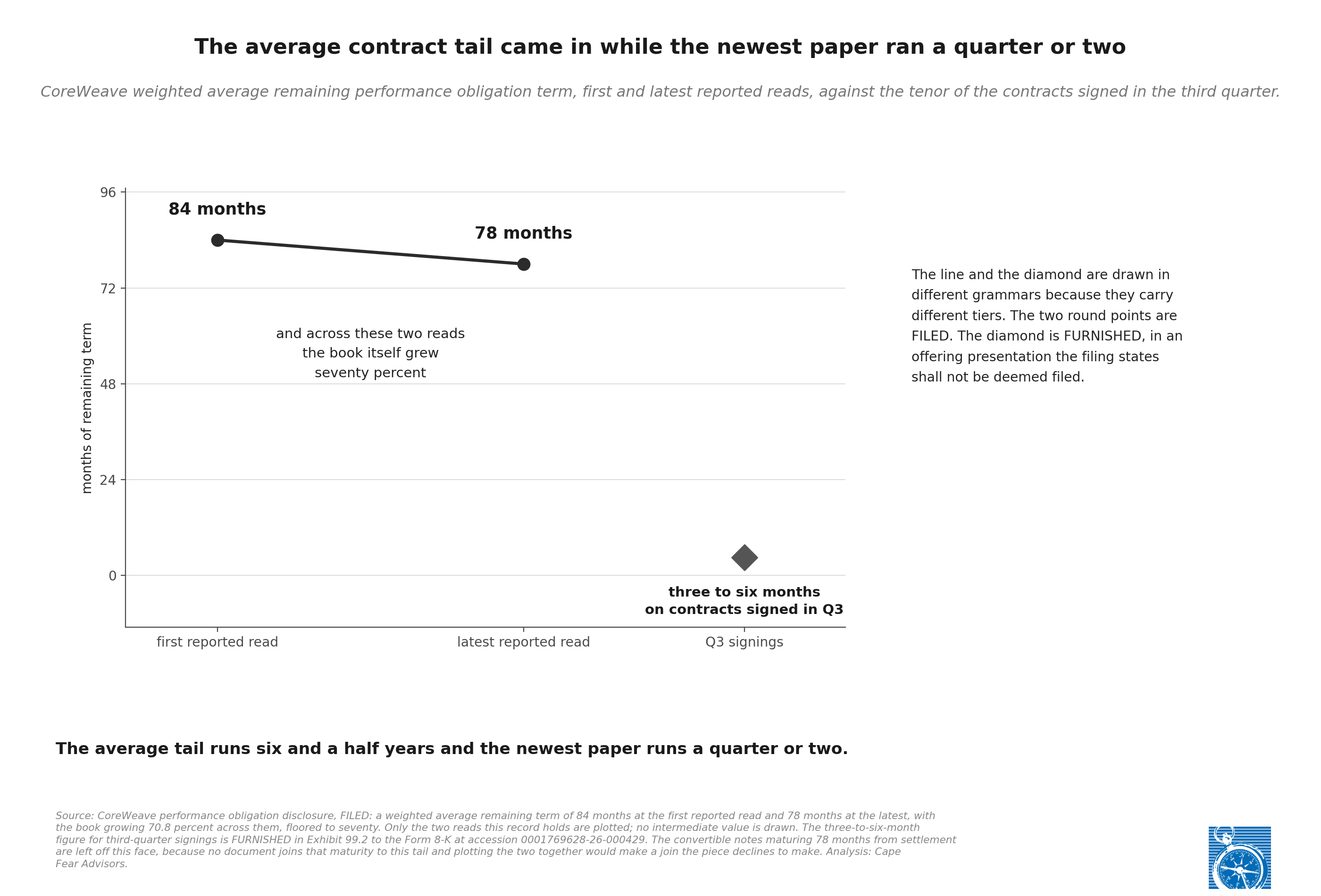
The money matches the tail almost exactly. The notes sold last week mature on April 1, 2033, which is 78 months from settlement, and they are non-callable before April 5, 2030. A landlord financing a single-tenant building for this operator has been reported taking a fifteen-year lease against it. No document joins the two seventy-eight-month figures, and this piece declines to join them.
Concentration moved and stayed concentrated. At December 31, 2025 one customer held 68 percent of accounts receivable; at March 31, 2026 three customers held 39, 17 and 22, being 78 percent across three names.
Three kinds of substitute
This business fills two roles. It rents computers to buyers whose own buildings are unfinished, and it takes delivery of chips the supplier needs to place. A substitute can end either role or both, and the record holds an instance of each.
The first kind is a buyer that builds its own buildings and fills them with the same supplier’s silicon. The chips still move, so the off-take role survives and the rental role ends. SpaceX described bringing online closer to ten gigawatts of compute than five by the end of 2027.
The second kind is a buyer that builds its own buildings and fills them with its own silicon, which ends both roles at once. Amazon’s Project Rainier runs on Trainium2, in the buildings Amazon asked Entergy Mississippi to power.
The third kind bypasses the middle rung entirely. A compute customer that designs its own accelerator ends the off-take role from the other end. Anthropic runs on Google’s tensor processors, OpenAI has its own program, and Meta has MTIA.
The substitution has reached the financing market too, in a different shape. TeraWulf, Cipher and Hut 8 have each leased capacity to Fluidstack against a Google backstop, and each filed it. A landlord that can price a lease against the credit of the party at the end of the chain has no reason to price it against the middle.
Gigawatts and dollars measure different things, and the artificial-intelligence share of hyperscaler capital spending is undisclosed at all four of the largest filers, so the scale claim here is the filed one. Those four companies spent $510.6bn on their own property and equipment in the twelve months to June 30, 2026, against a merchant debt stack of about $35bn. About fourteen times, and the two figures differ in kind in the comparison’s favor: one year of the buyers’ spending against a balance the merchant tier assembled over its whole life.
Demand is the reason all of this is being built, the buyers keep committing, and CoreWeave’s own reported backlog stands at $104.2bn with more than $25bn of new commitments added after the quarter closed.
The case for the shortage holding
One thing defeats the argument above, and it is the consensus view instead of a fringe one: the shortage holds. Power queues, transformer lead times and turbine slots bind the supply side for years past the chip cycle, and while the market stays short the marginal supplier keeps pricing at the margin. Extended at the slope of the last five months, the market reaches the $3.57 an hour this machine has to earn in about six and a half months. A one-year rate through $3.57, with CoreWeave’s own realized rate following it inside two reported quarters, would retire the requirement argument. Everything visible today runs that way: the rental rates are rising, the price increase went through in July, and the backlog keeps growing.
The shortage case sets the date and leaves the position. Amazon Web Services earned 39.3 cents on the dollar last quarter and Google Cloud 35.5, and those figures are struck after paying for whatever capacity they take from others. At the prices on offer renting is affordable to them, and a shortage that holds keeps it affordable for longer. What a shortage leaves untouched is which party absorbs the difference between a required price and a realized one. The party making the concession is the one selling.
A merchant operator that has to earn $3.57 an hour and realizes something near a market at $2.35 to $2.75 carries the difference itself. On the published figures the machines in service throw off cash equal to 8.968 percent of the money in them against newest money at 9.12, and once principal repayment is added back the payments run two to five billion dollars a year past what the machines bring in. That band is the cost of holding the position, and the position is a claim on what the equipment fetches after the books have written it off.
The self-sufficiency target
This business supplies capital to a build-out that wanted capacity sooner than the buyers could build it. In the first half of 2026 it raised $16,747m of debt and $2,982m of equity, and spent $14,117m on property, equipment and software, six times the EBITDA the half produced. That is capital reaching construction, and the ecosystem has that capacity because this company borrowed for it. For every dollar operations produced, nearly four dollars of new outside capital came in behind it.
A business funds itself when what it earns covers what it owes. Three things are owed here: the principal coming due, the equipment wearing out, and the stock handed to employees. One statement carries all four figures. Repayments of debt were $5,219m for the half, depreciation $2,540m, stock compensation $318m. Operations produced $3,663m against $8,077m of the three. Forty-five cents on the dollar, and operations covered seven tenths of the principal repayment by itself. Principal can be refinanced, which is the point of the test: it asks when new borrowing stops being necessary.
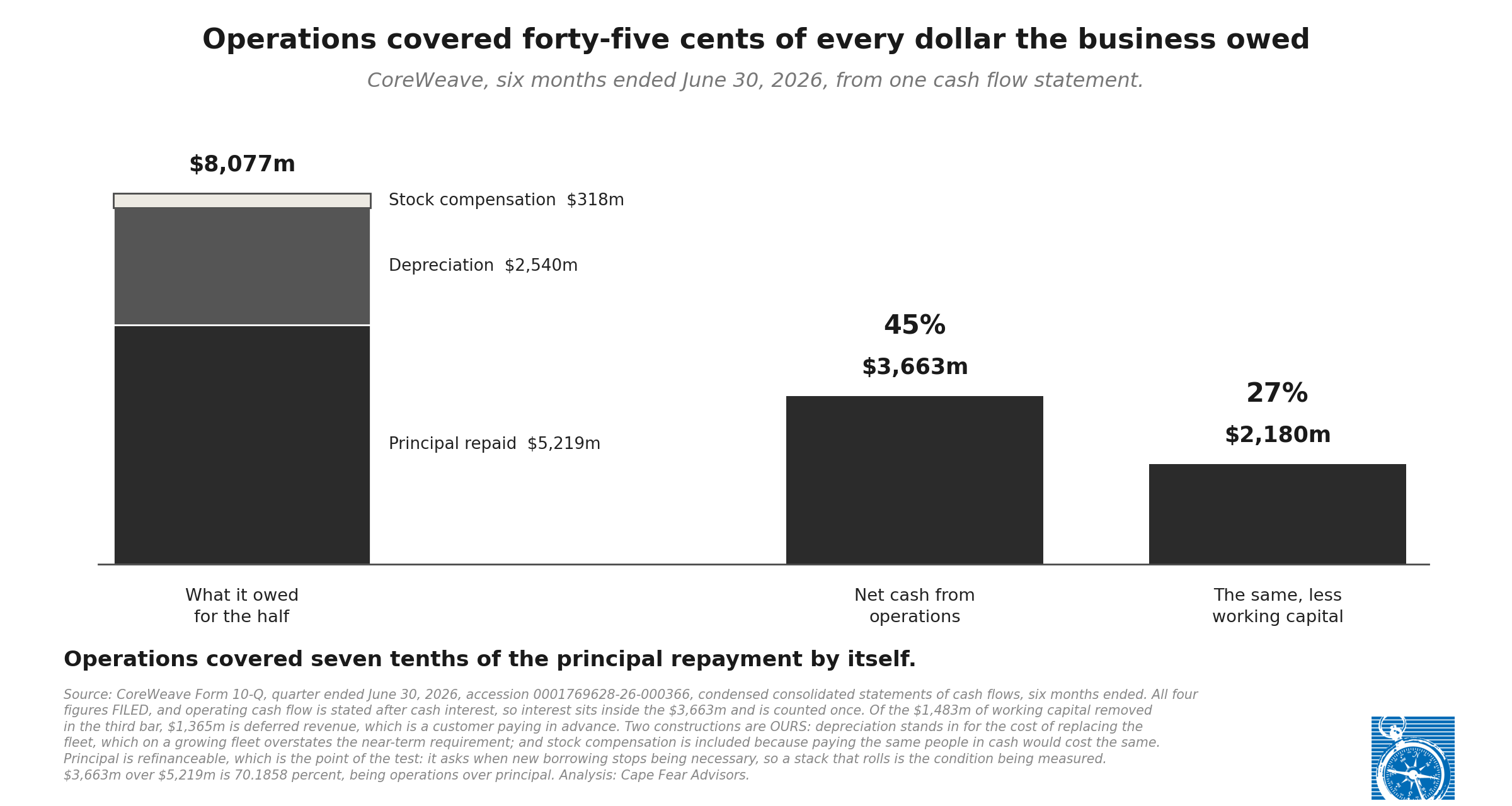
Part of what came in was the customers’ money. Of the $3,663m, $1,483m is working capital and $1,365m of that is deferred revenue, which is a customer paying in advance. Strip it out and the earnings side of the test falls to $2,180m.
And the customer paying in advance is the party building the replacement. About seventy percent of the contracts signed in the June quarter carried prepayment, and a handful of names hold the receivables. So part of what carries this position is advanced by the counterparties whose own buildings end the need for it.
Two of the three items are settled. Depreciation follows from the capital spent and interest from the rate paid, and both were fixed when the money was raised. What management still holds is the operating line, $1,231m in the June quarter against $2,033m of depreciation and interest.
Power sits inside that line, and power has no scale curve. A bigger load buys a negotiating position and meets a rising supply price at the same time. The company’s own risk factors say the grids in its markets “have faced substantial increases in demand for power,” and that alternatives may fail on “lack of supply or high cost per unit of electricity.” A cost metered by the unit stays metered at any size.
Two things run the company’s way. The fleet is still arriving: of $52,622m of gross property and equipment at June 30, $11,918m is construction in progress, so 22.6 percent of the asset base has yet to earn a dollar while the money behind it already costs. And price is moving. Closing the June quarter’s pre-tax gap takes 21.9 percent on revenue, and the company says it raised prices about 25 percent across product lines in July. The increase is larger than the gap. What it needs is the buyer’s agreement, and the buyer is the party building the replacement.
Meanwhile the equity is paying to lower the cost of the debt. The half’s cash flow statement carries $(492)m for capped calls on the earlier convertible, and September added $498.8m, against $2,982m of equity raised in the same half. Across three issues the hedges come to $1,330.8m on $10,288m of principal, or 12.9 percent, against a typical cost of 7 to 9 percent in Olga Usvyatsky’s benchmark work.
So the clock this company controls is how long the borrowing stays available on terms it can carry. Last week it went to the market three times in two days. In July a lender repriced the same question and replaced a balloon with scheduled amortization. The thing to watch is the next time this has to be paid for.
The layer underneath
Selling services in place of hours leaves the problem standing. Rackspace runs both models and its capital-light segment earns 4.67 cents against 21.83. The escape is owning the layer beneath the service being sold, and the layer that pays is the one with the lead time.
Core Scientific earns 58.5 cents on colocation, which is 83.2 percent of its revenue. That figure is a gross margin instead of an operating one, so it sits above the ladder’s measure and stands apart from it. Colocation is the layer that waits forty-eight months for a transformer, and its landlords finance it against the credit of whoever signed the lease. Among data center notes maturing in 2031, the filed coupons run from 6.000 percent on Cipher’s paper to 9.875 percent on the issue secured by a CoreWeave lease, with Applied Digital’s 7.000 percent in between. CoreWeave owns the chips, which can be replaced in months, and rents the building, which takes four years to build. Capacity responds fastest where it can be added fastest, so price competition arrives there first and margin leaves there first. That reading is this piece’s own and no filing states it.
CoreWeave has bought its way toward the other layer. It paid $1,029m for Weights & Biases in May 2025, 90.2 percent of it in stock, and $348m in aggregate for acquisitions the filing calls individually immaterial, $167m of that in convertible promissory notes. Goodwill went from $20m to $1,101m in one year and intangible assets from $5m to $235m. The move up the stack was bought substantially with paper, the currency the rest of this story is denominated in.
And the door is narrowing. Rackspace’s capital-intensive segment lost 2.79 points of margin year over year while its capital-light segment gained 0.78. This month one nuclear supplier to the data center industry paused its offering indefinitely, citing uncertainty in data center development, and two other companies tied to the sector slowed theirs; the only two listed companies focused solely on building data centers are down 1 to 2 percent across those weeks. The market that funds owning the layer underneath is where the skepticism landed.
What I do not know
What a six-year-old accelerator fetches, whether the crossover arrives next year or in four, what the artificial-intelligence share of hyperscaler capital spending is, and whether the two to five billion a year stays fundable and on what terms.
Four things would change the reading, and they have one thing in common: each is a condition under which something reaches the residual. A one-year rental rate through $3.57 with realized rates following. A performance-obligation tail that lengthens for two quarters instead of shortening. A merchant operator that reports an operating profit. And a financing that lowers the cost of carry instead of extending it.
Free to read, no paywall. Readers who find the work useful can support it at the foot of the page; payment offsets the time and buys no access.
Standing Disclosure
Cape Fear Advisors holds no direct position, long or short, in the securities discussed here. Any exposure is indirect, through managed funds it does not control, which may now include index funds holding the public companies named.
Anthropic is the developer of Claude, which is used in preparing this research, and Anthropic is also a compute counterparty inside the arrangements this piece reads: it is the customer at the Project Rainier site named above, it is one of the labs running on an accelerator its own supplier did not sell it, and a source read for the closing movement names Anthropic’s own offering. That nearness cannot be checked away, which is why no claim here rests on trust in the tool: every figure carries a public source and the record grades the rest. Amazon and Alphabet are Anthropic’s two largest outside backers, and both are read in this piece for their own filed margins.
NVIDIA supplies the equipment this business rents out and paid $2,000m in cash for 22,935,780 of its shares in January 2026. Amazon, Alphabet and Microsoft are read here for their own segment disclosures and are buyers of rented capacity in the same market. Core Scientific, Applied Digital, Galaxy Digital and Blockfusion appear as colocation providers or landlords with ties to the filer at the center. Nebius, DigitalOcean and Rackspace are read for their own filings and for nothing else.
Companies not named here may hold positions or supply relationships that bear on the filers discussed, which is why every piece is re-checked for bias, ground facts and filings rather than read against a fixed list.
Figures are quoted from the filers and from named parties without characterization, and the same standard of reading is applied to every party named. Nothing here identifies an error, an inconsistency or a bad actor, and nothing here is advice about any security.
Notes
Conventions, stated once and applied throughout. Percentages are floored in the direction that costs this piece’s argument, and the unrounded value is given wherever the printed one differs. Disclosure tiers: FILED with the Commission, FURNISHED and expressly not deemed filed, ANNOUNCED by a party, REPORTED by a named third party, and OURS where the reading is this piece’s own construction. The convertible’s internal rates run on exact dates from settlement with a short first coupon, which is the lower of the conventions available.
The margin ladder. Quarter ended June 30, 2026. CoreWeave Form 10-Q, accession 0001769628-26-000366: revenue $2,575m, operating loss $(49)m, interest expense net $(640)m, giving (1.9029) percent before interest and (26.757) after. Amazon Web Services $16,621m on $42,232m, 39.356 percent, accession 0001018724-26-000026. Google Cloud $8,814m on $24,768m, 35.586 percent, accession 0001652044-26-000071. DigitalOcean $29,371 on $281,184, 10.445 percent, accession 0001628280-26-052556. Rackspace consolidated $(33.2)m on $670.1m, (4.95) percent, accession 0001810019-26-000093. Nebius (30.21) percent. Microsoft Intelligent Cloud 41.347 percent for the fiscal year ended June 30, 2026, Form 10-K accession 0001193125-26-323660, which is an annual segment figure and is reported separately here instead of ranked against five quarterly ones. The gaps of 41.26 and 66.11 points print as forty-one and sixty-six.
The adjusted measures. PROBE, run at source September 21, 2026: “adjusted EBITDA” returns zero occurrences in the Microsoft 10-K, the Amazon 10-Q and the Alphabet 10-Q above, and “adjusted operating” returns zero in all three. Microsoft discloses adjusted net income and adjusted diluted earnings per share at the company level, excluding gains and losses on investments, which is why the body’s sentence is scoped to the cloud segment. Amazon’s non-GAAP measures are free cash flow and the effect of foreign exchange rates. Alphabet returns no occurrence of “non-GAAP.” Behind CoreWeave’s 58.6: adjusted earnings of $1,510m less operating income of $(49)m is $1,559m of add-backs, 60.5437 percent of revenue.
Rackspace’s two models. Form 10-Q accession 0001810019-26-000093, segment note. Public Cloud revenue $406.8m, third-party infrastructure $(322.3)m being 79.2 percent, segment operating profit $19.0m being 4.67 percent. Private Cloud revenue $263.3m, cost of revenue $(178.3)m, segment operating profit $57.5m being 21.83 percent. The ratio is 4.6757. Basis label: segment operating profit excludes corporate functions of $(49.1)m for the quarter, so both figures sit above about $109m of unallocated cost and stand one line short of operating income. The year-over-year segment movements of 2.79 points and 0.78 are from the same note.
The two-name tier. The inclusion test is a merchant seller of artificial-intelligence compute, operating its own fleet, filing with the Commission. Seven candidates were tested and five ruled out. Revenue-weighted spread across the tier is 62.4 points and unweighted 65.7, and Nebius carries the wider spread of the two, which corrects against this piece’s argument.
NVIDIA’s purchase. $2,000,000,000 divided by 22,935,780 shares is $87.199999, so a reader dividing gets $87.20 and the stated $2 billion is rounded down by sixteen dollars.
Twenty months against forty-eight. Lead times for large power transformers of up to forty-eight months against a requested service date about twenty months out: twenty-eight months short, about twelve removed by Mississippi Senate Bill 2001, sixteen standing. Same source as the rider below.
The Mississippi rider. REPORTED, Corey Trinetti, “Amazon’s Mississippi Data Centers: Canton, Ridgeland and the 2.2 GW Build,” Measured AI, September 21, 2026, read at source, which renders Entergy’s statements to the Mississippi Public Service Commission and the chairman’s characterization. The Interim Facilities Rate Adjustment began appearing on bills in July 2024 at about $1.27 a month for a residential customer at 1,000 kWh, stepped in January 2025 and again in January 2026 to about $5.43, or about $6.98 with related schedules. Entergy’s case on the other side, in full: the utility told the Commission in March 2026 that Amazon revenue fully offset what would otherwise have been a $36m rate increase, said in August 2026 that data center revenue was a major reason customers avoided a summer increase, and in June 2026 put 2030 rates about 16 percent below where they would otherwise sit, while conceding that today’s benefit is under a dollar a month. A higher third-party estimate exists, an advocacy report of May 2026 putting the household cost near $11 a month, and this piece uses the utility’s own $6.98. The order itself has yet to be read here, so the chairman’s words print as Trinetti renders them.
The origin and the pricing lens. CoreWeave Form 10-K for the year ended December 31, 2025, accession 0001769628-26-000104, risk factors, read at source. Both quotations are from that section. The filing states the discontinuation and gives no reason for it, and this piece supplies none. OURS: a seller’s floor is set by the next-best use of the asset, and an idle accelerator and a financed one imply different floors.
Sixteen months against seventy-eight. The sixteen months is Entergy’s residual on one project at one utility, so it is an instance and not an industry duration. The seventy-eight is the convertible’s tenor from settlement, which is the newest money and not the stack, whose weighted average life is unread here. The comparison is months against years and survives any gap length.
The spot premium. $2.75 over $2.35 is 17.02 percent. The credit agreement’s separate treatment of contracted and uncontracted capacity is FILED, and the published build of September 16 priced that carve-out at three and a third times on a financing measure, which is a financing exposure and not a rental rate.
The July repricing. The delayed draw term loan 5.5: talk of SOFR plus 425 to 450, launched at 99 and printed at plus 550 at 97, a yield near 9.1 percent, with a debt service coverage requirement and scheduled amortization in place of a balloon. REPORTED, from a term sheet. The 9.12 percent marginal secured rate is FILED in the credit agreement and is the figure the $231.1m annual saving is struck against. Scheduled amortization in place of a balloon moves principal repayment forward, which is the same quantity the two-to-five-billion band measures.
The convertible notes. Form 8-K filed September 17, 2026, accession 0001769628-26-000429, Items 7.01 and 8.01; Form 424B5 filed the same day, accession 0001628280-26-062362. Principal $3,700m; coupon 2.875 percent semiannual on April 1 and October 1, being $53.1875m a period; underwriting fees $55.5m or 1.50 percent; capped call premium $498.8m or 13.481 percent, paid from proceeds; cash retained $3,145.7m or 85.019 percent, with fees and hedge together 14.98 percent of gross. On the stated convention, from the September 22, 2026 settlement to maturity on April 1, 2033 with actual days over 365: 2.89 percent on the coupon alone, 3.15 percent net of fees, 5.72 percent net of fees and the hedge, and 7.94 percent to the first call date of April 5, 2030. The 5.72 is 1.99 times the stated coupon. The cap is $199.70, exactly 150.0 percent over the $79.88 reference; conversion rate 10.2194 per $1,000, being $97.8531 and a 22.50 percent premium, on 37,811,780 shares or 6.8557 percent of the register. The prospectus frames its own dilution on the Class A count alone, against which the same two figures are 7.6274 and 8.2402 percent; this piece uses the all-class denominator, which is the lower reading on both. The register was re-read at source September 22, 2026: the Form 10-Q cover page states that as of July 31, 2026 the company had outstanding 458,871,690 shares of Class A common stock, 92,664,912 of Class B and none of Class C, and no later filing restates it. The 551,536,602 used here is the sum of those two filed lines and is printed in no filing. On that all-class denominator the 35,000,000 registered shares are 6.3459 percent of 551,536,602 outstanding, and the 8-K states that shares will be sold under the Equity Distribution Agreement only after at least thirty days from the purchase agreement for the notes. The quoted purpose is from the equity program’s use of proceeds, which is the registered document; the convertible offering is under Rule 144A, carrying an exemption from registration. The indenture has not been read here.
The cost-of-debt chart. Exhibit 99.2 to the Form 8-K at accession 0001769628-26-000429, the convertible notes offering presentation. FURNISHED: the filing states that Item 7.01 including Exhibits 99.1 and 99.2 shall not be deemed filed. The slide gives weighted average interest rates of 14.9, 12.2, 9.0, 8.3 and 7.8 percent, and footnote 4 to the pro-forma column prices a $3.5bn convertible issuance at 2.625 percent and states that it “does not include DDTL 5.5.” Of the three differences from what printed, one runs the other way: a larger tranche at the low coupon would pull the average further down than the placeholder does. Two further footnotes sit on the same slide: a 10 percent effective rate is estimated for OEM and software license financing arrangements in every period, and the fiscal 2023 figure uses fiscal 2024 effective rates against fiscal 2023 principal. The same exhibit gives the offering’s talk ranges: base size $3.0bn against $3.7bn printed, coupon talk 2.375 to 2.875 percent printed at the top, conversion premium talk 22.5 to 27.5 percent printed at the bottom.
The rental rate series. From Chris Zeoli’s published work and its own sources: one-year H100 contracts at $1.70 in October 2025, $2.35 in March 2026, and a spot composite of $2.75 on September 14, 2026. The rising prices on three chip generations are the company’s own reported statement for the June quarter. The July 2026 increase of about 25 percent across product lines is FURNISHED in Exhibit 99.2, and it precedes the September 14 spot reading, so the two are printed side by side and not compounded. No filed figure gives the realized rate per GPU-hour, so the direction of the book against the current market is OURS, inferred from the rental series and the company’s own reported increases while the margin stayed negative. The tenor evidence is consistent: the weighted average remaining term came in from 84 months to 78 while the newest signings run three to six months, so the long-dated paper is the older paper.
The contract tail. The performance-obligation series and the 70.8 percent growth are from the three reported read dates. The three-to-six-month figure for third-quarter signings is FURNISHED in Exhibit 99.2. April 1, 2033 is 78.3 months from the September 22 settlement and April 5, 2030 is 42.4 months. The fifteen-year single-tenant lease is REPORTED and wants its own document.
Receivable concentration. CoreWeave Forms 10-K and 10-Q at the two dates named. Both are printed because the pair cuts two ways.
The substitutes. SpaceX: REPORTED, from a call carried in a subscription newsletter, which distinguishes compute from power and cooling and puts the power, cooling and electrical target near fifteen gigawatts, so the compute figure is the one that sizes the substitute; the transcript is the read that would upgrade this. Project Rainier and Trainium2 are reported by Trinetti. The three custom-silicon programs are REPORTED at 1.3 to 10 gigawatts per program through 2028, and no ratio is struck between those gigawatts and any dollar figure here. The three landlord arrangements are FILED in the landlords’ own 8-Ks, read at source September 22, 2026: Cipher at accessions 0000950103-25-012168 and 0000950103-25-015073, naming Fluidstack and Google at Barber Lake; TeraWulf at 0001104659-25-102858, naming Fluidstack and Google; Hut 8 at 0001104659-25-122052, naming Fluidstack and Google at River Bend.
Hyperscaler capital spending. Property and equipment additions across Amazon, Alphabet, Microsoft and Meta for the twelve months to June 30, 2026, from four cash flow statements, $510.6bn, against a FILED merchant debt stack of $35,551m of total principal: 14.362 times. The two are a flow and a stock and the body says so. PROBE, run at source September 21, 2026: searches of the four filings for an artificial-intelligence or AI-attributed capital expenditure figure return no occurrence at any of them, and no filer states the share of its capacity taken from third parties as a proportion. Alphabet’s filing carries one reference to third-party data centers, and it sits in a guarantees passage about backstopping their build-out instead of about capacity Alphabet takes. Meta’s carries eleven references to third-party cloud services, costs and capacity arrangements. None of them states a share.
The backlog. Revenue backlog $104.2bn from Exhibit 99.2, FURNISHED, with its note 1 stating that the figure excludes more than $25 billion of net new customer commitments added in early third quarter. Its note 5 defines revenue backlog as remaining performance obligations plus other amounts the company estimates will be recognized under committed customer contracts, so the perimeter differs from the filed performance-obligation figure above.
The crossover. One-year contracts moved from $1.70 to $2.35 in five months, being 38.2 percent or 6.69 percent a month compounded; at that rate $2.35 reaches $3.5696 in 6.455 months. The $3.57 requirement is from the published piece of September 16 at 85 percent utilization; the reliability ceiling in the Llama 3 paper implies $3.97 at 76.5 percent effective utilization, and this piece uses the lower requirement. On the hyperscaler figures: a segment operating margin is struck after cost of revenue, and cost of revenue includes whatever the filer pays third parties for capacity, so the body’s sentence is a statement about the basis of the measure and the share taken from others stays undisclosed.
The carry figures. Both are from the published piece of September 16 and both rest on filed inputs: the machines in service throw off cash equal to 8.968 percent of the money in them, the newest money costs 9.12 percent, and adding principal repayment back puts the payments two to five billion dollars a year above what the machines bring in. Against property and equipment net of $46,736m at June 30, 2026, FILED, the annual figure is 4.28 to 10.70 percent of the base and six years of it is 25.68 to 64.19 percent. The three clocks: book depreciation six years, FILED; physical life seven to nine years, from published retirement dates; and a repayment clock this shelf has put at about twenty-seven years, which is OURS and whose schedule is absent from this record, so the body’s sentence ends at what the equipment fetches after the books have written it off.
The half’s financing. Form 10-Q accession 0001769628-26-000366, condensed consolidated statements of cash flows, six months ended June 30, 2026. FILED: proceeds from issuance of debt, net $16,747m; repayments of debt $(5,219)m; issuance of common stock in private placements, net $2,982m; purchase of property and equipment including capitalized internal-use software $(14,117)m. Net new debt is $11,528m and net new external capital $14,510m, against operating cash flow of $3,663m, being 3.9612 times, printed as nearly four, the floor costing the argument. Gross proceeds of $19,729m against half-year revenue of $4,653m is 4.24 times, the same four-to-one this shop published on September 16, restated here from the statement itself. The $14,117m against EBITDA of $2,347m for the half is 6.0149 times; basis label, that denominator is unadjusted EBITDA, and the offering presentation states capital expenditure of $9.4bn for the quarter on its own definition, which would give 6.99 times against 4.78 on the filed cash flow basis.
The self-sufficiency target. Same statement. FILED: net cash provided by operating activities $3,663m; depreciation and amortization $2,540m; stock-based compensation expense $318m; repayments of debt $(5,219)m. The three sum to $8,077m and $3,663m is 45.35 percent of them; $3,663m over $5,219m is 70.1858 percent, and that ratio is operations over principal, where principal over operations is 1.4248 times. Operating cash flow is stated after cash interest, so interest sits inside the $3,663m and is counted once. Two constructions here are OURS. Depreciation stands in for the cost of replacing the fleet, which is the steady-state proxy; on a fleet still growing, current replacement spending runs below depreciation and later above it, so the target overstates the near-term requirement and understates the later one. And stock compensation is a non-cash charge, included because the value it transfers is real and because paying the same people in cash would take the same amount; the half’s payment of tax withholdings on restricted stock settlement was nil, against $133m in the comparable half of 2025. The prepayment share of about seventy percent on second-quarter signings is FURNISHED in Exhibit 99.2. No filing attributes the deferred revenue by customer, so the overlap between the parties paying in advance and the parties building the replacement is OURS, and it rests on the receivable concentration disclosure at the two dates above and on the prepayment share. Those two measure different things and cover different periods, being receivables at December 31, 2025 and March 31, 2026 against signings in the June quarter, which is why the body names the receivables and claims no concentration in the contract book.
The identification of the customers, and it is OURS. This bears on three places in the body. No filing read for this piece names a single CoreWeave customer: the concentration disclosure gives percentages without names, and the prepayment share is a share of signings without names. So wherever this piece says the counterparties holding the book are the parties building the replacement, the identification of those concentrated names with the buyers building their own capacity is this piece’s reading and carries no tier. It rests on the filed concentration, on the reported Project Rainier and custom-silicon programs, and on the filed disclosure that the supplier placed $2,000m of equity into the operator. A reader who declines the identification keeps the concentration and loses the substitution.
Power. Same filing, risk factors, read at source. Both quotations are from the passage on securing power, which also states that power providers and regulators “may impose onerous operating conditions, such as power generation procurement obligations or collateralization requirements.” The filing discloses no energy or electricity cost line, so the share of operating cost that power represents is undisclosed and this piece claims none. The absence of a scale curve in power is OURS, resting on the metered nature of the input and on the direction the filer’s own risk factor describes.
Construction in progress. Same filing, property and equipment note. Gross property and equipment $52,622m, accumulated depreciation and amortization $(5,886)m, net $46,736m, of which construction in progress $11,918m, being 22.65 percent of gross.
The June quarter’s cost structure. Same filing, statements of operations. FILED expense lines for the June quarter: cost of revenue $879m, technology and infrastructure $1,507m, sales and marketing $60m, general and administrative $178m, total $2,624m against revenue of $2,575m. Interest expense net $(640)m, other income net $125m, and loss before income taxes of $(564)m, which is the filed subtotal this note uses. Quarterly EBITDA of $1,344m implies depreciation and amortization of $1,393m, and the filing states depreciation on property and equipment of $1.4 billion for the quarter; the half ties at $2,540m against the first quarter’s $1,147m. Non-depreciation operating cost is therefore $1,231m, and depreciation and interest together are $2,033m, being 78.95 percent of revenue. The gap is 21.903 percent of revenue. The composition of the $125m is unread here, so a reader who judges it non-recurring should hold the higher figure. The July increase of about 25 percent is FURNISHED and applies to prices set going forward, so it reaches the installed book only as contracts renew, against a weighted average remaining term of 78 months.
The capped calls. The $(492)m is FILED in financing activities for the half, described as purchase of capped calls related to convertible senior notes. The $498.8m is ANNOUNCED for September. The two together are $990.8m in 2026 to date, 33.2 percent of the $2,982m of equity raised in the half. The two hedges cover two different convertible issues, and the principal on both stands. The three-issue series and its peer base are Olga Usvyatsky’s, in “Between Headlines and Numbers,” Deep Quarry, September 19, 2026, credited, and she cites this shop’s earlier work in the same piece: December 2025 $340.0m on $2,588m being 13.14 percent, April 2026 $492.0m on $4,000m being 12.30, September 2026 $498.8m on $3,700m being 13.48, and $1,330.8m on $10,288m being 12.9355 percent. Her base is Calcbench 2024, median 8.13 percent and average 8.78, with her 2025 follow-up putting the typical cost at 7 to 9 percent. On the median, 12.94 is 1.59 times it. She names three drivers as a caveat: the stock’s volatility, the notes’ maturity, and the distance between the conversion and cap prices.
Colocation and its landlords. Core Scientific colocation revenue at 83.2 percent of the total and colocation gross margin at 58.5 percent, FILED. Basis label: that is a gross margin and the ladder above is struck on operating margin, so the two are different measures and the body says so.
The landlord coupons, all FILED, all read at source September 22, 2026. Galaxy Helios Data Centers II LLC, an indirect subsidiary of Galaxy Digital, sold $3,507,000,000 of 9.875 percent senior secured notes due August 1, 2031 at 99.500, with CoreWeave named as the tenant under a lease dated August 8, 2025, Morgan Stanley representing the initial purchasers, and an uncapped completion guarantee from Galaxy’s partnership; accession 0001859392-26-000079. Cipher: 6.000 percent due 2031 at par, 6.125 percent due 2031 on $2.0bn, and a 7.125 percent 2030 issue whose filing names Fluidstack and Google. Applied Digital: 6.750 percent due 2031 at 98.000, 7.000 percent due 2031 on $1.59bn at par, and 9.250 percent due 2030 on $2.35bn at 97.000. TeraWulf: 7.250 percent due 2030 on $1.3bn, its filing naming Fluidstack, and 7.750 percent due 2030. Hut 8: 6.192 percent on $3,250m and 6.129 percent on $4,250m, both due 2042 and both at par.
The body prints the 2031 maturities only, because setting a 2031 coupon beside Hut 8’s 2042 paper crosses eleven years of tenor. Within 2031 the spread from the lowest filed coupon to the CoreWeave-tenanted issue is 3.875 points and the spread to the nearest one is 2.875 points, which is the narrower of the two and the one the body’s ordering rests on.
The move up the stack. CoreWeave Form 10-K accession 0001769628-26-000104, business combinations note. Weights & Biases aggregate consideration $1,029m, being cash $96m, stock and restricted stock awards $929m and replacement restricted stock units $4m, of which 90.2818 percent was paid in stock; the filer rounds the total to $1.0 billion. The $348m aggregate comprises cash $81m, stock $80m, convertible promissory notes $167m and contingent consideration $20m, and the note states the acquisitions were individually not material and names no company, so any attribution of that aggregate to a named list belongs to this piece and to no filing.
The financing market this month. ANNOUNCED on the indefinite pause, from the company’s own release citing uncertainty of data center development; REPORTED on the other two slowings and on the share prices, The New York Times, September 21, 2026.
Analysis: Cape Fear Advisors
Every post here is free and stays that way. A subscription says the work landed, and a paid one offsets the hours and the cost of the research behind it.
Follow on Substack →