
CoreWeave’s equity is a financed long position in the value of its computing fleet after the contracts servicing it expire. The premium is cash: $2,298m to $5,348m a year, on dates already written into the schedules, with principal starting in November. A deployed rack running at eighty-five percent utilization has to rent for $3.57 an hour to clear a 9.12 percent cost of money over six years, and March’s spot was $2.35. A six-year-old accelerator has changed hands at sixteen to twenty-four cents of its launch price, against a break-even that starts at thirty cents on the program dollar. What settles this is a price nobody publishes, six years out, where no market trades, and the one instrument that tried was paused inside two months.
A data center gets financed because somebody has already agreed to buy what it will produce. Jensen Huang said so from the Goldman Sachs stage on September 10, describing how the money comes together:
“the most important thing is we see their offtake because that financing doesn’t come together without the offtake, and that offtake is $100 billion.”
The offtake’s job, in that sentence, is to make the financing come together. A condition precedent to a capital raise, named as such by the party who arranged it.
CoreWeave holds the offtake of record. It also files the credit agreements, the property schedule and the lease note that let the arithmetic be checked, which is why it is the one read here. NVIDIA has since done others. The questions this piece answers were set out in CoreWeave: What Has to Happen Next on August 3.
What CoreWeave is
In the first half of 2026, CoreWeave’s net property and equipment rose $16,179m. With $2,540m of depreciation added back, gross additions are about $18,719m of capital converted into equipment, against $4,653m of revenue recognized. Four dollars in for every dollar out, on the half. The full-year guide implies 2.5 to 2.9, so the four is a build-phase ratio and not a steady state.
The money arrives from four places: customer prepayments of 15 to 25 percent of contract value at signing, $35,068m of debt at June 30, the listing and what followed, and $2,000m placed with NVIDIA in January at $87.20.
A company moving four dollars of capital per dollar of revenue is a financing company with a compute business.
What it converts
Three-year customer contracts become five-year debt, six-year book lives and twenty-year leases. CoreWeave states the gap in its own release: the newest facility’s approximate five-year maturity extends beyond the average three-year length of the underlying customer contracts. (3)
Duration conversion is the service being performed. It is also where the position comes from, because two of those five years sit outside the contracted book, and what happens in those two years turns on a price the public record leaves out.
Which relocates the demand question instead of settling it. Remaining performance obligations were $103,700m at June 30, and revenue has run between 2.10 and 2.13 times year over year for three consecutive quarters. CoreWeave can sell what it builds. The residual asks what a 2026 fleet fetches in 2029, which is demand forecast where the rest is demand observed.
What it sells, and what stands behind it
Underneath the hardware there is a contract, and the contract is the instrument. A customer agrees today to pay for compute hours delivered over the next three years, at a price fixed today. That is a forward sale, and CoreWeave has $103,700m of them outstanding.
Compute has no exchange, so nobody clears those forwards. Ronit Jain set out in June what one would look like, and his catalogue of what exists instead is the useful part: neoclouds “entering swap-like agreements and structured contracts to lock in forward pricing,” and AI companies committing to long-term capacity in “deals that resemble forwards and options on future access.” (9)
The pieces map across almost exactly. The forward sale is a committed multi-year capacity contract, and there is $103,700m of unsatisfied obligation behind it. The margin is the customer prepayment, 15 to 25 percent at signing. The collateral is the machines, advanced at seventy cents where contracted and nothing where not. And the capital standing behind the book is the equity.
A clearinghouse stands between two counterparties and mutualizes their defaults, and the resemblance stops short of that: this is the seller’s own capital behind the seller’s own forwards, which is the position of any manufacturer with an order book. What carries across is the arithmetic. It is the first-loss capital behind $103,700m of notional, the margin is collected once at 15 to 25 percent, and nothing is collected after. The asset securing the book is a depreciating machine whose price at expiry nobody publishes.
What the equity buys
Before the equity owns anything it buys something, and what it buys is a new machine at the supplier’s price. Lenders advance against that machine at a stated rate: 90.00 percent in the March 2026 facility, 70.00 percent in the August one. (2) So seventy cents of the dollar is borrowed and thirty is the equity’s, and the whole dollar goes to a vendor reporting a 75.0 percent gross margin, guided to 74.0. (5)
So the first question is the plainest one in the piece. Does the machine pay for itself out of rent.
Chris Zeoli’s rack model at Data Gravity asks the same question from the other end, building up from what people pay for a machine. (7) It puts a deployed GB300 NVL72 at about $5.68m in an existing AI-capable facility, with annual operating cost of $240K to $410K and colocation near $318K. Seventy-two GPUs running 85 percent of the year bill 536,112 hours. Six years of that cash flow, discounted at 9.12 percent and assuming the rack is thrown away at the end, has to cover the $5.68m: $1,270,718 a year of capital recovery, plus $643,000 of operating cost at the midpoint, across 536,112 billable hours. That is $3.57 per GPU-hour, with no residual assumed.
Utilization carries that answer and no filer reports it, so the requirement is a range: $3.19 at 95 percent, $3.57 at 85, $4.33 at 70, $5.52 at 55.
That rate existed. Early in 2024 the spot rate was about $8.00 an hour, which over six years recovers 286.9 percent of the rack. GB200-class capacity listed at $10.50 recovers 392.4 percent. At the price NVIDIA charges, a return of nearly three times cost was available two years ago. What closed it was the output price falling through the requirement.
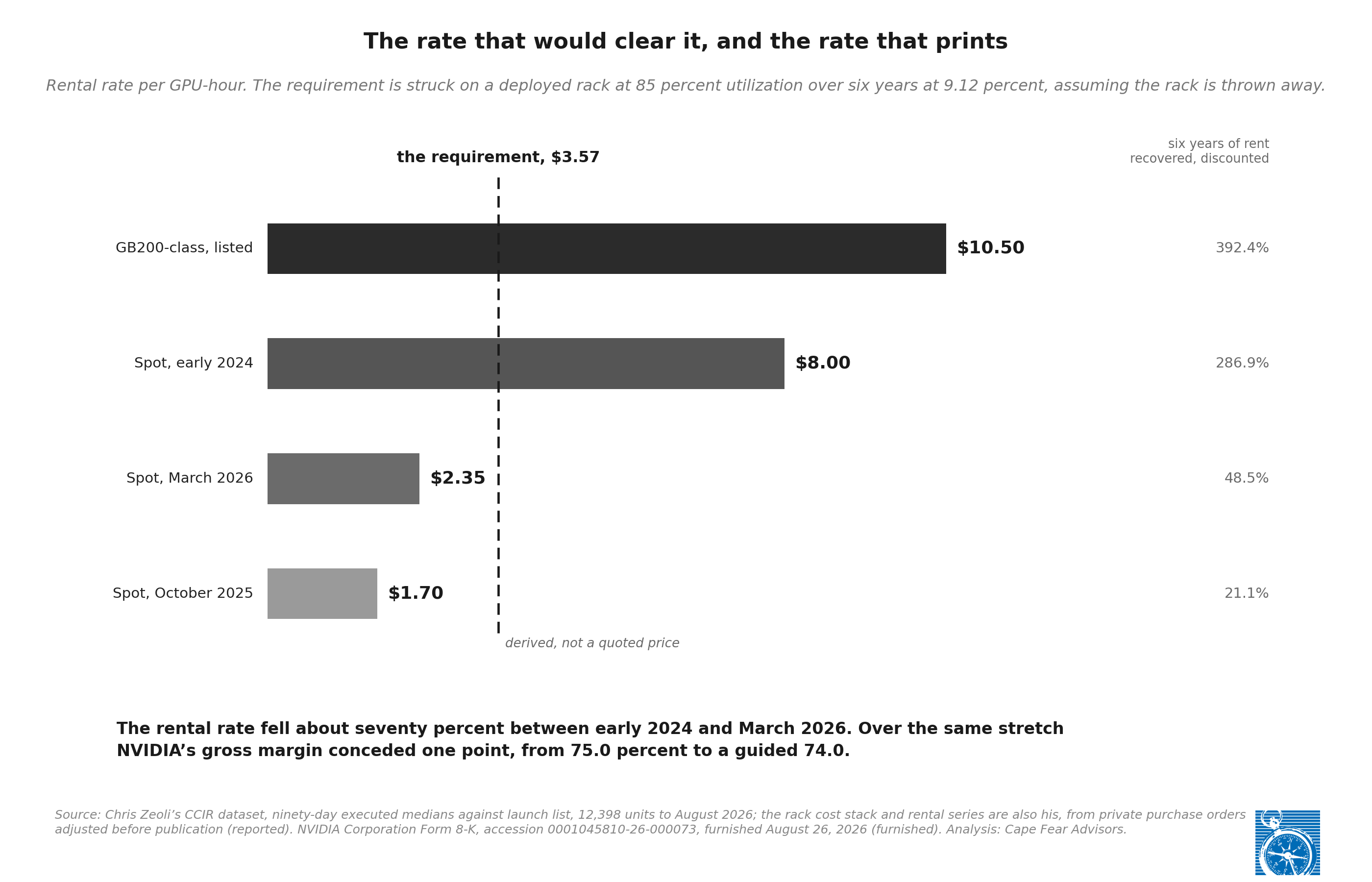
At $2.35 the six years of rent recover 48.5 percent of the rack in present value, and the rest has to arrive as a residual. Because it arrives at year six, it has to arrive grown: $4,934,084 on a $5,680,000 rack, or 86.8 percent, which is about 86 cents of the deployed cost.
So the machine does not pay for itself out of rent at the rate now printing, and the equity is relying on what is left at the end. Which is the position, and the rest of this is about what is left.
And this is where the two sides of the trade separate. Between early 2024 and March 2026 the rental rate fell about seventy percent. Over the same stretch NVIDIA’s gross margin conceded one point. NVIDIA holds $14,285m of property and equipment against $320,272m of total assets, 4.5 percent, and $99,369m in cash and securities. CoreWeave’s balance sheet is the plant. A party holding four and a half cents of plant per dollar of assets can concede a point when the price of an hour collapses. A party whose assets are the plant absorbs the difference, because the machines are bought, the debt is drawn and the dates are set.
What the equity owns
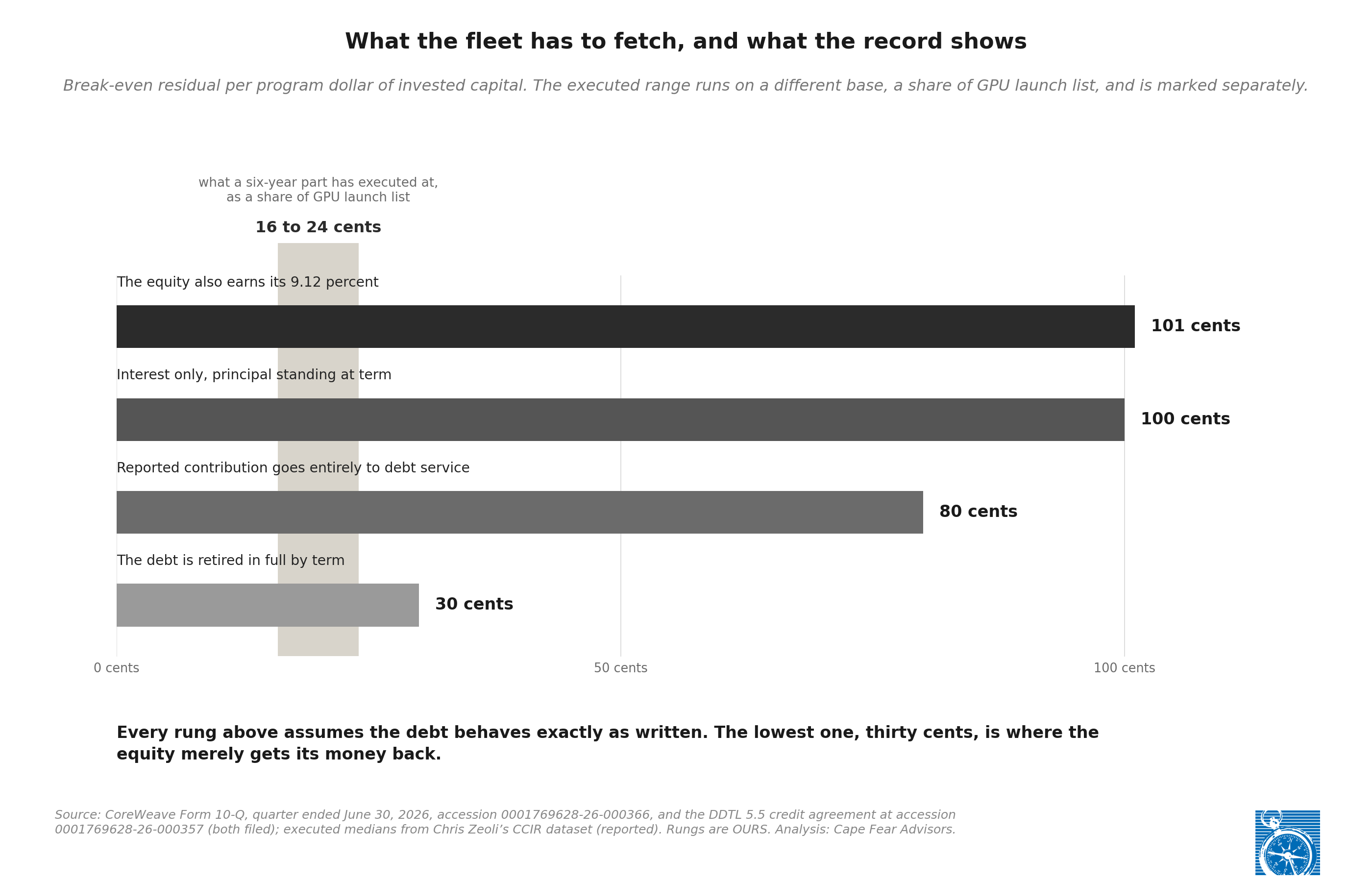
Those thirty cents are the position, and the identity behind them is short. The equity gets its thirty cents back when the fleet fetches thirty cents, where the debt is retired by the end of the holding period.
Thirty is the newest facility’s number and the balance sheet’s is larger. Against $64,257m of invested capital there is $35,068m of debt, so the equity has funded 45.4 cents of every dollar in the ground. Construction in progress advances at nothing, uncontracted capacity advances at nothing, and the older facilities advanced at ninety. So the lowest rung of the band below is the most favorable reading of this position, not a description of it, and the sixteen to twenty-four cents a six-year part has executed at looks worse against 45.4 than against 30.
The thing it owns thirty cents of holds more than accelerators. Of $40,704m of property and equipment in service at June 30, technology equipment is $33,823m, or 83.1 percent, and the rest is $6,881m of data center equipment, leasehold improvements, software and fixtures. The schedule carries no land, and the leasehold improvements attach to premises CoreWeave rents.
Which is the other half of the position. CoreWeave is a tenant, and the tenancy is a claim standing ahead of the residual one: $16,319m of operating lease liability at present value, $29,135m undiscounted, and a further $35,500m signed and not yet commenced.
The timing of the position is priced by the same agreement. A holder expecting the fleet to fetch more later would buy now and deploy later, and the newest facility puts a price on the wait. Funding Date Capital Expenditures “shall not include Capital Expenditures associated with Uncontracted GPU Capacity.” (2) An idle machine advances at zero on that facility and the equity funds all of it, against thirty cents on a contracted one, so waiting costs three and a third times deploying. The deployment schedule belongs to the lender as much as to the holder.
The debt is retired out of what the asset earns, so the arithmetic is checkable. Annualized operating income of $(386)m against depreciation of $5,080m gives contribution before depreciation of $4,694m, or 8.968 percent on the $52,339m of capital in service, against newest secured money at 9.12 percent, which is the rate read in NVIDIA, A Little Bit of Money In on September 13. Every cent of that contribution applied to a program dollar’s debt leaves 50.5 cents standing at year six.
Which gives a band of break-evens, and the band is the spine of everything below. Thirty cents retires the debt by term. About eighty cents lets the reported contribution cover debt service. The whole dollar covers interest with the principal still standing. About a hundred and one cents is where the equity earns its own 9.12 percent. The first three rungs mark where the equity gets its money back. The fourth marks where it gets paid.
Every rung prices the settlement, and this position is structured to settle in six years. What the band leaves out is reaching year six, which is a separate question with its own arithmetic and its own date. That question comes next, and it resolves first.
What it costs to hold
An option has a premium, and this one is paid in cash, annually, in public. The lenders want principal on a schedule.
Interest expense was $536m in the first quarter, $640m in the second, and is guided to $860m to $940m in the third, against full-year guided adjusted operating income of $960m to $1,150m. Principal repayment begins in monthly installments in November 2026, with $4,413m due in the rest of this year and $6,184m in 2027, against $5,524m of cash.
Annualize the third-quarter interest guide, add the filed 2027 principal, and debt service is $9,624m to $9,944m. Annualized first-half operating cash flow was $7,326m. The difference is $2,298m to $2,618m a year. Strip out customer prepayments, which were 37 percent of that cash flow and are a creditor claim in any stress state, and operating cash flow is $4,596m and the difference is $5,028m to $5,348m.
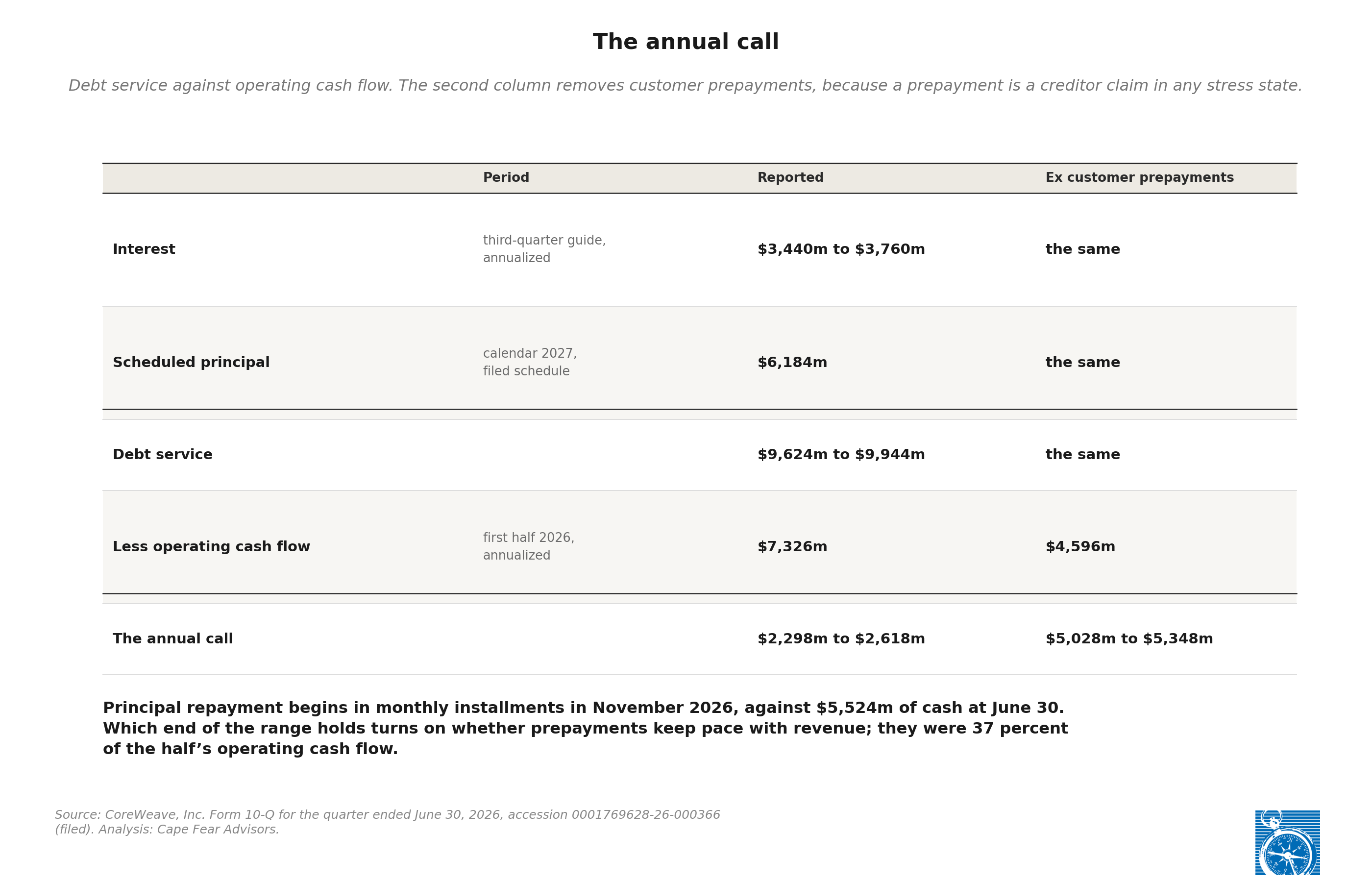
Three windows sit in that one subtraction and the choice understates it: interest ran $536m, then $640m, then a guide of $860m to $940m, so annualizing the guide freezes a series that has risen twice.
A second measure of the same burden runs smaller, for a reason that matters. Cost of money on $64,257m of invested capital at 9.12 percent is $5,860m against contribution of $4,694m, a gap of $1,166m a year, of which $79m is the earning fleet and $1,087m is construction in progress. The second begins earning only once it runs, which is an accounting fact about timing.
So there are two measures of one burden. The economic charge is $1,166m a year and contains no principal. The cash call is $2,298m to $5,348m and contains all of it. The second is two to four and a half times the first, and the difference is amortization. A schedule of principal payments takes no view of a depreciation schedule and no view of a residual. The banks want the money back on dates already written, and the larger figure is the one that has to be met.
What the cap leaves uncapped
A shareholder’s loss is capped at the amount invested. The cash balance carries its own floor at zero, and that floor binds first.
The two limits run on different clocks. The residual claim settles once, at the end, and it is the limited one. The cash settles every month, at full size, from operations or debt or equity, and where the first two fall short the balance arrives as equity, which divides one terminal claim among more holders.
The filed record measures it and names them. Across the eighteen months to June 30, 2026, CoreWeave spent $24,426m on capital expenditure and lost $2,533m while paid-in capital rose $7,989m, so close to three dollars in every ten of losses plus capital expenditure came from the equity. NVIDIA placed $2,000m of that in January at $87.20 and Jane Street $1,000m in April at $109.00. (11)
And money arriving to release a draw enlarges the requirement instead of relieving it. A dollar beside a 70 percent advance releases $2.33 of debt and buys $3.33 of equipment carrying 9.12 percent from the day it is ordered.
A bought call pays its premium once and can be abandoned by the holder. This one requires new cash every period to keep the option open. The alternative to paying is a liquidation at whatever the assets fetch on the day, in order of priority, with the residual claim last in the line.
Which puts the two clocks in the wrong order for the holder. The residual question resolves at year six; the cash question resolves every month, and any one of those months can end the position. And the second clock is much the shorter. $5,524m of cash at June 30 against a call of $2,298m to $5,348m a year is twelve to twenty-nine months, before a dollar of the $1,914m release. Cash on hand buys about one to two and a half years of a six-year position.
The facilities can draw and amortize exactly as written, every covenant can pass, and the residual holder can still finish smaller than it started.
The same dollar has three jobs
A dollar arriving here does one of three jobs. It covers that call. It sits beneath a lender’s advance to release a draw, which the undrawn facilities require before they fund. Or it is contributed to pass a coverage test, which the credit agreement permits in terms: Cure Equity is “deemed to increase the Net Operating Income” for the test. (4)
A dollar spent releasing a draw is unavailable to service the debt that draw creates, and the second and third jobs are the same act, so a period needing both needs the money twice and can spend it once.
They arrive together. Prepayments come with signings, so slower signings cut operating cash flow, widen the call, tighten the coverage test and call the cure, from one cause. And the first of the three has a date on it. Releasing the two facilities whose commitments lapse this year takes about $1,914m of cash beside the draws, and the nearest date is September 30, 2026. There is $5,524m of cash at June 30, so the release is affordable, and the ordinary course of business is that it happens: a release takes cash rather than a share issue, so it can be done without a filing, and the filed feed carries none through September 16.
Which is the finding rather than an objection to it. The $1,914m is affordable and it is the same $1,914m the call needs. One pool, three claims, and paying one is not paying the others.
The third option is available and it buys nothing. Stopping the build avoids the release cash and avoids adding service on undrawn commitments, and leaves the call where it is, because the call is struck on the $35,068m already drawn against the fleet already running. Waiting is a real choice here and the arithmetic of the gap does not notice it.
Which is where this piece’s own opening sentence comes due. A company moving four dollars of capital per dollar of revenue is a financing company with a compute business. The gap is the place where the compute business has to appear, because nothing on the financing side can close it. The advance rate is set. The facilities lend against machines and not against shortfalls. The cure is equity. And selling machines to meet the call settles the residual question early, at the price nobody publishes.
Three levers close it and all three are operating. A customer prepays. The rental rate rises. Utilization rises. At the current contribution margin, closing the call out of operations takes $4,560m to $10,611m of additional annual revenue against an annualized $9,306m, which is 49 to 114 percent more revenue. And the rate recovering to $3.57 supplies about $2,435m of it, covering the low end of the call and 45.5 percent of the high end. That is a scaling result and not a second opinion: the $3.57 is struck on one rack, and applying its ratio to the whole book is what produces the $2,435m, so the second figure inherits the first as an input. What makes it a finding is that the scaling did not have to land near the low end of the call, and it does.
Two qualifications, and the first is large. Ninety-eight percent of 2025 revenue was committed, so a better rate reaches the book only as contracts roll, 43 percent inside twenty-four months and 38 percent in months twenty-five through forty-eight on the filed schedule. The rate recovering arrives on the roll and not at once. And revenue from volume needs machines, which needs capital, which adds service.
What the market is paying
One number in this piece updates while the rest sit still. Across the two trading sessions from September 11 to September 15, CoreWeave’s close ran from $88.99 down to $80.92, a fall of 9.1 percent. Across the twelve months to that date it ran from $60.55 to $153.20, a factor of 2.53. (11)
On 551,536,602 shares and $29,544m of net debt, the September 15 close puts enterprise value at $74,174m against $64,257m of invested capital. The market pays about $1.15 for every dollar of capital in the ground. At the twelve-month high it paid $1.77. At the low it paid 98 cents.
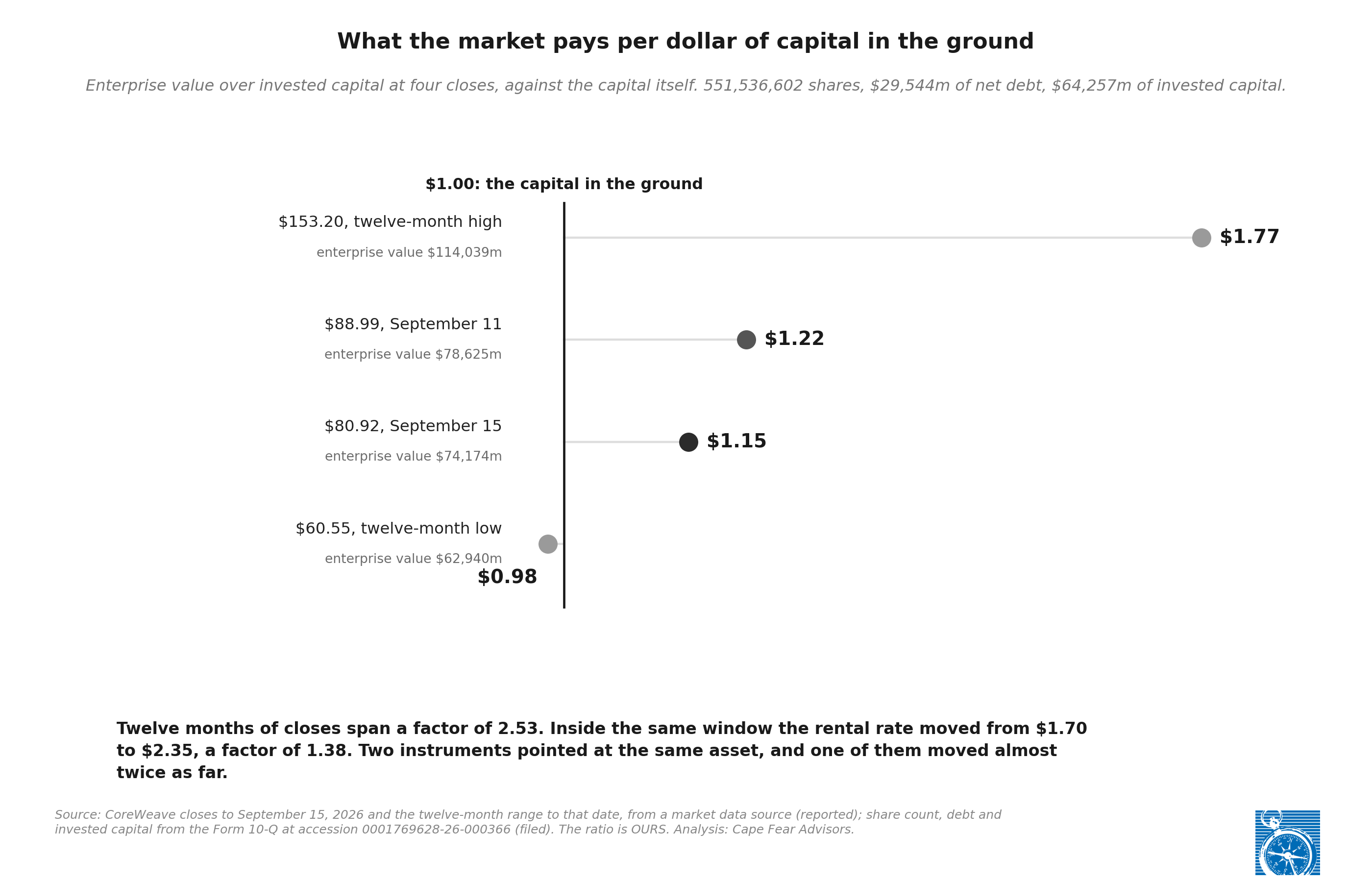
The share price is a weak instrument for the question here, and saying so is part of the argument. It is the market’s running estimate of a value nobody publishes, reached at one remove through a company, a capital structure and whatever the week is doing. Inside that same window the rental rate moved from $1.70 in October 2025 to $2.35 in March 2026, a factor of 1.38 against the share price’s 2.53. Two instruments pointed at the same asset and one of them moved almost twice as far. A marketplace in the machines would answer the question directly. The equity market answers a nearby question, loudly, and revises it on Tuesdays.
And the reason nothing better is available is structural. The question that settles this sits six years out. Credit desks call that the tenor, and a market exists at a given tenor only when somebody has a reason to trade there. Jain’s own design puts the natural range for forward trading in compute at three to eighteen months, and the contracts he proposes list six months forward, for reasons that hold on their own terms: demand comes from near-term work, and nobody can stockpile the asset. (9)
Laboratories hedge input costs over budget cycles. Operators hedge revenue over contract terms. Lenders finance against contracted capacity. Nobody in that list has a reason to trade six years out, which is the one year that settles this.
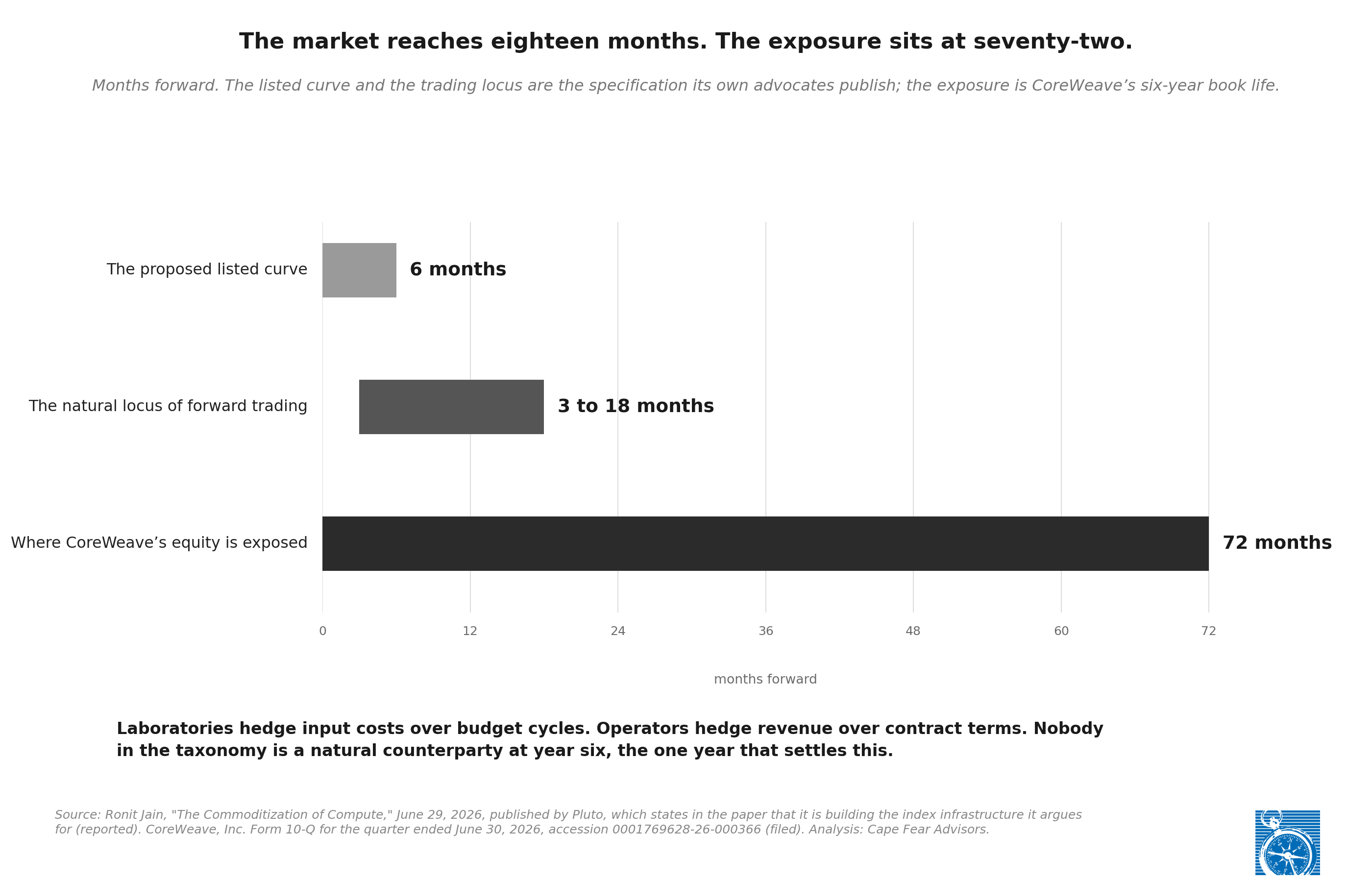
One party has written something at that distance, and then stepped back from it. NVIDIA announced a program in July that guaranteed to rent a provider’s unused capacity itself where the provider could not find another buyer, on agreements of a typical six-year duration. The price was half of any rental revenue above a base hourly rate set to cover the provider’s own costs, including depreciation of the chips, the data center and staffing. So the provider recovers its cost and NVIDIA takes half of everything above it, which is a floor under the downside bought with half the upside. That is a utilization guarantee at exactly the distance no market reaches. NVIDIA’s own quarterly filing puts the commitments at $36,000m as of July 26, 2026, on agreements it describes as typically six years in duration, and says they decrease as the capacity is taken up by third-party customers or by NVIDIA itself for research and development. So the figure is a gross commitment that two different kinds of use retire, and one of those uses is the guarantor’s own. NVIDIA stepped back from the program less than two months after announcing it, and the reporting does not establish why. Sharon AI and Firmus Technologies are the named participants and CoreWeave appears in none of the reporting. (10)
So the instrument is not hypothetical and it is also not a market. It had one writer, who was the party selling the machines. It ran to six years. And it stopped. The whole program, across every participant, carried commitments smaller than CoreWeave’s own invested capital.
The same arithmetic, called something else
Somebody pricing this as an ordinary operating business does what anyone does with a growth company. Forecast the cash flows that are visible, and put everything past the horizon into a terminal value. The visible window here is the contracted book. The terminal value is the residual, and those are the two objects this piece has been pricing all along under different names.
The book is straightforward. Remaining performance obligations were $103,700m at June 30, and at the current 50.4 percent contribution margin that is $52,265m. Spread evenly across the three-year average contract life and discounted at 9.12 percent it comes to $44,005m, which is 59.3 percent of enterprise value at the September 15 close. Taken as a single sum at year three it is $40,225m. The even spread favors that reading and is the one used here.
Which leaves about $30,100m past the horizon. Call it a residual and it is a claim on used machines. Call it a terminal value and it is a claim on a business that keeps re-letting them. Either way it resolves on the same date, and neither name makes it observable. And serving the contracted book is what spends the asset, so the cash flows credited inside the window and the value assumed after it are drawn from the same physical life.
The trade-off between the two prints. At the September 15 close, contribution flat leaves the fleet needing 139 percent of invested capital at year six. Contribution compounding at 20 percent a year leaves it needing 90 percent. At 40 percent a year, 1 percent. A fleet that holds its entire original cost requires contribution to compound at 16.9 percent a year.
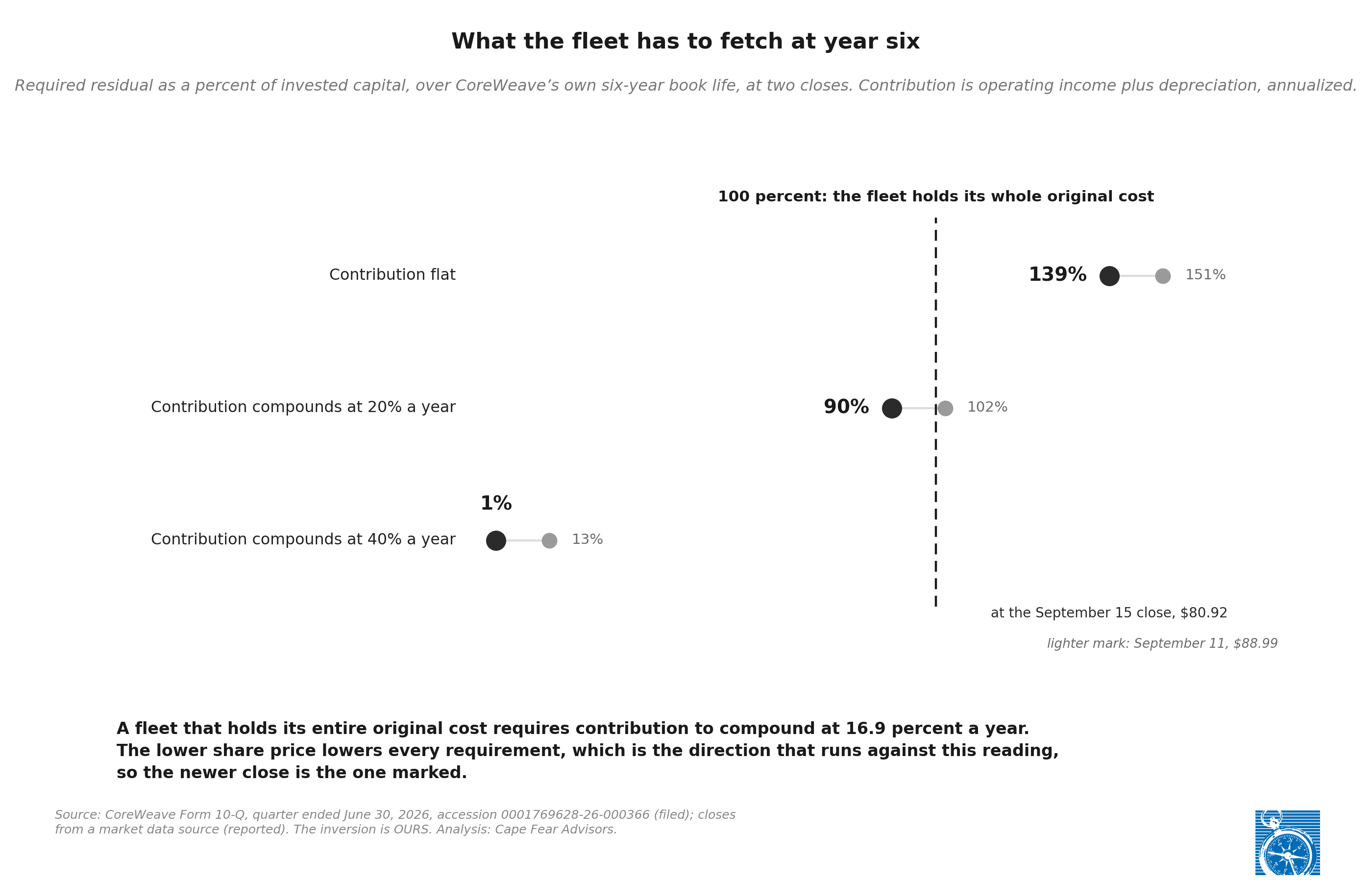
The lower share price lowers every requirement, which is the direction that cuts against this reading, so the September 15 close is the one used. At the September 11 close the same three figures are 151, 102 and 13 percent. Three qualifications sit under them. Growth on the existing fleet comes from price and utilization alone, because growth bought with new capital enlarges the base the residual is measured against. The two levers are coupled, because utilization consumes the physical life the residual is a claim on. And 9.12 percent is the assumption most favorable to the current price; at 12 percent the flat-contribution figure is 168 percent.
A reader who thinks the market is simply doing the ordinary thing is probably right. The ordinary thing puts about 40 percent of this price beyond the forecast horizon, six years out, at a date when nobody can yet say whether an operating business in this class clears its cost of capital. The method is the ordinary one and it is the right one. This is simply where it leaves the answer.
And the twelve-month low is what the price record hands the other reading. At $60.55 the market paid 98 cents per dollar of capital in the ground, and at 40 percent contribution growth the required residual turns negative: the contracted book alone would have covered it. The market has already priced this equity at a level where this reading would have had nothing to say.
What the record shows
Executed prices exist. Chris Zeoli’s CCIR dataset carries 12,398 units and $28.3m of completed sales since July 2023, with ninety-day medians against launch price. As an age curve it runs from above launch at under three years to sixteen and twenty-four cents at about six. Four other assemblies put a six-year part between ten and thirty cents. The lowest rung of the band is thirty. (7)
Those cents and the 86 cents the rack needed run on different denominators. Sixteen to twenty-four cents is a share of GPU launch list; the 86 cents is a share of a deployed rack, which carries facility, installation and network content that a sale of used accelerators returns nothing on. Restating the requirement against the accelerators alone raises it, so the distance between what the rack needs and what the record shows is wider than the two figures side by side.
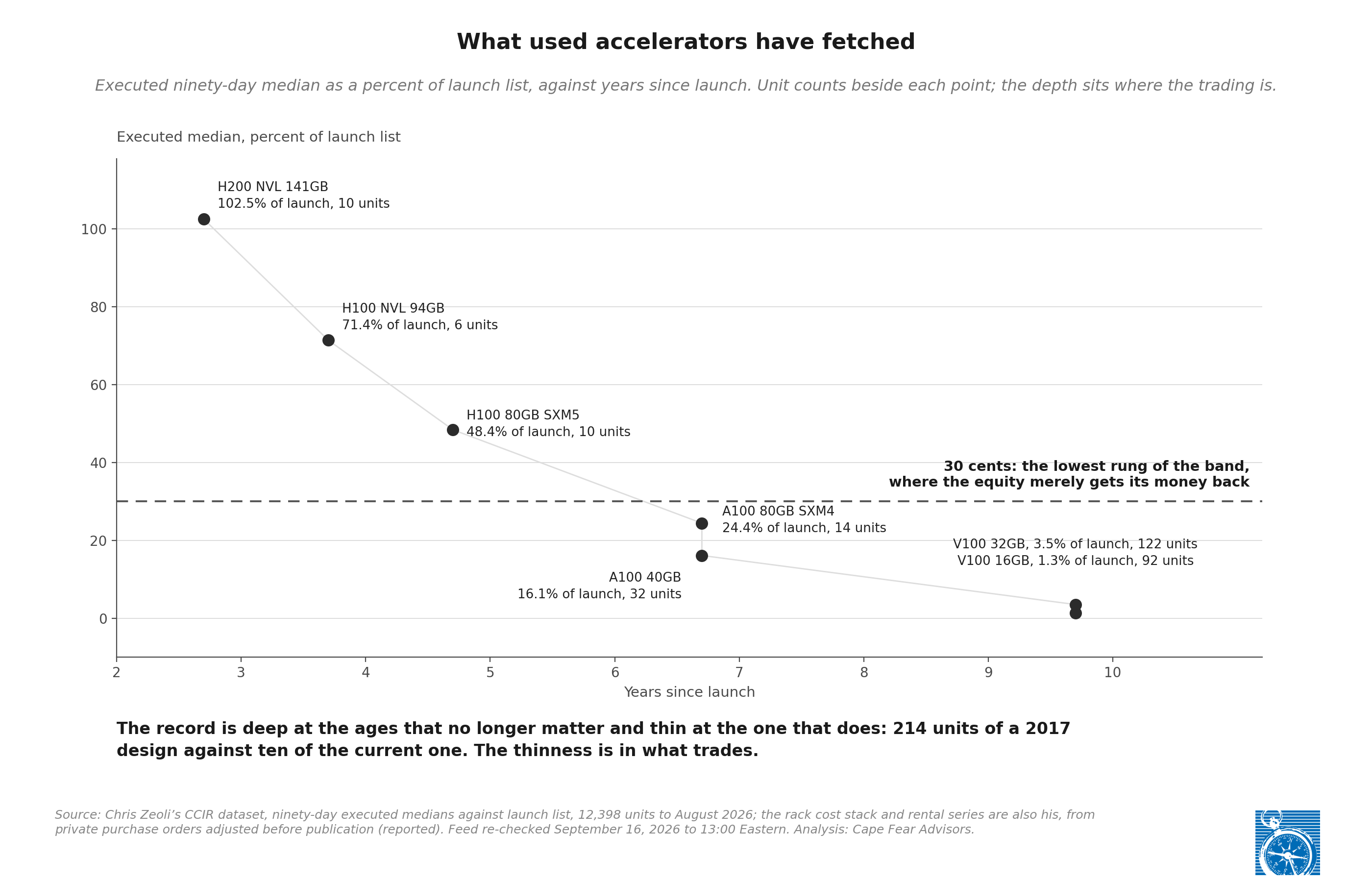
The top of that curve is the strongest fact in the record pointing the other way. An H200 changing hands at 102.5 percent of launch, two years and eight months on, is what a durable asset looks like. It measures a current part under supply constraint, which is a different object from an aged one. The row settles the first three years and says nothing about the sixth.
Three things bound what the table can carry. The depth sits in the older parts, 214 units of a 2017 design against ten of the current one, because older parts are what change hands. The denominator is launch list, which a fleet buyer pays under, so the retention shown is the low end. And a retail venue is a different venue from a fleet sale. The market is observable at the ages that no longer matter and thin at the one that does, and that closes on the day a current-generation fleet changes hands and somebody reports the price.
The rental series behind those values runs from about $8 an hour in early 2024 to $1.70 in October 2025 and $2.35 in March 2026. That last print is six months old at the date of writing, which is itself a statement about how often this price is published.
And the estimate standing in for the missing price has moved one way. Olga Usvyatsky’s assembly counts fifteen disclosed changes to useful life across six filers between 2020 and 2025, of which fourteen lengthened, the single reversal being Amazon in 2025. The same asset carries six years at CoreWeave and four at Nebius, both filed. (8)
Michael Intrator has answered that directly: the chips get re-rented on successive contracts, so six years measures how long a machine keeps earning rather than how long it keeps working. That is the operator’s own case, and the two figures together are the argument where the spread alone is only the conclusion.
When the operating company is the right frame
Everything above reads CoreWeave as a financing company with a compute business, on the frame its own arithmetic invites. That frame stops being the right one if the compute business closes the gap.
Five things would have to move. The rate recovers toward $3.57 from $2.35, which supplies about $2,435m of contribution and covers the low end of the call. Utilization proves higher than assumed, which every filer leaves undisclosed. The useful life proves longer than booked, which the first current-generation renewal cohort tests in 2027. The cost of capital falls, against a series that has widened twice this year. And NVIDIA’s margin falls, guided from 75.0 to 74.0. One is moving against, one is unreported by every filer, and the one that would do the most work arrives on the roll.
Where it would show, and two of these are sitting in documents already public. A fleet-scale price in current-generation hardware would supersede all of this, not dent it: a sale of thousands, priced and reported, in an 8-K or an insolvency docket or an auction record. CoreWeave’s H1 2026 gross property schedule is filed and unread here. The three other credit agreements either carry the uncontracted-capacity carve-out or they do not.
Then four that come with dates. Any filer disclosing a realized rate per GPU-hour, or a compute index publishing its first fixing. NVIDIA’s next commitments note, read for whether the $36,000m has been drawn down and by which of the two uses that retire it. Whether inference migrates off GPUs at scale, which the announced inference silicon first tests at the end of 2026. And the first renewal cohort, in 2027, on the filed recognition schedule.
What holds either way
The residual is unknown, and it is a residual either way this company is read. Read as an operating business, it is a residual on the plant and on the customer relationships. Read as a financing business, it is a residual on the value of the plant, and on whether the operating company lowers the cost of holding it. Neither reading makes it observable and both resolve on the same date.
The carry is filed. Between here and any answer, the equity funds $2,298m to $5,348m a year on dates already written into schedules, releases draws out of the same pool or watches commitments lapse, and pays NVIDIA’s margin on every machine it adds. That call runs whether the fleet eventually fetches a dollar or thirty cents, and the cap on a shareholder’s loss leaves every dollar of it standing.
Which is the whole of it. A financed claim on a mixed asset base whose largest component has no observable price at the age that decides it, held on a schedule the lender sets, at a cost the record states in full. The first test arrives in 2027 and the payments start in November. (12) (13) (14)
Standing Disclosure
Cape Fear Advisors reads filed documents and says where things sit. Nothing here identifies an error, an inconsistency, or a bad actor: every filing is taken on its face as accurate and complete under the rules that govern it, and every reading is a property of an arrangement rather than a judgment about anyone’s decisions or conduct. This is analysis and not investment advice; Cape Fear Advisors is a research shop, and every reader decides for themselves. Share prices are quoted to the close of September 15, 2026, with the twelve-month range to that date, and they move. The author holds no position in any security discussed. Cape Fear Advisors has no client, consulting or commercial relationship with any company named. Anthropic, whose models are used in this shop’s research, has NVIDIA among its investors; NVIDIA is read here as a counterparty to the subject. Every figure above is sourced, and where a source cannot be pulled to a document the note says so. Corrections are welcome, and they are published with a date on them.
Notes
(1) The filings. CoreWeave, Inc., Form 10-Q for the quarterly period ended June 30, 2026, accession 0001769628-26-000366. Revenue, operating income, depreciation, cash, debt, the property schedule, the lease note and the interest line are from this filing. Prior-period figures are from the Form 10-K for fiscal 2025, accession 0001769628-26-000104, and the quarterly filings cited in the checker brief.
(2) The advance rates, FILED. 70.00 percent from “Funding Date GPU Amount” in the DDTL 5.5 credit agreement, Exhibit 10.1 to accession 0001769628-26-000357. 90.00 percent from the March facility, accession 0001769628-26-000129. The exclusion of “Capital Expenditures associated with Uncontracted GPU Capacity” is from the same definition in the August agreement and was read at source; whether the three earlier facilities carry it is unread.
(3) The five-against-three sentence is Exhibit 99.1 to accession 0001769628-26-000357: the facility’s approximate five-year maturity extends beyond the average three-year length of the underlying customer contracts.
(4) Cure Equity is Section 7.03 of the same agreement, which provides that it is “deemed to increase the Net Operating Income” for the coverage test.
(5) NVIDIA’s margin, 75.0 percent filed and 74.0 percent guided, is the Form 8-K at accession 0001045810-26-000073, furnished August 26, 2026. The property, total asset and cash and securities figures are from the condensed consolidated balance sheet at July 26, 2026 in the same release.
(6) The quotation is Jensen Huang at the Goldman Sachs Communacopia and Technology Conference, September 10, 2026, as rendered by three accounts that differ in other particulars. The recording is unpulled and the two sentences used are common to all three renderings.
(7) The hardware prices, the rack model and the rental series are Chris Zeoli’s, across two pieces and one dataset. The deployed rack cost, the operating cost range and the colocation figure are from How Much Does an NVIDIA NVL72 Cost?, Data Gravity, August 31, 2026, and rest on recent purchase orders and bills of material reviewed by Data Gravity in August 2026 and adjusted before publication, so the article is pullable and the documents beneath it are not. The rental series, about $8 an hour in early 2024, $1.70 in October 2025 and $2.35 in March 2026, is from How the GPU Became Collateral, Data Gravity, September 10, 2026. The executed-price series is his CCIR hardware dataset at Compute Credit Index Research: 12,398 units and $28.3m of completed sales from July 2023 to August 2026, ninety-day trailing medians against launch price, read September 16 and current to that date. That dataset is live and it grows; his September 10 piece cites an earlier cut of it at 10,911 units and $26.3m, so every figure taken from it here, including the age curve and its depths, carries the September 16 read. The dataset also publishes modeled values on an income approach, which answer what a machine earns; the executed medians are the series used here.
(8) The useful-life record is Olga Usvyatsky’s assembly at Deep Quarry, Depreciation of GPUs: between useful lives and useful myths: fifteen disclosed changes across six filers between 2020 and 2025, of which fourteen lengthened, each change linked in her appendix to the filing that made it. CoreWeave’s six years and Nebius’s four are each filed by their own filer. Michael Intrator’s re-rental argument is his, as reported by Unicus Research.
(9) The derivatives framework, the three-to-eighteen-month range for forward trading, the six-month proposed curve and the catalogue of existing arrangements are Ronit Jain’s, from “The Commoditization of Compute”, June 29, 2026, published by Pluto, which states in the paper that it is building the index infrastructure it argues for. The mapping of CoreWeave’s contracted book onto those instruments is ours, and the remaining performance obligation figure is a revenue measure standing in for a notional.
(10) The utilization guarantee, and one dated predecessor. The scale and the duration are FILED. NVIDIA’s Form 10-Q for the quarterly period ended July 26, 2026, accession 0001045810-26-000075, captions the arrangement “AI cloud agreements” and states that “our commitments, which are typically six years in duration, totaled $36 billion as of July 26, 2026,” and that “our commitments decrease as capacity is used by third-party customers or by us for our research and development efforts.” On the revenue leg the filing says that “if certain criteria are met, we will participate in revenue share generated by the AI clouds from third-party customers.” The commitments note was read from NVIDIA’s own published copy of the filing, the EDGAR document having truncated at note 8 on two attempts. The rest is REPORTED, from Nvidia Pauses Revenue-Sharing Deals With AI Cloud Companies by Anissa Gardizy and Berber Jin, The Wall Street Journal, August 27, 2026: the July announcement, the program name, and the base hourly rate set to cover the provider’s costs including depreciation of the chips, data-center expenses and staffing, with NVIDIA taking half of revenue above it, which is the Journal’s reporting from people familiar with the deals and is the construction the filing leaves as “certain criteria.” Sharon AI and Firmus Technologies are named in NVIDIA’s own announcement. On the pause, the Journal reports that some NVIDIA employees raised antitrust exposure with customers and that some providers resisted the degree of control sought, including renting only to approved customers, and it states that the precise reason could not be learned. An NVIDIA spokeswoman said the July business model “is still in place and continues to evolve due to high demand.” Unicus Research published the pairing of the longest useful life with the pledged collateral, and the reading of this debt as refinanced rather than retired, on August 17, 2026, a month before this piece; the useful-life pairing reaches both readings through Olga Usvyatsky’s assembly.
(11) The share prices and the placements. The September 11 and September 15 closes and the twelve-month range of $60.55 to $153.20 are from a market data source and are REPORTED rather than filed; they move. The share count of 551,536,602 is from the Form 10-Q. The January placement of $2,000m with NVIDIA at $87.20 is filed. Jane Street’s $1,000m at $109.00 per share is Exhibit 99.1 to accession 0001769628-26-000167, furnished April 15, 2026, alongside a $6,000m cloud agreement with the same counterparty, which this piece does not read.
(12) The shelf this sits on. The framework is Quality of Cash: Circular Financing and the AI Bubble, August 2, 2026, which sets out the ladder from cash on the barrel to the most intricate vehicle. NVIDIA’s guaranty book, including the $105,000m cap, is read in NVIDIA, The Scarce Thing Is a Credit Standing, August 27, 2026.
(13) Ours. The option framing, the four-rung break-even band, the two measures of carry and their reconciliation, the inversion and its inverse, the required-rate solution, the three-jobs arithmetic, the release arithmetic, and the reading of the uncontracted-capacity exclusion as a price on deferral. Every one is arithmetic on stated inputs and none is a forecast.
(14) Arithmetic conventions, stated because they move the answers. Contribution is operating income plus depreciation, annualized from the half. The discount rate throughout is 9.12 percent, the marginal secured rate, which is the assumption most favorable to the current share price; the 12 percent alternative is printed where it matters. The inversion credits contribution growth from the first year, which lowers the required residual, so every figure in it is the low end. The backlog is valued on an even spread across three years, the convention favorable to the competing explanation, with the single-sum figure printed beside it. Enterprise value uses $35,068m of total debt, being the balance-sheet figure; a summarizing fetch of the earnings release returned $35,088m and the $20m difference is logged. The required rate assumes a zero residual, which raises it, and 85 percent utilization, which lowers it. The rounding convention is to round against the argument. That usually means flooring, and where flooring would favor the argument the figure moves the other way instead. The floored ones, with their unfloored values: the rental decline is 70.6 and prints seventy, the flat-contribution requirement is 139.75 and prints 139, the 12 percent alternative is 168.6 and prints 168, the year-six requirement is 86.87 and prints 86.8, and the residual after crediting the book is $30,169m and prints about $30,100m. Moved the other way for the same reason: the rate recovery covers 45.53 percent of the high end of the call and prints 45.5, and the runway is 12.4 months floored to twelve and 28.8 raised to twenty-nine.
Analysis: Cape Fear Advisors.
Every post here is free and stays that way. A subscription says the work landed, and a paid one offsets the hours and the cost of the research behind it.
Follow on Substack →