
At the Goldman Sachs conference in San Francisco on September 10, James Schneider asked Jensen Huang to explain, for people who are skeptical, why he believes the financing is not circular. (1) Huang answered, and then he carried on for another minute.
“Well, it’s not circular because we put a little bit of money in, and a lot of money comes back.”
“Is that finance talk? I look at the spreadsheet, we put in one and 100 comes back in. Is that circular?”
“If that is, let’s do more of that.”
The wires took different pieces of that and printed them in different orders, which is what wires do. (2) Whole, the passage carries a mechanism, and he set it out in the same breath.
“We bring the AI platform to them. They have to secure the land, power, and shell. We help them with financing, but very small part of it, but the most important thing is we see their offtake because that financing doesn’t come together without the offtake, and that offtake is $100 billion.”
And a sentence earlier: “we see their pipeline because we brought the pipeline to them.”
A small amount of money goes in. A large financing comes together behind an offtake. And the pipeline behind it, on his account, is one he brought.
The customer, by his definition
Earlier in the same appearance he defined the segment, and the definition is a ratio.
“$400 billion of VC funding went into AI natives in the last six months. $400 billion. AI natives, the definition of an AI native is somebody who spends two-thirds of their raised money on compute. There is no such thing as a low CapEx software company anymore.”
A customer defined by the share of its capital that returns as compute spending selects itself. Two-thirds of $400bn is roughly $267bn of compute buying over six months, out of money already raised, by companies whose defining property is that they spend it that way.
On our application of his ratio, the definition also sorts everyone else out. A company with other businesses has somewhere else to put the money and fails by having options. That is the line SpaceX sits on the far side of, with launch and connectivity and GPUs bought on purchase orders, and Applied Digital too, whose capital goes into shells and power. Intel, Nokia, Synopsys and Coherent, held in the same book, are supplier and strategic positions and create no demand for accelerators at all.
The sorting throws out most of the money, and the figure belongs in the open. Intel and SpaceX alone are $50,965m of the $63,440m NVIDIA reported at June 30, which is 80.3 percent, and adding the three suppliers takes it to 92.0 percent. What clears the ratio inside that report is about $5.0bn. The instruments this piece reads are small against the book they sit in, and two of the three sit outside the report altogether. (3)
NVIDIA reports these customers inside a bucket of its own, AI Clouds, Industrial and Enterprise, which sits apart from Hyperscale and holds more besides them, and it moved one company across that line in its second quarter. (4) The mix between customers defined by that ratio and customers with other interests is the series to watch, and it is furnished quarterly.
The spreadsheet
He says he looks at a spreadsheet, and he names the question it answers: what goes in against what comes back. We published an identity in August that answers the same question from two filed inputs he did not name. (5)
Where a lender advances a fraction a of equipment cost and the supplier turns a program dollar into cash at margin m, the share of the customer’s program that has to be spent with the supplier for a placement to return its own cash is (1 − a) / m. Two inputs, both filed. No discount rate, no horizon, no cost of capital.
Against CoreWeave’s own filed advance rates, at NVIDIA’s gross margin of 75.0 percent, the requirement runs 13.3 percent in March, 38.1 in May and 40.0 in August. One borrower, three of its facilities. (6)
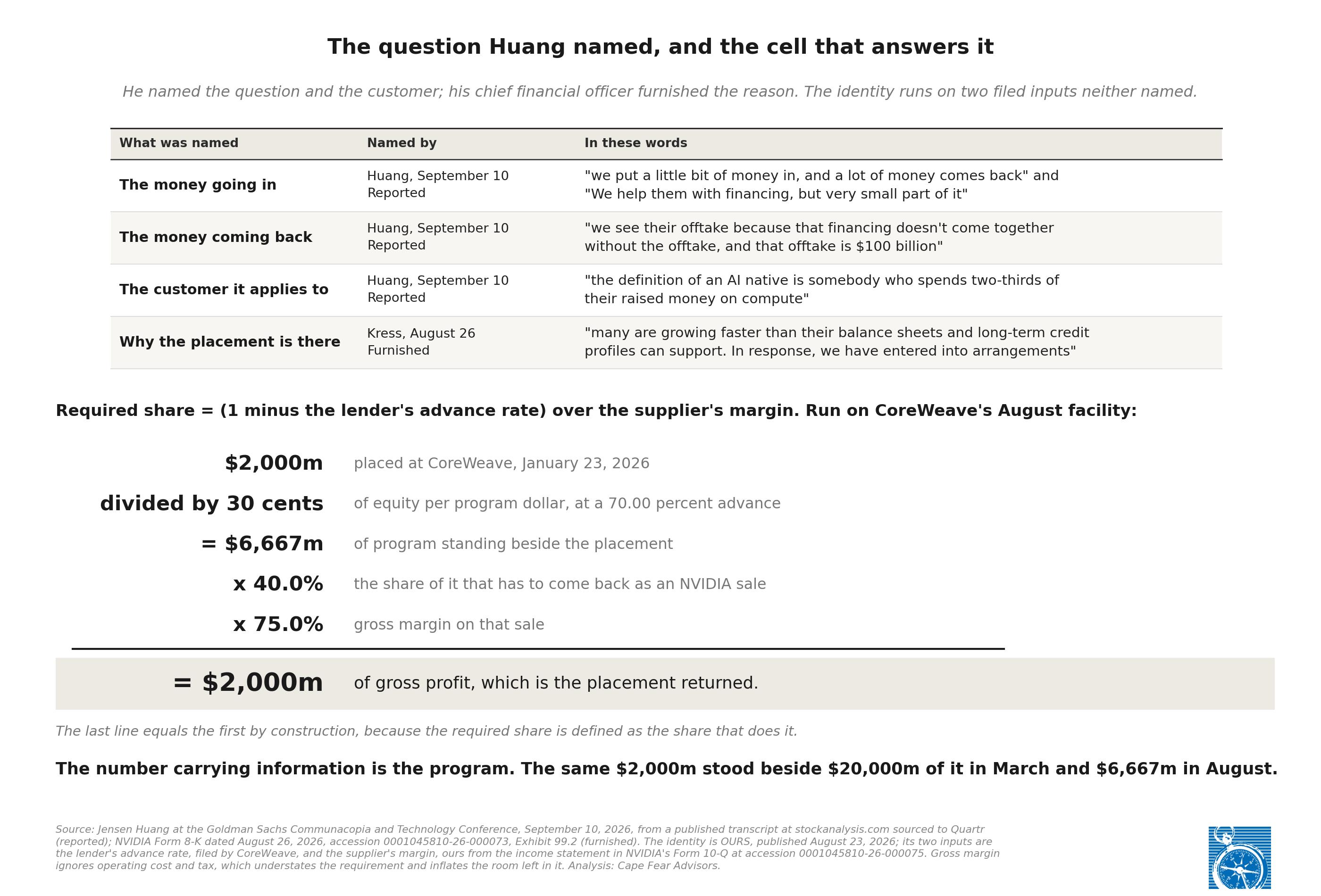
The requirement tripled in 130 days, and it did so in one step. In March the lender funded ninety cents of the equipment dollar, so ten cents came back through the supplier’s own till and thirteen percent of the program covered it. By May the lender funded seventy-one, and the requirement stood at thirty-eight. Between March and May it moved 24.7 points. Between May and August it moved 1.9.
Stated in dollars instead of percentages: the same $2,000m placement stands beside $20,000m of program at March’s advance and $6,667m at August’s, because a lender funding ninety cents of the equipment dollar leaves ten and a lender funding seventy leaves thirty. On this borrower’s terms a placement buys less program than it bought in March, and where each placement buys less the same total takes more of them.
Forty of a possible hundred leaves room to run. Nothing we have read shows a placement failing to return its cash, and whether any of them clears is a question this piece leaves open, because that takes the share a customer does spend with its supplier and no filing read here carries it. What the next facility settles is whether the step repeats or the plateau holds.
Two-thirds of raised money on compute is a public figure in the neighborhood of that missing term, and it arrived from the supply side. It runs on a different denominator, being all compute against all raised capital, so it stands as a marker rather than as an input.
A buyer, a supplier, a financier
Three seats sit at every one of these arrangements. A buyer of accelerators, a supplier of them, and a financier, or a structure standing where a financier would. The equity moves between the first two. What it releases comes from the third, against an offtake, which is the sequence Huang described from the chair.
He named the channel too. The neoclouds “secure land power and shell for us that the CSPs have already exhausted,” and CoreWeave and Nebius were among the ones he listed. On capital he was brief: “Lastly, capital. Sometimes we invest in them.”
Three GPU buyers carry that instrument. The seats fill the same way at each, and the currency changes every time.
CoreWeave, one end, the middle, the other end
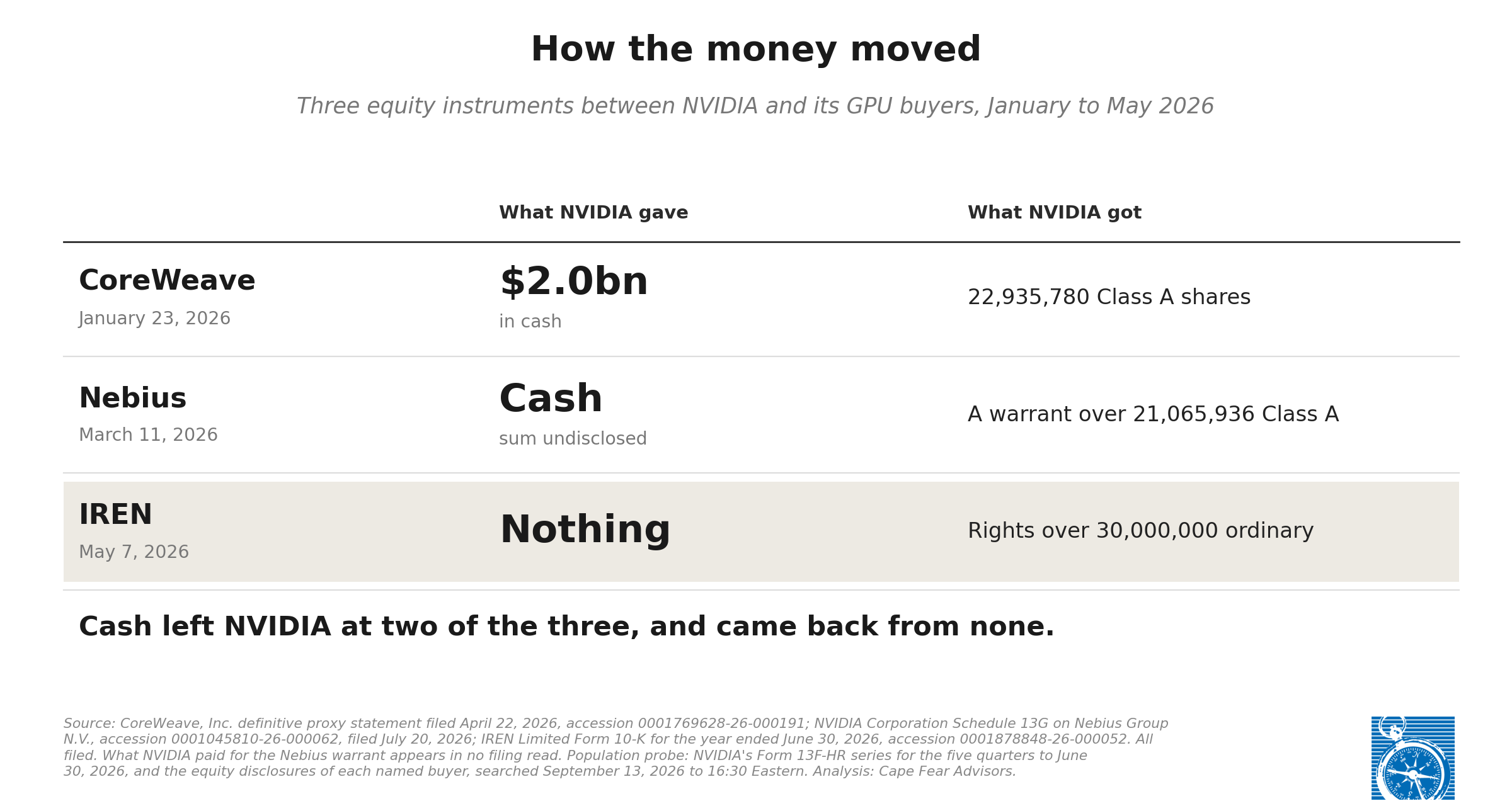
On January 23, 2026 NVIDIA bought 22,935,780 CoreWeave Class A shares at $87.20, two billion dollars, in cash. (7) A financing inflow on CoreWeave’s statements, an investment carried at fair value on NVIDIA’s, and both of those are the right answer.
Through the spring and summer that followed, CoreWeave’s secured facilities repriced. The advance rate on funded equipment moved from 90.00 percent to 71.42 to 70.00, and the spread from SOFR plus 225 to SOFR plus 550. Sequence, and nothing more than sequence: no filing joins the placement to the terms, and we decline to join them either.
Between the two ends sits what CoreWeave pays. It buys accelerators from a seller reporting a 75.0 percent gross margin across its business. It pays 9.625 percent on senior unsecured notes, with other unsecured coupons from 9.000 to 9.750 and a top effective rate of 15 percent. Roughly $345m of financing friction went out in six months. And on capital already in service it earned negative 0.74 percent. (8)
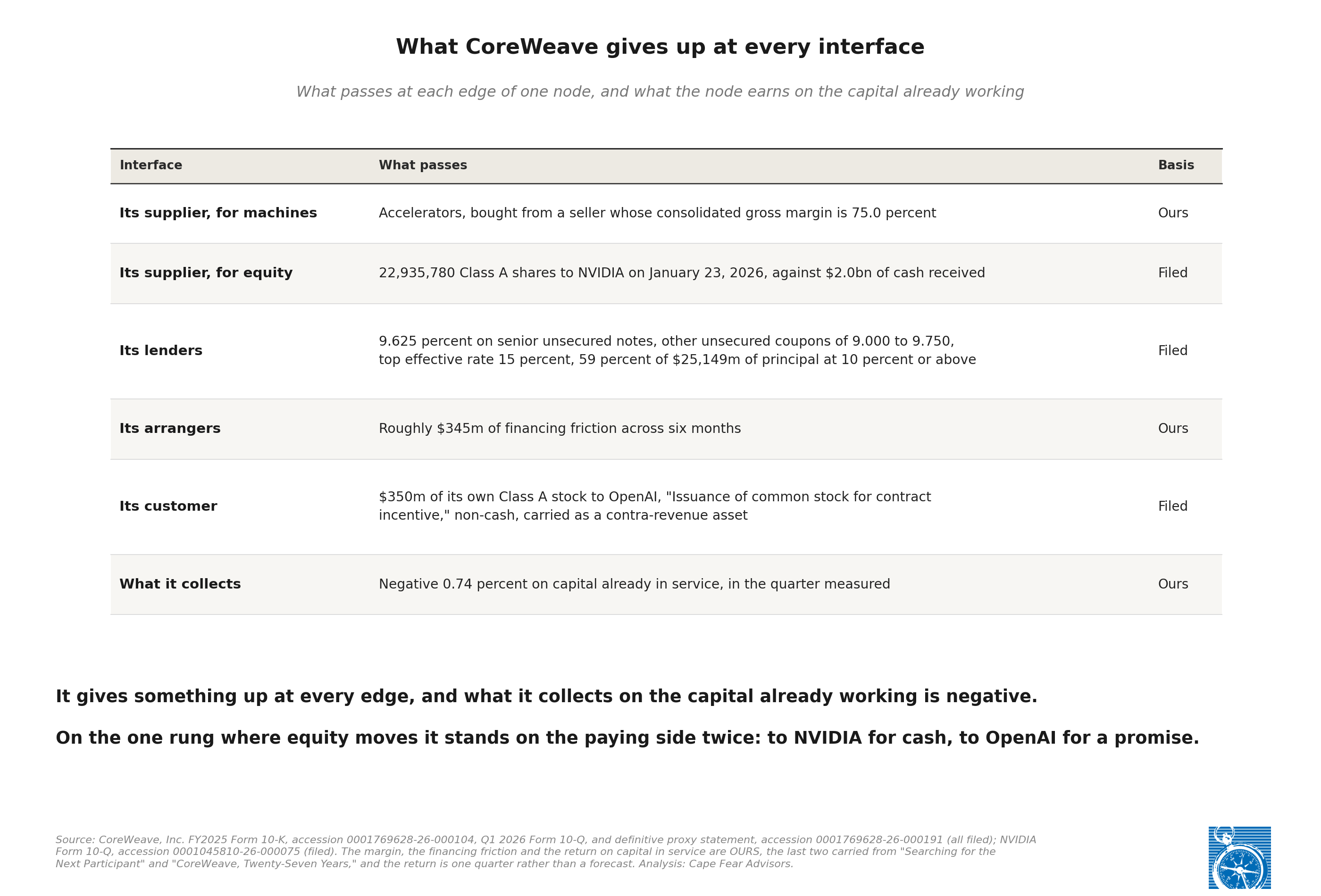
Then the other end, and CoreWeave had no cash for that one either. It issued approximately $350m of its own Class A stock to OpenAI, carried in the FY2025 cash flow statement under non-cash activities as “Issuance of common stock for contract incentive,” with no matching inflow in the financing section. (9) Payments to customers are a contra-revenue asset under CoreWeave’s own policy note, so the stock went out, a purchase commitment came back, and the value amortizes against the revenue it was given to obtain.
NVIDIA ran its own version of that trade in August, at a different rung and a different order of size: residual value guaranties on the Pike County campus, cumulatively capped at $105,000m, filed under Items 1.01 and 2.03 and again as an exhibit to its own quarterly report. We read it at the time in “NVIDIA, the Circle at Rest.” Neither the stock CoreWeave handed OpenAI nor the guaranty NVIDIA filed moved cash on the day it was struck, and the two sit at different points in the sequence. A placement puts capital in before the program runs; a guaranty pays only in a state that has yet to arrive. (10)
CoreWeave gives something up at every interface, and what it collects on the capital already working is negative. Equity to NVIDIA for cash, equity to OpenAI for a promise, and on the one rung where equity moves it stands on the paying side twice.
Nebius, paid in advance
NVIDIA’s Schedule 13G reports 22,256,412 Nebius Class A ordinary shares, 9.3 percent of the class. (11) Of that, 1,190,476 are shares it already held. The other 21,065,936 sit under “a pre-funded Class A ordinary share purchase warrant... acquired by NVIDIA on March 11, 2026 pursuant to a Securities Purchase Agreement.”
A pre-funded warrant is bought with substantially the whole exercise price paid at the front. Cash out, a claim on a customer’s equity back. What NVIDIA paid is absent from the documents we read, and the direction is the point.
Four months later, on July 10, a Nebius financing subsidiary signed a $775m senior secured term loan at SOFR plus 250. (12) Equity first, then the debt, and sequence again: no filing joins them, and we decline to join them either.
The 13F carries none of it. The Nebius line there reads 1,190,476 shares at every quarter end from June 2025 to June 2026, because pre-funded warrants sit outside the Section 13(f) list, and the instrument class surfaces in the 10-Q only as $10,806m of unregistered warrants and convertible preferred, naming nobody.
IREN, where the customer calls it price
IREN filed its 10-K on August 27, and the note that matters runs a few sentences. (13)
“In connection with its arrangements with NVIDIA Corporation (‘NVIDIA’) for the supply of GPUs, on May 7, 2026 the Group granted NVIDIA rights to acquire up to 30,000,000 of the Company’s Ordinary shares at an exercise price of $70.00 per share... The Investment Rights vest and become exercisable in tranches based on the volume of GPUs supplied by NVIDIA to the Group.”
Rights over 7.3 percent of the company as enlarged if they are exercised in full, or 7.8 percent of the shares outstanding today. NVIDIA paid nothing for them. They vest as the machines arrive.
“The grant-date fair value of the Investment Rights... was approximately $793.4 million. This amount will be capitalized as part of the cost of the GPUs acquired from NVIDIA and is recognized as the underlying GPUs are received by the Group, on a per-unit basis.”
IREN books the supplier’s equity as part of what the machines cost. Not a financing and not an investment. Price, recognized per unit as the units arrive, and IREN states the reason in the note: the rights were granted in connection with arrangements for the supply of GPUs.
The same rung as CoreWeave and Nebius with the sign reversed, and the reversal changes the ledger it lands on. Where the equity flows decides which ledger it lands on, an asset on the supplier’s balance sheet or equipment cost on the customer’s.
IREN’s own debt says the rest of it. A $3.6bn senior secured program sits in a bankruptcy-remote subsidiary against a Microsoft contract, and the creditors have no recourse to the group beyond named guarantees. That is the offtake making the financing come together, filed.
And that facility advances up to 95 percent, unredacted, twenty days after CoreWeave filed seventy. (14) The advance is the lesser of 95 percent of project costs and whatever a coverage test allows, against a named customer contract, an extended warranty and a remarketing right. Run through the same identity, ninety-five percent puts the requirement at 6.6 percent against CoreWeave’s 40.0. So the compression in the section above is CoreWeave’s own and not the asset class’s, and the distance between the two is the structure rather than the hardware.
Who had the cash
Fifteen days before the Goldman stage, NVIDIA furnished its commentary on the second quarter. Under Additional Commitments: (4)
“AI clouds and model makers are seeing extraordinary demand for AI infrastructure, yet many are growing faster than their balance sheets and long-term credit profiles can support. In response, we have entered into arrangements that help select customers secure the land, power and data center capacity needed to support their growth.”
In response is the filer’s own causal clause. Huang gave the same reading onstage from the other side, describing the constraint as “capital constraints, everybody’s balance sheets, investability.”
One condition, running in both directions, which is why the currency changes. A balance sheet that cannot support the growth has something other than cash to settle with. Either the supplier supplies the cash and takes paper back, which is CoreWeave and Nebius, or the customer settles in paper because paper is what it holds, which is IREN.
Across the three, no GPU buyer paid NVIDIA cash for the equity. Nobody picked a treatment either. Cash for shares is an investment, rights received against supply are price, and stock issued to a customer is contra-revenue. The treatments follow from what moved, and what moved followed from who had money.
The sure thing
Three seats, three times, and the same seat empty each time. The buyer needed capital. The supplier had it. A financier or a structure stood behind the offtake and released the rest.
Huang’s own summary of his position was “I’m not taking any risks. We’re not smart like you guys. I need a sure thing.” The three placements are the arrangement he described, and he described it accurately. What the filings add is that the same move runs in both directions. At CoreWeave and Nebius the cash went in, the paper came back, and the program followed the placement. At IREN both of those reverse. The paper moves toward the supplier, and it vests as the machines arrive, which is what a price does.
Standing Disclosure
Anthropic is the developer of Claude, which is used in preparing this research. NVIDIA holds a position in Anthropic, and Huang said on the stage read here that its share of Anthropic is growing quickly; Reuters reported on September 11 that NVIDIA is in talks to invest up to $10bn more in an Anthropic offering. So the company that makes the tool sits inside the equity book this piece sorts. Anthropic is outside the three buyers examined because it rents compute to sell models rather than buying accelerators to sell compute, and because NVIDIA’s position in it is private and sits outside the Section 13(f) perimeter, so no filing read here carries it. Anthropic also buys compute from several of the providers discussed and competes with OpenAI, which appears as CoreWeave’s counterparty. That nearness cannot be fully checked away, which is why no claim here rests on trust in the tool: every figure carries a public source, and the record grades the rest. Companies not named here may hold positions or supply relationships that bear on the filers discussed, and that possibility is part of why every piece is re-checked for bias, ground facts, and filings rather than read against a fixed list. Cape Fear Advisors holds no position in any security mentioned and receives no compensation from any company discussed. This is analysis of public filings and public statements, not investment advice. Figures are quoted from the filer without characterization, and where a construction is ours it is marked as ours.
Notes
(1) Jensen Huang, chief executive, NVIDIA Corporation, interviewed by James Schneider, senior equity analyst, Goldman Sachs, at the Goldman Sachs Communacopia and Technology Conference, San Francisco, September 10, 2026. Read in full at stockanalysis.com, sourced there to Quartr. Reported, and a transcript of spoken remarks is a rendering rather than a record; the conference recording has not been heard for this piece. The circular-financing exchange in order: Schneider, “So maybe help, for people who are skeptical, explain maybe why you believe it’s not circular.” Huang, “Well, it’s not circular because we put a little bit of money in, and a lot of money comes back.” Schneider, “Yeah.” Huang, “Is that finance talk? I look at the spreadsheet, we put in one and 100 comes back in. Is that circular?” Schneider, “Yeah.” Huang, “If that is, let’s do more of that. Not to mention the companies that we’re investing in, we see their pipeline because we brought the pipeline to them...” The passage closes: Schneider, “The returns.” Huang, “The returns are too great.” Huang, “It’s too good.” On the $500 billion platform, earlier in the same answer: “Hopefully, most of that $500 billion is going to be asset-backed.” On the buildout generally: “because of capital constraints, everybody’s balance sheets, investability.”
(2) The Wall Street Journal’s live-coverage card, timestamped September 10, 2026 at 2:39pm Eastern, renders the passage as “I put in one, and a hundred comes back. Is that circular?” Benzinga, carried by Yahoo Finance, prints “We put in one and 100 comes back in” and “Is that circular? If that is, let’s do more of that” as two quotations in different parts of one article. Both reported.
(3) NVIDIA Corporation, Form 13F-HR for the quarter ended June 30, 2026, accession 0001045810-26-000065, information table: Intel $29,989,261,126; Space Exploration Technologies Class A $20,975,594,582; CoreWeave Class A $4,699,617,158; Coherent $3,072,195,870; Nokia sponsored ADR $2,209,650,581; Synopsys $2,150,823,302; Nebius Group Class A $328,773,757; Generate Biomedicines $14,058,193. The total of $63,439,974,569, the 80.3 and 92.1 percent shares and the $5.0bn remainder are ours, being sums of those filed lines. Applying the two-thirds definition to any of these companies is also ours; NVIDIA applies it to none of them. The purchase-order sentence is from SpaceX’s registration statement, accession 0001628280-26-042639: “We do not have any long-term or other material contractual arrangements with our direct chip suppliers, instead procuring all of our GPUs on a purchase-order basis.” Applied Digital Corp appears in the 13F at 7,716,050 shares for the quarters ended June 30 and September 30, 2025 (accessions 0001045810-25-000199 and 0001045810-25-000219) and is absent from the table for December 31, 2025 (accession 0001045810-26-000011); ARM Holdings, Recursion Pharmaceuticals and WeRide leave on the same date.
(4) NVIDIA Corporation, Form 8-K dated August 26, 2026, accession 0001045810-26-000073, Exhibit 99.2, CFO Commentary on Second Quarter Fiscal 2027 Results, signed by Colette M. Kress, executive vice president and chief financial officer, furnished rather than filed, accepted at 16:21:19 Eastern. Its revenue tables report AI Clouds, Industrial and Enterprise separately from Hyperscale and state that a company was reclassified from the first to the second during the quarter for a change in its business model, with the prior period recast; the document names no company and this piece derives none. The Additional Commitments section is quoted in the body and continues: “We will focus on exceptional sites where visible, durable demand can support multiple generations of NVIDIA compute.” The Commitments section describes the equity book in one line: “Our equity investments are focused on AI model makers, infrastructure financiers, and other private companies, subject to certain contingencies.” Huang’s capital-constraints remark is from the transcript at note (1).
(5) “The Required Share,” Cape Fear Advisors, August 23, 2026, which carries the derivation and its limits. The ladder of financing rungs it sits inside is “Quality of Cash: Circular Financing and the AI Bubble,” August 1, 2026.
(6) The three advance rates are filed across CoreWeave’s credit agreements and were read at source for “The Required Share.” The August agreement, accession 0001769628-26-000357, Exhibit 10.1, defines the base: “‘Funding Date GPU Amount’ shall mean, with respect to any Credit Event, the amount equal to the product of (x) 70% and (y) Funding Date Capital Expenditures,” so the advance is struck against the program rather than against GPU cost. A term-by-term comparison of the defining language across all three agreements has not been run, and if the perimeters differ the series is not one measure. The 75.0 percent margin is ours, computed from the income statement in NVIDIA’s Form 10-Q for the quarter ended July 26, 2026, accession 0001045810-26-000075, which is filed. The three requirement figures are ours: 0.10/0.75, 0.2858/0.75 and 0.30/0.75, floored. The margin cancels between any two facilities, so the tripling holds at any margin applied consistently, and gross margin ignores operating cost and tax, which overstates the margin and understates the requirement. That conservatism protects the claim that the requirement is rising and works against the claim that room remains.
(7) CoreWeave, Inc., definitive proxy statement filed April 22, 2026, accession 0001769628-26-000191, “NVIDIA Related Party Transactions.” The same share count appears as the change in NVIDIA’s own 13F position between December 31, 2025 (accession 0001045810-26-000011) and March 31, 2026 (accession 0001045810-26-000042). 22,935,780 at $87.20 is $2,000,000,016, ours.
(8) The debt stack is filed in CoreWeave’s FY2025 Form 10-K at note (9) and in the debt note to its Q1 2026 Form 10-Q, which carries the $25,149m of total principal and the facility-by-facility effective rates from which the 59 percent above 10 percent is ours. The financing friction is from “Searching for the Next Participant,” August 16, 2026, and is ours. The return on capital in service is from “CoreWeave, Twenty-Seven Years,” is ours, and is a snapshot of one quarter’s economics rather than a forecast. The 75.0 percent margin is the seller’s consolidated figure at note (6) and says nothing about the margin on the units CoreWeave bought.
(9) CoreWeave, Inc., FY2025 Form 10-K, accession 0001769628-26-000104, statement of cash flows, non-cash investing and financing activities: “Issuance of common stock for contract incentive $350.” Financing activities report IPO proceeds of $1,491m and nil under proceeds from issuance of common stock. The contra-revenue asset treatment is in Note 1. Read at the time in “Adding It Up: The Quality of Cash.”
(10) NVIDIA Corporation, Form 8-K accepted August 17, 2026 at 8:41 am Eastern, accession 0001045810-26-000069, Items 1.01, 2.03 and 7.01, covering approximately 4.25 gigawatts of IT load at Pike County, Ohio, with the residual value guaranties cumulatively capped at $105,000m. The Form of Residual Value Guaranty is filed as Exhibit 10.1 to the Form 10-Q at note (6). The reading is “NVIDIA, the Circle at Rest,” September 8, 2026, which carries the nine termination events at Section 13(a), the redacted rating threshold and the cap. Nothing here characterizes the trigger or the recourse, which that reading does not reach.
(11) NVIDIA Corporation, Schedule 13G on Nebius Group N.V., accession 0001045810-26-000062, filed July 20, 2026 under Rule 13d-1(c), sole voting and sole dispositive power. Exercise of the warrant was barred before September 11, 2026. The July 13 event date is a counting rule: beneficial ownership includes securities exercisable within sixty days, and July 13 is sixty days before September 11. What NVIDIA paid appears in neither this filing, the Form 6-K at note (12), nor Nebius’s FY2025 Form 20-F, each read in full on September 13, 2026 between 14:00 and 15:15 Eastern; the Securities Purchase Agreement has not been located as a filed exhibit.
(12) Nebius Group N.V., Form 6-K, accession 0001104659-26-084452, filed July 17, 2026. Nebius Compute II, LLC and Nebius Compute II Oy entered a Senior Facility Agreement on July 10, 2026 with MUFG Bank, Ltd., London Branch as mandated lead arranger, for approximately $775 million at Term SOFR plus 2.50 percent on a one-month interest period. The 6-K discloses no advance rate. The unregistered-warrant line of $10,806m is from the Form 10-Q at note (6).
(13) IREN Limited, Form 10-K for the fiscal year ended June 30, 2026, accession 0001878848-26-000052, filed August 27, 2026, Investment Rights note. Black-Scholes inputs disclosed: volatility 67.5 percent, expected term five years, risk-free rate 3.96 percent, discount for lack of marketability 15 percent, dividend yield nil. The rights expire May 7, 2031. Both percentages are ours: 30,000,000 against 380,193,608 ordinary shares outstanding is 7.89 percent, and against 410,193,608 as enlarged on full exercise is 7.31 percent. The same filing carries the financing: an approximately $3.6 billion senior secured program through IE US Hardware 3, LLC, comprising a $1.5 billion delayed draw term loan and $2.1 billion of senior secured notes under a common terms agreement, with the statement that “except to the extent of the guarantees described above, the creditors of the Financing SPV have no recourse to the general credit of the Group.” Horizon 1 was delivered to and accepted by Microsoft in August 2026. What NVIDIA records against the $793.4m on its own side appears in no filing we have read.
(14) IREN Limited, Common Terms Agreement, Exhibit 10.37 to the Form 10-K at note (13), read at source September 13, 2026: “‘Advance Rate’ shall mean, in respect of a Tranche, as of any date of determination, the lesser of (a) the product of (i) 95% and (ii) the Project Costs relating to such Tranche... and (b) the principal amount that would result in a failure to remain in compliance with the Sizing DSCR Requirement.” The document carries no redaction markers. Whether the coverage test binds below the headline is undisclosed, since the financial model that sizes it is unfiled, and Project Costs and CoreWeave’s Funding Date Capital Expenditures have not been compared as perimeters. That caveat is the same one standing against CoreWeave’s own three rates at note (6), and it is applied to both comparisons or to neither. The 6.6 percent is ours, being 0.05/0.75, floored. Both agreements assume a six-year useful life in the definition of “GPU Depreciated Amount.”
Analysis: Cape Fear Advisors.
Every post here is free and stays that way. A subscription says the work landed, and a paid one offsets the hours and the cost of the research behind it.
Follow on Substack →