

In August of 1997 Apple was weeks from running out of money, and a rival saved it. Microsoft bought a hundred and fifty thousand shares of a new class of Apple stock for a hundred and fifty million dollars, and Steve Jobs stood on a stage in Boston and said the thing that made the deal possible. “We have to let go of this notion,” he told the room, “that for Apple to win, Microsoft has to lose.” (1)
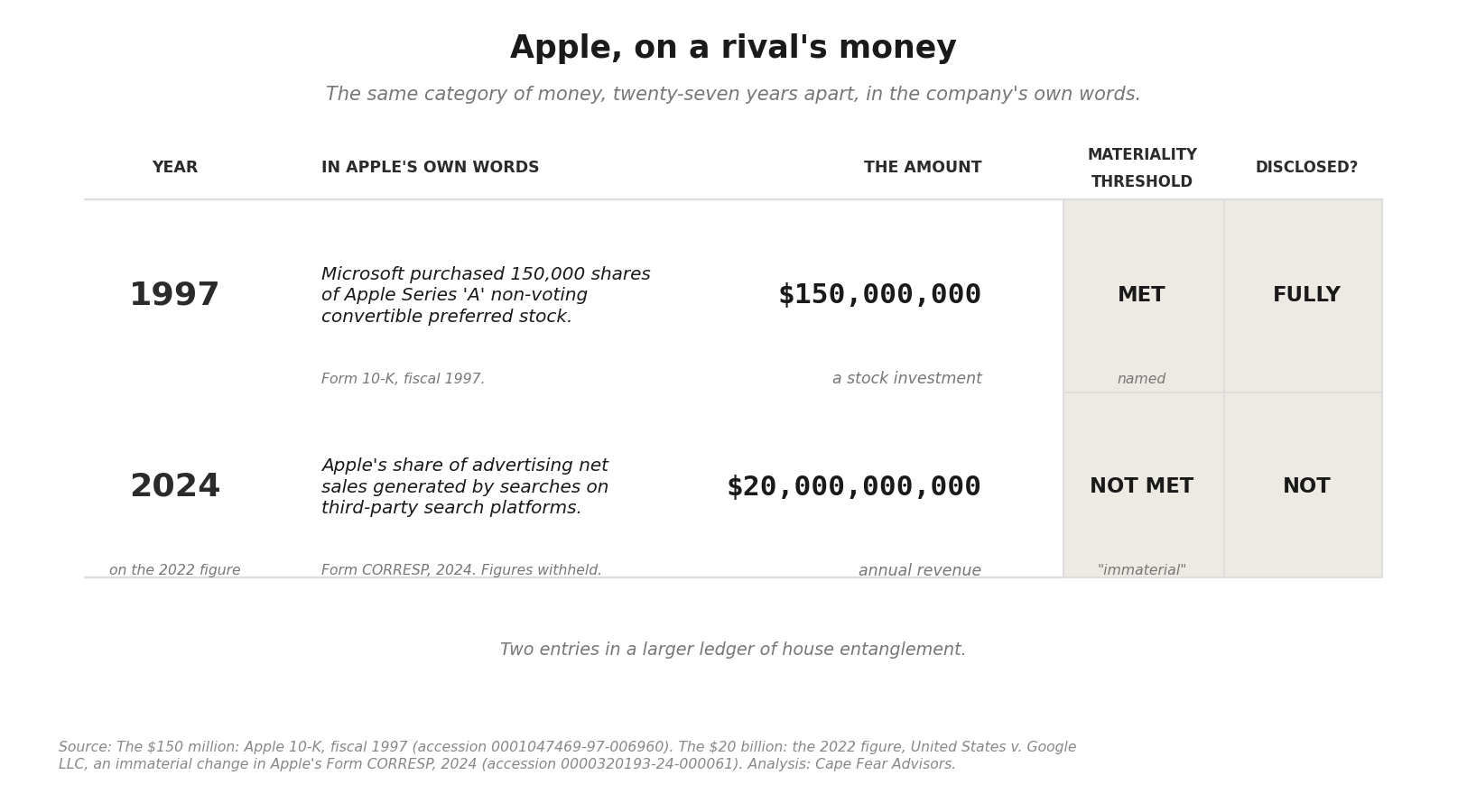
Apple disclosed the money the way a company discloses something that matters. It named the buyer. It gave the investment its own class of security, Series A Non-Voting Convertible Preferred, and it filed the certificate that defined the stock and the agreement that governed its sale, both by name, both in the exhibit list of that year’s annual report. (2) A hundred and fifty million dollars, from a rival, at the edge of bankruptcy, was material by any reasonable threshold, and Apple treated it that way: in the light, on the record, with the counterparty’s name attached.
And the same dollars tell the story twice. To Apple, a hundred and fifty million dollars was the difference between solvency and its opposite, and Apple gave the money a name, a class of stock, a certificate. To Microsoft, a hundred and fifty million dollars was small, and Microsoft never named it. The Apple stake it folded into an unnamed line for strategic technology investments and left there, never a named holding, coming or going; (3) the investments that were large enough to matter to Microsoft, it named, carried at fair value on its own balance sheet, and tracked for years. (4) The same money, at the same moment, was a named, material position on one balance sheet and a nameless, immaterial one on the other. Nothing about the dollars changed between the two ledgers; only the size of the house doing the counting. When Microsoft sold, in 2003, it more than tripled its money, having already helped keep Apple alive; the investment did its job and then some. The same stake held would be worth some three hundred billion dollars today, an arithmetic curiosity rather than a verdict on the sale. (5)
Twenty-seven years later another rival’s money arrives, and Apple has a different word for it.
In April of 2024, answering the Securities and Exchange Commission, Apple’s chief financial officer wrote that “the change in Services net sales was both quantitatively and qualitatively immaterial.” (6) The money at issue is what Google pays Apple to be the default search engine on the iPhone, roughly twenty billion dollars on the last figure the record holds, from 2022, which reached the public record not because Apple disclosed it but because, in a separate courtroom, Apple moved to seal the testimony that contained it and the motion failed. (7) The company that named a hundred and fifty million dollars to the share now declines to size a number more than a hundred times larger, and calls the change it drove beneath an investor’s notice.
Twenty billion dollars is about a hundred and thirty-three times a hundred and fifty million: the rescue that saved the company, paid over again every year, and the change it drives now called immaterial. Nothing about the money grew smaller. The company grew larger.
The word did not arrive on its own. In the spring of 2024 the Securities and Exchange Commission asked Apple, twice, to disclose more: to quantify what was driving the change in Services net sales, drivers Apple’s own quarterly filing had led with advertising, and to break the segment out by type. Apple declined. It answered that the change was quantitatively and qualitatively immaterial, that further detail would only be “information overload,” and it provided the figures the staff had asked for to the regulator under separate cover, withheld from the public letter. The staff completed its review a few weeks later with no further comment; the answer stood, and the figures stayed off the public page, on a file the Commission’s own closing letter says it neither endorses nor passes upon. (6) That is the posture in one venue: too immaterial to disclose. In the other, the antitrust courtroom, Apple had argued that the same number was too commercially sensitive to reveal, and only a failed motion to seal put it on the public record at all. (7) The two rooms run on different tests, investor materiality in one and competitive sensitivity in the other, which is how both papers could be signed. The tests differ; the payment does not. On one filed record the change is beneath an investor’s notice; on another, the figure is too sensitive for the public to see.
Materiality is a judgment, not a fact
Apple belongs on the same page as the four houses this series has already read, Microsoft and Amazon and Alphabet and NVIDIA, and materiality is why. Materiality is not a property of a number. It is a judgment, made by the party disclosing, and it tracks the size of the teller rather than the weight of the money. A hundred and fifty million dollars was material to a company worth a few billion; twenty billion is small against a company worth nearly five trillion. The standard did the thing it is built to do. It measured the money against the house, and the house had grown.
Materiality is not a property of a number. It is a judgment, made by the party disclosing, and it tracks the size of the teller rather than the weight of the money.
Every choice here was available under the rules as written, and a company may make the disclosure judgments the standard permits. What the rules allow is the whole of the story. (8)
What makes a house
A word this series has used since its first entry deserves a plain definition, and Apple is the case that supplies it. A house is not merely a large company, and it is not simply a participant in the buildout. Two things set a house apart, and they sit in an order.
The first is position. A house takes a structural cut of the table rather than a player’s seat at it, and it tends to stand on more than one side of a single counterparty at once. NVIDIA sits behind CoreWeave as an owner, across from it as a supplier, and in front of it as a customer. Alphabet is at once Apple’s payer, its supplier, its competitor, and the party whose legal remedy Apple’s revenue turns on. A player occupies one chair and can be counted where it sits. A house occupies several, and cannot be read from any one of them alone. That position is what earns a seat on this ledger, and it is why Apple belongs here despite looking, from the outside, like a standalone maker of devices: its cleanest revenue is another house’s money.
The second is what the seat buys. A house is large enough to set the terms of its own disclosure, to decide what is material and what is immaterial, what is named and what is not, and to make that judgment anywhere on its statements. The discretion scales with size. Alphabet exercises it at its investment line, where a large mark is folded into an aggregate; Microsoft at its earnings line, where one gain is set aside from the measure it prefers; Apple at its revenue line, in the word this piece began with. Each does it at a different place on the page, because each is large enough that the judgment holds.
Put the two together and the definition is a hierarchy. Position earns the seat; size is what the seat buys. Apple carries both in one body, the toll it takes and the word that leaves it unsized. And the test points past the five. Meta, built as one of the largest buyers of the machines, is reported to be preparing to sell their spare output to others, a step from the demand side of this table toward the supply side of it. (9) That is reported, not yet filed, and the distinction is the point: the capability is announced, and the frame will know the house when a filing carries the revenue. The definition is drawn so that the next house is recognized by the same two marks, position first and size behind it.
Houses working with houses
A rival’s money has flowed into Apple for its entire life, and only the label changed. In 1997 it was a lifeline, and Apple named it; now it is a toll, and Apple does not size it. The toll closes a circle the market rarely says out loud. Money pools into Google. Google turns search into one of the most profitable toll booths in business. And a slice of that toll, on the order of twenty billion dollars on the 2022 record, flows back to the rival, Apple, to keep the search box on the iPhone pointed at Google. An investor in Google is, in part, paying Apple. (10) Owning one house helps fund the other. The houses are not separate businesses that happen to compete; they are counterparties, wired to one another, and the wiring runs through a line Apple calls immaterial.
The wire runs both ways now, on the reported record. Apple has not built a frontier model of its own, and it is reported to be paying Google on the order of a billion dollars a year for Gemini to power the rebuilt Siri. (11) Google pays Apple to hold the search default; Apple pays Google to run the assistant that may one day replace it; and neither figure appears on either company’s public page. Two houses that compete in the open pay each other, in both directions, for the same ground, and book both flows without a number.
That line is among the most valuable cash Apple has. The Google payment lands in Services, the segment the market prizes above Apple’s hardware, the recurring, high-margin, software-shaped revenue that carries a richer multiple than the rest of the company and that the market reads as pristine. And a large piece of that pristine cash is a single check, from a single counterparty, that also competes with Apple in phones and in models and now in the assistant that may replace the search box itself. It is cash with nearly every quality of cash except the two that matter most, durability and independence. It arrives on the sufferance of one company and one regulator, and how it nets is the whole of the question the quality-of-cash lens exists to ask. That is Apple’s signature as a house. The other four take marks. Apple takes a toll, and books it as its cleanest money.
It is cash with nearly every quality of cash except the two that matter most, durability and independence. It arrives on the sufferance of one company and one regulator, and how it nets is the whole of the question the quality-of-cash lens exists to ask.
One more filed fact belongs beside the payment, and it is Apple’s own name for the money. In its taxonomy the Google arrangement is “Browser,” a line inside advertising net sales, “Apple’s share of advertising net sales generated by searches on third-party search platforms.” (6) Apple named it that precisely, to the staff, and left it nameless on its public page, folded into Services. By the company’s own classification the payment, roughly twenty billion dollars on the 2022 record, is advertising revenue, a share of the searches its users run, paid by the company that monetizes them. Apple is in the advertising business, and not tangentially, by its own description; it had the occasion to say so on its own page, and kept to the broader bucket.
What the house calls immaterial
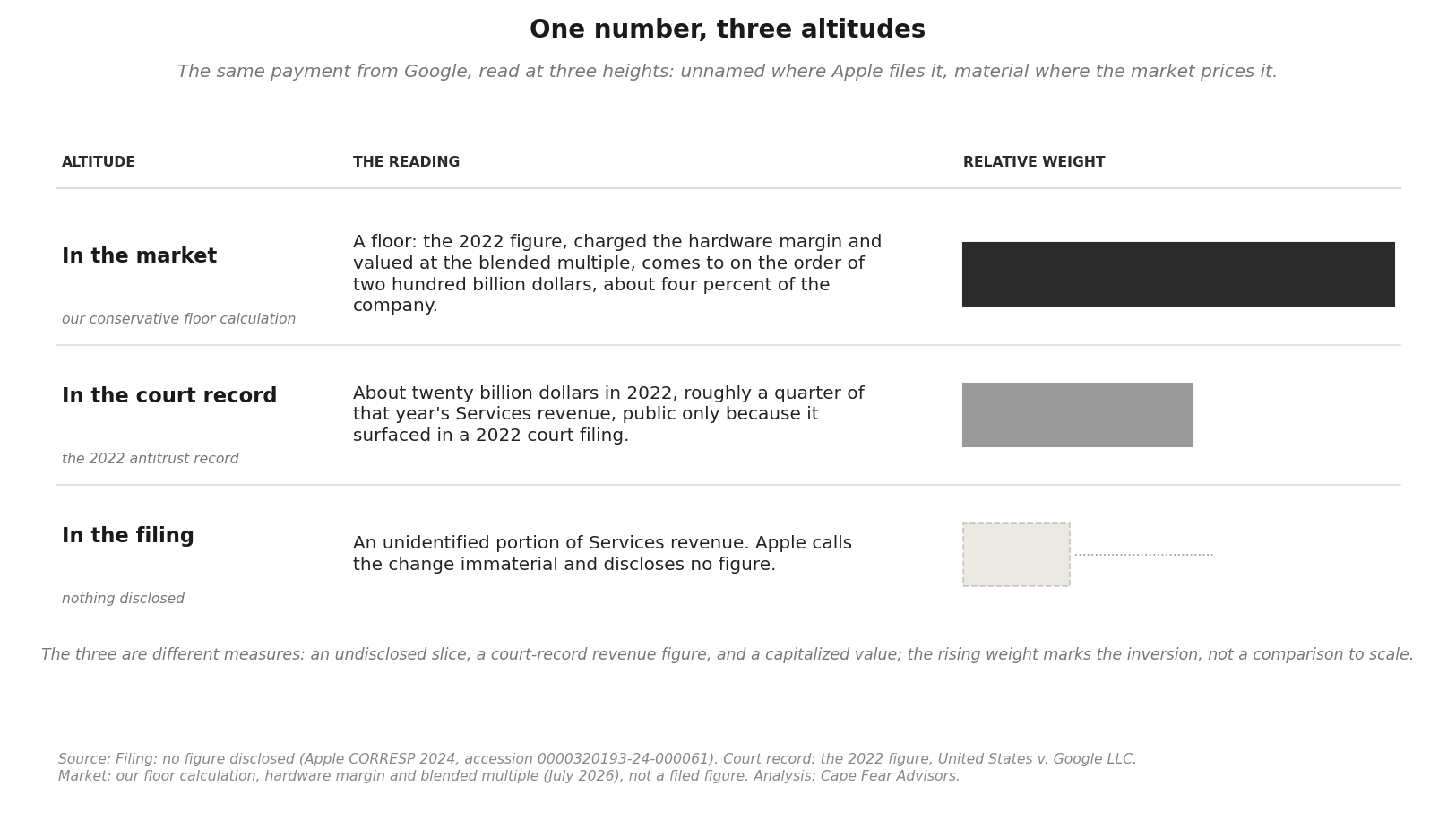
The word does its heaviest work on Apple’s own mark, its share price. At the level of the filing there is nothing to weigh: Apple calls the change immaterial, discloses no figure, and the payment sits as an unidentified portion of Services revenue, there to infer and not to see. At the level of the court record one number exists, about twenty billion dollars in 2022, roughly a quarter of that year’s Services revenue, and it is public only because a 2022 court filing put it on the record. And at the level of the mark, that revenue capitalizes into the share price, where its size can be floored rather than guessed.
Take the 2022 figure, roughly twenty billion, the last the record holds and, for all anyone outside Apple knows, an understatement of what the payment is today. Charge it Apple’s hardware margin, about thirty-nine percent, well below the roughly seventy-seven percent Services earns. And value the result the way the market values the rest of Apple’s gross profit, at the blended multiple, with no premium for the higher one Services commands. So floored, on assumptions that are ours and not the filing’s and conservative at every turn, the payment accounts for something on the order of two hundred billion dollars of Apple’s market value, about four percent of the company. (12) It is a calculation, a portion of the current value shown as if this dollar were worth exactly what every other Apple dollar is worth, and every choice in it leans low; the true contribution is plausibly larger on all three counts. A skeptic will answer that the market already knows the figure and discounts it, so the piece is smaller still. That may be so, and it leaves the point standing: the filer does not size it at all, and the market, at any multiple it likes, does. What the filing calls an immaterial change is, even floored, a material piece of the number the market most rewards.
And whether it continues is itself open, with a search-monopoly remedy on one side and, on the other, the migration of the query out of the search box and into an assistant. A material, continuation-uncertain piece of Apple’s mark sits outside the filings built to carry it, under a single word. Immaterial is not a footnote here. It is what keeps the material out of view.
What has to happen next
What happens to that twenty billion is filable, and it is worth watching from two directions. If the courts bar or reshape the default-search arrangement, the cut falls on Apple’s Services margin, not only on Google’s distribution. And if the query itself leaves the Safari box for an assistant, whoever’s assistant it turns out to be, the ground the payment stands on thins, which is the same marginal-query problem the rest of this series has read at the level of the chip, moved one layer up, to the search bar, where the actual cash changes hands.
There is a third direction, and the courts and the market do not control it; the house does. Apple can play the AI shift more ways than perhaps any other party at the table, and it is not forced into any of them. The bets can go in every direction, and whichever it places will show the materiality of this house, and it may put to the test the true materiality of the very tie it now calls a change beneath notice.
The size is the point. Apple holds about a hundred and thirty-two billion dollars in cash and marketable securities, and in its last fiscal year it took in four hundred and sixteen billion dollars and turned a hundred and eleven billion of that into operating cash. (13) That is a house with the balance sheet to play at the scale of the buildout, and it is also one of the few houses at which a twenty-billion-dollar payment from a competitor, or a partner, or both at once, can be set down as immaterial. Twenty billion is a nickel on the revenue dollar here. It only looks like nothing from this height.
That is Apple, the fifth house. It is the edge of the buildout rather than its engine, the demand rather than the supply, and its tell is not a mark it takes but a toll it books as its finest cash and does not size. The larger question sits just past this piece and keeps for its own day: the same word, immaterial, is the one under which a house’s heaviest dependences go unnamed, and whether a materiality standard that measures the money against the house still means anything when the houses are worth trillions is a question the standard has not yet been made to answer. A rival’s money saved the company once. A single word now keeps its successor out of view. Only the company changed.
DISCLOSURE, standing: Anthropic is the developer of Claude, which is used in preparing this research. CoreWeave announced a multi-year agreement with Anthropic in April 2026; Amazon and Alphabet, named in this piece, hold large positions in Anthropic; NVIDIA supplies the infrastructure providers that serve Anthropic. Figures are quoted from the filers without characterization, and the same standard of reading is applied to every filer named.
Figures are verified against the primary filings; documents are cited by accession number. Analysis: Cape Fear Advisors.
Cape Fear Advisors holds no position in any security named in this analysis and has received no compensation from any company discussed.
This analysis also appears on Substack.
Notes
(1) Steve Jobs, Macworld Expo, Boston, August 6, 1997, announcing Microsoft’s investment (verbatim from the keynote). A widely circulated line, “Thank you, Bill, you just made the world a better place,” conflates the 1997 keynote with a separate, later remark of Jobs’s about Gates’s philanthropy and is not used here.
(2) Apple Computer, Inc., Form 10-K for the fiscal year ended September 26, 1997, accession 0001047469-97-006960: “Microsoft purchased 150,000 shares of Apple Series ‘A’ non-voting convertible preferred stock for $150 million.” Filed with it: Exhibit 4.9, Certificate of Determination of Preferences of Series A Non-Voting Convertible Preferred Stock; Exhibit 4.10, Registration Rights Agreement dated August 11, 1997, between Apple Computer, Inc. and Microsoft Corporation.
(3) Microsoft Corporation, Form 10-K for the fiscal year ended June 30, 1998, accession 0001032210-98-001067: the report names Microsoft’s $1.0 billion investment in Comcast Corporation (“Comcast Special Class A common stock and convertible preferred stock are included in equity investments”) and does not name the Apple stake, which fell within Microsoft’s aggregate strategic technology investments. The only mentions of Apple in the filing are as a competitor. In Microsoft’s Form 10-K for the fiscal year ended June 30, 2003, accession 0001193125-03-045632, the same holds: Apple appears only as a competitor, and the disposition of the Apple position is not separately disclosed.
(4) The Comcast position, by contrast, is an interesting note in its own right, and it says more about Microsoft than about Apple. Microsoft carried its Comcast securities at fair value and named them in its risk factors as a held position through the fiscal 2004 10-K (accession 0001193125-04-150689); by fiscal 2005 only a backward-looking reference to them remained, and after fiscal 2005 Comcast does not appear in a Microsoft 10-K again. Even the exit of that named, billion-dollar holding was never itemized; it dissolved into net recognized gains and losses on investments. Microsoft named its material current holdings and aggregated their disposals. Apple never rose to a named holding at all.
(5) REPORTED (contemporaneous press and analyst reconstructions; Microsoft did not itemize the position or its disposition in its filings, as notes 3 and 4 record). Microsoft converted its preferred to approximately 18.1 million common shares (measured after the June 2000 split) by 2001 and sold its entire Apple position by 2003 for roughly five hundred and fifty million dollars, more than three times the original investment. The held-stake comparison is our arithmetic on market data as of July 2026: adjusted for Apple’s subsequent splits (2005, 2014, 2020), the same stake would be worth on the order of three hundred billion dollars today, about six to seven percent of Apple. The comparison is arithmetic, not a second-guess of a sale that returned several times its cost and helped keep a customer and partner solvent.
(6) Apple Inc., Form CORRESP filed April 29, 2024, accession 0000320193-24-000061, signed by Luca Maestri, chief financial officer, responding to comment letters of the Division of Corporation Finance dated March 6 and April 2, 2024 (accessions 0000000000-24-002512 and 0000000000-24-003505), on the Form 10-K for the fiscal year ended September 30, 2023. The staff asked Apple to quantify the drivers of the change in Services net sales under Item 303(b) of Regulation S-K, having noted that Apple’s own quarterly filing attributed the increase “primarily” to “advertising, video and cloud services,” and to break Services out by type, advertising included, under ASC 280-10-50-40. Apple declined, concluding that “the change in Services net sales was both quantitatively and qualitatively immaterial” and that further detail would be “information overload”; the requested figures were provided to the staff under separate cover and withheld from the public letter under a request for confidential treatment (Rule 83). In the same reply Apple classified the arrangement as “Browser,” “Apple’s share of advertising net sales generated by searches on third-party search platforms,” “with the customer being third-party search platforms.” The staff completed its review on May 16, 2024 (accession 0000000000-24-005673) with no further comment, reminding Apple that it remains responsible for the accuracy and adequacy of its disclosures “notwithstanding any review, comments, action or absence of action by the staff.”
(7) The figure of approximately twenty billion dollars for 2022 is in the record of United States v. Google LLC, No. 1:20-cv-03010-APM, in the United States District Court for the District of Columbia. It became public when Apple’s effort to seal the testimony that carried it was denied. The exact amount was not itemized in the record, and the current figure is not public. Apple’s Services net sales for fiscal 2022 were approximately $78.1 billion (Apple Form 10-K for the fiscal year ended September 24, 2022, accession 0000320193-22-000108), against which roughly twenty billion is about a quarter.
(8) The magnitude of the arrangement is something neither party puts on its own page, and the systemic question that raises is left to a separate piece. In the antitrust case Apple moved to seal the terms that tied the payment to its source, and the motion failed, which is the only reason the 2022 figure is public. (7) In its securities filing Apple calls the change immaterial and withholds the figure under a request for confidential treatment. (6) Alphabet, on the other side of the payment, folds it into aggregate traffic-acquisition costs and does not name Apple. (10) Each keeps the size of the tie off its own record by the instrument its venue allows.
(9) REPORTED, not filed. In early July 2026, Bloomberg and others reported that Meta is preparing a business, described as “Meta Compute,” to sell excess artificial-intelligence computing capacity to outside customers, on a model likened to CoreWeave’s, alongside a large reported infrastructure commitment. No such revenue is separately reported in a Meta filing as of this writing; the step from buyer to supplier is a reported plan, and it is noted here only as the frame’s nearest forward case, to be tested against the record when a filing carries it.
(10) Alphabet Inc., Form 10-K for the fiscal year ended December 31, 2022, accession 0001652044-23-000016. The payment to Apple falls within cost of revenues, in traffic acquisition costs (TAC), described only as amounts paid to unnamed “distribution partners” (browser providers, mobile carriers, and the like); Apple is not named in connection with these payments.
(11) REPORTED, not filed. In January 2026 Apple selected Google’s Gemini to power a rebuilt Siri, on terms reported at roughly one billion dollars a year (CNBC and others, January 2026). The arrangement is reported and is not broken out in either company’s filings.
(12) A Cape Fear Advisors floor calculation, not a filed figure, built to be conservative at every step. It begins from the 2022 payment of roughly twenty billion dollars, the last figure on the record; the current payment is not disclosed and may be larger, so the base itself understates. It charges that revenue Apple’s hardware gross margin of about thirty-nine percent, well below the roughly seventy-seven percent Services earns (both from Apple’s fiscal 2026 second-quarter results), giving on the order of eight billion dollars, about four percent of Apple’s total gross profit of roughly $190 billion (note 13). Valued at the same multiple as the rest of Apple’s gross profit, with no premium for the higher multiple Services commands, that is about four percent of Apple’s market capitalization of roughly four and eight-tenths trillion dollars (share price about $326, July 20, 2026), on the order of two hundred billion dollars. Each assumption is the low one, the dated revenue, the hardware margin, the blended multiple; the true figure is plausibly higher. The multiple and market capitalization are market data as of the date and will move.
(13) Apple Inc., Form 10-K for the fiscal year ended September 27, 2025, accession 0000320193-25-000079: total net sales $416.2 billion; net income $112.0 billion; cash generated by operating activities $111.5 billion; cash, cash equivalents, and marketable securities, current and non-current, approximately $132.4 billion; total gross profit approximately $190 billion (net sales less cost of sales).