

A generation ago, reading a company meant getting behind its reported earnings to the cash that confirmed them. That test, the quality of earnings, still stands. The contracted backlogs of the current build-out add a second number that needs the same scrutiny, a claim on cash not yet paid, and they call for a second test alongside the first: the quality of cash. Oracle’s annual report, filed this month against $638 billion of contracted future revenue, is where we strain it, and the answer, as always, sits in the footnotes.
The annual report names plenty
When we read Oracle’s fourth-quarter results earlier this month, we left one question open: whether the annual report, when it came, would name the customer behind the backlog. It came. It does not.
The filing names plenty. Its competition section names the companies Oracle competes with, in full and by legal name, including Adobe, Amazon, Microsoft, and SAP, among others. It names a transaction partner, too. On November 25, 2025, SoftBank Group Corp. acquired Ampere Computing, and Oracle received $4.3 billion in exchange for its equity, debt and call option interests, on a $2.7 billion realized gain. The sale is disclosed and the buyer is named.
That is the only name from the AI-infrastructure story anywhere in the filing, and it appears on a sale. The pattern is consistent. Oracle names the companies it holds equity in: Ampere, and TikTok USDS Joint Venture LLC, a 15 percent stake that is the substantial majority of its non-marketable investments. It names the buyer when it sells one. Investments and dispositions carry the name, because the accounting compels it. The customers behind $638 billion of contracted future revenue are aggregated, carried as a group.
There is a reason for it. A sale of an investment requires the filing to name the buyer. A revenue contract leaves the customer to the aggregate. The name appears where the accounting calls for it, and the customers, where it allows the group, are carried as a group.
The same logic runs through the rest of the filing. The next time it appears, it governs a number rather than a name.
The number is $638 billion
The number is $638 billion. It is the largest figure in the filing, and the one the market reads as proof of demand. Remaining performance obligations: revenue under contract, not yet delivered, not yet earned. Backlog.
It is a promise of future payment. The total of what customers have agreed to pay, carried forward and stated as a single figure, its value dependent on the contracts converting as written, over horizons that run past five years, at the rate and on the schedule the company expects. An estimate of future cash, presented as a present fact. A mark.
The accounting already has a standard for numbers like that. When a figure on a balance sheet is an estimate built on inputs no one can observe, fair-value measurement calls it Level 3 and asks the company to disclose the unobservable inputs and to show how the number moves when they change. The premise is that an estimate this soft is owed context; the reader is owed what it rests on. A backlog is the same kind of number, an estimate of future cash built on unobservable inputs, conversion, discount, and the customer’s performance among them. It is disclosed under the revenue standard instead, which asks for the aggregate and the timing. The same figure, under the fair-value standard, would carry the inputs and the sensitivity. The sensitivity belongs to that standard, and the backlog is filed under the other one.
“The discipline for reading a number that way is a generation old. It grew up around earnings, which are a record of the past. The backlog adds a second number that needs the same kind of testing, and it is a different kind of number.”
The discipline for reading a number that way is a generation old. It grew up around earnings, which are a record of the past: reported income could be real on the page and soft underneath, and the way to read a company was to get behind the recognized figure to the cash that stood behind it. Call it the quality of earnings. The income statement made a claim; the cash flow statement settled it. The work could be done inside one company’s filing, and it still can. That test has not retired.
The backlog adds a second number that needs the same kind of testing, and it is a different kind of number. Earnings look back; the backlog looks forward. It is a claim on cash not yet paid, owed by customers against contracts that run for years, and a claim on the future answers to a different test than a record of the past. Call it the quality of cash. It joins the quality of earnings rather than replacing it: one number for what has been earned, one for what is still to come. So the question for the backlog is the plain one. How much of the $638 billion is already backed by cash, and how much is an expectation.
Oracle answers it, across more than one page
Oracle answers it, in the way answers come, across more than one page. The annual report disaggregates the backlog by time. In its words, it expects to recognize “approximately 12% as revenues over the next twelve months, 34% over the subsequent month 13 to month 36, 34% over the subsequent month 37 to month 60 and the remainder thereafter.” It elected an available exemption and gave the schedule anyway. The reader can see when the company expects the revenue to arrive.
That disaggregation runs by time. It stops there. The $638 billion stands as a single figure, the funded portion and the portion still to be raised held together within it.
The split does exist. Twelve days before the annual report was filed, the earnings release reported that “the prepaid and customer supplied hardware portions of our large AI contracts now total $75 billion,” and that this “substantially reduces the amount of capital Oracle must raise.”
The same $638 billion, disclosed twice. The earnings release, furnished June 10, marks the $75 billion. The annual report, filed June 22, carries the figure whole.
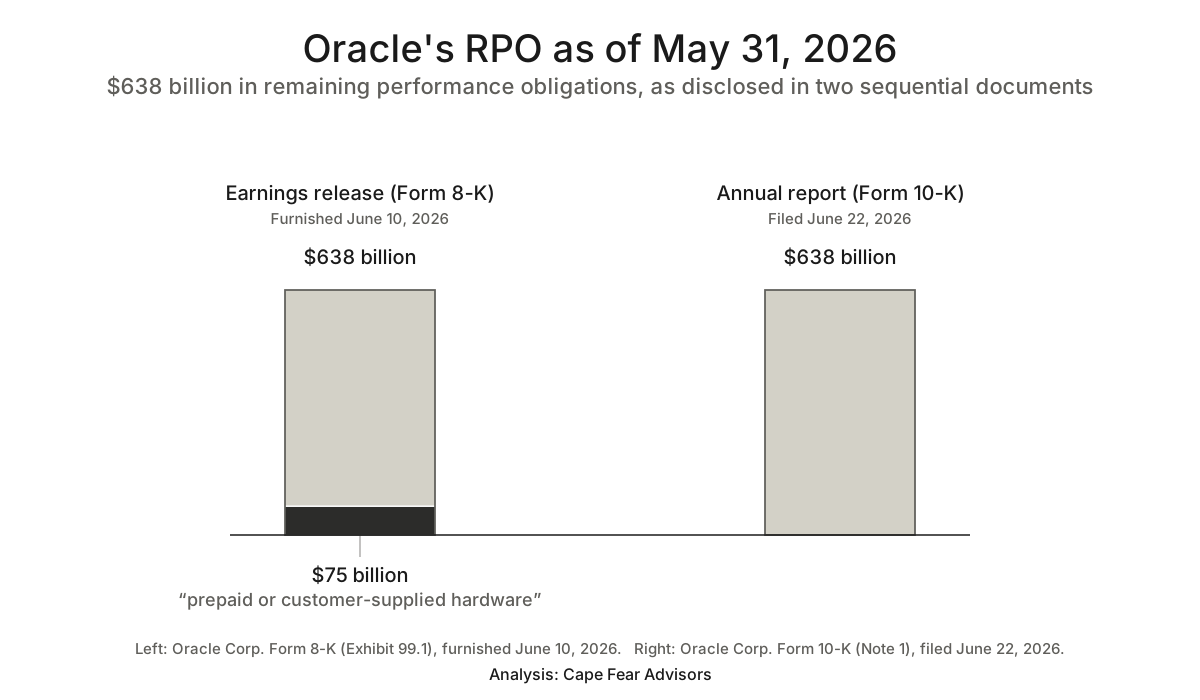
The number is true in both places; a company puts in a release only a figure it will stand behind. What changes between the documents is its necessity. The release was describing the quarter, of a buildout that needs less outside capital than its size suggests, and the $75 billion belongs to that description. The audited statements carry what the standard asks, and the standard asks for the aggregate and the timing. The figure appears where the description called for it, and the statements stand complete without it.
The certainty of the cash is itself a judgment
So we accept the $638 billion, and the judgments folded into it. A backlog this size carries many: when the contracts convert, at what discount, whether the customer performs. Oracle discloses the schedule and stands behind the figure. We accept it.
The judgments are not all equally visible. The schedule is on the page; the discount is in the method; the amount is in the release. The one that is hardest to see is the certainty of the cash that has not yet come, owed by customers, over years. That certainty is itself a judgment, and it is the one the backlog number leaves unspoken, because a single figure carries its magnitude but not its degree of doubt.
Oracle carries that, too, in a different section. Among the risk factors, the company writes that some of its customers “may be highly leveraged and subject to their own operating and regulatory risks,” and that it “may experience risks of non-payment and non-performance.” Should its key customers prove unable to pay or otherwise perform, the company writes, it “could be locked into multi-year commitments for excess data center space and related capital expenditures, as well as associated financings, without receiving corresponding revenue.”
“That is the company stating, in its own words, that the certainty of the forthcoming cash is a judgment. The backlog and that sentence are in the same filing.”
That is the company stating, in its own words, that the certainty of the forthcoming cash is a judgment. The backlog and that sentence are in the same filing. The number says how much is coming. The risk factor says that whether it comes is a judgment about someone else. Both are disclosed. Both are true. The work is to hold them at once.
The test travels
That is the test, and it travels. The question it carries into any filing of this kind is the plain one: of the backlog presented as a present fact, how much is cash, and how certain is the cash still to come. The answer to the second half lives partly outside the filing that reports the number, in the party that owes it. A reader can accept the backlog, as we accept Oracle’s, and still hold the question open. Oracle answered it where the standard let it: in the release, and in the risk factors. The question is what the test adds. The filing is where the asking begins.
“Analysis: Cape Fear Advisors. Sources: Oracle Corp. Form 10-K for the fiscal year ended May 31, 2026, filed June 22, 2026; Oracle Corp. Form 8-K (Exhibit 99.1), furnished June 10, 2026. Accounting standards referenced: ASC 606, Revenue from Contracts with Customers; ASC 820, Fair Value Measurement.”
Notes
- Oracle Corp., Form 10-K for the fiscal year ended May 31, 2026 (filed June 22, 2026), Item 1, “Competition.” The full enumeration: “Adobe Systems Incorporated, Alphabet Inc., Amazon.com, Inc., Cisco Systems, Inc., Intel Corporation, International Business Machines Corporation, Microsoft Corporation, Salesforce, Inc. and SAP SE, as well as other companies like Hewlett-Packard Enterprise and Workday, Inc.”
- Form 10-K, Notes to Consolidated Financial Statements. “On November 25, 2025, SoftBank Group Corp. acquired all of the equity interests of Ampere (the Ampere Acquisition). We received cash proceeds of $4.3 billion in exchange for our equity, debt and call option interests in Ampere… We recorded $2.7 billion of realized gain.”
- Form 10-K, Notes. “The substantial majority of the non-marketable investments we held as of May 31, 2026 were with TikTok USDS Joint Venture LLC, an equity method investee in which we have an ownership interest of 15%.”
- Form 10-K. “Remaining performance obligations were $638 billion and $138 billion as of May 31, 2026 and 2025, respectively.” The same figure is reported in Oracle’s fourth-quarter earnings release, furnished on Form 8-K (Exhibit 99.1) on June 10, 2026.
- The comparison here is to the kind of estimate, not the accounting category. A remaining performance obligation is disclosed under ASC 606, Revenue from Contracts with Customers, which calls for the aggregate transaction price allocated to unsatisfied obligations and an explanation of when the entity expects to recognize it (606-10-50-13). It is not a fair-value measurement and is not claimed to be one. The point is only this: an RPO of this kind is an estimate of future cash resting on inputs that cannot be observed from outside the company, which is the same character of estimate that, when it appears as a fair-value measurement, ASC 820 classifies as Level 3 and subjects to disclosure of the significant unobservable inputs and a sensitivity analysis (820-10-50). The two standards govern different things and are not interchangeable. What travels between them is the nature of the number, an unobservable estimate of future cash, and the observation is that the disclosure attaching to that nature differs depending on which statement the number lands in. Oracle itself applies ASC 820 elsewhere in the same filing.
- Form 10-K, Note 1. Oracle elected the practical expedient available under ASC 606 that permits omitting the timing of remaining performance obligations, and provided the quantitative schedule regardless.
- Oracle Corp., Form 8-K (Exhibit 99.1), furnished June 10, 2026. The $75 billion figure for the prepaid and customer-supplied hardware portion appears in the earnings release. It does not appear as a line in the audited financial statements of the Form 10-K filed June 22, 2026. An 8-K earnings release is furnished rather than filed: under Item 2.02 it is “not deemed filed” for purposes of Section 18 of the Exchange Act and is not incorporated into the registration statement. The 10-K is filed and audited. The distinction is not raised to suggest the figure is doubtful in either place; it is almost certainly accurate in both. It is raised because the funding characterization that bears most directly on the quality of the cash is present in the document that carries the lighter disclosure obligation and absent from the one that carries the heavier.
- Form 10-K, Item 1A, Risk Factors. Quoted verbatim; the fragments are drawn from the risk factor addressing large, long-term customer arrangements.
The quality of cash is a framework introduced by Cape Fear Advisors for reading contracted revenue and realized claims across the AI infrastructure buildout. The second application, against NVIDIA’s $40.7 billion receivable, is here. See also: Oracle Just Said a Lot About OpenAI. The full series is available on Substack.
Greg Collins serves as CEO of C3 Metrics, a marketing measurement and analytics firm, and maintains an advisory practice at Cape Fear Advisors focused on structural analysis and strategy.
Start a Conversation →