

Two days ago, against Oracle’s annual report, we set a second test beside the quality of earnings and called it the quality of cash: of a number presented as a present fact, how much is cash, and how certain is the cash still to come. Here we use it again.
The backward test is not the one this piece asks
The quality of earnings asks whether reported income is confirmed by cash; it looks back. NVIDIA’s first quarter answers it plainly: revenue $81.6 billion, operating cash flow $50.3 billion against $1.8 billion of purchases of property, equipment and intangible assets. That is the backward test, and it is not the one this piece asks.
The quality of cash asks the forward one. A backlog — revenue under contract, not yet delivered — is an estimate of future cash, resting on inputs no one outside the company can observe: whether the contracts convert, at what discount, whether the customer performs. It is a promise, stated as a present fact. Against Oracle, that promise was $638 billion, and the work was to strain it.
As of April 26, 2026, NVIDIA’s remaining performance obligations on contracts greater than one year were $2.6 billion. Against it, the balance sheet carried $40.7 billion of accounts receivable.
The near-cash number is the large one
The two are different kinds of number. The backlog is an estimate that runs for years and turns on judgments the reader cannot check. A receivable is revenue already earned and already billed, a current asset, carried net of the company’s allowance for amounts that may not pay — an allowance that, against $40.7 billion, stands at $4 million. It requires less judgment, and it allows less. The near-cash number is the large one; the estimate is the small one.
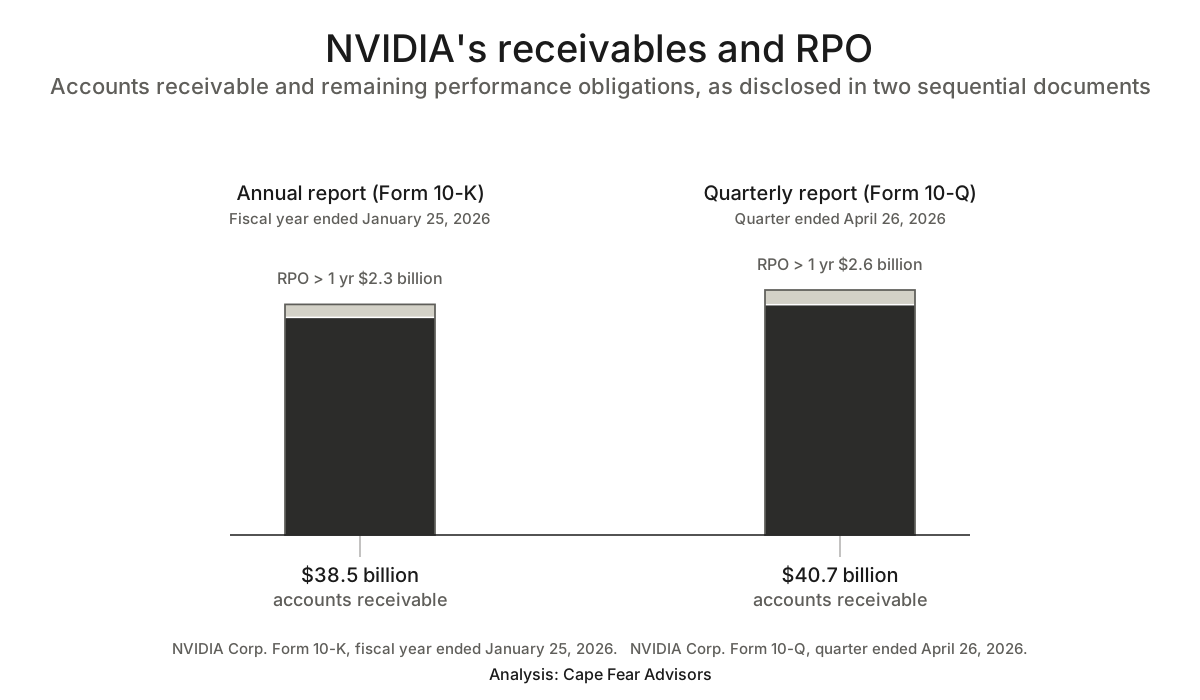
NVIDIA reports both, in both filings, in both periods. The annual report, for the year ended January 25, 2026, carried $38.5 billion of receivables against $2.3 billion of obligations; the quarterly report, three months later, $40.7 billion against $2.6 billion. The line items are required, and the required figures carry the realized claim ahead of the promised one.
“The near-cash number is the large one; the estimate is the small one. The same two kinds of number fall in opposite proportion.”
The one number that could soften the loop
The circular financing is real — NVIDIA holds equity in companies that buy its compute, which we read in May — and the mark those stakes produce is where a soft number would sit, if one did. The investments generated the bulk of $15.9 billion in other income for the quarter, lifting net income to $58.3 billion. That is the number to press. It does not reach the cash; the cash flow statement removes it to arrive at operating cash. The larger part is marked to quoted market prices; the rest is carried, in the company’s words, ‘at cost minus impairment, if any, and… adjusted for observable price changes,’ moved only on an observed transaction. The markup is the one mark-to-market requires; the removal from cash is the one the instruction directs; and an impairment, the filing says, would be measured the same observable way. The number is hard not by election but by rule. It moves only on what can be observed, in either direction, and only as non-cash. The one number that could soften the loop is the one the company is given no room to soften.
And the cash is there. At quarter end NVIDIA held $13.2 billion in cash and equivalents and $37.1 billion in marketable debt securities, against $259.5 billion of total assets. It raised no debt in the quarter; financing activity was a net use of $21.3 billion, nearly all of it returned to shareholders, against $7.5 billion of long-term debt outstanding. A separate $13 billion went out during the period for a technology license. The ring such a company runs is funded from what it holds.
The concentration says by whom
So we accept the position the filing shows, and read the second question a realized claim raises. The first — is it cash — the allowance answers. The second is who owes it. Three direct customers accounted for 30%, 18%, and 16% of the receivable at quarter end, two-thirds of it in three names; a quarter earlier the figures were 25%, 18%, and 13%. Which of the three sit among the companies NVIDIA funds is not separately disclosed under the segment structure introduced this quarter. The same small promise carries no soft backlog, and no forward floor either: almost nothing is under contract beyond the quarter. What stays open is whether the realized claim stays realized as that funded demand matures and the cadence that earns it turns. The company carries the cadence in its own words. It brings new architectures ‘on a one-year product cadence,’ and notes that ‘customers may postpone purchasing new architectures or may adopt new technologies more gradually than anticipated.’ The receivable says how much has been earned. The concentration says by whom. The risk factor says the pace that earns it is the company’s own. All are disclosed. All are true. The work is to hold them at once.
“The ring is the same in both. A company sells; the buyer it helped fund pays; the cash returns and funds the next sale.”
What differs is its quality
Against Oracle, the near-cash portion was the smaller share of a long promise, and the company supplied the figure that sized it. Against NVIDIA, it is the larger share, carried in the required filings. The same two kinds of number fall in opposite proportion.
The ring is the same in both. A company sells; the buyer it helped fund pays; the cash returns and funds the next sale. Within the accounting structure and the disclosures, that ring can be completed. It works. Nothing requires a company to complete it, and the filing does not say whether one has. Both rings run on cash; what differs is its quality — how much is earned and how much promised, how near it is, how much judgment stands between the number and the money. The next filing will move the proportion or hold it, and the asking begins there.
“Analysis: Cape Fear Advisors. Sources: NVIDIA Corp. Form 10-Q for the quarter ended April 26, 2026; NVIDIA Corp. Form 10-K for the fiscal year ended January 25, 2026. Framework: ‘Adding It Up: The Quality of Cash,’ Cape Fear Advisors, June 23, 2026.”
Notes
- NVIDIA Corp., Form 10-Q for the quarter ended April 26, 2026, and the fourth-quarter earnings release. Revenue was $81,615 million.
- Form 10-Q, Condensed Consolidated Statements of Cash Flows. Net cash provided by operating activities was $50,344 million; purchases of property, equipment and intangible assets were $1,757 million.
- Cape Fear Advisors, “Adding It Up: The Quality of Cash,” June 23, 2026, reading Oracle Corp.’s Form 10-K for the fiscal year ended May 31, 2026.
- Form 10-Q, revenue note. Remaining performance obligations on contracts greater than one year in length were $2.6 billion, of which approximately 40% is expected to be recognized over the next twelve months.
- Form 10-Q, Condensed Consolidated Balance Sheets. Accounts receivable, net, was $40,710 million.
- Form 10-K, Schedule II, Valuation and Qualifying Accounts. The allowance for doubtful accounts was $4 million, against accounts receivable of $40,710 million. Accounts receivable is a current asset; the company separately discloses, among its risk factors, that it may grant extended payment terms to some customers, which would lengthen collection on the affected balances.
- Form 10-K for the fiscal year ended January 25, 2026, Balance Sheets and revenue note. Accounts receivable, net, was $38,466 million; remaining performance obligations greater than one year were $2.3 billion.
- Cape Fear Advisors, “NVIDIA Q1 FY27,” May 21, 2026, which read the company’s equity investments in customers of its compute. The holdings and their measurement are disclosed in the Form 10-Q and Form 10-K investment notes. The share of revenue attributable to those customers became less separable under the segment structure introduced this quarter.
- Form 10-Q, Condensed Consolidated Statements of Income. Other income (expense), net, was $15,929 million; net income was $58,321 million. Net unrealized gains on publicly-held equity securities held at period end were $13.4 billion.
- Form 10-K, Note 1. Non-marketable equity securities are “measured at cost minus impairment, if any, and are adjusted for observable price changes in orderly transactions for a similar investment in the same issuer (the measurement alternative)”; impairment is assessed quarterly on observable factors, “including the investee’s operating performance and market trends.” Publicly-held equity securities are measured at fair value (Level 1 quoted prices or Level 2 observable inputs), with changes recognized in income as the standard for equity securities with readily determinable fair values requires; unrealized changes are non-cash and are removed in the statement of cash flows. The filing discloses that a hypothetical 10% decline in the publicly-held balance would reduce its fair value by $1.8 billion — the same measurement in the opposite direction.
- Form 10-Q, Balance Sheets. Cash and cash equivalents $13,237 million; marketable debt securities $37,098 million; total assets $259,474 million. Marketable equity securities, separately, were $30,237 million.
- Form 10-Q, Statements of Cash Flows and Balance Sheets. Net cash used in financing activities was $21,283 million, including $19,312 million of share repurchases; the statement reports no proceeds from the issuance of debt. Long-term debt outstanding was $7,470 million.
- Form 10-Q, revenue note, concentration of revenue and accounts receivable. Three direct customers accounted for 30%, 18%, and 16% of the accounts receivable balance as of April 26, 2026, and 25%, 18%, and 13% as of January 25, 2026. Separately, three direct customers each represented 21%, 17%, and 16% of total revenue for the quarter.
- Form 10-K, business description and risk factors. NVIDIA brings “new advanced architectures on a one-year product cadence, including our Rubin platform,” and notes that “customers may postpone purchasing new architectures or may adopt new technologies more gradually than anticipated.”
- Form 10-Q, Balance Sheets and accrued liabilities note. Inventories were $25,797 million; accrued obligations for excess inventory purchases were $3,121 million. NVIDIA recorded a $4.5 billion charge in the first quarter of the prior fiscal year, associated with H20 excess inventory and purchase obligations, after a license requirement closed its China data-center compute market.
- The comparison is to the character of the number, not the accounting line. Oracle’s “$75 billion” prepaid and customer-supplied hardware figure is a funded portion within its remaining performance obligations, supplied in the fourth-quarter earnings release furnished on Form 8-K (June 10, 2026). NVIDIA’s accounts receivable is a separate realized line on the balance sheet, beside its remaining performance obligations rather than within them. The two are alike in where they sit on the path from promise to cash — the near, realized end — and unlike in accounting category. The readings are directionally drawn.
- The $3.96 billion of accrued purchase consideration in current liabilities is the unpaid remainder of a non-exclusive license NVIDIA entered in December 2025 for the language-processing-unit technology of Groq, Inc. — under which it also hired certain Groq employees, while acquiring no equity interest, customer contracts, or existing products. The full arrangement is an outbound technology license of roughly $13 billion, recorded in investing activities, and is separate from NVIDIA’s equity-investment portfolio. Groq, Inc. is an inference-chip company, distinct from similarly named entities. We note it for size; at thirteen billion dollars it is, in this filing, a rounding entry.
The quality of cash is a framework introduced by Cape Fear Advisors for reading contracted revenue and realized claims across the AI infrastructure buildout. The first application, against Oracle’s $638 billion backlog, is here. See also: The Twelve Elements of NVIDIA’s $4 Trillion Valuation. The full series is available on Substack.
Greg Collins serves as CEO of C3 Metrics, a marketing measurement and analytics firm, and maintains an advisory practice at Cape Fear Advisors focused on structural analysis and strategy.
Start a Conversation →