
Akamai issued Anthropic a warrant vesting at 516,068 shares per additional billion committed, and it can take the shares back if the commitment goes unpaid. Three filed instruments settle part of a commercial price in equity, and each is accounted for differently. A fourth relationship is the largest of them, and no filing names what changing it cost.
On September 18, Akamai Technologies issued Anthropic a warrant to purchase 387,051 shares of a new class of non-voting convertible preferred stock. Each preferred share converts into 20 common, so the instrument covers 7,741,020 common shares, about 5.38 percent of the shares on the cover of the June quarter report. The exercise price is $2,226.60 a preferred share, which the filing states is the volume-weighted average price of the common over the 30 trading days before the issue date, multiplied by 20. That works out to $111.33 a common share, and the aggregate exercise price for the whole warrant is $861.8m. The strike equals the market.
The recipient of this warrant makes the tool used to prepare this research. The standing disclosure at the foot says what that means and what Cape Fear Advisors does about it.
The warrant vests in four tranches, and the schedule is filed.
The first tranche, 40 percent of the warrant, vests on the first payment Anthropic makes under one of two project plans entered the same day. The other three vest at 20 percent each, on cumulative thresholds of $3.0bn, $6.0bn and $9.0bn of additional contractual value committed. The exhibit defines that additional value as commitments in excess of the two project plans already signed, so the thresholds measure above the $11.6bn the parties announced.
Twenty percent of 7,741,020 is 1,548,204 common shares, and the step that earns it is $3.0bn. That is 516,068 shares per additional billion dollars committed, or one share for every $1,937.73. The rate is not an estimate. It is arithmetic on a filed schedule, and it holds for each of the last three steps.
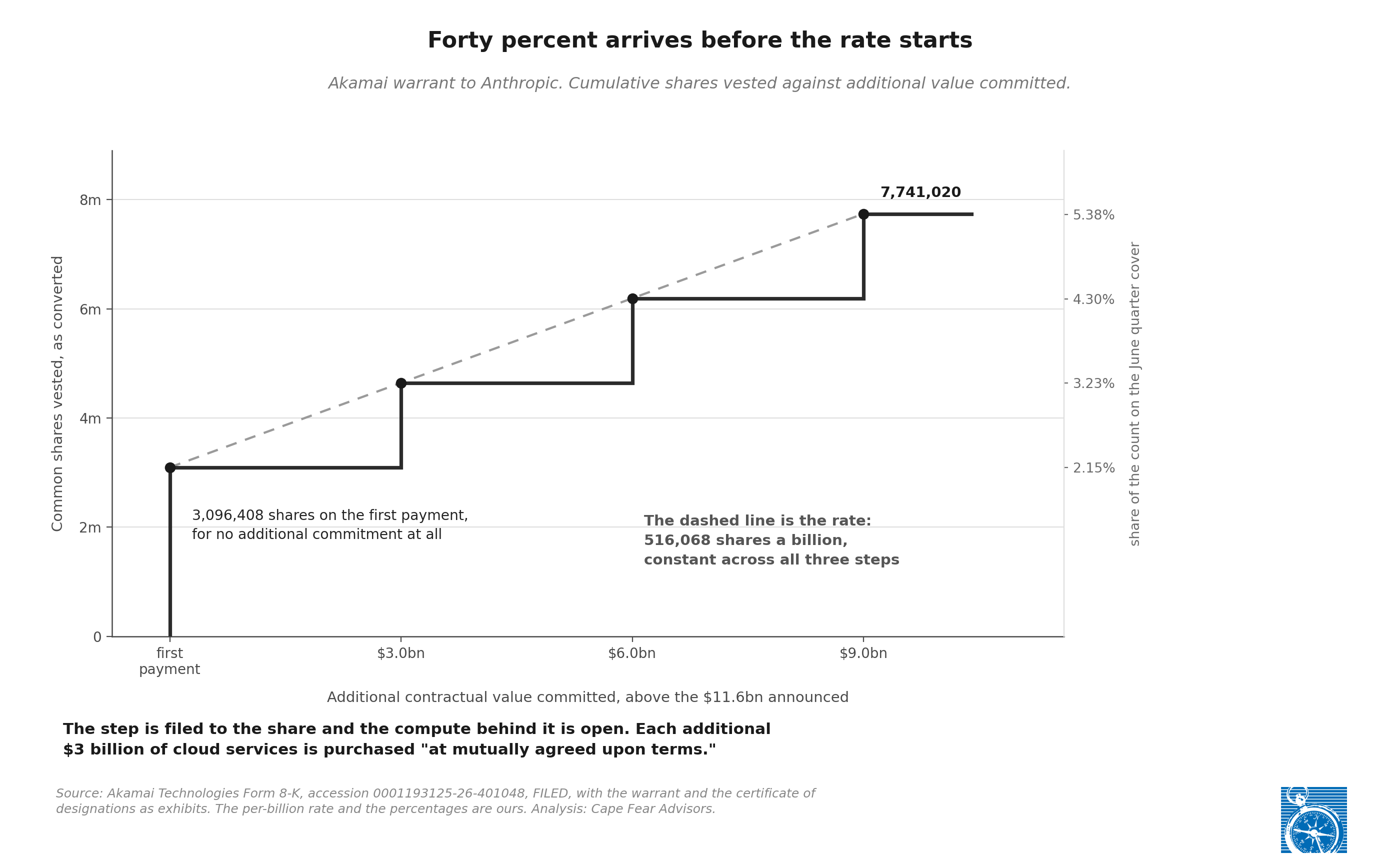
We can price what a billion dollars of commitment costs the seller in stock. Nothing filed says what that billion dollars buys in hours.
The release Akamai furnished the same week puts the same step in whole percentages, and adds five words the report does not carry. “Each additional $3 billion purchase of cloud services, at mutually agreed upon terms, will result in the vesting of approximately 1% of Akamai’s common stock outstanding.” The 1,548,204 shares a step earns are 1.07 percent of the cover count, which the release rounds down to approximately 1 percent.
So the equity rate is fixed to the share, and the price of the compute those dollars buy is settled between the parties later.
The equity can come back
Section 2.04 of the warrant is the part the current report’s summary leaves out. If Anthropic fails to pay the full contractual value due under any of the agreements, the warrant calls that a Payment Shortfall, and Akamai may claw back the tranche or tranches the shortfall relates to. The clawback reaches shares whether or not the warrant has been exercised. Common stock the preferred has already converted into is surrendered for cancellation, for no consideration. No vesting event occurs at all while a shortfall continues, and if an agreement ends before a threshold is met, the unvested portion terminates automatically.
Two limits sit on it. A shortfall contested in good faith suspends the clawback while the dispute runs. And there is a cure period after written notice before forfeiture takes effect, the length of which is redacted under Item 601(b)(10)(iv). That is one of three redacted passages in the exhibit, and it is the number that says how long a shortfall may run before the equity is recoverable. A second withholds the definition of a competitor, which governs who the shares may later be sold to.
An instrument that can be taken back for non-payment, after exercise and after conversion, is a price term with a performance condition attached. It is not a grant made at signing.
Entanglement reaches the accounts twice
Where a party holds equity in its counterparty, the mark runs through income and shows up in the quarter it moves. Where equity is part of the price, it arrives slowly or not at all: $349m of the $350m one seller paid its customer was still ahead of the income statement nine months later, and the warrant above has no disclosed value at all.
The headlines run the same way. The $11.6bn arrives with an equity schedule filed beside it on the same day. The $350m sits almost entirely in front of an income statement it has yet to reach. The largest of the four relationships here carries $24.1bn of annual revenue and a change of terms with no filed price. The filed answer, as last time, is that the price has legs, and the commercial leg is the only one in the headline.
The same customer, twice, on one basis
Anthropic appears twice in this year’s filed record on very different terms, and putting the two on a common basis is the plainest test of whether size explains any of it.
The Akamai commitment is about $11,600m over seven years, which is $1,657.1m a year and $138.1m a month. The SpaceX arrangement, described in that company’s registration materials after the Commission’s staff asked what consideration had been given to filing the agreement, runs at about $1.25bn a month, which annualizes to $15.0bn.
The larger arrangement is 9.05 times the smaller one.
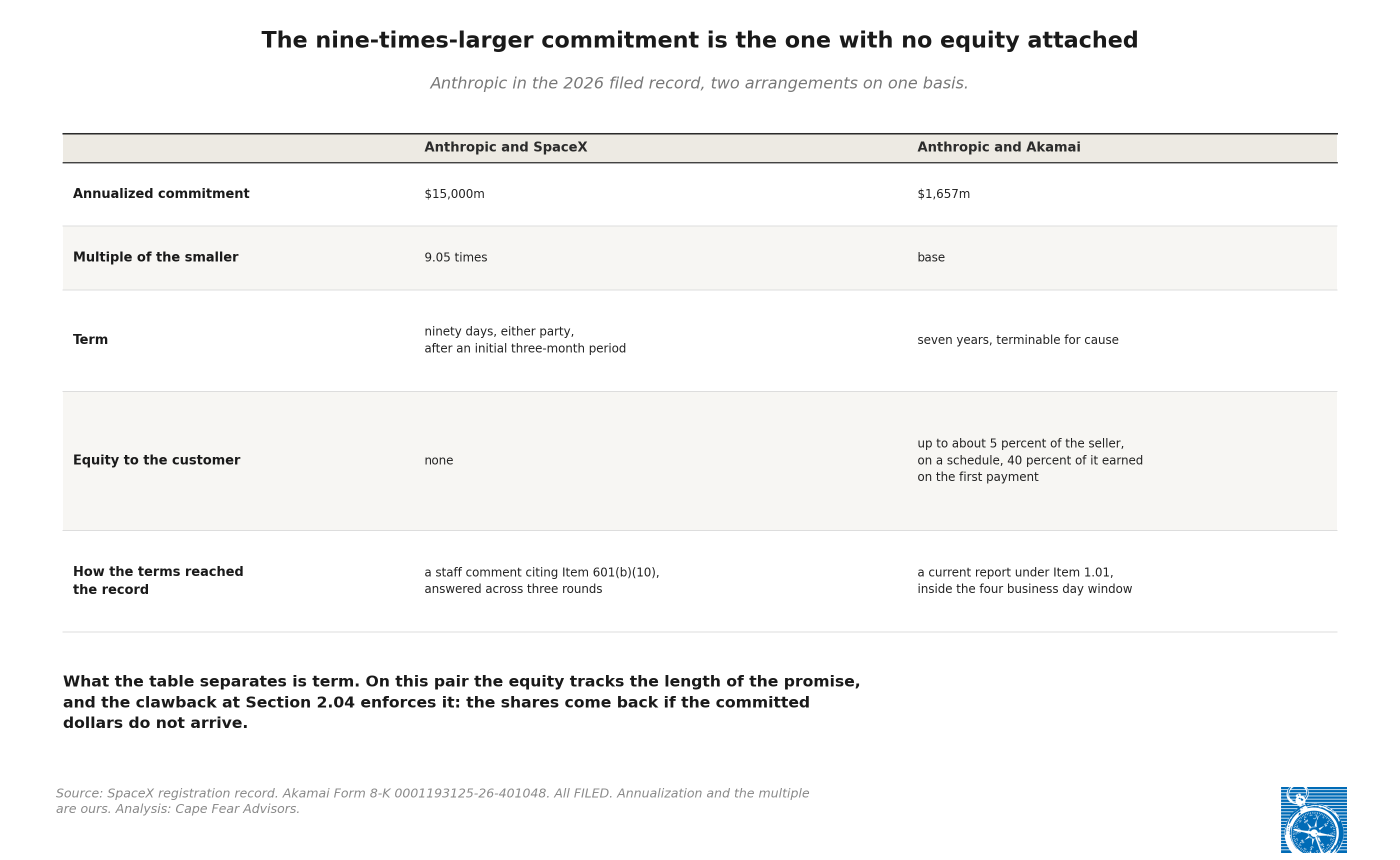
The objection arrives immediately, and it is the right one. Tenor, disclosure and equity might all be tracking size, in which case there is nothing here beyond a big contract and a small one.
The record runs the other way. The nine-times-larger commitment is the one struck at ninety days with no equity attached. The smaller, longer one is where the customer had to be paid to commit. Whatever is producing the equity, it is not the size of the order. What the two arrangements do separate is term. On this pair the equity tracks the length of the promise, and the clawback at Section 2.04 enforces it: the shares come back if the committed dollars do not arrive.
The disclosure row takes a sentence of its own. One filer described its arrangement when the staff asked. The other described its arrangement four business days after signing, on a current report, with the warrant attached as an exhibit and a certificate of designations beside it. Same counterparty, same calendar year, two elections.
Which instruments count
Two parties are entangled when what passes between them is more than the price of the thing being sold. A supplier that holds stock in its customer, a seller that pays part of the bargain in its own shares, a landlord that pays a tenant to sign. Entanglement is not a defect and it is not an accusation, and a great many ordinary commercial relationships carry it. What it means is that a figure quoted out of one of them has to be read with the rest of the consideration beside it.
The last note ended by asking how entangled the two parties to a price were, and treated the answer as a degree. Here the answer comes with three instruments and says what each of them cost.
A collection of interesting arrangements is not a census, so here is the test, stated plainly enough to be used on anything left out.
An instance enters when a document names the consideration, or names its absence. Not when a relationship looks entangled, and not when reporting describes a deal. A filing has to say what was given and what it was given for.
Three instruments pass. Each one is equity, and each one moved inside a commercial relationship.
Akamai and Anthropic. The consideration is named in Item 3.02 of the current report: the warrant was issued to Anthropic in consideration of Anthropic’s entry into the second of the two project plans. One plan, named, on the unregistered sales item.
CoreWeave and OpenAI. A master services agreement, an order form and a stock issuance agreement were signed on March 7, 2025, all dated the same day, and the stock agreement issues the shares “in satisfaction of the terms and conditions set forth in the Master Services Agreement.” The consideration is the agreement itself, named in the instrument that settles it.
IREN and NVIDIA. The annual report states it most plainly of the three: in connection with its arrangements with NVIDIA for the supply of GPUs, IREN granted NVIDIA rights to acquire ordinary shares vesting on the volume of GPUs supplied. Supply is named as the consideration and the grant is tied to it.
One relationship larger than any of them fails the test, and why it fails is the last thing taken up here.
A word on what the test leaves out, because these filers are also each other’s counterparties. Microsoft was CoreWeave’s largest customer through 2025, at about 67 percent of revenue, and that relationship was read at length last time. CoreWeave’s June 2026 quarterly puts its top customer at 40 percent of the first half and names no customer. A revenue concentration names no consideration between two parties, so it fails the test above and belongs to a different piece.
What each instrument prices, and what it withholds
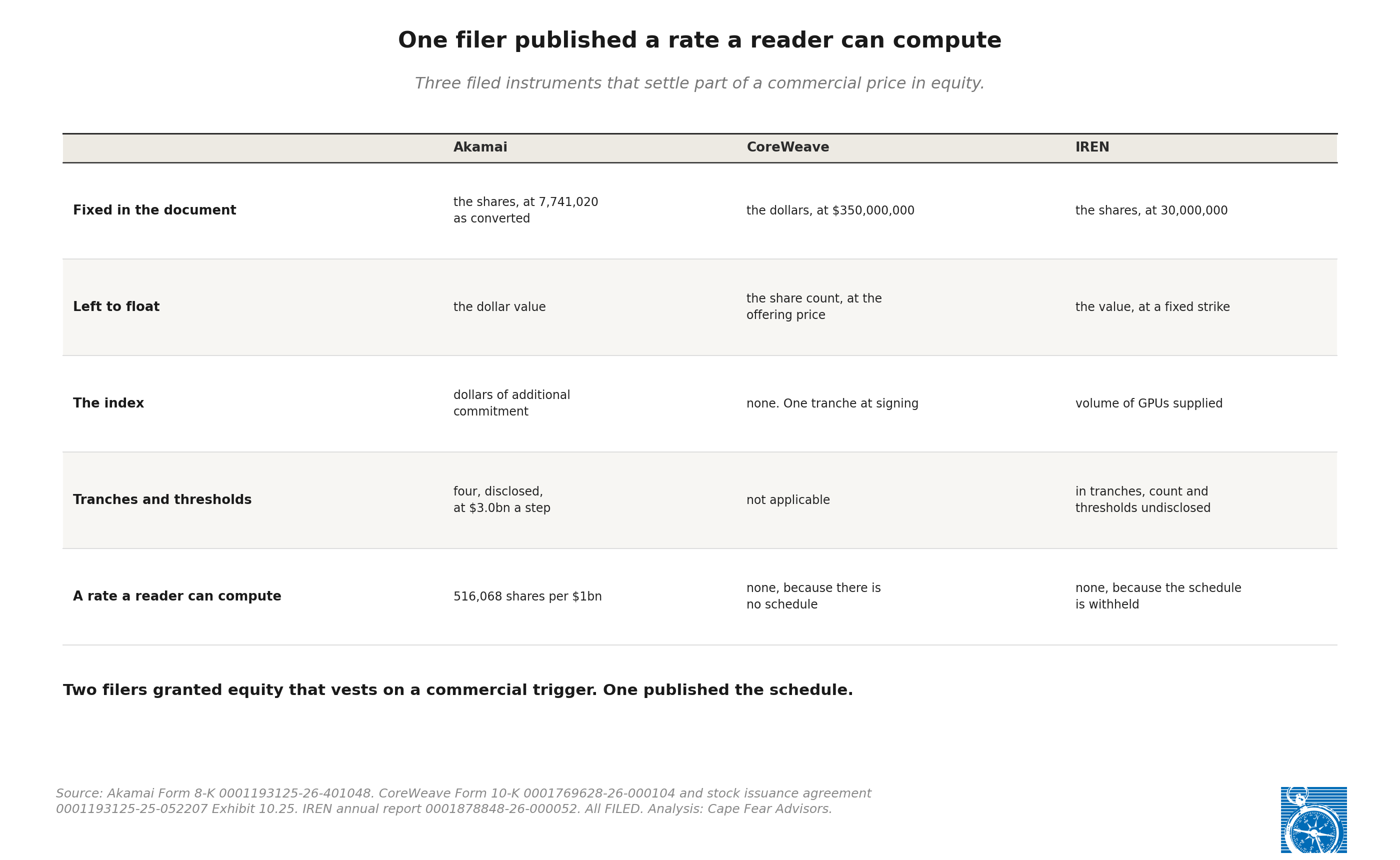
Two filers granted equity that vests on a commercial trigger. One published the schedule and one did not. IREN’s rights vest on GPU volume, which is a rate by construction, and the count of tranches and the volume thresholds are absent from the disclosure. The instrument exists, the index exists, and the arithmetic is not available.
Akamai is not the only filer to have priced a relationship in equity. It is the only one here whose rate is computable.
One tie confirms IREN’s schedule has not started running. The dilution table carries the investment rights at 4,520,548 on a weighted average basis among securities excluded from diluted earnings per share. Thirty million shares weighted from May 7 to June 30 is 55 days of 365, which is 4,520,547.95 and rounds to the 4,520,548 the table carries. The whole grant sat in the excluded bucket at year end, which is consistent with no volume threshold having been crossed and reported.
What the equity bought
Where both legs of the exchange are filed, the concession is computable. Where one leg is missing, it is not. Of the three instruments here, one closes.
The test runs row by row, and it is the same test each time: a filed commercial figure on one side, a filed equity figure on the other, and a quotient.
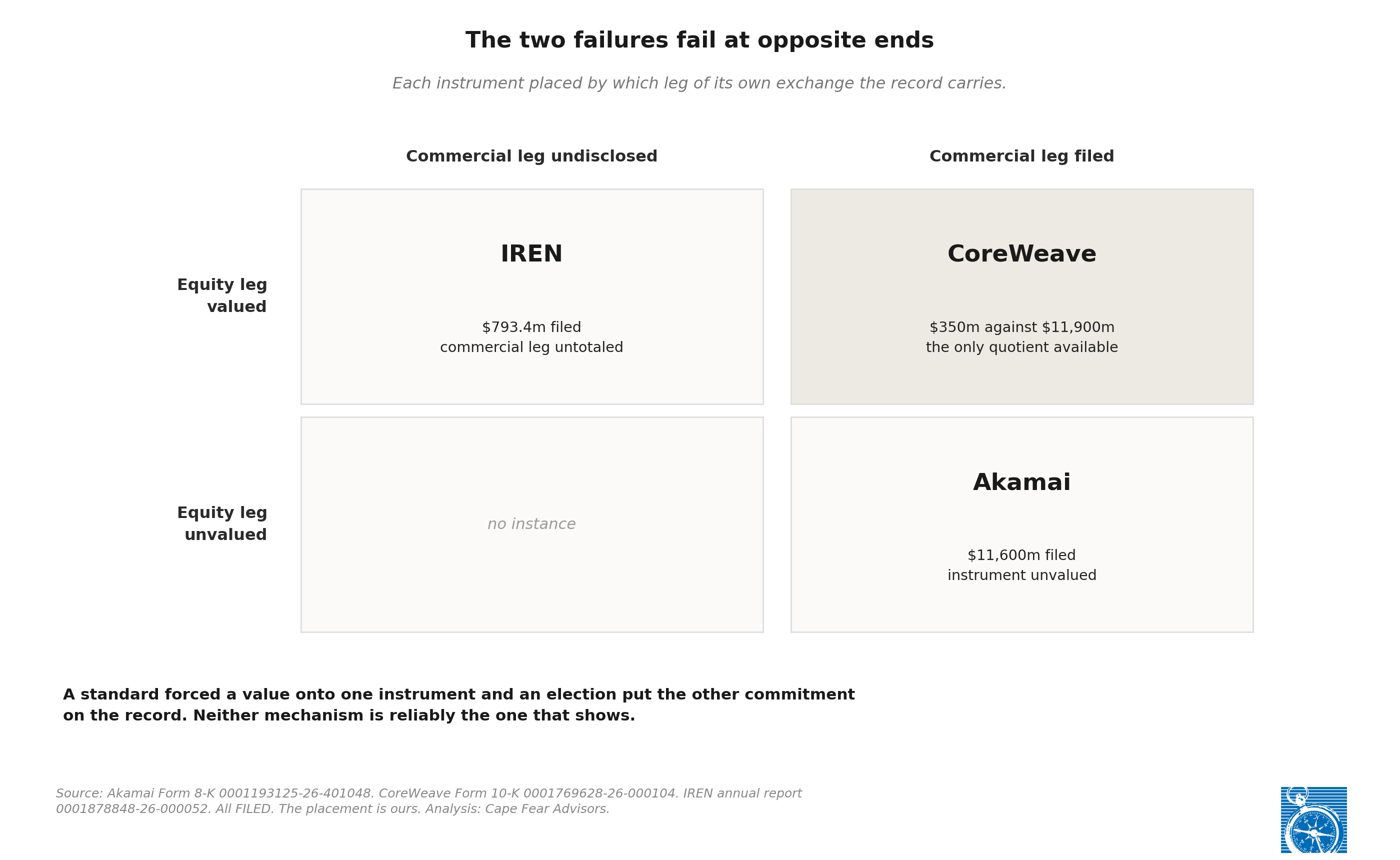
Two of the three fail, and they fail at opposite ends. Akamai filed the commitment and left the instrument unvalued. IREN filed the instrument at $793.4m of grant-date fair value and left the commercial total out. The legs are disclosed under different mechanisms, a standard that forces a value onto an instrument and an election that governs what a contract summary states, and neither mechanism is reliably the one that shows.
The one that closes
CoreWeave issued OpenAI $350,000,000 of Class A common stock in satisfaction of the terms of a master services agreement signed the same day. That agreement runs to about $11.9bn through October 2030. $350m against $11,900m is 2.94 percent.
The figure is a floor on the realized rate, for a reason the documents make plain. The dollars are fixed and the commitment is a ceiling. A term scan of the stock issuance agreement returns no clawback, no forfeiture, no repurchase right, no surrender and no vesting condition. What it does carry is two transfer restrictions: a lock-up agreement of no more than 180 days, and a market stand-off running 180 days from the closing of the offering. So 2.94 percent is the rate at full performance, and if the purchases fall short of the ceiling the stock stays where it went.
Two more figures sit against it. A second master services agreement with the same customer carries a September 2025 order form of up to about $6.5bn through May 2031. An order form with Meta runs to about $14.2bn through December 2031. No equity issuance appears against either in the filings read here. The equity rollforward for the year to December 31, 2025 carries one contract-incentive issuance and no other, and an instrument granted after that date would not appear in it.
The accounting closes as well. The stock sits on the balance sheet as a contra-revenue asset that nets against revenue as the services are delivered: $67m current and $282m non-current at December 31, 2025, which is $349m of the $350m still ahead of the income statement nine months after issue.
Two measures, two tables
What each filer parted with is one question. How much stock sits under option at a stated price is another. They answer different things, and putting them in one table invites a ratio between them that means nothing.
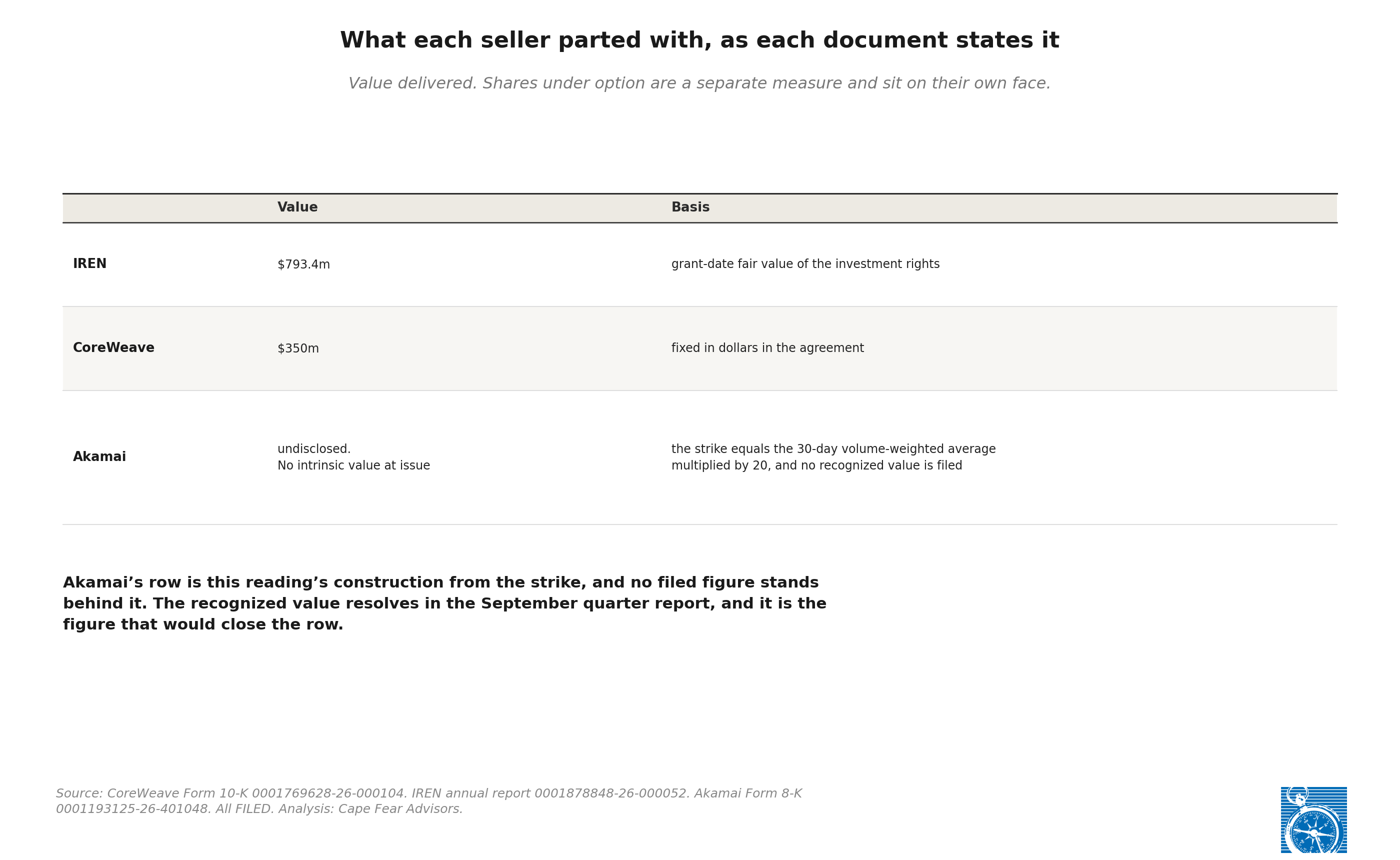
Against that, what is under option per additional billion committed: 516,068 shares, which at the September 18 strike of $111.33 is $57.45m, or 5.74 percent of the billion, as exposure. The label travels with the number. CoreWeave’s 2.94 percent measures value that left the seller. Akamai’s 5.74 percent measures shares a counterparty may buy at a price fixed in September.
A third figure can be assembled from what is already on this page, and it is better retired here than left to be built. The first tranche is 3,096,408 shares, which at $111.33 is $344.7m, and against the $11,600m announced that is 2.97 percent, three basis points from CoreWeave’s 2.94, and the resemblance is an accident of two denominators. One figure counts stock delivered against a purchase commitment and the other counts shares under option against one. And the denominators buy different things: a dollar committed to Akamai and a dollar committed to CoreWeave purchase differentiated offerings, so a rate struck per dollar of commitment is a rate per dollar of a different purchase in each case. The Akamai figure is also loose in its own favor, because the first tranche vests on the first payment while the $11,600m denominator states the whole commitment.
One currency, three destinations
The same thing moved in all three arrangements, which is the seller’s or the buyer’s own stock, and it landed in three different places in the accounts. CoreWeave nets it against revenue as a contra-revenue asset. IREN capitalizes it into the cost of the GPUs. Akamai has yet to say which: its stated policy tests whether a payment to a customer represents a distinct service, and its 2025 annual report carries no mention of the accounting amendment that governs share-based consideration payable to a customer.
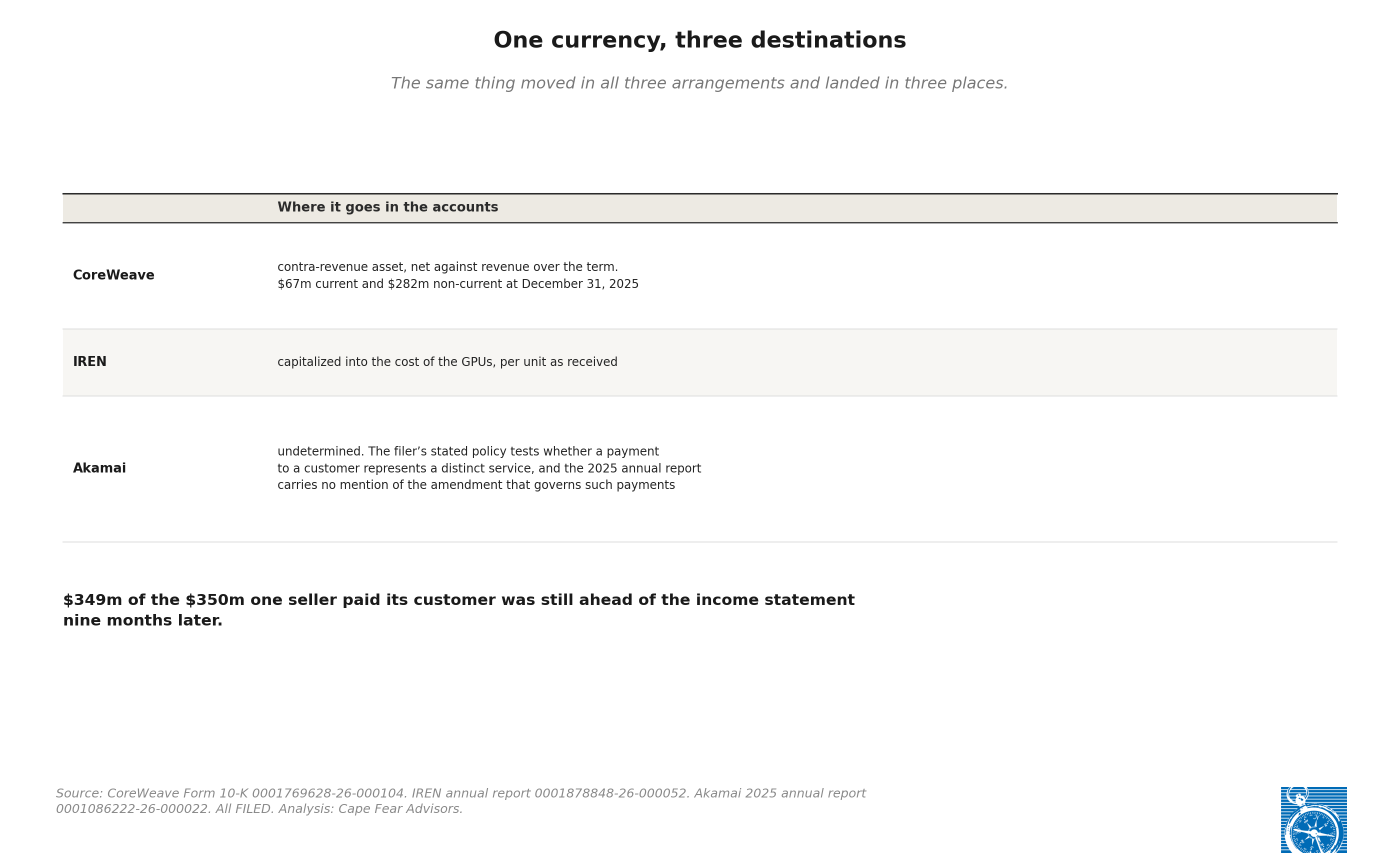
CoreWeave’s annual report flags that amendment as not yet adopted. Akamai’s September quarter report is where the distinct-service test resolves, and a recognized value for the warrant is the figure that would close the Akamai row.
One control belongs here, because it shows the same currency behaving as cash. In January 2026 NVIDIA invested $2bn in CoreWeave Class A common stock at $87.20 a share, which is 22,935,780 shares bought at a stated price. That is the financing leg moving on its own terms, at a price stated in the note that reports it.
Equity between commercial counterparties does not have to be part of the price. In these three instruments it was.
The relationship with no filed price
The largest arrangement in this record is the one the test leaves out, and why it leaves it out is the point.
Microsoft’s fiscal 2026 annual report puts revenue recognized from OpenAI at $24.1bn, which is 7.26 percent of the company’s $331,839m of total revenue, and a receivable of $6.0bn, which against that revenue is about 90 days. Microsoft holds an interest of about 25 percent as converted, has committed $13.0bn and funded $11.9bn of it.
The terms of that relationship changed twice. The annual report states that in October 2025 Microsoft signed a new definitive agreement extending the partnership, and its discussion section adds a further extension in April 2026. Microsoft filed 56 current reports and one amendment to one between September 21, 2020 and September 2, 2026, and not one of the 57 carries an Item 1.01. That is the item under which a filer reports entry into a material definitive agreement, and it is one of the two routes such an agreement ordinarily takes onto the record. The other is an exhibit to a periodic report, so the exhibit index of every periodic report Microsoft has filed since the October 2025 agreement was read. Three carry no Exhibit 10. The fourth carries four, and all four are compensation plans. A filer reaches Item 1.01 by its own materiality determination, and at $331,839m of revenue that threshold sits a long way up. Between the two routes, the consideration for the change is absent from everything read here.
What the record does carry is a subtraction. Three statements appeared in the fiscal 2025 annual report: a reciprocal revenue-sharing arrangement, exclusivity on the Azure API, and a right of first refusal on new capacity. Two of the three are absent from the fiscal 2026 report and the third is described in changed terms. The word exclusive appears once in the fiscal 2026 report, about game content. The phrase first refusal appears zero times. Revenue sharing survives, and it survives in one direction: Microsoft will continue to receive revenue-sharing payments. The paragraph got shorter, and that shortening is the trace the filings carry.
Sizing an entanglement by what a filer removes
Microsoft reports an adjusted net income measure whose sole adjustment is the OpenAI investment. In fiscal 2026 the difference between reported net income of $133,749m and the adjusted figure of $128,786m is $4,963m, which accounts for 3.71 percent of reported net income. In fiscal 2025 the adjustment ran the other way and came to 3.55 percent. The entanglement can be sized because the filer built a measure that removes it.
Two other filers carry the same kind of item, reached under three different accounting bases, at a very different scale, and present it differently.
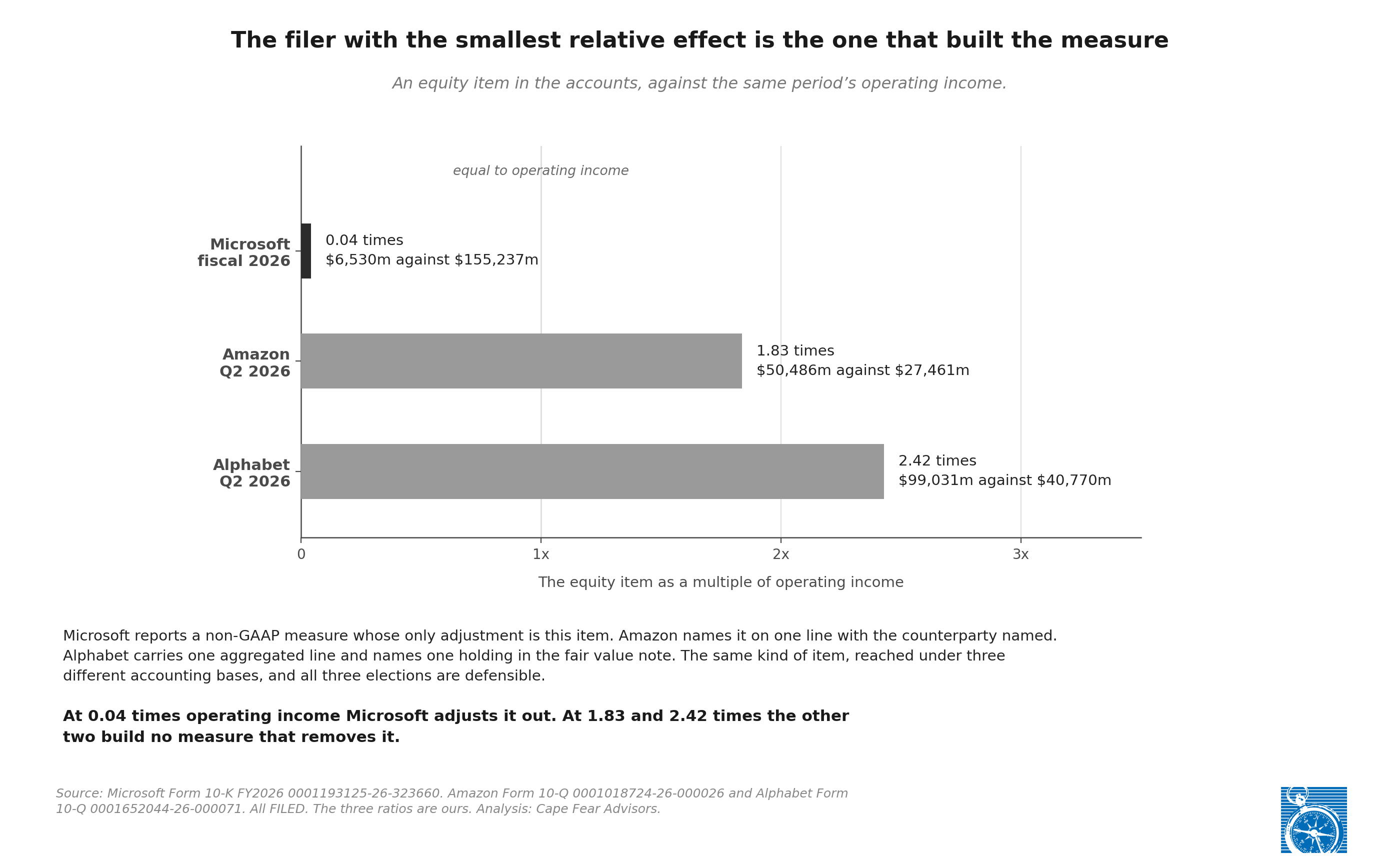
The filer with the smallest relative effect is the one that built the measure, at 0.04 times operating income against 1.83 and 2.42. All three elections are defensible and the item can be sized in all three. What the comparison shows is that disclosure here is a surface each filer chooses, and the choices diverge most where the amounts are largest.
Where to check us, and what comes next
Two different things are open here, and they belong apart.
The first is whether the record was read correctly, and that is checkable today against documents that already exist. If IREN’s tranche count and volume thresholds are in that annual report and this reading missed them, then the claim that one filer published a computable rate is wrong. Same for the Microsoft consideration: 57 current reports were read by their own item tags and the exhibit index of every periodic report filed since the October 2025 agreement, and if the consideration is named somewhere not opened, the closing section is wrong. Those are the two places to check this reading, and both can be checked now.
The second is what the next filings say, and none of that would falsify anything above. Akamai’s September quarter report resolves the distinct-service test, and a recognized value for the warrant closes the largest row in the census and turns an unvalued leg into a computable one, which is the biggest single improvement available to this reading. A later report may allocate the warrant across both project plans, in which case the single rate becomes a blended one; the schedule stays filed and the arithmetic stays available either way. And Microsoft may yet file the consideration for the change, at which point the relationship enters the census as a fourth row. That is the test doing its work. An arrangement sits outside the census until a document names what passed between the parties, and then it sits inside.
What made this readable
Two filings carry almost everything above. Akamai filed the warrant, the certificate of designations and the project plans as exhibits, on a current report under Item 1.01, four business days after signing. Microsoft reports an adjusted net income measure whose only adjustment is the OpenAI investment, and described the arrangement in its fiscal 2025 report in terms specific enough that the fiscal 2026 change is legible. Whether either filer said more than it had to turns on a materiality judgment not visible from outside, and no claim is made about it. What can be said is that both disclosures were detailed enough to compute from, and that everything here rests on them.
That is the whole of it. The next billion dollars of commitment can be priced in one relationship, to the share, because somebody wrote the schedule down. In the largest relationship here the terms changed in the spring, and no filing read for this piece names the price of the change.
The anatomy files. The exchange files one leg at a time.
Free to read, no paywall. Readers who find the work useful can support it at the foot of the page; payment offsets the time and buys no access.
Standing Disclosure
Anthropic is the developer of Claude, which is used in preparing this research, and Anthropic is a counterparty to the Akamai arrangement that opens this piece and to the SpaceX arrangement set beside it. That nearness cannot be fully checked away, which is why no claim here rests on trust in the tool: every figure carries a public source, and the record grades the rest. Others named here have ties to Anthropic: Akamai has granted it a warrant over Akamai shares and sells it compute; Amazon and Alphabet each hold large positions in it, and Amazon sells it compute; SpaceX sells it compute; NVIDIA supplies the silicon behind the capacity; and OpenAI, the counterparty in both the CoreWeave and the Microsoft arrangements, is a competitor of Anthropic. Companies not named here, among them the GPU and cloud suppliers behind the capacity, may hold positions or supply relationships that bear on the filers discussed, and that possibility is part of why every piece is re-checked for bias, ground facts, and filings rather than read against a fixed list. Figures are quoted from the filers without characterization, and the same standard of reading is applied to every filer named.
Notes
1. Akamai Technologies, current report, accession 0001193125-26-401048. FILED. The warrant, the certificate of designations and the form of the project plans are exhibits. Item 3.02 carries the consideration statement. Section 2.04 carries the clawback. Three passages are redacted under Item 601(b)(10)(iv), among them the cure period and the definition of a competitor.
2. Akamai Technologies, press release, FURNISHED with the current report at note 1. Source of the whole-percentage restatement of the vesting step and the phrase “at mutually agreed upon terms.”
3. Akamai Technologies, annual report for 2025, accession 0001086222-26-000022. FILED. Source of the consideration-payable policy and its distinct-service test.
4. CoreWeave, annual report, accession 0001769628-26-000104. FILED. Source of the contra-revenue asset at $67m current and $282m non-current, the master services agreement totals with OpenAI and Meta, the equity rollforward, the January 2026 NVIDIA purchase of $2bn at $87.20, and the flag that the amendment governing consideration payable to a customer is not yet adopted. It also names Microsoft as the top customer at approximately 67 percent of revenue for 2025.
5. CoreWeave, common stock issuance agreement, Exhibit 10.25 to accession 0001193125-25-052207. FILED. The recitals tie the issuance to the master services agreement and a related order form, both dated March 7, 2025, and Section 1.1 issues the stock “in satisfaction of the terms and conditions set forth in the Master Services Agreement” at the offering price. A term scan of the document returns no instance of clawback, forfeiture, repurchase or surrender, and no vesting condition. Section 5.4 requires a lock-up of no more than 180 days and Section 6 adds a market stand-off for 180 days after the closing of the offering.
6. CoreWeave, quarterly report for the June 2026 quarter, accession 0001769628-26-000366. FILED. Source of the customer-concentration figures: Customer A at 36 percent of the quarter and 40 percent of the six months, against 71 and 72 percent in the comparable 2025 periods. That report identifies Customer A nowhere, so the 2026 share is stated above without a name.
7. IREN, annual report, accession 0001878848-26-000052. FILED. Source of the 30,000,000 ordinary shares at $70.00, the grant-date fair value of $793.4m, the capitalization into GPU cost, and the dilution table entry of 4,520,548.
8. Microsoft, annual report for fiscal 2026, accession 0001193125-26-323660. FILED. The related-party paragraph is the source of the $24.1bn of revenue, the $6.0bn receivable, the approximate 25 percent as-converted interest, the $13.0bn of funding commitments and the $11.9bn funded, and the October 2025 definitive agreement. The reconciliation table is the source of net gains from the OpenAI investment of $6,530m pre-tax and $4,963m net of tax, against reported net income of $133,749m and adjusted net income of $128,786m. Searching the filed document returns one instance of the root “exclusiv,” in a passage about game content, and no instance of “first refusal”; revenue sharing appears twice and in both the payments run to Microsoft.
9. Microsoft, annual report for fiscal 2025, accession 0000950170-25-100235. FILED. Source of the three statements that the fiscal 2026 report drops or changes.
10. The Item 1.01 probe, run September 26, 2026 against the Commission’s submissions index for CIK 0000789019, which carries each current report’s own item tags. Between September 21, 2020 and September 2, 2026 Microsoft filed 56 Forms 8-K and one Form 8-K/A. Item 1.01 appears zero times across the 57.
11. The exhibit-index probe, run the same day across every Microsoft periodic report filed since the October 2025 agreement: accessions 0001193125-26-323660, 0001193125-26-191507, 0001193125-26-027207 and 0001193125-25-256321. Three carry no Exhibit 10. The fourth carries four, being the 2026 Stock Plan, its form of stock award agreement, the Executive Incentive Plan and the Deferred Compensation Plan for Non-Employee Directors, and none of the four mentions OpenAI.
12. Amazon, quarterly report, accession 0001018724-26-000026. FILED. Alphabet, quarterly report, accession 0001652044-26-000071. FILED. Sources of the equity items, the operating income figures and the presentation elections.
13. SpaceX registration record. FILED. Source of the monthly figure and the contract terms, described after the Commission’s staff asked what consideration had been given to filing the agreement.
14. The April 2026 extension is named in Microsoft’s fiscal 2026 annual report and is FILED at that accession. The detail of the terms announced that month is ANNOUNCED, carried at the parties’ own release.
15. The $11.9bn funded at note 8 and the $11.9bn ceiling at note 4 are separate figures. One is an investor’s drawn capital and the other a customer’s purchase ceiling, and neither derives from or constrains the other.
16. Rounding. Percentages are floored where rounding would favor the reading. The 5.74 percent exposure figure computes to 5.745 and is printed down; the 1.07 percent step computes to 1.077 and is printed down; and the third level on the vesting chart’s right axis computes to 4.309 and is printed down to 4.30.
17. Constructions. The per-billion rate, the annualized comparison of the two Anthropic arrangements, the 2.94 percent quotient, the 2.97 percent figure retired in the text, and the three ratios against operating income are ours, struck from the filed figures cited above.
Analysis: Cape Fear Advisors. Every figure above carries a public source, cited by accession. This piece makes no market call, no forecast and no valuation call, and takes no view on any security.
Every post here is free and stays that way. A subscription says the work landed, and a paid one offsets the hours and the cost of the research behind it.
Follow on Substack →