
Once a rack is installed it is rarely dismantled and rarely moved, so what gets repriced when a contract ends is an hour of compute rather than a piece of silicon. That price has a floor, set by the poor alternative of leaving a powered rack dark, and a ceiling the buyer sets, below what it would cost that buyer to produce the hour itself. At CoreWeave the buyer on the other side of that band was Microsoft at 67 percent of 2025 revenue, and the top customer’s share fell to 40 percent in the first half of 2026. The same annual report puts Microsoft on the list of competitors. This is a note about where that band comes from, and about the check to run on the first renewal figure that claims to locate it, beginning with how entangled the two parties to it were.
The hardware is at the buyers. Finished goods at TSMC run about two and a half days of shipments and are shrinking against a revenue line growing 36.04 percent. NVIDIA’s inventory is about a third of one quarter against a supply chain with long lead times, and the receivable, not the inventory, is where the shipped product shows. At CoreWeave, IREN and Nscale the credit agreements exclude GPU Servers from every ordinary-course disposition exception, so selling the equipment is forbidden by the paper that financed it.
This hardware is not bought to be held. A buyer acquires accelerators to put them into service and sell the hours they produce, along with the services wrapped around them. The chips left NVIDIA, they were invoiced, and they are somewhere between a loading dock and a running cluster.
The location is settled. What the machines earn in their second contract resolves their value.
The rack rarely moves, so the service is what gets priced
A rack goes into a hall, gets power and cooling and fabric, and stays there. Power is the reason more than the silicon: a powered, cooled and connected hall is the scarce thing, and it holds its option value whatever sits in the rack. Decommissioning and reselling at the end of a contract means giving that up to chase a price for the cards, when the alternative is to keep selling what the rack already produces. So the asset stays and the service changes hands. A cluster that was serving one customer serves another, or serves the same customer at a new price, and the thing that gets repriced is an hour of compute.
Loose accelerators do trade, and a decommissioned card is a commodity like any other. No issuer on this shelf marks its equipment to those quotes or values it in a filing. An installed rack and a loose card are different objects, and only one of them has a public price.
The chip is specific, immobile and dated. The hour of compute it produces is interchangeable with the hour produced by the rack beside it, within a generation and a fabric. Across generations the substitution is partial and depends on the workload, which is why the sellers price each generation separately and why those prices are the evidence.
The price sits in a band, and both ends are defined
The floor is the operator’s alternative to running the rack, and the alternative is poor. A rack that is powered, cooled and connected has almost no use except to sell what it produces. Its avoidable cost is a fraction of what was spent to put it there, and the credit that financed it forbids selling the equipment. Any margin over the cost of keeping it running beats leaving it dark, which is why capacity coming off contract gets re-offered.
The lenders wrote their paper around the same fact. At CoreWeave, IREN and Nscale the borrowing base runs on contracted revenue and on coverage ratios, and GPU Servers are carved out of every ordinary-course disposition exception. What the lender took as security is the revenue, and the paper that says so is read further down.
The highest the ceiling can go is what it would cost the buyer to produce the same hour itself. Microsoft, Amazon Web Services, Google and Oracle are all in the business of building capacity and selling the service on it, and their constraint has been power, shell and time. Microsoft spent $115.9bn on capital expenditure in fiscal 2026 demonstrating that it can build. A buyer that can build pays a third party no more than its own delivered cost, adjusted for speed and for the risk it avoids by not owning the equipment. One of those adjustments is this piece read from the other side: part of what a buyer pays above its own cost is the price of not holding the fleet when the contract ends.
The most the buyer will pay sits under that delivered cost, by whatever margin it will accept, and that is the ceiling. A buyer under pressure to widen its own margin will pay less for the same hour, a buyer willing to take compression or able to raise its own price will pay more, and both movements are about the buyer. There is one ceiling, and the buyer decides how far under its own cost it sits. Each party in this chain works from its own view of the margin it needs, and CoreWeave’s annual report shows why that is hard to settle: the largest customer is also on the list of competitors.
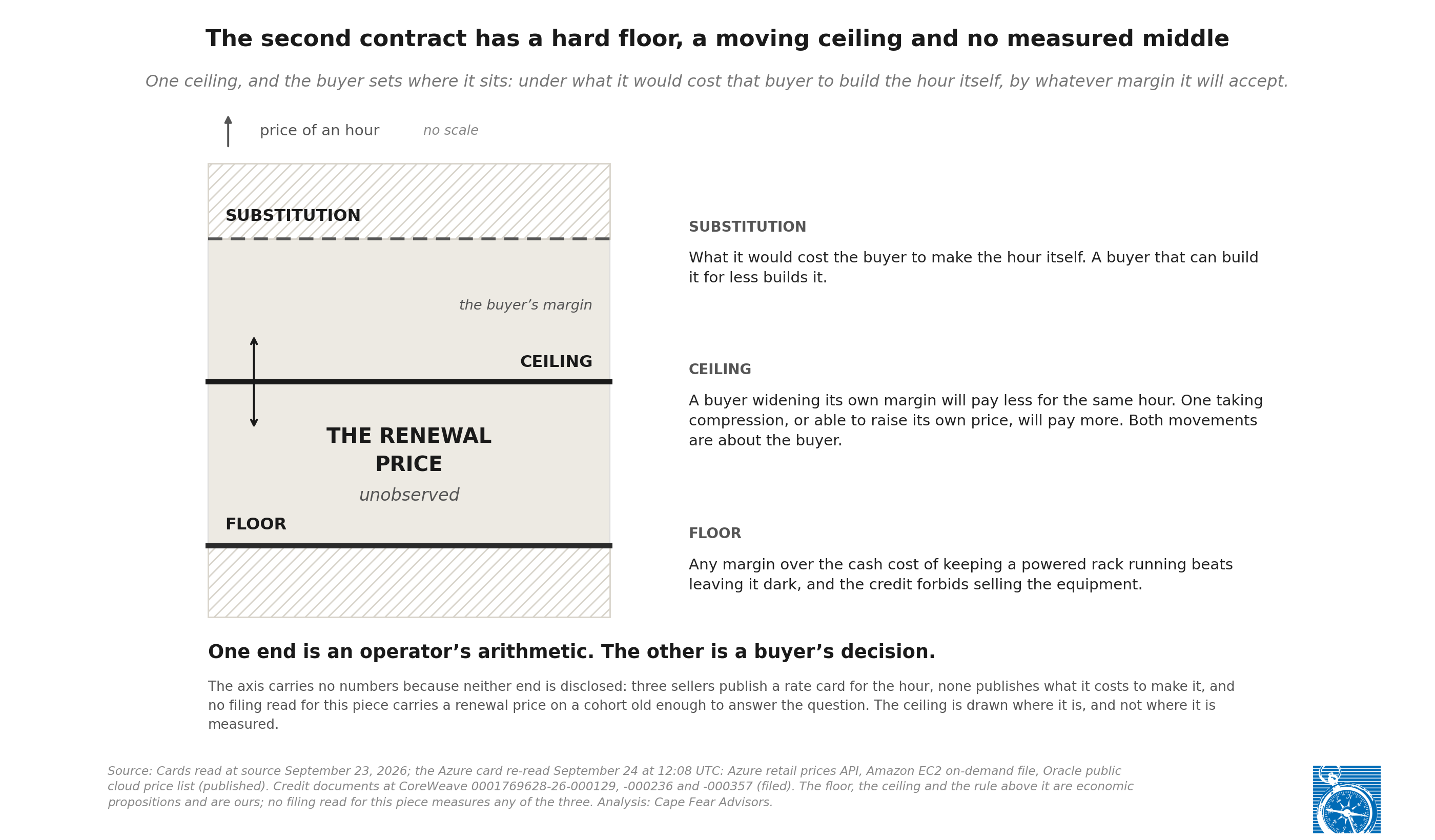
At the levered tier the ceiling has a name. CoreWeave recognized approximately 67 percent of its 2025 revenue from its top customer, Microsoft. The same annual report lists Microsoft among the key competitors who “may offer lower pricing than we do or bundle certain competing solutions and services at lower prices.” The counterparty on the second contract is also the substitute for it, and CoreWeave says both things in one document.
That concentration has fallen since, and the reason matters. The top customer took 45 percent of revenue in the first quarter of 2026 and 36 percent in the second, 40 percent across the half, against 72 percent in the first half of 2025. Revenue over the same half ran $2,194m to $4,653m, an increase of 112.07 percent. Every share is disclosed to the whole percent, so working each as a band of half a point either side, the top customer’s dollars sat between $1,837m and $1,884m against between $1,568m and $1,591m a year earlier. The low end of the current figure exceeds the high end of the prior one, so on the rounding as filed those dollars could not have fallen. The share fell because the base doubled.
The decline takes something away. Both 2026 quarterly reports identify customers as A through D and state that the letters may represent different parties than in a previous period, so no filing joins a name to the 36 percent. Microsoft, Amazon, Google and Oracle can each produce the hour themselves, and for 2025 the filer said how much of the revenue sat with one of them. For 2026 the filer leaves it unsaid, and the second customer at 26 percent is unnamed as well. How much of the revenue line faces a buyer that could substitute its own capacity is a 2025 number.
The rate cards are the closest published thing to the ceiling
Microsoft, Amazon and Oracle publish a rate for every accelerator generation they still operate. They were selected because they have the longest records of pricing compute through generation changes, because their cards are dated and machine readable, and because they reach back to silicon from 2014 and 2016. Rackspace was checked on the same day and publishes one GPU configuration with the accelerator unnamed, priced by auction.
Each card is read as a share of that seller’s own Hopper rung. Microsoft and Amazon are read on their Linux meters, since the Azure card quotes a Linux and a Windows rate for every size and the two differ by between four and fourteen percent. The reading holds on either basis. Indexed that way, the 2020 part prints at 33.32 percent on Azure, 39.90 on Amazon and 40.00 on Oracle.
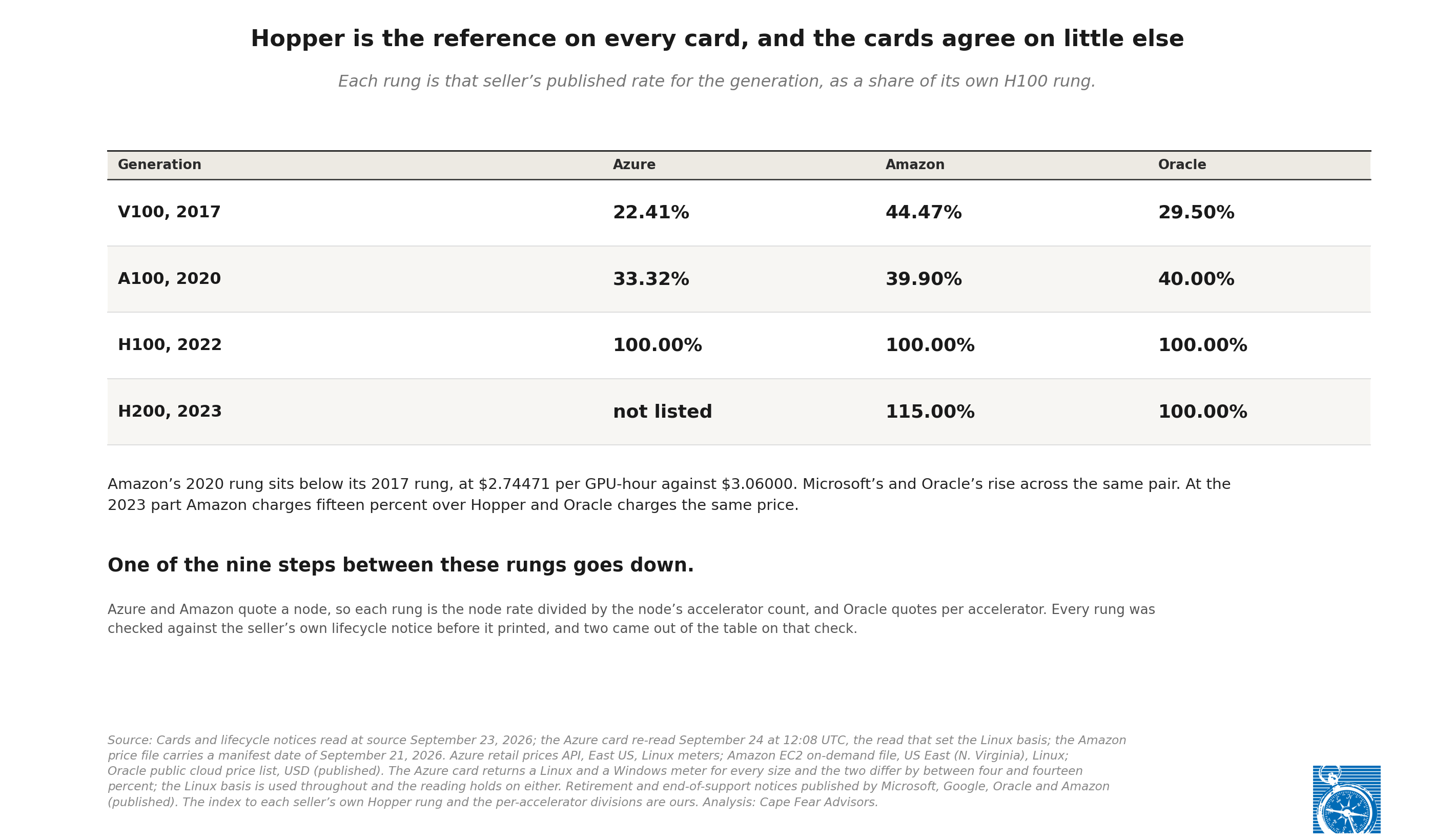
Microsoft and Oracle price the 2020 part above the 2017 part. Amazon prices it below, at $2.74471 per GPU-hour against $3.06000, so the newer and more capable accelerator is the cheaper one on that card. At the 2023 part, Amazon charges fifteen percent over Hopper and Oracle charges the same price.
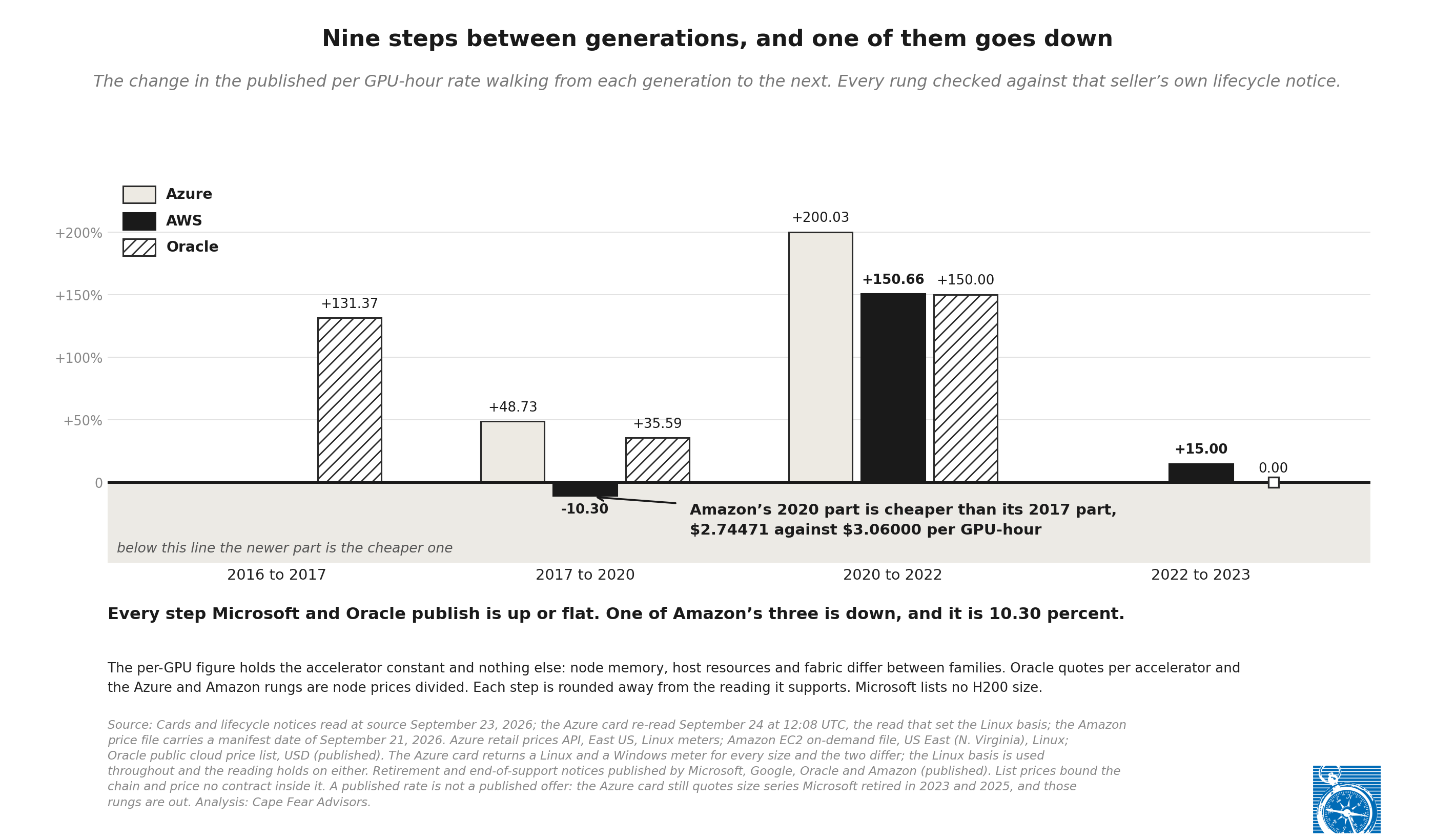
Every rung above was checked against the seller’s own lifecycle notices before it printed, and the notices disagree with each other the way the prices do. The Azure V100 rung is the NDv2 family, which carries no announced retirement, while Microsoft has withdrawn three other accelerator generations on published dates. Google set the P100’s end of support at September 15, 2026, about ten years, and that date has now passed. Amazon lists P3 and P3dn as previous generation and says it continues to support them, and P4d is current. Oracle’s P100 and V100 shapes carry no deprecation notice at all. A published rate is not a published offer, and the Azure retail card still quotes size series retired in 2023 and 2025, which is why the check runs and why two rungs came out of it. Those notices come back at the end as the one obsolescence observable that already exists.
The three disagree because they are selling different things around the same chip. Each packages compute with its own fabric, storage, software and support, bundles it against the rest of its portfolio, and prices to the customers it wants. The dispersion is the product of those choices and not a property of the accelerator.
The earning power of a vintage is a commercial decision. The three sellers with the most experience making it reach three different answers on the same day.
What the machine’s own decay settles, and what it leaves open
The equipment depreciates, and everybody agrees on that. How long it runs is unsettled, and the useful lives in the filings range from five years to six and have moved in both directions at different filers.
Failure is the part that behaves. Accelerators fail at rates that operators observe, plan around and cover, and a failed unit is replaced out of a pool. Obsolescence answers to somebody else, being set by what the next generation does to demand for this one, which is a pricing decision taken elsewhere.
The price is the variable, and CoreWeave names it
CoreWeave states the variable as its own risk, in its annual report for 2025, under a heading that says sales prices may decrease.
“We have limited experience with respect to determining the optimal prices for our platform.”
The same paragraph names the mechanism. As the market matures, or as competitors bring similar offerings, the company may be unable to optimize its prices or to attract customers at its offered prices or on the pricing model it has used historically. And the competitor it names is the large one: larger competitors with more diverse offerings may reduce the price of competing offerings or bundle them with services CoreWeave cannot match.
Three counts from the same document say what is absent from it. Obsolescence appears zero times. Secondary market appears once, about trading in the company’s own shares. Residual value appears once, to disclaim residual value guarantees in the company’s leases.
A company with limited experience setting the price sold two thirds of its 2025 output to a company that sets prices for a living and publishes them. The three most experienced sellers demonstrate that the price is a judgment by reaching three different ones.
Why the price can fall without anyone being wrong
Each operator forecasts total demand and its own share of it, and builds to the product of the two. Where the share estimates sum above one, which is the ordinary condition of a competitive market entering a new category, the aggregate build exceeds aggregate demand while every individual plan stays coherent and sincerely held. Each firm, conditional on winning the share it expects, is under-built rather than over-built, which is why each keeps buying while an observer adding the purchases together sees a surplus.
Both readings are correct at their own level, and the resolution is winners and losers. The sorting has a pattern: a firm with a long operating history, an existing customer base, a balance sheet that funds without project debt and workloads it can redeploy holds a better estimate of its own share and a softer landing when the estimate misses. A firm whose revenue is contracted to one or two counterparties holds no share estimate of its own. It holds a customer’s, and the borrowing base enforces the gearing.
Why the second contract is the one that matters
The first contract says little about price, and the arrangement it was struck in is most of the reason. Capacity was scarce, the parties held more than one relationship to each other, and at CoreWeave one counterparty took 67 percent of 2025 revenue. A price set in those conditions divides a scarce thing between two entangled parties. It prices an hour for the two of them and for nobody else. Entanglement runs past the two at the table: a lender holding a covenant on the asset has a stake in the renewal, and its terms reach what the borrower can accept.
The second contract is struck with some of that loosened. There are other buyers by then, three published cards to compare against, a cohort old enough to test, and a substitute the buyer can price for itself. That is why the second contract is the one to read. It is the first look this market gives at something closer to arm’s length.
The check to run on a renewal figure
The first renewal price that claims to locate this band will arrive in a call or a release before it arrives in a filing. The one figure of that kind offered so far arrived with no denominator attached, and one check catches most of what goes wrong with it.
Before a renewal, retention, re-lease, churn or repricing statistic is accepted, establish that a cohort of the stated age exists inside the business the statistic is offered about.
Oracle’s co-chief executive, Clay Magouyrk, on the September 10, 2026 call, offered this as the answer to a question about useful life: capacity that came up for renewal in the quarter was renewed or resold at a 20 percent premium to prior contracts, and the majority of those GPUs are four years or older. That statement is REPORTED, not filed, taken from published transcripts and cross-checked against a second, and Oracle filed no transcript with its results.
The cohort is real. Oracle has held cloud infrastructure since 2016, so it does own four-year-old accelerators. Those accelerators sit several builds earlier than the one the question was about, which the company itself places in the second half of fiscal 2026, and no denominator appears anywhere in the call: no count of units, no prior contract value, no share of fleet.
The test fails in the other direction just as often. Hardware introduced in a given year cannot come off a five-year term before that year plus five, so any account of a five-year contract maturing on a part younger than five years describes something other than what it names.
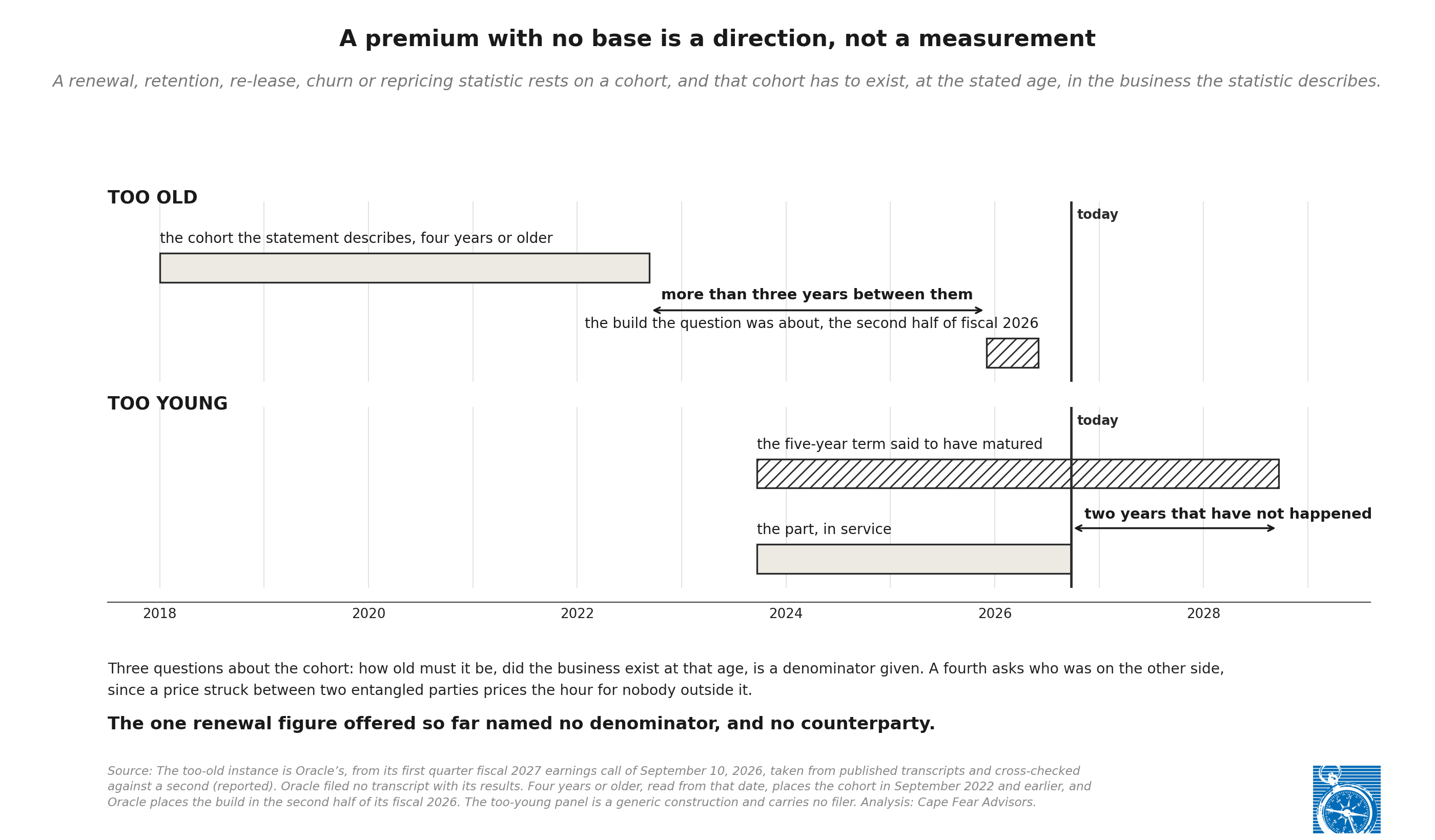
So the check is three questions about the cohort. How old must it be for the statistic to exist as described. Did the business being discussed exist at that age. Is a denominator given, since a premium with no base is a direction and not a measurement.
A fourth question sits behind those three, and it is entanglement. Who was on the other side of the price. A renewal struck between two entangled parties divides something between them, and it prices the hour for the two of them and for nobody else. The same figure fails it at once. The call names no counterparty to the renewed capacity, so whether that 20 percent premium was agreed at arm’s length sits outside anything Oracle has said, which is what makes the question live and not pedantic.
Failing any one of the four leaves the statistic usable and changes what it can be used to say, and the limit belongs beside the figure, not in a note.
Salvage is zero, and the paper runs on the stream
Salvage is what the equipment fetches if sold. The stream is what the installed fleet earns. One word has been doing both jobs, and separating them settles most of this debate.
The useful life is an estimate, and so is every other filer’s. Whether six years is the right number has been argued at length elsewhere, and the argument here is about the other end of the schedule. A depreciation choice sets a charge in the accounts and a test in the credit paper, and both of those reach the terms a party can accept on its next contract. The value of the machine is set by what it earns next, and a powered rack earns by running whatever any schedule says about it.
Salvage is zero, and the credit paper builds it in twice. Once in a provision that forbids the sale, and once in a method that depreciates the machines to nothing.
What the credit paper does
The provision first, because it is the affirmative evidence. All three issuers exclude GPU Servers from every ordinary-course disposition exception, while the borrowing bases run on contracted revenue and coverage ratios. A lender who thought the equipment had realizable value would permit the sale and sweep the proceeds, which is how secured paper is written where the metal is the collateral. These forbid the sale and lend against the revenue instead. The earning capacity is the collateral and the equipment is what produces it.
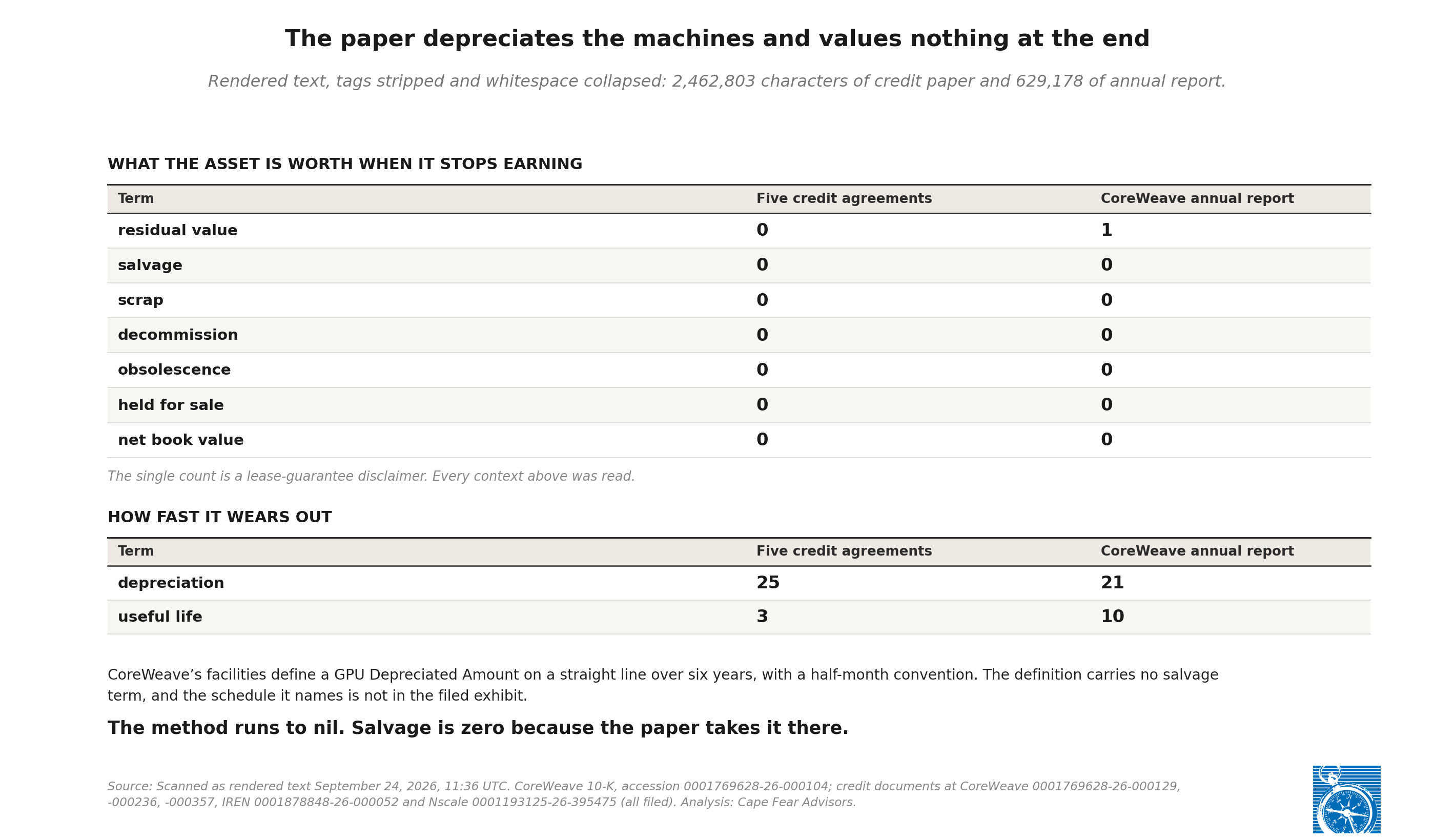
The method second, and it is the load-bearing one. CoreWeave’s facilities define a term called the GPU Depreciated Amount, being “the aggregate amount of depreciation applicable to Infrastructure calculated in good faith by the Borrower in accordance with Schedule 2.03 on a straight-line basis in accordance with GAAP assuming a useful life of six (6) years.” It carries a half-month convention for the month a machine goes into service, and the agreement names a schedule for it in its own table of contents.
A borrower and a secured lender negotiated a depreciation method for these machines, agreed six years and a straight line, and wrote no salvage term into it. The method carries the full cost to nothing. That is stronger evidence than silence, because the parties addressed the asset’s value over time in terms and chose a method with no salvage floor under it.
Two limits travel with that finding. The defined term appears in the definitions and in the schedule index and nowhere else in the public text, Schedule 2.03 itself is not in the filed exhibit, and the August facility carries seventy-seven redaction marks, so what covenant the measure feeds is unread. And only CoreWeave’s agreements carry it. IREN’s and Nscale’s use the word depreciation zero times.
The silence sits behind both of them. Across CoreWeave’s three agreements, IREN’s common terms agreement and Nscale’s exhibit, being 2,462,803 characters of rendered text with tags stripped and whitespace collapsed, read at source on September 23 and re-read on September 24 at 11:36 UTC against an expanded term list, the words residual, salvage, scrap, decommission, obsolescence and remarket each appear zero times against the equipment. Remarket appears twice, in IREN’s paper, and both times it remarkets the customer contract.
The strongest objection to a count like that is the genre. Revenue-secured facilities may carry no equipment residual machinery as a matter of form, the way paper secured on an airframe carries a great deal of it, and no survey of comparable paper was run for this piece. What answers it is the method. This is revenue-secured paper, and it does carry equipment depreciation machinery, in a version that ends at nothing.
What the accounts do
The annual report next. Across CoreWeave’s 10-K, 629,178 characters on the same method, salvage appears zero times, scrap zero times, decommission zero times, held for sale zero times, obsolescence zero times and remarket zero times. Residual appears once, disclaiming residual value guarantees in the company’s leases.
Then the filer’s own accounting policy, which agrees with the lender’s. Property and equipment is depreciated straight line over estimated useful lives, technology equipment at six years, with no salvage assumption stated anywhere, so the method carries the full cost to nil. The zero is embedded in the method and appears nowhere as a figure.
Why there is no salvage floor under any of it
The lender priced the question out of the document. The August facility advances 70 percent of equipment plus capped installation, runs to a term maturity of September 1, 2031 against an agreement dated August 7, 2026, and traps cash when contracted value falls below 2.40 times the principal outstanding. Lend 70 against a cost of 100, let the paper’s own six-year line take 16.67 a year off the asset, and the loan is covered by book from the first day.
It stays covered for 1.80 years of a term that runs 5.06, and at maturity the same line leaves about 16 against the 70 advanced. So the coverage the first day provides lasts a third of the facility, and the paper spends the rest of its life on the stream, which is what a borrowing base written on contracted revenue is for. This is our construction and not the lender’s statement. It places the whole cohort in service on the funding date, so machines placed later carry more book than it shows, and the amortization percentages that would settle it sit in a schedule the filing withholds.
And the impairment test points the same way from the opposite side. Recoverability is assessed by comparing carrying value to “the undiscounted future cash flows expected to be generated by the asset or asset group.” The only thing the asset can be tested against is what it earns.
There is a reason the method has no salvage floor under it, and it is the shape of the thing being measured. A depreciation schedule draws a continuous curve. What it draws through is a step: while a generation is current there is a merchant price to mark against, and once it is superseded the only value is what the installed machine earns in place. The transition between those two states is a date, and no straight line finds it.
The machinery was written, and it ends at nil. A lender with money at risk agreed six years and a straight line on these machines and put no salvage floor under either, which leaves the stream as the only thing the paper can run on.
The other variable, and it is nearly settled
The stream is a price times the hours the fleet delivers, so the second question is how many units keep running.
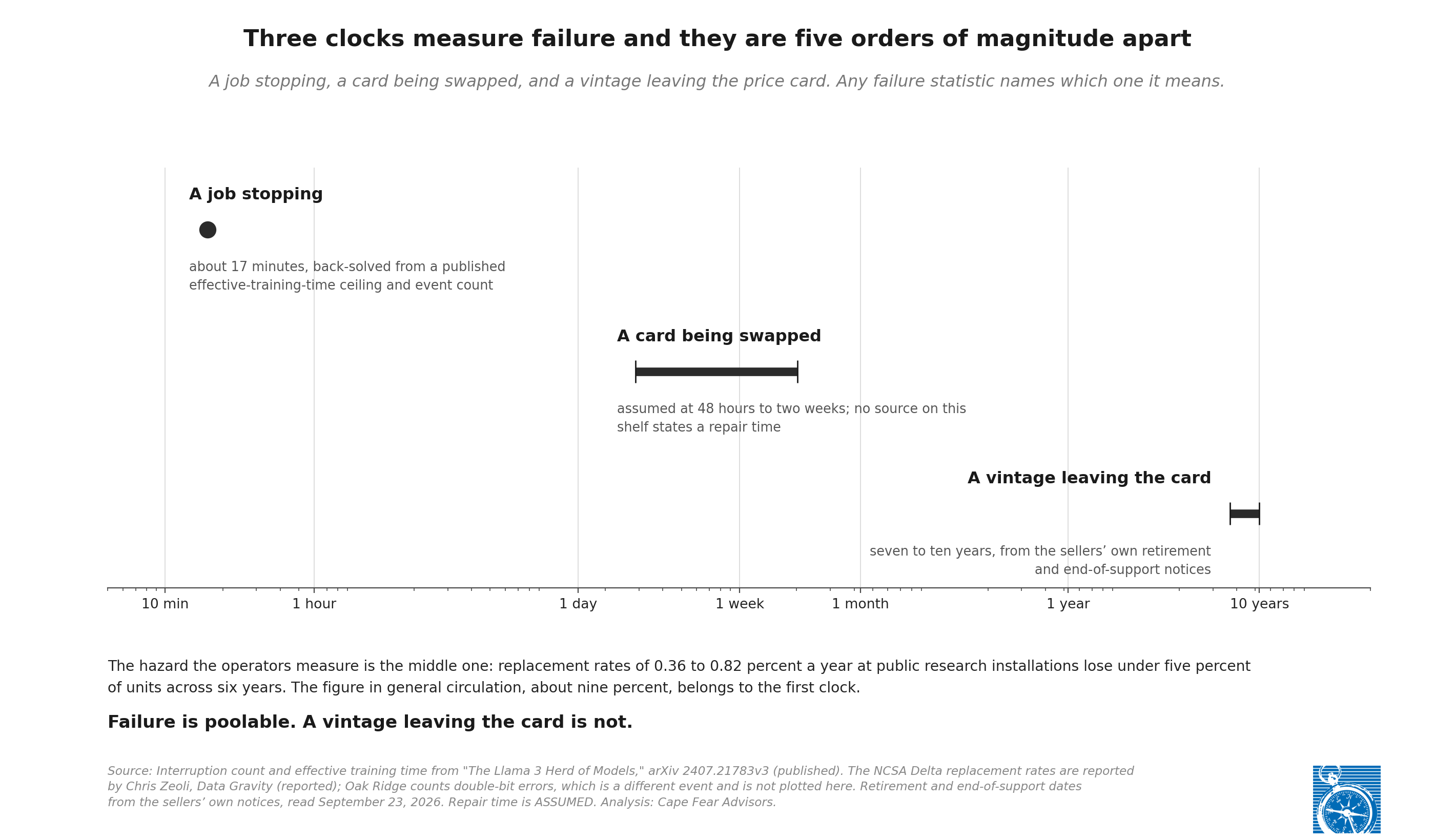
Measured replacement rates are small, and the reading that separates them from the interruption count is Chris Zeoli’s. NCSA’s Delta cluster replaced six cards in total across 448 A100s over 895 days and 608 H100s over 146 days, being 0.36 percent a year and 0.82 percent. On a constant hazard, a 0.82 percent rate loses under five percent of units across six years.
Oak Ridge’s figure measures a third thing and sits here as a bound, not as a third rate. Across 27,756 V100s over five and a half years, 0.4 percent threw a double-bit error. A memory fault is not a card replacement, and this section is about to hold somebody else to that distinction.
The figure in general circulation is 9 percent, and it measures something else. It comes from 419 unplanned job stoppages across 54 days on a 16,384-unit cluster, most of them memory errors that resolve on a row remap and a restart. A job stopping and a card being replaced are different events, and the two datasets differ by roughly a factor of eleven.
A second check belongs beside the first. The device is Chris Zeoli’s, who counts three clocks on the asset itself, and it works pointed at the word failure.
Three clocks measure failure and they run five orders of magnitude apart. A job stopping. A card being swapped. An instance type being withdrawn from sale. Any failure statistic names which one it is.
Who pays for an interruption
Interruptions do cost something, and the published figure is Meta’s: higher than 90 percent effective training time across that snapshot, inclusive of planned maintenance, where effective training time measures the time spent on useful training over the elapsed time. The mechanism is in the same paper, since the synchronous nature of training makes a job less fault-tolerant and a single GPU failure may require a restart of the entire job.
That number belongs to the customer. A merchant operator sells hours on a meter. A customer whose job stalls and restarts has lost progress, and the operator has still delivered the hour. The same paper makes the gap plain from the other side: model FLOPs utilization on that run was 38 to 43 percent, so the silicon delivered about two fifths of its theoretical throughput while running, and the operator bills the hour whether the customer reaches 41 percent of the chip or 4.
The ninety percent is also an upper bound. It belongs to the most capable operator in the world running its own job with automation built for it, and no merchant operator publishes the equivalent.
What that leaves, and the one asymmetry
With the survival term close to one, the stream is close to price times hours, and the residual is almost entirely a price question.
The perimeter is the merchant market. A second contract sets a price where the buyer could have bought the same hour from somebody else. Google’s own accelerator is quoted by Google, and no card read for this piece quotes it against a rival’s, so the residual on that part is a question about one company’s internal economics. Everything below is about the parts sold to somebody who had a choice.
One asymmetry survives, and it is the reason the credit documents look the way they do. Failure is a hazard rate on units: observable, schedulable, poolable, and Nscale’s agreement permits disposing of failed GPU Servers against warranty return and replacement. Obsolescence is a price event on a whole cohort, set by somebody else, arriving at once. One is diversifiable and priced into operations. The other is priced nowhere.
A contract is what survives an obsolescence event, and it survives for its term. CoreWeave stated the gap in its own August release: the facility’s approximate five-year maturity extends beyond the average three-year length of underlying customer contracts.
What would settle this, and how little of it exists
What would break the reading
An installed fleet sold at a price that matters. A retirement inside four or five years of launch, which would shorten the vintage below the range the notices show. A residual written into a credit document, or equipment marked to a resale venue. A merchant operator’s replacement rate an order of magnitude above the research installations. A master services agreement with a disclosed availability credit, which would move downtime onto the operator. Each of those costs this piece a claim it has made.
What would make the reading measurable
A renewal or repricing figure on a cohort that passes the vintage test. An operator’s own utilization and availability. A unit price for delivered compute from anyone selling it wholesale.
None of the three exists. Airlines publish seat miles, load factor and unit revenue, and the carriers publish them on the same basis. Regulated utilities publish rate base, capacity factor and standard reliability indices. A reader can compare two airlines on how hard the metal works. Nobody can compare two compute operators on how hard the silicon works, because the industry has not agreed what to count.
One obsolescence observable does already exist, and nothing read for this piece treats it as a residual signal: the sellers’ own retirement notices. Microsoft withdrew its K80 sizes in September 2023, its P100 sizes in August 2023 and its V100 NCv3 sizes in September 2025, which is seven to nine years after each chip launched. That range is Chris Zeoli’s observation; the dates are the seller’s.
This piece is written to be the frame those numbers land in, and not a complaint that they are late.
What is already required
Construction in progress is an ordinary balance-sheet caption, and segment reporting runs on a standard that already exists. Google discloses assets not yet in service. Oracle discloses construction in progress. Microsoft discloses neither and gives Azure a revenue line inside a larger segment. Those are elections inside a framework already written, which is a different thing from a metric the industry has not defined.
The residual is the stream. The stream is the price of an hour times the hours the fleet delivers, and the hours are close to settled. Whoever holds an installed fleet when its first contract ends holds one number that appears in no document read for this piece, and the whole of the question is what that number turns out to be.
Free to read, no paywall. Readers who find the work useful can support it at the foot of the page; payment offsets the time and buys no access.
Standing Disclosure
Anthropic is the developer of Claude, which is used in preparing this research, and Anthropic is a counterparty to arrangements of the kind read here. That nearness cannot be fully checked away, which is why no claim in this piece rests on trust in the tool: every figure carries a public source, and the record grades the rest. Others named in this piece have ties to Anthropic: Google and Amazon each hold large positions in it, and Amazon is the counterparty at the build where Anthropic is the named customer. Companies not named here, among them the GPU and cloud suppliers behind the capacity, may hold positions or supply relationships that bear on the filers discussed, and that possibility is part of why every piece is re-checked for bias, ground facts, and filings rather than read against a fixed list. Figures are quoted from the filers without characterization, and the same standard of reading is applied to every filer named.
Notes
Sourcing. Every figure above carries a public source, cited here by accession and section. FILED: CoreWeave Form 10-K 0001769628-26-000104, Forms 10-Q 0001769628-26-000222 and 0001769628-26-000366, Form 8-K 0001769628-26-000357 Exhibit 99.1, and credit documents at 0001769628-26-000129 Exhibit 10.1.1, 0001769628-26-000236 Exhibit 10.1 and 0001769628-26-000357 Exhibit 10.1; IREN 0001878848-26-000052; Nscale 0001193125-26-395475 Exhibit 10.24; Microsoft Form 10-K 0001193125-26-323660; NVIDIA Form 10-Q for the quarter ended July 26, 2026, 0001045810-26-000075, with the inventory and receivable series taken from the XBRL company-concept endpoint at CIK 1045810; Taiwan Semiconductor Manufacturing Company Form 6-K 0001046179-26-000541, Note 12 and the statement of comprehensive income; Oracle Forms 8-K 0001193125-26-387905 and 0001193125-26-389753.
The rate cards. PUBLISHED. Azure retail prices API, East US, Linux meters. Amazon EC2 on-demand file, US East (N. Virginia), Linux, manifest 2026-09-21T19:47:12Z. Oracle public cloud price list, USD. Read at source September 23, 2026, with the Azure card re-read September 24 at 12:08 UTC. The Azure card returns a Linux and a Windows meter for every size and the two differ by between four and fourteen percent; the Linux basis is used throughout and the reading holds on either. The Azure and Amazon rungs are node prices divided by the node’s accelerator count, and Oracle quotes per accelerator natively. The Oracle price list and the Rackspace page stand on the September 23 read.
The lifecycle notices. PUBLISHED. Retirement and end-of-support notices published by Microsoft, Google, Oracle and Amazon, read at source September 23, 2026. Two rungs came out of the price table on that check.
The Oracle renewal figure. REPORTED. The Magouyrk quotation is taken from two independent published transcripts of the September 10, 2026 call, and neither September 2026 Form 8-K filed or furnished a transcript.
The replacement rates and the three clocks. The reading that separates replacement from interruption, the three-clocks device, and the NCSA and Oak Ridge counts all reach this shelf through Chris Zeoli, How Long Does a GPU Last?, Data Gravity, September 21, 2026, and are credited at the point of use. The retirement range of seven to nine years is his observation and the dates behind it are the sellers’ own. His post is free to read in full, so a checker can reach the underlying counts without a subscription.
Earlier on this shelf. The competitive set behind the price is read in What Is the Point of the Neoclouds?, September 22, 2026, which sets six cloud filers against each other in one quarter. CoreWeave’s delayed-draw facilities and their coverage tests are read in CoreWeave, the Key, the Lock and the Clock, August 20, 2026. The NVIDIA balance-sheet work behind the opening is in Quality of Cash: The Supplier Addition, September 1, 2026.
On the useful life, and where that argument lives. Whether six years is the right number is a live question with a literature behind it. Olga Usvyatsky set out the accounting baseline in Depreciation of GPUs: between useful lives and useful myths, Deep Quarry, December 7, 2025. Michael Burry has pressed the earnings consequence across Cassandra Unchained. Ed Zitron has carried the question to a general audience, including in Where’re All The AI Chips?, Where’s Your Ed At, September 22, 2026. Chris Zeoli brought the failure and retirement evidence into it, in the post cited above, and this piece uses that evidence at three points. The first three are paid posts and the fourth is free to read in full. This shelf reads the other end of the schedule and leaves the estimate in those hands.
The interruption figures. PUBLISHED RESEARCH. The 419 unplanned stoppages, the effective-training-time figure and the model FLOPs utilization range are from “The Llama 3 Herd of Models,” arXiv 2407.21783v3, read at source September 21, 2026.
What is ours. OURS, and stated so a reader can separate it from the record. The floor, the ceiling and substitution as the ceiling’s own limit are economic propositions, and no filing read for this piece measures any of the three. The per-accelerator divisions, the index to each seller’s own Hopper rung, the nine generation steps, the concentration bands, the day counts and the advance-rate arithmetic are constructions from filed inputs, and each input is printed beside its result. The amortization percentages that would settle the advance-rate reading sit in a schedule the filing withholds.
Rounding. Every percentage this piece computes is rounded away from the reading it supports, so the computed figures understate the case. The shares quoted from the filings carry the filer’s own rounding to the whole percent, which the body states where it works the concentration bands.
Analysis: Cape Fear Advisors
Every post here is free and stays that way. A subscription says the work landed, and a paid one offsets the hours and the cost of the research behind it.
Follow on Substack →