

In May we counted about $235,000m of disclosed commitments at SpaceX and asked where the money would come from. In August, after the first quarter as a public company, the count came to about $400,000m. Three weeks later it comes to about $430,000m, and the reason is a spaceport in Louisiana announced since.
The stack is built on one basis and held there: cash to be deployed through 2030, every component filed or sitting in a public state or county record. The basis has not moved since May. The items have. (1)
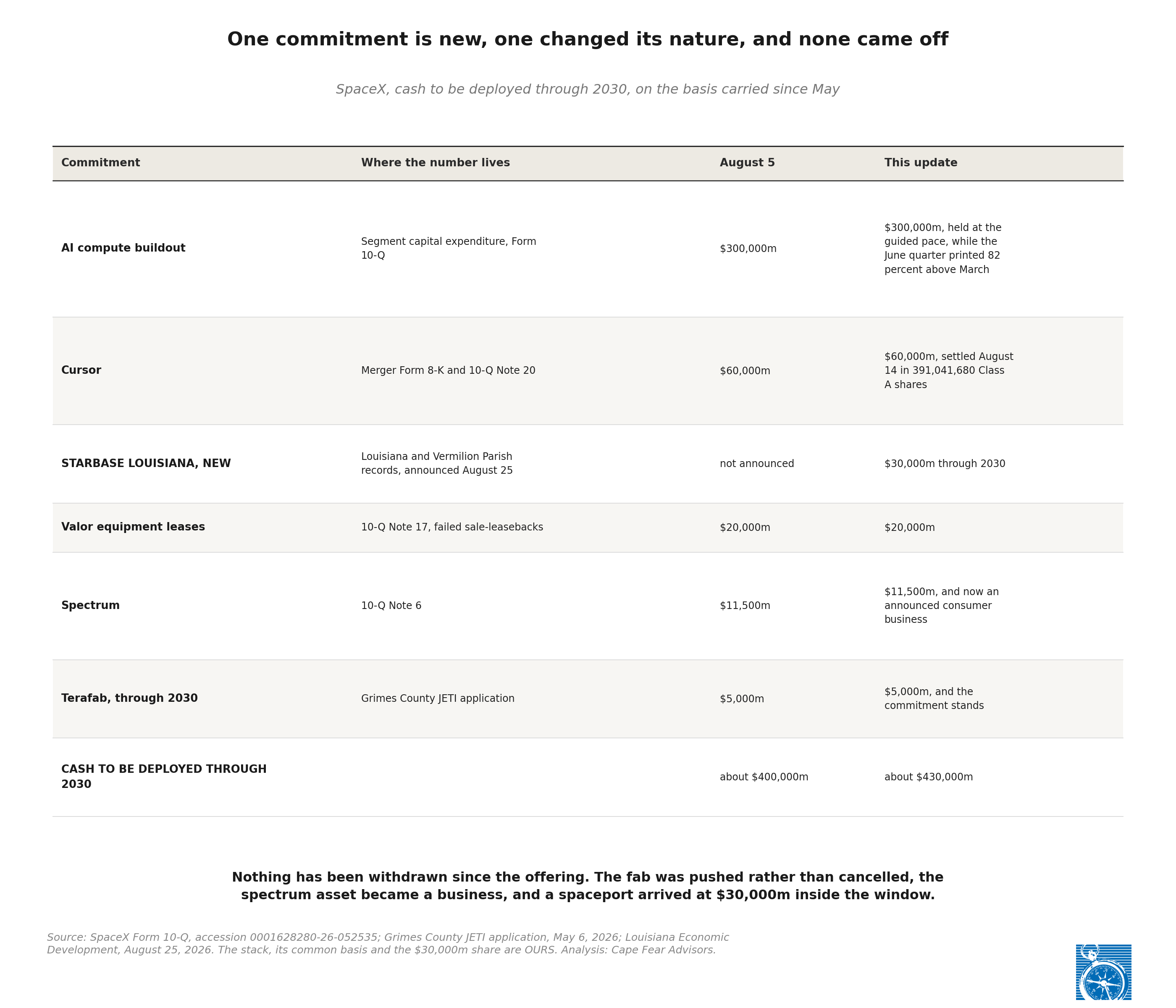
One commitment is new, one changed what it is, and nothing came off the list. That last part is the finding. A company that closed the largest offering in history on June 15 has since added a $100,000m launch campus, told its first earnings call it will build ground infrastructure and compete for wireless subscribers, and withdrawn nothing. (2)
The fab went quiet
Terafab was the keystone of the offering. On June 4, in an interview filed as a free writing prospectus, the founder said of it: “that’s why we need to do Terafab. It seems essential.” The Grimes County application set out phased investment up to $119,000m. A seventeen-year Intel veteran took the title Director, Terafab.
The through-2030 line for it is about $5,000m, on the county’s own by-year schedule, which puts the heavy spending past 2028. The commitment stands, and the $10m payment to Grimes County went out, which is money spent to keep a thing alive.
Everything else about it has stayed where it was, and analysts have asked. On the first earnings call, John Godyn of Citigroup asked a question in three parts: the capital expenditure outlook across the segments, whether buying versus building might accelerate growth with the mobile strategy named as the case in point, and “any related thoughts on capital needs for next steps in extreme vertical integration like Terafab, anything that’s needed to support future growth.” Two of those three are the same question in different clothes, which is whether to buy capacity or build it.
The chief financial officer answered on capital allocation in general, said the next two quarters should look like the current one at a company level, and described a payback under a year on AI compute, setting that against “building assets that are going to benefit us from launch sites for the next couple of decades.” The founder followed with a hundred billion of annual recurring revenue by December and a trillion of revenue, not ARR, pulled forward from 2031 to 2030.
Asked, and answered elsewhere
The segment split, the buy-against-build question and the fab all went unanswered. The word Terafab does not appear again in the transcript. (3)
The three went unanswered together, in different ways, and the difference is the useful part.
Asked by Kutgun Maral of Evercore ISI what the mobile buildout would cost, the president gave the question two paragraphs. She confirmed the terrestrial intent, declined the figure twice, and said why: the design puts small cells on hardware that already holds a Starlink dish, so “you don’t have to necessarily spend many billions of dollars in low-band spectrum all upfront before you deploy your system.” Her direction without a number was that “it will be quite Capex efficient.” The founder added a paragraph of his own on the same point. That is a business discussed at length and priced at nothing. (4)
The fab got neither the length nor the number. Its update to date consists of an unanswered question, one word, soon, said at an investor meeting for a different company, and some administrative gates cleared at a Texas school board. The record is silent on financing, on schedule and on priority. The switch that displaced it got a sentence of its own from the founder: “Going forward, we’ve decided to build exclusively on NVIDIA because we think the Vera Rubin architecture is the best architecture.” (5)
The disclosure stands as made, and this reading leaves it standing. The company named the project essential in a document filed to sell its own shares, and its status since is available from a county clerk and a word at somebody else’s meeting.
The AI compute line absorbed the difference and more, on the same page of the same stack. We called that the cost of not beginning when it was an argument about a schedule. It is an arithmetic result now, and it shows up on the seller’s books as clearly as on the buyer’s.
A customer changed categories at the supplier
NVIDIA’s second quarter carried one sentence about its own bookkeeping.
“During the second quarter we reclassified a company from AI Clouds, Industrial, & Enterprise (ACIE) to Hyperscale due to a change in their business model and recast the prior period revenue associated with this company.”
NVIDIA withholds the name. Setting the May release against the August recast sizes it exactly: Hyperscale for the quarter ended April 26 moved from $37,869m as first furnished to $43,050m as recast, ACIE moved the other way by the same $5,181m, and Data Center is unchanged. The reclassified company bought $5,181m of NVIDIA product in the quarter ended April 26, which is 6.34 percent of NVIDIA’s $81,615m of revenue in that quarter.
Two readers got there before us and by two different routes. Kakashii, writing on Substack, ran the same subtraction during the call and set the two platform tables side by side in a subscriber discussion thread he opened the same day. Gene Munster of Deepwater read the move as SpaceX within days of the print, pointing at eight gigawatts coming online next year.
Our own road is the definition and the phrase. NVIDIA defines Hyperscale as revenue from the public clouds and the world’s largest consumer internet companies, and Starlink satisfies the second clause where the other candidates satisfy neither. A launch and satellite operator standing up compute at scale is a change in business model in the ordinary meaning of the words. Three roads and one destination leave the identification an inference, and any error in ours is ours. (6)
The identification is the smaller half of it. The shape holds whoever the company turns out to be: a buyer got large enough to move a reporting line at the largest supplier in the market, and the supplier gave a change in the buyer’s business model as the reason. Whatever else a segment reclassification is, it is one company’s accountants stating that another company is no longer what it was.
Against that, NVIDIA printed a 75.0 percent gross margin in the quarter, and every dollar of equipment carries it. (7)
The two lines beside each other give the substitution its shape. The fab was to run up to $119,000m all in, and it is funded at about $5,000m through 2030, which buys no chips in that window. Its return was the margin it would have stopped paying. The line that replaced it is funded at about $300,000m over the same years, and every equipment dollar inside it carries that margin to the seller. An essential build with an enormous price and no revenue of its own has become a quantified purchase that funds somebody else’s gross profit.
The chips arrive either way, and either way they can fly or sit on the ground. What changes is who keeps the margin on them and what the buyer owns at the end. One route leaves an asset. The other leaves a receipt.
Whence the cash
The uses are one half. The sources are the half that decides.
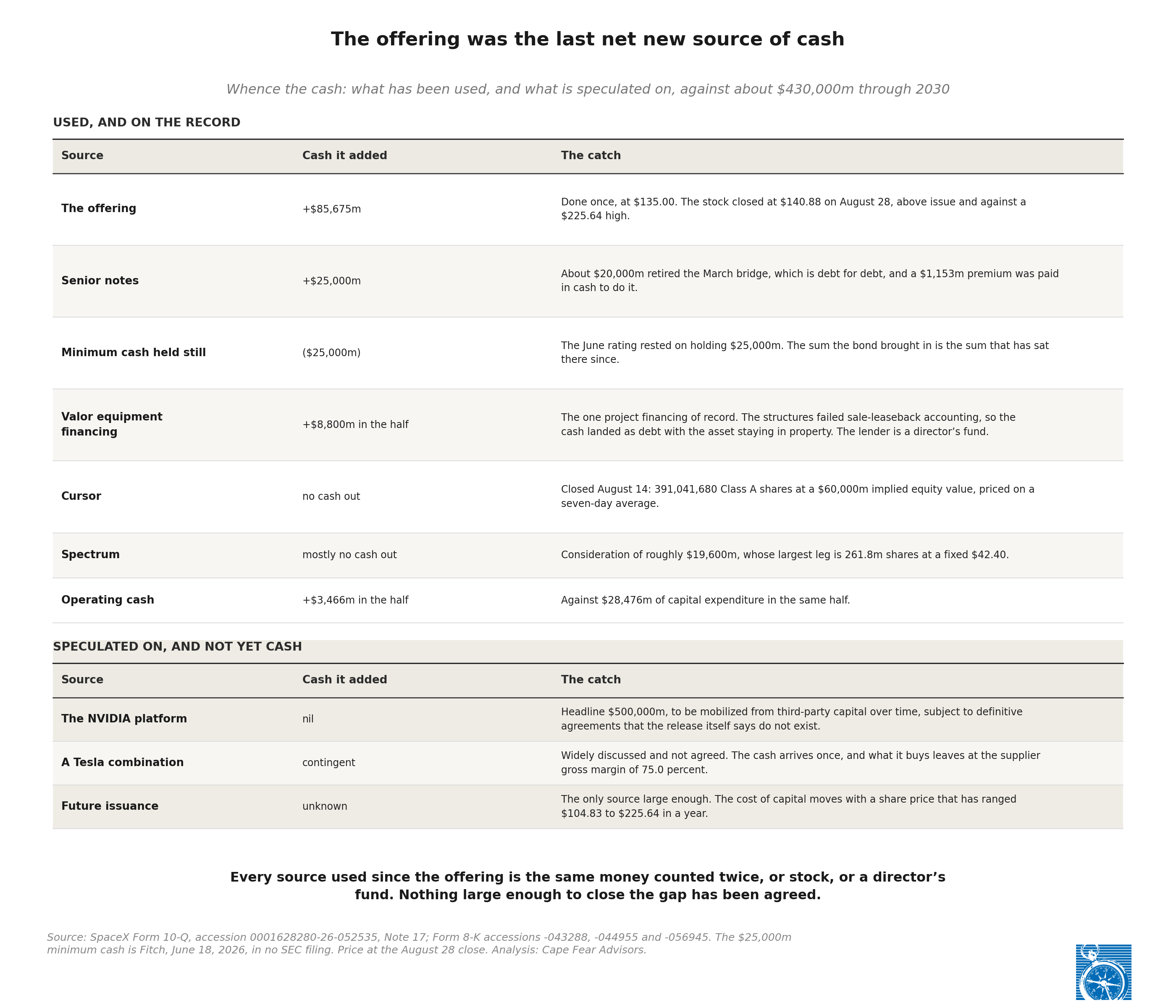
The offering brought in $85,675m net and it was done once, at $135.00. The stock closed at $140.88 on August 28, above the issue price and against a high of $225.64. Our August reading had them below issue, which was so at the time and has since changed in the company’s favor. (8)
The senior notes brought in $25,000m, of which about $20,000m retired the March bridge, which is debt exchanged for debt, and a $1,153m premium was paid in cash to do it. The June rating rested on holding $25,000m still, so the sum the bond brought in is the sum that has sat there since. (9)
Cursor closed on August 14, converting a $60,000m commitment into 391,041,680 Class A shares at an implied equity value of $60,000m, priced on the volume-weighted average of the seven trading days into the closing. That is sixty-one percent of the share count the offering itself sold. Spectrum ran to roughly $19,600m of consideration whose largest leg is 261.8m shares at a fixed $42.40. Operating cash came to $3,466m for the half, against $28,476m of capital expenditure in the same half.
And there is one project financing on the record, which the exhibit carries for the first time. The related-party balance behind the Valor equipment leases went from about $4,500m at the year end to $13,329m at June 30, so roughly $8,800m of cash arrived in the half. The structures failed sale-leaseback accounting, so the cash landed as debt with the asset staying in property, and the lender is a fund whose founder sits on the board. Related-party interest ran $513m for the half. (10)
When this company needed asset finance, it did not go to the asset finance market. That is a fact about what the market would have charged.
The list adds to one finding. The offering was the last net new source of cash. Everything since is the same money counted twice, or stock, or a director’s fund.
Where the next dollar can go
Three sources remain and all three are speculative, so the question of where they might come from carries a second question underneath it.
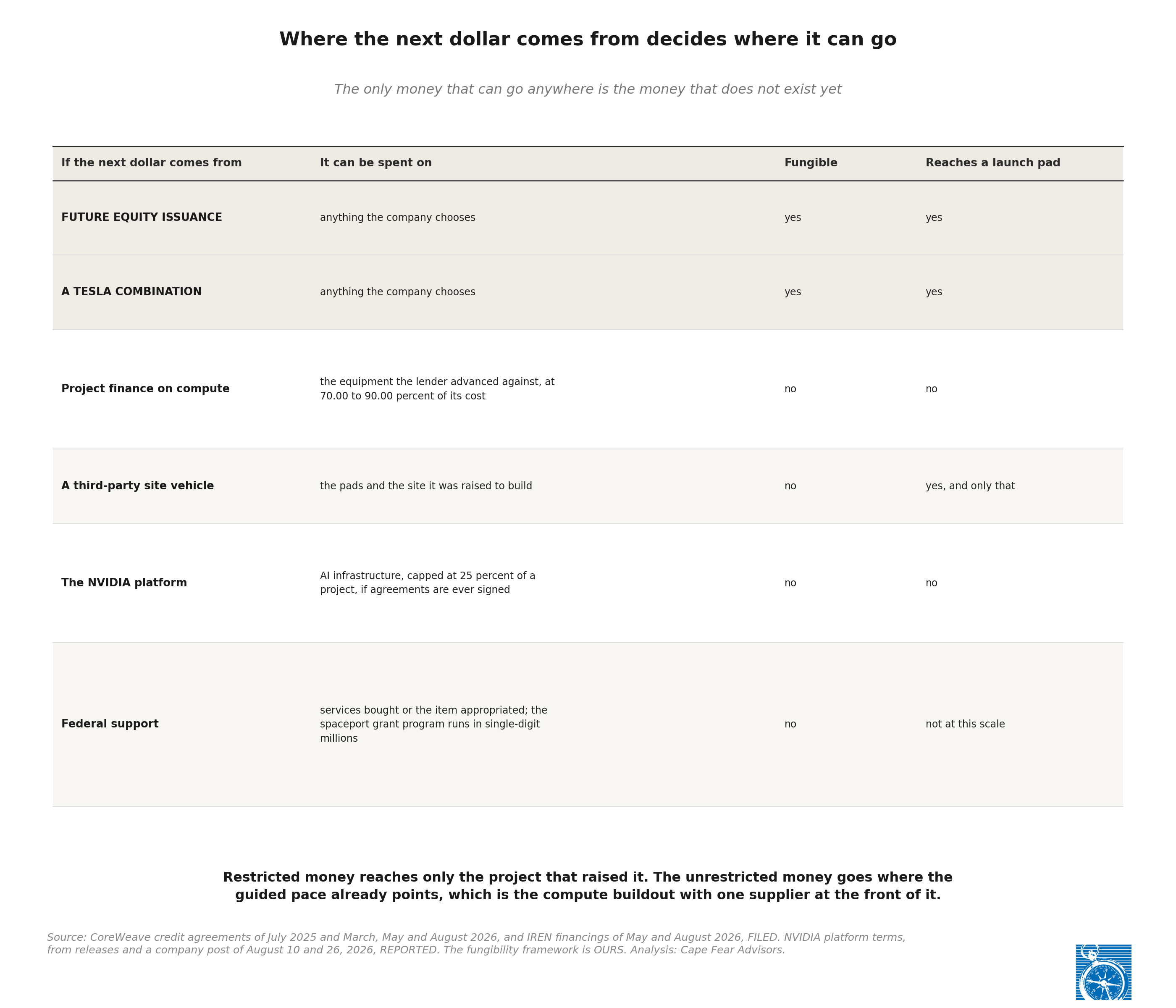
Money carries the strings of wherever it came from, and a lender advancing against equipment funds that equipment.
SpaceX has published no advance rate of its own, so the going rate for this collateral has to come from borrowers who do publish one. Two of them filed six times this year. Four CoreWeave facilities and two IREN financings put the advance rate between 70.00 and 90.00 percent of equipment cost, and each of those dollars stays with the equipment it bought. (11)
The NVIDIA platform, if definitive agreements are ever signed, funds AI infrastructure and stops there. Federal support buys services or funds an appropriated item, and the federal program that funds spaceport capital runs in single-digit millions against a $100,000m campus.
Louisiana supplies training and a rebate under Act 190 of 2026, both of which lower an operating cost. SpaceX pays the parish $20m upfront and $25m a year for twenty-five years, and pays a community foundation $25m. The net cash direction runs from the company to the state. (12)
Which leaves two that produce money the company can point anywhere: another equity issuance, and a combination with Tesla. Both are unrestricted. Both are contingent. The money that arrives without financing strings or project strings on it does not exist yet.
Something else may fit a hole this size, and its absence from this list marks the limit of what we can see. A sovereign investor could arrive. A government facility could be extended. We doubt both and hold the doubt loosely.
Two five hundreds, and what separates them
On August 10 NVIDIA announced partnerships with Apollo, BlackRock, Blackstone, Brookfield, Goldman Sachs and KKR to mobilize over $500,000m of third-party capital for AI infrastructure over time. The Q2 release adds three words: subject to definitive agreements. That phrase places the agreements in the future. The 25 percent residual support figure everyone quotes comes from a post, dated August 10, and appears in no filing. (13)
Daniel O’Regan of Mizuho asked this week whether that program is aimed at SpaceX, which needs $300,000m to $500,000m on the same firm’s estimate for its 2027 compute target alone. The numbers match the way two round numbers match. One is a use with dates on it. The other raises other people’s money over time against papers that have not been signed, caps its support at a quarter of a project, and offers residual value rather than cash.
Seven days after that announcement, NVIDIA guaranteed $105,000m of Ohio leases directly, with the platform standing aside. (14)
That direct arrangement is also the structure that would work for the pads, and the AI industry spent this year inventing it. A third party owns the site, the tenant leases it for twenty years, and a residual guarantee stands behind the whole. Run at a launch complex it would build the pads with somebody else’s money and move the obligation from the capital expenditure line into a lease footnote. It would change where the commitment appears, and leave every dollar of it owed.
The two records, and what each one carries
The Louisiana announcement came with a site visit by helicopter, a meeting with the governor, a new section of the company’s own web presence, and a headline built on a price and a date. All of it stops short of EDGAR, where the company’s most recent filing of any kind was filed on August 14, eleven days before the announcement. (15) Terafab at least got there, as free writing prospectuses to the offering, which is how the aspiration and the requirement both entered the filed record.
What the filings do say covers the ground, and covers it plainly. Capital will be spent as quickly as it can be deployed. Some things may go undone for want of cash. Further equity or debt may be issued to pay for the rest. Every reader has all three sentences and every reader chooses which to weigh. At some point, though, deferral itself becomes a change that merits its own report, and one word at an investor meeting for a different company falls short of one.
What remains is a pattern with one instance in it. A project is named essential, priced in the tens of billions, given a date, and then goes quiet while other announcements keep arriving. Whether Pecan Island follows the same arc is a question the next four quarters answer, and three places will show it: a by-year schedule in a parish record, a line in a segment, or another word at somebody else’s meeting.
What prints next
The June quarter is the last full picture. Cash and marketable securities came to about $100,000m, of which $25,000m holds still, leaving about $75,000m that can move. Net consumption in the quarter ran $17,279m, which is four quarters and change. Capital expenditure went from $10,100m in the March quarter to $18,400m in June, on revenue of $7,810m. At the step the company just printed, four quarters is the long end.
Netted against the cash that can move, the distance is about $351,000m. The title names the whole of what has to be spent, and the whole is the company’s own list. Every component on it is floored, none has come off, and the count has run $235,000m to $400,000m to $430,000m in three months, with a consumer telecommunications business carried at nothing.
A gap closes from either side, and the simplest close is the one where the spending does not happen. That resolution is already on the page. The fab is the line that went quiet, and it went quiet without being withdrawn, which is what a constraint looks like in a filing, as against in an announcement.
It carries its own bill. The chips arrive anyway, at a supplier’s margin, and the asset that would have ended the bill does not get built. Constraint by deferral is a decision with a price, and on this one item the price runs to three quarters of every dollar the deferral redirected.
The list of commitments grew by $30,000m in three weeks. The list of sources grew by an announcement. Both lists are the company’s own, and they are moving in opposite directions.
The third quarter arrives in November. It carries the first construction spend at Pecan Island if any lands early, the spectrum business as an operating line, whatever the AI capital expenditure does after an 82 percent step, and any answer at all on the sources side.
Standing Disclosure
Cape Fear Advisors holds no direct position, long or short, in the securities discussed here. Any exposure is indirect, through managed funds it does not control, which may include index funds holding the companies named. Anthropic develops the tool used in preparing this research and is a compute counterparty to SpaceX, one of the filers read here. That nearness cannot be checked away, which is why no claim here rests on trust in the tool: every figure carries a public source. Parties named across this series carry their own ties to Anthropic, and each piece is re-checked against its own cast, and against no fixed list. Figures are quoted from the filers and from named parties without characterization, and the same standard of reading is applied to every party named.
Notes
(1) The stack itself, its common basis, the through-2030 conversion of each component, and the fungibility framework in the third exhibit are ours. Every component is filed or sits in a public state or county record, and each is tagged where it appears. The May count of about $235,000m and the August count of about $400,000m are ours, on the same basis. The components foot to $426,500m, printed throughout as about $430,000m, on the same rounding convention the August count used at $396,500m. The increase of $30,000m is exact either way.
(2) The consumer mobile business is REPORTED. On the company’s debut earnings call of August 4, 2026 the president said SpaceX intends to build ground-based infrastructure to complement the satellite service and to compete for wireless subscribers against the incumbent carriers, carried through Bloomberg and trade coverage of August 5, 2026 under the Starlink Mobile name, alongside 12 million Starlink subscribers and 1.7 million added in the quarter. No capital figure has been attached to it, which is why the spectrum line on the first exhibit holds at its cash leg of $11,500m and the direction change is carried in words. The spectrum acquisition itself is FILED, 10-Q Note 6, at roughly $19,600m of consideration.
(3) The exchange is quoted from the edited transcript of the SpaceX second quarter 2026 webcast of August 4, 2026, published by the company on its own investor relations site. Read three ways: through the published document at 12:40 pm Eastern on August 29, 2026; against an independently produced transcript of the same call carried by Investing.com at 1:05 pm; and off the document itself at 1:40 pm, when both quoted strings were compared character for character and the occurrence count was run. Terafab appears once in the whole transcript, in Godyn’s question. Godyn’s question carried three specifics and the answers engaged none of them: no segment split was given, the buying-against-building question was not taken up, and the fab was not mentioned. Nothing here claims the fab was singled out for avoidance, and the record does not support that reading. Johnsen’s and Musk’s answers are described from the full text and the phrases in quotation marks are verbatim. What else was read for this section: the Form S-1 and final prospectus and the free writing prospectuses to the offering; the Form 10-Q for the quarter ended June 30, 2026; the Grimes County JETI application and the associated development agreement; and general coverage through August 29, 2026. The word soon is REPORTED, from a Tesla investor meeting. HSBC named Terafab on July 24, 2026 in a list of unproven technologies, so the point is not that the project has gone unmentioned by anyone. The point is that the company has published no update on its status, financing or schedule, including when asked.
(4) The mobile exchange is from the same transcript, read at the same sittings and confirmed against the full passage. Kutgun Maral of Evercore ISI asked about Starlink Mobile in the United States and whether the buildout would come by capital expenditure, by an MVNO arrangement or by acquisition. Gwynne Shotwell confirmed the terrestrial intent, said twice that she would not discuss the capital expenditure, and explained the reason at length: small cellular base stations mounted on the hardware that already carries a Starlink dish, deployed as needed, against spending on low-band spectrum upfront. Elon Musk added a further passage on the same design. An earlier working version of this section characterized the exchange as a refusal alongside the fab, and the full text does not support that reading: the question was engaged at length and only the number was withheld. The quoted phrases are verbatim. Nothing here treats a declined figure as evasion, and the observation is narrower: a business now on the company’s own list of ambitions carries no capital number, which is why the spectrum line on the first exhibit holds at its cash leg.
(5) The exclusivity is Musk’s, verbatim, in the same transcript. Earlier entries in this series carried the switch to bought silicon through reported coverage; this replaces that with the company’s own words.
(6) The reclassification language is FURNISHED, NVIDIA Form 8-K accession 0001045810-26-000073, Exhibit 99.2, second quarter fiscal 2027 CFO Commentary. The $5,181m is ours, derived by setting the Hyperscale and ACIE figures for the quarter ended April 26, 2026 as furnished May 20 (accession 0001045810-26-000051) against the same period as recast on August 26. Hyperscale $37,869m to $43,050m; ACIE $37,377m to $32,196m; Data Center $75,246m unchanged. The two moves offset to the dollar, which is the check that one company crossed one boundary. Total revenue for that quarter was $81,615m and for the June quarter $96,221m, with Data Center at $89,023m, all FILED. The Hyperscale definition is NVIDIA’s own, published with the framework in the Q1 release. Kakashii published both platform tables side by side on Substack during the call, which is the same subtraction run here and reached independently. He names the company in the discussion, annotating the tables “Nvidia classified SpaceX as a hyperscaler starting from Q2” and writing “So it is SpaceX, Nvidia notify us that starting from Q2, they treat SpaceX as hyperscaler.” REPORTED, read direct from his Substack at 2:05 pm Eastern on August 29, 2026, rather than from a secondary account of it. Munster’s figures are REPORTED, from a post, and his denominator is not stated, so no comparison of percentages is attempted here. Beth Kindig of I/O Fund reported the reclassification on August 27 and named no company. One reading we hold without asserting: the xAI acquisition was effective February 2, 2026, eight days into NVIDIA’s fiscal 2027 first quarter, and that same quarter’s release introduced the Hyperscale and ACIE framework, so a classification following a change of ownership fits the dates. NVIDIA’s own six words say business model rather than corporate structure, and both readings survive. Separately from the accounting, both companies describe the relationship as material: SpaceX has said it will buy only NVIDIA data-center chips and expects a significant share of next year’s output, and NVIDIA has named SpaceX among its lead partners in call commentary.
(7) NVIDIA gross margin of 75.0 percent for the quarter ended July 26, 2026, FILED, Form 10-Q accession 0001045810-26-000075. It is the consolidated company figure. No segment or per-part margin is disclosed, and nothing here treats the consolidated figure as the margin on any particular product. The Terafab figures are from the Grimes County JETI application of May 6, 2026, REPORTED from county records, and the June 4 quotation is FILED, free writing prospectus accession 0001628280-26-041365.
(8) The closing price of $140.88 on August 28, 2026 and the 52-week range of $104.83 to $225.64 are REPORTED from a quote page read at 2:05 pm Eastern on August 29, 2026. Our August piece carried the shares below the $135.00 issue price, which was accurate when written and is not accurate now; they closed back above issue during the week of August 10. The correction is taken here because it runs against this reading rather than for it. The Cursor closing is FILED, Form 8-K accession 0001628280-26-056945, period August 14, 2026, Items 2.01 and 3.02: 389,289,254 Class A shares for the outstanding stock plus 1,752,426 for vested restricted stock units, at an implied equity value of $60.0 billion and a price equal to the volume-weighted average closing price over the seven consecutive trading days immediately preceding the closing, with approximately 29,128,326 restricted stock units and 44,365,047 options assumed. The comparison to the offering uses the 638,888,888 Class A shares sold there, FILED at accession 0001628280-26-043288, and is ours.
(9) The $25,000m minimum cash balance appears in no SEC filing. The figure is stated in the Fitch rating action of June 18, 2026, REPORTED, whose account places the commitment in private bond documentation. The provenance was worked out and published in “SpaceX, Adding It Up: The $400 Billion Cash Gap”, August 2026, whose cover-to-cover reading of this 10-Q found no minimum-cash or minimum-liquidity covenant in any debt document; the one financial maintenance covenant in the capital structure is a 3.75 to 1 leverage test on an undrawn revolver. The commitment is a management policy the agencies credited, which is a different thing from a term a lender can enforce, and it holds the cash all the same.
(10) SpaceX Form 10-Q for the quarter ended June 30, 2026, accession 0001628280-26-052535, Note 17. FILED. The roughly $8,800m is the change in the related-party balance across the half and is ours. Valor appears on both exhibits, at $20,000m of lease obligations among the uses and at the cash the structures delivered among the sources. That is one instrument read from both ends, which is what a sources and uses is for. The offering, notes, bridge, premium, Cursor and spectrum figures are FILED at the same 10-Q and at Form 8-K accessions 0001628280-26-043288, 0001628280-26-044955 and 0001628280-26-043411.
(11) Advance rates: CoreWeave delayed draw facilities of July 2025 at 80.00 percent, March 2026 at 90.00 percent, May 2026 at 71.42 percent and August 7, 2026 at 70.00 percent; IREN financings of May 2026 and August 2026, the latter covering 90 percent of the capital cost of the chips. FILED. The comparison across issuers is ours. The federal spaceport capital program referred to is the FAA Space Transportation Infrastructure Matching program.
(12) Starbase Louisiana, REPORTED, from the Louisiana Economic Development announcement of August 25, 2026 and contemporaneous trade coverage: about $100,000m across 125,000 acres at the Pecan Island site in Vermilion Parish; five launch complexes of two pads each, ten pads in all, plus propellant production, power generation, deepwater shipping, vehicle processing, an airport and housing; construction beginning by the end of 2027; a first launch as soon as 2029, with the state’s own language putting initial operations in 2030; 3,000 direct jobs over ten years at an average $92,600 and more than 30,000 at peak construction; and payments in lieu of taxes of $20m upfront and $25m a year for twenty-five years. The $30,000m carried through 2030 is ours, and it is built from the company’s own scope rather than from a straight line. A launch in 2029 needs one of the five complexes, and no complex works without the propellant production, power generation and marine access the whole campus shares. One fifth of the program is $20,000m, the shared infrastructure is not one fifth of anything, and construction starting at the end of 2027 leaves 2028, 2029 and 2030 to carry it. Ten thousand million in each of those three years is the conservative read, and a straight line over the full build would put $40,000m to $44,000m inside the same window. The by-year schedule is the load-bearing number and it is not in the announcement. Terafab’s profile came out of a Grimes County JETI filing rather than an SEC document; this one will sit in the Vermilion Parish payment agreement, any cooperative endeavor agreement with the state, and the Act 190 rebate application. Same filer, second state, same two records.
(13) The platform: NVIDIA press release of August 10, 2026, “to mobilize over $500 billion of third-party capital for the buildout of AI infrastructure over time,” and the second quarter release of August 26, 2026, which adds “subject to definitive agreements.” The 25 percent residual-value support figure is from a dated post of August 10 and appears in no filing. All REPORTED.
(14) The Ohio guaranties are FILED, NVIDIA Form 8-K accession 0001045810-26-000069, entered August 17, 2026, capped at $105,000m, with obligations terminating on the earliest of four events, the third of which is the tenant achieving a satisfactory credit rating. Mizuho’s estimate that SpaceX requires $300,000m to $500,000m to meet its 2027 compute target, and its question whether the NVIDIA program is aimed at SpaceX, are REPORTED through MarketWatch, August 28, 2026. The June quarter cash, capital expenditure, revenue, operating cash and interest figures are FILED at accession 0001628280-26-052535.
(15) The filing sweep is ours, and it was run against the primary record: the EDGAR submissions file for Space Exploration Technologies Corp., CIK 0001181412, at data.sec.gov, read at 2:29 pm Eastern on August 29, 2026, reading the filing-date array in full. The link in the body goes to the human-readable company index at the same agency, which is where a reader can repeat the count; the probe itself was run on the submissions record, and the two are named separately here so that the route and the reader link are not taken for the same thing. The most recent entry of any type carries a filing date of August 14, 2026. Three entries share that date: the 8-K reporting the Cursor closing under Items 2.01 and 3.02, accepted 12:23 pm UTC, and two Schedule 13G filings by holders. Nothing has been filed since, by the company or about it, so nothing about the August 25 announcement could have reached EDGAR. Nothing here says a filing was required for it, and no such claim is made; the observation is that the two records carry different amounts of detail, which is the same observation this shelf made about Grimes County in July. The risk language is FILED, SpaceX Form S-1 and final prospectus, accessions 0001628280-26-036936 and 0001628280-26-042639, and repeated in the 10-Q: capital expenditure scaling as quickly as power and compute can be deployed; projects subject to separate negotiation with timelines, milestones and capital expenditures not yet determined; and further issuances of equity or convertible debt securities as a stated means of funding, with significant dilution named as the consequence. The Terafab aspiration and requirement reached the filed record as free writing prospectuses to the offering, accessions 0001628280-26-041365 and 0001628280-26-040610. The Louisiana site visit, the meeting with the governor and the company web section are REPORTED from contemporaneous coverage of August 25, 2026.
Analysis: Cape Fear Advisors.
This piece also appears on Substack. Cape Fear Advisors is an independent advisory firm based in Portsmouth, NH.
Contact Cape Fear Advisors