

Priced against CoreWeave’s own most expensive borrowing, a buyer of its stock would have to forecast a higher after-tax operating margin than NVIDIA earns. What distinguishes the arrangement is the claim a buyer holds besides the stock, and a dollar placed in March unlocked three times the gross profit that a dollar placed in August unlocks. The key is equity, what it opens is debt, and together they buy the equipment on which both figures turn.
Two disclosures before the ledger. A supplier buying stock in its customer is ordinary, a customer buying stock in its supplier is ordinary, and the record here is clean and complete. The arrangement also resembles one that has a history, and the resemblance is fair to raise; what separates the cases is where the claim ranks, which the documents settle. The subject throughout is what the stock returns and to whom.
And the grouping is a construction. The filings present these three transactions separately, and setting them side by side is a choice. Every figure carries its source and the accessions are public.
Three placements, and the first one was paid in stock for backlog
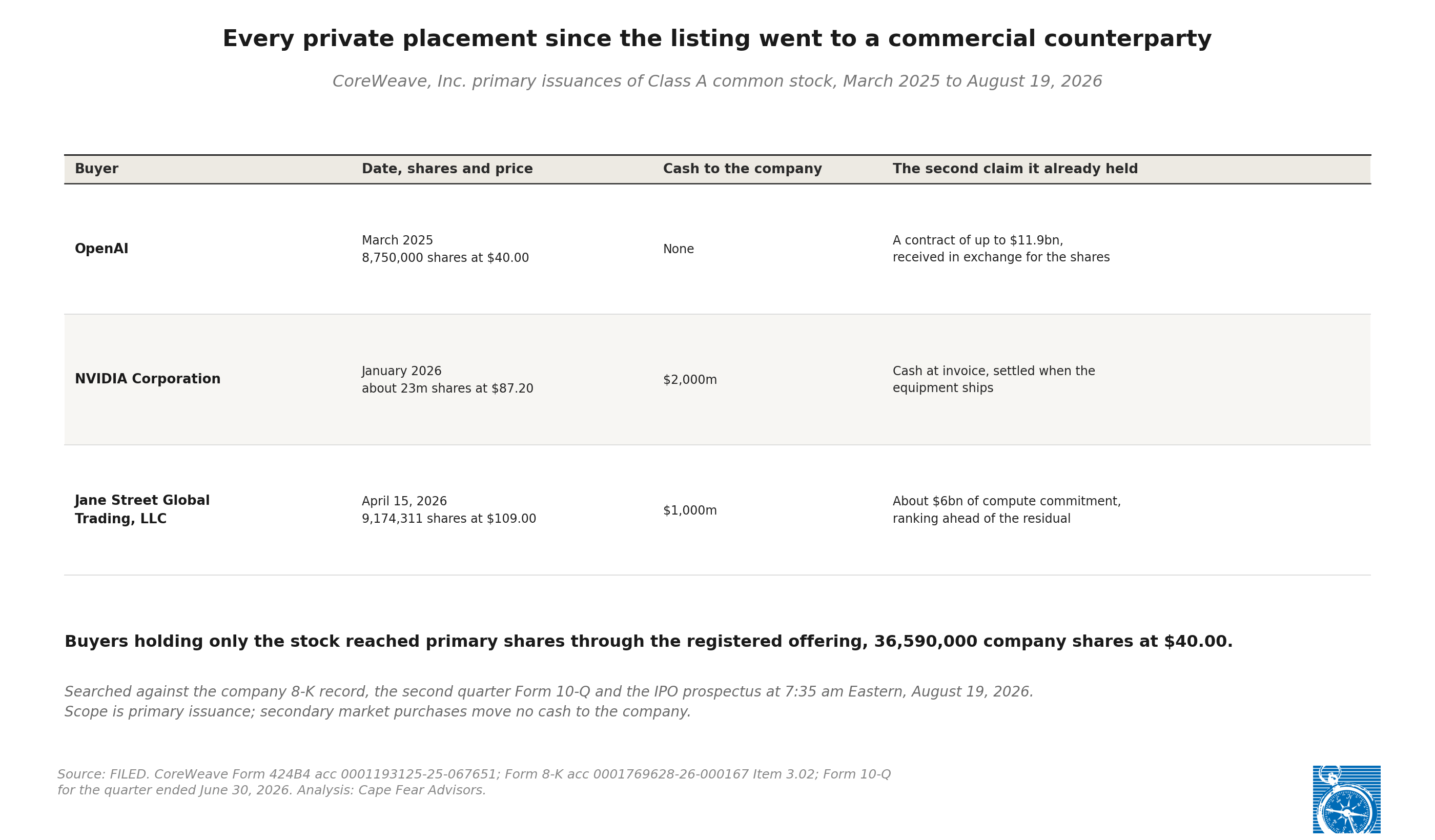
In March 2025, immediately after its initial public offering closed, CoreWeave issued 8,750,000 shares to OpenAI at the offering price of $40.00, or $350.0m. In exchange it received a contract of up to $11.9bn. The prospectus states the transaction’s cash proceeds to the company as zero (1).
So the first thing CoreWeave bought with its public equity was backlog.
In January 2026, NVIDIA bought about 23 million shares at $87.20 for $2,000m. NVIDIA supplies the equipment CoreWeave’s credit facilities finance, holds a master services agreement as a customer, and held stock already.
On April 15, 2026, Jane Street Global Trading, LLC bought 9,174,311 shares at $109.00 for approximately $1,000m in cash, reported under Item 3.02. A commitment of about $6bn to use the company’s platform was announced the same day (2).
Three placements, and each one bought something different. CoreWeave issued shares and received contracted revenue. NVIDIA paid cash for a position in a company that buys its equipment. Jane Street paid cash and, the same day, committed to the platform, which is a customer funding capacity it will use itself.
The distinction matters because the credit rests on two legs, and the placements touch them differently. The equipment is the collateral. The facilities lend against title to it at carrying value, secured by substantially all assets of the borrower and a first-priority pledge of 100 percent of the borrower’s equity. The contracts are what the covenants measure: a projected contract value ratio of 2.40, minimum contracted revenue of $1,000m with investment grade counterparties counted at 100 percent and others at 75, and a debt service coverage ratio of 1.35 (3).
Remaining performance obligations stood at $103.7bn at June 30. The company’s revenue policy states that the figure is the transaction price “net of estimated variable consideration,” and defines that variable consideration as potential future reductions for credits under availability of service agreements, amounts that may go unrecognized because of delivery delays, and committed capacity the company has the right to resell. So the published figure is already net of a reduction, and two probes of the annual and quarterly filings found no figure for it. And some part of the contracted revenue those covenants measure is contracted revenue the company issued shares to obtain (4).
Both legs are in the presentation, and where one of them sits is the finding.
The company defines cost of revenue as the direct costs of data centers: rent, utilities including power, depreciation and amortization including depreciation of power installation and distribution systems, and personnel for data center operations. It defines a separate line, technology and infrastructure, as depreciation and amortization related to servers, switches, networking equipment and internally developed software, together with research and development personnel and software subscriptions (5).
So the depreciation of the equipment the facilities lend against sits below the gross profit line. For 2025 the company reported revenue of $5,131m, cost of revenue of $1,453m, and technology and infrastructure of $2,929m. That second line is twice the first, and total depreciation for the year was $2,400m against cost of revenue of $1,453m.
The gross margin that presentation produces is 71.7 percent. NVIDIA’s gross margin for its fiscal 2026 was 71.07 percent. The two are struck on opposite sides of the same hardware: one after the cost of building it, the other before the depreciation of owning it.
And the measure the company guides to is struck above the cost of the arrangement. Adjusted operating margin excludes stock compensation, acquisition costs and amortization of acquired intangibles, and is taken before interest and tax. For the first half the filed operating loss was $193m and the filed net loss was $1,366m, so about $1,173m, or 25.2 percent of revenue, sits below the line the guidance describes (6).
Those three are the whole population of private placements since the listing. Buyers holding only the stock reached primary shares through the registered offering, 36,590,000 company shares at $40.00.
The key, and what it opens
CoreWeave signed three delayed draw term loan facilities between March 30 and August 7, 2026. Each defines the loan as a percentage of the capital expenditure it funds. That percentage ran 90.00, then 71.42, then 70.00. The balance comes from outside the facility. At 70 percent, one dollar of outside money carries three dollars and thirty-three cents of equipment (7).
Four other terms moved the same direction over the same one hundred and thirty days. The spread over SOFR more than doubled, from 225 basis points to 550. The coverage test rose from 1.15 times to 1.35. The facilities shrank, from $8,500m to $2,600m. And the parent guarantee changed. The March facility was described in the company’s filing as guaranteed on a limited recourse basis for specified bad acts, and in the company’s own overview of that facility as “Non-recourse to Parent” with a “customary ‘bad-boy’ guarantee.” The August facility is guaranteed unconditionally, under an agreement in which CoreWeave, Inc. stands as primary obligor rather than surety, with surety defenses waived. That last one changes recourse instead of price, and it places the parent’s whole balance sheet inside the structure (8).
$4,599m of committed capacity sits undrawn on the two newest facilities, and those commitments terminate on September 30 and December 31 of this year. Drawing it calls for about $1,914m of outside money beside it.
Equity here buys access, not runway. Standing alone against a capital program guided at $35bn to $39bn, $1,914m funds under three weeks. Placed beneath the draws, the same $1,914m releases $4,599m of borrowing and about $6,513m of purchases (9).
That is the key, and it is a quantity, not a party. Any holder of equity can turn it, and several instruments reach part of the same requirement. What the rest of this piece measures is what turning it returns, and to whom.
The hurdle a buyer of the stock has to clear
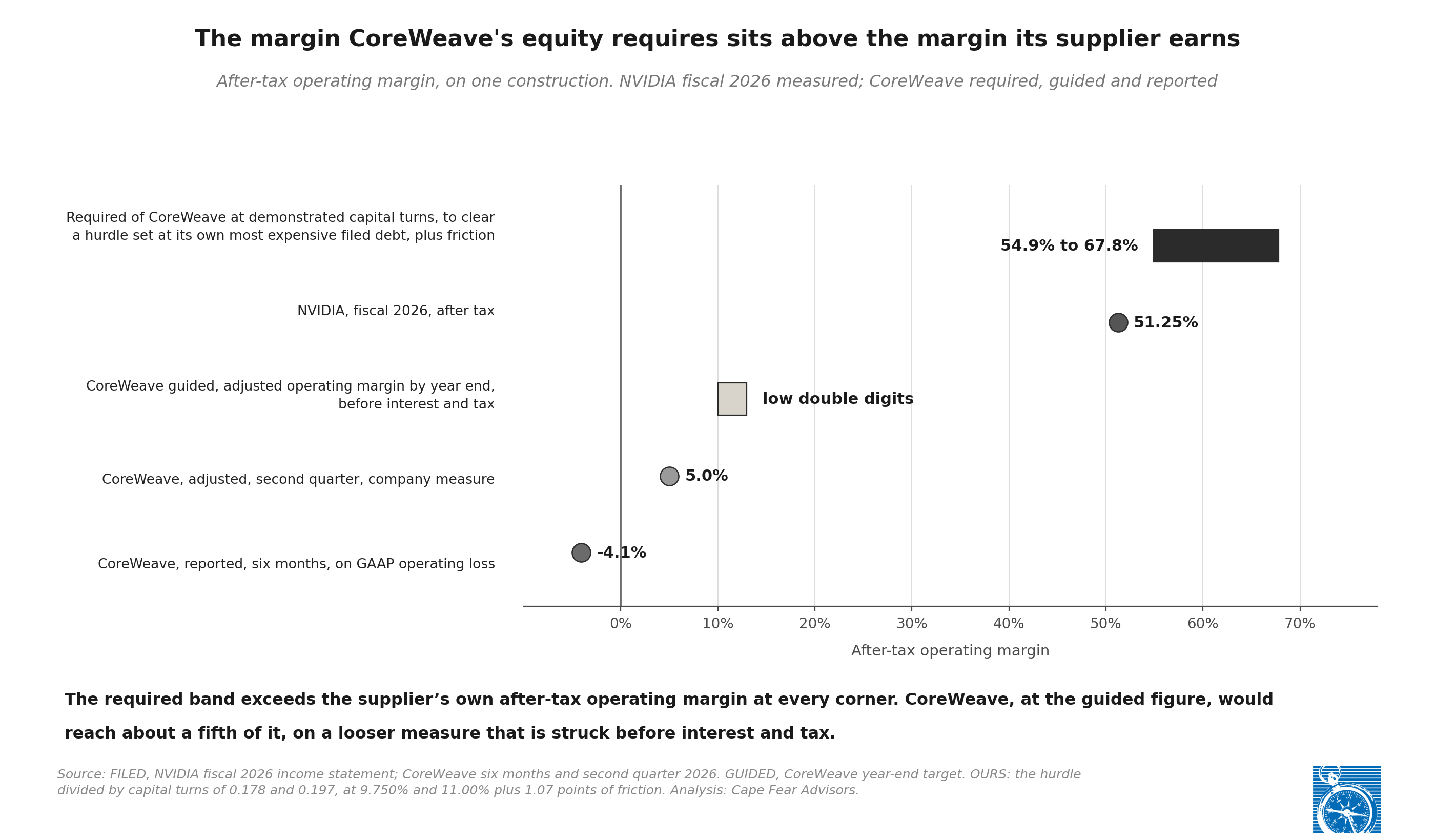
Pricing the common begins with rank. A claim junior to an instrument yielding a given rate is priced to require more than that rate. CoreWeave’s most expensive filed obligations are the 9.750 percent senior notes issued in April and its OEM financing, which runs at about 11 percent effective on the recourse portion. The common ranks behind both. So a buyer of the common requires a return above 9.750 percent, and on the second measure above 11 percent. That statement rests on the order of claims alone, with no model of risk in it (10).
Return on capital is margin multiplied by capital turns, so the margin a company must earn to clear a hurdle is the hurdle divided by its turns. This shelf has published CoreWeave’s turns at 0.178 trailing and 0.197 on the second-quarter revenue rate annualized, and has published the friction in its financing at 1.07 points a year.
The four corners of that division run 54.9, 60.8, 61.3 and 67.8 percent (11).
A buyer of the common has to forecast an after-tax operating margin somewhere between about 55 and 68 percent. Every step above is rounded toward the lower requirement.
The band holds at the capital turns the company has demonstrated. A buyer forecasting better turns is forecasting the improvement the band prices: at double today’s turns the requirement falls to roughly 27 to 34 percent, which is still between two and a half and three times the guided figure, on the stricter measure.
Two comparisons put that figure in scale, and the first one is the piece.
NVIDIA reported revenue of $215,938m for fiscal 2026, operating income of $130,387m, and income tax expense of $21,383m on pre-tax income of $141,450m. That is an operating margin of 60.38 percent, an effective rate of 15.12 percent, and an after-tax operating margin of 51.25 percent, struck on the same measure as the band above (12).
So a buyer of CoreWeave’s common, to clear the return CoreWeave’s own capital structure implies, has to forecast CoreWeave earning a higher after-tax operating margin than NVIDIA earns. At every corner of the band, on the same measure, against the company that sells it the equipment.
The second comparison is closer to home. CoreWeave’s stated target is a low double-digit adjusted operating margin, on a measure that excludes stock compensation and intangible amortization and is taken before interest and tax. The required figure is roughly five times the guided one, on the stricter measure of the two. And the company’s measured return on capital in service is negative 0.74 percent (13).
Which is where the second claim comes in. For a buyer holding only the stock, that hurdle is the whole calculation. For a buyer that also invoices the company, the stock is one line in a sum, and the second line differs from it on every dimension that sets a required return.
It arrives earlier, at the shipment instead of a distribution years out. It ranks higher, as an invoice settled in cash ahead of a residual sitting behind a $1,300m gate. It carries less risk, because it is realized before the outcome the stock is exposed to. And the company’s financial leverage multiplies it, which the stock alone does for its holder in market value only: at the newest advance rate a dollar of equity stands beside three dollars and thirty-three cents of equipment purchases.
So one dollar buys a dollar of residual for every holder, and for one holder it also buys a claim against three.
What the other line is, buyer by buyer
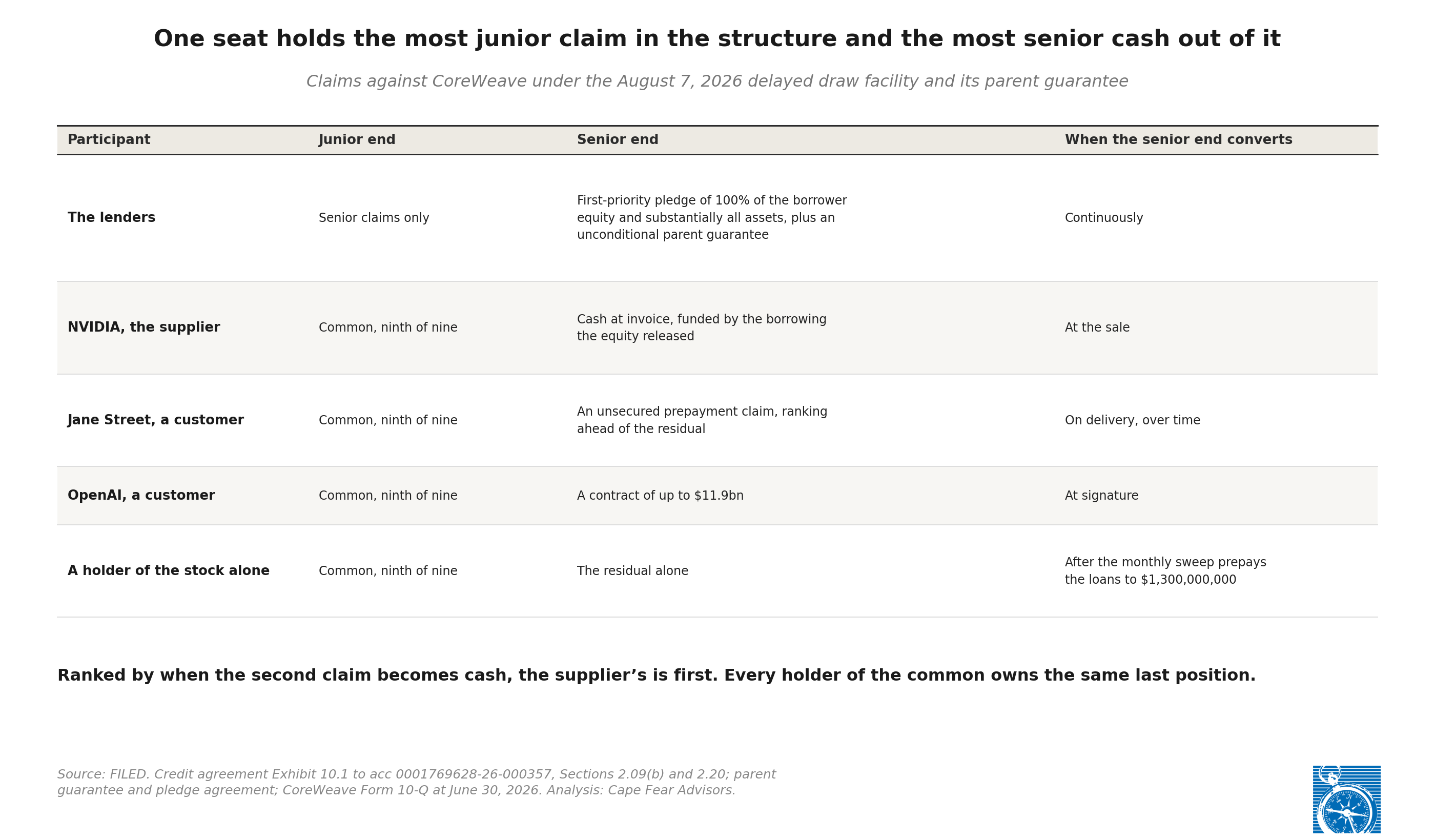
The common ranks ninth of nine in the August facility’s payment waterfall, and cash reaches it after a monthly sweep has prepaid the loans down to a Minimum DDTL Amount of $1,300,000,000. Ahead of it stand the lenders, holding a first-priority pledge of 100 percent of the borrower’s equity and substantially all its assets, plus the unconditional parent guarantee. Ahead of it also stand the customers, whose prepayments are unsecured claims: $9,692m of deferred revenue at June 30 against $5,524m of cash (14).
Every holder of the common owns that same last position. The three placement buyers own something else as well, and the three second claims convert at different moments.
NVIDIA’s converts at the sale, and as a multiple of the amount placed. An invoice is settled in cash when the equipment ships, and the cash that settles it is the borrowing the equity released. That places one participant at the most junior claim in the structure and the most senior cash coming out of it, with the second realized as the first is deployed.
Jane Street’s converts over time. A prepayment ranks ahead of the residual and turns into delivered compute across the life of the commitment.
OpenAI’s converted at signature. Shares went out, a contract came in, and the cash column read zero.
Ranked by when the second claim becomes cash, the supplier’s is first.
What the arrangement costs a holder who owns only the stock
The slice has a share count. About $1,914m at $109.00 is roughly 17.6 million shares, near 3.1 percent of the enlarged count against 551.5 million outstanding at July 31. Struck at $99.54, the price implied by NVIDIA’s own June 30 holdings report, it is about 19.2 million shares and 3.3 percent. Drawing the full $10,199m of undrawn capacity would call for about $2,536m and roughly 23.3 million shares, near 4.0 percent. Each figure is rounded toward the smaller number (15).
Dilution is shared pro rata. The second claim belongs to one holder.
The company has also priced what it will pay to blunt dilution, in one place. Alongside its December 2025 convertible it bought capped call transactions costing about $340m, and alongside its April 2026 convertible it bought more, at $492.0m. About $832m of cash spent to limit the dilution its convertible notes create. The placements carry their dilution unhedged, and those are the ones that go to a holder with a second claim (16).
Which brings the ledger to the supplier
NVIDIA has held CoreWeave stock through six quarterly reports, and every change in the position has been an addition. The count moved from 24,182,460 at March 31, 2025 to 47,213,353 at March 31, 2026 and stood there at June 30, valued at $4,700m, an implied $99.54 against the $87.20 paid in January.
Two instruments carry that count, and the second is the holder’s own. A quarterly holdings report shows what a manager reports. A Schedule 13G shows what a beneficial owner declares. NVIDIA filed one on CoreWeave in May 2025, reporting 24,182,460 shares and 7.0 percent of the Class A. It amended that filing on January 26, 2026, for an event date of January 23, reporting 47,213,353 shares and 11.5 percent, sole voting power and sole dispositive power over all of them, with the box for shares excluded from the aggregate marked no. The two instruments agree to the share (17).
The same amendment carries the one statement of purpose the record does make. NVIDIA certifies there that the shares “were not acquired and are not held for the purpose of or with the effect of changing or influencing the control of the issuer.” That is a statement about control, filed under the rule that requires it, and nothing here reads it further than it goes.
What the January placement released can be bounded from filed figures alone, and the bounds below take the most conservative filed input at every step.
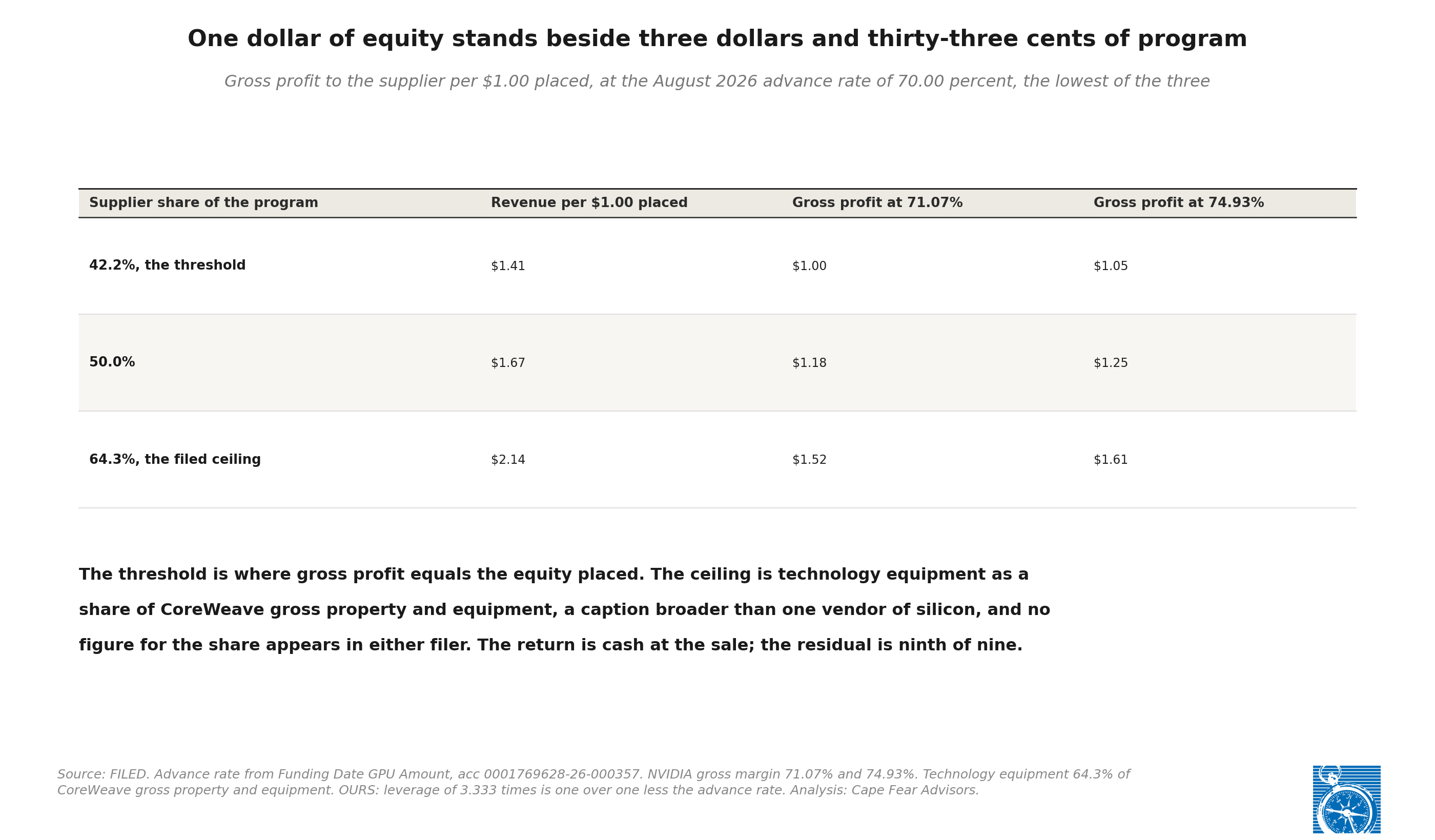
The August facility’s 70.00 percent advance rate produces the smallest program of the three, so $2,000m of equity stands beside about $6,667m. NVIDIA’s gross margin was 71.07 percent for fiscal 2026 and 74.93 percent for the most recent quarter, and the fiscal year figure is the lower of the two. On that basis, gross profit on the program passes the $2,000m placed once NVIDIA’s share of it passes 42.2 percent. Technology equipment is 64.3 percent of CoreWeave’s gross property and equipment and 69.2 percent of what it added in the half, which is a ceiling, because that caption is broader than one vendor’s silicon (18).
A threshold near 42 percent, a ceiling near 64, and a search of both filers’ disclosures found no figure for the share between them.
Stated as a multiple of the amount placed, one dollar of equity stands beside three dollars and thirty-three cents of program, and gross profit on it runs from one dollar at the threshold to about $1.52 at the ceiling. Every figure in that sentence uses the lowest advance rate and the lower margin. That return is collected in cash when the equipment ships. The residual it sits beside is collected ninth of nine, after a gate, at a date the documents leave open.
What the record supports about the next dollar
The same dollar buys less than it did
The advance rate decides how far a dollar of equity reaches, and it has fallen twice. Run the return at each of the three filed rates, holding the share at the filed 64.3 percent ceiling and the margin at the lower of the two (19).
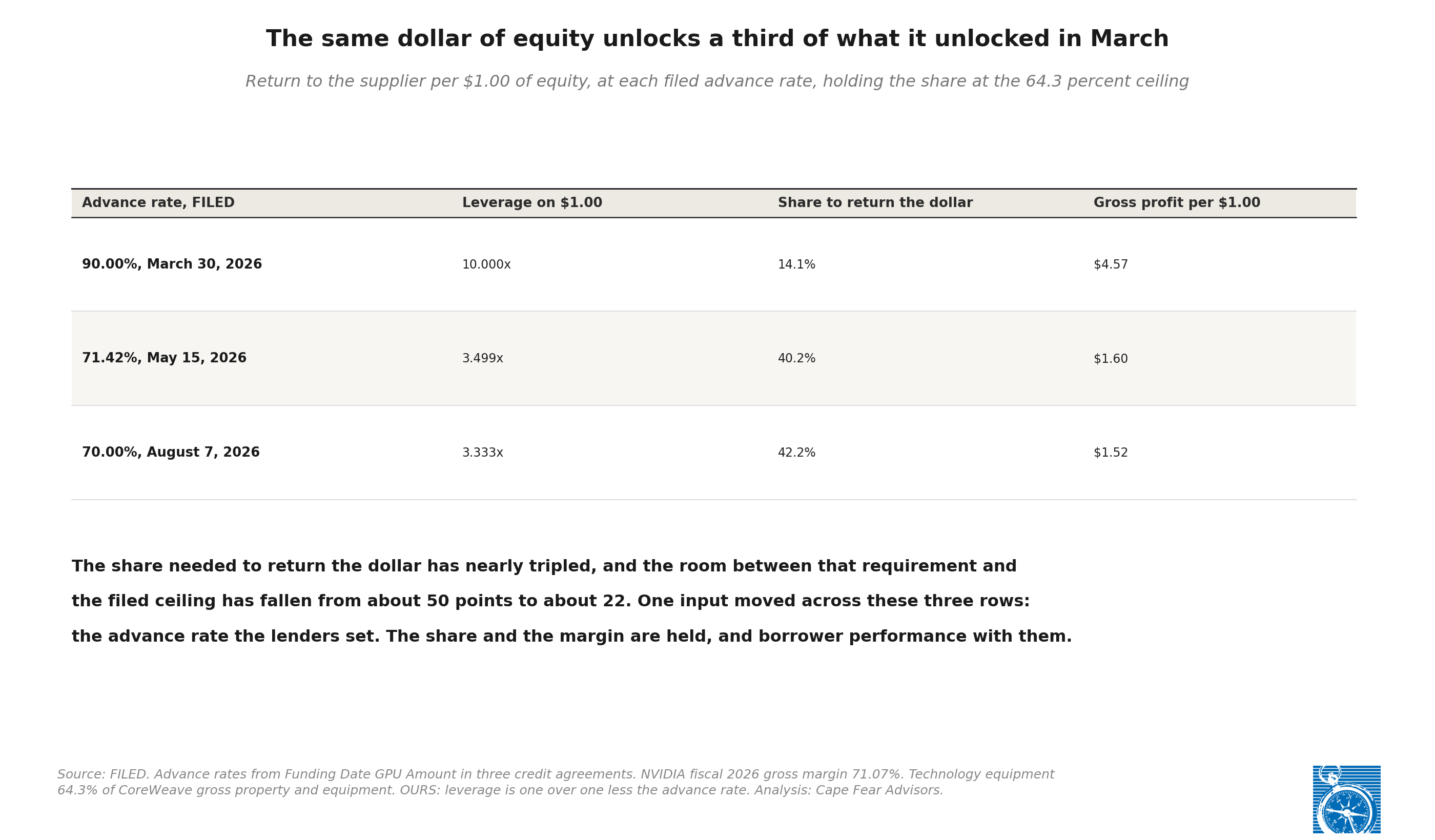
At the March rate a dollar of equity stood beside ten dollars of equipment, and gross profit on it reached $4.57 at the ceiling share. At the August rate it stands beside three dollars and thirty-three cents, and reaches $1.52. The gross profit a dollar unlocks has fallen by about two thirds.
The share needed to return the dollar moved the same way, from 14.1 percent to 42.2. In March the supplier’s share of the program could have been anything above about a seventh and the placement returned its cost in gross profit. In August it has to exceed two fifths. The room between the requirement and the filed ceiling has gone from about 50 points of share to about 22.
One input moved across those three rows. The share is held at the filed ceiling, the margin is held at the lower of the two reported figures, and the only thing that changes is the advance rate the lenders set. A fall of about two thirds in what a dollar unlocks, attributable to one contractual term, with the borrower’s own performance held constant.
The point at which it stops clearing is an identity rather than a forecast. Gross profit equals the equity placed when leverage, multiplied by the supplier’s share of the program and by its margin, equals one. So the advance rate at which a dollar just returns a dollar is one less the share times the margin (20).
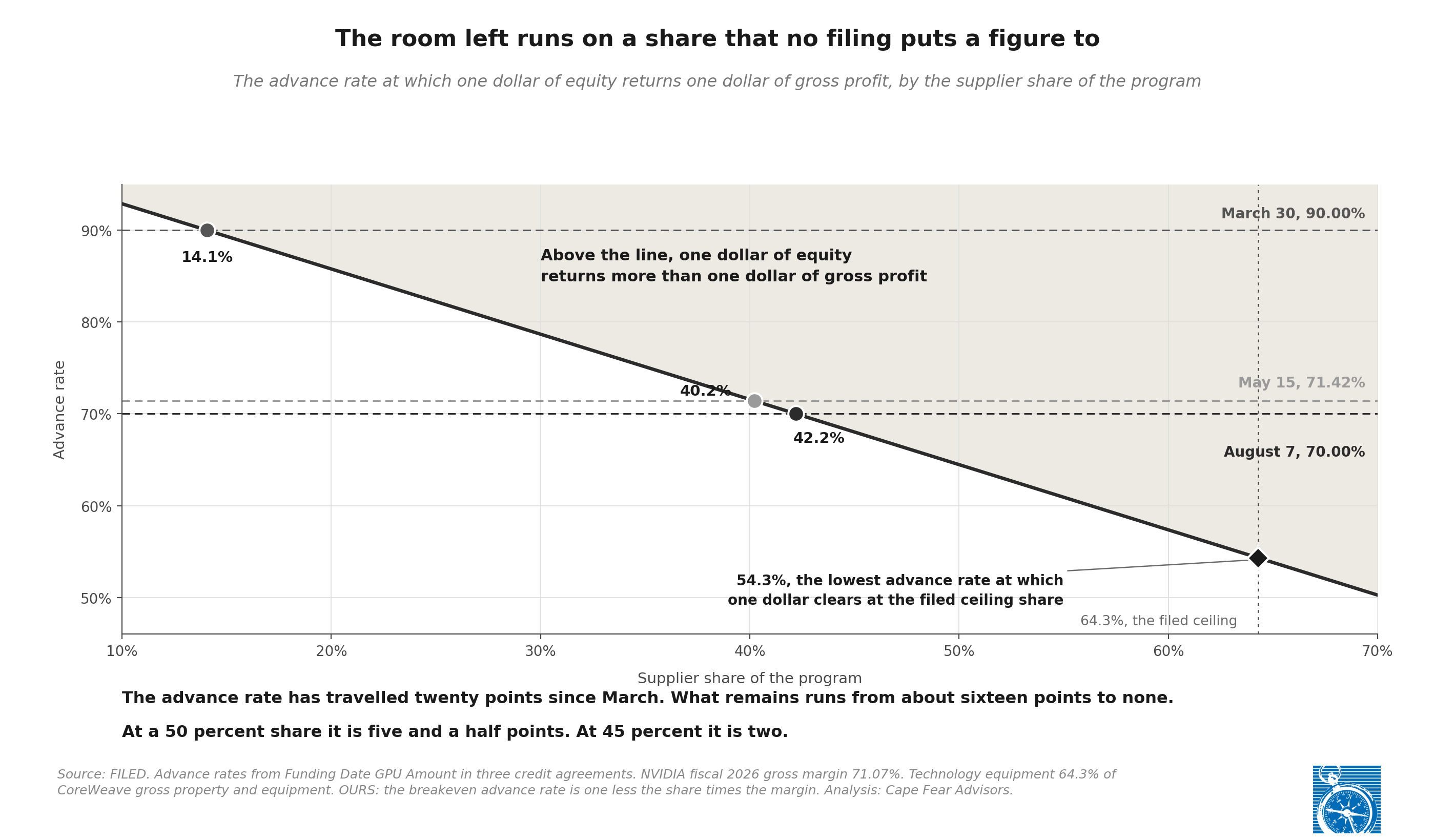
The advance rate has already travelled twenty points, from 90.00 to 70.00. What remains runs from about sixteen points to none, and which it is turns on a share that no filing on either side puts a figure to.
And the same movement reaches the two parties at different distances. The supplier’s limit is the row where the dollar stops returning a dollar. The borrower’s limit arrived earlier and carries dates: the equity required beside each dollar of equipment has tripled, and $4,599m of commitments terminate on September 30 and December 31.
And the debt it unlocks costs more to carry
Two changes compound. A dollar of equity unlocks a third of the equipment it unlocked in March, and each dollar of that equipment carries a wider spread.
The contractual spread borne by a dollar of equipment is the advance rate multiplied by the margin over SOFR. In March that was 90.00 percent of 225 basis points, or 2.02 percent a year. In May, 71.42 percent of 450, or 3.21 percent. In August, 70.00 percent of 550, or 3.85 percent. The negotiated spread carried by each dollar of equipment has nearly doubled in one hundred and thirty days (21).
The SOFR leg runs the other way, because a lower advance rate borrows less against the same equipment, so the total interest depends on where SOFR sits. The spread is the part the parties agreed and the part that is filed.
For a holder of the common, both changes land in the same place. The dilution funds a smaller program, and the program it funds carries a higher financing cost. Equity issued on August terms buys less and carries more than equity issued in March, and the holder bears both.
For a participant weighing whether to supply it, the table above is the whole of the change: $4.57 of gross profit per dollar placed at the March rate and $1.52 at the August rate, on the same ceiling share. The record states the terms. What the terms show is that the same decision is a different decision than it was in March.
The position ranks the three things that can happen to the undrawn capacity. Another party funds the slice, the capacity draws, and the 47,213,353 shares are supported by whatever the draw builds. NVIDIA funds it, the capacity draws, and the margin on the released program arrives besides. The capacity lapses on its dates, and the two agreements retire with the money unspent. A holder of the stock gains from the first two and the third leaves it holding the mark alone, which is the same arithmetic every existing shareholder faces, with one line added for the shareholder that also ships the equipment.
One pairing, stated as a sequence.
On August 10 NVIDIA published an argument for the residual value of its hardware, resting on fungibility, a standard architecture, and an economic life it described as running toward a decade. On August 12 CoreWeave’s chief executive told CNBC: “We contracted a 2020 vintage architecture all the way out to 2029 at full freight.” The second is the demonstration the first requires, published by the counterparty, forty-eight hours later (22).
Reduced to what changed hands
The January transaction reduces to two items that moved, and both moved from CoreWeave to NVIDIA.
A share certificate, 22,935,780 shares, carried at $99.54 at June 30 against the $87.20 paid.
And cash. NVIDIA sent $2,000m in, and CoreWeave sent back invoices settled at the point of sale, funded by the borrowing that equity released. Above a 42.2 percent share of the program at the August advance rate, and above 14.1 percent at the March rate, the cash returning exceeds the cash that went out (23).
The filings link no placement to any facility, and the share of the program is sized nowhere between the threshold and the ceiling. What the rates establish is the arithmetic of the exchange, and no dollar is traced.
And every alternative eliminated above is a variation on changing one of those two items. A price concession changes what the invoice says. Vendor credit changes when it is paid. The residual value platform leaves both alone and moves no cash until ready-for-service in 2028. What remains is the form the record already carries, twice: a certificate one way, and the purchase price, in full, in cash, the other. That is the price the buyer’s own chief executive described in August, and it is the simplest arrangement available to either party.
The newer instruments, and the hole they reach
Since the January placement NVIDIA has published, and then filed, a different way of supporting a customer.
On August 10 it described platforms built to mobilize third-party capital into AI infrastructure, with financial institutions independently assessing each opportunity on the customer, demand, utilization, cash flow and residual value, and with NVIDIA providing residual value support for up to 25 percent of an opportunity, “limited, residual-value based and designed to complement, not replace, independent underwriting.” The same post describes that capital as independent and long-term, sourced from institutions and directed across opportunities, with no single customer named.
A week later the instrument reached the record. NVIDIA filed residual value guaranties with SB Energy Corp. covering approximately 4.25 gigawatts of IT load at the Portsmouth site, capped at $105,000m, reported under Item 2.03 as an off-balance sheet arrangement. Payment requires ready-for-service conditions expected beginning in 2028, and it is triggered by OpenAI’s insolvency or a failure to pay under a lease (24).
That instrument reaches a different requirement from the one described above. It moves cash on a third party’s default in 2028 or later, and the requirement here is cash standing beside a draw before December 31. It supports an asset’s terminal value, and the covenant here measures Total Indebtedness against Consolidated Adjusted EBITDA. And the platform’s published terms place a compute buyer on the underwritten side of the transaction, as the customer whose cash flow the institutions assess.
There is also a price to every route. This shelf has published the friction: $327m of new debt discount and issuance costs incurred in the first half, against $18m of issuance costs on both equity placements combined, and a further $832m spent on capped calls across the two convertible issues. A private placement sold direct to a buyer carries no underwriter, and therefore no discount (25). Of every route to the same dollar, the one already used twice is the one that arrives whole.
Where the record stops
Seven instruments can fill the outside leg, and two of them already have: convertible notes twice, at $2,587.5m in December 2025 and $4,000m in April 2026, both at 1.75 percent. Customer prepayments, a registered takedown, preferred stock, a slowed capital program and an eligible new customer contract each reach part of the requirement. Common equity is distinguished by arithmetic, and by no permission: the parent guarantee caps total net leverage at 6.00 to 1.00 on Total Indebtedness less Unrestricted Cash over Consolidated Adjusted EBITDA, convertible notes count as Indebtedness until they convert, and common equity funds the leg while leaving the measure alone.
Preferred stock reaches the same covenant through a door that closes behind it. A breach may be cured by “a contribution of capital (1) in the form of common equity, (2) in the form of preferred equity having terms reasonably acceptable to the Revolving Agent or (3) in such other form having terms reasonably acceptable to the Revolving Agent.” Preferred sits outside Total Indebtedness where it is perpetual or long-dated. Preferred that matures or is mandatorily redeemable before the facility does is Disqualified Stock, a liability under the accounting, and enters the measure it was brought in to cure. The terms that compensate a buyer are the terms that fail the test, and the terms that pass the test return the buyer to a perpetual residual, with the Revolving Agent’s consent required besides.
The filings record positions, prices and dates. Reasons live elsewhere, and this piece reads the record. The three placements are set side by side because they share a feature, and the sequence between any placement and any facility is a sequence.
NVIDIA’s disclosure of customer concentration covers its direct customers, which it defines as add-in board manufacturers, distributors, ODMs, OEMs and system integrators; cloud service providers sit in a separate class it calls indirect (26). So NVIDIA’s junior claim on CoreWeave is public and sized to the share in a quarterly holdings report, while its senior claim reaches the record through CoreWeave’s documents alone. The round trip is visible because two companies each disclose one half of it.
What would change it
A filing showing NVIDIA’s position reduced. An amendment raising an advance rate. Capital expenditure guided down, which retires the requirement. A large customer advance arriving with no stock attached. A registered takedown or an at-the-market program, at a size that funds the slice, to buyers who hold only the stock. Preferred, on terms the Revolving Agent accepts, from a party whose entire return is the security. Or a fourth facility at an advance rate below about 54 percent, which would leave a dollar placed returning under a dollar in gross profit even at the filed ceiling.
That last one is the cleanest test, because it is the case where a buyer with one claim pays the price a buyer with two has been paying.
And the list divides by who holds the decision. Whether to place equity, whether to hold or reduce the position, and the price at which the equipment sells are all NVIDIA’s, exercisable when it chooses. CoreWeave’s side of the same list runs on dates it has already agreed to: commitment terminations on September 30 and December 31, a coverage test in November, another in February. One party holds decisions and a price. The other holds a calendar. That is a description of the structure, and the structure was assembled one agreement at a time, in public.
The system, as it is
Vendor financing, customer prepayments, credit backstops and residual value guarantees are the ordinary furniture of capital-intensive industry. Each appears in these filings correctly characterized, disclosed on the calendar its own rules set. Whether an arrangement of this shape serves anything beyond its participants sits outside what a filing can settle, and this piece leaves that question where it belongs.
One comparison will occur to any reader, and it should be drawn on the documents, and on the documents alone. The canonical case is the equipment makers who lent their customers the money to buy the equipment, booked the sale, and carried the loan. In that arrangement the supplier held the customer’s paper, ranked ahead of the equity, and recognized revenue against credit it had extended itself.
Here the seat is inverted. The supplier holds the customer’s common stock, ninth of nine, and collects its revenue in cash when the equipment ships. The credit was extended by the lenders behind three facilities, arranged by JPMorgan, MUFG and Morgan Stanley, who set their own advance rates, took a first-priority pledge of the borrower’s equity and substantially all its assets, and hold an unconditional parent guarantee. Every one of those terms moved against the borrower across five months, which is what independent underwriting looks like while it is repricing (27).
The supplier holds the customer’s common stock, ninth of nine, and collects its revenue in cash when the equipment ships. The credit was extended by the lenders behind three facilities, arranged by JPMorgan, MUFG and Morgan Stanley, who set their own advance rates, took a first-priority pledge of the borrower’s equity and substantially all its assets, and hold an unconditional parent guarantee.
And the inversion is why the placement stands on the claim alone. At a 42.2 percent share of the program, gross profit on the released purchases equals the equity placed. At the filed 64.3 percent ceiling it is about $1.52 for every dollar. Above the threshold the outlay comes back from the claim alone, before the certificate carries any value at all, so the stock is what remains after the trade has already cleared.
What the filings settle is position. CoreWeave holds $4,599m of committed borrowing that draws when equity stands beside it, and otherwise retires on two dates this year. Three buyers have supplied equity since the listing, and every one of them held a claim on the company before it bought the stock.
NVIDIA can decide whether to be the key. The claim is its own either way, and it converts at the sale, which happens when somebody turns the key.
The missing piece is a second claim. The one that converts soonest belongs to the supplier.
Notes
Figures are stated in $m with commas, and in $bn only where the filer itself states a round headline figure that way. FILED means in a document filed with the SEC, cited by accession. FURNISHED means provided under Item 7.01 and not deemed filed. GUIDED is management’s own forward figure. OURS is our arithmetic on stated inputs, with the inputs named so a reader can reject the construction line by line.
(1) FILED, CoreWeave Form 424B4, accession 0001193125-25-067651. 8,750,000 shares issued to OpenAI at the $40.00 offering price, $350.0m, immediately after the offering closed, with no cash proceeds to the company, in connection with a contract of up to $11.9bn.
(2) FILED, Form 8-K, accession 0001769628-26-000167, Item 3.02: a Securities Purchase Agreement with Jane Street Global Trading, LLC for 9,174,311 shares at $109.00, approximately $1,000m in cash, under Section 4(a)(2). The compute commitment of about $6bn is FURNISHED, in Exhibit 99.1 under Item 7.01, and carries a different liability standard from the body of the same filing. The NVIDIA placement of about 23 million shares at $87.20 for $2,000m is FILED in the Form 10-Q for the quarter ended June 30, 2026, accession 0001769628-26-000366.
(3) FILED, credit agreement Exhibit 10.1 to accession 0001769628-26-000357 and the parent guarantee and pledge agreement: security over substantially all assets of the borrower and a first-priority pledge of 100 percent of its equity; a debt service coverage ratio of 1.35; a projected contract value ratio of 2.40; minimum contracted revenue of $1,000m crediting investment grade counterparties at 100 percent and others at 75.
(4) FILED, Form 10-Q: remaining performance obligations of $103.7bn at June 30, 2026, against $60.7bn at December 31, 2025 in the Form 10-K. FILED, revenue policy, identical in both filings: RPO “represent the aggregate amount of the transaction price, net of estimated variable consideration, allocated to performance obligations not delivered, or partially undelivered,” and that variable consideration “primarily consists of potential reductions to the transaction price in the future, such as estimates of future potential credits to customers under availability of service agreements, amounts that may not be recognized as revenue due to delivery delays, and estimates of committed cloud computing capacity that the Company has the right to resell.” Two probes found no figure for the deduction: the second-quarter Form 10-Q and its notes at 4:35 pm Eastern on August 18, 2026, and the complete set of tagged facts in the Form 10-K XBRL instance for the year ended December 31, 2025, together with its revenue policy text, at 9:05 pm Eastern the same day.
(5) FILED, CoreWeave Form 10-K for the year ended December 31, 2025, accounting policies and consolidated statements of operations, read from the filing’s XBRL instance. The cost of revenue policy reads that it “primarily consists of direct costs for data centers, including costs associated with the Company’s facilities, such as rent, utilities including power, depreciation and amortization, including depreciation of power installation and distribution systems, and personnel costs for employees involved in data center operations and customer success.” The technology and infrastructure policy reads that it “consists of costs associated with the Company’s infrastructure, such as depreciation and amortization related to the Company’s servers, switches, networking equipment and internally developed software,” together with research and development personnel and software subscriptions. FILED figures for 2025: revenue $5,131m, cost of revenue $1,453m, technology and infrastructure $2,929m, sales and marketing $144m, general and administrative $651m, total costs and expenses $5,177m, operating loss $46m. Those four expense lines sum to the filed total exactly. Research and development of $352m is disclosed separately and sits inside technology and infrastructure. Depreciation for the year was $2,400m. OURS: gross profit of $3,678m is a gross margin of 71.7 percent, and technology and infrastructure is 2.02 times cost of revenue.
(6) FILED, second-quarter results: revenue of $4,653m for the six months, an operating loss of $193m and a net loss of $1,366m. OURS: $1,366m less $193m is $1,173m, or 25.2 percent of $4,653m. The company defines adjusted operating income as operating loss adjusted to exclude stock-based compensation, acquisition-related costs and amortization of acquired intangibles, taken before interest and tax; adjusted operating income was $128m in the second quarter, a 5 percent margin. The composition of that $1,173m is left open here. Interest expense is GUIDED at $860m to $940m for 2026, on a perimeter this piece leaves unreconciled, and the company carries $1,835m of notional foreign exchange forwards outside hedge accounting.
(7) FILED, in the definition of “Funding Date GPU Amount” in each credit agreement: 90.00 percent, accession 0001769628-26-000129; 71.42 percent, accession 0001769628-26-000236; 70.00 percent, accession 0001769628-26-000357.
(8) FILED, same three accessions, and REPORTED for one line. Spreads of 225, 450 and 550 basis points over SOFR; coverage tests of 1.15, 1.35 and 1.35; sizes of $8,500m, $3,100m and $2,600m; commitment terminations in June 2027, September 2026 and December 2026. The March facility’s parent guarantee is described in the filing as limited recourse for specified bad acts, and in CoreWeave’s own March 2026 facility overview, REPORTED, as “Non-recourse to Parent; Parent will provide customary ‘bad-boy’ guarantee covering GPU installation and related performance obligations.” The March guarantee exhibit itself remains unread for this piece. That overview also states a 90 percent loan to cost during installation and, after customer acceptance, a 1.2 times coverage test implying up to about 102 percent loan to cost, so a reader working from it would measure a larger fall in leverage than this piece states. The May and August facilities are unconditionally guaranteed, the August parent guarantee naming the guarantor as primary obligor and not merely a surety, with surety defenses waived.
(9) OURS on filed advance rates and filed expiry dates, built facility by facility because a blended rate misstates it: $1,999m undrawn at 71.42 percent calls for $800m beside it, $2,600m at 70.00 percent calls for $1,114m, giving $4,599m of capacity, $1,914m of slice and about $6,513m of equipment. GUIDED capital expenditure is $11.5bn to $13.5bn for the third quarter and $35bn to $39bn for 2026. OURS: $1,914m against the annual range is 2.55 to 2.84 weeks, stated as under three weeks.
(10) FILED: 9.750 percent senior notes due 2031, issued under the indenture dated April 14, 2026. FILED: OEM financing outstanding of $5,102m at June 30, 2026, running at about 11 percent effective on the recourse portion. The step from those rates to the required return on the common is a statement about the order of claims.
(11) OURS, and previously published in “CoreWeave: Searching for the Next Participant,” August 16, 2026: capital turns of 0.178 trailing and 0.197 on the second-quarter revenue rate annualized, and financing friction of 1.07 points a year. The four corners are the hurdle divided by turns: 10.82 percent over 0.197 and 0.178 gives 54.9 and 60.8 percent; 12.07 percent over the same gives 61.3 and 67.8 percent. At double the demonstrated turns the same hurdles give 27.5 to 33.9 percent.
(12) FILED, NVIDIA fiscal 2026 ended January 25, 2026: revenue $215,938m, gross profit $153,463m, operating income $130,387m, income tax expense $21,383m on pre-tax income of $141,450m. OURS: an operating margin of 60.38 percent, an effective rate of 15.12 percent, and an after-tax operating margin of 51.25 percent.
(13) OURS, published August 16, 2026: a return on capital in service of negative 0.74 percent, against a published 9 percent hurdle and a filed cost of debt of 9.27 percent excluding the convertible. That cost of debt was struck on issued coupons. The company also carries $4,661m of notional pay-fixed interest rate swaps, so the coupon stack describes the cost of the floating book only in part.
(14) FILED, credit agreement Sections 2.09(b) and 2.20: distributions rank ninth of nine, and a monthly sweep prepays the loans until the outstanding balance is at or below a Minimum DDTL Amount of $1,300,000,000. FILED, Form 10-Q: deferred revenue of $9,692m against cash and equivalents of $5,524m at June 30, 2026.
(15) OURS on filed inputs, with 551.5 million shares outstanding at July 31, 2026. $1,914m at $109.00 is about 17.6 million shares, near 3.1 percent of the enlarged count. At $99.54 it is about 19.2 million and 3.3 percent. $2,536m at $109.00 is about 23.3 million and near 4.0 percent. Rounded toward the smaller figure at each step.
(16) FILED: capped call transactions of about $340m alongside $2,587,500,000 of 1.75 percent convertible senior notes due 2031, completed December 11, 2025, accession 0001769628-25-000105; and $492.0m alongside $4,000,000,000 of 1.75 percent convertible senior notes due 2032 priced in April 2026, at a cap price of $230.00.
(17) FILED, NVIDIA Forms 13F-HR: 24,182,460 shares at March 31, 2025; 24,277,573 at June 30, September 30 and December 31, 2025; 47,213,353 at March 31 and June 30, 2026, valued at $4,700m, an implied $99.54. Every change in the position is an addition, and 24,277,573 plus the 22,935,780 implied by $2,000m at $87.20 equals 47,213,353 to the share. FILED, and corroborating that count from the holder rather than the manager: NVIDIA Schedule 13G on CoreWeave, Inc., accession 0001045810-25-000103, filed May 15, 2025 under Rule 13d-1(d) for an event date of March 31, 2025, reporting 24,182,460 shares of Class A common stock, 7.0 percent of the class, sole voting power and sole dispositive power over all of them; and Amendment No. 1, accession 0001045810-26-000008, filed January 26, 2026 under Rule 13d-1(c) for an event date of January 23, 2026, reporting 47,213,353 shares, 11.5 percent of the class, sole voting power 47,213,353, shared voting power zero, sole dispositive power 47,213,353, shared dispositive power zero, and the aggregate amount marked as excluding no shares. The percentages are of the Class A common stock and are struck on a different denominator from the share counts elsewhere in this piece, which are of total shares outstanding across classes. The Item 10 certification in the amendment reads that the securities “were not acquired and are not held for the purpose of or with the effect of changing or influencing the control of the issuer of the securities and were not acquired and are not held in connection with or as a participant in any transaction having that purpose or effect.”
(18) OURS on filed inputs, taking the lowest advance rate and the lower margin at every step. At 70.00 percent, $2,000m stands beside about $6,667m. At a 71.07 percent gross margin, gross profit passes $2,000m once the supplier’s share of that program passes 42.2 percent. Technology equipment was 64.3 percent of gross property and equipment at June 30 and 69.2 percent of additions in the half, which bounds the share from above because the caption is broader than one vendor’s silicon.
(19) OURS on filed advance rates and filed margins, holding the share at the 64.3 percent technology equipment ceiling. Leverage is one over one less the advance rate: 10.000, 3.499 and 3.333 times. The share at which gross profit equals the equity placed is one over leverage times margin, giving 14.1, 40.2 and 42.2 percent at the 71.07 percent fiscal year margin. Gross profit per dollar placed at the ceiling share is $4.57, $1.60 and $1.52.
(20) OURS, on filed inputs. Leverage is one over one less the advance rate. Gross profit equals the equity placed when leverage times the supplier’s share times its margin equals one, which rearranges to an advance rate of one less the share times the margin. At the 71.07 percent fiscal year margin that gives 54.3 percent at the 64.3 percent ceiling share, 60.9 at 55 percent, 64.5 at 50 percent, 68.0 at 45 percent and 70.0 at 42.2 percent. The identity reproduces both anchors: at a 90.00 percent advance rate the breakeven share is 14.1 percent, and at 70.00 percent it is 42.2 percent. The higher of the two reported margins would move each advance rate about two and a half points lower, and the lower margin is used throughout.
(21) OURS on filed inputs. The spread borne per dollar of equipment is the advance rate multiplied by the applicable margin over SOFR: 90.00 percent of 2.25 gives 2.02 percent; 71.42 percent of 4.50 gives 3.21 percent; 70.00 percent of 5.50 gives 3.85 percent, a factor of 1.90 across the three. The SOFR component per dollar of equipment is the advance rate itself and therefore falls across the same three facilities, so the total carrying cost depends on the level of SOFR and is left unstated here.
(22) NVIDIA’s platform statement is dated August 10, 2026 and is REPORTED as published by the company. The CoreWeave chief executive’s remark is REPORTED, CNBC, August 12, 2026.
(23) OURS on filed inputs. $2,000m at $87.20 implies 22,935,780 shares, and NVIDIA’s Form 13F-HR for the period ended June 30, 2026 carries an implied $99.54. The thresholds are the share of the program at which gross profit equals the equity placed, computed at the 71.07 percent fiscal year gross margin: 14.1 percent at a 90.00 percent advance rate and 42.2 percent at 70.00 percent. Cash returning is gross profit, not revenue, because the supplier pays its own cost of goods out of the same receipt.
(24) FILED, NVIDIA Form 8-K, accession 0001045810-26-000069, Items 1.01 and 2.03: residual value guaranties with SB Energy Corp. covering approximately 4.25 gigawatts of IT load at the Portsmouth site, cumulatively capped at $105 billion for the initial commitment, payment requiring ready-for-service conditions expected beginning in 2028, and a Trigger Event of OpenAI’s insolvency resulting in a default under a lease or a failure to make payments under a lease. Exhibit 99.1 is furnished, not filed.
(25) OURS, published August 16, 2026: $327m of new debt discount and issuance costs incurred in the first half of 2026 and $18m of issuance costs on the two equity placements, $345m in total against $19,729m raised, stated then and now as a floor because arranger and agency fees sit in fee letters the credit agreements reference without attaching.
(26) FILED, NVIDIA Form 10-Q. Direct customers are described as “add-in board manufacturers, distributors, ODMs, OEMs, and system integrators.” Cloud service providers are described as indirect customers, and no revenue is disclosed by indirect customer.
(27) FILED. Arrangers and agents from the cover pages of the three credit agreements: accessions 0001769628-26-000129, 0001769628-26-000236 and 0001769628-26-000357. The security and guarantee terms are cited in the notes on the credit agreement and the waterfall. The five terms that moved are cited in the note on the facility terms.
Standing disclosure: This piece reads filings by CoreWeave, Inc. and NVIDIA Corporation. NVIDIA’s disclosed equity portfolio includes Space Exploration Technologies Corp., on which this shelf maintains a separate open file, and CoreWeave; the two together are 40.5 percent of that reported portfolio. Documents were assembled and arithmetic checked with the assistance of an AI research tool. Every figure is sourced below and every construction is labeled.
Documents were assembled and arithmetic checked with the assistance of an AI research tool built by Anthropic, a company on which the principal of Cape Fear Advisors maintains no position. Anthropic’s disclosed arrangements with Amazon, Google, and Broadcom overlap with the collateral pool documented in this series. Where that adjacency is relevant, it is noted in the analysis.
Analysis: Cape Fear Advisors. Not investment advice.
Published August 19, 2026.
This piece also appears on Substack. Cape Fear Advisors is an independent advisory firm based in Portsmouth, NH.
Contact Cape Fear Advisors