


On its third-quarter call on November 10, CoreWeave set out how it will pay for the rest of its build. "Looking ahead, we will not use the unsecured debt market to fund our business at current yields. Nor do we need to," said Michael Intrator, the chief executive. Nitin Agrawal, the chief financial officer, said that "at current yields, we do not intend to issue additional parent-level unsecured debt through 2027." The deal loans, the company said, "can finance anywhere from 70% to 100% of the associated CapEx." Customers had prepaid on "70% of our deals" this year, "with customers funding up to 100% of the contract value upfront," and "in the next three months alone, we will collect approximately $9 billion in prepayments and deposits from signed customer contracts." Together with vendor financing and its own cash flow, "we expect these sources to fund the significant majority of our capital needs through 2027, with only a limited amount expected to be raised at the parent company level." (1)
The quarterly report filed two days later shows how the year so far was funded, and where the money landed.
In the first nine months of 2026, CoreWeave's debt rose by a net $25.9 billion. About $8.0 billion of that landed in the special-purpose subsidiaries that hold individual deals: $10.9 billion drawn, net, on the newer deal loans, less $2.9 billion repaid on the older ones. The other $17.9 billion landed at the parent, CoreWeave, Inc., or in vendor financing. Of that, $14.5 billion was senior notes and convertible notes, which is the parent-level unsecured debt the plan now sets aside. Customer prepayments added $3.5 billion to operating cash, and two private placements added $3.0 billion of equity, $2.0 billion of it from NVIDIA. (2)
Each deal loan pays the parent for equipment. Under the newest facility, the loan on any funding date is capped at 70 percent of that date's capital spending, and the parent's invoice for the GPUs it sells to the deal is capped at the same amount. (3) The remaining 30 percent, the coupons on the parent's notes, the vendor financing and the company's overhead are the parent's to pay.
The deals carry their loans from their own accounts; the parent carries everything else, and the plan sets aside the money that paid for it this year.
The parent also guarantees every deal loan except DDTL 4.0, and one of DDTL 3.0's two borrowers. On those loans it stands second, behind each deal's own cash. On everything else it stands first. (2) The limits of the DDTL 3.0 guarantee are set out below.
The quarter, deal by deal
Between June 30 and September 30, the three oldest deal loans repaid $1,061 million. The four newer ones drew a net $5,057 million. The parent added $8,071 million: $4,200 million of convertible notes due 2033, $2,671 million of vendor financing with recourse to the parent, and $1,200 million on its revolving credit facility. (2)
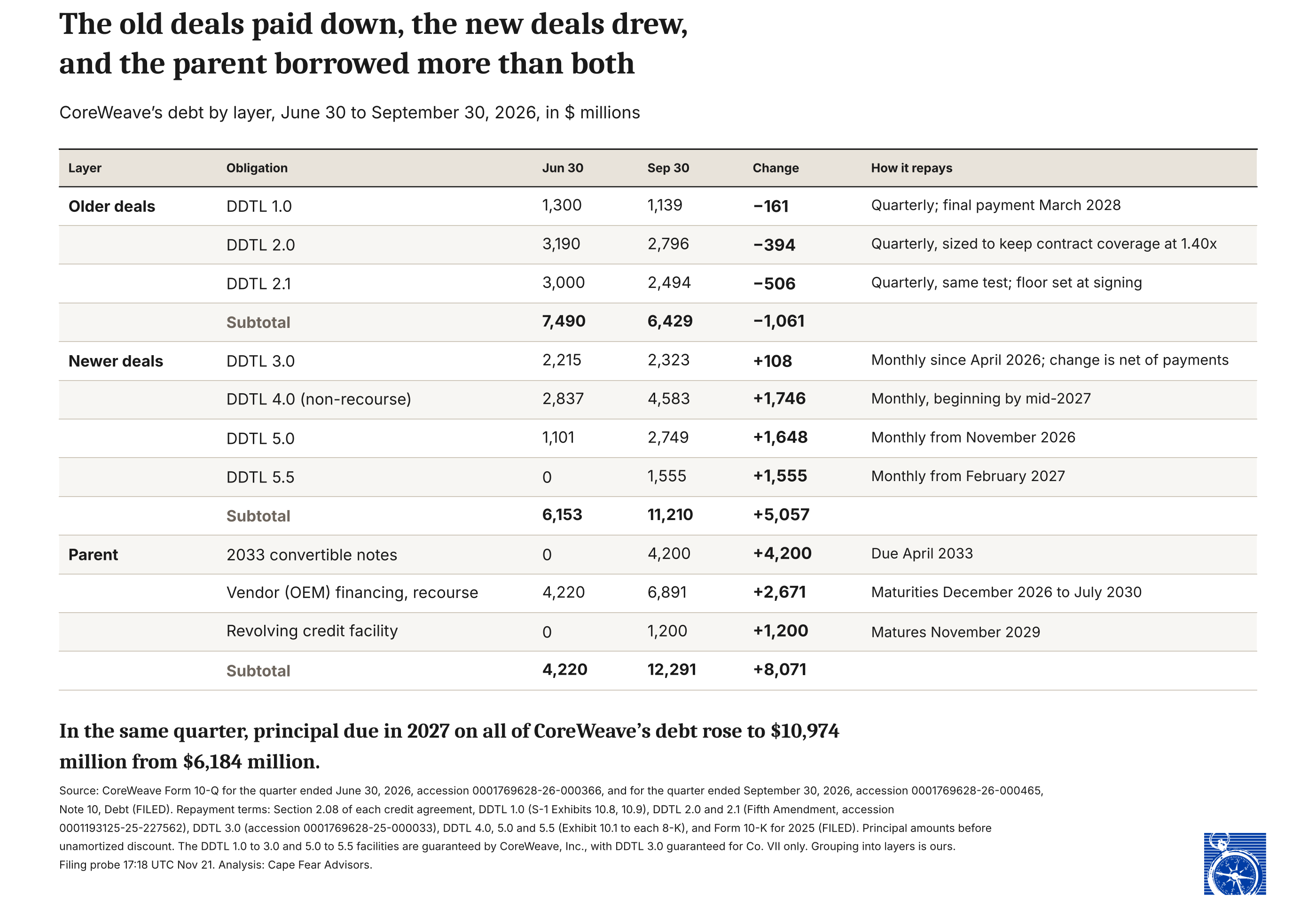
The older deals paying down is the structure working as designed. Their loans were sized against customer contracts, and each waterfall pays principal from the cash deposited in that deal's own account. The newer deals were still drawing at the end of the quarter. DDTL 3.0 has repaid monthly since April; the other three begin between November 2026 and mid-2027.
In the same quarter, the principal CoreWeave owes in 2027 rose to $10,974 million from $6,184 million. (2)
Seven deals, seven rules
Each deal loan is a separate credit agreement with its own repayment clause, Section 2.08 in every one of them. Read side by side, the seven clauses fall into two families. (4)
The three oldest loans repay quarterly, and the payment is sized by the contracts behind them. DDTL 2.0 and DDTL 2.1 require whatever payment keeps projected contract cash at 1.40 times the remaining debt service, or keeps the loan under a share of the GPUs' depreciated cost, whichever is larger. Their payments have run ahead of a level schedule, which is what a contract-coverage test produces when the contracts run shorter than the loans: DDTL 2.0 repaid $1,847 million in the first half of 2026 and $394 million in the third quarter. (2)(4)
The four newer loans repay monthly against a percentage schedule set at signing. DDTL 3.0 began in April 2026, DDTL 5.0 begins in November 2026, DDTL 5.5 in February 2027, and DDTL 4.0 by mid-2027, site by site. Margins run from SOFR plus 2.25 percent on DDTL 4.0 to SOFR plus 13.00 percent on the non-investment-grade loans under DDTL 2.0, and the share of equipment cost a loan will finance runs from 60 percent on those same non-investment-grade loans to 90 percent on DDTL 4.0 and on DDTL 2.0's investment-grade loans. (4)
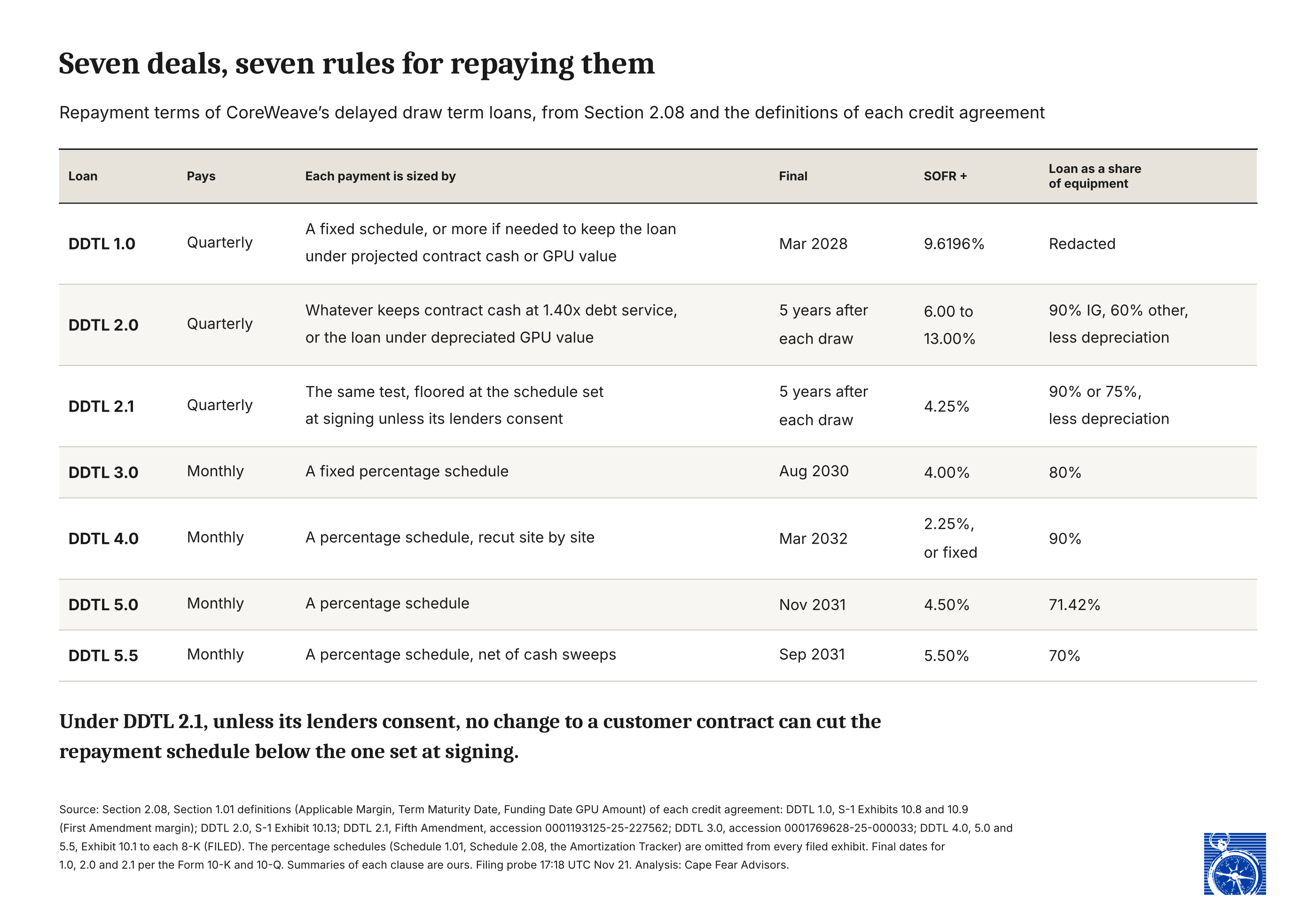
One clause in DDTL 2.1, added in September 2025, sets the terms for the rest of this piece. It provides that "no modifications to any Fifth Amendment Contract shall reduce any applicable Fifth Amendment Amortization Amount" below the amount "implied in the Projected Contracted Cash Flow Spreadsheet and/or Amortization Tracker" in effect when the amendment was signed. Only the 2.1 lenders can consent to a lower amount, and an amendment that cuts a contract's value by 3 percent or more triggers an update to the tracker. (5)
Under DDTL 2.1, unless its lenders agree otherwise, a customer contract that is amended, repriced or shortened leaves the loan's schedule where it was set, and the difference has to come from somewhere other than that contract.
The record has a limit here. Every percentage schedule behind these clauses, Schedule 1.01 for DDTL 1.0, Schedule 2.08 for the four newer loans and the Amortization Tracker for DDTL 2.1, is omitted from the filed exhibits. The rules are public; the dollar amounts by month are not.
Cash for expense, principal for depreciation
Each deal's customer cash goes into an account at the subsidiary and is paid out in a fixed order, Section 2.20(b) of each agreement. The order changed between the two families. (6)
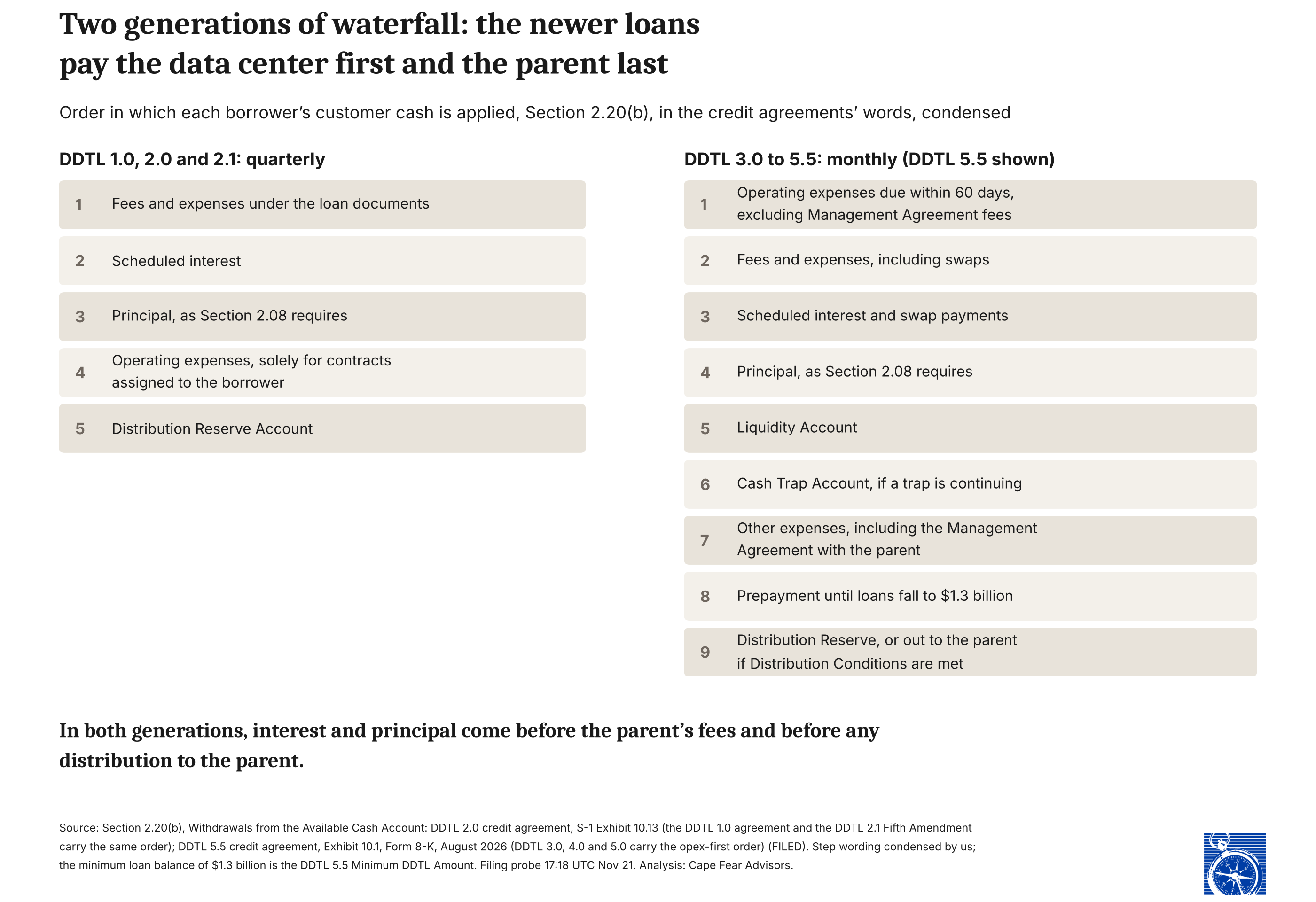
In DDTL 1.0, 2.0 and 2.1, the lenders come first: fees, then interest, then principal, then operating expenses "solely with respect to any contractual obligations assigned or otherwise transferred to the Borrower," then a reserve account. In DDTL 3.0 through 5.5, the data center comes first: operating expenses due within 60 days, a defined term covering the deal's operating costs and capital spending, including data center rent and pass-through utilities, insurance and taxes, and excluding fees under the Management Agreement with the parent. Then come fees, interest, principal, a liquidity reserve and any cash trap. The parent's Management Agreement fees come seventh. In DDTL 5.5, an eighth step sweeps remaining cash to prepay the loan until it falls to $1.3 billion, and only then can cash leave for the parent, and only if the Distribution Conditions are met. (6)
A lender reading these documents sees what the income statement does in its own terms. Where the income statement charges depreciation, the loan charges principal, in cash, on a schedule. Where the income statement accrues an expense, the waterfall pays it in cash in the order written.
The covenant floor shows how thin the margin is by design. DDTL 5.5 requires a debt service coverage ratio of 1.35 times, measured in cash. A loan of $70 for every $100 of equipment, at about 9.4 percent (SOFR plus the 5.50 percent margin) and repaid in 54 monthly payments, costs about $86.10 in interest and principal over its life. At 1.35 times, the deal needs about $116 of operating cash over the same period, a cushion of about $30.10. (7) At DDTL 5.5's terms, that cushion is about the same size as the 30 percent of equipment cost the parent puts in. The match belongs to these terms: at an 80 percent advance the cushion would be about $34 against $20 of equity, and at 60 percent about $26 against $40.
Where the cash lands
The customer contracts begin at the parent. CoreWeave's master services agreements with NVIDIA (April 2023), Meta (December 2023) and OpenAI (May 2025) are each between the customer and CoreWeave, Inc. (8) They are written to move. Meta's agreement says that withholding consent "in connection with an assignment to an affiliate who passes Customer's vendor onboarding process for the purpose of financing an Order Form" is unreasonable. OpenAI's allows either party to assign the agreement "in its entirety (including all Order Forms)" to an affiliate without consent. DDTL 3.0 records one such move: an "Assignment and Assumption Agreement, dated as of March 14, 2025, by and among Parent and the Co-Borrower," the subsidiary that holds the OpenAI order. (8)(9)
Once a contract is in a deal, the loan counts the cash that reaches the deal. Under DDTL 5.5, net operating income starts from the amounts "deposited in the Available Cash Account" of the subsidiary over the trailing three months, less the operating costs paid from it. The contract value the lenders test is measured "net of any payments already received (including all upfront payments)." (3)(4) Cash moves down into a deal freely: "any Parent Company from time to time may deposit cash into the Available Cash Account." The agreement's route for parent money to meet a coverage test is Section 7.03, under which a shortfall "may be cured" by "the receipt of Equity Proceeds." Cash moves up only after the coverage tests, the liquidity reserve and, in DDTL 5.5, the $1.3 billion sweep are satisfied. (3)
A dollar that reaches a deal from its customer counts toward that deal's loan; a dollar from the parent is written into the documents as a cure.
NVIDIA appears in this structure four times. It supplies the GPUs the parent sells into each deal. It bought about 23 million CoreWeave shares at $87.20 in January, about $2.0 billion. It is a customer under the April 2023 agreement, which provides for "Bulk Credits," defined as "prepaid credits for on-demand use." And under a September 2025 order form with an initial value of $6.3 billion, NVIDIA "is obligated to purchase the residual unsold capacity through April 13, 2032," subject to "delivery and availability of service requirements." (10) That order form is with the parent, and it pays for capacity that has been built and delivered and is unsold.
Prepayments: counted once, partly refundable
Operating cash flow was $5,638 million in the first nine months. Before changes in working capital it was $4,015 million. The rise in deferred revenue added $3,492 million, and the other working-capital lines took away $1,869 million: receivables, prepaid expenses, payables and lease liabilities. Set against the total, the deferred-revenue line is 61.9 percent; without it, operating cash flow was $2,146 million. (2) The line is net, after revenue recognized from earlier prepayments, so gross collections were larger.
The prepayment also comes back out of the contract. The S-1 set out the mechanics in 2025: "The prepayment generally offsets customer payments due at the end of the contract," and "in the final months of the contract, the initial customer prepayment is credited against amounts that would otherwise be billed, and no additional cash is collected by us." (11) For a deal loan that counts only the cash deposited in the deal's own account, those are months of service with no customer cash coming in; the prepayment was counted once, when it arrived, wherever it arrived.
The third-quarter report adds a sentence: "$1.9 billion of the deferred revenue balance from the beginning of the period was reclassified from deferred revenue to customer liabilities... as contracts became cancellable during the quarter." Customer liabilities stood at $1,915 million on September 30, against $137 million at the start of the year. It is the second such move this year. In the first quarter, $1.3 billion moved the same way with no reason stated; by June 30, other current liabilities, the caption that holds customer liabilities, totaled $70 million. (2)(12)
The filed agreements show the routes by which prepaid money becomes refundable. All three provide refunds of unused prepaid fees when the customer terminates under the agreement. OpenAI's adds that if a force majeure delay "continues for thirty (30) consecutive days or longer, Customer may terminate the affected Order Form... and receive a refund of all pre-paid fees not applied to Services performed." Meta's provides, after a force majeure delay of a redacted length, termination "without cost or liability" and "a refund of all pre-paid fees." (8) The quarterly report does not say which contracts became "cancellable," which customer holds them, or what made them so.
Two facts sit side by side here and stay distinct. The refund obligation runs with the contract, and the filed contracts are with the parent unless an order form has been assigned to a deal. The location of the prepaid cash is undisclosed: the filings show no entity-level balance of deferred revenue or customer liabilities. What the loan documents settle is the lenders' side. Contract value for the lenders is measured net of upfront payments already received, so a prepayment the parent has spent sits outside the deal's tests either way.
The calls at the parent
The filed total for 2027 principal does not divide by deal, and the schedules that would divide it are omitted. Two figures bound it.
The first applies each quarterly deal loan's third-quarter payment for four quarters and spreads each monthly loan's balance evenly over its remaining payments. It puts $6,200 million of 2027 principal on the seven deal loans and $4,774 million, 43.5 percent, outside them.
The second asks how much could sit outside them. Everything outside the deal loans that falls due in 2027 is vendor and software financing or the Magnetar loan, $7,856 million in all at September 30, and some of it falls due in the last quarter of 2026. Holding the deal loans' fourth-quarter payments at their third-quarter pace, the filed total for that quarter leaves at most $6,732 million of it for 2027. The part outside the deal loans is then at most 61.3 percent. Both ends of that range rest on the same third-quarter pace. If the deal loans pay more in the fourth quarter, through DDTL 5.5's sweep or a coverage-sized payment on DDTL 2.0 or 2.1 of the kind that ran at about $920 million a quarter in the first half, more vendor financing is left for 2027 and the upper end rises; $72 million more in fourth-quarter deal payments would take it past 62 percent. A level spread of every deal loan's balance, which would put only $3,896 million on the deal loans, fails the same test on its own fourth-quarter figure: on that construction, it needs more vendor financing due in 2027 than the filed totals leave. (13)
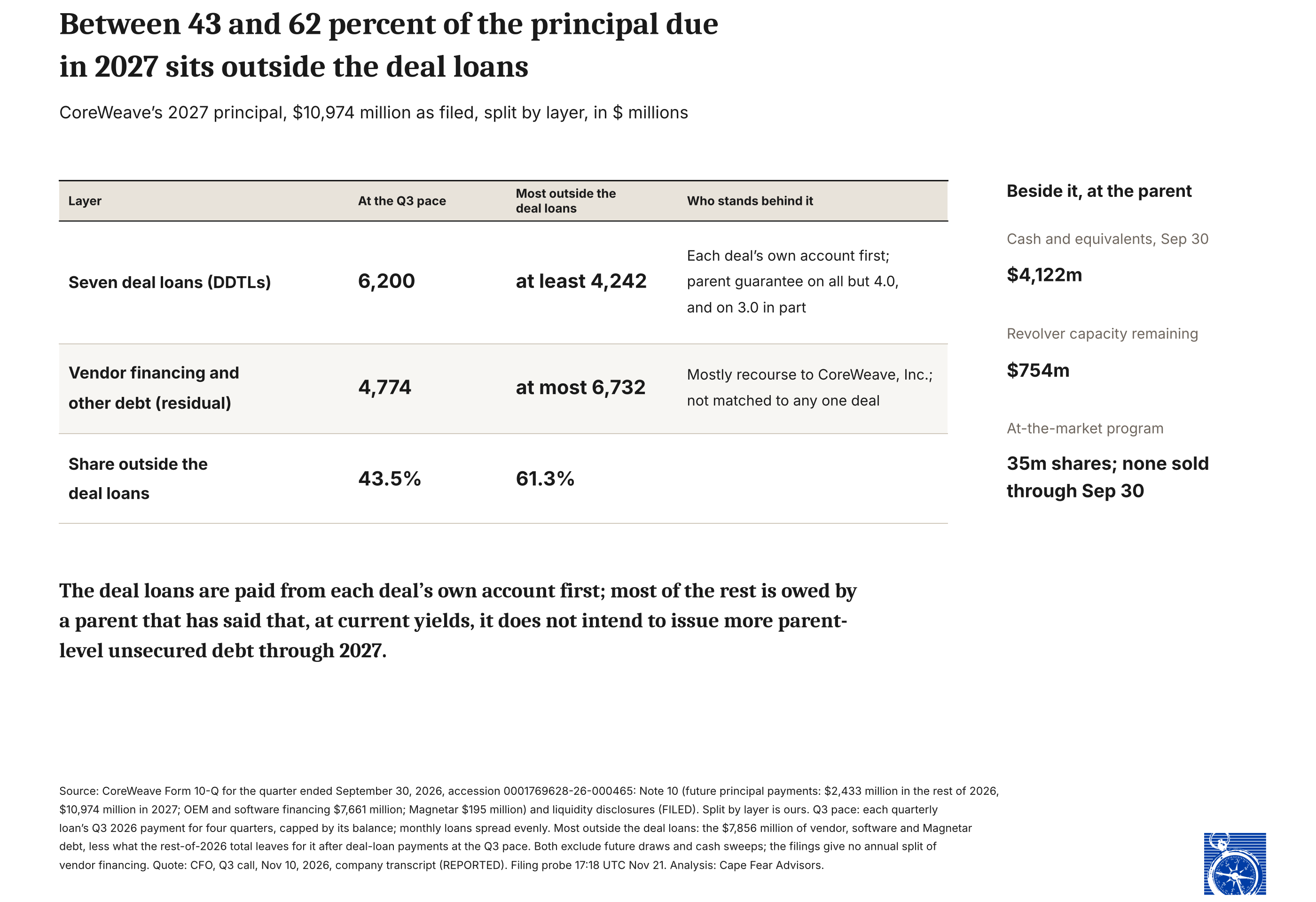
On the filed totals at the third-quarter pace, between 43 and 62 percent of the principal due in 2027 sits outside the deal loans, most of it vendor financing with recourse to the parent.
Beside it, at September 30, the parent had $4,122 million of cash and equivalents and $754 million of remaining revolver capacity. An at-the-market program registered in September covers up to 35 million shares; none were sold through September 30. (2) The parent's unsecured notes yield in the mid-teens (14), the "current yields" the company cited when it set out the plan.
The largest source is operating cash: $4,015 million before working capital in nine months, and more in a full year at the current rate of growth. On its face that covers much of the 2027 call. It cannot be set against the parent's calls directly, and the reason is the subject of this piece. Much of that cash is earned inside the deals, and each waterfall holds it for interest, principal, reserves and, in DDTL 5.5, the sweep before any of it can reach the parent. Cash from contracts that stay with the parent reaches it without passing a waterfall. The filings carry no entity-level split of operating cash, so how much of the $4,015 million reached CoreWeave, Inc. is not public. The question the parent's calls raise is how much of the company's operating cash the deals release to it, and no filing answers it.
Tested before
The structure has been tested by its own lenders. On December 31, 2024, the lenders under DDTL 2.0 granted a Limited Waiver. "Based upon information provided... by the Borrower," its Exhibit A sets out "Specified Defaults/Events of Default." For borrowings on five dates from October 11 to December 31, 2024, "the calculations of the IG Funding Date GPU Amount was overstated by $[*]." On each of those dates, "proceeds of the Loans were used by the Specified Foreign Entities to acquire Infrastructure," the subsidiaries in Spain, the United Kingdom and Sweden. "Certain transfers of the proceeds of Delayed Draw Loans were made to the Parent for the purpose of acquiring Infrastructure by the Specified Foreign Entities." Notice was not given within the three business days the agreement requires. The Required Lenders "hereby waive" the listed items, and a February 2025 amendment deemed the foreign subsidiaries obligors until June 13, 2025. The waiver was filed as an exhibit to the S-1 and identified by its title. The Financial Times reported it in March 2025, and CCIR has since set out its terms. (15)
DDTL 3.0, signed in July 2025, shows how a deal is kept inside its tests. Its December 31, 2025 First Amendment added construction monitoring through May 2026 at the OpenAI site, on which Olga Usvyatsky and Francine McKenna wrote in August (16). The same amendment moved the start of the 1.40 times coverage test to after October 1, 2027, from April 30, 2027, and restarted a contract realization test of 0.85 from February 2026. It also set how equity can be used to meet those tests: before October 28, 2026, there was "no limitation" on cure rights or on counting "CRR Equity Proceeds" toward the realization ratio; "on and after October 28, 2026," the two together may occur "in no more than three consecutive calendar months" in any four. (17) The parent guarantee on DDTL 3.0 covers only one of its two borrowers, Co. VII; "the Guaranteed Obligations shall exclude any and all Obligations of the Co-Borrower," Co. V, which holds the OpenAI order. The guarantee falls away from April 30, 2027 if, among six conditions, OpenAI is rated investment grade by S&P and Moody's and the parent signs a management agreement and a guaranty of Co. V's performance. The 10-Q's own summary is broader: "All obligations under the DDTL Facilities, other than the DDTL 4.0 Facility, are unconditionally guaranteed by us." The exhibit governs, and the summary does not mention the exclusion. CCIR read this scope first; we have confirmed it against the exhibit. (2)(9)
The waiver was granted, and the facility continued under amended terms; DDTL 3.0's tests were reset by amendment. Both show the deal-level tests doing what they are written to do: the borrower reported, and the lenders decided.
Reporting by deal
CoreWeave reports one segment. Its quarterly report says its chief operating decision maker, the chief executive, "reviews discrete financial information presented on a consolidated basis" and measures performance by "consolidated net loss." (2) The lenders get a different view. Under DDTL 3.0, 4.0, 5.0 and 5.5, each month the borrower must deliver "a written report... identifying the amounts paid at each step of the waterfall in Section 2.20 for the prior calendar month," and under 4.0, 5.0 and 5.5, a quarterly Operating Report as well. (3) On its call, the company described its own year by deal: prepayments "on 70% of our deals." (1) The newer deals' lenders receive each deal's waterfall every month; the shareholders receive the company as one segment each quarter.
Its quarterly report also says its disclosure controls were "not effective" as of September 30, 2026, citing material weaknesses in IT general controls, segregation of duties, and the number of qualified personnel in its accounting, finance and operations functions. It adds that the deficiencies "did not result in a material misstatement" of its financial statements. The filings include no parent-only statements. (2)
The deal loans already measure each deal every month: net operating income, debt service coverage, projected contract value against the loan, and the contract realization ratio. None of it appears in the company's own reports. NVIDIA reports its business in segments; a company whose debt is built deal by deal could report the same way, with each deal's cash, coverage and schedule, the cash each deal releases to the parent, and the parent's calls beside them. A deal-level table would replace the estimates in this piece with the company's own numbers.
What the 10-K updates
The annual report, due about February 2027, updates this reading in five places.
- The 2027 split. Maturities by year for the deal loans and for vendor financing replace the two bounds above. On the filed totals at the third-quarter pace, the deal loans owe between $4,242 million and $6,200 million in 2027.
- Where the prepayments sit. The filings show no entity-level balance today. The refund obligation follows the contract, and the filed contracts are the parent's unless assigned.
- The $1.9 billion. The customer-liability roll-forward shows whether it returns to deferred revenue, is refunded or is recognized. The first quarter's $1.3 billion left the caption by June 30, and the filings do not say which way.
- The company's $9 billion. The fourth quarter's change in deferred revenue and customer liabilities, with revenue recognized from deferred balances, gives the gross collections the call described. Nine months of 2026 added $3,492 million to deferred revenue on a net basis. The call did not say how much of the $9 billion is prepayments and how much is deposits, which can be refundable. (12)
- The parent's calls. Our reading is that the parent meets its 2027 calls in part through sales under the at-the-market program beyond the "limited amount" the plan allows at the parent, or through relief on a deal loan that lets cash pass the Distribution Conditions to the parent sooner, or both. If the 10-K and the year's filings show those calls met from operating cash, prepayments and vendor financing, with at most a limited amount raised at the parent and without covenant relief or new parent-level unsecured debt, the plan worked as stated and this reading was wrong. A small at-the-market sale fits both readings; the size of the sales is what separates them.
The 10-K also carries the company's first auditor attestation on internal controls. Before it come the 8-K for the reported investment-grade facility, any amendment or waiver on a deal loan, Form 4s, and NVIDIA's 10-Q, due by December 4.
Our earlier readings of CoreWeave's filings: "CoreWeave, Adding It Up" (June), "CoreWeave, Taken as a Whole" (July 4), "CoreWeave, Adding It Up: One Filing, Two Announcements" (August 11), "CoreWeave: The Sum of the Participants" (August 12), "CoreWeave: Searching for the Next Participant" (August 16), "CoreWeave, the Key, the Lock and the Clock" (August 20), "CoreWeave's Call Option on Used GPUs" (September 16), "Circular Financing, and One Company in the Middle of It" (September 20) and "What the Price Believes: CoreWeave" (October 18).
Free to read, no paywall. Readers who find the work useful can support it at the foot of the page; payment offsets the time and buys no access. Corrections run in daylight, dated, in a comment or in the following piece, and a reader who finds one is doing us a favor.
Standing Disclosure
Cape Fear Advisors holds no direct position, long or short, in the securities discussed here. Any exposure is indirect, through managed funds it does not control, which may include index funds holding the public companies named.
Anthropic, a subject of our coverage, is the developer of Claude, which we use in preparing our work. That nearness cannot be checked away, which is why no claim here rests on trust in the tool: every figure carries a public source and every derived figure carries its inputs in the notes. Figures are quoted from the filers without characterization, and the same standard of reading is applied to every filer named.
Notes
[1] CoreWeave, Inc. third-quarter 2026 earnings call, November 10, 2026, proofread transcript posted on the company's investor relations site, read at source November 20 (REPORTED): Michael Intrator, chief executive, and Nitin Agrawal, chief financial officer, as quoted. The sources the company lists for "the significant majority of our capital needs through 2027" are its deal loans, customer prepayments, OEM financing and its own cash flow, as read in our November 20 piece, "CoreWeave, the Sum of the Deals", note 25. About $9 billion of prepayments and deposits "expected in the next three months alone" also appears in the furnished release, Form 8-K, accession 0001769628-26-000461, Exhibit 99.1 (FURNISHED).
[2] CoreWeave Form 10-Q for the quarter ended September 30, 2026, accession 0001769628-26-000465: condensed consolidated statements of cash flows; Note 2 (contract balances); Note 7 (other current liabilities: customer liabilities $1,915 million); segment information (chief operating decision maker); Note 10 (debt; guarantees: "All obligations under the DDTL Facilities, other than the DDTL 4.0 Facility, are unconditionally guaranteed by us"; future principal payments; OEM and software financing; revolver); Item 4 (controls) (FILED). June 30 balances and 2027 principal of $6,184 million: Form 10-Q for the quarter ended June 30, 2026, accession 0001769628-26-000366 (FILED). Changes and shares are ours. Nine-month debt by layer (OURS on FILED, December 31 to September 30): deal loans up $7,968 million (newer up $10,870 million; older down $2,902 million); senior notes up $6,272 million; convertible notes up $8,200 million; vendor and software financing, recourse, up $3,373 million (of which $1,469 million was a non-cash reclassification of equipment payables); revolver up $200 million; other lines, a net reduction of $123 million. Operating cash flow reconciliation (OURS on FILED): $4,015 million before working capital changes, plus $3,492 million from deferred revenue, less $1,869 million from receivables ($1,134 million), prepaid expenses and other assets ($1,053 million) and lease liabilities ($295 million), net of payables and accrued expenses (adding $613 million), equals the filed $5,638 million. The third-quarter vendor increase of $2,671 million may include non-cash reclassifications of equipment payables; the quarter's filings do not split it.
[3] DDTL 5.5 credit agreement, August 7, 2026, Exhibit 10.1 to Form 8-K (FILED): definitions of Funding Date GPU Amount (70 percent of Funding Date Capital Expenditures), Net Operating Income, Available Cash, Equity Proceeds, Distribution Conditions and Minimum DDTL Amount ($1,300,000,000); Section 2.20(a) and (b); Section 7.03 (Right to Equity Cure); Section 5.04(f)(ii) and (g) (monthly waterfall report and quarterly Operating Report); the same monthly waterfall report appears in the DDTL 3.0, 4.0 and 5.0 agreements, and the Operating Report in 4.0 and 5.0. The Net Operating Income definition also contains a proviso referring to "any amounts deposited in the Available Cash Account by any Parent Company, except if applied as Cure Equity"; as drafted, it is attached to the cost deduction in clause (b), and this piece rests the cure point on Section 7.03. Our first reading of DDTL 5.5 set the agreement beside its release: "CoreWeave, Adding It Up: One Filing, Two Announcements", August 11.
[4] Section 2.08 and Section 1.01 of each credit agreement (FILED): DDTL 1.0, S-1 Exhibits 10.8 and 10.9; DDTL 2.0, S-1 Exhibit 10.13; DDTL 2.1, Fifth Amendment, September 29, 2025, Exhibit 10.1 to Form 8-K, accession 0001193125-25-227562; DDTL 3.0, Exhibit 10.1, accession 0001769628-25-000033; DDTL 4.0, 5.0 and 5.5, Exhibit 10.1 to each 8-K. Projected Contract Value "net of any payments already received (including all upfront payments)": DDTL 1.0 and DDTL 3.0 definitions; the DDTL 5.5 figure is redacted. We listed the special-purpose borrowers' amortization schedules among what the filings do not disclose in "CoreWeave: Searching for the Next Participant", August 16, and set out the advance-rate ladder in "CoreWeave, the Key, the Lock and the Clock", August 20. CCIR first set out several of these terms in CCIR Research, "CoreWeave's Q3 2026 Debt, Entity by Entity", November 2026; each is quoted here from the agreement.
[5] DDTL 2.1 Fifth Amendment, Section 2.08(b) and definitions of Amortization Tracker and Amortization Tracker Trigger Event (FILED). The lender consent: "other than with the prior written consent of the Fifth Amendment Required Lenders."
[6] Section 2.20(b), Withdrawals from the Available Cash Account: DDTL 1.0 (S-1 Exhibit 10.9), DDTL 2.0 (S-1 Exhibit 10.13) and DDTL 2.1 (Fifth Amendment), fees first; DDTL 3.0, 4.0, 5.0 and 5.5, operating expenses first (FILED). Permitted O&M Payments as defined in the newer agreements.
[7] OURS. Level monthly payments on $70 at 9.4 percent a year over 54 months, February 2027 to the 10-Q's expected final payment in July 2031, total about $86.1; 1.35 times that is about $116.3, a cushion of about $30.1. The 9.4 percent assumes SOFR near 3.9 percent plus the DDTL 5.5 margin of 5.50 percent. The 10-Q gives an effective rate of 11 percent on DDTL 5.5, which includes fees and discount; on that rate, debt service is about $89.1 and the cushion about $31.2. At the same rate and term, an 80 percent loan gives debt service of about $98.4 and a cushion of about $34.4; a 60 percent loan, about $73.8 and $25.8. The coverage test is measured on trailing three-month cash (Debt Service Coverage Ratio definition) and applied here over the loan's life with level payments.
[8] Master Services Agreements between CoreWeave, Inc. and NVIDIA Corporation (April 10, 2023; S-4/A Exhibit 10.31, accession 0001140361-25-036118), Meta Platforms, Inc. (December 10, 2023; Q3 2025 Form 10-Q Exhibit 10.5, accession 0001769628-25-000062) and OpenAI OpCo, LLC (May 8, 2025; S-4/A Exhibit 10.32): assignment, refund upon termination, and force majeure sections (FILED). Order forms, which carry payment terms, are not filed.
[9] DDTL 3.0 credit agreement, July 28, 2025, Exhibit 10.1, and Parent Guarantee and Pledge Agreement, Exhibit 10.2, accession 0001769628-25-000033 (FILED): definitions of MSA Assignment, Guaranteed Obligations, Guarantee Termination Date and Parent Guarantee Fallaway Conditions, clauses (a) through (f). CCIR first described the guarantee's scope, in CCIR Research, "CoreWeave's Q3 2026 Debt, Entity by Entity".
[10] CoreWeave Form 8-K, September 15, 2025, accession 0001769628-25-000047, Item 1.01 (FILED); NVIDIA MSA definition of Bulk Credits (note 8); January 2026 private placement, Q3 2026 Form 10-Q (FILED).
[11] CoreWeave, Inc. Form S-1, accession 0001193125-25-044231, March 3, 2025, contract-to-cash cycle ("Contract signing" and "Go-live") (FILED). The language was first drafted in the confidential DRS; Francine McKenna and Olga Usvyatsky, "High on customer financing: How CoreWeave and others use prepayments to pull cash flow forward," The Dig with Deep Quarry, November 14, 2026 (REPORTED), set it out with the SEC staff's comment of January 13, 2025 asking for the weighted-average prepayment, and with the 10-K's practical-expedient policy on significant financing components.
[12] Q1 2026 Form 10-Q, accession 0001769628-26-000222 ("reclassification of $1.3 billion to customer liabilities"; customer liabilities $1,469 million at March 31) and Q2 2026 Form 10-Q (other current liabilities $70 million at June 30, with no separate customer-liabilities figure) (FILED). Cape Fear Advisors marked the first-quarter reclassification on July 4, in "CoreWeave, Taken as a Whole", and noted its round trip on August 12, in "CoreWeave: The Sum of the Participants"; Olga Usvyatsky and Francine McKenna, "What CoreWeave's $1.3 Billion deferred revenue reclassification might be telling us," Deep Quarry with The Dig, August 15, 2026, analyzed it in work that followed; Francine McKenna and Olga Usvyatsky, "High on customer financing: How CoreWeave and others use prepayments to pull cash flow forward," The Dig with Deep Quarry, November 14, 2026, returned to it with the Q3 reclassification, the ASC 606 mechanics of a "cancellable" prepayment, and the point that the company did not split its expected $9 billion between prepayments and deposits (REPORTED).
[13] OURS on FILED. Third-quarter pace: each quarterly loan's third-quarter payment (DDTL 1.0 $161 million; 2.0 $394 million; 2.1 $506 million) for four quarters, capped by the balance left after the fourth-quarter 2026 payment; each monthly loan's September 30 balance divided evenly over its remaining payments. Bound: the filed principal due in the rest of 2026 is $2,433 million. On the pace construction, the deal loans owe about $1,309 million of it, the most of any construction here, which leaves about $1,124 million for vendor financing and the Magnetar loan. Of the $7,856 million in those lines at September 30 ($7,661 million OEM and software financing; $195 million Magnetar), at most $6,732 million remains for 2027, so the deal loans owe at least $4,242 million. The level spread ($3,896 million on the deal loans, $724 million in the fourth quarter) would need $7,078 million of 2027 principal outside them against at most $6,147 million left on its own fourth-quarter figure. The population is complete on Note 10's own table: the senior notes, convertible notes and revolver mature in 2029 or later, the convertible promissory notes had no balance at September 30, and the $47,505 million total of future principal payments equals the face amount of the debt lines in the table, so finance leases sit outside it. At the third-quarter pace the upper end has $72 million of room: $6,804 million of 2027 principal outside the deal loans would reach 62.0 percent. Both figures exclude future draws on DDTL 4.0 and 5.5 and any cash sweep. Percentages: 43.5 and 61.3, printed outward as 43 and 62. Our October reading of the 2027 funding need and the 2031 to 2032 maturities: "What the Price Believes: CoreWeave".
[14] REPORTED: CoreWeave 2032 notes at 14.5 to 14.7 percent (No Diligence) and the 9.75 percent notes due 2031 near 80, as read in our November 19 note and cited in "CoreWeave, the Sum of the Deals", note 19.
[15] Limited Waiver and Second Amendment to Credit Agreement (DDTL 2.0), December 31, 2024, S-1 Exhibit 10.15, recitals, Section 2 and Exhibit A, quoted; Third Amendment, February 28, 2025 (FILED). First reported by the Financial Times, March 2025 (REPORTED); set out in CCIR Research, "CoreWeave's Q3 2026 Debt, Entity by Entity".
[16] Olga Usvyatsky and Francine McKenna, "What CoreWeave's $1.3 Billion deferred revenue reclassification might be telling us," Deep Quarry with The Dig, August 15, 2026 (REPORTED), which found the construction-monitoring amendment, in work that followed Cape Fear Advisors' August 12 note.
[17] First Amendment to Credit Agreement and Parent Guarantee and Pledge Agreement (DDTL 3.0), December 31, 2025, Form 10-K Exhibit 10.31 (FILED): Sections 6.12(a), 6.12(b) and 7.03(c) as amended; construction monitoring.
Filing probe: EDGAR, CoreWeave (CIK 1769628), 18:01 UTC November 21, 2026 (unchanged from 16:42). Latest filings: seven Forms 144 on November 20 covering restricted stock (about $2.3 million in total); no 8-K since the 10-Q of November 12. Re-run within the hour before publication.
Analysis: Cape Fear Advisors.
This piece also appears on Substack. Cape Fear Advisors is an independent advisory firm based in Portsmouth, NH.
Contact Cape Fear Advisors