


NVIDIA has acted as the AI build's central bank. It lends its standing to customers who lack one, through guarantees, payment terms and capacity commitments, and it sets the terms on which the rest of the circle borrows. A central bank works through credit. This week the headlines were about equity: one man, and share prices. The credit record moved differently. The financing NVIDIA extends is moving closer to its own balance sheet, toward stronger credits and its own shareholders. (1)
The credit documents moved the way they were written to. What they show is compression, not collapse: lenders, lessors and rating agencies wrote exits into each layer of this build, the build is shrinking along those lines, and the shrinking sorts winners from losers by where each company sits in the circle. (2)
In short:
- The platform: the $500 billion NVIDIA announced in August as "third-party capital" leans on NVIDIA's credit for up to a quarter of each deal, had closed "no loans" by mid-November, and where a borrower is already investment grade, the same lenders lend on its own name. (3)
- The guarantee: the $105 billion behind OpenAI's Ohio campus is a ceiling that builds as each building is finished, from fiscal 2029, declines as rent is paid, and ends on a rating.
- The build: customers pay at the front, NVIDIA backs the neoclouds only after financing and acceptance, and NVIDIA now signs $74 billion of data center leases in its own name.
- The sorting: Anthropic's exits sit with its renters of NVIDIA-powered capacity; CoreWeave runs on its customers' cash and credit where equity stood.
The platform was NVIDIA's credit, offered at a distance
On August 10, NVIDIA announced partnerships with Apollo, BlackRock, Blackstone, Brookfield, Goldman Sachs and KKR "to Mobilize Over $500 Billion of Third-Party Capital" for AI compute. Three days later the Wall Street Journal attributed to Jensen Huang a figure for NVIDIA's own part: residual value support of up to 25 percent of a deal. (4)
Three months on, the reporting runs one way. The New York Times reported on November 13 that "No loans have closed," and that at least one of the six firms was discussing leaving. Reports this week from Bloomberg and the Journal, as relayed, say lenders want more protection than the roughly 25 percent on offer and that the first transaction may slip to January or into 2027. Colette Kress, NVIDIA's interim chief executive, told analysts on Tuesday that the company is "rigorously evaluating future investments, commitments, and guarantees." (5)
On the reported terms, the price of the outside money was more of NVIDIA's own credit. NVIDIA's support was part of the offer from the start, and the lenders' reported terms ask for more of it, so each step toward a first deal moves the risk closer to NVIDIA's balance sheet. S&P counted it as NVIDIA's from the first week: affirming NVIDIA's AA on August 18, it listed the option to backstop up to $125 billion, a quarter of the intended platform capital, among NVIDIA's added credit risks. (6)
The contrast sits on the same list of firms. In October SpaceX, rated investment grade by all three major agencies, signed a commitment letter for a $40 billion lease of compute led by Apollo and Goldman Sachs, with BlackRock and KKR committing: four of the platform's six names, lending on a lease reported as supported "primarily by the credit of SpaceX itself." Where the borrower's credit is already investment grade, the same lenders arrive on the borrower's name. (7)
The $105 billion, read to its conditions
The largest number in NVIDIA's guarantee table belongs to the PORTS-Pike campus in Pike County, Ohio, which SB Energy is building to host NVIDIA infrastructure under leases to OpenAI. The August 8-K sets the terms, and the third-quarter commentary describes them in NVIDIA's own words. (8)
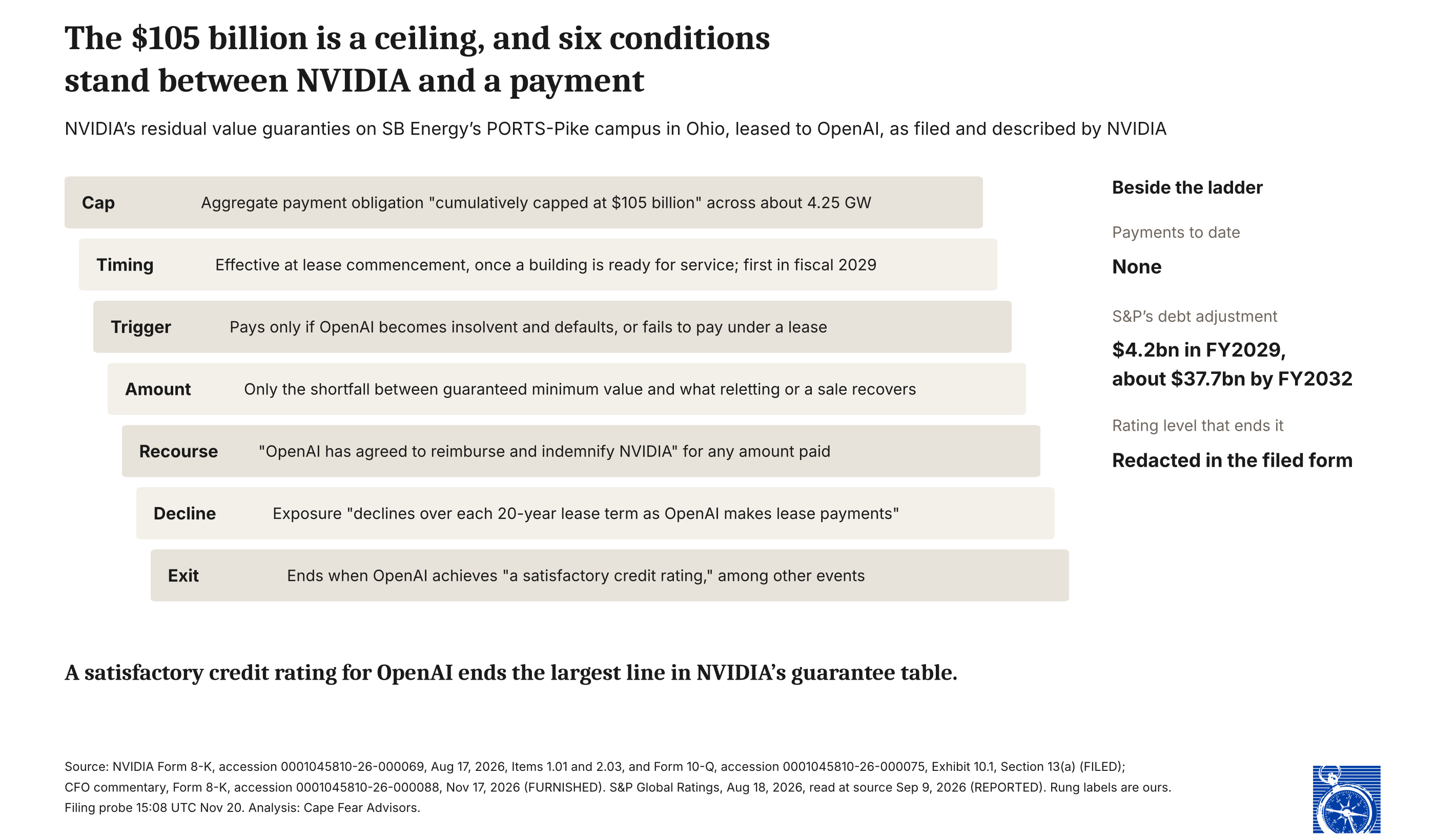
- Effective by building: each guaranty "will become effective upon commencement of the applicable lease," with payment subject to the lessor meeting "ready-for-service conditions... expected beginning in 2028." NVIDIA puts the first in fiscal 2029.
- Paid on a default, and only the shortfall: NVIDIA pays only if OpenAI becomes insolvent or stops paying, and then the gap between "the guaranteed minimum value of a lease" and what a new lease or a sale recovers.
- Backed by the tenant: "OpenAI has agreed to reimburse and indemnify NVIDIA for any and all amounts actually paid."
- Ended by a rating: each guaranty terminates when, among other things, OpenAI achieves "a satisfactory credit rating."
NVIDIA's commentary states the shape: "Our exposure therefore builds over time as each building comes online, up to a maximum of $105 billion, and then declines over each 20-year lease term as OpenAI makes lease payments." No payments have been made. S&P's own measure, struck as the gap between the guaranteed minimum value and its assessment of each building, adds $4.2 billion to NVIDIA's adjusted debt in fiscal 2029, rising to about $37.7 billion in fiscal 2032. The $105 billion caps NVIDIA's cumulative payments. A payment needs a finished building, a tenant default and a shortfall after reletting or sale, and whether the cap equals the total guaranteed value, and so whether reaching it requires a sale or new lease to recover nothing, the filing does not state. (9)
The rating condition connects this campus to the rest of the build. In September we read the filed form of the guaranty in "The Circle at the Gate": of nine events that release NVIDIA, three turn on a rating, and each level is redacted. On Thursday we set out how Anthropic's new revolver releases its liens once two of the three major agencies rate it investment grade. OpenAI's rating would end NVIDIA's guaranties on the same kind of test. A satisfactory credit rating for OpenAI would end the largest line in NVIDIA's guarantee table. (10)
Front and back of the build
The commitments describe a build paid for at the front by customers and supported at the back by NVIDIA.
At the front, customer cash. Customers are paying ahead for capacity across the chain. Oracle's operating cash flow for its August quarter included $11.4 billion of customer prepayments with a significant financing component, against none a year earlier. CoreWeave takes prepayments of 15 to 25 percent of contract value. One smaller operator, Axe Compute, reported customer prepayments of about twelve times its equity. (11)
NVIDIA's own terms reach the front for investment-grade buyers. Its second-quarter 10-Q describes "longer payment terms ranging from 90 days up to one year" for "investment-grade customer purchases... to assist customers with large data center builds." Receivables stood at $81.0 billion on October 25, up from $38.5 billion in January, and days sales outstanding at 64, up from 45 two quarters earlier. On Tuesday's call Kress said of those customers, "Those IG customers can be very helpful, particularly when it comes to enabling the amount of money that is required." (12)
At the back, NVIDIA's support for everyone else. The $32 billion of neocloud agreements "take effect only if the neoclouds secure financing to purchase the data center infrastructure products and the related compute capacity is deployed, made operational, and accepted by us." NVIDIA's support arrives after the lender's construction risk has passed. The total fell from $36 billion in a quarter in which supply commitments rose by $111 billion. (13)
NVIDIA as tenant
The turn is most direct in one line of the commitments. NVIDIA's cloud service agreements and data center lease commitments rose to $102 billion from $74 billion in the quarter, both figures covering the two lines together. Of the $102 billion, $74 billion is data center leases not yet commenced, "terms up to twenty years," starting between the fourth quarter of fiscal 2027 and fiscal 2033, and NVIDIA "may assign some of these leases to third parties in the future." The commentary describes this capacity as the infrastructure that "powers our research and development," from chip design to its open models. (14)
A guarantee puts NVIDIA behind a neocloud's lease. A lease puts NVIDIA's own name on it. The same capacity, on NVIDIA's credit directly, with the option to assign it later, is the circle drawn in to its center. It also puts a stated number beside the cadence NVIDIA has set for its products, a new generation each year: the compute to design them is now a commitment of up to twenty years. (15)
Where the dollars went
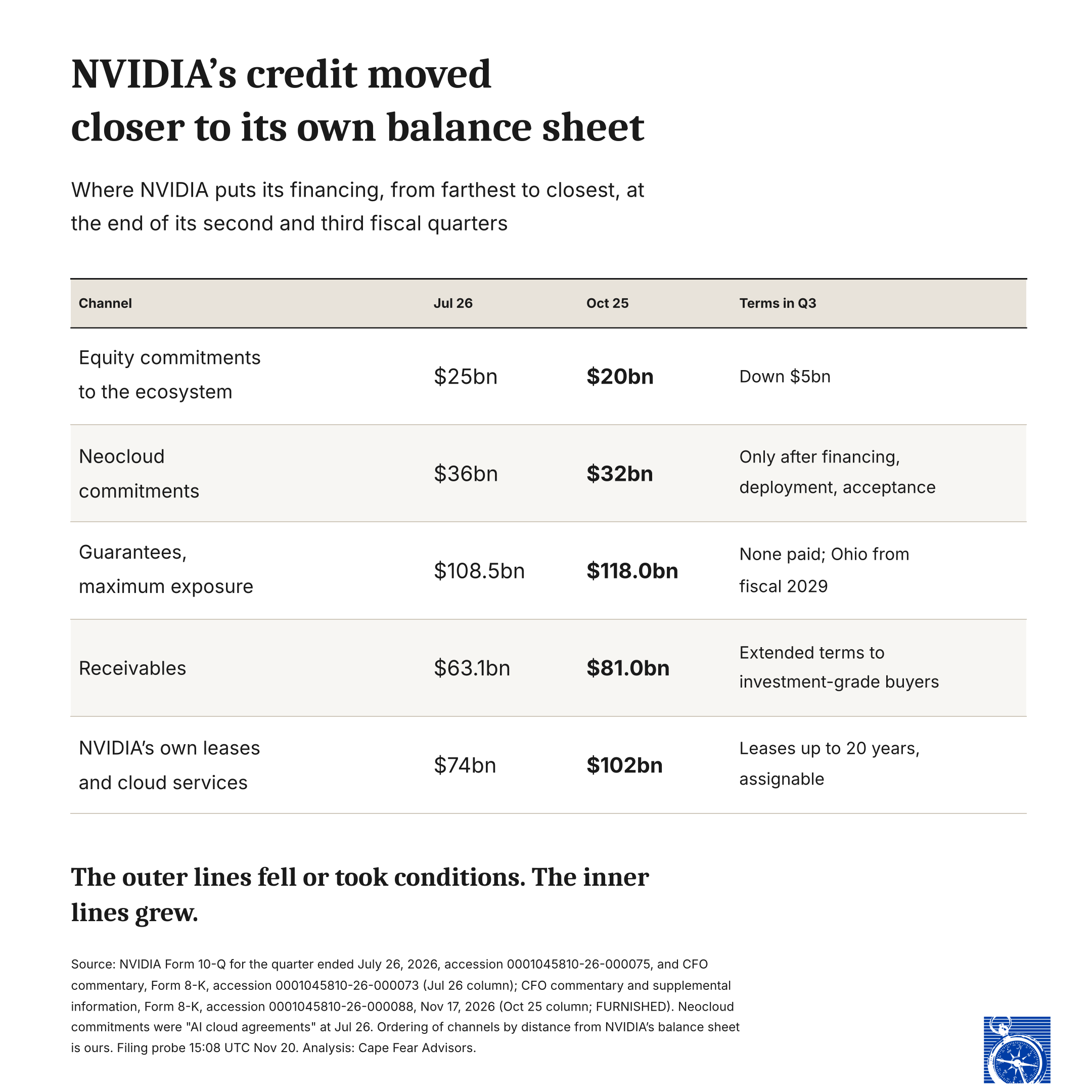
In order from the farthest from NVIDIA's balance sheet to the closest, the third quarter's lines move one way. (16)
- Equity in the ecosystem: commitments fell to $20 billion from $25 billion in a quarter that placed $15.4 billion in private companies, so part of the fall is commitments funded; the forward pipeline is what shrank. NVIDIA's $10 billion purchase of Anthropic stock was scheduled to close with the offering on November 20.
- Backstops: guarantees rose to $118.0 billion from $108.5 billion, on a new $9.5 billion line of "power and systems credit support." None has been paid.
- Capacity commitments: $32 billion, from $36 billion, now conditioned on financing and acceptance.
- Customer terms: receivables up $17.9 billion in the quarter, on extended terms to investment-grade buyers.
- NVIDIA's own leases and cloud services: $102 billion, from $74 billion.
- Shareholders: $28.1 billion returned in the quarter, with $227.3 billion of authorization to use "through fiscal 2028," about $45 billion a quarter if spread evenly.
The forward commitments outward fell or took conditions, and the guarantees grew by one new $9.5 billion line. Receivables and NVIDIA's own leases grew. Much of this began before the change at the top: the extended terms first appear in the second quarter, and the buyback increase dates to September. What the third quarter adds is the conditions, the leases and the plan to use the whole authorization by fiscal 2028. (17)
Credit has learned
The compression so far has moved risk without a default, and the documents show why. Each commitment in the chain carries its own exit, written into its conditions. (18)
- NVIDIA's neocloud commitments: if financing and acceptance are "not timely resolved... certain commitments could be reduced or eliminated."
- The PORTS-Pike guaranties: effective only when a building is ready for service, and ended by a rating.
- Nscale's Anthropic order: if its financing misses a longstop date, "each party may terminate this Order," and "neither party will have any further obligation or liability."
- Anthropic's newest compute contracts: "subject to contingent conditions prior to commencement, such as the counterparty's ability to secure financing."
- CoreWeave's parent guarantee: contracted revenue from investment-grade counterparties counts at 100 cents, the rest at 75.
A structure with an exit at every commitment shrinks by lapse, not by default. Read together, the clauses carry the lessons of earlier vendor-financing cycles: support that waits for acceptance, guarantees that wait for a finished building, and contracts that dissolve when the financing misses its date. The compression this quarter is the structure doing what its documents provide for.
The pricing agrees
The pricing says the same. CoreWeave's secured loans, matched to customer contracts, are "continuing to trade around par value," its finance chief said on November 10, while its unsecured notes trade at yields in the mid-teens. Credit is pricing the contract and the collateral ahead of the company. The same terms run through the smaller builders. WhiteFiber's term loan for its North Carolina site funds only on "customer acceptance of the first 40 megawatts" by Nscale, and a month of filings read by The Credit Terrain counts twelve builders whose AI customers put money in before the capacity earns anything. The newest terms go further. SpaceX's binding commitment letter for its $40 billion lease puts the equipment "for use at data centers selected by the Company," with rent each quarter of one-twentieth of the financed cost, paid in advance, so the lessor is repaid within the term. The Financial Times reports that the lenders want to bar SpaceX from launching the leased chips into orbit. The newest credit terms fix where the collateral sits and repay it within the term. (19)
The places to watch are where an exit would be used first: Nscale, which says it has "not obtained binding commitments for any of the financings" its Anthropic contracts need, and NVIDIA's own cash, with $222 billion of commitments due in fiscal 2028 beside $53.5 billion of cash and marketable debt securities and $48.3 billion of operating cash flow in the third quarter, and a repurchase plan of about $45 billion a quarter against $22.1 billion repurchased in the third. (20)
Where the compression lands
The compression has a direction inside each customer's book. Anthropic's final prospectus sorts its largest compute commitments by how firmly they hold. Amazon, Google and Microsoft are owed "regardless of actual usage" and are non-cancelable except for breach, and the Broadcom lease is non-cancelable for its five-year term. The three renters of NVIDIA-powered capacity carry the exits. Each SpaceXAI agreement "may be cancelled by either party upon 90 days' advance written notice" after initial periods ending in January and March 2027. Lambda's August agreement, about $34.9 billion, "is currently terminable by either party." Nscale's depends on financing it has yet to obtain. In all, $186.2 billion of Anthropic's obligations sit in arrangements subject to termination rights or to conditions before they start. (21)
Anthropic's floors sit with its core suppliers, and its exits sit with the three renters of NVIDIA-powered capacity. As capacity contracted closer to its core arrives, the arrangements with exits are the ones it can release. The SpaceXAI capacity, up to $120.5 billion at about $3.1 billion a month once delivered, is the largest line that can end on notice. (22)
Who compresses
OpenAI sits in the other system: the PORTS-Pike guaranty, the Oracle campuses, SoftBank's financing. Its compression shows in that system's documents: SoftBank's $3.7 billion charge on power equipment, and the conditions in NVIDIA's guaranty. (23)
Microsoft has put its own terms on the record. Amy Hood, its finance chief, told analysts on October 28 that "some third party capacity deliveries we expected in Q1 were delayed," that some GPU contracts "have been delayed to H2," and that "Customer demand continues to exceed available supply." Its quarterly report carries $364.6 billion of leases, primarily for data centers, not yet commenced, "with some arrangements subject to certain contractual conditions being met," and a caution that it "may modify capacity allocations, deployment priorities, pricing, or other commercial arrangements." People familiar with its plans told CNBC that Microsoft is narrowing its roster of neoclouds and "opted not to renew a deal with Oracle"; a spokesperson said the company "regularly review[s] these investments against customer demand." The buyer with its own data centers chooses which outside capacity to keep. (24)
Who holds, and on what
CoreWeave has set out its own funding plan, and it runs the circle with the equity turn replaced. On its November 10 call it said it "will not use the unsecured debt market to fund our business at current yields," and will fund "the significant majority" of its capital needs through 2027 from delayed-draw term loans matched to customer contracts, which "can finance anywhere from 70% to 100% of the associated CapEx," from customer prepayments, from OEM financing and from its own cash flow, "with only a limited amount expected to be raised at the parent company level." Prepayments came on 70 percent of this year's deals, "with customers funding up to 100% of the contract value upfront," and about $9 billion is due in the next three months. More than 75 percent of committed capital spending through 2027 is tied to investment-grade and enterprise customers. The customer's cash and the customer's credit now stand where equity stood. At the parent, stockholders' equity was $4.0 billion at September 30 against $91.5 billion of assets, and the nine months brought $3.0 billion of new equity in two private placements, $2.0 billion of it from NVIDIA, beside $8.2 billion of convertible notes. CoreWeave's own case is that a slower build makes its paid-off fleet "more valuable." The parent's thin equity is where that case gets tested. (25)
What the 10-Q updates
NVIDIA's 10-Q for the quarter is due by December 4. It updates this reading in five places: the guarantee table and any role in the platform; the equity commitments and whether the Anthropic purchase appears in subsequent events, a matter of NVIDIA's materiality judgment; receivables, the extended terms and any significant financing component; purchase obligations and their cancellability; and repurchases. The first ratings on OpenAI and Anthropic, when they come, reprice the guaranties and the revolver together. (26)
Free to read, no paywall. Readers who find the work useful can support it at the foot of the page; payment offsets the time and buys no access. Corrections run in daylight, dated, in a comment or in the following piece, and a reader who finds one is doing us a favor.
Standing Disclosure
Cape Fear Advisors holds no direct position, long or short, in the securities discussed here. Any exposure is indirect, through managed funds it does not control, which may include index funds holding the public companies named.
Anthropic, a subject of our coverage, is the developer of Claude, which we use in preparing our work. That nearness cannot be checked away, which is why no claim here rests on trust in the tool: every figure carries a public source and every derived figure carries its inputs in the notes. Figures are quoted from the filers without characterization, and the same standard of reading is applied to every filer named.
Notes
[1] OURS: the reading. The central-bank frame is ours, set out in "NVIDIA, AI's Monetary Policymaker," August 24, 2026, and "NVIDIA, The Scarce Thing Is a Credit Standing," August 27, 2026. This is the fourth piece in our Circle sequence, after "The Circle at Work" (September 7), "at Rest" (September 8) and "at the Gate" (September 10). FURNISHED: NVIDIA Form 8-K, accession 0001045810-26-000088, November 17, 2026 (release, CFO commentary, supplemental financial information). FILED: NVIDIA Form 10-Q for the quarter ended July 26, 2026, accession 0001045810-26-000075; Form 8-K, accession 0001045810-26-000069, accepted August 17, 2026.
[2] OURS. Price moves this week are context only; no figure in this piece is computed from a share price. The thesis is the reading of notes (8) through (25) together.
[3] REPORTED: The New York Times, Maureen Farrell and Rob Copeland, November 13, 2026 ("No loans have closed"). FILED and FURNISHED per notes (8), (9) and (14).
[4] REPORTED: NVIDIA press release, August 10, 2026, "NVIDIA Partners With Apollo, BlackRock, Blackstone, Brookfield, Goldman Sachs and KKR to Establish AI Compute Infrastructure Financing Platforms to Mobilize Over $500 Billion of Third-Party Capital." REPORTED: The Wall Street Journal, August 13, 2026, attributing the 25 percent residual value figure to Huang on X. No filing read for this piece states the platform's terms.
[5] REPORTED: The New York Times per note (3). REPORTED, as relayed: Bloomberg, November 15, 2026, via Dealroom (no deals; the first may slip to January; lenders want more protection); The Wall Street Journal, November 18 to 19, 2026, via Investing.com and BigGo Finance (no capital deployed; larger guarantees than about 25 percent sought; first transaction no earlier than 2027). The Journal and Bloomberg originals were not read for this piece. REPORTED: NVIDIA third-quarter call, November 17, 2026, transcripts (singjupost; stockanalysis).
[6] OURS. S&P Global Ratings, "Nvidia Corp. To Provide Financial Support For SB Energy AI Infrastructure Campus Buildout; Ratings Affirmed," August 18, 2026, sourceId 101702328, read at source September 9, 2026: AA affirmed, stable outlook; the option to backstop up to $125 billion, 25 percent of more than $500 billion of intended third-party platform capital, described as adding credit risks. Our reading of it: "The Circle at the Gate," September 10, 2026, note 18.
[7] FILED: Space Exploration Technologies Corp. Form 8-K, accession 0001104659-26-118614, October 26, 2026 (commitment letter, Item 8.01). REPORTED: Yahoo Finance, October 26, and TechTimes, October 27, citing SpaceX's investor statement (lead arrangers, commitments, "supported primarily by the credit of SpaceX itself"). REPORTED: Moody's Baa1, Fitch BBB+, S&P BBB, June 2026 (Investing.com; Euronews). OURS: four of six.
[8] FILED: Form 8-K per note (1), Items 1.01 and 2.03: residual value guaranties on about 4.25 gigawatts; "cumulatively capped at $105 billion"; effective "upon commencement of the applicable lease"; "ready-for-service conditions under the lease for the relevant premises, expected beginning in 2028"; Trigger Events, OpenAI's insolvency resulting in a lease default or failure to pay; payment of the shortfall "between the guaranteed minimum value of a lease (as set forth in the Agreements) and amounts recovered through a replacement lease or sale"; "OpenAI has agreed to reimburse and indemnify NVIDIA for any and all amounts actually paid by NVIDIA to the Lessor"; termination on, among other events, "OpenAI achieving a satisfactory credit rating"; an option on about 3.8 additional gigawatts at NVIDIA's discretion.
[9] FURNISHED: CFO commentary per note (1): "Our guarantees take effect phase by phase, with each one becoming effective only when its related building is completed and ready for service. The first is expected in fiscal 2029"; the exposure sentence as quoted; "To date, we have not made any payments related to our guarantees." S&P per note (6): the guaranty treated as debt, with an adjustment of $4.2 billion in fiscal 2029 rising to approximately $37.7 billion in fiscal 2032, tax affected at 21 percent, struck as the difference between the guaranteed minimum value and the agency's assessed value of each building. FILED: Form 10-Q per note (1), Exhibit 10.1, Form of Residual Value Guaranty, Section 13(a): nine termination events, of which items (iii) to (v) turn on a credit rating with each level redacted; as read in "The Circle at the Gate," September 10, 2026.
[10] OURS, with FILED: Anthropic, PBC, final prospectus, accession 0001628280-26-074944 (A&R Credit Agreement, release on an Investment Grade Rating "from at least two out of three of Moody's, S&P, and Fitch"). Our piece of November 19, 2026, "NVIDIA, the Circle Draws In."
[11] FILED: Oracle Corporation Form 10-Q for the quarter ended August 31, 2026, accession 0001193125-26-389274 (cash flow statement: "Increase in deferred revenues from customer prepayments with significant financing component," $11,363 million; prior-year period, none). FILED: CoreWeave, Inc. Form 10-Q for the quarter ended September 30, 2026 (prepayments of 15 to 25 percent of total contract value), as read in our CoreWeave notes. REPORTED: No Diligence, "Day 61," November 18, 2026, citing Axe Compute's Form 10-Q (customer prepayments $569.3 million against shareholders' equity of $46.3 million).
[12] FILED: Form 10-Q per note (1), balance sheet components ("In certain cases, for investment-grade customer purchases, we have and may in the future provide longer payment terms ranging from 90 days up to one year to assist customers with large data center builds depending on size"); accounts receivable $63,059 million at July 26, 2026 and $38,466 million at January 25, 2026. FURNISHED: CFO commentary per note (1), accounts receivable $81.0 billion, 64 days sales outstanding, "extended payment terms on large, multi-quarter agreements with certain investment-grade customers." FURNISHED: second-quarter CFO commentary, Form 8-K, accession 0001045810-26-000073, August 26, 2026 (60 days, "up from 45 days sequentially"). REPORTED: call transcripts per note (5).
[13] FURNISHED: CFO commentary per note (1), Additional Commitments, as quoted; neocloud agreements $32 billion ("Formerly referred to as 'AI cloud agreements'"); supply commitments "increased from $279 billion last quarter to $390 billion." FURNISHED: second-quarter commentary per note (12), AI cloud agreements $36 billion. OURS: $390 billion less $279 billion.
[14] FURNISHED: CFO commentary per note (1), Commitments: "Our cloud service agreements and data center lease commitments together of $102 billion, an increase from last quarter's $74 billion, provide the physical and cloud infrastructure that powers our research and development"; "Our upcoming data center leases have terms up to twenty years and have not commenced. These leases are expected to commence between the fourth quarter of fiscal 2027 and fiscal 2033. We may assign some of these leases to third parties in the future"; future commitments table: cloud service agreements $28 billion, data center leases not commenced $74 billion, of which $63 billion in fiscal 2032 and thereafter.
[15] OURS.
[16] FURNISHED: CFO commentary and supplemental information per note (1): equity investments $20 billion in the commitments table; guarantee table, land, power and shell guarantees for neoclouds $3.5 billion, SB Energy credit support $105.0 billion, power and systems credit support $9.5 billion, total $118.0 billion; capital returned $28.1 billion; repurchase authorization $227.3 billion, "which we plan to utilize through fiscal 2028." FILED: Form 10-Q per note (1): equity investment commitments of $25 billion and maximum guarantee exposure of $108.5 billion at July 26, 2026. FURNISHED: third-quarter supplemental information, net additions to non-marketable equity securities of $15.4 billion, as read in our November 17 notes. FILED: Anthropic final prospectus per note (10), NVIDIA's 120,481,927 Class N shares for approximately $10.0 billion. OURS: $227.3 billion over five quarters (the fourth quarter of fiscal 2027 and fiscal 2028), about $45 billion a quarter; receivables $81.0 billion less $63.1 billion.
[17] FURNISHED: second-quarter commentary per note (12) (extended terms first cited); third-quarter commentary per note (1) (authorization increase approved in September 2026).
[18] FURNISHED: CFO commentary per note (1), Additional Commitments ("If they are not timely resolved, the amount and timing of our commitments may be affected, and certain commitments could be reduced or eliminated"). FILED: Form 8-K per note (8). FILED: Nscale plc Form S-1, accession 0001193125-26-395475, Exhibit 10.25, form of Anthropic order ("each party may terminate this Order... neither party will have any further obligation or liability under this Order"), as read in our October 10 piece. FILED: Anthropic final prospectus per note (10), subsequent events. FILED: CoreWeave, Inc. Form 8-K, accession 0001769628-26-000357, Exhibit 10.2, parent guarantee and pledge agreement (100 cents and 0.75). OURS: the reading of the clauses together, and the reference to earlier vendor-financing cycles.
[19] REPORTED: CoreWeave, Inc. third-quarter 2026 earnings call, November 10, 2026, proofread transcript posted on the company's investor relations site, read at source November 20, Nitin Agrawal, chief financial officer, as quoted ("the asset-level secured debt market has remained stable, with our loans continuing to trade around par value"); unsecured yields: CoreWeave 2032 notes at 14.5 to 14.7 percent, No Diligence per note (11), and 9.75 percent notes due 2031 near 80, as read in our November 19 note. FILED: SpaceX Form 8-K per note (7), Item 8.01: a binding commitment letter of October 24, 2026 to enter into a master finance lease with an entity managed by Apollo Global Management, for equipment "for use at data centers selected by the Company," each tranche on a schedule of "approximately five to five and one-quarter years," rent "payable quarterly in advance" of "one-twentieth of the financed cost of the applicable tranche," plus a fixed rate and costs; aggregate principal payments of about $40 billion; closing expected before year end; schedules expected to commence in the first half of 2027. OURS: twenty quarterly payments of one-twentieth repay the financed cost over five years. REPORTED: Financial Times, "Lenders Aim to Bar SpaceX from Launching $40bn of Chips Into Orbit," November 2026, as listed in DealBook, November 20; single-source reporting, unread at source. FILED: WhiteFiber, Inc. Form 10-Q, accession 0001213900-26-117728 (NC-1 term loan of $300 million, funding "subject to... readiness and customer acceptance of the first 40 megawatts"; Nscale the contracted tenant). REPORTED: The Credit Terrain, "What a Month of Filings Shows About Who Pays for AI Data Centers, What Those Payers Owe and When It Falls Due," November 17, 2026 (11,595 filings, October 20 to November 16; twelve companies whose AI customers pay, reimburse or front costs before revenue).
[20] FILED: Nscale plc Form S-1/A, accession 0001193125-26-458722, November 12, 2026 ("As of the date of this prospectus, we have not obtained binding commitments for any of the financings required to fund performance under the Anthropic Services Agreements"); REPORTED: the NVIDIA convertible note purchase, expected about November 16, unconfirmed in any filing as of the probe below. REPORTED: CoreWeave 2032 notes at 14.5 to 14.7 percent, No Diligence per note (11); 9.75 percent notes due 2031 near 80, as read in our November 19 note. FURNISHED: commitments table per note (1), fiscal 2028 total $222 billion, supply and capacity $203 billion; cash, cash equivalents and marketable debt securities $53.5 billion. S&P per note (6): downgrade threshold of adjusted leverage exceeding 1.5x. FURNISHED: CFO commentary per note (1): "Cash flow from operating activities was $48.3 billion"; third-quarter supplemental information, repurchases of $22,122 million in the quarter, as read in our November 17 notes. OURS: $227.3 billion over five quarters, about $45.5 billion a quarter.
[21] FILED: Anthropic final prospectus per note (10), Liquidity and Capital Resources, Infrastructure Service Arrangements: Microsoft, "at least $47.2 billion and up to $49.2 billion between November 2026 and June 2033, regardless of actual usage... non-cancelable except in the event of Microsoft's uncured material breach or, on a per-tranche basis, for certain undelivered tranches"; Google, "at least approximately $121.3 billion between April 2026 and July 2033, regardless of actual usage"; Amazon, "at least $110.0 billion between May 2026 and April 2036, regardless of actual usage"; SpaceXAI Arrangements, "up to $120.5 billion over terms extending into 2029," about $3.1 billion a month "once all capacity has been delivered, which we expect in December 2026," and "Following initial non-cancelable periods ending in January 2027 and March 2027 under the respective agreements, each agreement may be cancelled by either party upon 90 days' advance written notice"; Lambda, about $41.3 billion, of which the August 2026 agreement, about $34.9 billion, "is currently terminable by either party," with no notice delivered and no current intention to terminate; "Approximately $186.2 billion of the aggregate total of our contractual obligations relates to arrangements that are subject to either exercisable termination rights or contingent conditions prior to commencement." The Broadcom lease term per S-1/A No. 2, as read in our November 13 piece. Nscale per note (20).
[22] OURS: the reading. FILED per note (21). The conditional total stood at $213.8 billion in S-1/A No. 1 (October 26), as read in our November 2 piece, "Anthropic, Amended"; the final prospectus states $186.2 billion.
[23] REPORTED: SoftBank Group's $3.7 billion third-quarter loss on power equipment deposits and contract settlements (company results, November 10, 2026, as carried in Power Signal, November 16). FILED: the guaranty per notes (8) and (9).
[24] REPORTED: Microsoft fiscal 2027 first-quarter earnings call, October 28, 2026, Amy Hood, prepared remarks, transcript (singjupost): "Capital expenditures were $45.2 billion as some third party capacity deliveries we expected in Q1 were delayed"; "some 3P GPU as a service contracts that have been delayed to H2"; "Customer demand continues to exceed available supply." Microsoft publishes its own transcript; this piece quotes a third-party copy. FILED: Microsoft Corporation Form 10-Q for the quarter ended September 30, 2026, accession 0001193125-26-436133: "As of September 30, 2026, we had additional leases, primarily for datacenters, that had not yet commenced of $364.6 billion, with some arrangements subject to certain contractual conditions being met. These leases will commence between fiscal year 2027 and fiscal year 2034 with lease terms of 1 year to 20 years"; Risk Factors ("we may modify capacity allocations, deployment priorities, pricing, or other commercial arrangements"). REPORTED: CNBC, November 6, 2026, "Microsoft moves to consolidate its relationships with neoclouds in AI," read at source (two people who asked not to be named; "Two people said that Microsoft opted not to renew a deal with Oracle"; spokesperson statement as quoted). Bloomberg reported the plans first. OURS: whether the caution is new to this 10-Q is unchecked against the 10-K.
[25] REPORTED: CoreWeave, Inc. third-quarter 2026 earnings call, November 10, 2026, proofread transcript posted on the company's investor relations site, read at source November 20: Michael Intrator, chief executive, and Nitin Agrawal, chief financial officer, as quoted ("Looking ahead, we will not use the unsecured debt market to fund our business at current yields. Nor do we need to"; "at current yields, we do not intend to issue additional parent-level unsecured debt through 2027"; DDTLs "can finance anywhere from 70% to 100% of the associated CapEx" and "have priced somewhere from 225 to 550 basis points above SOFR"; "Through 2027, more than 75% of committed CapEx is tied to investment-grade and enterprise customers"; "This year, we have collected prepayments on 70% of our deals, with customers funding up to 100% of the contract value upfront. In the next three months alone, we will collect approximately $9 billion in prepayments and deposits from signed customer contracts"; "Taken together, we expect these sources to fund the significant majority of our capital needs through 2027, with only a limited amount expected to be raised at the parent company level"; "If supply is delayed, our installed paid-off fleet becomes more valuable"; the next DDTL "will be an investment-grade facility," financing "more than 90% of the associated CapEx"). Text search of the transcript, November 20, 14:4x UTC: no instance of "equity," "convertible" or "at-the-market." FURNISHED: CoreWeave Form 8-K, accession 0001769628-26-000461, November 10, 2026, Exhibit 99.1 (about $9 billion of prepayments and deposits "expected in the next three months alone"; about $4.2 billion of convertible senior notes; an at-the-market equity program for up to 35 million shares; full-year 2026 capital expenditures of $37 billion to $39 billion). FILED: CoreWeave Form 10-Q for the quarter ended September 30, 2026, accession 0001769628-26-000465: total stockholders' equity $4,025 million against total liabilities and stockholders' equity of $91,481 million; private placements of about 23 million shares to NVIDIA at $87.20 for $2.0 billion (January) and about 9 million shares at $109.00 for $1.0 billion (April, purchaser not named), $2,982 million net in the cash flow statement; convertible senior notes of $4.0 billion (April, due 2032) and $4.2 billion (September, due 2033); an equity distribution agreement entered September 17, 2026; recourse debt $41,600 million and non-recourse debt $5,273 million; bankruptcy-remote subsidiaries' debt secured by $22.2 billion of non-current assets. OURS: the reading and the sums.
[26] OURS: the calendar; NVIDIA's due date is 40 days after the October 25 quarter end.
Probes. EDGAR, NVIDIA, Nscale, SpaceX, CoreWeave and Anthropic dockets, 15:28 UTC November 20, 2026: NVIDIA, latest Form 144 (November 19) and 8-K (November 17), no 10-Q; Nscale, latest S-1/A (November 12); SpaceX, latest Schedule 13G/A (November 16); CoreWeave, latest Form 4 (November 13); Anthropic, latest 424B4 (November 19), no closing 8-K and no option exercise. Re-run within the hour before publication.
Analysis: Cape Fear Advisors.
This piece also appears on Substack. Cape Fear Advisors is an independent advisory firm based in Portsmouth, NH.
Contact Cape Fear Advisors