


A loan priced on a customer’s credit pays out of the customer’s obligation to pay. In CoreWeave’s filed contracts, that obligation depends on CoreWeave delivering.
On its third-quarter call, CoreWeave said its next DDTL, a delayed draw term loan, would be an investment-grade facility financing more than 90 percent of the associated capital spending, at a spread implying a 7 to 7.5 percent yield.(1) Bloomberg reports a loan of about $4.5 billion backed by chips and a Meta Platforms contract, reported for syndication as soon as next week.(2) No 8-K has been filed. The template is already on file. DDTL 4.0, signed March 30, is an $8.5 billion investment-grade facility, reported as secured by Meta contracts.(3)
“CoreWeave, the Sum of the Deals” argued that each deal stands on its own cash. This is the other half of the coin. Each deal also stands on its own customer, and the customer holds the options.
Built customer by customer
Every delayed draw term loan CoreWeave has filed is secured by specific customer contracts. DDTL 2.1 advances 90 percent on one class of contract and 75 percent on the next, reported as Microsoft and OpenAI. DDTL 3.0 names OpenAI in its cash trap. The customers behind 4.0 and 5.0 are redacted. Lenders are paid first from each deal’s cash. Where the contract-value terms are public, they measure it “net of any payments already received (including all upfront payments).”(4)
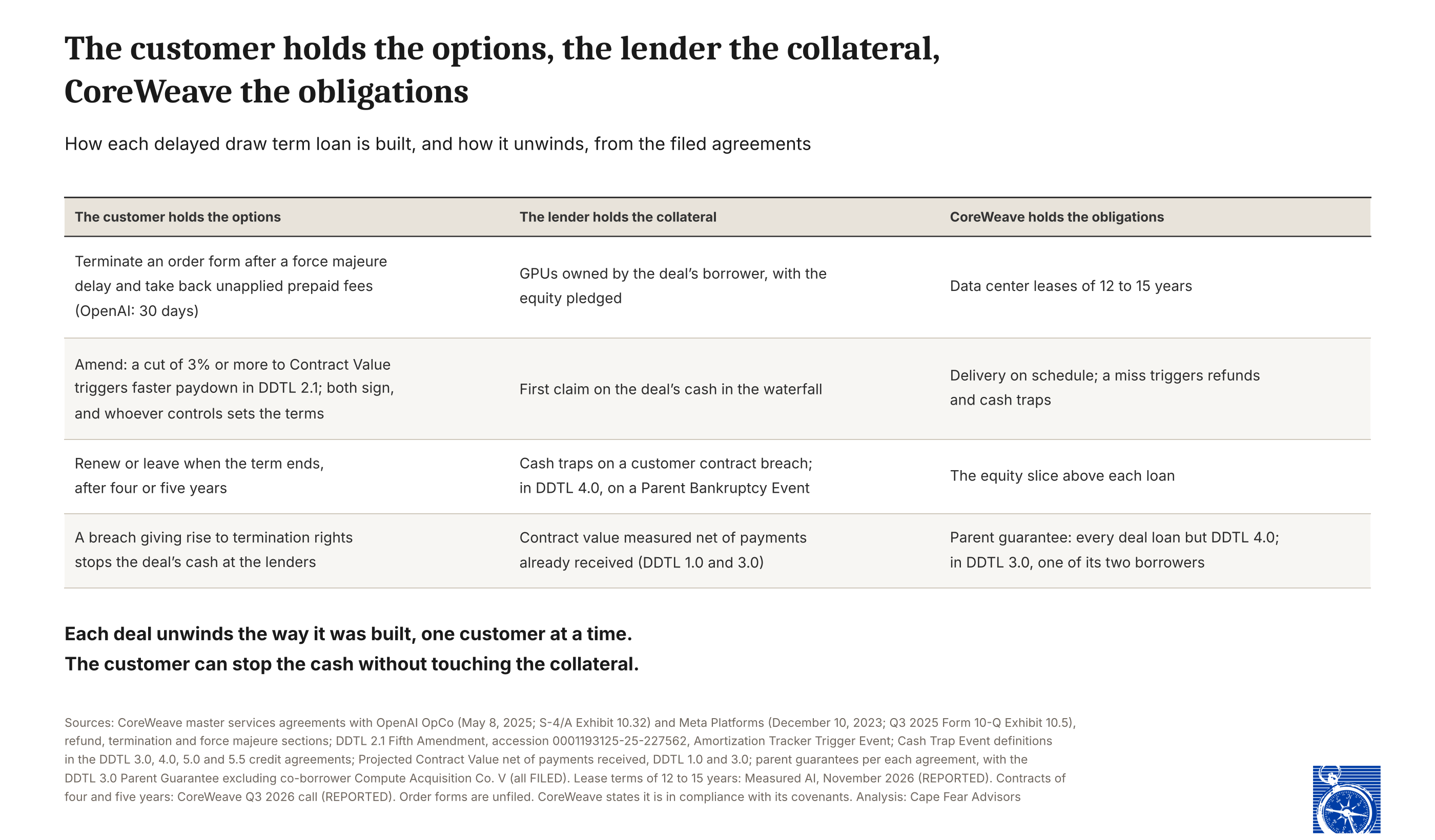
So a deal unwinds the way it was built, one customer at a time. The filed routes:
- Delay. OpenAI’s master services agreement lets it end an order form after a force majeure delay of 30 days and recover “all pre-paid fees not applied to Services performed.” Meta’s agreement refunds “all pre-paid fees” after a force majeure delay of a redacted length, and the pro rata share on termination.(5) A comparable clause is in use at another builder’s campus. On September 24, Bloomberg reported, Oracle sent a force majeure notice on its Jupiter campus in New Mexico to the developer, Blue Owl’s STACK Infrastructure, seeking to defer payments if the campus misses 2028. The Financial Times reported the $18 billion of loans tied to the campus quoted at 89 to 91 cents. Oracle said such notices “do not, by themselves, establish a project delay.”(6) By the time a refund is owed, much of the prepaid cash has gone into the build: CoreWeave describes its funding as “anchored by secured lending, customer prepayments, and operating cash flows.”(7) The refund is a claim on CoreWeave. The customer’s lever is the next payment.
- Breach. A material breach “giving rise to termination rights” is a Cash Trap Event in DDTL 3.0, 4.0, 5.0 and 5.5. The deal’s cash stops at the lenders.(4)
- Amendment. In DDTL 2.1, a contract amendment that cuts Contract Value by 3 percent or more triggers the Amortization Tracker.(4) An amendment takes both signatures. Which party sets its terms is the question of who controls.
- Expiry. CoreWeave’s long contracts run four and five years.(1) The leases behind them run 12 to 15 years, on Measured AI’s reading of the landlords’ filings.(8) Shorter terms are part of the offer, and CoreWeave prices them higher: more than $40 million per megawatt a year, against $20 million to $25 million on four- and five-year contracts. “Short-term contracts let us respond to a strong pricing environment and earn premium returns,” Michael Intrator said on the call.(1) The release describes DDTL 5.5 as “designed to support shorter-duration customer contracts.”(9) The leases outlast every contract inside them.
CoreWeave describes 98 percent of its revenue as committed take-or-pay.(8) Take-or-pay binds payment for capacity made available. Three of the routes run through capacity that is late, capacity lost to a breach, or a term that ends. The fourth runs through new terms both parties sign.
On the filed record, CoreWeave states it is in compliance with its covenants, and no cash trap, refund or termination has been disclosed.(9) The first two routes turn on delivery; the other two turn on terms.
Twice this year, CoreWeave moved prepaid money out of deferred revenue. The first, $1.3 billion in the first quarter, had cleared customer liabilities by June 30, to an undisclosed destination. The second, $1.9 billion in the third quarter, moved “as contracts became cancellable.” Cape Fear Advisors and Deep Quarry with The Dig followed the first one in August.(9)
In this structure, the customer holds the options, the lender holds the collateral, and CoreWeave holds the obligations: the leases, the delivery, the equity slice and the parent guarantee, which covers every deal loan except DDTL 4.0 and, in DDTL 3.0, only one of its two borrowers.(10) CoreWeave holds some options of its own: termination rights at some landlord sites, and set-off of prepaid amounts if a customer breaches.(5)(8)
Whose credit, whose risk
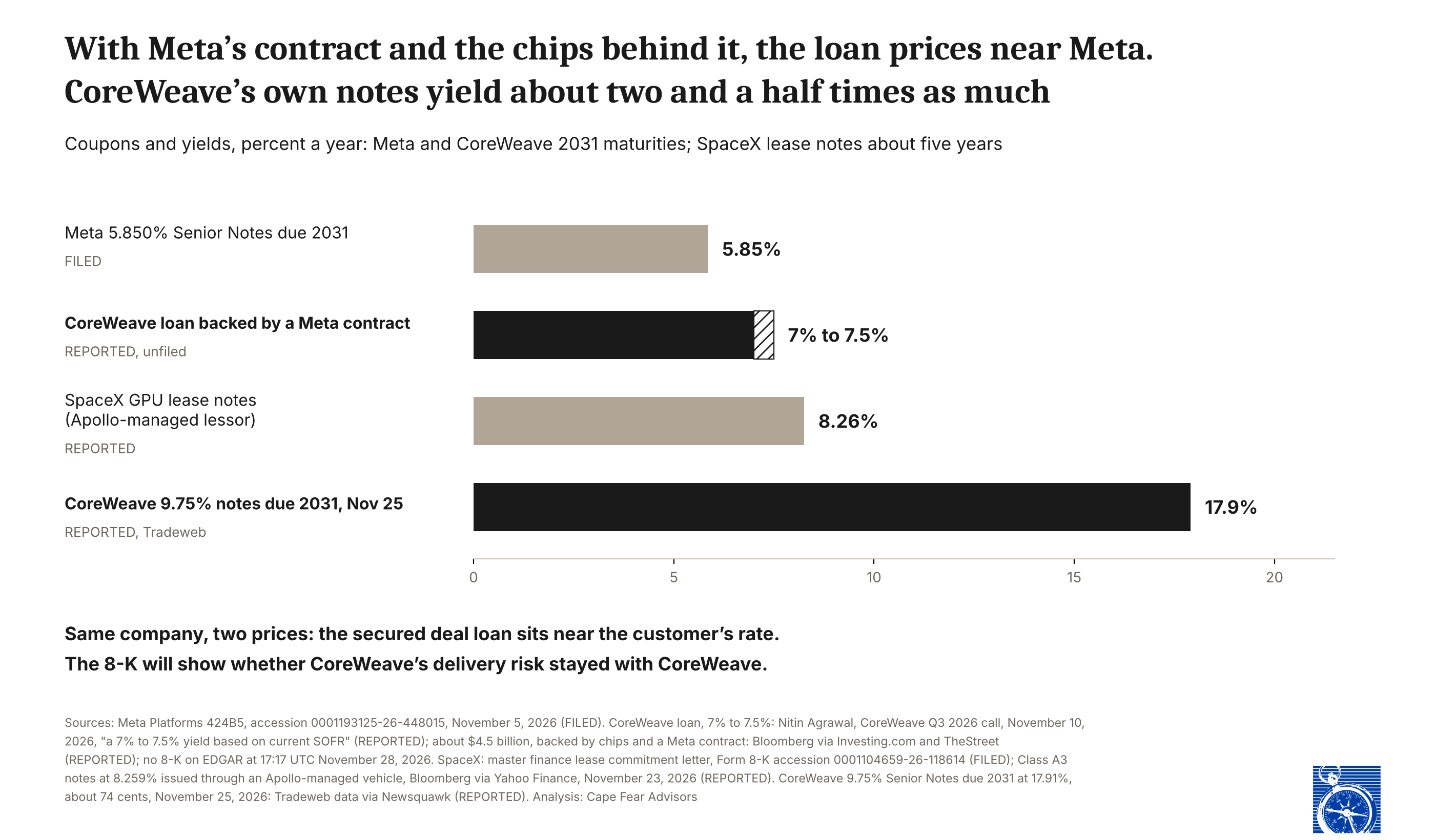
The reported 7 to 7.5 percent sits near Meta’s own rate. Meta’s five-year notes, sold in November, pay 5.85 percent. CoreWeave’s 9.75 percent notes due 2031 yielded 17.9 percent on November 25.(11) The deal loan is secured by chips, senior and capped by its advance rate, and it prices 1.15 to 1.65 points over Meta’s notes. The parent notes are unsecured, trade near 74 cents and yield more than 10 points over the loan. The deal loan’s rate sits near the customer’s, not the company’s.
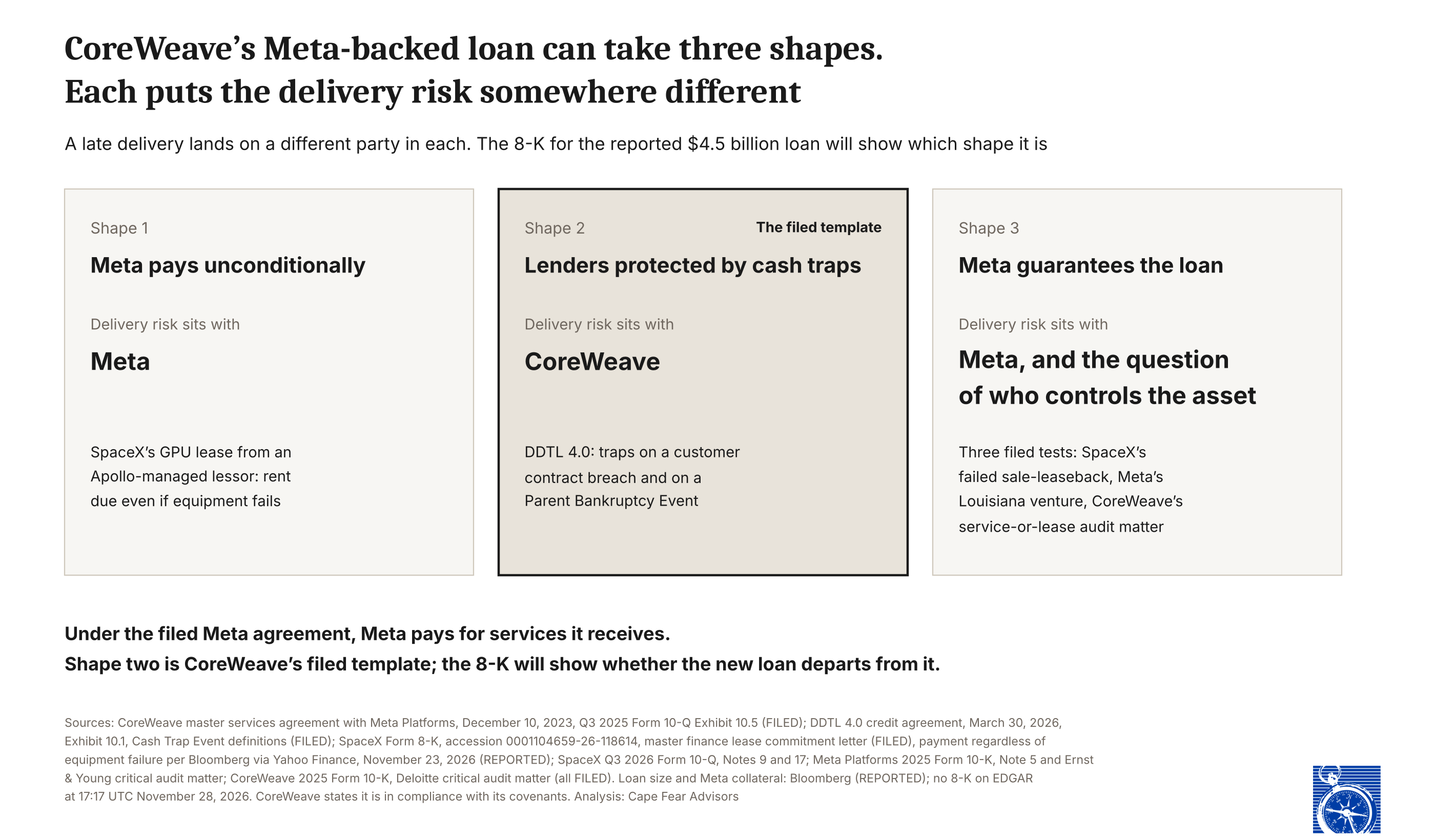
Under the filed Meta agreement, Meta pays for services it receives. A delay that runs long enough returns the prepayment.(5) So the loan can take one of three shapes:
- Meta’s payment is made unconditional for this contract. SpaceX’s filed GPU lease with an Apollo-managed lessor works this way. Rent is one-twentieth of financed cost each quarter plus a fixed rate, and SpaceX is reported to pay even if the equipment fails.(12) That is a lessee’s undertaking, and the filed cloud agreements read differently.
- The lenders take CoreWeave’s delivery risk at Meta’s price, and protect it with the deal’s terms. DDTL 4.0 shows those terms: a cash trap on a breach of the customer contract, and a second trap on a Parent Bankruptcy Event, so the deal’s cash stops rising to CoreWeave if CoreWeave fails.(3)
- Meta guarantees the loan itself. The lenders then hold Meta’s risk outright, and a different question opens: who controls the borrower and its assets. The filings show three related tests. SpaceX’s GPU leases with Valor Equity Partners sit on its balance sheet as $12.9 billion of debt because the leases would have been finance leases, so the sale failed under the lease standard. Meta’s Louisiana data center venture carries Meta residual value guarantees with a threshold of about $28 billion; Meta concluded it lacks the power to direct the venture and carries it as an equity-method investment, and its auditor named that judgment a critical audit matter. CoreWeave’s auditor names its own: whether its customer contracts are cloud services or leases of equipment, the question “CoreWeave, Taken as a Whole” set out in July.(13) In this shape, CoreWeave operates capacity Meta stands behind, and the parent’s residual looks like a fee.
DDTL 4.0, the filed template, has the second shape. Under it, the customer’s credit sets the price and CoreWeave carries the risk that sets off the unwind. The third shape moves the risk and, with it, the question of whose asset the cluster is.
Where the dollar lands
A prepayment made into the deal stays in the deal until its tests release it. Until then it repays the deal’s lenders or sits behind them. Cape Fear Advisors’ model runs the parent’s cash through 2027: its share of each build, its own debt service and overhead, against the cash that reaches it. On that model, every $2.25 billion of the guided $9 billion that lands in a deal account and not at the parent adds about $0.65 billion to $0.8 billion a quarter to the new prepayments 2027 needs.(14)
The same dollar appears in four ledgers: the deal’s contract value, the deal’s waterfall, the parent’s liquidity, and the parent’s share of each 2027 build. It is spent once. Each deal can be modeled on its own. Added together, they draw on one supply of cash, and there is only so much of it.
A one-point rise in SOFR costs about $95 million to $141 million a year on the deal loans, a ninth to a sixth of third-quarter operating income at an annual pace.(14) That is the smallest pressure modeled here. The larger one is the price of the parent’s own money. The parent’s shelf is the 17.9 percent one; the 7 to 7.5 percent deal loans only reduce how much of it the parent has to fill.
What the 8-K will show
- Who owns the borrower, and whether the Building 4 lease at Polaris Forge is assigned to it.
- The advance rate and the collateral, named or lettered.
- Whether the pledged Meta contract keeps its refund and termination rights.
- The cash trap triggers, including any parent-bankruptcy trap.
- A parent guarantee, a Meta guarantee, or a bad-acts guarantee only.
- Reserves funded at closing, and when amortization starts.
Francine McKenna made the customer-leverage point in Fortune in October, telling Jim Edwards she doubted Microsoft would carry its CoreWeave commitments if demand for compute softened. With Olga Usvyatsky in The Dig on November 15, she called prepayments and deposits “a de-facto form of credit.” That makes the customer a lender as well as a customer. The customer can stop the cash without touching the collateral. The filings show how.(15)
Our earlier readings of CoreWeave’s filings include “CoreWeave, Taken as a Whole” (July 4), “CoreWeave: The Sum of the Participants” (August 12), “CoreWeave, the Key, the Lock and the Clock” (August 20) and “CoreWeave, the Sum of the Deals” (November 21).
Free to read, no paywall. Readers who find the work useful can support it at the foot of the page; payment offsets the time and buys no access. Corrections run in daylight, dated, in a comment or in the following piece, and a reader who finds one is doing us a favor.
Standing Disclosure
Cape Fear Advisors holds no direct position, long or short, in the securities discussed here. Any exposure is indirect, through managed funds it does not control, which may include index funds holding the public companies named.
Anthropic, a subject of our coverage, is the developer of Claude, which we use in preparing our work. Others named here have ties to Anthropic: SpaceX sells it compute under a contract described in Anthropic’s prospectus; Apollo has financed capacity for it; Microsoft has announced an investment in it; OpenAI competes with it. That nearness cannot be checked away, which is why no claim here rests on trust in the tool: every figure carries a public source and every derived figure carries its inputs in the notes. Companies not named here, among them the GPU and cloud suppliers behind the capacity, may hold positions or supply relationships that bear on the filers discussed, and that possibility is part of why every piece is re-checked against the filings rather than read against a fixed list. Figures are quoted from the filers without characterization, and the same standard of reading is applied to every filer named.
Notes
[1] CoreWeave, Inc. third-quarter 2026 earnings call, November 10, 2026, proofread transcript posted on the company’s investor relations site, read at source November 28 (REPORTED). Nitin Agrawal, chief financial officer: “we expect to launch our next DDTL in the coming weeks”; “This will be an investment-grade facility with multiple rating agencies indicating a high investment-grade rating”; a spread “that implies a 7% to 7.5% yield based on current SOFR” while “financing more than 90% of the associated CapEx.” Michael Intrator, chief executive: short-term capacity at “more than $40 million per megawatt annually”; “pricing for new infrastructure on four and five-year contracts is moving to $20 million to $25 million per megawatt”; “Short-term contracts let us respond to a strong pricing environment and earn premium returns.”
[2] Bloomberg, November 11 and later, via Investing.com and TheStreet (REPORTED): size, pricing and collateral; the $4.5 billion size and the syndication timing per the Investing.com relay of Bloomberg. EDGAR probe, CoreWeave CIK 1769628, 17:17 UTC November 28, 2026: no 8-K for the facility; latest filings are Forms 4 of November 24. Oracle and Meta probed at the same time: no new 8-K. Re-run within the hour before posting.
[3] DDTL 4.0 credit agreement, March 30, 2026, Exhibit 10.1 to Form 8-K (FILED): commitments up to $8.5 billion; Cash Trap Event definitions, including breach of a customer contract and the Parent Bankruptcy Event; data center sites redacted. Meta as the contract counterparty is REPORTED.
[4] DDTL 2.1 Fifth Amendment, Exhibit 10.1, accession 0001193125-25-227562 (FILED): advance rates of 90 and 75 percent by contract class, and the Amortization Tracker Trigger Event; the class labels as Microsoft and OpenAI per CCIR Research, “CoreWeave’s Q3 2026 Debt, Entity by Entity,” November 20, 2026 (REPORTED). DDTL 3.0, 4.0, 5.0 and 5.5 credit agreements (FILED): Cash Trap Event definitions; DDTL 3.0 names OpenAI OpCo and Phoenix 1. Projected Contract Value “net of any payments already received (including all upfront payments)”: DDTL 1.0 and 3.0 definitions (FILED); the DDTL 5.5 figure is redacted, and DDTL 4.0 and 5.0 test debt service coverage on net operating income.
[5] Master services agreements with Meta Platforms (December 10, 2023; Q3 2025 Form 10-Q Exhibit 10.5) and OpenAI OpCo (May 8, 2025; S-4/A Exhibit 10.32), refund, termination, set-off and force majeure sections (FILED). Order forms, which carry payment terms, are unfiled.
[6] Oracle’s notice: Bloomberg, September 24, 2026, as relayed by Searchlight New Mexico, September 25, and ENR, September 28 (REPORTED). Loans quoted at 89 to 91 cents: Financial Times, as relayed by Searchlight New Mexico (REPORTED). Oracle’s statement: Michael Egbert to The Santa Fe New Mexican, as relayed by Searchlight New Mexico (REPORTED). The Bloomberg and FT originals were not read here. The notice is unfiled: EDGAR, Oracle CIK 1341439, 16:48 UTC November 28, 2026, every filing since September 1 other than ownership forms; the November 4 prospectus supplement carries no reference to force majeure or New Mexico.
[7] Michael Intrator, third-quarter 2026 call, as quoted by The Dig, November 15, 2026 (REPORTED).
[8] Lease terms of 12 to 15 years and CoreWeave’s termination rights at Polaris Forge 1 and Helios: Measured AI, November 2026 (REPORTED). Take-or-pay share of revenue: CoreWeave, as quoted in Fortune, October 16, 2026 (REPORTED).
[9] CoreWeave Form 10-Q, Q1, Q2 and Q3 2026 (FILED): reclassifications to customer liabilities; customer liabilities of $1,469 million at March 31 and $1,915 million at September 30; other current liabilities of $70 million in total at June 30; the covenant compliance statement. Third-quarter 2026 earnings release, Form 8-K, accession 0001769628-26-000461, Exhibit 99.1 (FURNISHED): DDTL 5.5 “designed to support shorter-duration customer contracts.” Cape Fear Advisors, “CoreWeave: The Sum of the Participants,” August 12, 2026, and Deep Quarry with The Dig, “What CoreWeave’s $1.3 Billion deferred revenue reclassification might be telling us,” August 15, 2026.
[10] DDTL 3.0 Parent Guarantee and Pledge Agreement, Exhibit 10.2, accession 0001769628-25-000033 (FILED): the guarantee excludes the co-borrower, CoreWeave Compute Acquisition Co. V. The Q3 2026 Form 10-Q summary describes the guarantees without the exclusion; the exhibit governs, as set out in “CoreWeave, the Sum of the Deals,” November 21, 2026. DDTL 4.0: a bad-acts guarantee only (FILED).
[11] Meta Platforms 424B5, accession 0001193125-26-448015 (FILED): 5.850% Senior Notes due 2031. CoreWeave 9.75% Senior Notes due 2031 at 17.91 percent, about 74 cents, November 25, 2026: Tradeweb data via Newsquawk, as stamped on the page, and Option Beast, November 27 (REPORTED). The 2031 notes are used because they match the maturity of Meta’s 2031 notes. The other available print, about 15 percent on the 9.625% notes due 2032 (The Wall Street Journal, from MarketAxess, November 10), gives a multiple of about two. No print later than November 25 was found.
[12] SpaceX Form 8-K, accession 0001104659-26-118614, October 26, 2026 (FILED): master finance lease commitment letter and rent terms. Payment regardless of equipment failure: Bloomberg via Yahoo Finance, November 23 (REPORTED).
[13] SpaceX Form 10-Q, Q3 2026, accession 0001628280-26-066880, Notes 9 and 17 (FILED): sale-leaseback transactions with Valor “which would have been deemed finance leases, resulting in failed sale-leaseback transactions”; debt of $2,181 million current and $10,716 million non-current. Meta Platforms Form 10-K, 2025, accession 0001628280-26-003942 (FILED): Note 5, the Louisiana venture, a 20 percent interest, residual value guarantees with an aggregate threshold of about $28 billion, the conclusion that Meta is not the primary beneficiary, and a maximum exposure to loss of $45.95 billion; Ernst & Young’s critical audit matter, “Consolidation accounting for a variable interest entity.” The venture’s name and Blue Owl’s role are REPORTED. CoreWeave Form 10-K, 2025 (FILED): Deloitte & Touche’s critical audit matter on whether customer contracts are “a revenue contract for cloud-based services or a lease contract for cloud computing equipment.”
[14] OURS. The model runs the parent’s cash quarter by quarter from the fourth quarter of 2026 through 2027, on FILED and REPORTED inputs: the parent’s share of capital spending on each build (capital spending less each deal loan’s advance), the deal loans’ scheduled debt service, parent overhead and interest, and the cash that reaches the parent from operations and prepayments. Fourth-quarter receipts at $9.0 billion; Building 4 on the reported $4.5 billion loan; SOFR +100 basis points with known hedges. The 2027 break-even in new prepayments per quarter: $904 million with 100 percent of the $9 billion at the parent, $1,556 million at 75 percent, $2,375 million at 50 percent, $3,193 million at 25 percent (steps of $652 million, $819 million and $818 million). SOFR: the 2027 average floating balance on the deal loans is $9.47 billion with known hedges (DDTL 5.0 at 95 percent under Section 5.23; DDTL 4.0’s fixed tranche of about $2.4 billion) and $14.14 billion with all floating, so one point costs $95 million and $141 million. Third-quarter operating income of $207 million (FILED) at an annual pace is $828 million; $95 million and $141 million are 11.5 and 17.0 percent of it.
[15] Jim Edwards, “CoreWeave investor explains how the loss-making AI ‘neocloud’ provider plans to claw its way out of debt,” Fortune, October 16, 2026, https://fortune.com/2026/10/16/coreweave-investor-explains-ai-neocloud-debt/ (McKenna’s view as reported; the same article notes force majeure as one route out of the Microsoft agreement). Francine McKenna and Olga Usvyatsky, “High on customer financing: How CoreWeave and others use prepayments to pull cash flow forward,” The Dig with Deep Quarry, November 15, 2026, https://thedig.substack.com/p/high-on-customer-financing-how-coreweave. Chiltern Capital, “CoreWeave: The End of the AI Trade?”, October 18, 2026, models the same waterfall from the bond side.
Analysis: Cape Fear Advisors.
This piece also appears on Substack. Cape Fear Advisors is an independent advisory firm based in Portsmouth, NH.
Contact Cape Fear Advisors