


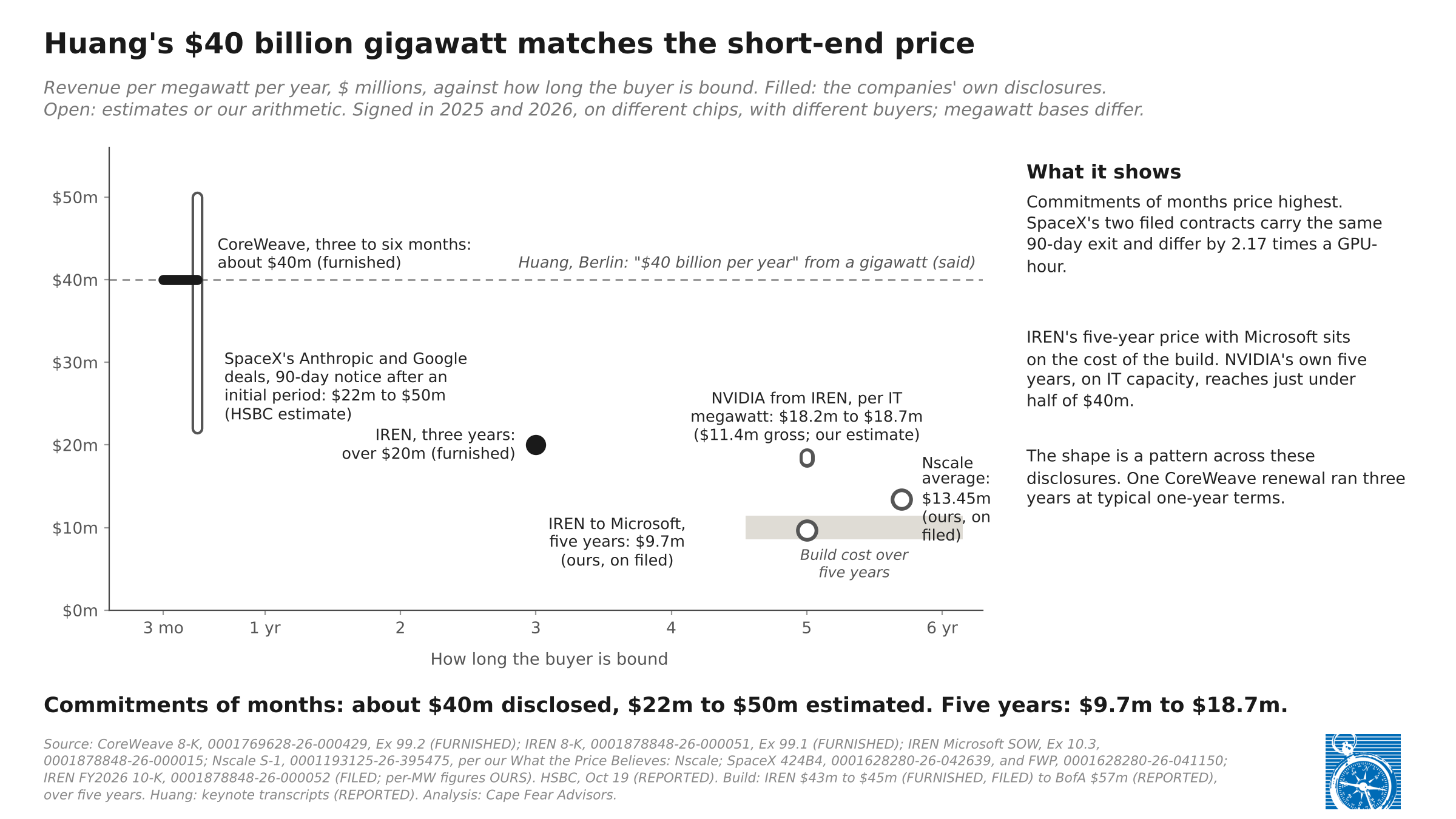
The price, by commitment
The builders' disclosures now give prices, or the inputs for them, at several lengths of commitment. At three to six months and at three years, the builders publish the rate. At five years, they publish the contract value and the capacity, and the rate is our division:
- Three to six months: about $40m a megawatt-year. CoreWeave's September investor presentation gives "~$40M/MW" as the pricing range for short-dated contracts signed in the third quarter (FURNISHED) (2).
- Ninety days' notice: SpaceX's filed contracts with Anthropic and Google run to 2029, but after initial periods either party can end them on 90 days' notice (FILED). They pay about $5.27 and $11.46 a GPU-hour (OURS) (3). HSBC puts these deals at $22m to $50m a megawatt-year (REPORTED).
- Three years: more than $20m. IREN's August results release: "Recent 3-year contracts >$20m revenue per MW (IT)," with "Active discussions at ~$25m per MW (IT)" (FURNISHED) (4).
- Five years and more: $9.7m to $18.7m (OURS). IREN's contract with Microsoft pays $9.7m per IT megawatt-year (FILED; OURS); Nscale's contracts average $13.45m, per our What the Price Believes: Nscale (5); and NVIDIA's five-year contract with IREN comes to about $18.2m to $18.7m per IT megawatt (OURS) (6).
In these disclosures, the shorter the commitment, the higher the price. At the short end, SpaceX's two contracts carry the same exit and differ by 2.17 times a GPU-hour.
The commitment here is how long the buyer is bound. Microsoft's purchase-order terms let it "terminate these PO Terms or the applicable SOW with or without cause," and its statement of work with IREN says that section, among others, does "not apply to this Agreement" (FILED) (7). SpaceX's contracts run to 2029, but either party can leave on 90 days' notice after an initial period, so they sit at about six months. On their stated term, which SpaceX's 10-Q calls "typically three years" (FILED) (8), they would sit beside IREN's three-year rung. Those two exits are the ones read here. For CoreWeave, IREN's three-year contracts, Nscale and NVIDIA, the stated term stands in for the binding period.
The megawatts differ too (9). Huang's gigawatt is facility power, and most of the rates here are per IT megawatt. On IREN's own ratio of 1.6, Microsoft's $9.7m per IT megawatt is about $6.1m per gross megawatt, so a common basis widens the gap to $40m. CoreWeave's basis is undisclosed: its $40m is measured against "power required to service clusters." If that is IT power, the short-end price is about $25m per gross megawatt, and Huang's $40m sits above it. On IT capacity, NVIDIA's five-year top of $18.7m sits just below IREN's three-year floor of more than $20m; the step between those two rungs is small.
The step mixes more than term. The prices were signed at different dates, on different chips, with buyers of different credit. CoreWeave told investors of a price increase of about 25% across its GPU types in July (2), and IREN finances its recent deployments for "non-investment grade" customers. The step is a pattern across today's disclosures, and one renewal runs the other way: CoreWeave renewed older A100 capacity on a "3-year contract signed in line with typical 1-year terms" (2).
What five years buys
IREN's Microsoft build has both halves on the record (10). The data center runs $14m to $16m a megawatt (FURNISHED), and the GPUs $29.0m: $5.8bn of Dell servers across 200 MW (FILED). Together, $43m to $45m. Bank of America put the cost at $49m a megawatt, and about $57m for AI-focused sites, on October 23 (REPORTED). Huang said $50m.
Spread across five years, IREN's $43m to Bank of America's $57m is $8.6m to $11.4m a year. IREN's five-year price with Microsoft sits on the cost of the build. Over the term Microsoft pays $48.32m a megawatt: above IREN's own $43m to $45m, before power, staff and interest, and below Bank of America's $49m.
What the builder gets for the lower price is lower-cost money (11). IREN's $3.6bn investment-grade program for the Microsoft contract carries 7.05% to 7.12% in its 10-K (6.0% in its release, which excludes fees). The $2.4bn it arranged for its "non-investment grade customer deployments" carries 9.0%. IREN's recent contracts, whatever their length, bring more cash up front: prepayments of 45% to 55% of GPU cost, against about a third on Microsoft's.
At IREN, the longest contract from the strongest buyer borrows at the lowest rate.
Who buys on which rung
The hyperscaler commits for five years. Microsoft pays IREN $9.7m. HSBC estimated on October 19 that hyperscalers earn $17m to $18m a megawatt-year, and credits the difference to shorter contracts, a general-purpose cloud and a broad base of smaller customers (REPORTED) (12). At HSBC's figure, the gap is 43% to 46% of the hyperscaler price.
NVIDIA commits for five years too. Its contract with IREN supports "its internal AI and research workloads" (FILED) (6). It pays $11.4m to $11.7m a megawatt-year on about 60 MW, which IREN's figures indicate is gross, or about $18.2m to $18.7m per IT megawatt on IREN's own ratio: under half of Huang's $40m either way. For IREN, the contract pays well against its cost. Its value is 2.13 times the $1.6bn of Dell systems bought for it, where Microsoft's is 1.67 times its GPUs. It was signed alongside NVIDIA's rights over up to 30m IREN shares, valued at $793.4m and granted in connection with GPU supply (FILED).
Where NVIDIA stands behind the AI clouds instead, $36bn of commitments at July 26, its 10-Q says the clouds "can unilaterally stop providing to us and sell to third-party customers at more advantageous rates" (FILED) (13).
Huang's $40bn matches the price of a commitment measured in months. When NVIDIA buys, it commits for five years.
A lab's filed price comes with a 90-day exit. Anthropic and Google have agreed to pay SpaceX about $5.27 and $11.46 a GPU-hour, under contracts either side can end on 90 days' notice (3). Which rung the labs settle on, the price of leaving early or the price of five years, is the negotiation the next year of contracts will record.
Built for years, sold by the quarter
In August, Dan Davies put SpaceX's Anthropic contract, on his estimate of Colossus 1's cost, at about a 50% return on capital: "nice work if you can get it" (REPORTED) (14). He also flagged its break clauses. The short end pays well. The buildings last longer than the commitments.
SpaceX's 10-Q describes its cloud contracts as "typically three years and terminable by either party upon 90 days' notice," and its SI segment spent $16.4bn on capital in the third quarter alone (FILED) (8). IREN's 10-K names the exposure: "If the term of our customer contracts is shorter than the useful life of the associated assets or the tenor of the associated power commitments and financing, we are exposed to re-contracting and pricing risk at the end of contract terms" (15).
Oracle, which sells capacity to OpenAI (REPORTED) (16), and SpaceX now both sell capacity to the labs from long-lived buildings. That puts both on the line between the five-year price and the price by the quarter. Oracle holds its Investor Day on Wednesday.
The lowest rate finances the five years. The builder's return beyond the build depends on the short-term price lasting.
What we are watching
- Wednesday, October 28: Oracle Investor Day; Microsoft and Alphabet results.
- Thursday, October 29: Amazon results.
- November 5: IREN's first-quarter fiscal 2027 results (REPORTED date). Our What the Price Believes on IREN follows.
- Around November 10: CoreWeave's third quarter, and whether short-dated pricing holds.
- Anthropic's S-1, when it files: a lab's prices, from the buyer's side.
The builders' numbers in full: What the Price Believes: CoreWeave and What the Price Believes: Nscale.
Free to read, no paywall. Readers who find the work useful can support it at the foot of the page; payment offsets the time and buys no access. Corrections run in daylight, dated, in a comment or in the following piece, and a reader who finds one is doing us a favor.
Standing Disclosure
Cape Fear Advisors' principal holds a small long position in Tesla call options, held since earlier in 2026, and no other position in the securities discussed, other than any held through broad index or pooled funds over which he exercises no control. Anthropic, a customer behind the SpaceX and Nscale figures above, develops Claude, which is used in preparing this research. The same standard of reading is applied to every filer named.
Notes
[1] Huang, GTC Berlin keynote, October 21 (REPORTED). Investing.com renders the sentence "If we just said it is $40 billion per year of revenue generation that comes out of that infrastructure"; Singju Post renders it "And so we just said, it's $40 billion per year of revenue generation that comes out of that infrastructure." Both carry "The revenue generation" expected as "tens of billion dollars per year," and the cost of "Land, power, shell, all of the compute networking storage, power cooling." Neither says what kind of revenue, or over what contract length.
[2] CoreWeave 8-K, accession 0001769628-26-000429, Ex 99.2, September 17 (FURNISHED). Slide 7: the range is for "signed short-dated contracts" of three to six months in the third quarter, "Calculated as annualized revenue divided by power required to service clusters for related short-term contracts"; the volume is undisclosed. The same slide: "~25% price increase across SKUs in July 2026." Slide 10: the A100 renewal "Extends into 2029," priced as a "3-year contract signed in line with typical 1-year terms." HSBC's October 19 note gives about $40m a megawatt-year for the short-dated deals (REPORTED).
[3] SpaceX final prospectus, 424B4, accession 0001628280-26-042639 (FILED): Anthropic, "$1.25 billion per month through May 2029" for "approximately 325,000 NVIDIA GPUs"; "After the initial three-month period, the agreements may be terminated by either party upon 90 days' notice." SpaceX free writing prospectus, June 5, 2026, accession 0001628280-26-041150 (FILED): Google, "$920 million per month from October 2026 through June 2029" for "approximately 110,000 NVIDIA GPUs, CPUs, memory, and other related components"; "After December 31, 2026, the agreement may be terminated by either party upon 90 days' notice." Per GPU-hour at 730 hours a month (OURS): $5.27 and $11.46, a ratio of 2.17. Both are agreed rates; both bundles include CPUs and other components, and the Anthropic capacity includes the earlier COLOSSUS cluster. HSBC, October 19 (REPORTED; first page only, read from a published screenshot).
[4] IREN 8-K, accession 0001878848-26-000051, Ex 99.1, August 27 (FURNISHED). The release states no period for the figure. Its "~2 year payback," defined as "estimated capital expenditure for GPUs and ancillaries divided by contracted revenue less estimated direct costs," fits an annual figure (OURS).
[5] IREN and Microsoft: $9,664.2m total contract value (SOW, Ex 10.3, accession 0001878848-26-000015) over about 200 MW of IT load; price term five years (OURS on FILED). Nscale: What the Price Believes: Nscale 1.0, page 10, total contract value less the active $2.6bn, over the 1,315 MW still to deliver, over 5.7 years (OURS on the S-1, 0001193125-26-395475, FILED). The S-1 describes the Anthropic agreements as "multi-year."
[6] IREN FY2026 10-K (FILED): "a five-year cloud services contract with NVIDIA to support its internal AI and research workloads representing approximately $3.4 billion of total contract value." $3,400m over 60 MW over five years is $11.33m, printed $11.4m, rounded against the argument. IREN's May call gives "approximately $700 million of ARR," $11.67m (FURNISHED, 8-K 0001878848-26-000028). On that call, "Of that 250 megawatts, approximately 60 megawatts will be deployed to support the NVIDIA AI Cloud contract," within "400 megawatts of gross capacity," which reads the 60 MW as gross. IREN's own ratio, 480 MW gross (July 20 release, 0001140361-26-028871) to about 300 MW IT (August 27 release), both FURNISHED, is 1.6 (OURS); at 1.6, $18.13m to $18.67m per IT megawatt, printed $18.2m to $18.7m. Dell systems for the contract: about $1.6bn (8-K Item 1.01, 0001878848-26-000030, FILED). Contract value over Dell: 2.125; Microsoft's over its $5.8bn of GPUs: 1.666 (OURS). NVIDIA's rights over up to 30,000,000 IREN shares at $70, valued at $793.4m, vest with GPU deployment (10-K Note 24, FILED). The 10-K grants the rights "in connection with its arrangements with NVIDIA" for the supply of GPUs, capitalizes them into GPU cost, and accounts for them separately from the cloud services agreement.
[7] IREN and Microsoft statement of work, Ex 10.3, 0001878848-26-000015 (FILED). The attached PO Terms, section 14: "Microsoft may terminate these PO Terms or the applicable SOW with or without cause." Exhibit F: "Sections 3, 4.a, 5, 7-17, 19-23, 25-28, 30 and Exhibit A of the PO Terms do not apply to this Agreement." The SOW's own termination rights cover late delivery and nonpayment. $9.664m over 1.6 is $6.04m, printed $6.1m (OURS).
[8] SpaceX Form 10-Q for the quarter ended September 30, 2026, accession 0001628280-26-066880 (FILED): MD&A description of SI revenue from cloud services, and the segment table, SI capital expenditures of $16,444m for the three months.
[9] IREN's ratio of gross to IT capacity: 480 MW gross in its July 20 release (0001140361-26-028871) against about 300 MW IT in its August 27 release (0001878848-26-000051), both FURNISHED; 480 over 300 is 1.6 (OURS). The two figures are five weeks apart. Microsoft: $9.664m over 1.6 is $6.04m, printed $6.1m. CoreWeave, if per IT megawatt: $40m over 1.6 is $25.0m. NVIDIA: $11.33m to $11.67m per gross megawatt times 1.6 is $18.13m to $18.67m per IT megawatt, printed $18.2m to $18.7m. The ratio sets every per-IT figure for NVIDIA in this piece.
[10] IREN data center cost per IT megawatt: FURNISHED (November 2025 investor presentation). GPUs: $5.8bn of Dell servers for the 200 MW (8-K, FILED). Bank of America, via Reuters, October 23 (REPORTED).
[11] IREN FY2026 10-K, accession 0001878848-26-000052 (FILED): the $3.6bn GPU Financing, through IE US Hardware 3, LLC, "in support of the Microsoft Agreement," carries 7.12% on the DDTL Facility and 7.05% on the USPP Senior Notes in the debt table; the August 2026 Financing Agreements "bear interest at a per annum rate equal to 9.0%." The August 27 release gives the Microsoft program at 6.0%, a weighted average excluding fees with the floating portion hedged (FURNISHED). Prepayments: the August 27 release's "Recent customer prepayments represent 45-55% of GPU capex," defined in its footnote 4 as amounts "contractually payable by customers in advance of service delivery" over estimated GPU capex. The July 20 release (0001140361-26-028871, footnote 3) gave about 45% for agreements executed since June 1, 2026. Neither ties the figure to contract length. Microsoft's "Upfront Payment" under the SOW, which the 10-K describes as "to be paid prior to the applicable delivery date," is $1,932.8m; over $5.8bn of estimated GPU capex, 33.32% (OURS).
[12] HSBC Global Investment Research, CoreWeave, October 19 (REPORTED; first page only; the reasons are paraphrased). ($17m less $9.664m) over $17m is 43.15%; ($18m less $9.664m) over $18m is 46.31%; floored, 43.1% and 46.3%. HSBC's figure is a blend across customers and contract lengths, and the gap is a revenue difference before Microsoft's own costs.
[13] NVIDIA Form 10-Q for the quarter ended July 26, 2026, accession 0001045810-26-000075, Note 10 and MD&A (FILED). The commitments are "typically six years in duration" and "decrease as capacity is used by third-party customers or by us for our research and development efforts." NVIDIA may share in revenue the clouds earn from third parties. A separate $29bn of cloud service agreements supports NVIDIA's own research.
[14] Dan Davies, "if it floats, flies or megaFLOPs," Back of Mind, August 14, 2026 (REPORTED). His capital base is Colossus 1, about $13bn; the filed agreements span COLOSSUS and COLOSSUS II. On break clauses: "Anthropic apparently has some very strong break clauses."
[15] IREN FY2026 10-K, risk factors (FILED). The one filed end-of-lease marker we found: IREN's own option, under a 36-month lease of about $102m of GPUs, to buy them "at the lower of its prevailing fair market value and 18% of the initial purchase cost" (FY2025 10-K, 0001878848-25-000063, FILED). It is a ceiling on the price, not a market sale.
[16] The Wall Street Journal, September 10, 2025, reported an OpenAI agreement to buy about $300bn of computing capacity from Oracle over about five years (REPORTED).
Analysis: Cape Fear Advisors.
This piece also appears on Substack. Cape Fear Advisors is an independent advisory firm based in Portsmouth, NH.
Contact Cape Fear Advisors