


On Thursday IREN announced a five-year contract with a customer prepayment "covering 90% of associated GPU capex," and on Friday its stock rose 20%. The 90% is a share of the chip bill. IREN's one filed customer contract, with Microsoft, states its prepayment as 20% of contract value; on the chip bill, it comes to 33.3%. This piece sets the two on one base, follows that base through five IREN announcements as they move from a filing to press releases, and adds a second lesson from Oracle: whether an answer fits the question it was given. (1)
The week the numbers moved
IREN closed Friday at $21.64. It had closed Wednesday at $21.71. Thursday's 17.0% fall and Friday's 20.0% rise came close to offsetting, and the week's headline was the second of the two. (2)
The swings were wider than one week. From September 30 to November 6, IREN fell 47.1%, CoreWeave 46.7%, Nebius 45.1% and Cipher 58.6%. Core Scientific fell 26.4% and TeraWulf 23.2%. Oracle fell 15.4% and NVIDIA 18.3%, against 8.5% for the Nasdaq Composite. Microsoft, a customer of several of them, rose 3.5%. In the 18 sessions from October 14, IREN moved 8% or more in a day ten times. (2)
The research desks moved the other way from Friday's tape. Cantor Fitzgerald kept its Overweight rating and cut its target to $47 from $99, writing that the quarter "beat expectations on financial metrics but missed on timing expectations." BTIG, Macquarie and HC Wainwright lowered their targets too, and Goldman Sachs stayed at Neutral. The Motley Fool's account of the rally named the prepayment as "another sign of pricing power." (3)
The figure the coverage reached for is the one with the least behind it. The rest of this piece sets out why, using only IREN's documents and its own call.
Ninety percent of what
IREN has one customer contract on file in full. On November 3, 2025, it reported under Item 1.01 that Microsoft would take GPU capacity at its Horizon data centers in Childress, Texas, over a five-year average term, with "total contract value... approximately $9.7 billion." The prepayment was stated as a share of that value: "20% of the contract value for each tranche to be paid prior to the applicable delivery date and credited against the service fees due and payable after the 24th calendar month." The same filing gave the load, about 200 megawatts, and the GPU spend, about $5.8 billion. (4)
Twenty percent of a five-year contract is about one year of fees paid before service starts. The filing also says how the money comes back: as credits against fees after the second year. (5)
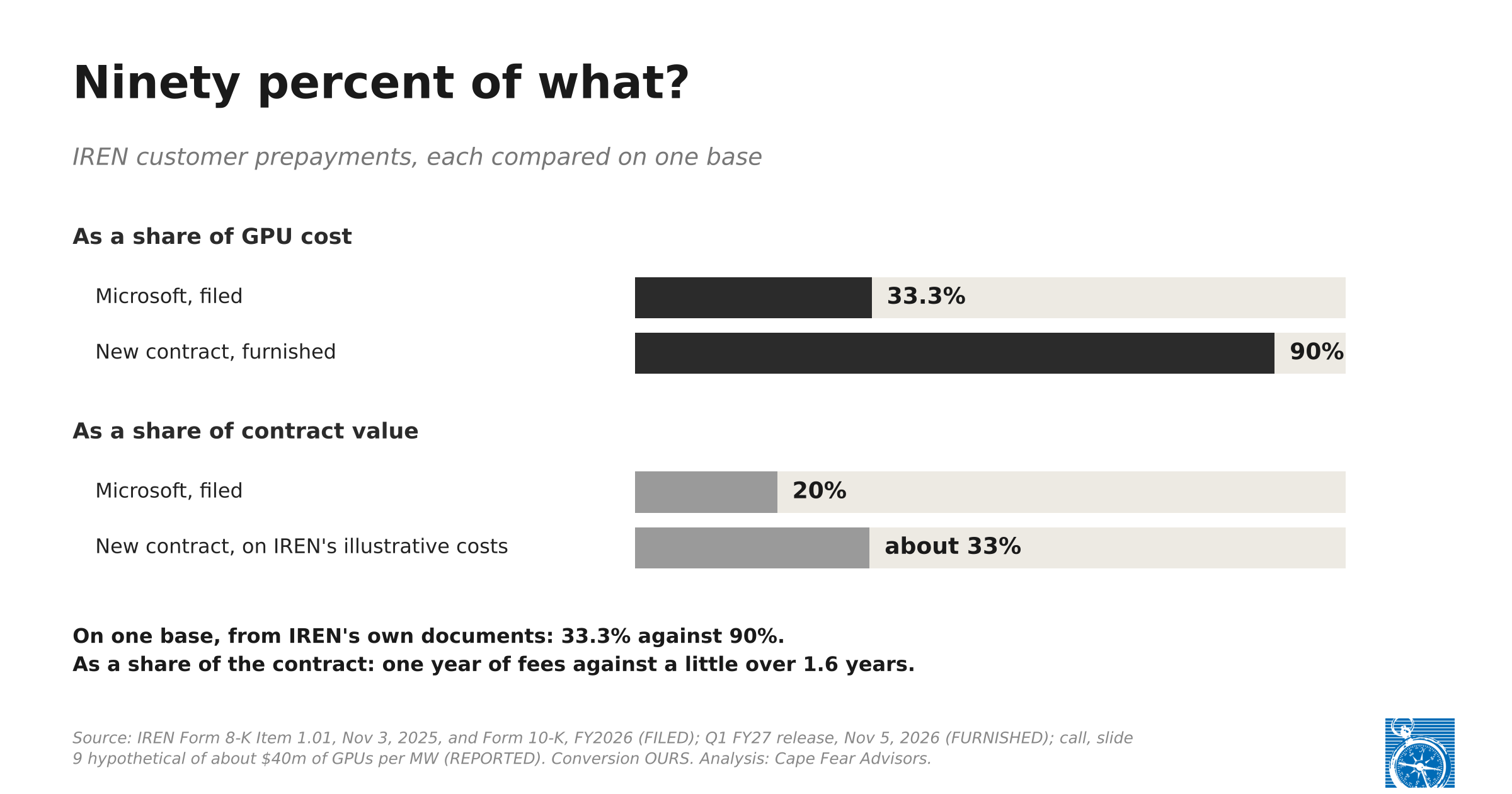
The new contract is stated differently. The release says "Approximately $22 million per IT-MW on a five-year contract including customer prepayment covering 90% of associated GPU capex." The base is the chip bill. (6)
The Microsoft prepayment can be put on that base from IREN's own filings: $1,932.8 million against $5.8 billion of GPU spend is 33.3% of the chip bill. On one base, from IREN's own documents, the filed contract's prepayment is 33.3% and the furnished one's is 90%, about 2.7 to 1. That is the comparison the record supports without any help. (5)
What the 90% cannot show is how much of the customer's whole bill it represents. The release gives no contract value, no megawatts, no customer and no repayment terms. (6)
IREN's call supplies one way to translate it. Its chief financial officer walked through "a hypothetical 1-megawatt liquid cooled deployment for around $60 million of CapEx, 1/3 for the data center and 2/3 for GPUs, and customer prepayments of 0% to 90% of the GPU costs." On that hypothetical, 90% of $40 million of GPUs is $36 million, and five years at $22 million a megawatt is $110 million. Measured against contract value, the way the Microsoft filing measures it, the 90% comes to about a third of what the customer would pay, a little over 1.6 years of fees, against Microsoft's one. The conversion rests on IREN's illustration, labeled by IREN as illustrative, because the contract's own figures are not stated. (7)
The $22 million needs the same care. It is "estimated annual revenue per MW (IT)... based on internal assumptions on power consumption," a measure IREN builds, and newer, costlier chips raise it on their own. On the call, the chief financial officer put the quarter's five-year pricing at "approximately $17 million." (8)
Five announcements, five rungs
Much of IREN's record is complete. The Microsoft contract is filed and complete, Horizon 1 was delivered to and accepted by Microsoft in August, two-thirds of the backlog is with investment-grade counterparties by IREN's account, and IREN defines its measures in its footnotes, which is what makes this reading possible at all. (9)
That contract is the top of a ladder. Each of IREN's customer announcements since then has carried a little less of what a reader would need to check it. (10)
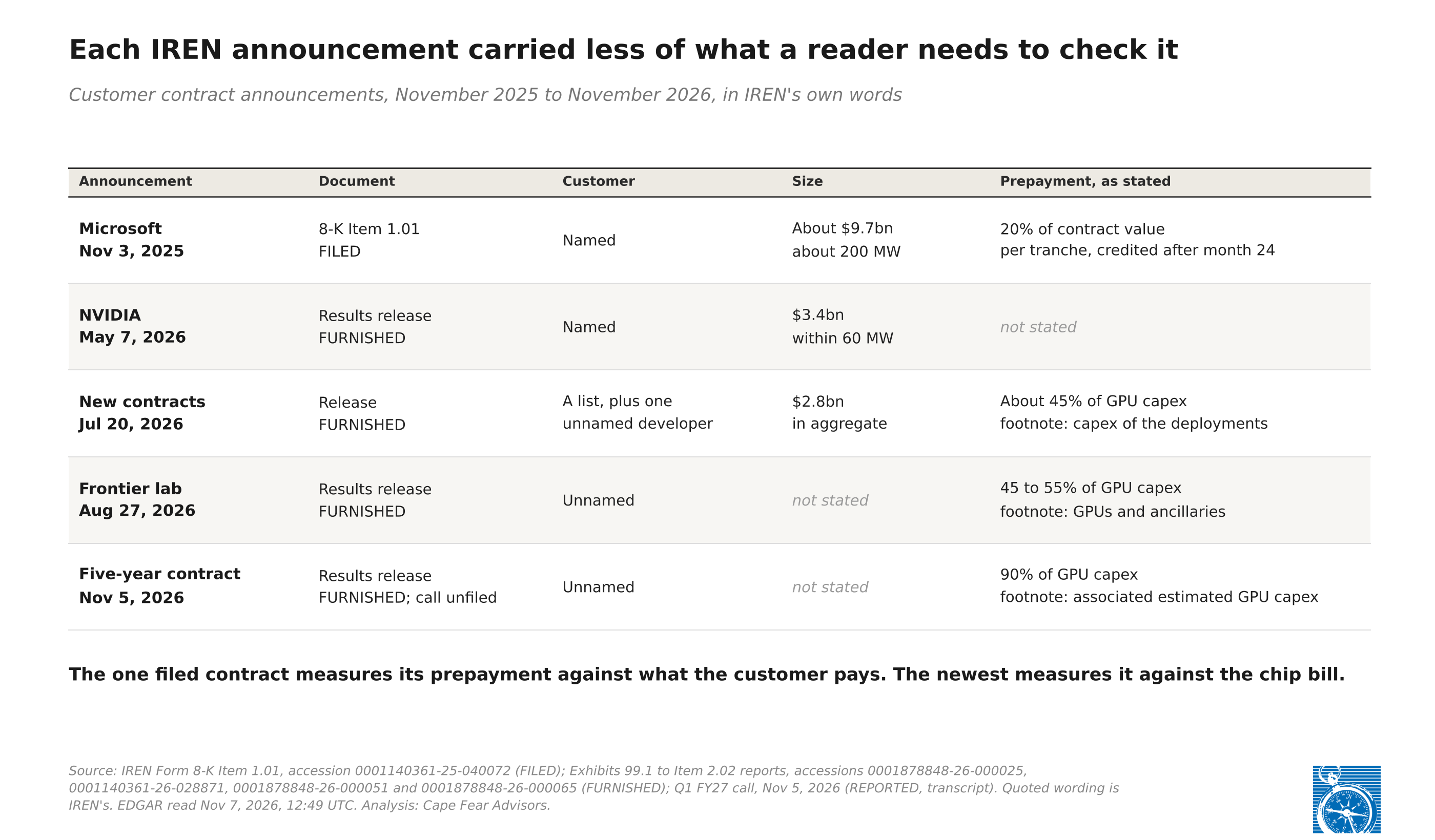
In May, IREN announced a $3.4 billion, five-year contract with NVIDIA in its quarterly release, naming the customer and the size, "within 60MW" at Childress, with no prepayment stated. In July, a release announced $2.8 billion of new contracts "with leading AI developers," beside a customer list that included "a new leading AI developer," unnamed, and prepayments of "approximately 45% of the associated GPU capital expenditure." In August, the annual results release announced "a new multi-year AI Cloud contract with a leading frontier AI lab," with no value, and prepayments of "45-55% of GPU capex." In November came the 90%, with neither customer nor size. (10)
The base moved inside the footnotes. July's footnote measured prepayments against "the estimated capital expenditure attributable to the associated deployments." August's measured them against "estimated capital expenditure for GPUs and ancillaries." November's measures against "associated estimated GPU capex." That is three wordings in under four months, each defined, and each different from the one filed contract's. (10)
The document moved too. The Microsoft contract is in a current report under Item 1.01, a filed document. The four announcements after it are in releases furnished as exhibits to results reports, which sit outside the liability that attaches to filed statements. IREN furnished the transcript of its May call as an exhibit; no transcript of the August or November call is on EDGAR. The 10-Q filed the same day as the November release does not mention the new contract, which was signed after the quarter. (11)
A current report naming the customer and the value would settle every question here. IREN filed one for Microsoft. As of Saturday morning, none has been filed for this contract. (11)
What the call adds
The call fills in the surroundings of the 90% and leaves the contract itself as it was.
The chief executive placed the signing in the week of the call: "We just had a customer agree to fund 90% of the GPU CapEx." He listed it separately from "one of the leading frontier AI labs" expanding its capacity. The chief financial officer described recent prepayments as "up to 90%." (12)
He also set out a funding target: "Across the portfolio, we are targeting total financing for GPU CapEx, including prepayments, of 90% of associated GPU CapEx," against "circa 95% and greater than 100%" on the earlier investment-grade and non-investment-grade financings. IREN's own releases count the two kinds of money together. In August, the Microsoft program's loan "together with prepayments, funds 96% of associated GPU capex," and the Mackenzie loan "together with customer prepayments, provides funding in excess of GPU capex." The lender's money and the customer's money are stated as shares of one bill and added. The 10-Q books them differently: prepayments with a significant financing component now carry interest in finance expense. (13)
On the new contract, the customer's prepayment alone equals the portfolio target. The release says nothing about a loan beneath it.
Asked by Cantor Fitzgerald whether IREN favored investment-grade customers or those "prepaying for the entirety of the CapEx in some cases," the chief executive answered that two-thirds of the backlog is investment grade, "Microsoft, NVIDIA," and that "there is a portion that is a lower credit, but they tend to go hand in hand with higher prepayments." That is a general statement about the book, made on the call, and the customer behind the 90% is not named. (14)
Two analyst questions went unanswered in the recorded replies. Goldman Sachs asked whether customers could "exit any leases or get any of their kind of GPU deposits back" after a long delay; the reply on that point addressed community relations and siting. Macquarie asked about "the tenant responsibility to cover any change orders" on Microsoft's network redesign; the answer was that the added spend is "entirely immaterial." (15)
Does the answer fit the question
Oracle supplied the week's second lesson, of a different kind.
On September 10, Oracle's co-chief executive Clay Magouyrk told analysts: "Of all the GPUs that came up for renewal in Q1, that capacity was renewed or resold at a 20% premium to prior contracts." He added that "the majority of those GPUs are 4 years or older." (16)
On Friday, Bloomberg reported that Microsoft is "winding down an arrangement to rent AI computing from Oracle," and had been "turning off rented computing capacity from Oracle in recent months after declining to renew the contract," because it "no longer met Microsoft's evolving needs" on older Nvidia chips. Bloomberg could not determine the arrangement's size. (17)
Oracle answered the same day: "Demand for OCI's AI infrastructure remains strong, including for earlier-generation GPUs. As Clay shared on our latest earnings call, GPU capacity that came up for renewal in Q1 was renewed or resold at a 20% premium to prior pricing for long-term contracts." The phrase "for long-term contracts" does not appear in the September remark. (18)
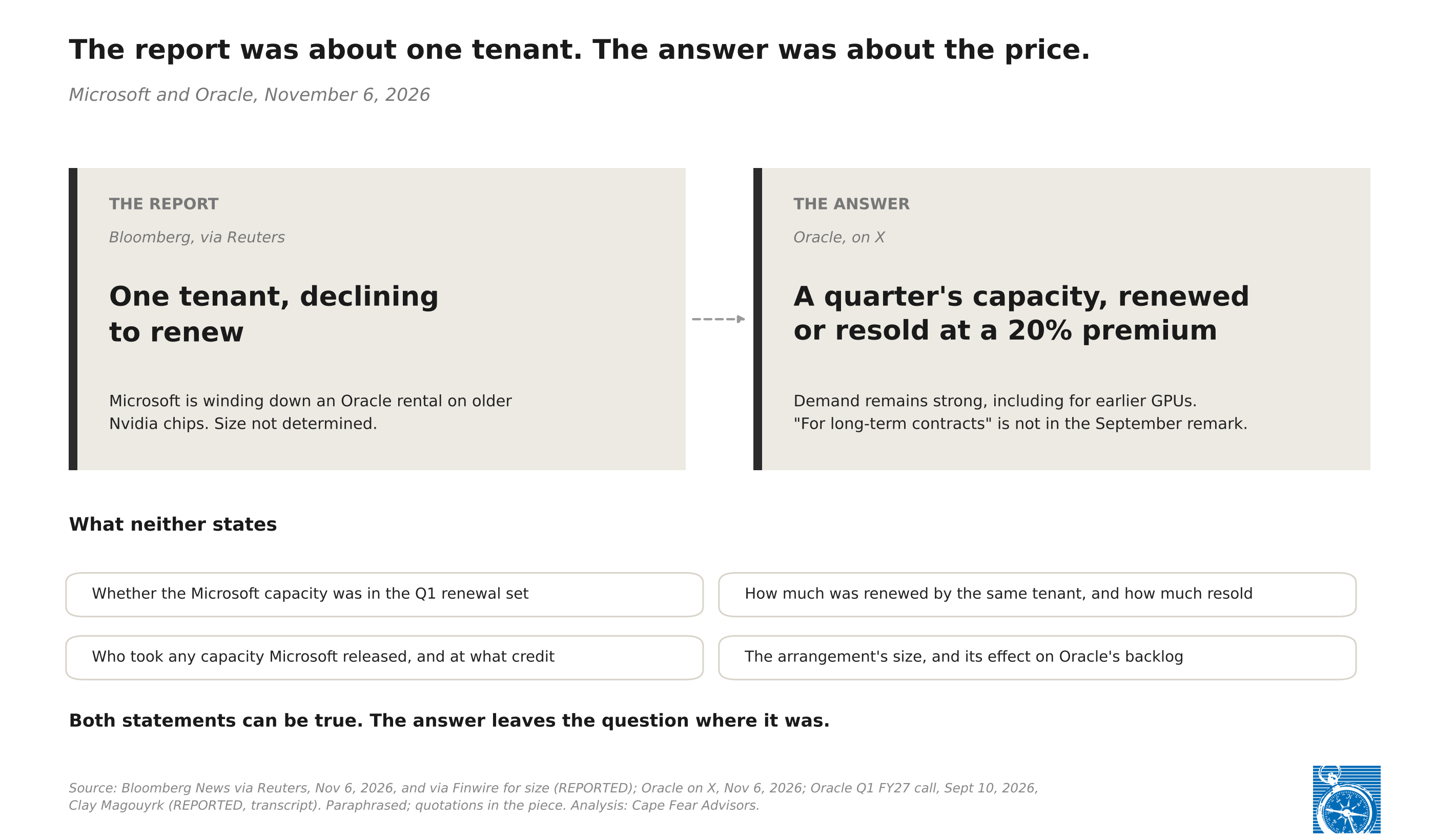
The report concerned one tenant and one contract. The answer concerned the price of capacity across a quarter, with renewals and resales counted together. Both can be true at once, and the answer leaves the question where it was: whether Microsoft's capacity was in that renewal set, who took any capacity Microsoft released, at what credit, and what it does to Oracle's backlog. None of that is on the record, and this piece makes no estimate of it. (19)
The two cases rhyme from opposite ends. IREN's figure keeps the word and changes the base. Oracle's answer keeps the price and leaves out the tenant. In each, the number on offer can be accurate, and the thing a reader needs to judge it sits somewhere else.
Two questions for any AI headline
The September piece asked what each announced figure measured. These two follow from it.
First, what is it a percentage of? A prepayment, a margin or a growth rate means what its base means, and the base can change from one release to the next while the word stays the same. The filed contract is the place to find a base that holds still.
Second, does the answer fit the question? A statement about a portfolio, offered in reply to a report about one contract, can be accurate and still be about something else.
The filings that settle this week's figures are scheduled. IREN's December-quarter 10-Q, due in February, carries the backlog that will include the new contract, and the deferred revenue that will show its prepayment. Oracle's November-quarter 10-Q, due in December, carries its remaining performance obligations and prepayments. Microsoft's December-quarter 10-Q, due in late January, carries the $364.6 billion of leases it had signed and not yet started at September 30. (20)
Free to read, no paywall. Readers who find the work useful can support it at the foot of the page; payment offsets the time and buys no access. Corrections run in daylight, dated, in a comment or in the following piece, and a reader who finds one is doing us a favor.
Standing Disclosure
Cape Fear Advisors holds no direct position, long or short, in the securities discussed here. Any exposure is indirect, through managed funds it does not control, which may include index funds holding the public companies named.
Anthropic, a subject of our coverage, is the developer of Claude, which we use in preparing our work. That nearness cannot be checked away, which is why no claim here rests on trust in the tool: every figure carries a public source and every derived figure carries its inputs in the notes. Figures are quoted from the filers without characterization, and the same standard of reading is applied to every filer named. The author's operating business works in advertising measurement.
Notes
[1] "Adding It Up: How to Read an AI Headline," September 30, 2026. FURNISHED: IREN Limited Form 8-K, Item 2.02, Exhibit 99.1, accession 0001878848-26-000065, November 5, 2026.
[2] REPORTED: daily closing prices, Yahoo Finance chart data, read November 7, 2026. IREN $40.88 (September 30), $21.71 (November 4), $18.03 (November 5), $21.64 (November 6). September 30 to November 6: CoreWeave $87.12 to $46.40; Nebius $235.88 to $129.49; Cipher $15.82 to $6.55; Core Scientific $15.98 to $11.76; TeraWulf $14.80 to $11.37; Oracle $137.30 to $116.10; NVIDIA $228.38 to $186.64; Microsoft $512.90 to $530.61; Nasdaq Composite 26,861.06 to 24,579.43. OURS: percentage changes. IREN's daily moves of 8% or more from October 14 to November 6: October 14, 16, 22, 29 and 30, and November 2, 3, 4, 5 and 6. Microsoft is a named customer in IREN's Form 8-K per note (4), in Nebius's Form 6-K of September 8, 2025, and among "other significant customers" in CoreWeave's risk factors; its Oracle arrangement is REPORTED per note (17).
[3] REPORTED: Investing.com, "Cantor Fitzgerald cuts IREN stock price target on delayed timeline," November 6, 2026. BTIG ($80 to $65), Macquarie ($90 to $55), HC Wainwright ($74 to $56) and Goldman Sachs (Neutral, $30) as carried by TradingView and ad-hoc-news, November 6, 2026; the primary notes were not read. The Motley Fool, "Stock Market Today, Nov. 6: Iren Soars 20%," November 6, 2026.
[4] FILED: IREN Limited Form 8-K, Item 1.01, accession 0001140361-25-040072, November 3, 2025. The GPUs are NVIDIA GB300s.
[5] OURS on FILED: 20% of contract value over a five-year average term is about one year of fees on level billing. FILED: Microsoft upfront payment $1,932.8 million, IREN Form 10-K for the year ended June 30, 2026, accession 0001878848-26-000052; OURS: $1,932.8 million over $5.8 billion is 33.3%; 90 over 33.3 is 2.70.
[6] FURNISHED: release per note (1), highlights and footnote 7.
[7] REPORTED: IREN Q1 FY27 earnings call, November 5, 2026, Anthony Lewis, chief financial officer, transcript as published by The Motley Fool. OURS: $60 million times two-thirds is $40 million; 90% of that is $36 million; $22 million times five is $110 million; $36 million over $110 million is 32.7%, and over $22 million is 1.64 years. The hypothetical is IREN's and IREN calls it illustrative. A lower GPU cost per megawatt lowers the share, and a higher one raises it.
[8] FURNISHED: release per note (1), footnote 7. REPORTED: call per note (7): "During the quarter, 3-year pricing was at $19 million to $23 million per megawatt of IT load and 5-year pricing at approximately $17 million."
[9] FILED: 10-Q per note (11), Recent Developments ("Horizon 1 was delivered to and accepted by Microsoft in August 2026"). FURNISHED: release per note (1) ("approximately two-thirds with investment-grade counterparties").
[10] FURNISHED, each an Exhibit 99.1 to a Form 8-K under Item 2.02: May 7, 2026, accession 0001878848-26-000025 ("5-year contract for air-cooled Blackwell GPUs"; "Deploying within 60MW of existing data centers at Childress"); July 20, 2026, accession 0001140361-26-028871, and its footnote 3 ("agreements executed since June 1, 2026"); August 27, 2026, accession 0001878848-26-000051, and its footnote 4; November 5, 2026, per note (1), footnote 7. The NVIDIA contract is also described in the Form 10-K per note (5).
[11] FILED: Form 8-K per note (4). FURNISHED: releases per note (10); each Item 2.02 report states that the information "shall not be deemed to be 'filed' for purposes of Section 18 of the Securities Exchange Act of 1934... or otherwise subject to the liabilities of that section" (November 5 report per note (1)). FURNISHED: May 8, 2026 call transcript, Form 8-K Exhibit 99.1, accession 0001878848-26-000028. FILED: IREN Form 10-Q for the quarter ended September 30, 2026, accession 0001878848-26-000066, no mention of the contract (search November 5 and 6, 2026). EDGAR submissions read November 7, 2026, 12:49 UTC: IREN's filings since November 5 are the 10-Q and the Item 2.02 report; no other current report, and no transcript for the August 27 or November 5 calls.
[12] REPORTED: call per note (7), Daniel Roberts, co-chief executive, in the question-and-answer session; Lewis, prepared remarks.
[13] REPORTED: call per note (7), Lewis. FURNISHED: August 27 release per note (10), highlights. FILED: 10-Q per note (11), notes to the financial statements (significant financing components on customer prepayments) and MD&A (finance expense).
[14] REPORTED: call per note (7), Brett Knoblauch, Cantor Fitzgerald, and Roberts in reply.
[15] REPORTED: call per note (7), Michael Ng, Goldman Sachs; Roberts and Kent Draper in reply. Paul Golding, Macquarie; Roberts in reply.
[16] REPORTED: Oracle Corporation Q1 FY27 earnings call, September 10, 2026, as carried by The Motley Fool, September 11, 2026, and the gloom.sh transcript.
[17] REPORTED: Bloomberg News, November 6, 2026, as carried by Reuters, "Microsoft is winding down Oracle deal to rent AI cloud capacity, Bloomberg News reports"; the size point as relayed by Finwire, November 6, 2026.
[18] Oracle, @Oracle on X, November 6, 2026, read November 7, 2026; Reuters per note (17) carries the first sentence as a spokesperson's statement.
[19] OURS. Oracle's filings and Microsoft's filings were not found to state the arrangement's terms; Bloomberg reports its size as undetermined.
[20] FILED: Microsoft Corporation Form 10-Q for the quarter ended September 30, 2026, accession 0001193125-26-436133, leases not yet commenced.
Analysis: Cape Fear Advisors.
This piece also appears on Substack. Cape Fear Advisors is an independent advisory firm based in Portsmouth, NH.
Contact Cape Fear Advisors