


On October 20 SpaceX raised its compute target to 13 gigawatts or more by the end of 2027, moved its trillion from 2030 revenue to an end-2027 run rate, put Terafab chips in volume in 2028, and dated new constellations from 2027. Set against the $430 billion we added up in August, the one row that closed, Cursor, closed in shares, and the rest stand, now joined by new ones with dates and no prices. The sequence is the same wherever the adjectives point: the capital goes out first, the capacity follows, and the revenue follows the capacity.
This shelf has added up what SpaceX has said it will build against the cash it holds since May: $235 billion in May, $400 billion in early August, and $430 billion on August 29. The third quarter is the first full quarter of public results, and the call that came with it raised the targets again.(1)
The title’s word is ours. The one figure on the call with an adjective attached came with the speaker’s own. After the chief executive set annualized revenue at “somewhere between $500 billion and $1 trillion” by the end of 2027, he handed over “on that crazy note,” and added that he did not want “to give Bret a heart attack.” Bret Johnsen is the chief financial officer.(2) [REPORTED] In August the trillion was revenue in 2030. On October 20 it was annualized revenue at the end of 2027: three years earlier, and on a run-rate measure, which for a growing business reads higher than the year’s revenue.(14)
The ladder, as spoken
The call set out a capacity ladder in steps, each with its own degree of confidence.(2) [REPORTED]
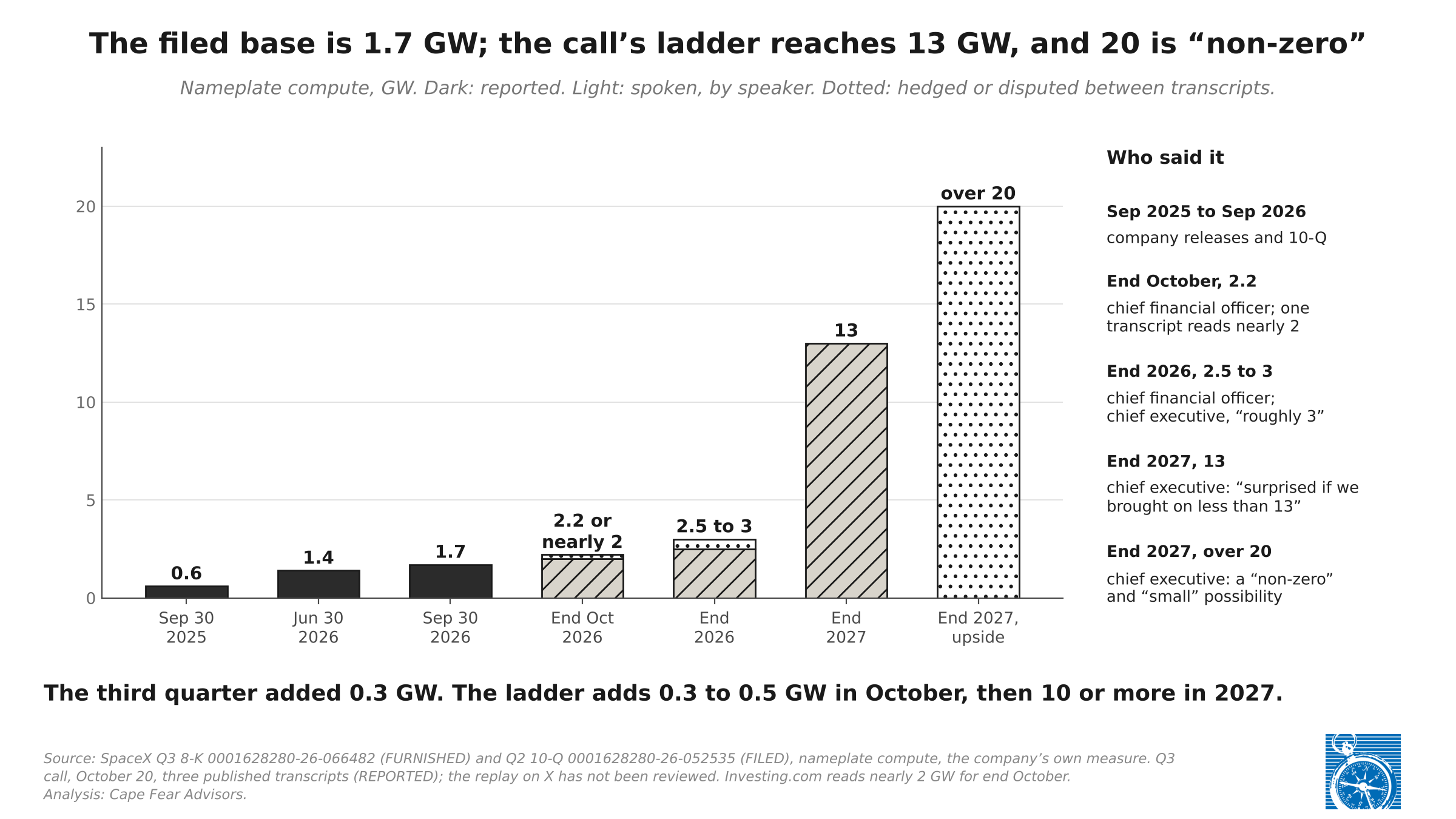
- End of October: “nearly 2.2 gigawatts of nameplate compute,” from the chief financial officer.
- End of 2026: “roughly 3 gigawatts,” maybe 2.5 to 3.
- 2027: “highly confident of 10 gigawatts incremental,” and “surprised if we brought on less than 13 gigawatts of compute by the end of next year.”
- Beyond that: a plan for 20 gigawatts of incremental power and cooling, which he called difficult but not impossible, and a “non-zero possibility,” described in the same breath as “a small possibility,” of more than 20 gigawatts of compute online next year.
The filed base is 1.7 gigawatts at September 30.(3) [FURNISHED] The quarter added 0.3 gigawatts. The ladder adds 0.3 to 0.5 gigawatts in October alone, depending on the transcript, then 10 or more in 2027.
Nameplate compute is the company’s own measure. The second-quarter 10-Q defines it as the GPUs installed at period end times their all-in power draw, leaving out cooling, power losses and other facility load.(8) It sits outside the audited statements and is specific to SpaceX, so it compares cleanly with itself, quarter on quarter, for as long as the definition holds. The release relabels it from “nameplate compute draw” to “nameplate compute,” and the definitional changes it lists in its notes leave this one out.(3)
Two figures on the ladder differ between transcripts, and they bear on each other. All three published transcripts we read carry “roughly 200,000 GB300s online per month” in the prepared remarks. In the answer to JPMorgan, two read 220,000 a month and one reads 20,000. For the end of October, two read 2.2 gigawatts and one reads nearly 2. On our arithmetic, at 1.4 to 2.0 kilowatts per processor all-in, 200,000 to 220,000 processors a month is 0.28 to 0.44 gigawatts. That rules out 20,000, and it fits the step to nearly 2 gigawatts more closely than the step to 2.2.(4) [REPORTED; OURS] The replay, posted as a broadcast on X, is the primary record.
In space, no one can hear the safe harbor language
The release lists, among its forward-looking statements, “the amount and timing of our annualized revenue run-rate” and the “ability to expand nameplate compute,” and the webcast opened with the standard caution.(3)(2) Every target above arrived labeled. The labels speak to liability. The cost of building to the targets is a separate matter, and it is arithmetic.
What the ladder costs
Two bounds on the cost of a gigawatt, both struck on SpaceX’s own figures.(5) [OURS on FILED and FURNISHED]
- A floor of $22.5 billion per gigawatt, the company’s own fourth-quarter guide at its lowest reading: the low end of the dollars, at the third quarter’s SI share, over the high end of the gigawatts.
- A ceiling of $34.5 billion, being cumulative AI and SI capital expenditure of $58,818m through September 30 over 1.7 gigawatts, floored. It overstates, because it includes capacity still under construction.
The guide itself, on total capital expenditure, spans the ceiling. Capital expenditure of $35 billion to $40 billion for the fourth quarter, for the 0.8 to 1.3 gigawatts that take the fleet to 2.5 to 3, comes to $26 billion to $50 billion a gigawatt. The guide in August was “very similar” to the second quarter’s $18.4 billion. The third quarter came in at $19.6 billion.(2)(3)(14) [GUIDED; FURNISHED]
Set beside our neocloud work, the floor runs low and the ceiling sits inside the range. Our Nscale reading carries $28.1 million of equipment per IT megawatt on the filed commitments, and about $37 million all-in at Monarch. The CoreWeave exhibit in a Goldman Sachs note we read this week carries $30 million, the same order as our CoreWeave reading.(13) The units are close and not identical. SpaceX’s floor sits a fifth to nearly two-fifths below those figures, consistent with the company’s account of its build speed and of power brought in-house, down to turbine blades it casts itself.(2) Two items keep it a floor rather than a measured cost. Payables rose $5.0 billion in the quarter, and in the first half $3.9 billion of equipment arrived through other financings, the line that carries the Valor leases, outside the capital expenditure line.(3)(8) [OURS on FILED, FURNISHED and REPORTED]
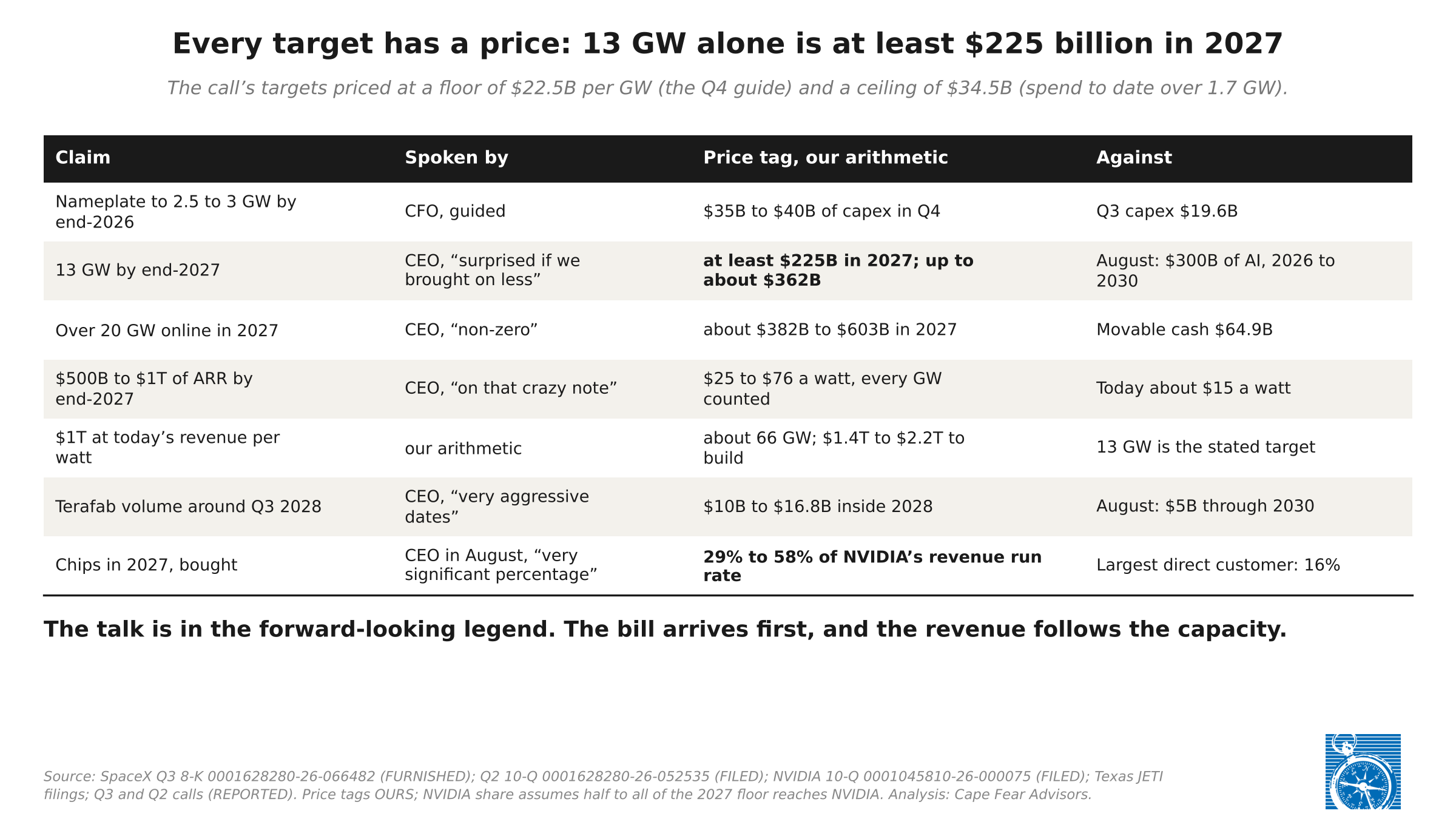
At the floor, 13 gigawatts by the end of 2027 costs at least $225 billion of compute capital expenditure in 2027 alone. That is 10 to 10.5 gigawatts of additions at $22.5 billion each. At the ceiling it is about $362 billion. More than 20 gigawatts, the “non-zero possibility,” is about $382 billion to $603 billion.(5) [OURS]
And the revenue the targets imply. SpaceX’s SI solutions and infrastructure revenue, excluding Cursor’s first half quarter, annualizes to about $25.7 billion on 1.7 gigawatts: about $15 a watt across the whole fleet.(3)(5) [OURS on FURNISHED] The chief financial officer put current pricing on new deployments “slightly above the high end of the $30 to $50 per watt range,” and the chief executive set the target split at about half the compute used internally and half rented.(2) [REPORTED] $500 billion to $1 trillion on 13 to 20 gigawatts is $25 to $76 a watt, across every gigawatt, the internal half included.(5) [OURS] At today’s $15 a watt, $1 trillion takes about 66 gigawatts, a build of $1.4 trillion to $2.2 trillion at the two bounds.
The chips come first, and they are bought
Terafab and the NVIDIA purchases sit in different states on the record. The fab is a spoken schedule and a set of state tax applications. The chips are capital expenditure already paid. The call put volume at Gibbons Creek “around Q3 of ‘28,” with “very aggressive dates,” so the 2027 ladder is built on bought chips, at NVIDIA’s prices.(2) [REPORTED] In August the chief executive said SpaceX would “receive a very significant percentage of NVIDIA’s GPUs next year.“(14) [REPORTED]
The arithmetic gives that phrase a size. NVIDIA’s quarter to July 26 carried $96,221 million of revenue, about $385 billion a year at that rate, and its largest direct customer took 16 percent of it.(15) [FILED; OURS] If half of the $225 billion 2027 floor reaches NVIDIA, SpaceX alone is 29 percent of that run rate. If all of it does, 58 percent.(5) [OURS] Either end is well above NVIDIA’s largest direct customer today. NVIDIA’s revenue will have grown by 2027, which lowers the share, and SpaceX discloses no split of its spending between chips and everything around them, which is why this is a range.
Terafab’s own price moves forward with the schedule. The state applications put Phase 1 at $10.37 billion; the company’s August announcement put the initial phase at $16.8 billion. The applications also put $176 million of property on the ground in 2027 and $4.2 billion in 2028.(6) [FILED locally; REPORTED] Volume by the third quarter of 2028 brings about $10 billion to $16.8 billion inside 2028, against the $5 billion through 2030 in our August count.(5) [OURS] Until then the company pays for both: the fab, and the chips the fab exists to replace.
The first test chip comes earlier and elsewhere: an SRAM chip to test the line, at “the research fab in Austin,” in “approximately May or June of next year,” with thanks to ASML and other suppliers “in accelerating equipment deliveries.“(2) [REPORTED] The first ASML extreme ultraviolet tool for Terafab’s development facility is reported for the middle of 2027, with that building’s shell finishing later in the year; the reporting leaves its location unstated. A search of Tesla’s and SpaceX’s filings and of the trade press on the morning of October 21 found no record placing an extreme ultraviolet tool in Austin.(16) [REPORTED]
The stack, rewritten
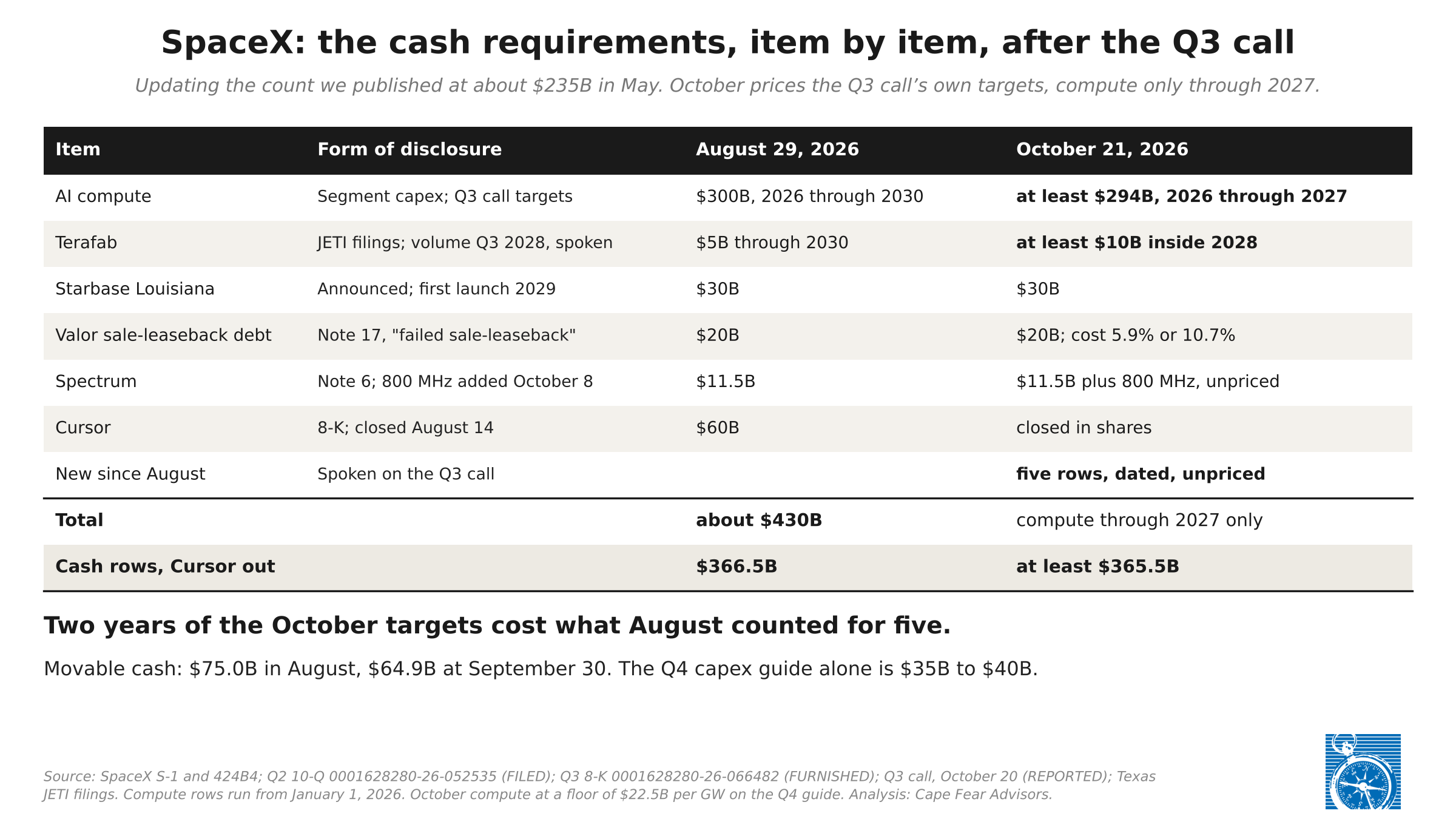
August’s count was cash to be deployed through 2030, in six rows.(1) Here it is with the quarter and the call set beside it. Each row keeps its August figure and gains an annotation.
| Row | August 29 | After the third quarter and the call |
|---|---|---|
| AI compute, 2026 through 2030 | $300,000m | at least $294,000m by the end of 2027 alone, being $39,995m spent in nine months, about $29,300m to $33,500m guided for the fourth quarter, and at least $225,000m for 2027 |
| Cursor | $60,000m | closed August 14, in shares |
| Starbase Louisiana | $30,000m | stands; first launch “targeted for 2029,” internal aspiration 2028 |
| Valor | $20,000m | stands; its cost is a switch, below |
| Spectrum | $11,500m | stands, with an 800 MHz purchase added, unpriced |
| Terafab | $5,000m | at least $10,000m inside 2028 |
(3)(5)(7) [FURNISHED; REPORTED; OURS]
Cursor’s row closed the way August said it would: “dilution, not cash.” The rest held. Without Cursor, the cash rows came to $366.5 billion in August, with five years of compute. Counting only two years of compute on the call’s own ladder, they come to at least $365.5 billion, within a billion of August’s five-year count, before any compute spending in 2028, 2029 or 2030.(5) [OURS]
And five rows arrived with dates and no prices.(2) [REPORTED]
- Mobile V2 satellites, with approval for 15,000, flying from 2027.
- Starmind satellites from 2027.
- Starlink at about 100 times today’s bandwidth, on “the order of 100,000 satellites,” within about three years.
- 20 gigawatts of power and cooling against 10 gigawatts of compute.
- The orbital compute the prospectus dated to 2028.
The largest item is Tesla
The largest number the call touched sits in no row of the stack. The chief executive said both boards had formed special committees “to discuss this idea at the request of shareholders,” that “the special committees have not reached agreement on the terms of any transaction,” and that there is “no guarantee that they will.” Assuming a combination will happen, he said, “would be overstating it.” It “will need a 50% vote of all shares, not just those who vote,” which is what Tesla’s certificate of formation provides.(2)(17) [REPORTED; FILED]
At prices on the morning of October 21, Tesla’s equity is valued at about $1.48 trillion and SpaceX’s at about $2.0 trillion.(18) [OURS on REPORTED and FILED] SpaceX’s movable cash is about 4 percent of Tesla’s value, so a combination at these sizes is paid in stock, by arithmetic. Tesla already holds $2.00 billion of SpaceX Class A shares, bought in March. Its proxy, filed the day before the call, describes no committee on a SpaceX transaction, and its December 3 ballot carries none.(11) [FILED]
On August’s fungibility test, restricted money reaches only the project that raised it, and only future equity issuance and a Tesla combination produce money the company can point anywhere.(1) The committees put a process under the second, without terms.
The quarter, credited
The chief financial officer guided third-quarter capital expenditure in August as “very similar” to the second quarter’s $18.4 billion, and it came in at $19.6 billion. His forward figures on this call run to the first quarter of 2027. The 2027 ladder, the $500 billion to $1 trillion and the Terafab dates came from the chief executive.(2)(14) [GUIDED; FURNISHED; REPORTED] Net income was $4.4 billion. Operating income was $2.8 billion after $1.2 billion of stock compensation tied to Cursor. Cash and marketable securities fell $10.2 billion, against $17.3 billion of net consumption in the second quarter.(3) [FURNISHED; OURS]
The cash that came in is real, and most of it arrived through items that recur at a lower rate, or reverse.(5) [OURS on FURNISHED]
- Customer prepayments: deferred revenue added $2.75 billion to operating cash flow, money paid ahead of service that becomes revenue later without new cash.
- One-time margin: the chief financial officer guided fourth-quarter gross margin back toward the second quarter’s, citing one-time benefits and customer mix in the third quarter, including tariff refunds of about three points of Connectivity margin.(2) Gross margin moved from 55.3 percent in the second quarter to 62.4 percent in the third, about $1.0 billion of gross profit on third-quarter revenue.
- Cursor: $514 million of cash came with it.
- The first coupon on the $25 billion of June notes falls on January 15, 2027, about $809 million, accrued and unpaid at September 30.(8) [FILED; OURS]
Taking out only what the company itself called one-time, the Cursor cash and the prepayments, the quarter consumed at least $14.4 billion.(5) [OURS] Recurring earning power, on adjusted EBITDA of $8.8 billion less the one-time margin, is about $7.8 billion a quarter, about $31 billion a year. The quarterly figure covers about a fifth of the fourth-quarter capital guide; the annual figure, more than an eighth of the 2027 floor.
The margins are being managed well. The order of events is the one August described.
Sources, at the September 30 line
Movable cash is $64.9 billion, being $89.9 billion of cash and marketable securities less the $25 billion Fitch’s June rating rested on, a figure that sits in the agency’s rating action and in none of the filed debt documents we have read.(3)(9) [FURNISHED; REPORTED] The fourth-quarter guide uses 39 to 46 percent of it in one quarter, on operating cash flow like the third quarter’s, leaving about $35 billion to $40 billion at the end of 2026.(5) [OURS]
On funding, the chief financial officer named “a number of available pools of debt capital that we are talking to,” operating cash flow “first and foremost,” and partners across “the vendor and customer side,” and committed to “keep ourselves in that IG status.” No amount, lender or structure was named.(2) [REPORTED] The reported $40 billion chip financing is restricted to the AI row and had not been drawn at September 30: financing activities were a net outflow of $472 million in the quarter.(3)(10) [REPORTED; OURS on FURNISHED]
Valor’s cost is a switch. The second-quarter 10-Q gives other financings, the line that carries the Valor leases, an average fixed rate of 5.9 percent. The related-party interest line comes to about 10.7 percent annualized on the third quarter’s balances. On $12.9 billion the two readings are about $0.76 billion and $1.40 billion a year.(3)(8) [FILED; FURNISHED; OURS] The quarterly report should say which applies.
What would change the reading
Each item is a document with a date.
- The third-quarter 10-Q. In the second quarter it came out with the release on the same day. This quarter it is not on EDGAR as of 11:43 am Eastern, October 21, about 20 hours after the release.(12) It carries purchase commitments against the 13 gigawatt ladder, the $5.0 billion of payables, the Valor rate, and remaining performance obligations against the $63 billion of backlog spoken on the call.
- Tesla’s third-quarter results, tonight, October 21. Whether Tesla’s side confirms the committees, and whether “our Terafab initiative” repeats.
- Any Rule 425 filing or Form 8-K from either company. The first filed page of a combination.
- NVIDIA’s third-quarter results, in November. Whether a customer of the size above shows in its concentration disclosure.
- January 15, 2027. The first coupon on the June notes.
- SpaceX’s fourth-quarter results, early 2027. Capital expenditure against the $35 billion to $40 billion guide, December’s revenue against $100 billion of ARR, and nameplate against 2.5 to 3 gigawatts.
- May or June 2027. The first Terafab test chip, and any filed Terafab commitment or schedule.
This shelf prints the answer either way.
Free to read, no paywall. Corrections run in daylight, dated, in a comment or in the following piece.
Standing Disclosure
Cape Fear Advisors’ principal holds a small long position in Tesla call options, held since earlier in 2026, and no other position in the securities discussed, other than any held through broad index or pooled funds over which he exercises no control. Anthropic, a SpaceX cloud customer, develops Claude, which is used in preparing this research. The same standard of reading is applied to every filer named.
Notes
(1) Cape Fear Advisors, “SpaceX, Adding It Up: The $430 Billion Cash Gap,” August 29, 2026, and the May and August pieces linked in the text. August stack, cash to be deployed through 2030, with the AI compute row on a 2026 through 2030 basis, the guided pace of about $63bn a year rounded down to $300bn, as recorded in our August 5 working note, so the October column counts compute from the same January 1, 2026 start: AI compute $300,000m, Cursor $60,000m, Starbase Louisiana $30,000m, Valor $20,000m, Spectrum $11,500m, Terafab $5,000m, footing to $426,500m. Movable cash $75,009m; net consumption $17,279m in the second quarter. The fungibility test is quoted from that piece. OURS.
(2) SpaceX third-quarter 2026 earnings webcast, October 20, 2026. Speakers: Andrea Williams, Elon Musk, Gwynne Shotwell, Bret Johnsen. The company’s event page links a broadcast on X, the release and a Q&A platform, and carries no transcript as of October 21. Quotations are checked across three published transcripts, Motley Fool, Benzinga and Investing.com, read October 21. Every quotation here appears in at least two of the three in the words printed. Where they differ, this piece paraphrases outside quotation marks. Two of the three give the “crazy note” line to the chief executive and Benzinga gives it to the chief financial officer; the piece follows the two. Investing.com reads “nearly 2 gigawatts” for the end of October, against 2.2 in the other two. The replay has not been reviewed. “Would be overstating it” as reported by DealBook (The New York Times), October 21, and in the transcript. REPORTED; forward figures by the chief financial officer GUIDED.
(3) SpaceX Form 8-K, Item 2.02, October 20, 2026, accession 0001628280-26-066482, Exhibit 99.1: segment revenue, operating income, capital expenditure and nameplate compute; consolidated statements of operations, balance sheet and nine-month cash flows; forward-looking statements legend; Note 2, other definitions. FURNISHED. Third-quarter cash flows are nine months less the six months in note 8. OURS.
(4) Prepared remarks: “roughly 200,000 GB300s online per month” in all three transcripts in note 2. Answer to Douglas Anmuth: 220,000 a month in Benzinga and Investing.com, 20,000 in Motley Fool. GB300 per-processor power of 1.4 to 2.0 kW all-in is our assumption, covering the processor with its share of networking, cooling and facility load. 200,000 to 220,000 a month over that range is 0.28 to 0.44 GW a month. The September 30 base of 1.7 GW to 2.2 GW is a 0.5 GW step; to nearly 2 GW, about 0.3. OURS.
(5) Our arithmetic on the inputs named in notes 2, 3, 6, 8 and 15. Cost per gigawatt: the floor of $22.5bn is $35,000m times 83.9 percent over 1.3 GW, $22.59bn floored. The ceiling of $34.5bn is cumulative AI and SI capex of $58,818m over 1.7 GW, $34.599bn floored: $463m (2023), $5,633m (2024) and $12,727m (2025) from the prospectus, plus $39,995m for nine months of 2026. The 2027 floor: 10 to 10.5 GW of additions at $22.5bn, at least $225bn. Over 20 GW: 17 to 17.5 GW of additions at $22.5bn and $34.5bn, $382bn to $603bn, floored. The Q4 guide per GW: $35bn over 1.3 GW is $26.9bn, floored to $26bn; $40bn over 0.8 GW is $50bn. Required revenue: $1T over 13 GW is $76.92 a watt, floored to $76. The stack through 2027: $39,995m plus $29,300m plus $225,000m is $294,295m, floored to $294,000m. With Louisiana $30,000m, Valor $20,000m, Spectrum $11,500m and Terafab at least $10,000m, the cash rows excluding Cursor are at least $365,500m, against $366,500m in August. Fourth-quarter SI share: 83.9 percent, the third quarter’s $16,444m of $19,593m. Revenue per watt: $7,022m less $608m, annualized, over 1.7 GW, $15.09. $1T over that is 66.3 GW; at $22.5bn and $34.5bn, $1,491bn and $2,286bn, floored to $1.4tn and $2.2tn. NVIDIA share: $225,000m, halved and whole, over $96,221m times four, 29.2 and 58.4 percent, floored. The halved case is an assumption for illustration. Recurring EBITDA: $8,809m less about $1,041m, being third-quarter consolidated revenue of $14,575m times the gross margin difference from the second quarter. Both margins are consolidated: cost of revenue of $5,478m on $14,575m (62.4 percent) in the third quarter and $3,495m on $7,814m (55.3 percent) in the second, each cost the sum of the three segments’ cost of revenue. Consolidated revenue rose 86.5 percent quarter on quarter, Cursor included from August 14. Adjusted consumption: $10,154m plus $2,753m, $1,041m and $514m, $14,462m, floored to $14.4bn. The Valor switch: $12,897m at 5.9 percent is $761m; $351m times four is $1,404m. 10.7 percent is $351m times four over the average of $13,329m and $12,897m. Needs and costs floored; cash and value rounded up.
(6) Texas JETI applications for the Grimes County site, as read in “The Terafab Record,” July 7, 2026: Phase 1 $10.37bn, initial phases $55bn, up to $119bn across four phases, and the by-year taxable-value schedule. FILED with the state. SpaceX website, August 6, 2026, “approximately $16.8 billion” for the initial phase. REPORTED.
(7) Cursor: GAAP purchase consideration $42.5bn and $23.4bn of awards attributed to post-acquisition service, Exhibit 99.1 (note 3), FURNISHED. Share count 391,041,680 as read in the August 29 piece. 800 MHz agreement, October 8, Exhibit 99.1.
(8) SpaceX Form 10-Q, quarter ended June 30, 2026, accession 0001628280-26-052535. FILED. The SpaceX Notes: $25,000m, weighted average coupon 5.855 percent, interest payable January 15 and July 15, first payment January 15, 2027. Note 9, Other Financings: average fixed interest rate of 5.9 percent at June 30, 2026, and the failed sale-leaseback debt with CTC Property. Note 17: Valor debt and related-party interest of $327m in the quarter. Supplemental non-cash disclosure: $3,921m of property and equipment financed by other financings in the six months. Key Business Metrics: the definition of nameplate compute draw. Six-month cash flows. The first coupon is OURS on a 30/360 accrual from June 26.
(9) Fitch rating action, June 18, 2026, as read in our August pieces. REPORTED. Our reading of the filed debt documents found no minimum-cash term; the one maintenance covenant found is a leverage ratio on the revolver (note 8).
(10) Financial Times, October 6, 2026, about $40bn of bank and investment-grade debt to buy NVIDIA chips; early stage. REPORTED.
(11) Tesla, Inc. definitive proxy statement, October 19, 2026, accession 0001104659-26-116700: every reference to a special committee concerns executive compensation; Tesla’s $2.00bn purchase of SpaceX Class A common stock completed March 12, 2026; the beneficial ownership table at September 30, 2026. FILED.
(12) EDGAR submissions record for CIK 0001181412, read at 11:43 am Eastern, October 21, 2026: the latest filing is the Form 8-K in note 3. Re-run before print. Second-quarter 8-K and 10-Q both August 4, 2026.
(13) Cape Fear Advisors, What the Price Believes: Nscale, release 1.0, October 20, 2026: equipment capex of $28.1m per IT MW on the filed non-Monarch commitments over 855 MW, and Monarch at $29.0m of equipment plus $8m of campus and power per IT MW. OURS on FILED. Goldman Sachs Global Investment Research on CoreWeave, one page as posted publicly on October 20, 2026, Exhibit 3: capex $30m per MW. REPORTED; the rest of the note is unread. Cape Fear Advisors, What the Price Believes: CoreWeave, release 1.0, October 17, 2026. SpaceX’s nameplate is GPU all-in draw; Nscale’s figures are per IT MW. SpaceX’s floor against $28.1m, $30m and $37m is about 20, 25 and 39 percent below. OURS.
(14) SpaceX second-quarter 2026 earnings call, August 4, 2026, as recorded in our August 5 notes: the chief financial officer’s third and fourth quarter capital expenditure “very similar” to the second quarter’s, and the chief executive’s “very significant percentage of NVIDIA’s GPUs next year.” REPORTED.
(15) NVIDIA Form 10-Q for the quarter ended July 26, 2026, accession 0001045810-26-000075, Note 7 and Concentration of Revenue, as read in “Terafab Is Stateless,” October 3, 2026. FILED.
(16) Tom’s Hardware, October 14, 2026, citing Tim Culpan of Culpium and SemiAnalysis estimates; Let’s Data Science, October 15, 2026, which states that the reports “do not establish a public order confirmation.” REPORTED. The Culpium source remains unverified at source. Tesla’s furnished first-quarter update describes “the Tesla-owned Research Fab on our Gigafactory Texas campus.” EDGAR full-text search of Tesla and SpaceX filings from January 1, 2026, run at 10:59 am Eastern, October 21: “EUV” 0 hits, “extreme ultraviolet” 0 hits, “research fab” 1 hit (Tesla’s update furnished April 22, 2026, accession 0001628280-26-026551). A web search the same morning on the trade press for EUV with Austin, Giga Texas and the research fab found no placement. The search records a failure to find, not a finding of absence.
(17) Tesla, Inc. Certificate of Formation, Exhibit 3.1 to the Form 10-Q for the quarter ended June 30, 2024, accession 0001628280-24-032662: a majority of the shares entitled to vote then outstanding is sufficient for any action, “including any ‘fundamental business transaction’.” FILED. Tesla’s Form 10-K description of securities, Exhibit 4.17, accession 0001628280-26-003952, also states that Tesla is subject to Section 21.606 of the Texas Business Organizations Code, which can require two-thirds of the shares an affiliated shareholder does not own for a business combination within three years. Whether it reaches a SpaceX combination is for the parties’ counsel and is not read here.
(18) Share prices as displayed at about 10:30 am Eastern, October 21, 2026: Tesla $373.71, SpaceX $147.79. REPORTED. Shares outstanding: Tesla 3,952,648,559 at September 30 (note 11, FILED); SpaceX 8,240m Class A and 5,339m Class B at September 30 (note 3, FURNISHED). $64,855m over $1,477bn is 4.39 percent. OURS.
Analysis: Cape Fear Advisors.
This piece also appears on Substack. Cape Fear Advisors is an independent advisory firm based in Portsmouth, NH.
Contact Cape Fear Advisors