

In March, OpenAI closed its largest round: $122 billion committed at an $852 billion valuation. The company announced the total, and each lead investor detailed its own piece in its own filing. Read across those filings, the $122 billion resolves into four commitments on four sets of terms. Amazon’s $50 billion arrives as $15 billion now and $35 billion tied by contract to a cloud agreement. NVIDIA’s $30 billion is equity, paired with a separate purchase of its systems. SoftBank’s $30 billion runs through a fund, subject to closing conditions. A broader pool of about $12 billion completes the total. At least $35 billion is contingent, and the dollar figures carry a cash-and-services split the round leaves to the filings. One reference point runs through these terms, the company’s public listing, filed for confidentially on June 8. This is where the round stands, what the filings say, and what the S-1 will settle.
Where the round stands
OpenAI announced the round on February 27 at $110 billion and closed it on March 31 at $122 billion committed, an $852 billion post-money valuation. The company named SoftBank as co-lead, alongside a16z, D. E. Shaw Ventures, MGX, TPG, and accounts advised by T. Rowe Price, and reported more than $3 billion raised from individual investors through bank channels. OpenAI named the three anchor amounts; each investor’s own filing set out the terms behind its piece.
Amazon committed $50 billion: $15 billion at the close, and $35 billion that arrives, in the companies’ words, ‘in the coming months when certain conditions are met.’ The filing behind the round states the rest. The $35 billion is callable on five business days’ notice, and it is tied to the cloud agreement that accompanies it. If that agreement ends, the $35 billion obligation ends with it. Alongside the equity, OpenAI agreed to consume about two gigawatts of Amazon’s Trainium capacity.
NVIDIA committed $30 billion as equity at the close, a straight stake in place of the September 2025 letter of intent, which would have paid in up to $100 billion as OpenAI deployed its systems. Alongside the equity, OpenAI committed to about five gigawatts of NVIDIA’s Vera Rubin systems.
SoftBank committed $30 billion through Vision Fund 2, subject to customary closing conditions, financed initially through bridge loans and replaced over time through asset sales. Upon completion, its cumulative stake is expected to reach about $64.6 billion, near 13 percent. By SoftBank’s own terms, the closings accelerate if OpenAI lists.
A broader pool of about $12 billion completes the round, the $122 billion less the three anchor checks.
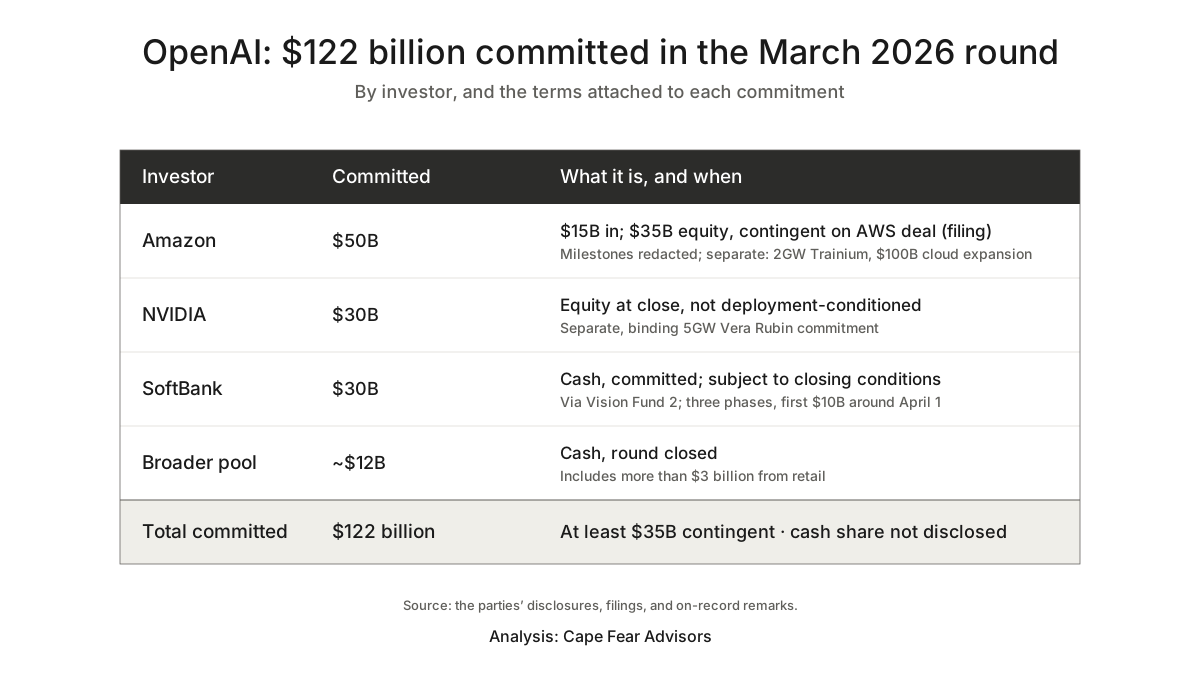
The total is $122 billion committed. At least $35 billion of it is contingent. The dollar figures are disclosed; the split between cash and services behind them stays with the company.
The lead chair moved
The lead on OpenAI’s rounds has changed hands since 2019.
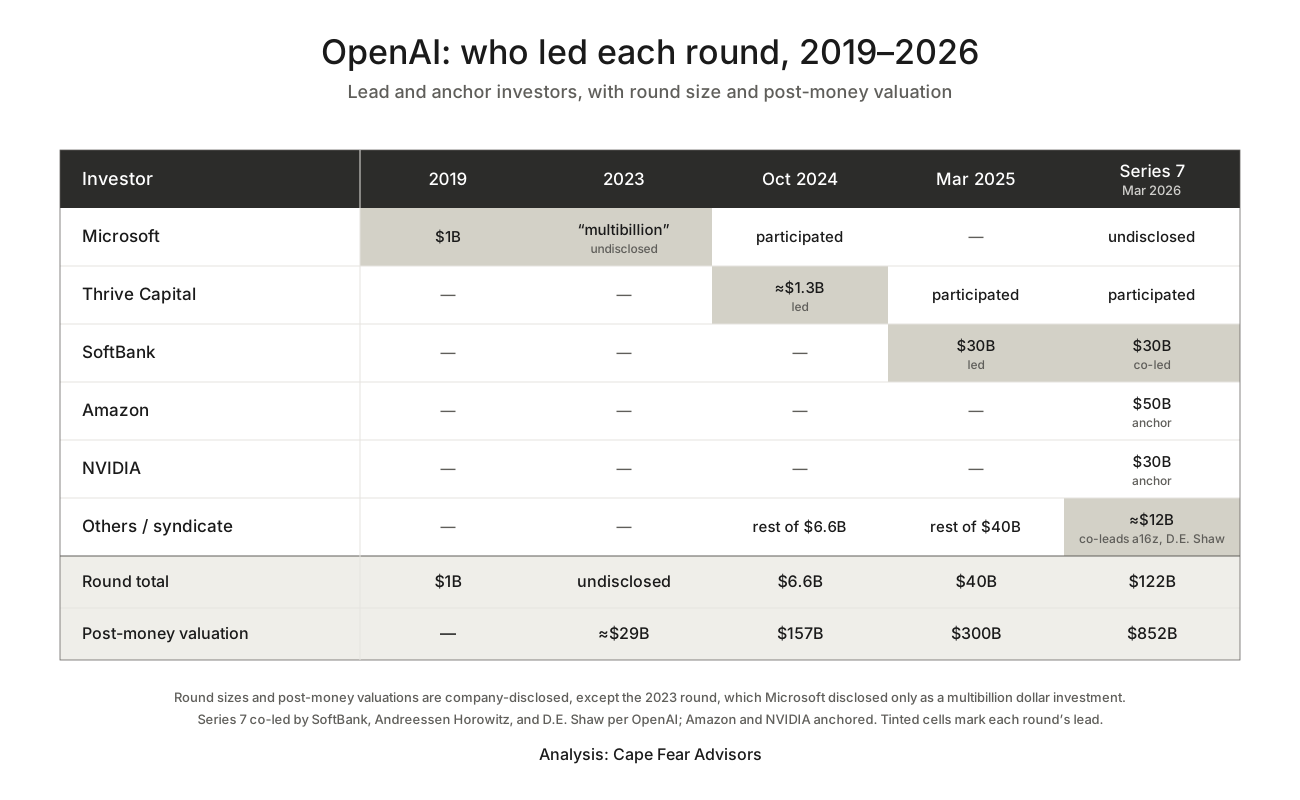
Microsoft anchored the first two, in 2019 and 2023. The lead passed to Thrive Capital in October 2024, to SoftBank in March 2025, and SoftBank held it into March 2026, co-leading Series 7. Amazon and NVIDIA wrote the two largest checks in that round, $50 billion and $30 billion, and came in as anchors, behind the lead.
Across those rounds the valuation moved from about $29 billion to $852 billion. The parties writing the largest checks in the last round, and the parties holding the lead, are different parties.
“The total is $122 billion committed. At least $35 billion of it is contingent. The dollar figures are disclosed; the split between cash and services behind them stays with the company.”
What the filings say
Each commitment was disclosed by the party that made it. Read together, they share parties and reference points.
Amazon’s $35 billion and OpenAI’s Trainium purchase sit in one agreement, linked by its terms. NVIDIA’s equity and OpenAI’s purchase of NVIDIA systems were announced in the same round. SoftBank routes its $30 billion through the fund whose stake it carries on its own books, and its chairman, Masayoshi Son, chairs Stargate, the venture behind the buildout the round helps fund.
Two of those parties also appear in OpenAI’s audited 2025 accounts. About nine percent of OpenAI’s 2025 revenue came from Microsoft and SoftBank, both equity holders, and about half of the 2025 cost stack flowed to Microsoft. The compute the round helps pay for runs, in large part, on contracts with Oracle and Amazon that we read separately as well.
Each of these is on the record, in the filings and announcements of the parties to it. The round puts them on one valuation and one timetable.
What the S-1 will settle
OpenAI filed a draft registration statement with the SEC on June 8, confidentially. A confidential draft keeps the price, the share count, and the date open. The public S-1, when it lands, carries the items the round’s terms turn on.
The first is the cash-and-services split. The round reports dollar totals; the S-1 reports cash flows, and the share of the $122 billion that arrives as cash will show against the share that arrives as compute and services.
The second is the timing of the listing. Some of the round’s terms point to it. By SoftBank’s own terms, its closings accelerate if OpenAI lists, and the bridge that funds its stake comes due in March 2027. On the $100 billion that became $30 billion, NVIDIA’s Jensen Huang told an investor conference the larger figure was ‘probably not in the cards’ because OpenAI is going public. Amazon’s $35 billion is conditional as well, by both companies’ announcements, though the filing redacts the milestones; reporting has placed them at a listing or an AGI declaration, which the companies leave unconfirmed.
The company has set the same event in front of itself. Sam Altman told staff he expects OpenAI to go public ‘within the next year,’ and that ‘many things could cause it to be sooner or later in that range.’ The S-1 announcement said a listing may be a while off, with steps the company would rather take private first.
“The ‘when’ is a calculation before it is a date. It runs on the dated terms, the deadlines and the contingencies, and on the cash requirement: what OpenAI spends, and the cash the round delivers to meet it.”
So the ‘when’ is a calculation before it is a date. It runs on the dated terms, the deadlines and the contingencies, and on the cash requirement: what OpenAI spends, and the cash the round delivers to meet it. The cash on hand and the burn are on the record now. Ed Zitron’s reporting of OpenAI’s audited 2025 accounts, verified by the Financial Times, put the year-end cash at roughly a year of runway against the operating loss, which we added up separately. The committed total is one quantity, the cash and the burn another. What still joins them is the cash-and-services split, how much of the $122 billion is cash and when it lands. The S-1 is where that comes from, and the listing is the event the company has set its terms against.
“Analysis: Cape Fear Advisors. Figures come from the parties’ own disclosures wherever those exist, and from named reporting where they do not. Full figure-by-figure sources below.”
Sources
Primary disclosures
OpenAI, “OpenAI raises $122 billion to accelerate the next phase of AI,” March 31, 2026. The round closed at $122 billion in committed capital and an $852 billion post-money valuation, up from the $110 billion announced February 27 at a $730 billion pre-money valuation. OpenAI’s announcement states the round was anchored by Amazon, NVIDIA, and SoftBank, with continued participation from Microsoft, and that SoftBank co-led alongside a16z, D. E. Shaw Ventures, MGX, TPG, and accounts advised by T. Rowe Price Associates. More than $3 billion came from individual investors through bank channels. The credit facility was expanded to $4.7 billion. OpenAI stated the three anchor amounts of $50 billion, $30 billion, and $30 billion at the February announcement.
OpenAI and Amazon, “OpenAI and Amazon announce strategic partnership,” February 27, 2026. Both companies state the $50 billion as $15 billion now and $35 billion ‘in the coming months when certain conditions are met.’ Neither names the conditions. OpenAI commits to consume approximately 2 gigawatts of AWS Trainium capacity, and the two expand their existing $38 billion cloud agreement by $100 billion over eight years. AWS becomes the exclusive third-party distributor for OpenAI’s Frontier platform.
OpenAI, round announcement, February 27, 2026, on the NVIDIA commitment. OpenAI states it committed to ‘3GW of dedicated inference capacity and 2GW of training on Vera Rubin systems,’ five gigawatts in total, alongside NVIDIA’s equity.
SoftBank Group, “Follow-on Investments in OpenAI,” February 27, 2026. $30 billion follow-on through SoftBank Vision Fund 2, subject to the satisfaction of customary closing conditions. Cumulative investment expected to total $64.6 billion, an ownership interest of about 13 percent. The consideration is to be financed initially through bridge loans and other arrangements from major financial institutions, then replaced over time through existing assets. Closing dates may accelerate in the event of a public listing.
Jensen Huang, Morgan Stanley Technology, Media & Telecom Conference, March 4, 2026. On the September 2025 $100 billion figure: ‘probably not in the cards,’ because OpenAI is going public. The $30 billion ‘might be the last time’ NVIDIA invests before an IPO.
OpenAI and SoftBank, “Announcing The Stargate Project,” January 21, 2025. SoftBank and OpenAI named as Stargate’s lead partners, SoftBank with financial responsibility and OpenAI with operational responsibility. ‘Masayoshi Son will be the chairman.’
From the filing
Series C Preferred Stock filing, as read by GeekWire, March 2026. Amazon’s $15 billion is due March 31. The later tranche is stated at $34,999,999,447.98 and is callable on five business days’ notice once milestones are met. The milestones are redacted. The $35 billion equity commitment is contractually linked to the cloud agreement: if the Joint Collaboration Agreement terminates, the $35 billion obligation terminates with it.
As reported
Financial Times, February 2026. NVIDIA’s $30 billion is a dedicated equity stake, not tied to deployment milestones, removing the earlier requirement that OpenAI direct spending toward NVIDIA hardware. It replaces the September 2025 letter of intent of up to $100 billion, which was conditioned on each gigawatt of NVIDIA systems deployed and never closed. NVIDIA declined to comment. Reuters reported that at the announcement it was not confirmed whether the $30 billion replaced the September commitment, and that OpenAI and NVIDIA did not clarify. Huang confirmed the replacement at the Morgan Stanley conference on March 4, 2026, resolving that question.
The condition on Amazon’s $35 billion (The Information; The Verge). With the milestones redacted in the filing, reporting has placed the trigger at an OpenAI IPO or an AGI milestone. Neither Amazon nor OpenAI has confirmed a specific trigger. This piece leaves the condition open.
Reuters, March 2026. SoftBank’s $30 billion paid in phases, the first roughly $10 billion around April 1.
Analysis (Cape Fear Advisors)
The roughly $12 billion broader pool is the round’s $122 billion less the three anchor commitments of $50 billion, $30 billion, and $30 billion. ‘At least $35 billion contingent’ is Amazon’s conditional tranche. The total carries no cash figure because the split between cash and services across the strategic commitments is not disclosed.
The reading that NVIDIA’s equity is not deployment-conditioned is ours, drawn from what the parties did disclose: a direct stake at the round’s valuation, paired with a separate binding commitment to NVIDIA systems, and Huang’s March 4 statement that the $100 billion was off. The parties did not use that phrase.
Earlier rounds
2019: Microsoft’s initial $1 billion investment in OpenAI. January 2023: a tender offer was reported by the Wall Street Journal to value OpenAI at about $29 billion. 2023: Microsoft described its investment only as ‘multiyear, multibillion dollar.’ The amount and the implied valuation were reported, not disclosed. October 2024: $6.6 billion at a $157 billion post-money valuation, led by Thrive Capital. March 2025: up to $40 billion at a $300 billion post-money valuation, led by SoftBank, whose effective share was $30 billion after syndicating $10 billion to co-investors.
See also: OpenAI, Adding It Up, on the audited 2025 financials, and Oracle Just Said a Lot About OpenAI, on the RPO chain. The full series is available on Substack.
Greg Collins serves as CEO of C3 Metrics, a marketing measurement and analytics firm, and maintains an advisory practice at Cape Fear Advisors focused on structural analysis and strategy.
Start a Conversation →