


"Whoever does not know foreign languages knows nothing of their own."
Johann Wolfgang von Goethe, Über Kunst und Altertum, 1821, collected in Maxims and Reflections. Our translation of "Wer fremde Sprachen nicht kennt, weiß nichts von seiner eigenen."
On Monday night Meta priced $37.5 billion of new equity. Three of its chip suppliers, NVIDIA, AMD and Broadcom, had indicated interest in buying up to $5.0 billion of it, at the same price and on the same terms as everyone else. In February, AMD had given Meta a warrant over up to 160 million AMD shares at a penny each, vesting as Meta buys AMD's chips. Equity moved between one supplier and one customer twice in eight months, and only once carried a concession. The price on an invoice is one number. What a customer pays for compute in 2026 is that number adjusted by stock, warrants, guarantees, loans and netting, and each adjustment is filed by a different company, on a different line, on its own calendar. We name the seven instruments, place each on our cash ladder, and read where each lands in the accounts. (1)
Meta, building its own stack
Meta joins our reading as a different company from the one that first rented outside AI capacity. Its third-quarter report states the change in its own figures. (2)
- Spending: $83.0 billion of capital expenditure in the first nine months of 2026, up from $48.3 billion a year earlier, against $96.9 billion of operating cash flow. Guidance for the full year is $135 billion to $145 billion.
- Commitments: about $355.7 billion of leases not yet commenced, for data centers, energy and colocation, starting between now and 2036 on terms up to 30 years; and $454.5 billion of non-cancelable contractual commitments, $121.4 billion of them due in 2027.
- Funding: no share repurchases in the nine months, against $26.2 billion a year earlier; $24.9 billion of new debt; and on Monday, $37.5 billion of new equity.
What the money builds is a full stack for one customer, Meta itself: four superclusters of more than a gigawatt each, custom silicon "aimed at reducing the cost of compute," its own frontier model, Muse Wonder, and an agentic product, Muse, which signed up more than 10 million users in the United States and Canada in its first weeks, with shopping the leading use. The business it serves is consumer AI carried by advertising. In Meta's words, its AI investments "are already generating tangible returns through increased engagement, improved advertising performance and increased monetization." Anthropic meters intelligence by the token. Meta's consumer products carry no meter; the return shows up in the feed and the ad auction. (3)
Two filed details mark how far the company has come. The earlier form of renting is still on the books: a contingent obligation to buy up to $14.72 billion of cloud capacity over five years, which "may be reduced if the cloud service provider is able to sell such capacity to other customers." The capacity contracted since sits inside commitments the company calls non-cancelable, and against about $824.9 billion of leases and commitments in all, the reducible kind is under 2 percent. And Meta writes its own credit support. It has given residual value guarantees to its two unconsolidated data center ventures, with a maximum of $41.4 billion, up from $28.1 billion at the start of the year. Rated Aa3 and AA-, Meta stands behind its own landlords. Further on, we read the mirror image: Anthropic's lessor borrowing a supplier's standing.
On the filed record, Meta is funding the buildout the way an investment-grade company can: from operating cash, its own debt and now its own equity, with its own name on the guarantees. That is the customer at the center of what follows, building the whole stack and bringing in the suppliers it needs.
The ladder, and the rung we read here
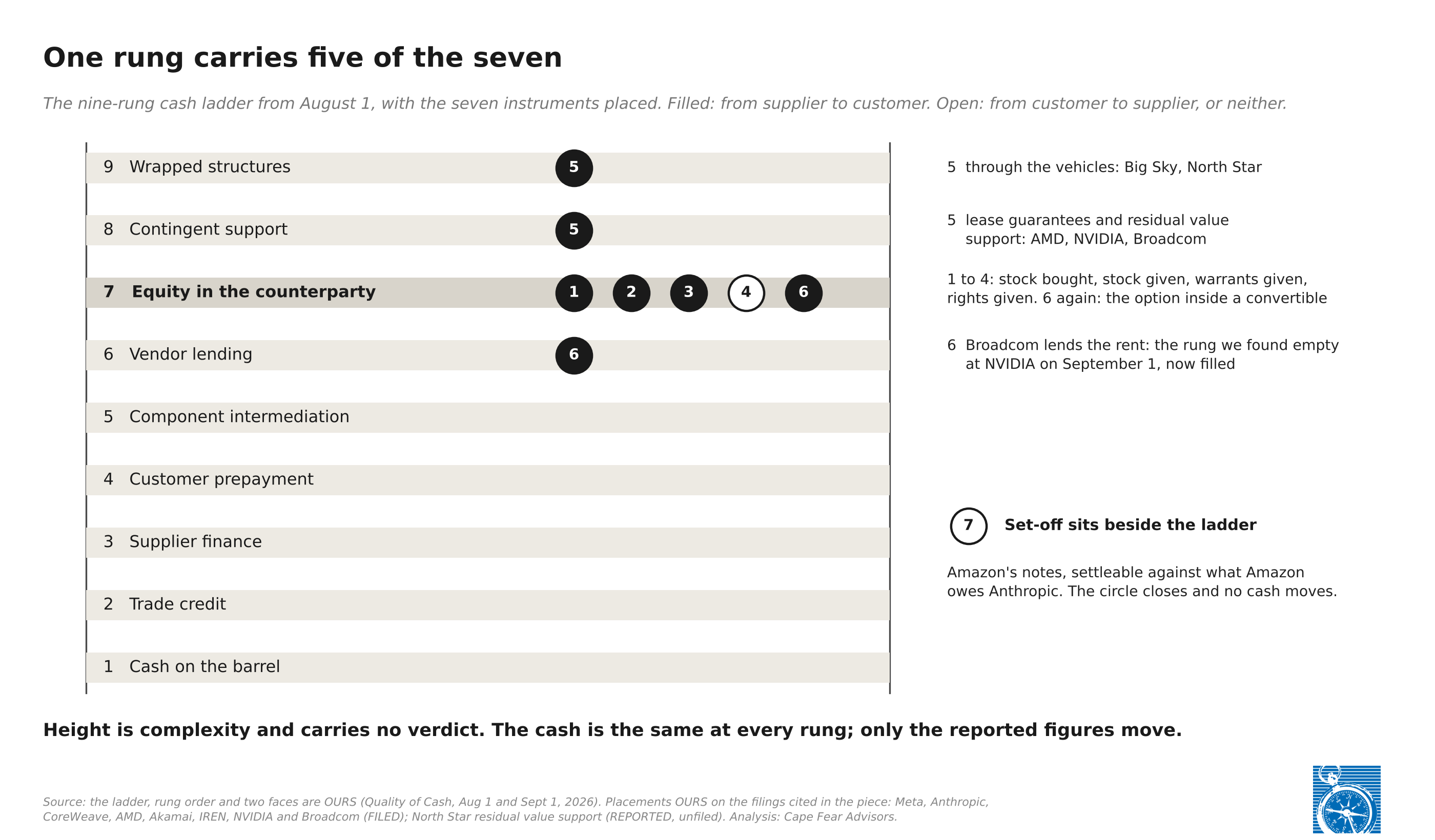
Circular financing is ordinary. A trade receivable is the simplest instance of it, and most of finance runs in circles. The question we ask is where the price lands, and who files it. On August 1 we published a ladder for reading these arrangements without accusing anyone of anything. Nine rungs, from cash on the barrel at the bottom to wrapped structures at the top, each one a step further for the cash to travel before it returns. The law of the ladder is that the cash is the same at every rung and only the reported figures move. Height is complexity, and it carries no verdict. (4)
One rung matters most here: equity in the counterparty. On September 13 we read that rung at NVIDIA and found it paid for in three currencies. NVIDIA paid $2.0 billion in cash for CoreWeave stock. It paid cash at Nebius for a pre-funded warrant. And at IREN it paid nothing: IREN granted NVIDIA rights over 30 million shares, valued at $793.4 million at grant, and booked that value into the cost of the GPUs it bought from NVIDIA. (5)
Seven instruments, and what paid for each
We read seven instruments, numbered as they appear on our first exhibit:
1. A supplier buys the customer's stock.
2. A supplier gives the customer stock.
3. A supplier, or a landlord, gives the customer warrants.
4. A customer gives the supplier equity rights.
5. A supplier guarantees or supports a partner's lease.
6. A supplier lends the customer the rent.
7. Supplier and customer settle by set-off.
The first four are equity, the next two are credit, and the last moves nothing at all.
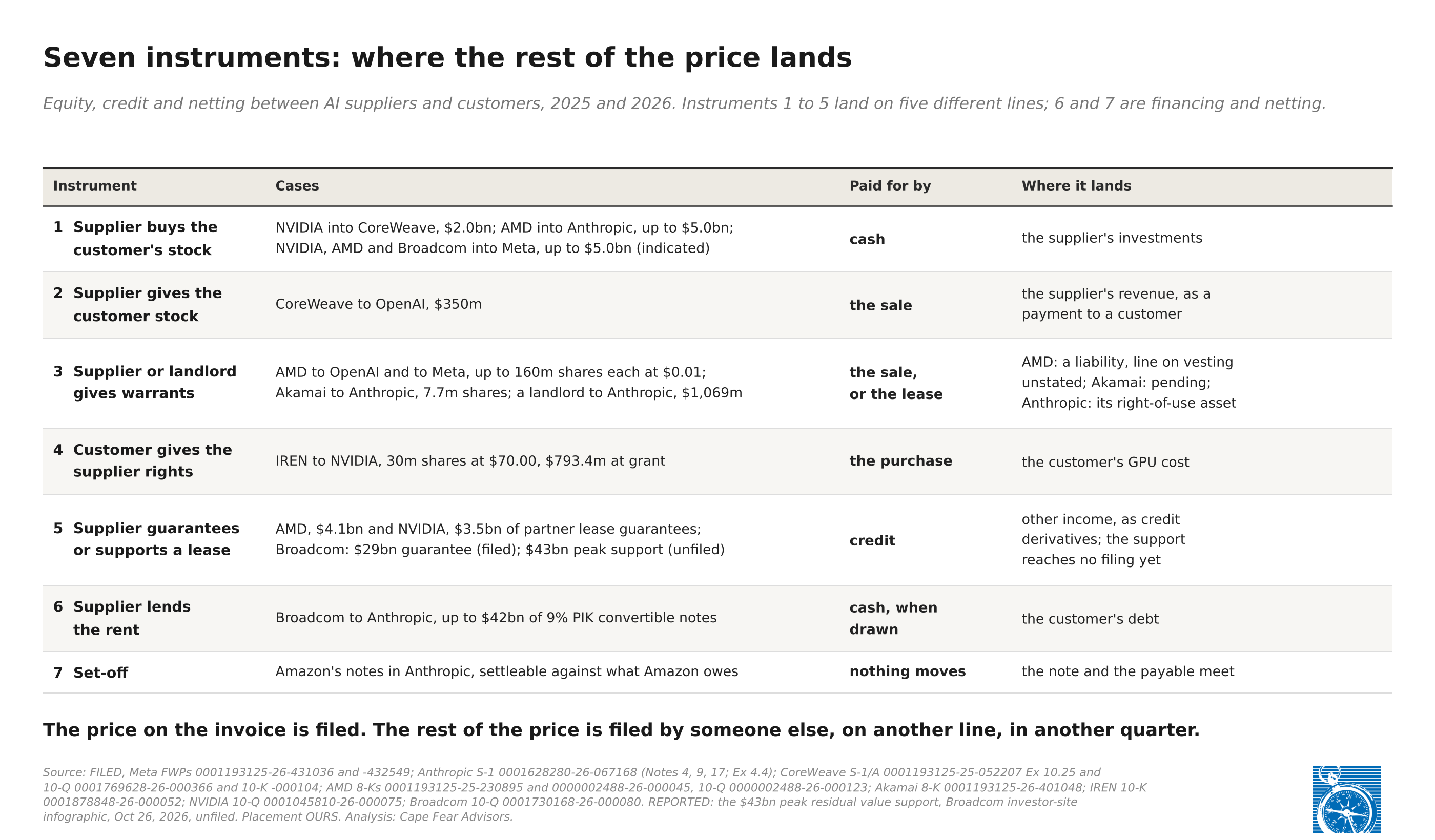
What sorts the four equity instruments is what paid for the equity. When a supplier pays cash for a customer's stock, cash leaves and comes back as orders. When equity changes hands as part of the sale itself, no cash moves at all, and the price does.
Paid for in cash, the first instrument:
- NVIDIA into CoreWeave, $2.0 billion at $87.20 a share, January 2026. (5)
- AMD into Anthropic: under a July 2026 hardware supply agreement for Helios systems, "AMD committed to purchase up to $5.0 billion of the Company's Class N common stock, if certain conditions are achieved." (6)
- NVIDIA, AMD and Broadcom into Meta, up to $5.0 billion between them, indicated and nonbinding, "at the same price and on the same terms" as everyone else. (7)
Paid for by the sale, the second, third and fourth:
- CoreWeave to OpenAI: $350 million of CoreWeave stock under a commercial agreement, which CoreWeave books as a payment to a customer, against revenue. (8)
- AMD to OpenAI, October 2025, and AMD to Meta, February 2026: each a warrant over up to 160 million AMD shares at $0.01, vesting in tranches as the customer buys AMD GPUs, the first tranche at 1 gigawatt and the last at 6, with stock-price thresholds that for Meta's warrant escalate to $600. (9)
- Akamai to Anthropic, September 2026: a warrant over 7,741,020 Akamai shares as converted, at $111.33. Forty percent vests on Anthropic's first payment under the project plans that carry its $11.6 billion commitment, and 20 percent more for each further $3.0 billion committed, which by our arithmetic completes vesting at $20.6 billion. (10)
- A landlord to Anthropic: warrant rights over a privately held company's shares, received "as consideration under an agreement entered into but not yet commenced," valued at $1,069 million at June 30, 2026. (11)
- IREN to NVIDIA: the rights over 30 million IREN shares at $70.00, vesting with the volume of GPUs NVIDIA supplies. (5)
The second list runs in both directions. A supplier gives its customer equity in most of these cases, and in the IREN case the customer gives the supplier equity. Either way the equity is part of what the buyer pays or receives for the goods, and so it is part of the price.
Five lines for one idea
Each filer books its piece under its own rules, and the rules send the same economic idea to different places. (12)
- Revenue. CoreWeave records stock issued to OpenAI as a contra-revenue asset, amortized against what OpenAI pays. (8)
- The cost of an asset. IREN capitalizes the $793.4 million of NVIDIA's rights into the cost of the GPUs, recognized per unit as the machines arrive. (5)
- The right-of-use asset. Anthropic will recognize the landlord's warrant rights "as lease incentives upon commencement of the related arrangements and recognized as a reduction of the related ROU assets." (11)
- Other income. AMD and NVIDIA record their guarantees of partners' data center leases as credit derivatives, with changes in fair value through other income. (13)
- Investments. A cash purchase sits in the buyer's securities book, as NVIDIA's CoreWeave shares do.
The two largest warrants on the list land on none of the five lines. AMD's second-quarter 10-Q states that both the OpenAI and Meta warrants "will be classified as liabilities until certain conditions for equity classification are met." It reports that no tranche had vested at June 27, 2026, and that the warrants had no impact. Where their value lands when a tranche vests is unstated in those documents. Akamai's 8-K sets out its warrant's terms and states no accounting for it; its 2025 annual report states the policy that would govern it, under which a payment to a customer reduces revenue unless it pays for a distinct service. We set that test out on September 26. (9, 10)
The standard-setter has already moved on awards of this kind. In May 2025 the Financial Accounting Standards Board issued ASU 2025-04 on share-based consideration payable to a customer, which treats vesting tied to the customer's purchases as a performance condition. The award is measured at its grant-date fair value, the probability of vesting is judged under the stock compensation rules of Topic 718 with Topic 606's constraint on variable consideration set aside, and the transaction price is reduced once vesting is probable. The update applies to fiscal years beginning after December 15, 2026. CoreWeave's annual report describes its purpose as "to reduce diversity in practice." The warrants AMD and Akamai gave their customers, vesting on what those customers buy, sit inside the question it addresses. (12)
Meta's own third-quarter 10-Q mentions AMD zero times, and the word warrant zero times. (14)
Credit as the currency
The fifth and sixth instruments pay in a supplier's credit standing instead of its stock.
AMD's second-quarter 10-Q discloses "a maximum gross exposure of $4.1 billion from guarantees issued in connection with certain commercial partner data center lease obligations with terms up to 15 years," and adds that the guarantees "may be issued in exchange for warrants." NVIDIA carries $3.5 billion of guarantees of the same kind. In AMD's case the supplier may take equity in return for its credit. (13)
Broadcom carries this furthest, and with one customer. Against Anthropic it now holds four positions at once, and beyond the sale they reach four rungs of the ladder: vendor lending, equity in the counterparty, contingent support, and, through its financing vehicles, wrapped structures. (15)
- It sells the chips. Broadcom XPU accelerators and networking. Anthropic's S-1 carries about $161.2 billion of rent under its five-year equipment leases with Broadcom, excluding interest, and the largest of them, the 2026 Lease Arrangement, about $125.2 billion.
- It lends the rent. Broadcom agreed to buy up to $42 billion of Anthropic's 9 percent payment-in-kind convertible notes, issued to pay that rent, from Anthropic or a designated financial partner. A convertible is a loan with an option attached, so that one commitment sits partly on vendor lending and partly on equity in the counterparty.
- It guarantees the first vehicle. Broadcom's own quarterly report discloses what it calls a Backstop, given to a financial partner for "the customer's lease obligations over the 5-year lease terms": any difference between 85 percent of what is owed and the value of the racks, up to about $29 billion. Anthropic's S-1 describes the same kind of support from its side without a name: "partners who guarantee the lease obligations to support the development of data center capacity that is expected to host such partner's chips."
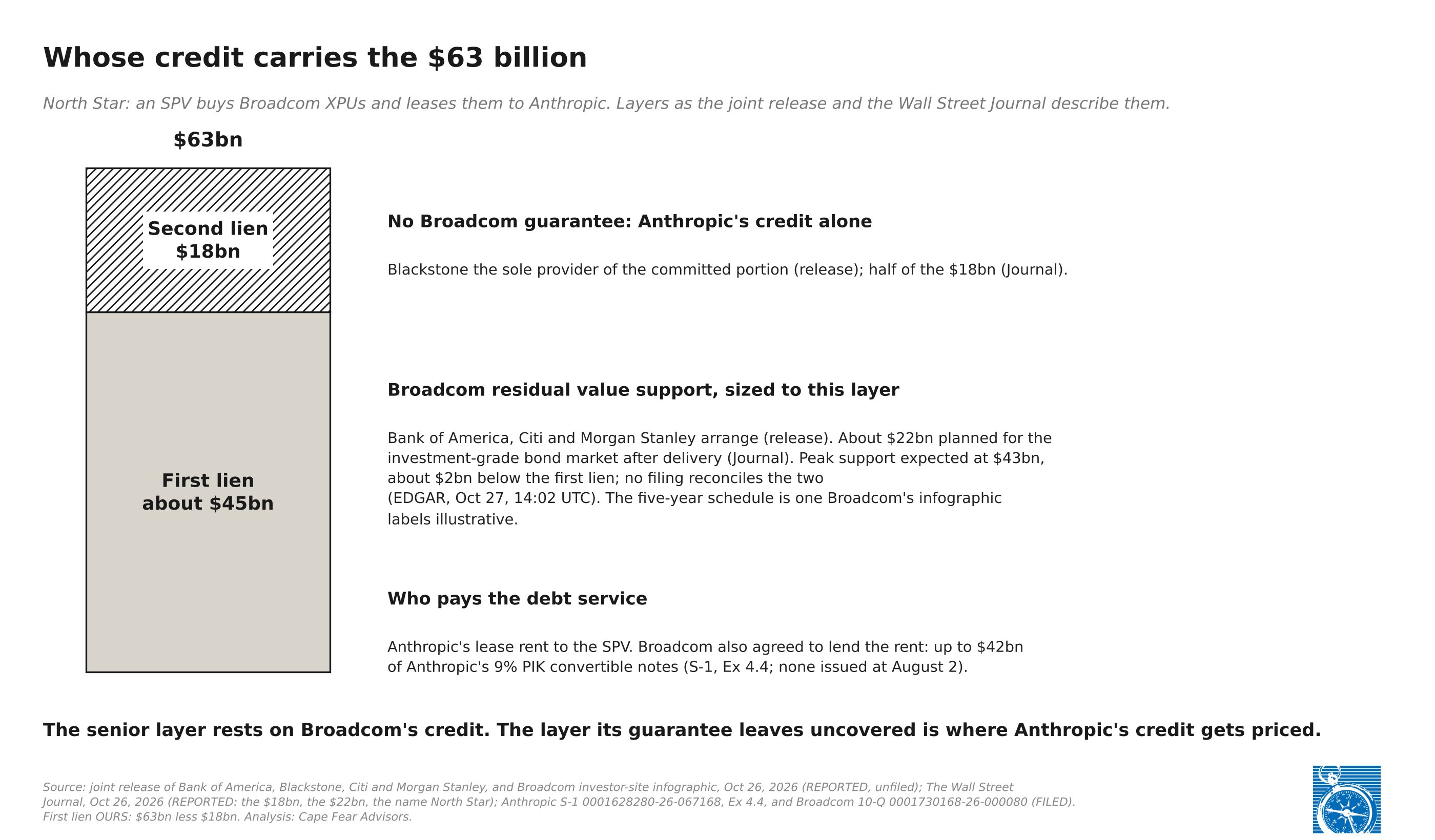
- It supports the second. On Monday, Bank of America, Citi, Morgan Stanley and Blackstone announced a $63 billion special purpose vehicle that buys Broadcom XPUs and leases them to Anthropic, with deliveries expected from 2027. In the joint release, Broadcom provides residual value support "for the amount equivalent to the first lien portion of the financing." An infographic on Broadcom's investor site gives the terms: any shortfall between 72.5 percent of what is owed on the lease and the value of the racks, with peak exposure "expected to be $43 billion," on an amortization schedule to zero over five years that it labels "Illustrative only." In Broadcom's words, "RVS is not a direct cash outlay." (16)
That last sentence is the ladder's law stated by a supplier. A guarantee moves no cash until its condition fires, and until then it moves only the reported figures, or in this case no filed figure at all. Checked on EDGAR at 8:14 am Eastern on October 27, Broadcom's latest filing was dated September 25. (16)
The Wall Street Journal reported on Monday night that $18 billion of the financing carries no Broadcom guarantee, half of it financed by Blackstone, which fits the release's "sole provider of the committed portion of the second lien." Read with the release, that puts the first lien Broadcom supports at about $45 billion. The infographic's peak exposure sits $2 billion below that, and nothing filed reconciles the two. The Journal names the vehicle North Star, the sequel to Big Sky, an earlier vehicle Apollo helped finance, so on its account the two guarantees above belong to two structures. It also reports that Broadcom agreed to higher interest rates on the loans. The documents we have read leave unstated who bears that rate, the supplier or the rent, and whether North Star finances the 2026 Lease Arrangement Anthropic filed or adds to it. (17)
On those figures the senior debt rests on Broadcom's credit, and the $18 billion beneath it rests on Anthropic's alone. On August 27 we wrote that in this buildout the scarce thing is a credit standing. Here a supplier lends its own, and the layer its guarantee leaves uncovered is where the customer's credit gets priced. (18)
One rung fills here that stood empty in September. On September 1 we found vendor lending, a seller lending its buyer the purchase price, unoccupied on both of NVIDIA's faces, and we printed what would fill it. Broadcom's commitment to fund Anthropic's rent through convertible notes is a filed vendor-lending instrument, named on Anthropic's side and filed as "our customer" on Broadcom's. Broadcom's report stated that none had been issued at August 2. Whether any are drawn now sits in Anthropic's next filing. (19)
The closure
The seventh instrument moves no cash on either side.
Amazon holds convertible notes in Anthropic. Amazon is also a compute supplier to Anthropic, with at least $110.0 billion committed, and one of the cloud marketplaces through which Anthropic sells, and a customer. Anthropic's registration statement says the notes "may also be settled in cash at maturity or, at Amazon's election, by set-off against amounts Amazon owes the Company under certain commercial agreements with Amazon." (20)
A loan repaid with what the lender owes the borrower is the circle closed on one signature. Our August 1 piece called closure, and not height, the point where the ladder stops measuring distance. Set-off is that point written into a note.
Two kinds of equity, one customer
Meta's offering puts the first and third instruments side by side, at one customer, in one year.
The cornerstone indication is the first: cash for stock, at the public price, "on the same terms." AMD's February warrant is the third: equity given to the customer as part of the sale. Meta priced on Monday night. The common stock grew to $25.0 billion at $625.00 a share, against a last sale of $630.56. The mandatory convertible came at $12.5 billion with a 6.50 percent dividend and a 17.5 percent conversion premium. The pricing term sheet names no allocation to NVIDIA, AMD or Broadcom. (21)
The concession ran one way. It came from the supplier to the customer, with the supply contract, as a warrant at a penny. When suppliers moved to buy into the customer, the terms were the public price. Filled in full, the indications would be 20 percent of the common stock offering; which supplier took what is still open. (21)
The price on the invoice is filed. The rest of the price is filed too, by somebody else, on another line, in another quarter. Reading it means reading all of them.
What we are watching
Meta's final prospectus supplements, for any cornerstone allocation. AMD's third-quarter 10-Q, the first that could carry a vested tranche and the line it lands on, and Akamai's in early November, with the Anthropic agreement as an exhibit. Broadcom's annual report in December, where North Star's support would reach a guarantees note. Anthropic's amended registration statement, for any draw on Broadcom's notes, for the landlord's name, and for where North Star sits among its leases. When each arrives, we will say what it shows.
What free costs
We are watching AI divide into two businesses. Anthropic sells intelligence to companies, metered by the token, and in its registration statement it sizes its market as the wages of the world's knowledge workers. Meta gives intelligence to consumers, and the advertisers who reach them pay for it.
On August 10, Mark Zuckerberg published an essay of about 6,500 words, "The Future is for Everyone." In it he wrote: "Everyone will have free or affordable access to these tools." Those who want more compute will pay through "a dynamic auction mechanism that will guarantee that everyone gets the lowest price possible." The essay uses the words advertising, ads and advertisers zero times. On Monday, Meta's offering document described what its first frontier model makes possible, "additional high-margin services beyond the Muse network, including its API, Muse Code, and other enterprise offerings," and said its AI investments already return through "improved advertising performance." (22)
Free to the user is a price too. The advertiser pays it, about $824.9 billion of leases and commitments carry it, and since Monday an offering that three suppliers asked to join helps fund it. The essay names a price mechanism for the compute a user buys beyond the free tier. It names none for what pays for the free tier itself.
The segments differ, and the lesson carries across them. Meta and Anthropic buy from the same suppliers, AMD and Broadcom among them, through the same instruments, from very different credit positions. Meta writes its own guarantees at AA-. Anthropic's lessor borrows Broadcom's. Anthropic's registration statement states no credit rating for the company, and its own $15 billion revolving credit facility stays secured by substantially all of its assets until it obtains an investment-grade rating from two of Moody's, S&P and Fitch. (23) To understand Anthropic, our readers have to understand Meta first, because Meta shows what the buyer's side of this market looks like when the buyer holds the credit. We read Anthropic against that next.
Free to read, no paywall. Readers who find the work useful can support it at the foot of the page; payment offsets the time and buys no access. Corrections run in daylight, dated, in a comment or in the following piece, and a reader who finds one is doing us a favor.
Standing Disclosure
Cape Fear Advisors holds no direct position, long or short, in the securities discussed here. Any exposure is indirect, through managed funds it does not control, which may include index funds holding the public companies named.
Anthropic is the developer of Claude, which we use in preparing our work, and Anthropic is a party to five of the arrangements read here: AMD's commitment to buy its stock, Akamai's warrant, the landlord's warrant rights, Broadcom's leases, notes and support, and Amazon's notes. Amazon is also an Anthropic investor and supplier. That nearness cannot be checked away, which is why no claim here rests on trust in the tool: every figure carries a public source. Companies not named here may hold positions or supply relationships that bear on the filers discussed, which is part of why every piece is re-checked against the filings. Figures are quoted from the filers without characterization, and the same standard of reading is applied to every filer named.
Notes
[1] FILED. Meta Platforms free writing prospectus, accession 0001193125-26-431036, October 26, 2026 (cornerstone indications); pricing term sheet, accession 0001193125-26-432549, filed October 27. AMD Form 8-K, accession 0000002488-26-000045, February 24, 2026, Items 1.01 and 3.02.
[2] FILED. Meta Platforms Form 10-Q for the quarter ended September 30, 2026, accession 0001628280-26-066773. Cash flow statement, nine months: operating cash $96,873 million; purchases of property and equipment $83,055 million against $48,308 million; repurchases of Class A common stock none against $26,248 million; proceeds from issuance of long-term debt, net, $24,910 million. Note 10: leases not yet commenced "approximately $355.73 billion," commencing "during the remainder of 2026 through 2036 with lease terms ranging from greater than one year to 30 years"; "$454.52 billion of non-cancelable contractual commitments," with about $45.85 billion and $121.41 billion due in 2026 and 2027; "contingent obligations to purchase up to $14.72 billion of cloud capacity over a five-year period, which may be reduced if the cloud service provider is able to sell such capacity to other customers." Unconsolidated data center ventures: maximum residual value guarantees $41,493 million at September 30, 2026 against $28,091 million at December 31, 2025. Risk Factors: "we have launched Muse, an agentic AI." OURS: $355.73 billion plus $454.52 billion plus $14.72 billion is $824.97 billion, of which $14.72 billion is 1.78 percent. Figures in the body are rounded against the reading: spending, commitments, current exposure and the prior-year repurchases floored; operating cash and the prior-year exposure rounded up.
[3] FILED. Meta free writing prospectus, accession 0001193125-26-431036, October 26, 2026: 2026 capital expenditure of $135 billion to $145 billion; four superclusters "with more than one gigawatt of capacity each"; custom silicon "aimed at reducing the cost of compute and improving returns on every dollar invested"; "more than 10 million Muse users in the U.S. and Canada within the early weeks of launch," shopping "the leading use case, with over 25% of Muse weekly active users"; Muse Wonder, "its first frontier model"; ratings Aa3 and AA-. Meta's pricing term sheet, accession 0001193125-26-432549, for the $37.5 billion.
[4] OURS. "Quality of Cash: Circular Financing and the AI Bubble," August 1, 2026; "Quality of Cash: The Supplier Addition," September 1, 2026. "Circular Financing, and One Company in the Middle of It," September 20, 2026: "Most of finance is circular." The rung order and the reading of each rung's two faces are ours.
[5] OURS: "NVIDIA, A Little Bit of Money In," September 13, 2026, and the filings it cites. FILED: IREN Limited Form 10-K for the year ended June 30, 2026, accession 0001878848-26-000052, Note 24: rights over 30,000,000 ordinary shares at $70.00, granted May 7, 2026, vesting "in tranches based on the volume of GPUs supplied by NVIDIA," grant-date fair value about $793.4 million, "capitalized as part of the cost of the GPUs acquired from NVIDIA."
[6] FILED. Anthropic, PBC Form S-1, accession 0001628280-26-067168, October 26, 2026, Note 17.
[7] FILED. Meta free writing prospectus per note (1): NVIDIA, AMD and Broadcom "have, severally and not jointly, indicated an interest in purchasing up to an aggregate of $5.0 billion" of the Class A offering "at the same price and on the same terms and conditions as the other purchasers." The indications are nonbinding. The same sentence appears in the preliminary prospectus supplement for the common stock, accession 0001193125-26-431040, October 26, 2026, which names the three "the Cornerstone Investors."
[8] FILED. CoreWeave Form S-1/A, accession 0001193125-25-052207, Exhibit 10.25, the Common Stock Issuance Agreement with OpenAI of March 7, 2025, for $350 million of Class A common stock; CoreWeave Form 10-Q for the quarter ended June 30, 2026, accession 0001769628-26-000366, Note 1, 9 million shares "with an aggregate value of $350 million," and the equity line "Issuance of common stock for contract incentive." CoreWeave Form 10-K for 2025, accession 0001769628-26-000104, revenue policy: "Consideration provided upfront to customers is recorded as a contra-revenue asset. Revenue is recognized net of the contra-revenue asset amount over time."
[9] FILED. AMD Form 8-K, accession 0001193125-25-230895, October 6, 2025 (OpenAI); Form 8-K per note (1) (Meta); Form 10-K for fiscal 2025, accession 0000002488-26-000018; Form 10-Q for the quarter ended June 27, 2026, accession 0000002488-26-000123. Text searched October 26, 2026, 18:50 to 19:08 UTC, for any statement of the income-statement line on vesting: none found in those documents. EDGAR checked again October 27 at 14:36 UTC: AMD's only 8-K since, accession 0000002488-26-000182 of September 28 on the World Labs acquisition, mentions neither warrant.
[10] FILED. Akamai Technologies Form 8-K, accession 0001193125-26-401048, September 24, 2026: Project Plans 2 and 3 under the master services agreement, about $11.6 billion committed by Anthropic; a warrant over 387,051 shares of Series B Non-Voting Convertible Preferred, 7,741,020 common as converted, exercise price $111.33 per common share, vesting 40 percent "upon the first payment by Anthropic... under Project Plan 3" and three tranches of 20 percent "upon each additional $3.0 billion of contractual value committed," exercisable to the seventh anniversary of issue. OURS: $11.6 billion plus three steps of $3.0 billion is $20.6 billion. The 8-K and its Exhibits 4.1 and 99.1, searched at 14:01 UTC October 27, 2026, carry no statement of the warrant's accounting. FILED: Akamai Form 10-K for 2025, accession 0001086222-26-000022, revenue recognition policy: "If the payment to the customer does not represent payment for a distinct service, revenue is recognized only up to the net amount of consideration after customer payment obligations are considered." Searched at 14:08 UTC October 27, 2026 for "2025-04": zero instances. Our reading of September 26, "What the Next Billion Costs," cited the same policy. Akamai's latest filing on EDGAR at 14:36 UTC October 27 is a Form 4 of September 28; its September quarter report is not yet filed.
[11] FILED. Anthropic S-1 per note (6), Note 4, Fair Value Measurements. Fair value $345 million at December 31, 2025 and $1,069 million at June 30, 2026, Level 3; the $724 million difference is the gain on warrant rights in Anthropic's first-half other income, set out in our first read of the S-1, October 26, 2026. The issuer is unnamed in the S-1.
[12] The general rule for consideration a seller pays its customer is ASC 606-10-32-25 through 32-27. ASU 2019-08 (November 2019) measures share-based payments to a customer under ASC 718 and records them as a reduction of the transaction price. ASU 2025-04 (May 2025) treats vesting conditions based on the customer's purchases as performance conditions and is effective for fiscal years beginning after December 15, 2026. The grantor measures the award at its grant-date fair-value-based measure, "estimates the probable outcome of the performance condition," and "does not apply the guidance on constraining estimates of variable consideration under ASC 606"; REPORTED, Deloitte, Heads Up, May 16, 2025, read at 14:20 UTC October 27, 2026; FILED, CoreWeave Form 10-K per note (8), recent accounting pronouncements: issued "to reduce diversity in practice." Each filer's own treatment is quoted from its filing in the note cited; the placement on five lines is OURS.
[13] FILED. AMD Form 10-Q per note (9), Guarantees. NVIDIA Form 10-Q for the quarter ended July 26, 2026, accession 0001045810-26-000075: "The maximum gross exposure under all agreements is $3.5 billion," classified as credit derivatives.
[14] FILED. Meta Platforms Form 10-Q per note (2), searched October 26, 2026 at 19:08 UTC and again October 27 at 14:02 and 14:37 UTC for "AMD," "Advanced Micro," "warrant," "NVIDIA" and "Broadcom": zero instances each.
[15] FILED. Anthropic S-1 per note (6): the five-year master equipment leases with Broadcom, "an aggregate of approximately $161.2 billion excluding interest"; the 2026 Lease Arrangement, "approximately $125.2 billion excluding interest"; the Infrastructure Partner 2026 Note Purchase Agreement with Broadcom, Exhibit 4.4, up to $42.0 billion of 9 percent PIK convertible notes. Broadcom Form 10-Q for the quarter ended August 2, 2026, accession 0001730168-26-000080: "we arranged for a financial partner to take on certain agreements to purchase AI racks... and the related lease agreements with a customer"; the Backstop "for the customer's lease obligations over the 5-year lease terms," liability "equal to any difference between 85% of the outstanding amounts owed on the lease Backstop and the value of the AI racks received," maximum "approximately $29 billion"; and convertible promissory notes "our customer may, under certain circumstances and if needed, issue to us... up to an aggregate principal amount of $42 billion... As of August 2, 2026, no notes have been issued to us." Broadcom's April 2026 Form 8-K, accession 0001193125-26-144028, for the capacity. The S-1's description of "partners who guarantee the lease obligations" is in Risk Factors and in Liquidity and Capital Resources; the S-1 text, searched at 13:49 and again at 14:37 UTC October 27, 2026, carries "residual value" zero times and names no guarantor of its leases; its "guarantor" instances, three, all concern the revolving credit facility, and no amendment to the S-1 was on EDGAR at 14:36 UTC.
[16] Two company documents of different kinds, both unfiled. REPORTED, the joint release of Bank of America, Blackstone, Citi and Morgan Stanley, October 26, 2026, issued through PR Newswire with Broadcom as source: the $63 billion, the first lien arrangers, Blackstone as sole provider of the committed second lien, and residual value support "for the amount equivalent to the first lien portion of the financing." REPORTED, an infographic on Broadcom's investor site of the same date, read October 27, 2026, an investor presentation and the sole source here for the 72.5 percent formula, the peak exposure "expected to be $43 billion," and the quoted sentence. Its chart of the support amortizing to zero over five years carries the footnote "Illustrative only. Reflects an assumed delivery schedule and lease payment profile; actual RVS balances and timing may differ." Deliveries "starting in calendar 2027" are from the release. EDGAR submissions for Broadcom, CIK 1730168, checked at 12:14, 14:02 and 14:36 UTC October 27, 2026: latest filing September 25.
[17] REPORTED. Alexander Saeedy, Anissa Gardizy and Matt Wirz, "Broadcom CEO Intervened to Seal $63 Billion Anthropic Debt Deal," The Wall Street Journal, October 26, 2026, 9:09 pm ET, citing people familiar with the matter: bank commitments of over $40 billion, with about $22 billion planned for distribution to the investment-grade bond market once the chips are delivered; $18 billion of debt without a Broadcom guarantee, half financed by Blackstone; the names North Star and Big Sky, and Apollo's role in Big Sky; Broadcom's agreement to higher interest rates. OURS: $63 billion less $18 billion is $45 billion.
[18] OURS. "NVIDIA, The Scarce Thing Is a Credit Standing," August 27, 2026; "The Required Share," August 23, 2026.
[19] OURS on FILED. "Quality of Cash: The Supplier Addition," September 1, 2026, printed the trigger in its close. Broadcom Form 10-Q per note (15): none of the notes issued at August 2, 2026.
[20] FILED. Anthropic S-1 per note (6), Note 9, Convertible Notes; Amazon's compute commitment of at least $110.0 billion, and the statement in Risk Factors that Amazon, Google and Microsoft "are also our customers."
[21] FILED. Meta pricing term sheet per note (1): 40,000,000 shares at $625.00, "increased the size of the Common Stock Offering to $25.0 billion"; Nasdaq last reported sale of $630.56 on October 26; 12,500,000 shares of 6.50% Series A Mandatory Convertible Preferred, threshold appreciation price $734.2144, "a premium of approximately 17.5%." Term search for "NVIDIA," "Advanced Micro," "AMD," "Broadcom," "Cornerstone," "allocat" and "indicat" in the term sheet, October 27, 2026 at 14:37 UTC: zero instances each. No final prospectus supplement on EDGAR at 14:36 UTC. OURS: $5.0 billion over $25.0 billion is 20 percent.
[22] REPORTED, read at source. Mark Zuckerberg, Founder and CEO, Meta, "The Future is for Everyone," August 10, 2026, meta.com/thefutureisforeveryone, about 6,500 words. Text searched for "advertising," "ads" and "advertisers" at 13:24 UTC October 27, 2026: zero instances; re-counted at 14:37 UTC, unchanged, with the root "advertis" also zero. Searched again at 14:07 UTC for "revenue," "business model" and "monetiz": "revenue" twice, both as tax revenue from Meta's data center investment in Richland Parish, Louisiana; the other two terms zero. FILED: Meta free writing prospectus per note (3): "advanced models, including Muse Wonder, can support additional high-margin services beyond the Muse network, including its API, Muse Code, and other enterprise offerings." FILED: Anthropic S-1 per note (6), Industry, Market, and Other Data, for its estimate of "global knowledge workers' wages," more than $40 trillion in 2025.
[23] FILED. Anthropic S-1 per note (6), Liquidity and Capital Resources, the A&R Credit Facility: obligations "guaranteed by certain of our material subsidiaries and secured by substantially all of our assets," with guarantees and security released "on and after the date we have obtained an Investment Grade Rating (as defined in the A&R Credit Agreement) from at least two out of three of Moody's, S&P, and Fitch." Meta's ratings per note (3). The S-1 searched at 14:32 UTC October 27, 2026, with counts: "credit rating" 2, both in the facility's pricing after the release date; "investment grade" 2 and "investment-grade" 1, being the release condition, the investment of offering proceeds pending use, and the short-term investment policy; "Moody" 1, "S&P" 1 and "Fitch" 1, all in the release condition quoted above; "Standard & Poor" 0 and "rating agenc" 0. No rating is stated for Anthropic.
Analysis: Cape Fear Advisors.
This piece also appears on Substack. Cape Fear Advisors is an independent advisory firm based in Portsmouth, NH.
Contact Cape Fear Advisors