

In July we called Apple the company outside the frame. It had been left off a chart of the AI builders because "hyperscaler" is "a label Apple has not applied to itself," and it was the only one of seven large balance sheets we read that week to shrink. On Tuesday morning the Wall Street Journal's Heard on the Street column reached a similar place from the market's side, calling Apple an AI safe haven with "no big AI bills coming due." (1)
Apple filed its annual report a few hours later, and the bills are in it. They sit in rent and licenses on a schedule that runs to 2030, alongside memory that AI demand has repriced. The rest of Apple's AI position is held in reserve, like potential energy: in its chips, in 2.5 billion devices, in a balance sheet with almost all of its borrowing power unused, and in a margin that AI can lift or wear down. Apple's strategy sits outside the record. What the record shows is its outline, and the outline looks considered. We expect to make out more of it with each filing.
Kinetic and potential
Oracle spent $28,499 million on data centers and equipment in the three months to August 31, more than three times what Apple spent on capital in its whole year. Customers prepaid $11.4 billion of that quarter's cash. On Monday Oracle priced $10 billion of notes at yields of 7.062% to 8.667%, with expected ratings of Baa2 on negative outlook, BBB- and BBB, and filed for $10 billion of new stock alongside them. That is energy in motion: cash turned into buildings, and buildings financed with debt. (2)
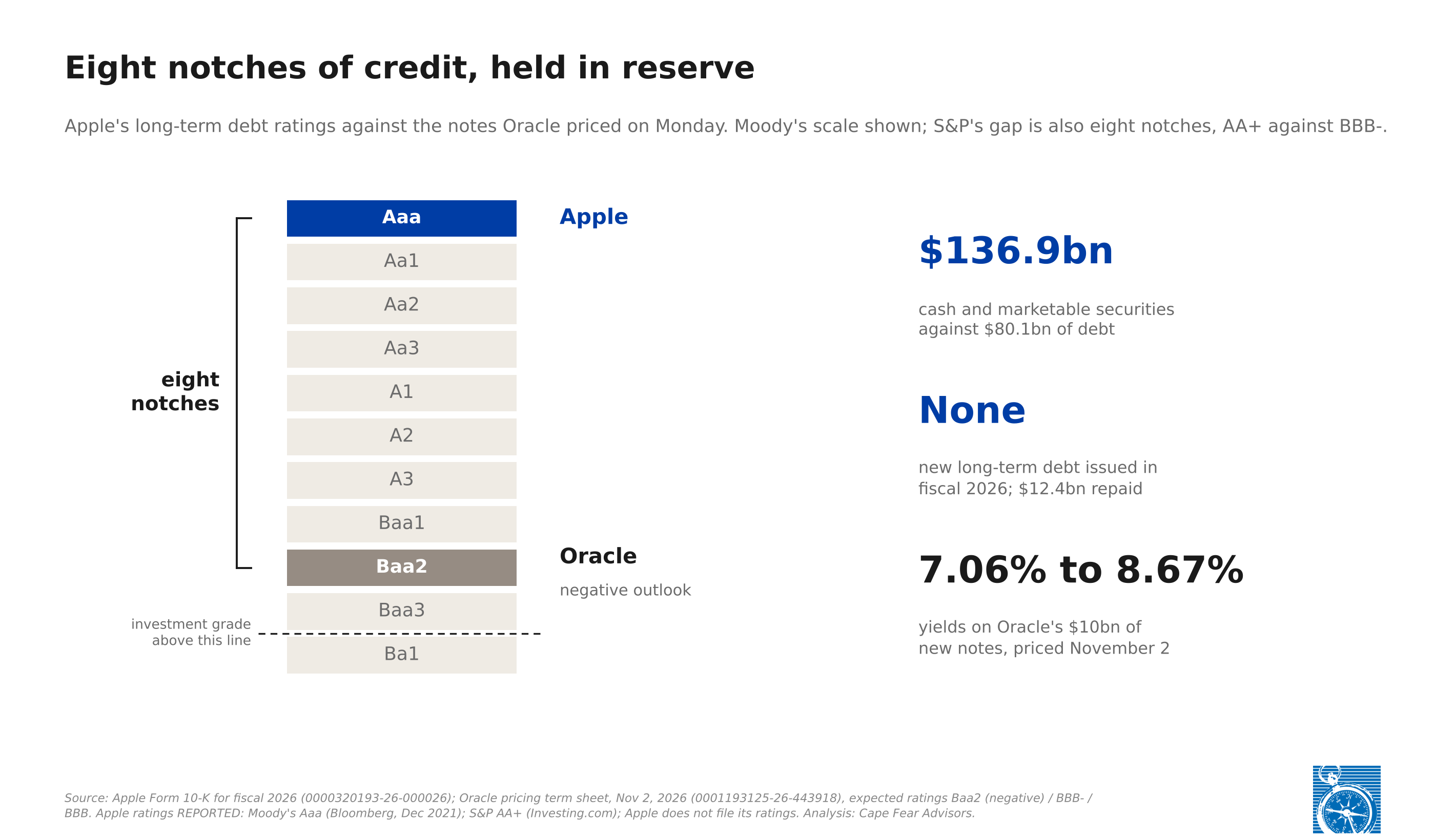
Apple spent $9,041 million on capital in fiscal 2026, down from $12,715 million. It produced about $136 billion of free cash flow and returned $102.1 billion of it to shareholders. It issued no new long-term debt and repaid $12.4 billion. It holds $136.9 billion of cash and marketable securities against $80.1 billion of debt, and its debt is rated Aaa by Moody's and AA+ by S&P. (3)
The agencies are moving on AI spending: on October 30 S&P revised its outlook on Meta, a consumer company funding its own build, to negative from stable, keeping the AA- rating and citing "significant uncertainty around capital spending and free operating cash flow." (3)
Eight rating notches separate Apple's credit from Oracle's at both agencies. That gap is stored energy: borrowing capacity at the top of the rating scale, left in reserve.
Stored is a different thing from idle. Apple is spending on AI. It is spending in places other than the capital budget.
What Apple is paying for
Research and development rose 32% to $45,765 million, "primarily due to higher infrastructure-related costs, including investments in artificial intelligence, and headcount-related expenses." (4)
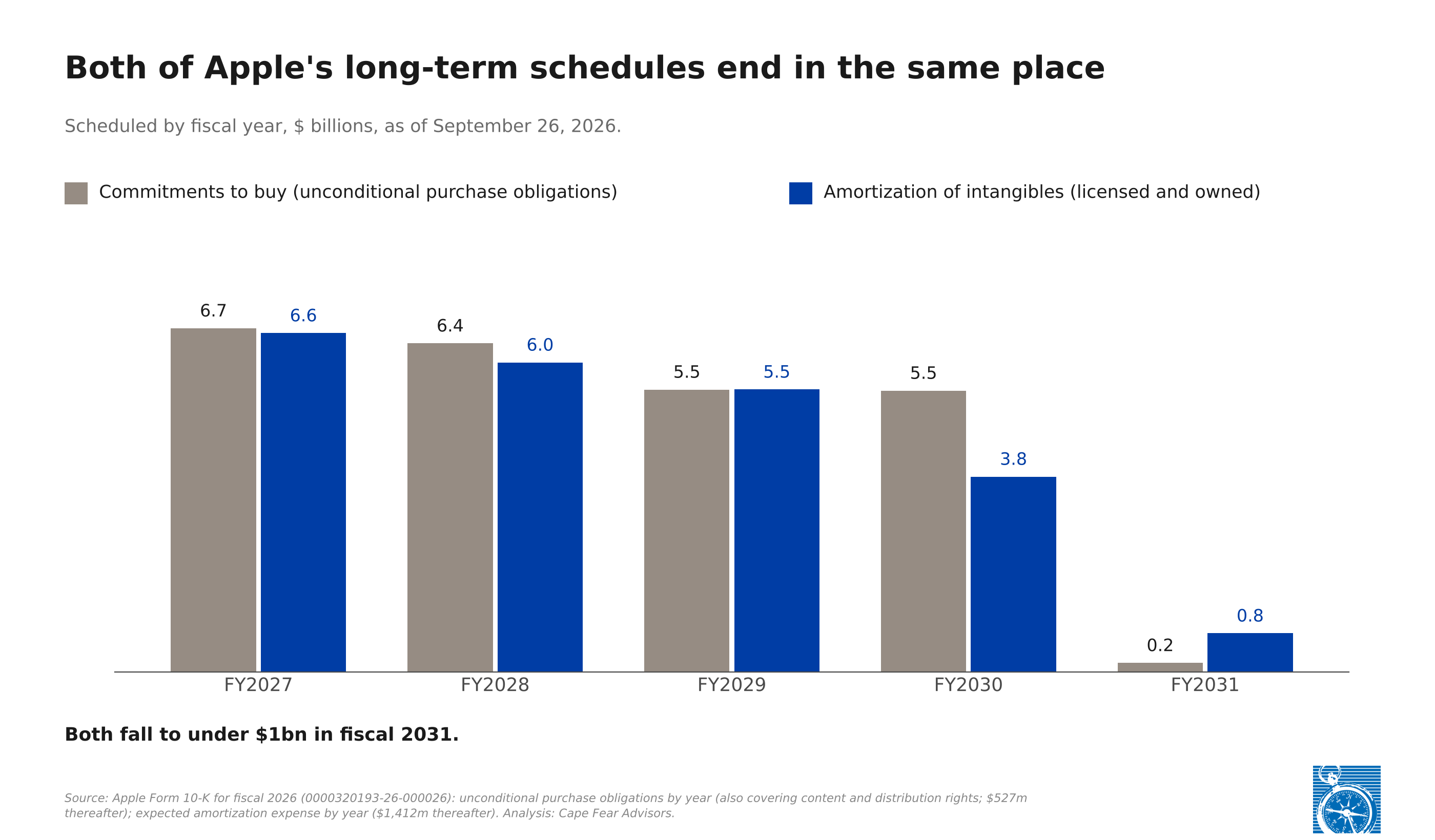
Apple's commitments to buy goods and services rose to $24,844 million from $13,308 million, at about $5.5 billion to $6.7 billion a year through fiscal 2030. Part of that line is content and distribution rights; Apple does not break it out. (5)
A new class of asset, licensed intangibles, rose to $29,582 million from $16,061 million. Amortization of all intangibles was $4.9 billion this year and is scheduled at $6.6 billion next year. Other non-current liabilities rose $12.8 billion in the same year, in a line the filing leaves unitemized. (6)
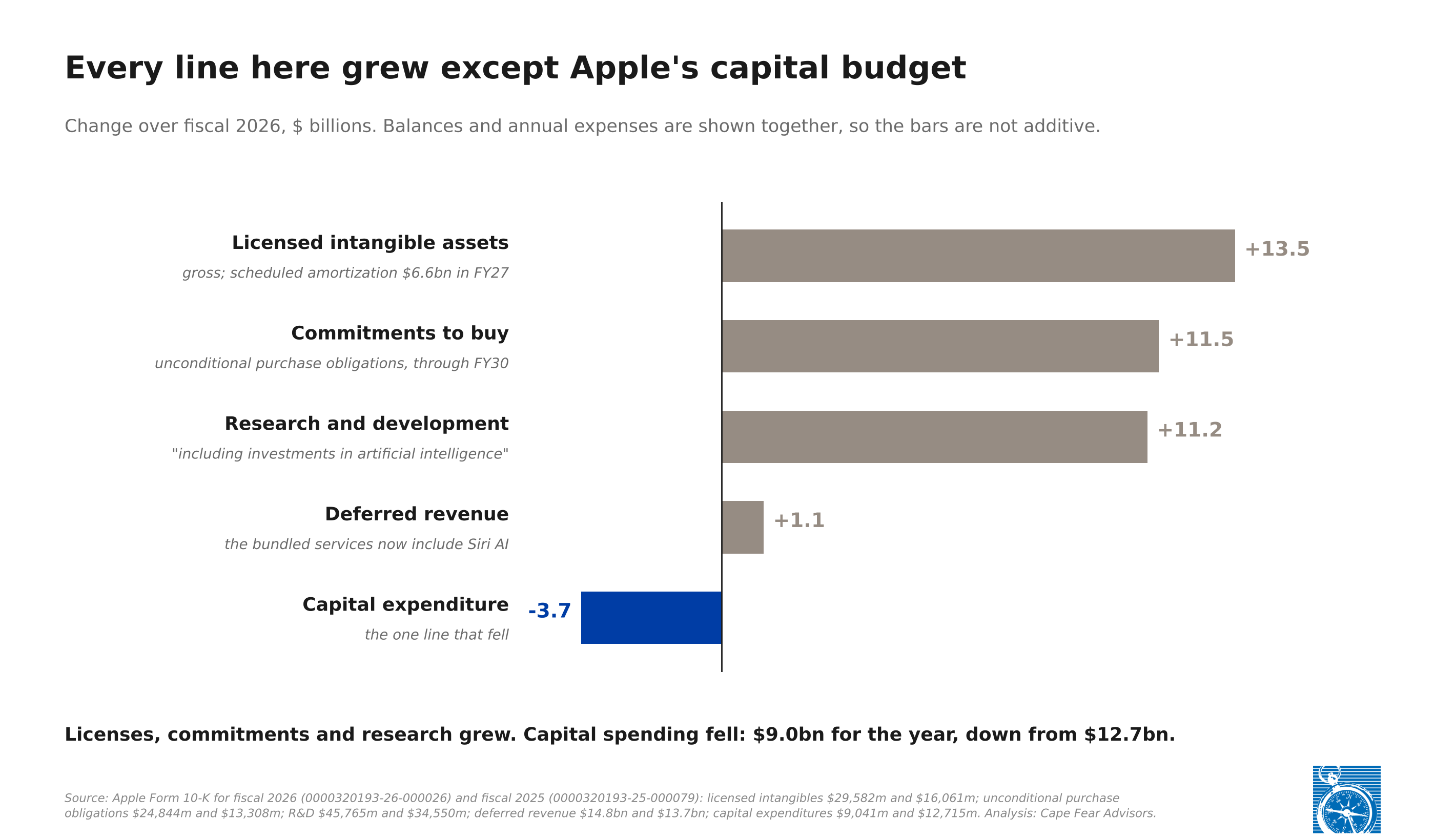
Siri AI now sits beside iCloud, Siri and Maps in the bundle of services each iPhone, Mac and iPad carries, so part of each device's price is set aside and recognized over time. The chief financial officer said the cloud cost of running it will land in services cost of sales. (7)
And a new risk factor says the AI business "depends on access to sufficient compute capacity," that the market has seen "constrained supply, extended lead times, and increasing costs," and that Apple "relies on third-party cloud service providers." (8)
Apple names none of its providers. On January 12, Apple and Google said Apple's next models "will be based on Google's Gemini models and cloud technology." In the quarter before that statement, Apple's commitments rose by $19.9 billion, and in the quarter after it the licensed intangibles appeared. Sequence, not causation, and no filing on either side names the other. (9)
Updating our July reading
Some of what we wrote in July needs correcting, and some of it looks better now than it did.
The correction first. We wrote that Apple's intangible amortization "had run about $160 million a quarter" and "jumped to $833 million" in the June quarter. Those numbers were changes in accumulated amortization, which rises with the expense and falls when old, fully amortized assets are written off. The annual report now gives the expense itself: $3.7 billion in fiscal 2025 and $4.9 billion in fiscal 2026. The older licenses were amortizing at close to $1 billion a quarter all along. That takes down our timing for the new asset, which we said "switched on" in the June quarter, and our attribution of the whole $5.1 billion current portion to the new purchase. (10)
What holds: Apple added $13.5 billion of licensed assets in the year, the current portion, which Apple classifies as falling within a year, is still rising, now $5,422 million against $2,208 million a year earlier, and nothing filed says what any of it is. Spread over four to five years, the year's additions come to about $2.7 billion to $3.3 billion a year, roughly three times the $1 billion reported for Apple's Gemini license, where we had said five. In July we said either the reported figure understated the arrangement or other licensed property shared the line. The annual report says both, in part. (11)
A test running in the market
AI's demand for memory chips has pushed their price up sharply, and Apple's chief executive called the pricing "unprecedented." Apple's answer so far has been to buy early and charge more. Components inventory stood at $10,447 million at year end, up from $2,124 million. Manufacturing purchase obligations reached $89.7 billion, $82.7 billion of it due within a year. Prices on many products rose at the end of June, by as much as a third according to the Journal. (12)
Whether that comes out ahead is unknown. Products gross margin rose to 39.3% for the year, helped by tariff refunds. The December quarter is guided to 45% to 46% overall, down from 47.9%, with memory most of the decline. Apple's iPhone shipments fell 4% in the September quarter against a 22% fall for the whole market, by IDC's count. The chief financial officer said it is "early to really read price elasticity." The December quarter is the first real read on whether Apple earns more from the shortage than it costs. (13)
The same question runs through services. As a cost, AI arrives there as inference and, possibly, as license amortization; the $1.7 billion step in amortization next year would be a little under 1.4 points of this year's services margin if it all landed there. As revenue, it arrives through the Siri AI deferral, through iCloud plans with "usage limits on features that rely on server-side models," and through what the chief financial officer called "a compelling reason for customers to upgrade." Services earned a gross margin of 76.2% this year, which is the margin of a platform. Google Cloud, selling capacity, earned an operating margin of 36.2% last quarter. A neocloud selling capacity alone, in our September reading of CoreWeave, earned about 9% on its capital. They are three different measures, set side by side for order of magnitude. The point to watch is where AI's cost in Apple's services starts growing faster than the revenue AI brings in. (14)
What "the edge" means
The next two sections step outside the filings. They run on Apple's published research, outside studies and our own arithmetic, and they describe what the filings point toward.
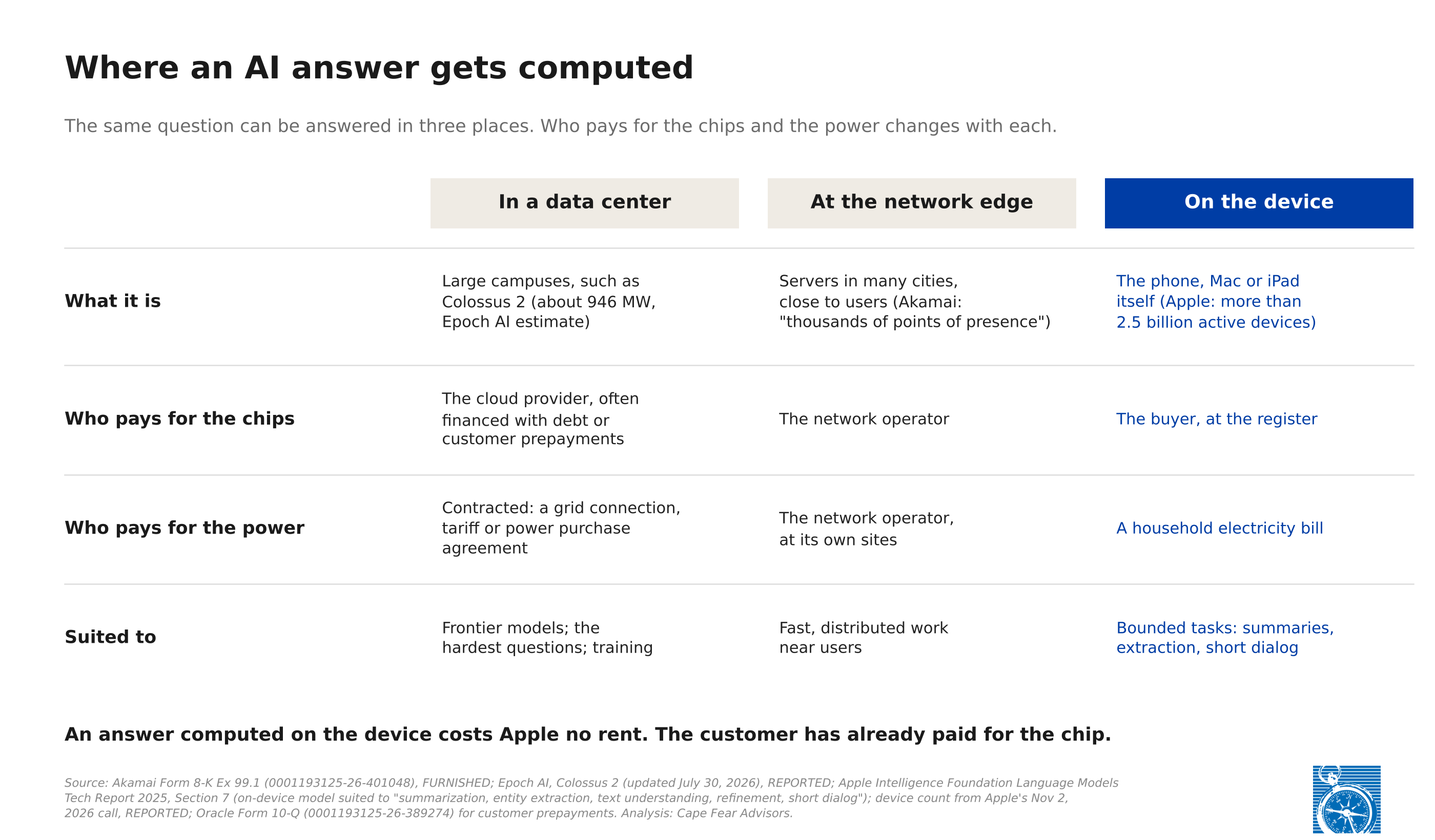
Most writing about AI infrastructure is about training, the months-long work of building a model in a data center. The money that recurs is in inference: running the model each time someone asks it something. Inference can run in three places. It can run in a data center. It can run at the network edge, on servers spread across many cities close to users, which is what Akamai sells Anthropic across "thousands of points of presence." Or it can run on the device in someone's hand or on their desk. Running it on the device is what people mean by moving AI to the edge. (15)
Three things limit how much a device can do. The model's weights have to fit in its memory. The speed of an answer depends on how fast those weights move through the chip, which Apple's own engineers describe as the bottleneck for generating text. And a phone has a battery and no fan. (16)
A fourth thing works in the device's favor: most of what people ask a phone to do sits well short of frontier work. Apple's technical report describes its on-device model as one that "excels at a diverse range of text tasks like summarization, entity extraction, text understanding, refinement, short dialog," and says that "it is not designed to be a chatbot for general world knowledge." Turning "lunch with Sam on Thursday at noon" into a calendar entry is AI, and it is entity extraction, well inside that list. Developers have been able to call that model from their own apps since 2025. The skill in the system is sizing each job to the compute it needs and sending only the hard ones away. (17)
Apple's third-generation models push the device's share further. The smallest has 3 billion parameters. A larger one has 20 billion, but it is built as a "mixture of experts" that wakes only 1 billion to 4 billion of them for any given request, keeps the full model in flash storage and loads pieces into memory as needed. The latest chips add accelerators that Apple says cut the wait for a first answer by up to four times against the prior generation. On a desk, the reach is larger still: in October Apple's researchers ran an 816-billion-parameter model across four Mac Studios at more than 36 tokens a second. (18)
The hard requests go out to a server. Apple's own servers run on Apple chips, and since June some of that work also runs on NVIDIA GPUs in Google Cloud, the first time Apple has used third-party data centers for it. Apple says its aim is to "match every user request to the model that provides the best response at the lowest latency," and its chief financial officer says the company is in "very, very early stages of understanding the kind of mix." Google's Android works the same way, trying the model on the phone first and falling back to the cloud. (19)
The economics follow from where each answer is computed. An answer computed on the device costs Apple no rent; the customer has already paid for the chip. An answer computed in the cloud is the bill in the commitments note. And Apple has opened its developer framework to "nearly any LLM, local or server-based," with Anthropic and Google announced to bring Claude and Gemini into it, which puts Apple's interface between the models and the people using them. (20)
Who pays for the power
A data center's electricity is a contract, a queue and a public argument: a grid connection, a utility tariff or power purchase agreement, often a gas line, and the debt that finances the building. A device's electricity arrives on a household bill. A Mac mini with an M5 Pro chip draws 6 watts sitting idle and 145 watts at full load. (21)
Horace Dediu put the idea in a line in March: "Apple turned 2 billion devices into the data center." It can be given a rough size, in two numbers.
The first is capacity. In laboratory tests, an iPhone running a small language model drew up to 13.8 watts while writing an answer, and phones spent roughly 0.3 to 0.9 joules on each token, the word fragment these models produce one at a time. Apple counts more than 2.5 billion active devices. If one in ten were writing an answer at the same moment, at 6 watts each, the draw would be 1.5 gigawatts, in bursts, since batteries drain and chips heat up. (22)
The second is use, and that number stays private. The arithmetic runs in steps. At 0.5 joules per token, a device averaging a tenth of a watt of AI work produces about 17,000 tokens a day, and 2.5 billion of them add up to 250 megawatts. A quarter of a watt is about 43,000 tokens and 625 megawatts. Epoch AI estimates that Colossus 2, SpaceX's AI campus in Memphis, runs on 946 megawatts. The device base matches it at about 65,000 tokens a day per device, close to 100 pages of generated text. That matches the power draw, a different thing from matching the machine: Colossus 2 trains and runs frontier models, work beyond a phone at any wattage. Only recent models run Apple Intelligence (the iPhone 15 Pro and later, and Macs and iPads with M1 chips or later), and Apple gives no count of them, so each figure here is an upper reading. (23)
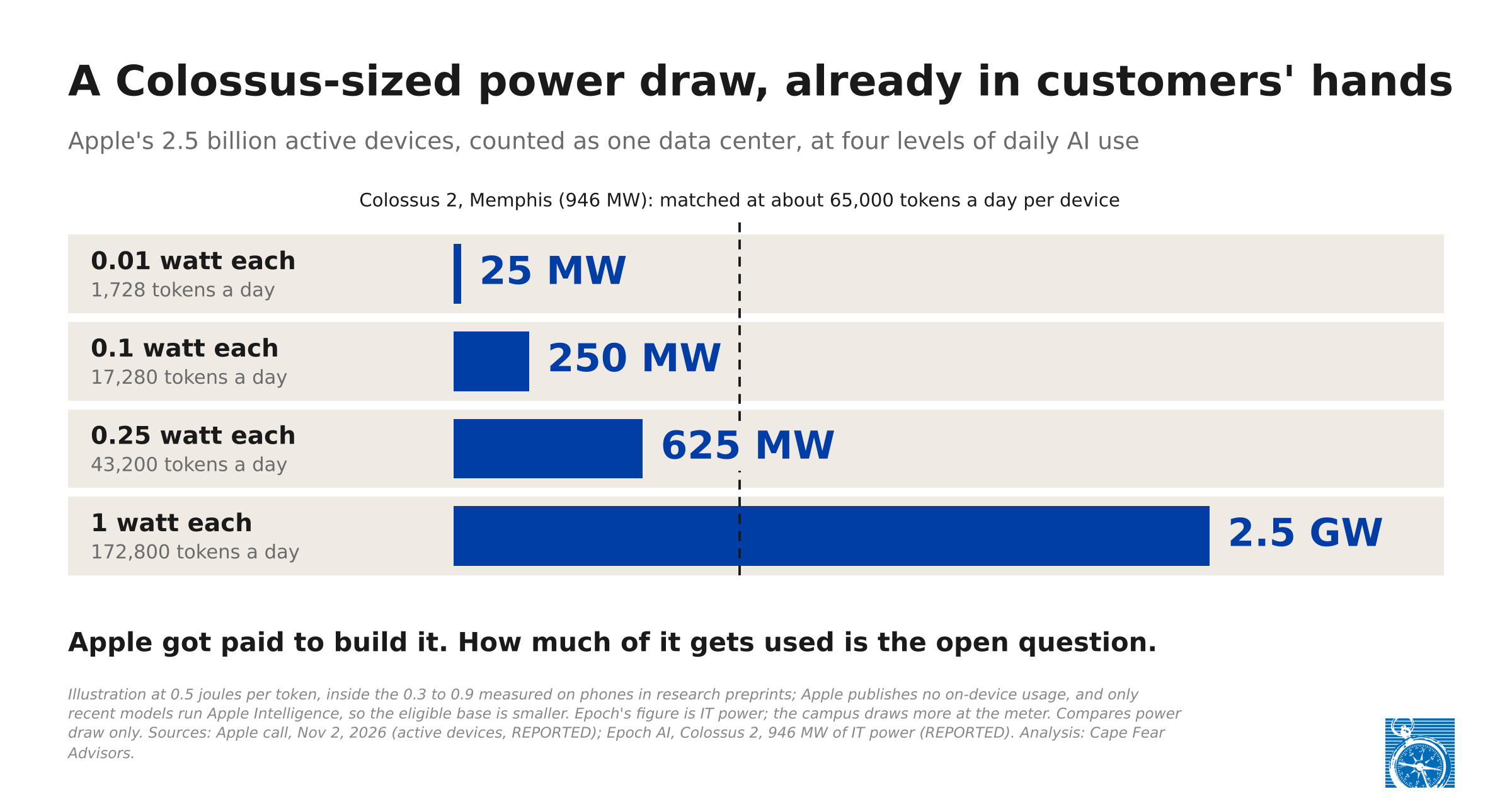
Apple got paid to build it. Its customers bought the chips, the memory and the batteries, at Apple's margin, and they pay for the electricity. Apple can tap that capacity for its own features or route the work to its servers and Google's. Either way, the construction was paid for at the register.
All of it is potential. How much gets used, how efficiently, and whether it is switched on for this work at all remain open. Apple's researchers are testing one version of the idea, a system called Minions that "aggregates idle Apple Silicon GPUs across macOS devices to execute large-scale machine learning inference workloads." It is a research paper, and Apple describes no deployment. (24)
Whether a question costs more energy to answer on a phone or in a data center is unsettled too. One recent study found phones about three times less efficient than a busy server; another, backed by Qualcomm, found savings of 75% to 95%. What holds either way is where the bill lands. It sits inside household utility payments, it appears in no filing, and the capacity exists the day the device is sold, with no wait for a substation. (25)
The schedule ends in 2030
Both of Apple's long-term schedules end in the same place. The commitments fall from $5.5 billion in fiscal 2030 to $178 million in fiscal 2031. Amortization falls from $3.8 billion to $0.8 billion over the same step. (26)
Not starting has a cost, and some of that cost is the price of seeing more before committing. Working through the options and watching how things develop is part of what management is paid for. Apple's record has that look. It rents compute and licenses models during the most expensive stretch of the industry's build, keeps its credit almost untouched, and puts its own money into chips, devices and the software that routes work between them. The familiar line that Apple arrives late reads, on this schedule, as sequence.
That is a reading of structure and schedule. It claims nothing about intent or about whether the plan works, and the record can test it. It weakens if the commitments are renewed past 2030 at scale, if Apple's capital spending steps up into data centers, if the cloud share of Siri AI keeps rising, or if large license additions recur every year.
What comes next
The July piece set several things to check against this report. Revenue growth of 12% beat guidance of 9% to 11%. Gross margin of 47.9% landed inside guidance of 47% to 48%, and the decline excluding tariff refunds was, in the chief financial officer's words, "driven entirely by memory impacts." The tax note now names Ireland and Singapore. The intangibles received a table and a schedule, and still no sentence. One July line reversed: Apple's total liabilities rose for the year, to $292.5 billion. (27)
The December quarter answers the memory test and gives the first full quarter of Siri AI in the deferral and in services cost. The first-quarter report updates the commitments and the licensed balance. The Claude and Gemini integrations are announced and not yet shipped. And the line that carries amortization will be named when Apple adopts the new expense disclosure rules in the fourth quarter of fiscal 2028. (28)
Free to read, no paywall. Readers who find the work useful can support it at the foot of the page; payment offsets the time and buys no access. Corrections run in daylight, dated, in a comment or in the following piece, and a reader who finds one is doing us a favor.
Standing Disclosure
Cape Fear Advisors holds no direct position, long or short, in the securities discussed here. Any exposure is indirect, through managed funds it does not control, which may include index funds holding the public companies named.
Anthropic, a subject of our coverage, is the developer of Claude, which we use in preparing our work, and is named here as a provider announced for Apple's framework and as Akamai's customer. That nearness cannot be checked away, which is why no claim here rests on trust in the tool: every figure carries a public source and every derived figure carries its inputs in the notes. Figures are quoted from the filers without characterization, and the same standard of reading is applied to every filer named. The author's operating business works in advertising measurement, near the search economics touched on here.
Notes
[1] "Apple, Adding It Up: The Immaterial Toll Booth," July 31, 2026. REPORTED: Asa Fitch, "Apple Is an AI Safe Haven, but Safety Isn't Cheap," The Wall Street Journal, November 3, 2026.
[2] FILED: Oracle Corporation Form 10-Q for the quarter ended August 31, 2026, accession 0001193125-26-389274 (capital expenditures $28,499 million; "we received $11.4 billion of prepayments from customers that included a significant financing component"); pricing term sheet, November 2, 2026, accession 0001193125-26-443918; preliminary prospectus supplement, $10,000,000,000 of common stock, accession 0001193125-26-442729.
[3] FILED: Apple Inc. Form 10-K for the fiscal year ended September 26, 2026, accession 0000320193-26-000026, accepted November 3, 2026, 13:05 UTC: capital expenditures $9,041 million and $12,715 million; operating cash flow $145,097 million; repurchases $86,390 million; dividends $15,721 million; proceeds from term debt, none; repayments of term debt $12,396 million; cash and equivalents $36,305 million, current marketable securities $20,417 million, non-current $80,213 million; commercial paper $1,997 million, term debt $9,906 million and $68,208 million. Free cash flow OURS. REPORTED: Moody's Aaa since December 2021 (Bloomberg); S&P AA+ (Investing.com). A ResearchPool listing, undated, shows a Moody's affirmation of Aaa with a stable outlook; no change to either rating found in a search November 3, 2026, 19:5x UTC. Apple does not file its ratings. OURS: Aaa to Baa2 and AA+ to BBB- are each eight notches. REPORTED: S&P Global Ratings, Meta Platforms outlook revised to negative from stable, AA- kept, October 30, 2026, via Reuters (SRN News syndication); S&P's report is subscriber-only.
[4] FILED: 10-K per note (3), MD&A: $45,765 million and $34,550 million; the sentence is quoted in full.
[5] FILED: 10-K per note (3), commitments note: unconditional purchase obligations 2027 $6,712 million; 2028 $6,418 million; 2029 $5,515 million; 2030 $5,494 million; 2031 $178 million; thereafter $527 million; described as "supplier arrangements, distribution rights, and licensed intellectual property and content." Fiscal 2025 10-K, accession 0000320193-25-000079: $13,308 million.
[6] FILED: 10-K per note (3), Note 6: licensed gross $29,582 million and $16,061 million; amortization expense $4.9 billion, $3.7 billion and $3.6 billion; expected 2027 $6,617 million, 2028 $6,044 million, 2029 $5,517 million; current portion of licensed intangible assets $5,422 million and $2,208 million. Other non-current liabilities $54,332 million and $41,549 million. The fiscal 2025 10-K carries no intangibles note (whitespace-normalized search, November 3, 2026, 14:4x UTC).
[7] FILED: 10-K per note (3), Notes 1 and 2: "iCloud, Siri and Siri AI, and Maps"; total deferred revenue $14.8 billion and $13.7 billion. REPORTED: Kevan Parekh, earnings call, November 2, 2026: "the associated cloud costs will be recognized through services cost of sales," via the Investing.com transcript, cross-checked against Six Colors and 9to5Mac; Apple publishes an audio replay only.
[8] FILED: 10-K per note (3), Item 1A. The supply concentration heading now ends "and Computing Resources."
[9] FILED: unconditional purchase obligations $13.3 billion (September 2025) and $33.2 billion (December 2025), and the intangibles line first presented in the March 2026 10-Q, as read July 31. REPORTED: Apple and Google joint statement, January 12, 2026. FILED: Alphabet Inc. Form 10-Q, accession 0001652044-26-000084, "Apple" zero mentions. Google appears in Apple's 10-K five times, all as a search licensee and in the antitrust case (search November 3, 2026, 19:32 UTC).
[10] FILED: accumulated amortization $11,649 million, $11,970 million, $12,803 million and $13,784 million (10-Qs 0000320193-26-000013 and -000020; 10-K per note (3)); expense per note (6).
[11] OURS on FILED: licensed gross additions net of retirements $13,521 million; over five years $2.7 billion and over four years $3.3 billion, floored. Gross additions exceed the net figure by retirements of about $2.7 billion to $2.8 billion across all intangibles; the split is not filed, and part may be renewals. REPORTED: Mark Gurman, Bloomberg, November 2025, roughly $1 billion a year.
[12] REPORTED: John Ternus, call per note (7): "What we're seeing with memory pricing right now is unprecedented"; "we changed the price on many of our products, including Mac and iPad at the end of June." WSJ per note (1): increases "by as much as 33%." FILED: 10-K per note (3): components $10,447 million and $2,124 million; manufacturing purchase obligations $89.7 billion, $82.7 billion payable within 12 months.
[13] FILED: 10-K per note (3), products gross margin 39.3% and 36.8%, "partially offset by higher costs, including memory." REPORTED: December quarter guidance and Parekh, call per note (7); REPORTED: IDC preliminary estimates, Worldwide Quarterly Mobile Phone Tracker, October 14, 2026, as carried by TelecomLead: Apple 57.3 million units, down 4.0%; market 255.3 million against 327.3 million, down 22.0%.
[14] OURS on FILED: $6,617 million less about $4.9 billion is about $1.7 billion, over services revenue of $123,301 million, 1.39 points, a ceiling, since the numerator assumes all of it lands in services and the denominator holds services revenue at this year's level; the line carrying amortization is not stated. FILED: services gross margin 76.2% (10-K per note (3)); Google Cloud operating income $11,121 million on revenues of $30,709 million (Alphabet 10-Q per note (9); OURS, 36.2%). "CoreWeave's Call Option on Used GPUs," September 16, 2026: contribution of 8.968% on capital in service against 9.12% for its newest money. REPORTED: Ternus and Parekh, call per note (7).
[15] FURNISHED: Akamai Technologies Form 8-K, accession 0001193125-26-401048, Exhibit 99.1.
[16] Apple, published: "Exploring LLMs with MLX and the Neural Accelerators in the M5 GPU," Apple Machine Learning Research, November 19, 2025 (token generation bounded by memory bandwidth).
[17] Apple, published: "Apple Intelligence Foundation Language Models: Tech Report 2025," arXiv 2507.13575, Section 7, describing the approximately 3-billion-parameter on-device model offered to developers through the Foundation Models framework. The calendar example is ours.
[18] Apple, published: "Introducing the Third Generation of Apple's Foundation Models," June 8, 2026; "Exploring LLMs with MLX and the Neural Accelerators in the M5 GPU" per note (16), up to four times faster time to first token than M4; "Local and Distributed Large LLM Inference with MLX and RDMA on Mac Studio," October 15, 2026.
[19] Apple, published: "Expanding Private Cloud Compute," Apple Security Research, June 8, 2026. REPORTED: Amar Subramanya at WWDC, "Our goal is to match every user request to the model that provides the best response at the lowest latency," Bloomberg (Chris Welch), June 9, 2026, via Claims Journal; the same report quotes Craig Federighi, "We use none of the models that Google deploys to its customers." Parekh, call per note (7). Google, published: Android Developers Blog, April 17, 2026 ("falls back to cloud if Gemini Nano is not available on the device").
[20] Apple, published: Apple Newsroom, June 8, 2026; WWDC26 session 339. The Claude and Gemini packages are a stated plan.
[21] Apple, published: support article 103253, Mac mini (M5 Pro), 64GB: 6 W idle, 145 W at CPU maximum, measured at the wall.
[22] REPORTED: Horace Dediu, "The Most Brilliant Move in Corporate History?", Asymco, March 10, 2026, as crossposted by J. Bradford DeLong, March 16, 2026; "over 2.5 billion active devices," call per note (7). REPORTED, preprints (not peer-reviewed): Laskaridis et al., "MELTing point: Mobile Evaluation of Language Transformers," arXiv 2403.12844: iPhone 14 Pro running Zephyr-3B (4-bit), "a maximum of 13.8W of sustained (averaged) power draw," and 0.16 to 0.21 mWh per token across the phones and frameworks tested, 0.58 to 0.76 joules; Huang et al., MNN-AECS, arXiv 2506.19884: Qwen2.5-1.5B (4-bit) decoding at 6.2 to 8.7 watts and 300 to 860 millijoules per token on an Android phone. OURS: one device in ten at 6 watts across 2.5 billion is 1.5 gigawatts; the share and the wattage are illustrations, and no filing measures concurrent AI use.
[23] REPORTED: Epoch AI, Colossus 2 entry, updated July 30, 2026, "supported by 946 MW of IT power," an estimate from satellite imagery cross-checked against the SpaceX S-1. Apple, published: support article 121115, October 22, 2026: Apple Intelligence "is available on" iPhone 15 Pro and Pro Max, iPhone 16 models or later, iPhone Air and iPhone Duo; iPad models with M1 or later and iPad mini (A17 Pro); Mac with M1 or later and MacBook Neo (A18 Pro); Apple Vision Pro. OURS: tokens a day are watts times 86,400 seconds divided by 0.5 joules, an illustrative figure inside the measured range in note (22): 0.1 W is 17,280 and 0.25 W is 43,200; 946 MW over 2.5 billion devices is 0.378 W, or 65,388 tokens, about 49,000 words at three-quarters of a word per token, or about 98 pages at 500 words a page. Two conventions, named because they run in opposite directions. First, 0.5 joules sits inside the measured range in note (22) and below its midpoint, about 0.58; a lower figure raises the tokens needed to match. Second, Epoch's 946 MW is IT power, and the campus draws more at the meter once cooling is added, while a device's draw is all at the wall; comparing against IT power lowers the tokens needed, which favors the frame. Corrected together, at 0.58 joules and a facility-to-IT ratio of 1.15 to 1.2, the match is about 64,800 to 67,600 tokens a day, and "about 65,000" holds. The comparison is of power draw only. No filing measures the power AI work adds to a device.
[24] Apple, published: "Minions: A Dynamic and Distributed Virtual GPU Cloud Built on Idle Apple Silicon Devices," Apple Machine Learning Research, October 2026 (arXiv 2610.12970).
[25] REPORTED, preprint and press: Guégain and Coignion, "The Battery Price of edge AI," arXiv 2609.11940, July 10, 2026 (not peer-reviewed); University of California, Riverside with Qualcomm, as reported by Axios, June 26, 2025. No agency estimate comparing the two was found (search of IEA, LBNL and EPRI publications, November 3, 2026).
[26] FILED per notes (5) and (6): amortization expected $3,815 million in 2030, $756 million in 2031 and $1,412 million thereafter; purchase obligations $5,494 million in 2030, $178 million in 2031 and $527 million thereafter. Both schedules fall to a tail after 2030 and run on past 2031; the 10-K gives no year-by-year split of either tail.
[27] FURNISHED: Form 8-K Exhibit 99.1, accession 0000320193-26-000024. REPORTED: call per note (7). FILED: 10-K per note (3): income tax reconciliation; total liabilities $292,455 million and $285,508 million.
[28] FILED: 10-K per note (3), Recent Accounting Pronouncements: ASU 2024-03 adoption "in its fourth quarter of 2028."
Analysis: Cape Fear Advisors.
This piece also appears on Substack. Cape Fear Advisors is an independent advisory firm based in Portsmouth, NH.
Contact Cape Fear Advisors